Why do you want to starve the poor? The Gap Psychology of the rich.

Why do you want to starve the poor?

Oh, you don’t. Well, your government does. Here are excerpts from an article that appeared in a recent issue of the New York Times:

SNAP cuts can be costly elsewhere
Recipients of food stamps are healthier, studies found
By Austin Frakt and Elsa Pearson The New York Times

The Department of Agriculture recently finished work on a new rule that may take food stamps away from nearly 700,000 Americans by tightening work requirements.

Why do you wish to tighten work requirements on the poor? Is it that you harbor Puritanical instincts demanding that people labor to receive benefits from the federal government?

Image result for American poor workers
Too many benefits to the lazy poor.

Many of the rich don’t work, or they labor only minimally. Yet, they receive massive tax benefits from the U.S. government. Why the “special” rules for the poor?

Why don’t you demand that the rich labor in real jobs to receive those tax benefits? Why do you demand that the poor be required to work in order to receive their minimal benefits?

Give me one good excuse.

Fake Excuse 1. No, your tax dollars do not pay for food stamps, so you can’t use that excuse. The federal government creates brand new dollars to pay for food stamps. Federal tax dollars do not pay for anything.
Fake Excuse 2. And no, even if the government gave loafers food stamps, that would not lead to nationwide indolence. Food stamps comprise such a meager amount of money, you know full well that you wouldn’t quit your job in order to receive them.

Any others?

Image result for rich people on yachts
Not enough benefits to the hard-working rich.

Continuing with the excerpts:

Several times in the past year, the government has proposed cutting food stamp eligibility. The new rule is intended to save almost $8 billion over five years.

The problem with that reasoning is:

Fake Excuse 3. While food stamps are an important part of many poor people’s survival income, $1.6 billion represents pocket change to the federal government, barely noticeable to a government that spends trillions.
Fake Excuse 4. The federal government, being Monetarily Sovereign, does not need to save money. It freely creates all the dollars it needs simply by pressing computer keys.

The article continues:

It’s not clear how much money would actually be saved, research suggests, given the costs that might come from a decline in the health and well-being of many of the country’s 14.3 million “food-insecure” households.

The Department of Agriculture defines food insecurity as a lack of consistent access to enough food for an active, healthy life. It affects low-income, single-parent, and black and Latino households the most, but it cuts across many demographic lines and affects 11% of American households overall.

Citing a strong job market, the Trump administration has said helping able-bodied adults was no longer necessary.

Sonny Perdue, the agriculture secretary, said: “We need to encourage people by giving them a helping hand but not allowing it to become an indefinitely giving hand.”

Sonny, doesn’t believe in giving people money, because . . .  well, just because:

Sonny Perdue, 72, Secretary of Agriculture. The former Georgia governor built a fortune in agribusiness and real estate. Shortly after joining Trump’s cabinet, he transferred control of investments worth at least $8 million—including a stake in a multimillion-dollar grain-merchandising business—to his four adult children.

Correction: Sonny doesn’t believe in giving money to poor people who desperately need it. Giving billions to his rich kids is just fine, however.

Continuing the excerpts:

Food insecurity is linked to worse health outcomes, including poor mental health, high blood pressure and diabetes, with children particularly vulnerable.

Low-income people may be eligible for federal Supplemental Nutrition Assistance Program benefits, better known as food stamps. The details vary by state.
“SNAP recipients often work, but their employment can be unsteady,” said Dr. Seth Berkowitz, an internist and assistant professor at the University of North Carolina School of Medicine.

Seasonal variation in some labor markets — like agriculture or even retail consumer jobs when sales may spike around the winter holidays — can put people temporarily out of work, making it hard for them to keep food on the table. “The way these work requirements are imposed could pull support out from under people even when they are working.”

The real motive of the GOP (“Party of the Rich”) is not to force people to labor for their money, but rather to widen the Gap between the rich and the rest. (See: Gap Psychology)

Because there is no limit to the lust of the rich to be richer and ever richer, there also is no limit to the punishment they dole out to the poor. Whatever rule the Department of Agriculture publishes, it will not ever be enough to satisfy the rich.

Depend on this: Immediately after the rule is published, the Party of the Rich will begin to demand an even harsher rule.

One study found that receiving SNAP benefits was associated with a reduction in annual health care spending of about $1,400 per person among low-income adults.

Another study found that each additional $10 of monthly SNAP benefits was linked with a lower risk of hospitalization for Maryland residents enrolled in both Medicare and Medicaid.

In Massachusetts, an increase in SNAP benefits slowed the increase in Medicaid hospitalization costs.

The authors of the article, Austin Frakt and Elsa Pearson, in typical New York Times fashion, try to make their point based on cost, not on compassion or concern for Americans’ health.

This probably is wise, because compassion totally is missing from the GOP, from Trump and from the “religious” right (who are perhaps the least religious people on earth). That lack of religion is proved every day at the U.S. southern border.

And as for cost, it is a phony concern. The federal government, being Monetarily Sovereign, can afford anything.

The Special Supplemental Nutrition Program for Women, Infants and Children WIC is similar to SNAP, but as its name suggests, it provides nutritional support only for low-income mothers and their young children.

What about low-income fathers? What about low-income teens? What about low-income adults who don’t have children?

The only social concern exhibited by the “religious right” involves the survival of fetuses. There is no concern for the pregnant woman or for the fetuses after they are born. In their world, abortion is bad, but feeding children and adults is worse. 

How do they know? Jesus told them.

For additional help, people often turn to local food pantries, such as those that partner with the Greater Boston Food Bank.

Local food pantries are funded by the private sector and local governments, none of which is Monetarily Sovereign. They can run short of money. The federal government cannot.

Illogic is taking money from those whose money is limited instead of taking it from a government with unlimited funds.

Research suggests food pantries are also effective at providing immediate relief. They have far fewer eligibility requirements than SNAP or WIC — sometimes none — but limit when and how often clients can receive food.

Some pantries are even on college campuses, helping the almost 40% of college students who report struggling to afford food.

Food pantries also serve as a community entry point for a variety of initiatives, including cooking and nutrition classes.

The federal government has the financial power to do all of the above, yet the burden falls on the private sector and local governments.

A review of 12 pilot pantry-based programs found these could improve participants’ nutritional knowledge and diet.

One of the interventions studied a novel approach to food pantry design that allows clients to choose their own food and take part in monthly nutritional goal setting.

Three months in, participants were less likely than those using a traditional food pantry to experience severe food insecurity.

A year later, they were eating more fruits and vegetables.

What a concept. Actually allowing poor people to choose their own food! Who would have believed it would allow the poor to eat more healthfully? Not the federal government, which is dominated by the Gap Psychology of the rich, who run America, and the “religious” right, which runs the GOP.

While interventions can help, they are not long-term solutions nor do they address underlying problems, like food deserts (communities where healthy food is hard to find) and food swamps (those where unhealthy food abounds). We eat what’s available and affordable, even if that’s bad food.

The Trump administration’s solution to food insecurity is to cut funding for food stamps. Presumably, the rationale is: By starving the poor to death, there will be fewer poor to feed. Problem solved.

Feeding America estimates at least 30% of those with food insecurity nationwide aren’t eligible for SNAP. In some states, it’s nearly 50%.

Tightening eligibility for the program, as new work requirements would do, would only increase that number.

And that, dear friends, is how we make America great, again.

Rodger Malcolm Mitchell
Monetary Sovereignty
Twitter: @rodgermitchell
Search #monetarysovereignty Facebook: Rodger Malcolm Mitchell

…………………………………………………………………………………………………………………………………………………………………………………………………………………………………………………………………………………………..

The most important problems in economics involve:

  1. Monetary Sovereignty describes money creation and destruction.
  2. Gap Psychology describes the common desire to distance oneself from those “below” in any socio-economic ranking, and to come nearer those “above.” The socio-economic distance is referred to as “The Gap.”

Wide Gaps negatively affect poverty, health and longevity, education, housing, law and crime, war, leadership, ownership, bigotry, supply and demand, taxation, GDP, international relations, scientific advancement, the environment, human motivation and well-being, and virtually every other issue in economics.

Implementation of Monetary Sovereignty and The Ten Steps To Prosperity can grow the economy and narrow the Gaps:

Ten Steps To Prosperity:

1. Eliminate FICA

2. Federally funded Medicare — parts A, B & D, plus long-term care — for everyone

3. Provide a monthly economic bonus to every man, woman and child in America (similar to social security for all)

4. Free education (including post-grad) for everyone

5. Salary for attending school

6. Eliminate federal taxes on business

7. Increase the standard income tax deduction, annually. 

8. Tax the very rich (the “.1%”) more, with higher progressive tax rates on all forms of income.

9. Federal ownership of all banks

10. Increase federal spending on the myriad initiatives that benefit America’s 99.9% 

The Ten Steps will grow the economy and narrow the income/wealth/power Gap between the rich and the rest.

MONETARY SOVEREIGNTY
A movie about Gap Psychology in everyday life

Gap Psychology is the desire to distance oneself from those considered “below” you in any socioeconomic ranking, and to come closer to those above.

You are subject to Gap Psychology, whether you realize it or not.

Think about where you live, who your friends are, where you go to school, the type of job you’ll accept, how you vote, who you marry, and as in the case of the movie, “Parasite,” your relationship with those you employ and those who employ you.

A discussion of Parasite can be found here; some excerpts from that discussion are below:

The Invisible Line
“Parasite” nails the inherent inequality of hiring household help
By Sarah Todd
The South Korean satire-thriller Parasite is emerging as a major contender this awards season.

It’s on the Oscars shortlist for best international film, while writer-director Bong Joon-ho received Golden Globe nominations for best director and best screenplay, and the movie’s cast is up for best film ensemble at the Screen Actors Guild awards.

(The movie) focuses on the complex relationships and moral ambiguity that surrounds hiring household help.

For the uninitiated (spoilers ahead!), Parasite tells the story of the Kims, a poor family who connive their way into working (for) the wealthy Parks.

To get on the rich family’s payroll, the Kims must appear more educated and accustomed to rubbing shoulders with the upper class than they actually are.

The son pretends to have a prestigious university degree; the daughter poses as a trained art therapist. The parents invent lengthy employment histories as a highly sought-after driver and housekeeper.

Yet even as the Kims disguise themselves, they must also respect what Mr. Park, the head of the family, refers to repeatedly as “the line”—the boundaries that mark them as employees in a hierarchical relationship, the terms of which are defined exclusively by the Parks.

It’s fine for Mrs. Park to expect the Kims to come to work on their day off to put together a last-minute birthday party for her son. But it’s unacceptable for Mr. Kim to talk too much about himself as he drives his boss home at the end of a long work day.

The Kims may be the wealthy family’s intimates, even confidantes, but they are never to think of themselves as equals.

This dynamic rings true to the real-life experiences of many domestic workers, according to Megan Stack, a journalist and author of the book Women’s Work: A Reckoning With Work and Home.

Power imbalances tend to manifest most frequently like this,” Stack writes. “The house becomes both an intimate family setting and a job site at the same time. But employers are the ones who have the power, and they end up getting to decide (often without being conscious of it) whether they are approaching the employee in a way that corresponds to an intimate relationship or in a way that corresponds to an employment relationship.

So the employee has to navigate both a faux family relationship and a job where basic labor rights can be granted or withdrawn on the whim of an unreliable manager.”

It’s a job arrangement that depends on a wide gap between haves and have-nots.

Women shouldn’t feel guilty about hiring household help, but that they should push for regulations that ensure domestic workers are earning fair wages and working under non-exploitative conditions.

The movie also exposes the toxicity of the Parks’ expectation that they can pay domestic workers to care for them without caring about the workers in return, or even seeing their employees as fully human.

There is a deep unfairness in the notion that employers get to decide where that line between intimacy and work is drawn—and, usually, it keeps shifting around.

Nannies are asked to be “simultaneously present and absent in children’s lives”—and to be sensitive enough to know when to negate themselves in order to preserve their boss’s feelings.

Parasite makes it impossible for audiences to ignore the uncomfortable ways in which household labor has been constructed to prioritize one group’s emotional life over another—and suggests that money is not all that’s owed to the people who power middle- and upper-class homes.

The income/wealth/power Gap, which stimulates Gap Psychology, always has existed in our lives, always will exist, and indeed must exist in any realistic socio-economic setting. The problem, however, occurs when the Gap becomes too wide, as it always tends to do.

The width of the Gap is determined by the more powerful — i.e., those “above.”  Their natural instincts are to widen the Gap, because it is the Gap that makes them superior. (Without Gaps, no one would be superior. We all would be the same.) And the wider the Gaps, the more superior they are.

Thus, over time, a Gap tends to persist or even widen, because that is what the more powerful want.

Then, moral pressure causes a revolution by the lower group and/or an awakening by the upper group.

The Gap temporarily narrows. It becomes “improper” or unlawful. Then, it again begins to widen, as the upper group resumes its resistance.

Typical scenario: A weaker group is bullied by a more powerful group’s leaders. These actions are mimicked by the more powerful group’s followers until the bigotry becomes routine and traditional.

At some tipping point, the bullied group resists and/or the more powerful group’s leaders find virtue, and they declare the bullying to be improper or unlawful.

After a time, some of the more powerful group’s leaders begin to justify and to resume the bullying, and the cycle repeats.

Slavery in America, the Civil War, and its aftermath provide one example. Today, years after blacks received the right to vote, America’s bigots attempt, and often succeed, in making voting more difficult for blacks.

Social Security, launched as a partial cure for poverty, now is under atta ck, as is healthcare and other benefits for the poor.

Another example. I play tennis, and I much prefer to play with those whose skills are at least equal to, and preferably superior to my own. On the surface, this may seem illogical, because I have a much greater chance of winning when I compete with inferior players. Still, I dislike playing with them.

I like to play with the “big boys,” and it doesn’t trouble me at all that the “big boys” may not relish playing with me.

Gap Psychology is everywhere. From your “trophy” (or not-so-trophy) wife, to the size of your house in the “right” neighborhood, to sending your children to the “right” school, to belonging to the “right” club, to your clothing, your jewelry, your car, to having the “right” job, the certificate on your wall, yours and your child’s achievements, to your friends, to being an “A-lister (or not),” even to your accent and the language you use, you live your life guided by Gap Psychology, whether you are willing to admit it or not.

If you are a fan of a team, your emotions watching that team are guided by Gap Psychology. When you see a list of nations, states, or cities,  ranked by any positive measure, you want to see your nation, state, or city near the top.

Would you like to be rich? “Rich” is a comparative, not an absolute. You can be rich only if others are poorer. The wider the Gaps below you, the richer you are.

Gap Psychology certainly is not your sole motivator, but it is the single, most powerful motivator in human society, and perhaps in other social animals’ societies, too.

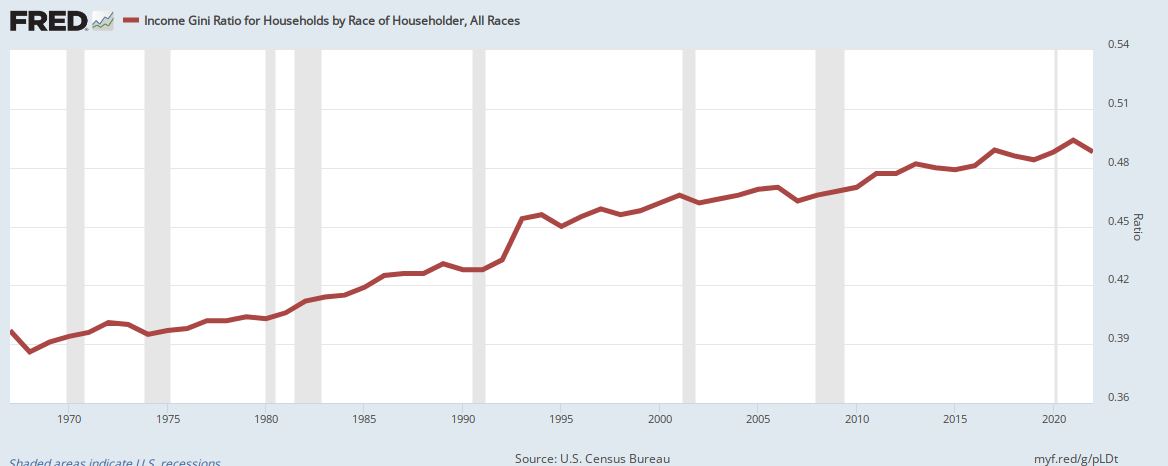
The Gap in America is too wide, and is widening.

The GINI Index. The higher the number, the wider the Gap.

But the Gap can be narrowed. Because the U.S. government is Monetarily Sovereign, and so has the unlimited ability to create its own sovereign currency, it also has the unlimited ability to narrow the Gap.

Applying the Ten Steps to Prosperity (below) would narrow the Gap.

Because of Gap Psychology, the very rich do not want the Gap narrowed. But they comprise only 1% of the voting population.

Narrowing the Gap is a job for the 99%. They can’t hope the 1% will save them.

Rodger Malcolm Mitchell
Monetary Sovereignty
Twitter: @rodgermitchell
Search #monetarysovereignty Facebook: Rodger Malcolm Mitchell

…………………………………………………………………………………………………………………………………………………………………………………………………………………………………………………………………………………………..

The most important problems in economics involve:

  1. Monetary Sovereignty describes money creation and destruction.
  2. Gap Psychology describes the common desire to distance oneself from those “below” in any socio-economic ranking, and to come nearer those “above.” The socio-economic distance is referred to as “The Gap.”

Wide Gaps negatively affect poverty, health and longevity, education, housing, law and crime, war, leadership, ownership, bigotry, supply and demand, taxation, GDP, international relations, scientific advancement, the environment, human motivation and well-being, and virtually every other issue in economics.

Implementation of Monetary Sovereignty and The Ten Steps To Prosperity can grow the economy and narrow the Gaps:

Ten Steps To Prosperity:

1. Eliminate FICA

2. Federally funded Medicare — parts A, B & D, plus long-term care — for everyone

3. Provide a monthly economic bonus to every man, woman and child in America (similar to social security for all)

4. Free education (including post-grad) for everyone

5. Salary for attending school

6. Eliminate federal taxes on business

7. Increase the standard income tax deduction, annually. 

8. Tax the very rich (the “.1%”) more, with higher progressive tax rates on all forms of income.

9. Federal ownership of all banks

10. Increase federal spending on the myriad initiatives that benefit America’s 99.9% 

The Ten Steps will grow the economy and narrow the income/wealth/power Gap between the rich and the rest.

MONETARY SOVEREIGNTY


Why do the richer grow richer and the poorer stay poorer?

The November 2019 issue of Scientific American magazine included an article titled, “The Inescapable Casino,” by Bruce M. Boghosian a professor of mathematics at Tufts University, with research interests in applied dynamical systems and applied probability theory.

Professor Bruce M. Boghosian

The article purportedly reveals:

“A novel approach developed by physicists and mathematicians describing the distribution of wealth in modern economics with unprecedented accuracy.”

Economics is based mostly on psychology, which itself is a science only in the loosest application of the term. Thus, unlike most sciences, economics rarely is capable of creating reproducible tests that result in mathematical laws.

But, SA being a science magazine, Professor Boghosian’s article attempts to attach scientific credibility to economics by creating a casino-based mathematical explanation of why the rich get richer and the poor stay poorer.

His own summary of his findings is:

“1. Wealth inequality is escalating in many countries at an alarming rate, with the U.S. arguably having the highest inequality in the developed world.

“2. A remarkably simple model of wealth distribution developed by physicists and mathematicians can reproduce inequality in a range of countries with unprecedented accuracy.

“3. Surprisingly, several mathematical models of free-market economies display features of complex macroscopic physical systems such as ferromagnets, including phase transitions, symmetry breaking and duality.”

Here are a few more snippets from Professor Boghosian’s article:

Suppose you are invited to play a game. You must place some ante—say, $100—on a table, and a fair coin will be flipped. If the coin comes up heads, the casino will pay you 20 percent of what you have on the table, resulting in $120 on the table.

If the coin comes up tails, the house will take 17 percent of what you have on the table, resulting in $83 left on the table. You can keep your money on the table for as many flips of the coin as you would like.

Each time you play, you will win 20 percent of what is on the table if the coin comes up heads, and you will lose 17 percent of it if the coin comes up tails. Should you agree to play this game?

After five wins and five losses in any order, the amount of money remaining on the table will be:

1.2 x 1.2 x 1.2 x 1.2 x 1.2 x 0.83 x 0.83 x 0.83 x 0.83 x 0.83 x $100 = $98.02

so you will have lost about $2 of my original $100 ante.

The rest of the article describes the mathematics of why supposedly even exchanges between richer persons and poorer persons ultimately favor the richer persons. And mathematical examples are given of water boiling, the strength of a ferromagnet and phase transitions.

Aha. But, it’s mathematics, so it must be true — except not only does it have nothing to do with casino play, it has nothing to do with real-world economics.

First, the examples do not describe “wealth.” They seemingly describe net income, a different concept.

But far more important, although the examples are supposed to demonstrate why the richer grow richer and the poorer stay poor (or poorer), they do not.

The problem has long been known in the computer world as “GIGO,” Garbage In, Garbage Out. What is the basis for Boghosian’s 20% and 17% starting figures? There is none.  The professor arbitrarily chose numbers that “worked,” which “amazingly” multiplied to prove his point, whatever that may be.

Had he arbitrarily chosen even slightly different numbers, the results would have been vastly different. Try it yourself with ever-so-slightly different numbers.

Further, the whole concept of paying or receiving a percentage of what’s “on the table” has nothing to do with the way a casino operates, and even less to do with the way your personal finances operate.

You do not make or lose a percentage of what’s on the table. You make or lose a percentage of what you invest.

Finally, Boghosian proves his point by making predictions of the past. It’s a problem all we economists face. Unable to predict the future with any reasonable degree of accuracy, we predict the past.

We take any set of inputs and compare them to all past results, and if we can find some inputs that correspond with results, we claim to have discovered cause and effect.

It’s, for instance, the classic problem of chartists — the people who use graphs of past stock market movements to predict future stock market movements. The graphs provide perfect representations of the past — until they don’t, because the past does not perfectly create the future in psychology.

Not being an economist, Boghosian hasn’t encountered this flaw, so he is excited to have discovered this strange mathematical relationship among boiling water, ferromagnets, phase transitions, and wealth transfers.

(He also has no understanding of Monetary Sovereignty, so he speaks of taxes funding government activities, which is true only of monetarily non-sovereign governments. But that is a mere detail.)

That said, Boghosian is correct about money tending to flow upward from poorer to richer, and he is correct that it involves percentages, but not in the way he claims.

Here, in simple terms, are the three reasons why the richer grow richer and the poorer stay poorer.

  1. Richer people have higher incomes.
  2. Richer people spend a lower percentage of their higher incomes.
  3. Richer people save and invest a higher percentage of their higher incomes.

Put those three bits of mathematics together and you can see the rather obvious solution to the title question.

Consider three classic nuclear families of two parents and two children.

In nuclear family “A” the parents together earn $30,000 a year. To pay for food, housing, clothing, taxes, entertainment, school, etc. the nuclear family just scrapes by, spending $30,000 a year, and saving/investing $0. After 10 years, they have saved $0, and their children will receive nothing when the parents die.

In nuclear family “B” the parents together earn $50,000 a year. To pay for food, housing, clothing, taxes, entertainment, school, etc. the nuclear family spends $45,000 a year, and saves/invests $5,000, about 10% of their income. After 10 years, they have saved about $50,000, more or less, depending on how well they invested, and their children may, or may not, receive a minimal amount when the parents die.

In nuclear family “C” the parents together earn $1,000,000 a year. To pay for food, housing, clothing, taxes, entertainment, school, etc. this nuclear family spends $500,000 a year, and saves/invests $500,000, about 50% of their income. After ten years they have saved about $5 million, depending on how well they invested, and their children will receive millions when the parents die.

And there it is, in simplistic terms, the reason why the richer grow richer and the poorer stay poorer, and the Gap between them widens.

Choose any set of numbers you wish, and you will find that the richer are able to save and invest not just more of their incomes, but a higher percentage of their incomes, and they are able to pass down to their children substantially more.

The pseudo-mathematical formula is:

More x More = Increasingly more.

So mathematically, the Gap between the richer and the poorer not only must grow, but it must grow at an increasing rate.

But there’s even more.

The Gap is what make the rich rich and the poor poor. Without the Gap no one would be rich or poor. We all would be the same. So to feed their desire to become richer, the rich must widen the Gap, which can be accomplished by increasing their own wealth or by decreasing the wealth of the poorer.

This desire to widen the Gap is known as “Gap Psychology.”

The rich run the politics of America. To become richer, they pay politicians to provide favorable tax laws for the rich, and to resist giving benefits to the poor. They also pay the media and university economists to disseminate false statements about Social Security, Medicare, and other social benefits becoming “unsustainable” and  “insolvent.”

In summary, the Gap between the rich and the rest naturally widens, not because of a mathematical formula involving inter-class transactions, but rather because the rich are able to retain, invest, and pass to their children a higher percentage of their higher incomes.

And that is why a nation’s overall prosperity depends on such efforts as are described in the Ten Steps to Prosperity (below).

Rodger Malcolm Mitchell
Monetary Sovereignty
Twitter: @rodgermitchell
Search #monetarysovereignty Facebook: Rodger Malcolm Mitchell

…………………………………………………………………………………………………………………………………………………………………………………………………………………………………………………………………………………………..

The most important problems in economics involve:

  1. Monetary Sovereignty describes money creation and destruction.
  2. Gap Psychology describes the common desire to distance oneself from those “below” in any socio-economic ranking, and to come nearer those “above.” The socio-economic distance is referred to as “The Gap.”

Wide Gaps negatively affect poverty, health and longevity, education, housing, law and crime, war, leadership, ownership, bigotry, supply and demand, taxation, GDP, international relations, scientific advancement, the environment, human motivation and well-being, and virtually every other issue in economics.

Implementation of Monetary Sovereignty and The Ten Steps To Prosperity can grow the economy and narrow the Gaps:

Ten Steps To Prosperity:

1. Eliminate FICA

2. Federally funded Medicare — parts A, B & D, plus long-term care — for everyone

3. Provide a monthly economic bonus to every man, woman and child in America (similar to social security for all)

4. Free education (including post-grad) for everyone

5. Salary for attending school

6. Eliminate federal taxes on business

7. Increase the standard income tax deduction, annually. 

8. Tax the very rich (the “.1%”) more, with higher progressive tax rates on all forms of income.

9. Federal ownership of all banks

10. Increase federal spending on the myriad initiatives that benefit America’s 99.9% 

The Ten Steps will grow the economy and narrow the income/wealth/power Gap between the rich and the rest.

MONETARY SOVEREIGNTY
 

Federal Budget: Doing right by doing “wrong.”

His adversaries in Congress accuse him of defying the law, acting like a king, and speaking and acting in a way that was unbecoming of the presidency.

He is an outspoken, temperamental populist given to fiery speeches laden with insults, blatant racism, and suggestions that his political enemies be hanged.

He rose to political power by aligning himself with a loyal base of poor mountaineers and small farmers seeking a political champion.

He is hated for his adamant opposition to racial equality and the rule of law. Rather than root out institutional white supremacy that had fueled the American Civil War, he thwarts attempts to bring blacks equal protection under the law.

“Everyone would and must admit that the white race is superior to the black,” he said.

He suggests deporting millions of black men. He accuses [his political opponents] of plotting a coup.

He casts himself as the only thing standing between whites and “negro domination.”

As you may have guessed, the above excerpt is from an article titled, The impeachment of Andrew Johnson,” though it sounds uncannily familiar, doesn’t it?

Donald Trump is the least intelligent, most immoral, least capable, most psychopathic President I’ve seen in my 84 years, and his administration’s record collection of temporary and acting incompetents (like substitute teachers) does nothing to improve his decision-making.

Yet despite himself, Trump sometimes accidentally does something right, though he probably doesn’t realize it — nor does Eric Boehm and the editors of Reason.com, as excerpts from the following article demonstrate:

BUDGET DEFICIT
Federal Deficit Hit $984 Billion Last Year—a Nearly 50 Percent Increase Since Trump Took Office
In three years in office, Trump has added more to the national debt than President George W. Bush did in his entire two terms.
Eric Boehm | 10.25.2019

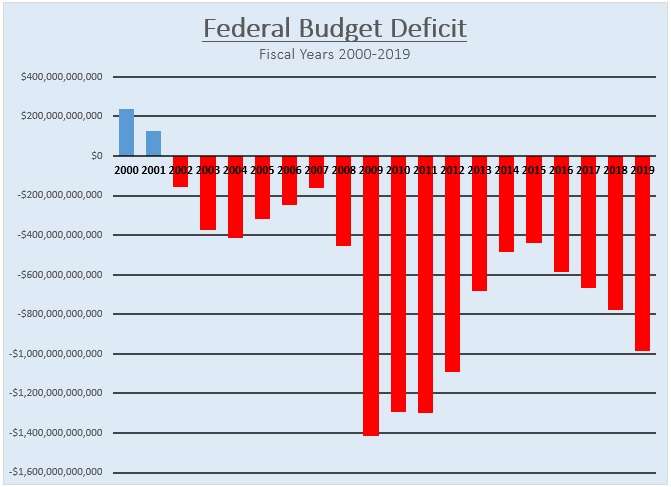
During the 2016 campaign, President Donald Trump said he’d be able to wipe out the national debt in eight years. Instead, after three years in office, he’s overseen a nearly 50 percent increase in the gap between how much the government takes in and how much it spends.

Chart by Eric Boehm. Source: U.S. Treasury data

The Treasury Department announced Friday that the official federal deficit for fiscal year 2019, which ended in September, was $984 billion—in line with what the Congressional Budget Office (CBO) estimated last month.

The announcement serves as official confirmation that the federal government’s mountain of red ink has grown dramatically during Trump’s first three years in the White House.

It is now approaching levels not seen since the early Obama years.

In order to “wipe out the national debt in 8 years,” (a 100% reduction in the debt) the Trump administration would have to run an 8-year surplus totaling about $20 trillion, i.e take $20 trillion out of the economy.

History has taught us that removing $20 trillion from the private sector — would cause, not just a recession, but a depression — and not just any old depression, but a depression the likes of which America never has experienced.

Every depression in U.S. history has been introduced with federal debt reduction, which takes dollars out of the private sector.

1804-1812: U. S. Federal Debt reduced 48%. Depression began 1807.
1817-1821: U. S. Federal Debt reduced 29%. Depression began 1819.
1823-1836: U. S. Federal Debt reduced 99%. Depression began 1837.
1852-1857: U. S. Federal Debt reduced 59%. Depression began 1857.
1867-1873: U. S. Federal Debt reduced 27%. Depression began 1873.
1880-1893: U. S. Federal Debt reduced 57%. Depression began 1893.
1920-1930: U. S. Federal Debt reduced 36%. Depression began 1929.
1997-2001: U. S. Federal Debt reduced 15%. Recession began 2001.

The economy usually is measured by Gross Domestic Product (GDP), and the formula for GDP is:

GDP =Federal Spending + Non-federal Spending + Net Exports.

To reduce federal debt one must reduce federal spending, and/or increase tax collections, both of which reduce GDP.

Federal deficit decreases cause recessions (vertical gray bars), which are cured by federal deficit increases.

By formula, federal debt reductions cut GDP.

The deficit is growing despite growth in tax revenues. The Treasury Department reported that while overall tax receipts rose by about 4 percent, federal spending grew by 8 percent.

In a statement, Treasury Secretary Steve Mnuchin said the data showed “President Trump’s economic agenda is working”; he also touted the low unemployment rate and ongoing economic growth.

One would think that deficit growth and economic growth happening simultaneously, and the fact that deficits pump growth dollars into the economy, would be sufficient to convince Trump, Mnuchin, and Eric Boehm that deficts grow the economy.

Sadly, such irrefutable evidence + mathematical logic don’t seem to be sufficient.

What’s really irresponsible is spending growth that’s outpacing revenue growth by a rate of 2-to-1.

Trump’s defenders will point out that he’s not solely responsible for setting the government’s budget.

That’s true, but he has the final say on all spending bills and he has been refusing to force the spending cuts Mnuchin says are necessary.

Why is “spending that’s outpacing revenue growth” (i.e. adding dollars to the economy) “irresponsible”?

Mnuchin never says, probably because it isn’t irresponsible; it’s necessary for economic growth.

When Congress passed a bipartisan budget plan in March 2017 that annihilated Obama-era spending caps, Trump begrudgingly signed the bill while promising that he’d never agree to another spending hike like that.

Earlier this year, when Congress passed another budget-busting spending bill, Trump signed it without so much as expressing a second thought.

Could it be that Trump intuitively understands that federal deficits spending adds growth dollars to the economy?

Perhaps nothing demonstrates Republicans’ complete abdication of fiscal conservatism as much as this: In three years in office, Trump has added more to the national debt than President George W. Bush did in his entire two terms. (Though Bush did have the advantage of starting out with a budget surplus in his first year.)

Fiscal conservatism, aka “austerity,” aka taking money from the private sector which needs the money, and giving it to the federal government, which doesn’t need the money, is the worst possible financial plan — unless one prefers recessions and depressions.

Recessions are caused by money shortages and cured by money supplements. The private sector is limited in its ability to create growth dollars; the federal government, being Monetarily Sovereign, is not limited.

Now we come to two of the most amazing sentences in Mr. Boehm’s article:

In the early Obama era, it was not uncommon to hear Republicans admit that Bush’s spendthrift ways had paved the way for worse.

Now, on an annual basis, Trump’s deficit spending is nearly as bad a Obama’s was over two terms.

During Bush’s 2nd term, the deficit averaged only about $250 Billion, at which point began the “Great Recession.”

During Obama’s 2 terms, the deficit averaged over $1 trillion, and the economy grew massively, and it continues to grow.

And yet, Mr. Boehm wants deficit reduction! It boggles.

Give Trump a few more years and I’m sure he’ll surpass Obama. That’s because the nature of the current budget deficit is fundamentally different from the peaks of the early 2010s.

Those deficits eventually tapered off for a variety of reasons. Recovery from the Great Recession boosted tax revenue.

The spending binge approved in response to the recession faded away.

And fiscally prudent Republicans imposed some modest caps on future spending growth.

But, Mr. Boehm, the deficit still averaged over $700 Billion — far more than the Bush later years — and the economy still grows, also far faster than during the Bush later years.

Coincidence, Mr. Boehm?

Now? The country is running a massive (and growing) deficit despite a decade of economic growth and a low unemployment rate.

“Higher outlays for Medicare, Social Security, Defense, and interest on the public debt” drove the deficit increase in fiscal year 2019, the Treasury Department says.

See how Boehm still doesn’t get it?

The “massive (and growing) deficit” has caused “a decade of economic growth and a low unemployment rate.”

Then Boehm goes on to exacerbate the ignorance:

The current deficit isn’t the result of temporary circumstances like World War II or a major recession.

It’s a systemic deficit, a result of poor budgeting and bad decision-making by members of Congress and the current administration.

It’s not going to resolve itself, and it’s on pace to get much worse.

We only can pray that he is correct and that the deficit will get much “worse,” i.e. pump much more growth money into the economy.

The Government Accountability Office (GAO) has called the federal government’s current fiscal situation “unsustainable,” and the CBO expects the national debt to hit “unprecedented levels” in the coming decades, well above the record highs set during World War II.

Ah, yes: “Unsustainable.” The favorite word of the economic ignorant. You probably have seen dozens of articles decrying the debt or deficit by using this word, and in not one of those articles did you ever see an explanation of why it supposedly is “unsustainable.”

The economic blowhards have been condemning the debt for longer than you have been alive, and still they have learned nothing. (See: “It is 2019, and the phony federal debt “time bomb” still is ticking.”)

“A deficit of this size following the longest span of economic growth in history shows just how reckless our leaders have become.

This is exactly the time when deficits should be contracting, not expanding,” Leon Panetta, co-chairman of the Committee for a Responsible Federal Budget, said in a statement.

No, Mr. Panetta. “The longest span of economic growth in history” was caused by deficits. Without deficits, there could have been no growth.

There is no time when deficits should be contracting unless one prefers a contracting economy.

And please don’t get me started on that Committee for a Responsible Federal Budget, which has been wrong forever about federal finances.

“But instead of getting our fiscal house in order and preparing for the next downturn, our leaders continue to binge on debt-fueled tax cuts and spending hikes rather than showing the leadership necessary to set our fiscal path.”

Clearly, Panetta believes (or more likely, is trying to make you believe) that our Monetarily Sovereign federal government can run short of its own sovereign currency, the U.S. dollar.

He also wants you to believe that federal financing is like personal financing.

You’ll notice (and this is important) that nowhere in Boehm’s diatribe is there any data showing how federal deficits have an adverse effect on the economy.

He simply spouts generalized reprimands like, “unsustainable,” “mountain of red ink,” “irresponsible,” “abdication of fiscal conservatism,” “spendthrift ways,” “spending binge,” “poor budgeting and bad decision-making,” and on and on.

But where, Mr. Boehm, are the data showing cause and effect — the data showing that large deficits cause some negative effect? They are nowhere to be found.

You will not find anywhere, a graph like the one above, showing that Federal deficit decreases cause recessions, which are cured by federal deficit increases.

The reason for the absence of such data: They do not exist.

A growing economy requires a growing supply of money, and federal deficit spending increases the money supply.

Even the ordinarily distasteful words “deficit,” and “debt,” are misleading, because they really represent surpluses for the economy.

Everything — language and the absence of data — has been gathered together to make you fear the one thing necessary to grow our economy: Federal deficit spending.

Why?

The very rich, who run America, do not want you to ask for more benefits from the federal government. This is their way making you agree to unnecessary limitations on what you receive from the government.

It’s a function of Gap Psychology, the desire of the rich to distance themselves from the rest of us. It is their way of becoming richer, for the larger the Gap the richer they are.

Democrats have abandoned all pretense of caring about the national debt, or even attempting to explain how they might pay for new federal programs.

And Republicans seem capable of offering nothing more than obviously false promises and empty rhetoric.

Mr. Boehm is right about the Democrats and Republicans duplicity, but not in the way he claims. These are the parties that have agreed on the useless — no, harmful — federal debt ceiling.

Both parties have capitulated the demands of the rich that you be misled.

Aside from that, Mr. Boehm’s article is one giant, misleading mess of false economics.

Rodger Malcolm Mitchell
Monetary Sovereignty
Twitter: @rodgermitchell
Search #monetarysovereignty Facebook: Rodger Malcolm Mitchell

…………………………………………………………………………………………………………………………………………………………………………………………………………………………………………………………………………………………..

The most important problems in economics involve:

  1. Monetary Sovereignty describes money creation and destruction.
  2. Gap Psychology describes the common desire to distance oneself from those “below” in any socio-economic ranking, and to come nearer those “above.” The socio-economic distance is referred to as “The Gap.”

Wide Gaps negatively affect poverty, health and longevity, education, housing, law and crime, war, leadership, ownership, bigotry, supply and demand, taxation, GDP, international relations, scientific advancement, the environment, human motivation and well-being, and virtually every other issue in economics.

Implementation of Monetary Sovereignty and The Ten Steps To Prosperity can grow the economy and narrow the Gaps:

Ten Steps To Prosperity:

1. Eliminate FICA

2. Federally funded Medicare — parts a, b & d, plus long-term care — for everyone

3. Provide a monthly economic bonus to every man, woman and child in America (similar to social security for all)

4. Free education (including post-grad) for everyone

5. Salary for attending school

6. Eliminate federal taxes on business

7. Increase the standard income tax deduction, annually. 

8. Tax the very rich (the “.1%”) more, with higher progressive tax rates on all forms of income.

9. Federal ownership of all banks

10. Increase federal spending on the myriad initiatives that benefit America’s 99.9% 

The Ten Steps will grow the economy and narrow the income/wealth/power Gap between the rich and the rest.

MONETARY SOVEREIGNTY