Reason.com, a mouthpiece for the Libertarian Party, bills itself as “free minds, free markets.” More accurately, it should be called “closed minds, closed markets, and free lies.”
Here is the latest post from Eric Boehm, Reason.com’s economic policy reporter. As expected with Libertarian economic “thought,” it is loaded with wrong inferences, misunderstandings, and/or outright lies.
November’s $249 Billion Federal Budget Deficit Set a Record. Now, Congress Is Preparing To Spend Even More. The government spent $501 billion in November but collected just $252 billion in revenue, meaning that about 50 cents of every dollar spentwere borrowed. ERIC BOEHM | 12.16.2022 1:00 PM
The article comes with the photo and caption shown above.
Boehm doesn’t realize that his photo undermines his claim that “about 50 cents of every dollar spentwere borrowed.”
The photo shows someone (presumably representing the government) creating dollars from thin air using a copy machine. This immediately demonstrates the senselessness of the Libertarian economic claims because it illustrates why the federal government has no need to borrow dollars.
In fact, the government does create dollars from thin air simply by pressing computer keys, so it never borrows dollars.
Boehm claims that T-bills, T-notes, and T-bonds represent borrowed money. Completely false. They represent dollars deposited intoprivately held accounts, similar to safe deposit boxes. The government never touches the contents of those accounts.
The dollars are the property of the depositors, not of the government, and remain inviolate until the accounts mature when the contents are returned to the owners. The dollars never are borrowed or used by the government or by anyone else.
Though those dollars often incorrectly are termed federal “debt,” the government does not owe the money any more than a bank owes the contents of a safe deposit box.
As the St. Louis Federal Reserve Bank has said:
“The U.S. government can never become insolvent, i.e., unable to pay its bills . . . the government is not dependent on credit markets to remain operational.
“Not dependent on credit markets” is government-speak for, “does not borrow.”
Further, even if the T-securities were debt, the federal government pays all its debt by creating new dollars ad hoc. It does this by the simple expedient of passing laws and pressing computer keys, both of which it has the infinite ability to do.
Debt never is a burden on the U.S. government or on taxpayers.
As for those taxes you are forced to pay, they are destroyed upon receipt by the Treasury. You take dollars from your checking account — dollars that are part of the M2 money supply measure — and when they reach the Treasury, they cease to be part of any money supply measure.
There is no measure of the Treasury’s money holdings because the Treasury has infinite money. Thus, your tax dollars disappear, effectively destroyed.
So much for all that talk about falling deficits.
The federal government ran a $249 billion deficit during the month of November—that’s the largest total ever posted for that month, and a staggering $56 billion increase over the deficit from November 2021.
The economy is measured by Gross Domestic Product (GDP). The formula for GDP is:
GDP = Federal Spending + Non-federal spending + Net Exports
Thus, by simple algebra, federal spending always grows the economy. Boehm may not realize that he is complaining about economic growth.
Nearly 50 cents of every dollar spent were borrowed and added to the national debt. That’s utterly unsustainable.
“Unsustainable” is the favorite word of deficit liars, who never explain why any size deficit cannot be sustained.
In what year did the federal “debt” become “unsustainable”?
The gross federal “debt” (deposits) totaled $51 billion in 1940. It now totals about $30 trillion, nearly a 600-fold increase, and here we are, sustaining.
For over 80 years, the debt whiners have claimed the debt is “unsustainable.” Year after year after year, they have been proven wrong, and still, they learn nothing. Truly pitiful.
And now Congress is gearing up to spend even more.
Though the final details of a lame-duck session omnibus bill won’t be known until next week (likely not until just before lawmakers are asked to vote on it), it’s a near certainty that the final agreement will add to this year’s budget deficit and the ballooning national debt.
Translation: The final agreement will add to the budget deficit which will grow GDP.
Congress passed a short-term spending deal on Thursday night to avert a government shutdown and give lawmakers another week to hammer out a more comprehensive deal to fund the government through the end of the current fiscal year.
Where did the dollars to fund the government come from? The government merely created them from thin air by creating laws and pressing computer keys, something they can do forever.
That larger omnibus bill could include billions of dollars in additional military and humanitarian aid for Ukraine, as well as emergency funds for hurricane relief, The Washington Post reports.
The final price tag is likely to be about $1.7 trillion, according to Politico.
That will be $1.7 trillion added to Gross Domestic Product.
Depending on what else ends up in the final version of the end-of-year omnibus, the package will add between $240 billion and $585 billion to this year’s budget deficit, according to an analysis by the Committee for a Responsible Federal Budget (CRFB), a nonprofit that advocates for balancing the books.
It says much about your lack of economics knowledge when you resort to the CRFB for your ideas. Here is what happens when the government balances the books:
1804-1812: U. S. Federal Debt reduced 48%. Depression began 1807. 1817-1821: U. S. Federal Debt reduced 29%. Depression began 1819. 1823-1836: U. S. Federal Debt reduced 99%. Depression began 1837. 1852-1857: U. S. Federal Debt reduced 59%. Depression began 1857. 1867-1873: U. S. Federal Debt reduced 27%. Depression began 1873. 1880-1893: U. S. Federal Debt reduced 57%. Depression began 1893. 1920-1930: U. S. Federal Debt reduced 36%. Depression began 1929. 1997-2001: U. S. Federal Debt reduced 15%. Recession began 2001.
Balancing the books is a good idea for monetarily non-sovereign entities like cities, counties, states, euro nations, businesses, and individuals. They do not have the unlimited ability to create their own sovereign currencies.
In fact, they have no sovereign currencies.
But the U.S. government is Monetarily Sovereign. It can create infinite dollars and the legal ability to make those dollars worth anything it chooses.
Over the 10-year budget window used by the Congressional Budget Office and other number crunchers to assess the federal budget, the damage could exceed $5 trillion.
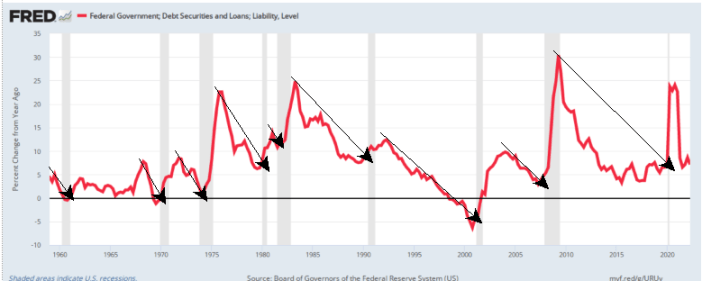
Recessions (vertical gray bars) follow reductions in federal deficit growth.
Translation: Exchange the words “economic growth“ for the term “damage” and you will see the truth.
“Not only would these policies increase deficits, but they would also worsen inflation,” the CRFB warns in its analysis.
“With inflation surging and debt approaching record levels, policymakers should avoid passing costly end-of-year policy changes.”
As always, the CRFB spouts nonsense. Inflation is not caused by or “worsened” by federal deficits. All inflations through history have been caused by shortages of important goods and services.
Changes in federal debt, i,e, deficits (red), do not correspond with changes in inflation (blue).
If federal deficits “worsened inflation,” one would expect the peaks and valleys of the above graph to correspond. They do not.
Inflations are not caused by federal spending. Today’s inflation was caused by COVID-related shortages of oil, food, shipping, lumber, computer chips, labor et al.
For much of the past year, the Biden administration has been touting falling deficit figures as evidence that the economy was picking upand, implicitly, as a signal that government spending could increase without adding to the nation’s tenuous fiscal situation.
If true, that would be incredibly uninformed by the Biden administration.
Mathematically, it is not possible for falling deficit figures to be evidence of growing Gross Domestic Product. That would be like falling food supplies being evidence of growing nutrition.
That was always misleading, as the falling deficit was entirely the result of one-time, emergency COVID-19 spending coming off the books.
The underlying figures showed all along that the deficit situation was continuing to worsen, and that President Joe Biden’s policies were adding trillions of dollars to the deficit over the long term.
Wait, Mr. Boehm. You say emergency COVID-19 spending came off the books, yet now we have inflation. What happened to your claim that increased federal spending causes inflation?
November’s spending and revenue figures should put an end to these silly games. We’re only two months into the fiscal year, but the federal government is now on pace to run a deficit of about $1.9 trillion, which would be the largest nonpandemic budget deficit ever and a huge increase from the $1.38 trillion deficit in the fiscal year that ended on September 30.
That spending has helped reduce the likelihood of a recession, which by the way, is defined as two consecutive quarters of reduced GDP — a reduction which is exactly what you want to do.
A major driver of November’s rapidly expanding deficit was something else that fiscal hawks have been warning about for a while: higher borrowing costs created byhigher interest rates.
The Wall Street Journal notes that the federal government spent 53 percent more on borrowing costs last month than it did in November 2021.
The higher borrowing costs were foolishly and arbitrarily created by the Fed. They do nothing to prevent/cure inflation. They do nothing to cure the shortages that cause inflation.
In fact, higher interest rates exacerbate the shortages and thus, exacerbate inflation. In essence, the Fed is applying leeches to cure anemia.
Higher borrowing costs are not the result of federal deficits. They are the result of Fed ignorance.
The best time to stop borrowing heavily was yesterday (or several years ago), but the second-best time would be today. Instead, Congress is likely to make this problem even worse—again—by continuing to spend like there’s no tomorrow.
SUMMARY
The entire Boehm article is based on commonly held myths. The facts are:
Federal deficits are necessary for economic growth. (That is simple mathematics.)
The U.S. federal government never borrows dollars. (Why would it, given its infinite ability to create dollars).
Reduced federal spending causes recessions and depressions. (Again, this is simple mathematics.)
Inflations are caused by shortages of key goods and services, not by federal spending. (As demonstrated by history).
Inflations are cured by federal spending to acquire and distribute the scarce goods and services. (Again, as demonstrated by history.)
Increasing interest rates does not help prevent or cure inflations.
Increasing interest rates exacerbates the shortages that cause inflations. (That is why raising interest rates is recessionary.)
I recently received an Email from you, which I will quote in its entirety.
Congress has until December 16th to fund the government and avoid a federal shutdown. If they avoid that, they’ll likely have done so with the same tired Washington tactic of promising billions in new deficit-funded spending or tax cuts, driving the national debt even higher.
We have asked Congress not to borrow any new money for the rest of 2022.
With our Debt Fixer interactive tool, you have the opportunity to craft a national budget that puts America on a sustainable fiscal course heading into 2023.
How It Works: The Debt Fixer gives users the opportunity to confront many of the same budget decisions that lawmakers face and to see how those choices affect the debt. You’ll be asked to make decisions on a range of policy options with the goal of stabilizing the debt at 90 percent of Gross Domestic Product (GDP) within ten years and 60 percent of GDP by 2050.
Afterwards, users can share select to share their fiscal choices with Members of Congress and social media. Can you do better than Congress? Give it a try now!
If you’re a teacher and would like to use the Debt Fixer in your class, please let us know by e-mailing debtfixer@crfb.org.
We can provide additional resources for your classroom including guest speakers and a customizable link where you can compare your classes results. If you enjoy Debt Fixer, we encourage you to check out our other interactive resources: Budgeting for the Future, Is It Worth It, and the Social Security Reformer.
Here you’ll be able to test your budget knowledge, compare the costs of proposals and policies, and choose the options to stabilizing the debt at 90 percent of Gross Domestic Product (GDP) for future generations.
I have bolded the following phrases from your Email: “driving the national debt even higher,” “not to borrow,” “not to borrow,” “sustainable fiscal course,” “stabilizing the debt at 90 percent of Gross Domestic Product (GDP), and “stabilizing the debt at 90 percent of Gross Domestic Product (GDP).”
As I suspect you know, the U.S. federal government is Monetarily Sovereign, i.e., it has the infinite ability to create its own sovereign currency, the U.S. dollar. This ability sometimes (incorrectly) is referred to as “printing” dollars.
The infinite ability to “print” dollars means the U.S. government never unintentionally can run short of dollars.
THE CHALLENGE
Given the fact that the U.S. government cannot run short of dollars, I challenge you to answer the following questions:
DRIVING THE NATIONAL DEBT EVEN HIGHER:Given the federal government’s infinite ability to “print” (create) dollars why should anyone be concerned about the size of the “national debt”?
NOT TO BORROW: Given the federal government’s infinite ability to create dollars why should the federal government need to borrow dollars?
DEBT FIXER: Given the federal government’s infinite ability to create dollars, why does the federal debt need fixing?
SUSTAINABLE FISCAL COURSE:Given the federal government’s infinite ability to create dollars, and the fact that it has sustained its fiscal course for the past 80+ years while the federal debt has increased 62,500%, why do you believe it’s current fiscal course suddenly has become unsustainable?
STABILIZING THE FEDERAL DEBT AT 90 PERCENT OF GROSS DOMESTIC PRODUCT (GDP): In what way does the ratio of federal debt / GDP affect the economy?
I have followed your Emails for several years, during which time you repeatedly have voiced the same concerns about federal deficit spending. Yet, you never have answered the above questions.
Here are the facts you continually ignore:
The government’s infinite ability to create dollarsmeans it never needs to be concerned about any debt. It has a greater ability to pay its debts than Elon Musk’s ability to pay a 1 cent debt.
The federal government does not borrow, nor will it ever need to. As the St. Louis Fed reported: ““As the sole manufacturer of dollars, whose debt is denominated in dollars, the U.S. government can never become insolvent, i.e., unable to pay its bills. In this sense, the government is not dependent on credit markets to remain operational.” The U.S. government provides T-security accounts into which other governments and private citizens are allowed to deposit dollars for safekeeping. The purpose of these accounts is not to provide the federal government with dollars, but rather to provide the world with a safe place to store unused dollars. This helps stabilize the dollar. To pay off these deposits, the federal government merely returns the dollars that are in those accounts. Returning existing dollars is no burden on the federal government or on U.S. taxpayers.
The federal debt is not a real debt. It is deposits that are owned by other governments and private citizens. It does not need “fixing.” If the federal government stopped issuing T-securities tomorrow, that would have no effect on the government’s ability to spend dollars and to pay its bills.
The federal government has proved, year after year, that its course is sustainable. Despite a massive increase in the so-called “debt,” the government has no difficulty funding every expenditure.
The ratio of federal “debt” to GDP is economically meaningless. It has no effect on the government’s ability to spend or on inflation, or on any aspect of economic health. GDP dollars do not pay for federal debt. The ratio also is ludicrous because it compares a multiyear figure (debt) to a one-year figure (GDP). One easily could ask, “Why not compare debt to the six-month GDP or the one-month GDP, or even the ten-year GDP?”
There is no relationship between the Debt/GDP ratio (blue) and inflation (red).
There is a strong relationship between reductions in federal debt and recessions or depressions. Most recessions have resulted from periods of declining deficits.
U.S. depressions tend to come on the heels of federal surpluses.
1804-1812: U. S. Federal Debt reduced 48%. Depression began 1807. 1817-1821: U. S. Federal Debt reduced 29%. Depression began 1819. 1823-1836: U. S. Federal Debt reduced 99%. Depression began 1837. 1852-1857: U. S. Federal Debt reduced 59%. Depression began 1857. 1867-1873: U. S. Federal Debt reduced 27%. Depression began 1873. 1880-1893: U. S. Federal Debt reduced 57%. Depression began 1893. 1920-1930: U. S. Federal Debt reduced 36%. Depression began 1929. 1997-2001: U. S. Federal Debt reduced 15%. Recession began 2001.
America’s debt /money supply growth parallels America’s GDP growth
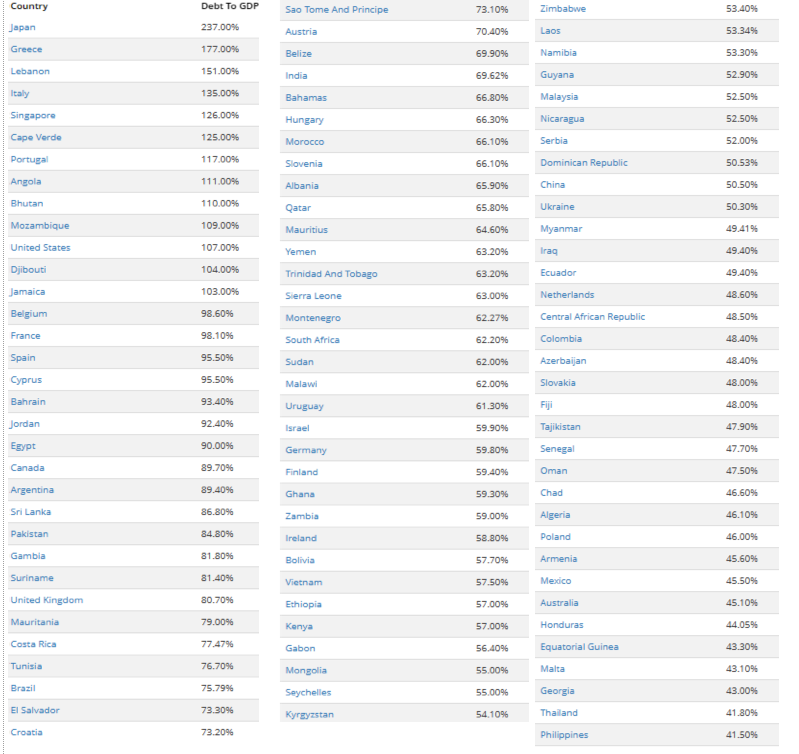
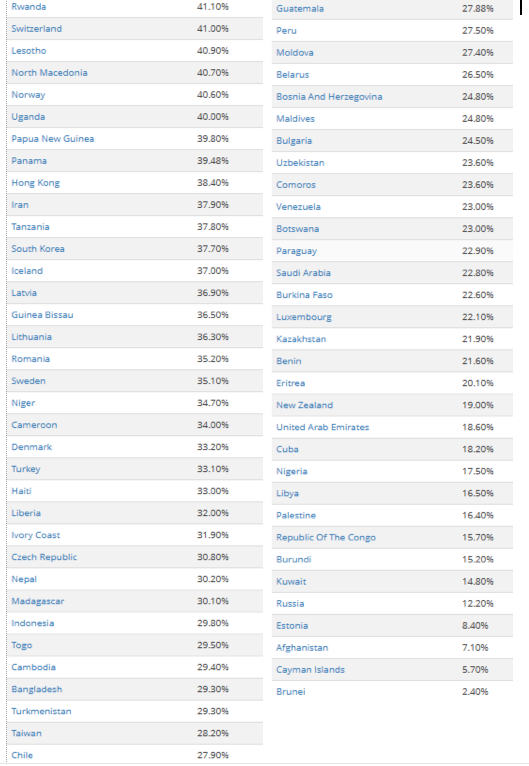
Using the tables below, see if you can determine which economies are “healthiest.”
(You won’t succeed, because the debt/GDP ratios tell you nothing about the health of a nation’s economy:
SUMMARY The CRFB never has and never will accept my challenge. They never will answer the questions, because the true answers would eliminate their reason for existence.
The CRFB is worse than useless. It is harmful to America. I believe they know they are harmful, in which case that would make them traitors.
I believe they are paid by the rich in America to widen the income/wealth/power Gap between the rich and the rest of us, in which case that would make them paid traitors.
I am angry at them. They hurt America.
If you believe they have answers and can meet the challenge, feel free to contact them. I’d be interested in seeing how they try to squirm out of this. Contact Maya MacGuineas at MacGuineas@crfb.org and find her on Twitter @MayaMacGuineas.
If you think I am angry at the CRFB, you’re right. I believe they have done, and continue to do, irreparable harm to America by giving aid and comfort to politicians who vote against benefits.
The claim that Medicare and Social Security can run short of money is absurd, especially so when the federal government, at the touch of a computer key, can provide all the money these agencies need.
The claim that the federal debt is too high also is absurd, when it isn’t even debt and it could be paid off entirely simply by returning the dollars in storage.
Even more absurd is to worry about the debt/GDP ratio, which compares a multi-year figure to a one-year figure, and is indicative or predictive of nothing.
The number erroneously referred to as Federal “debt” is the total of outstanding Treasuries. When you buy a Treasury (T-bill, T-bond, T-note), you add to the so-called “debt.”
I say “so-called” because Treasuries are not debts of the United States, nor are they debts of taxpayers.
Treasuries are deposits into Treasury Security accounts.
They resemble bank safe deposit boxes in that the depositor, not the bank or U.S. government, owns the deposits, and the bank never touches them.
Similarly, the federal government neither uses nor even touches the dollars that are in Treasury accounts.
The federal government does not use tax dollars to pay off a T-bill, T-note, or T-bond. The dollars do not help fund federal spending. Nor are they owed by future taxpayers.
Upon maturity, the federal government returns the dollars in a T-account as though these dollars were in a safe-deposit box.
Thus the so-called federal “debt” cannot be too high, nor can it be “unsuitable” (another favorite word of debt worriers) any more than a safe deposit box’s contents can be too high or unsustainable.
The federal government pays its bills out of the General Fund, similar to a checking account, and by law, this fund cannot be negative.
As a bookkeeping device, the federal government sells enough T-securities to offset whatever would be a negative General Fund total.
This accounting trick has no practical significance because the Federal Reserve, now Monetarily Sovereign, has the unlimited ability to increase the dollar balance in the General Fund.
Quote from former Fed Chairman Ben Bernanke when he was on 60 Minutes: Scott Pelley: Is that tax money that the Fed is spending? Ben Bernanke: It’s not tax money… We simply use the computer to mark up the size of the account.
Statement from the St. Louis Fed: “As the sole manufacturer of dollars, whose debt is denominated in dollars, the U.S. government can never become insolvent, i.e., unable to pay its bills. In this sense, the government is not dependent on credit markets to remain operational.”
Treasury securities are not a form of borrowing; they are not owed by the government or taxpayers and do not help the government pay its bills. So what is their purpose:
They provide the world with a safe, convenient, interest-paying place to store unused dollars. This helps stabilize the value of the dollar.
Because the Fed arbitrarily determines the interest at which deposits will accumulate funds, these accounts help the Fed control overall interest rates.
Among those who don’t understand Treasuries (T-bills, T-bonds, T-notes), a persistent refrain is, “What if China dumps or stops buying Treasuries?” What would the federal government do?
That is like asking a bank, what if your big, safe-deposit-box customer started taking money out of his box? The answers are:
Nothing, or
If the government needed to add dollars to the total “debt,” the Monetarily Sovereign Federal Reserve would buy T-securities — as many as it wished, whenever it wanted.
Alan Greenspan: “A government cannot become insolvent with respect to obligations in its own currency.”
The U.S. is not unique in its unlimited ability to create dollars. The European Union has the unlimited ability to create euros:
Press Conference: Mario Draghi, President of the ECB Question: I am wondering: can the ECB ever run out of money? Mario Draghi: Technically, no. We cannot run out of money.
All of the above brings us to these excerpts from an article that appeared online:
Americans often quote the saying of President Theodore Roosevelt, “Speak softly but carry a big stick.” In other words, it is important to make only realistic threats.
(In that vein), threatening to dump US Treasuries is silly.
China is the second-largest foreign holder of US treasuries, only after Japan. China’s holdings of US treasury securities dropped to $980.8 billion in May, falling below $1 trillion for the first time in 12 years, according to data released by the US Department of the Treasury.
The further deterioration of China-US relations will likely have a direct impact on China’s risk appetite for holding US treasuries, and reducing holding of US treasuries could become a precautionary option.
This was the only large scale ultimatum the Global Times story presented and it’s bizarre to see that one mentioned. China and Japan have both been reducing their holdings of US Treasuries in recent years, with no adverse impact to the US government funding or the dollar.
….the real reason China cannot sell off its holdings of U.S. government bonds is because Chinese purchases were not made to accommodate U.S. needs.
Rather, China made these purchases to accommodate a domestic demand deficiency in China: Chinese capital exports are simply the flip side of the country’s current account surplus, and without the former, they could not hold down the currency enough to permit the latter.
To see why any Chinese threat to retaliate against U.S. trade intervention would actually undermine China’s own position in the trade negotiations, consider all the ways in which Beijing can reduce its purchases of U.S. government bonds…
China can buy other U.S. assets, other developed-country assets, other developing-country assets, or domestic assets. No other option is possible.
The first two ways would change nothing for either China or the United States. The second two ways would change nothing for China but would cause the U.S. trade deficit to decline, either in ways that would reduce U.S. unemployment or in ways that would reduce U.S. debt.
Finally, the fifth way would also cause the U.S. trade deficit to decline in ways that would likely either reduce U.S. unemployment or reduce U.S. debt; but this would come at the expense of causing the Chinese trade surplus to decline in ways that would either increase Chinese unemployment or increase Chinese debt.
By purchasing fewer U.S. government bonds, in other words, Beijing would leave the United States either unchanged or better off, while doing so would also leave China either unchanged or worse off.
China remains an export-depended economy (even though it is currently trying to shift its economic model).
Therefore, it needs to run a current account (or trade) surplus. If it does not, China will face either
more unemployment, for reduced exports mean that the Chinese exporters are forced to lay off workers,
or more debt, as Beijing will encourage large fiscal transfers to the households (social security, unemployment benefits, food stamps, etc.) or the creation of new businesses to mitigate the consequences of unemployment.
All this requires more money and, consequently, more debt.
This is why China purchases US Treasuries: to run trade surpluses and avoid higher debt/unemployment — not, as many think, to “help” American consumers so that they can purchase more Chinese imports.
China might make geopolitical waves by buying Japanese government debt. The yen is trading at very low levels and the Japanese central bank has had to buy over half the debt outstanding.
This is one of the steps the Federal Reserve could take and often has taken. The Japanese Central Bank is Monetarily Sovereign like the Fed and the EU.
Even if China wanted to buy Japanese debt to support Japan (as in make a point about the US failure to do much about its long-standing post financial crisis distress), it’s not clear the market is liquid enough for China to procure all that much.
In other words, this idea of punishing the US by dumping Treasuries may be appealing to a domestic audience, which has long been unhappy about the magnitude of China’s dollar foreign exchange reserves.
But no one knowledgeable in the US will lose sleep over it.
SUMMARY
The so-called federal “debt” is not a debt. lt is the total of depositsinto Treasury Security accounts, which are similar to bank safe-deposit boxes.
Neither the federal government nor future taxpayers owe the “debt.” To pay it off, which is done daily, the Treasury simply returns the contents of these accounts to the account owners.
These accounts serve two purposes: To provide a safe, interest-paying repository for unused dollars (which stabilizes the dollar) and to help the Fed control interest rates.
Thus, there is no danger inherent in a “too-large debt.” Even if China stopped buying T-securities, the U.S. government and U.S. taxpayers would be just fine.
Gap Psychology describes the common desire to distance oneself from those “below” in any socioeconomic ranking and to come nearer those “above.” The socio-economic distance is referred to as “The Gap.”
Wide Gaps negatively affect poverty, health and longevity, education, housing, law and crime, war, leadership, ownership, bigotry, supply and demand, taxation, GDP, international relations, scientific advancement, the environment, human motivation and well-being, and virtually every other issue in economics.Implementation of Monetary Sovereignty and The Ten Steps To Prosperity can grow the economy and narrow the Gaps: Ten Steps To Prosperity:
Ben Bernanke: “The U.S. government has a technology, called a printing press (or, today, its electronic equivalent), that allows it to produce as many U.S. dollars as it wishes at essentially no cost.“
Alan Greenspan: “A government cannot become insolvent with respect to obligations in its own currency.
Money is not a physical object. It is not a dollar bill or a coin, both of which are titles to money, not money itself.
Money is nothing more than numbers on a balance sheet. The federal government has absolute control over its balance sheets. It can change numbers at will, merely by passing laws, which is how it created the first U.S. dollars. It simply passed laws.
The federal government can add money to your checking account by instructing your bank to increase the account’s balance. It sends your bank a “Pay to the order of” document. New dollars are created and added to your account when your bank obeys those instructions.
Federal checks don’t bounce because Congress passes laws to prevent bouncing. Example: Every time we reach a “debt ceiling,” Congress raises it so that federal checks are honored.
That is how the federal government pays bills and creates dollars.
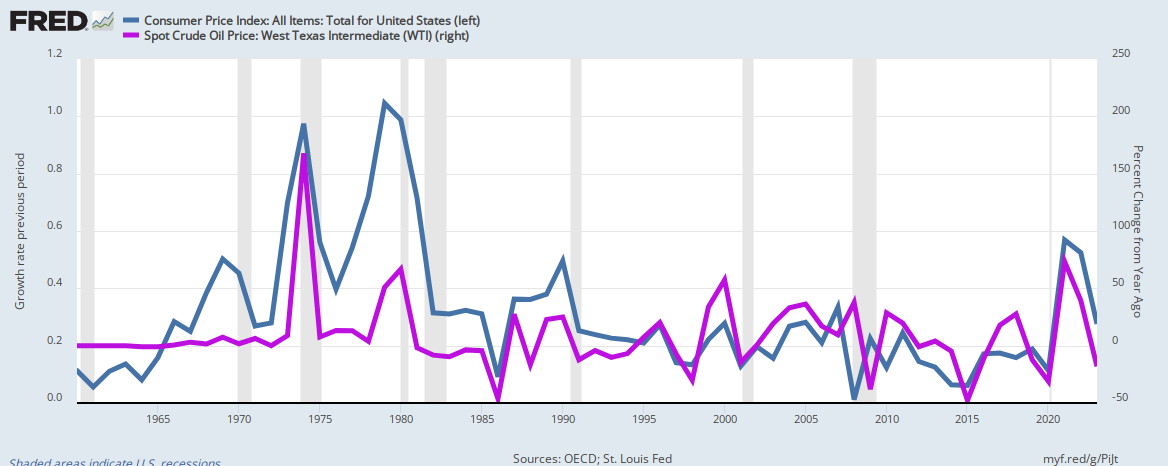
2. Federal spending never causes inflation. Shortages of critical goods and services cause inflation. The most common inflation-causing shortage is the shortage of oil.
The blue line is inflation. Purple is oil pricing. Vertical gray bars are recessions. Inflation tends to parallel oil pricing. The data show that oil shortages cause oil prices to rise, leading to inflation.
The best way to cure inflations is to remedy the shortages. Contrary to popular wisdom, federal spending does not cause the shortages that cause inflation.
Again, the blue line is inflation. The red line represents federal deficit spending. You’ll see no parallelism here. The data show that spending does not cause inflation.
The federal government cannot run short of dollars, and federal deficit spending does not cause inflation. Once you fix those two absolute truths in your mind, you will understand the rest of this post.
We cannot rely solely on a private sector, constrained by money supply and the profit motive, to finance what the world needs. The federal government is constrained neither by money supply nor profit motive.
Here is how I visualize paradise. No poverty. No hunger. No crime. No “bad” neighborhoods. Good healthcare for all. The Gaps between the richest and the rest are narrow. All who want a good education receive one. Children and the elderly receive good care.
There is plenty of good food, good water, suitable affordable housing, good air, and good weather.
How do youvisualize paradise?
Here are just a few of the things we could do:
1. Provide free, comprehensive, no-deductible healthcare and long-term care to everyone in America, regardless of age, income, or health history.
The government can pay for everything related to medical care: Doctors, nurses, hospitals, drugs, ambulances, equipment manufacturers, etc.
There would be no need for Medicare Part A, B, C, D, or Supplementary. The government would function as the insurance company.
It would not be “socialized medicine.” As with Medicare, the government only would pay, not administer. Doctors and nurses still would make all medical decisions.
2. Eliminate the Federal Insurance Contribution Act (FICA) tax on employees and employers. FICA is the ultimate regressive, anti-employment tax that is utterly useless.
Contrary to popular myth, FICA does not fund Social Security or Medicare. FICA dollars taken from employees and employers come from the economy. Those dollars are destroyed upon receipt by the U.S. Treasury.
3. Provide tax-free Social Security benefits to everyone in America. Each person would receive the same benefits. There would be no age, current employment, or previous employment history deductions.
This may be the most direct benefit to employ because it can be done at the stroke of a pen. President Obama did it temporarily in 2011. FICA should be cut permanently. Payroll-Tax Cut Measure Signed Into Law by Obama4. Provide free college for everyone who wants one. Education is so essential to America’s future that the founders of this nation made sure it was provided free to everyone — at least, for grades K-12, where monetarily non-sovereign (state & local) governments offer it.
Today, college is far more critical than it was back in the 1700s, so for the same reasons that grades k-12 generally are free, college should be free and accessible to all.
5. Pay a salary to all those attending school.Going to school is a job, like any other job. America needs an educated populace.
Many children, especially those of high school and college-age, don’t attend school because they and their families need income.
A school salary will help young people resist the temptation to quit school, commit crimes, or join gangs.
6. Federally funded school lunch for pre-school through grade 12. No means-testing, thus eliminating the stigma.
The National School Lunch Program (NSLP) is a federally assisted meal program operating in public and nonprofit private schools and residential child care institutions. It provides nutritionally balanced, low-cost lunches to children each school day.
About 7.1 million children participated in the NSLP in its first year. By 2016: 30.4 million children participated.
Like most federal programs, the NLSP is unnecessarily complex and means-tested.There is a lunch program (“high lunch” and “low lunch), a breakfast program (“severe-need” and “non-severe need), an after-school-snack program, a special milk program, a summer food service program, and a seamless summer program, each having various remuneration schedules.
Rather than having a government agency serve as America’s dietician, the entire breakfast/lunch program should be handled like Medicare, where the doctor makes the decisions and Medicare pays the bills.
For NLSP, the local dietician should schedule the meals and submit costs to the government. Not only would this be simpler, but it would encourage serving fuller, better, more nutritious meals.
7. Eliminate means-testing from all federal programs. Federal means-testing is complex and expensive. It arbitrarily defines who will receive benefits and eliminates the poor who almost, but not quite, are poor enough.
Means-testing stigmatizes those who receive benefits; it encourages cheating to qualify and discourages efforts to improve one’s means.
A classic means-testing example is the Supplemental Nutrition Assistance Program (SNAP, food stamps). It is a massively complex program with many requirements.
According to the Council on Aging:
*The Supplemental Nutrition Assistance Program, or SNAP, is the most extensive domestic hunger safety net program, helping low-income older adults achieve food security.
*Approximately three out of five seniors who qualify to receive SNAP are missing out on benefits—an estimated 5 million people.
*For older adults with low income, the $1,248 average annual benefits can mean the difference between having food and going without.
Federal means-testing has one purpose: To minimize the amount of money the federal government spends.
Yet, there is no reason the federal government ever needs to minimize spending. The federal government has infinite money; federal spending creates economic growth, and federal spending does not cause inflation.
Federal means-testing for benefit programs is all negatives with no positives. It is based on the false premise that the federal government’s finances are limited, like state and local government finances.
8. Financially support the research, development, and usage of renewable, low- or zero-carbon energy. We have begun to experience the terrible result of carbon-based fuels. Global warming is upon us, with even worse results coming.
The government must do much more to encourage zero-carbon energy: solar, wind, geothermal, hydrogen, hydro, and nuclear.
It must fund research on unknown or unproven energy sources, for instance, the massively expensive tokamak. Solar panel production should be supported, and installation should be free. Financial support should be given to companies offering existing forms of renewables and to people who use renewables.
That will help reduce climate change and take inflationary pressure off oil.
9. Financially support the research and development of low-carbon-fueled cars, trucks, buses, ships, trains, airplanes, homes, offices, andfactories. This includes funding research into more efficient batteries and electric infrastructure, transmission networks, superconductors, and charging stations.
10. Financially support the purchase and use of low-carbon-fueled cars, trucks, buses, ships, trains, airplanes, homes, offices, and factories. Often, the public is slow to adopt new technology, especially if it is not immediately and financially beneficial.
The federal government has the power to make adoption financially beneficial while R&D brings the technology into economic self-sufficiency.
11. Financially support water purification and desalination research, development, and distribution. The world is covered with water that isn’t good for drinking or growing crops. We need more efficient water purification, desalination, transportation, and usage.
America is losing its fresh water daily.
What is Water Scarcity?Water scarcity involves water crisis, water shortage, water deficit or water stress.
Water scarcity can be due to physical water scarcity and economic water scarcity. Physical water scarcity refers to a situation where natural water resources are unable to meet a region’s demand while economic water scarcity is a result of poor water management resources.
About 70% of the Earth’s surface is covered with water, and 3% of it is actually freshwater that is fit for human consumption. Around two-thirds of that is tucked in frozen glaciers and unavailable for our use.
“Water scarcity already affects every continent and around 2.8 billion people around the world. More than 1.2 billion people lack access to clean drinking water.””
Causes of Water Scarcity: Overuse, pollution, conflict, distance, drought, governmental access, global warming, illegal dumping, groundwater pollution, and natural disasters.
All of these can be moderated or eliminated by properly used government funding.12. Financially support farmers and advanced farming methods (for example, hydroponics, genetic engineering of more productive, healthful crops, reduced use of fertilizers, water, and pesticides).
The federal government financially should support the purchase of efficient farm equipment.
American farmers are nearing extinction. President Trump’s trade war hasn’t helped matters. After the United States slapped tariffs on Chinese goods, including steel and aluminum, last year, China retaliated with 25 percent tariffs on agricultural imports from the U.S.China then turned to other countries such as Brazil to replace American soybeans and corn.
Even large companies are facing unprecedented challenges; Dean Foods, a global dairy producer that buys milk from thousands of small farmers, filed for bankruptcy in 2019.
13. Give more financial support to pure scientific research. Unlike applied research, pure research is not designed to result in profits. Its purpose is to add to scientific knowledge. It is why we went to the moon and want to go to Mars, not for immediate gains but for learning.
Sometimes we learn much that is valuable today. Sometimes we find that much we may discover has value 100 years from now. We build a long-term knowledge base handed down through the generations. That is one of the qualities that differentiates humans from all other animals.
Even “failed” research has immediate value in showing what doesn’t or might work in the distant future. Failed research can be the beginning of serendipity.
The profit-motivated private sector cannot justify doing much pure research. For example, pharmaceutical companies are reluctant to spend money searching for the causes and cures of rare diseases. But that research is valuable, not only for curing rare diseases today, but it may lead to other purposes we hadn’t even imagined.
Consider such projects as weather prediction and control, meteor and comet protection, volcano prediction and control,
14. Support the states with a per-capita payment. Something like Social Security for the U.S. states.
State and local governments are monetarily non-sovereign.
Unlike the Monetarily Sovereign U.S. government, states generally run short of the dollars they need to take care of local problems: Schools, streets, infrastructure, parks, garbage/recycling/water, police, fire departments, etc.
Most states borrow, which means they later will need to spend less (provide less to their residents), tax more (take more from their residents), or both.
The federal government should take those burdens from local taxpayers’ shoulders.
15. Federal support for the postal service. The mail is as vital to America as any other government service. There is no public benefit to requiring the postal service to pay its own way.
Although COVID-19 has choked off the USPS revenue in recent months, factors that arose well before coronavirus have contributed to the unsustainability of the Postal Service’s financial situation for years.
While the USPS generates enough revenue to cover its operating costs, its pension and retiree health care liabilities push its bottom line into the red. The USPS has operated at a loss since 2007.
Because of the rise of email and digital communication, USPS has seen the volume of First-Class Mail decline from a peak of 103.5 billion pieces in 2000 to just shy of 55 billion pieces in 2019.
USPS has tried to increase the delivery of marketing mail and has tried to compete with UPS and FedEx in the parcel delivery sector, including by forging a delivery deal with Amazon.
This has provoked criticism from (past) President Trump (Because of his personal animosity with Jeff Bezos.)
Can there be life without beauty?16. Increase support for the arts. The arts are the difference between seeing the world in color vs. drab shades of gray.
Science provides pronouns, nouns, and verbs, but the arts offer adjectives, adverbs, and interjections.
To live as humans, we need music, painting, architecture, poetry, and literature.
If you have visited or seen photos of Soviet-era architecture, you understand the cold, functional, inhumanity of a joyless world.
17. Eliminate income taxes on all but the top 1%. The Gap is too wide, and it is widening. In that regard, here is what FOXwrote:
In 2018, the top 1% of taxpayers – defined as those with adjusted gross income (AGI) (AGI) above $540,009 – earned 20.9% of all AGI and paid 40.1% of all federal income taxes, according to data from the Tax Foundation.
The group paid more in income taxes (at about $615 billion) than the bottom 90% of taxpayers combined ($440 billion).
Do you see what’s wrong with what the mouthpiece for the rich wrote? That 20.9% figure is bogus. Much of the income the top 1% receives isn’t counted in AGI (Adjusted Gross Income.)
Think of the fully paid, comprehensive health insurance, travel, meals, vacations, apartments, stock options, entertainment, clothing, taxis, and other expenses that companies spend on behalf of key employees.
You pay for those things using your AGI dollars, but the upper 1% doesn’t. The richest among us may not remember what it’s like to write a personal check. Do you think Donald Trump even carries a wallet?
Then there is real estate depreciation, which is how billionaire Donald Trump pays fewer tax dollars than you did.
And remember, FICA and other taxes paid by the “lowly” 99% are not paid by the 1% who don’t take salaries.
GOVERNMENT WASTE
Waste is bad. The word “waste” is a pejorative. State and local government waste comes out of your pocket.
But federal waste is another matter. The dollars cost you nothing. In fact, wasted federal spending adds stimulus dollars to the economy.
Of course, it would be far better for those dollars to have produced something of value, but the mere spending benefits us all.
So, don’t worry so much about wasted federal spending. Of course, we want federal dollars to be functional, but even the most outrageously wasted dollars — bridges to nowhere — still add to the nation’s economic growth.
SUMMARY
There is so much the wealthiest entity on the planet — the U.S. government — could do to benefit Americans and the world.
But, the government is restricted by the widespread false belief that federal finances are like state and local government finances.
That false belief seems logical to the private sector, which is monetarily non-sovereign and limited in what it can spend.
I have listed several areas where the populace would benefit from federal money input. You probably can think of many others.
None of these suggestions involves socialism, which is ownership and control. All the federal government would be asked to do is provide money.
The federal government already has the power to bring us closer to paradise. You only need to understand the two essential truths and convey them to the world:
The federal government cannot unintentionally run short of dollars.
Federal deficit spending does not cause inflation and often can cure inflation.
Scott Pelley: Is that tax money that the Fed is spending?
Ben Bernanke: It’s not tax money… We simply use the computer to mark up the size of the account. (Quote from Ben Bernanke when, as Fed chief, he was on 60 Minutes:)
Statement from the St. Louis Fed:“As the sole manufacturer of dollars, whose debt is denominated in dollars, the U.S. government can never become insolvent, i.e., unable to pay its bills. In this sense, the government is not dependent on credit markets to remain operational.”
Press Conference: Mario Draghi, President of the ECB, 9 January 2014Question: I am wondering: can the ECB ever run out of money?Mario Draghi: Technically, no. We cannot run out of money
Gap Psychology describes the common desire to distance oneself from those “below” in any socioeconomic ranking and to come nearer those “above.” The socioeconomic distance is referred to as “The Gap.”
Wide Gaps negatively affect poverty, health and longevity, education, housing, law and crime, war, leadership, ownership, bigotry, supply and demand, taxation, GDP, international relations, scientific advancement, the environment, human motivation and well-being, and virtually every other issue in economics.Implementation of Monetary Sovereignty and The Ten Steps To Prosperity can grow the economy and narrow the Gaps:
Ten Steps To Prosperity:





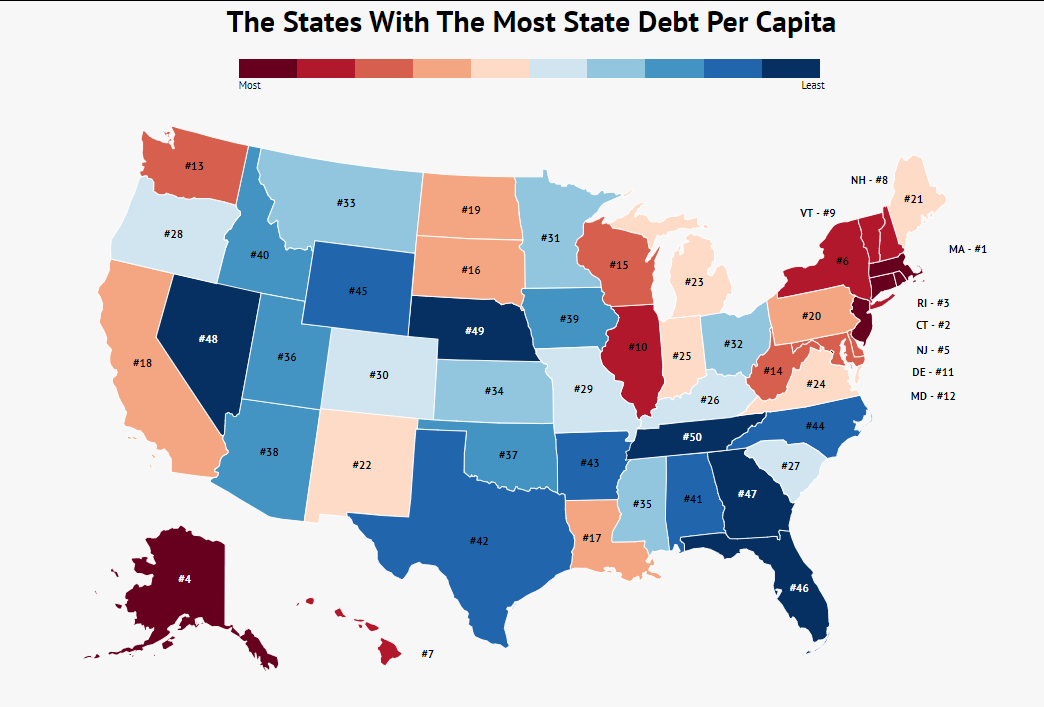 Unlike the Monetarily Sovereign U.S. government, states generally run short of the dollars they need to take care of local problems: Schools, streets, infrastructure, parks, garbage/recycling/water, police, fire departments, etc.
Most states borrow, which means they later will need to spend less (provide less to their residents), tax more (take more from their residents), or both.
The federal government should take those burdens from local taxpayers’ shoulders.
15. Federal support for the postal service. The mail is as vital to America as any other government service. There is no public benefit to requiring the postal service to pay its own way.
Unlike the Monetarily Sovereign U.S. government, states generally run short of the dollars they need to take care of local problems: Schools, streets, infrastructure, parks, garbage/recycling/water, police, fire departments, etc.
Most states borrow, which means they later will need to spend less (provide less to their residents), tax more (take more from their residents), or both.
The federal government should take those burdens from local taxpayers’ shoulders.
15. Federal support for the postal service. The mail is as vital to America as any other government service. There is no public benefit to requiring the postal service to pay its own way.

 #Monetary Sovereignty - Mitchell