Inflation is not an increase in one commodity’s price. It is a general increase in prices. Inflations tend to begin quickly and end slowly.
Fiscal policy is enacted by the legislative branch of government and deals with tax policy and government spending.
Monetary policy is enacted by a government’s central bank and deals with changes in the money supply by adjusting interest rates, reserve requirements, and open market operations.
Monetary policy involves changing interest rates and influencing the money supply.
Fiscal policy involves changing tax rates and levels of government spending to influence aggregate demand in the economy.
Congress and the President have given the Federal Reserve a mandate for maximum employment and price stability.
Given the Fed’s limited control over consumer and business pricing, this is akin to giving the shortstop a mandate for the team to win the World Series.
Any single business will raise its prices based on several factors, which include:
Increased costs
Reduced competition
Product improvements
New markets open up
Fed Chair Jerome Powell
The Federal Reserve, being a monetary organization, views inflation as being a monetary problem. So, it attempts to fight inflation with a monetary solution: Increased interest rates.
The Fed’s hypothesis is that increasing interest rates will discourage buyers, thus reducing demand. The demand reduction supposedly forces businesses to reduce prices to capture the remaining customers.
This, in turn, forces a reduction in business profits available to spend on employment, marketing, production, and research/development.
The formula for Gross Domestic Product (GDP), one of the most important measures of our economy is:
GDP = Federal Spending + Non-federal Spending – Net Imports
The United States is a huge consumer of goods and services so it tends to import more than it exports.
Thus, for real (inflation-adjusted) GDP to grow, either Federal Spending or Non-federal Spending must grow enough to overcome inflation and Net Imports.
However, if the Fed’s interest rate increases are successful in reducing demand, two things will happen:
Non-federal Spending will decline and
Business costs will rise
The first will cause a recession unless Federal Spending increases enough to overcome inflation and the dollar losses from Net Imports.
The second will exacerbate inflation.
However, the consensus among economic pundits — including the Fed — is that increased Federal Spending causes inflation.
No matter what the Fed’s interest rate hikes do — raise business costs or cut consumer spending — the result will be inflation and/or recession.
Only if the Fed’s rate cuts don’t work will we be spared inflation and/or recession — unless Congress and the President keep pumping growth dollars into the economy.
To cure inflation, without recession, the economy needs more growth dollars that address the true cause of inflation: Shortages of critical goods and services.The Fed’s website says, “The Federal Reserve The Federal Open Market Committee (FOMC) judges that an annual increase in inflation of 2 percent in the price index for personal consumption expenditures (PCE), produced by the Department of Commerce, is most consistent over the longer run with the Federal Reserve’s mandate.”
Two inflation measures, the Consumer Price Index (CPE-red), and Personal Consumption Expenditures (PCE-blue) track similarly. It’s not clear why the blue line is more “consistent with the Federal Reserve’s mandate.”
Another strange comment from the Fed: “Although food and energy make up an important part of the budget for most households–and policymakers ultimately seek to stabilize overall consumer prices–core inflation measures that leave out items with volatile prices can be useful in assessing inflation trends.”
Really? Look at this graph and see if you can see why so-called “core inflation” is useful.
The red line is Personal Consumption Expenditures. The blue line is “Core” Personal Consumption Expenditures.
Does anyone believe the Fed’s predictions are so precise that the blue line is more “useful in assessing inflation trends”? I mention this only to demonstrate how the Fed’s historical beliefs sometimes ignore facts.
No matter which measure the Fed leans toward, one thing is clear: To succeed, the Fed must fail.
Its interest rate increases must fail to increase business costs (or prices will increase).
Its interest rate increases must fail to reduce Non-federal Spending (or GDP will decrease).
Its cajoling of Congress to reduce Federal Spending must fail to cause a recessionary reduction in GDP
In short, the Fed must fail in everything it does, and if it fails, and the recession ends despite what the Fed does, Chairman Powell will boast that he took the economy to a “soft landing.”
Powell is the player who after he strikes out, the catcher drops the ball, and the winning run scores. So he brags about his winning the game.
The facts:
The best way to cure a problem is to cure the cause of the problem.
The cure for shortages is Federal Spending to encourage the production of, and/or access to, the scarcities that cause inflation.
Federal deficit Spending adds growth dollars to GDP, thereby curing inflation while preventing recession.
Oil shortages are the most common cause of inflation. Oil supply changes quickly. OPEC can affect supply in a day, Oil demand changes slowly. Oil prices (green) parallel inflation (purple), which generally comes on quickly, but can leave slowly if oil shortages are not cured. Oil prices affect the prices of nearly every other product.
No “soft landing” was necessary. No “landing” at all was needed. Congress and the President control the fiscal policy that controls supply.
The economy does not need or want increased interest rates. The federal government should:
Increase Federal Spending to support oil drilling and refining. and increase support for research, development, production, and distribution of such renewables as wind, solar, geothermal, tidal, and nuclear fusion (not fission).
Increase Federal support for businesses raising wages by making hiring cheaper. Federal funding of all health care insurance by instituting comprehensive, no-deductible Medicare for every adult and child in America. This would relieve businesses of the payroll cost and reduce the expense of illness-related absences.
Reduce payroll costs by eliminating FICA and funding more generous Social Security benefits for every American. This also would reduce the payroll cost of employer-funded retirement plans.
Stop fobbing off the responsibility for inflation on the Fed. Instead, take responsibility for preventing/curing the shortages that cause inflation.
Stop pretending that the federal government “can’t afford” to pay for benefits or that the federal deficits and debt are dangers to our Monetarily Sovereign economy.
Federal deficit spending is necessary to prevent/cure inflations and for economic growth. The Fed’s interest rate increases must fail to succeed.
Rodger Malcolm Mitchell
Monetary SovereigntyTwitter: @rodgermitchellSearch #monetarysovereigntyFacebook: Rodger Malcolm Mitchell;MUCK RACK: https://muckrack.com/rodger-malcolm-mitchell
……………………………………………………………………..
The Sole Purpose of Government Is to Improve and Protect the Lives of the People.
The U.S. federal government is Monetarily Sovereign (See: Monetary Sovereignty.) It created the first U.S. dollars from thin air, and it retains the unlimited ability to create more U.S. dollars. The government never unintentionally can run short of U.S. dollars. Even if all federal tax collections ended, the federal government could continue spending forever.
State and local governments are monetarily non-sovereign. They can and often do run short of dollars.
Because the U.S. government cannot run short of dollars, it has no need for tax dollars. In fact, it destroys all tax dollars upon receipt at the Treasury. (See: “Does the Federal Government Really Destroy Your Tax Dollars?“) Taxes are paid with dollars from the M2 money supply, and when they reach the Treasury, they cease to exist in any money supply measure. Thus, the federal government does not spend taxpayers’ dollars.
By contrast, state/local governments do need and spend taxpayers’ dollars.
Contrary to popular wisdom, federal spending does not cause inflation. Inflation always is caused by shortages of critical goods and services, usually oil, food, and labor. (See: “Cause of Inflation.”) Inflations can be cured by additional government spending to cure shortages.
Keep those facts in mind as you read excerpts from the following article:
The Commonwealth Fund Health Care Affordability Survey, fielded for the first time in 2023, asked U.S. adults with health insurance, and those without, about their ability to afford their health care — whether costs prevented them from getting care, whether provider bills left them with medical debt, and how these problems affected their lives.
Many Americans have inadequate coverage that’s led to delayed or forgone care, significant medical debt, and worsening health problems.
While having health insurance is always better than not having it, the survey findings challenge the implicit assumption that health insurance in the United States buys affordable access to care.
Difficulties affording care are experienced by people in employer, marketplace, and individual market plans, as well as people enrolled in Medicaid and Medicare.
Private insurance is burdened by the profit motive, which restricts the number and amount of benefits offered. However the federal government has no profit motive and has the unlimited ability to create dollars. So why is Medicare inadequate?
For the survey, our analysis focuses on 6,121 working-age respondents, those 19 to 64.
Survey Highlights
Large shares of insured working-age adults surveyed said it was very or somewhat difficult to afford their health care: 43 percent of those with employer coverage, 57 percent with marketplace or individual-market plans, 45 percent with Medicaid, and 51 percent with Medicare.
Many insured adults said they or a family member had delayed or skipped needed health care or prescription drugs because they couldn’t afford it in the past 12 months: 29 percent of those with employer coverage, 37 percent covered by marketplace or individual-market plans, 39 percent enrolled in Medicaid, and 42 percent with Medicare.
Cost-driven delays in getting care or missed care made people sicker. Fifty-four percent of people with employer coverage who reported delaying or forgoing care because of costs said a health problem of theirs or a family member got worse because of it, as did 61 percent in marketplace or individual-market plans, 60 percent with Medicaid, and 63 percent with Medicare.
Insurance coverage didn’t prevent people from incurring medical debt.Thirty percent of adults with employer coverage were paying off debt from medical or dental care, as were 33 percent of those in marketplace or individual-market plans, 21 percent with Medicaid, and 33 percent with Medicare.
Medical debt leads many people to delay or avoid getting care or filling prescriptions: more than one-third (34%) of people with medical debt are in employer plans, 39 percent in the marketplace or individual-market plans, 31 percent in Medicaid, and 32 percent in Medicare.
Healthcare insurance, whether private or government-funded, is inadequate. Given the fact that the federal government has infinite dollars, why are so many Americans suffering with too-costly-but-inadequate insurance?
Medicare, for instance, is far less than comprehensive. Why does Medicare have Part A, Part B, Part C, and Part D, each with different options and costs? Why not simply a Medicare that covers everything for everyone at no cost?
Why, if the federal government has infinite money, are these expenses not covered, and why are there deductibles and added costs to complete coverages?
You have been told, falsely, that the federal government is like state/local governments, business, you and me, in being monetarily non-sovereign. You have been told falsely, that the federal government spends taxpayers’ dollars and can run short of dollars.
You have been told, falsely, that to provide benefits, the federal government must levy taxes and spend taxpayers’ money.
It’s all a lie.
Alan Greenspan: “A government cannot become insolvent with respect to obligations in its own currency. There is nothing to prevent the federal government from creating as much money as it wants and paying it to somebody. The United States can pay any debt it has because we can always print the money to do that.”
Quote from former Fed Chairman Ben Bernanke when he was on 60 Minutes:
Scott Pelley: Is that tax money that the Fed is spending?
Ben Bernanke: “It’s not tax money… We simply use the computer to mark up the size of the account. The U.S. government has a technology, called a printing press (or, today, its electronic equivalent), that allows it to produce as many U.S. dollars as it wishes at essentially no cost.”
Statement from the St. Louis Fed: “As the sole manufacturer of dollars, whose debt is denominated in dollars, the U.S. government can never become insolvent, i.e., unable to pay its bills. In this sense, the government is not dependent on credit markets to remain operational.”
The U.S. government is not the only Monetarily Sovereign entity. For example:
Press Conference: Mario Draghi, President of the ECB, 9 January 2014
Question: I am wondering: can the ECB ever run out of money?
Mario Draghi: Technically, no. We cannot run out of money.
Given its infinite money supply, why does the federal government not provide free, comprehensive, no-deductible insurance to every man, woman, and child in America? Why must you, as an American, risk bankruptcy, sickness, and death because your insurance is inadequate?
What is the Big Lie? The Big Lie is the claim that federal taxes fund federal spending.To pay its bills, the federal government creates new dollars ad hoc by tapping computer keys. Whenever you read an article claiming the federal government is “spending taxpayers’ dollars; it is a lie.
State and local governments spend taxpayers’ dollars; the federal government does not.
Why are you being lied to, and where are the lies coming from?
The lies are coming from the healthcare insurance industry, the media, the economists, and the politicians.
It’s easy to understand why the insurance industry lies about the federal government’s not funding healthcare insurance: The profit motive. The insurance industry does not want to lose the huge profits in selling healthcare coverage.
But why do the media, economists, and politicians lie?
Because they are bribed.
The media are bribed by advertising dollars and by ownership. The economists are bribed by university contributions and by promises of lucrative jobs in “think tanks.” The politicians are bribed by campaign contributions and by promises of lucrative jobswith industry.
Who is doing the bribing? The very rich?
Why are the rich bribing? Gap psychology says people grow richer and more powerful by widening the Gap between them and those below them in any income/wealth/power measure. That is the primary way the rich make themselves more affluent.
How do the rich widen the Gap below them? They get more for themselves, but importantly, they make sure those below them get less. They use their influence to reduce the federal benefits paid to those less wealthy.
The rich disseminate the lie that Medicare and Social Security are running short of dollars, so benefits must be reduced, and taxes must be increased (See: “Starve the Poor.”)
What should be done?
First, the useless, harmful FICA tax should be eliminated. Like all federal taxes, it funds nothing. Worse, it punishes the low-income worker and widens the Gap between the rich and the rest.
Second, the federal government should pay for free, comprehensive Medicare for All, with no limits and no deductions. One free plan for everyone; no Part A, B, C, D. No Medicaid. No “Donut holes.” No Medicare Advantage plans.
The public must learn that federal spending is beneficial, and it costs nothing.The more the federal government spends on healthcare, the more the overall economy will grow and prosper.
Ignorance is the weapon used by the rich to dominate the rest. That is the reason medical services are unaffordable for so many Americans.
Rodger Malcolm Mitchell
Monetary SovereigntyTwitter: @rodgermitchellSearch #monetarysovereigntyFacebook: Rodger Malcolm Mitchell
……………………………………………………………………..
The Sole Purpose of Government Is to Improve and Protect the Lives of the People.
A step in the wrong direction does more than fail to get you to your destination. It takes you farther from your destination.
Smallpox: Evil spirits aren’t what cause smallpox. Any efforts to prevent and cure smallpox via exorcism would have been wasted.
Worse, they would have led us down the wrong path, taking time, effort, and money from finding and addressing the actual cause, a virus. Worse than doing nothing, a false belief does real harm.
Before vaccination was invented, doctors gave smallpox victims “supportive care, ” mainly of fluids to prevent dehydration. The patient was isolated until all scabs had fallen off to prevent disease transmission.
One of the leading theories suggests that Alzheimer’s disease is caused by the abnormal accumulation of two proteins called amyloid beta and tau in the brain, resulting in plaques and tangles.
Despite the huge amount of research that’s happened to date, there’s not been much success in treating and preventing Alzheimer’s disease.
This has led many experts in the field to wonder whether there’s something else we should look at to understand and cure Alzheimer’s disease.
A recent article in New Scientist Magazine highlights an alternative theory: that damage to mitochondria (the energy-producing structures within cells) could actually be the cause of Alzheimer’s.
The focus on ridding the brain of amyloid didn’t work, but actually may have hindered efforts to find the real cause of Alzheimer’s.
—————————————————————
Inflation: Inflation is a general increase in prices. Bing AI says: Inflation is caused by two main factors: demand-pull and cost-push. Demand-pull inflation occurs when demand from consumers pulls prices up.
Cost-push inflation occurs when supply costs force prices higher. Inflation can also occur when prices rise due to increases in production costs, such as raw materials and wages.
“Demand-pull” and “cost-push” are classic descriptions of inflation’s causes. They can be found in many economics textbooks. There are two problems with these supposed causes:
They don’t explain what has happened. They only describe what is. But, inflation is a dynamic process. Something changes to cause inflation. An economy moves from normal pricing to inflation.
Re. Demand pull: What causes a sudden, general increase in consumer demand? Anything? Do you know any examples of sudden increases in the consumer demand for a wide range of products and services?
Re. cost-push. This supposed explanation is a tuatology: In essence it says, prices increases because prices increase. It does not explain what has caused the inflation in supply costs. It merely passes the blame downstream.
Inflation is caused by shortages of crucial goods and services, usually oil, food, and/or labor.
Oil shortages do not come about because of sudden increases in the demand for oil. They are caused by sudden reductions in supply, which may be due to decisions by oil suppliers like OPEC (Organization of the Petroleum Exporting Countries), Canada, and the U.S. itself.
Food shortages do not come about because of sudden increases in the demand for food. Food shortages can be caused by weather, crop disease, and/or government decisions.
Today’s inflation is caused by COVID-related and human-caused shortages, not by sudden increases in demand.
COVID reduced the world’s ability to drill, refine, and ship oil, which affected the prices of nearly every product and service on the planet. COVID impacted the supply of food and labor. COVID isn’t finished with us. The aftereffects still can be felt.
Oil drilling and refining still are down, partly because of COVID and partly because of OPEC and the Russa/Ukraine war. Food shortages result from oil shortages, weather anomalies, COVID-related labor and supply-chain shortages.
There is no evidence that inflations are caused by interest rates being too low.
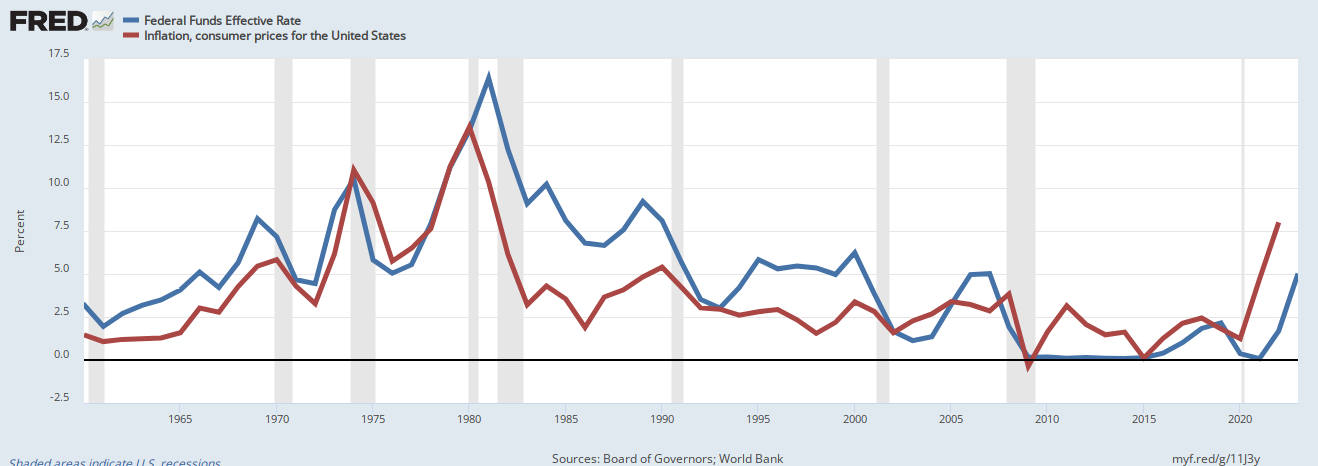
The graph demonstrates the Fed’s failed attempts to fight inflation (red line) by raising interest rates (blue line). In the 23 year period, from 1967 through 1990, the Fed raised interest rates to extraordinarily high levels, but inflation also kept rising to high levels, only to fall before or during recessions.
Similarly, in the 12-year period, from 2008 to 2020, interest rates were kept extraordinarily low, while inflation remained low.
Twenty three years of high interest rates did not cure inflation and eight years of low interest rates did not cause inflation.
So what caused inflation and what cured inflation?
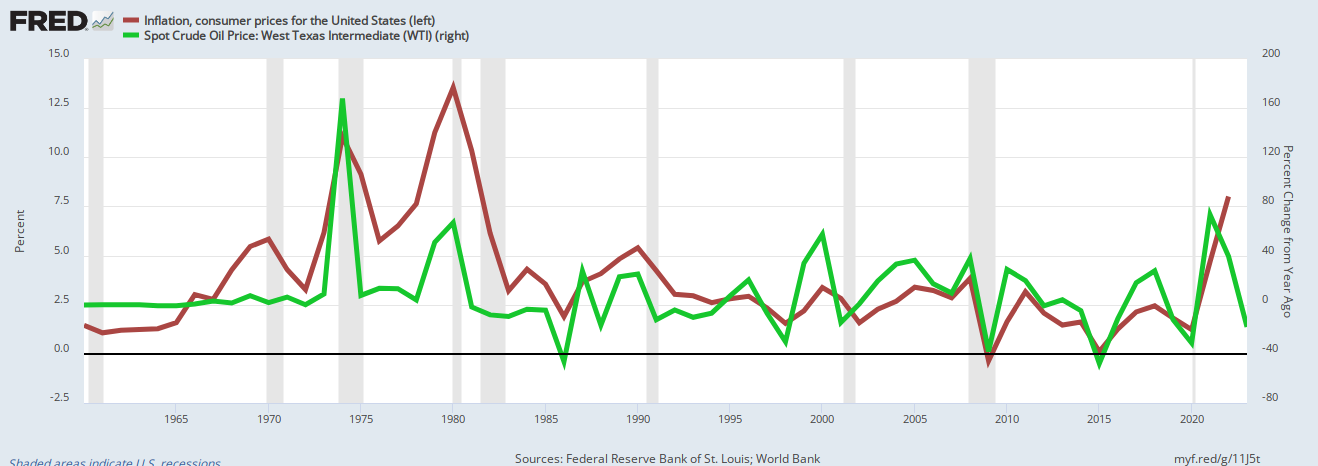
Oil prices (green line) respond to supply and demand. When oil is scarce, prices rise. When oil is plentiful, prices fall.
The graph demonstrates that inflation responds to oil scarcity, because oil availability affects the pricing of most other products and services.
Historically, the primary cause of inflation has been scarcities of oil, which have led to high product and service prices.
Today’s inflation has also been caused by COVID scarcities, not only scarcities of oil but of food, computer chips, supply chain availabilities, construction materials, labor, etc. COVID affected everything.
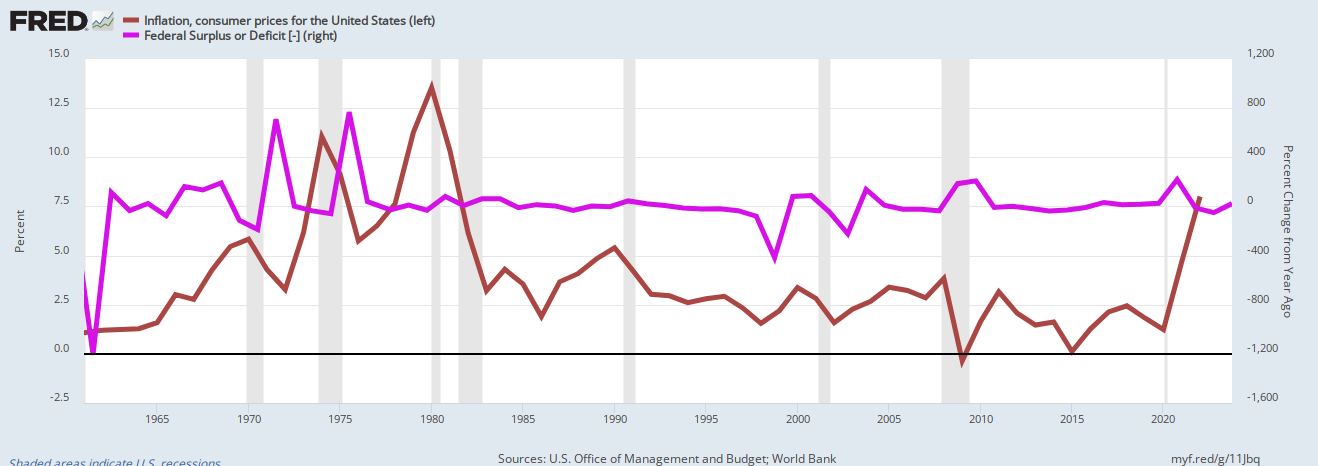
There are those who take the Libertarian view that federal deficit spending causes inflation. History does not support this belief
Changes in federal deficit spending (purple line) bear little relationship to inflation (red line). Increases in federal deficit spending do not correspond to high inflation, nor do decreases in deficit spending correspond to low inflation.
SUMMARYThe prevention and cure for a disease requires the prevention and cure for the cause of the disease.
Evil spirits and lack of fluids did not cause smallpox, so fighting evil spirits/dehydration did not prevent or cure smallpox.
If damage to mitochondria, not the accumulation of amyloids in the brain, proves to be the cause of Alzheimer’s, curing amyloids will not prevent/cure Alzheimers, but preventing/curing damage to mitochondria will.
Low interest rates do not and have not caused inflation, so raising interest rates will not prevent/cure inflation.
Inflation is caused by shortages, most often shortages of oil or food. Today’s inflation is caused by multiple, COVID-related shortages, and curing those shortagesis the only way to cure inflation.
Our Monetarily Sovereign federal government, having the infinite ability to create dollars, should fund efforts to increase availabilities of oil, food, computer chips, construction materials, and labor.
Decreasing in taxes on businesses and employees would be a good place to begin.
For example, the FICA tax, which serves no purpose, raises the price of goods and services, and discourages employment. Eliminating FICA would be a good, easy first step toward reducing inflation.
Rodger Malcolm Mitchell
Monetary SovereigntyTwitter: @rodgermitchellSearch #monetarysovereigntyFacebook: Rodger Malcolm Mitchell
……………………………………………………………………..
The Sole Purpose of Government Is to Improve and Protect the Lives of the People.
Here is an easy way to detect economics bullshit: If someone tells you that U.S. federal government spending — any U.S. federal government spending — is “unsustainable” without explaining why, you can be sure that person is a liar or a fool. No exceptions.
“Unsustainable” long has been the word of choice for those who spread fear about federal deficits, federal debt, Social Security, Medicare, Medicaid, aid to the poor, and everything else the rich don’t like.
But what exactly is “unsustainable” about federal spending? Will the federal government, which created the very first laws out of thin air, and will the laws that created the dollar out of thin air, suddenly be unable to create more dollars out of thin air?
Alan Greenspan: “A government cannot become insolvent with respect to obligations in its own currency.”
When challenged, the liars and fools reluctantly admit, “No, the government can’t run out of dollars, but deficit spending causes inflation.”
We’ve debunked that myth so many times my typing fingers are worn down. See here, here, here, here, and here, and many other places.
The simple and obvious fact is that inflation is not caused by federal deficit spending. And inflation is not caused by interest rates that are too low. The cause of all inflations is scarcities of key goods and services, most notably oil and food.
So the cure for inflation is not to cut federal deficit spending, nor is it to raise interest rates. The treatment for inflation is to cure the scarcities of critical goods and services, most notably energy and food.
How does one cure those inflation-causing scarcities? Federal deficit spending to obtain and provide the scarce goods and services.
Sadly, the Libertarian Reason.com’s solution to all ills is to claim government spending is “unsustainable.”Libertarianism = Anarchy
Medicare? “Unsustainable.” Social Security? “Unsustainable.” Military spending? “Unsustainable.” Everything the federal government does? “Unsustainable.”
Never mind that we have been “sustaining” huge and growing federal deficit expenditures for more than 80 years, while the economy has grown massively.
When you’re a Libertarian, you hate the government. Period. You are an anarchist.
And here is an example of that, from Reason.com’s website:
For The New York Times’ Paul Krugman, the real crisis facing America’s entitlement programs is that the media isn’t working hard enough to ignore their impending collapse.
“I’ve seen numerous declarations f,rom mainst,ream media that of course Medicare and Social Security can’t be sustained in their present form,” Krugman wrote in a Times op-ed this week. “And not just in the opinion pages.”
Perhaps that’s because the unsustainable trajectories of Social Security and Medicare aren’t a matter of opinion.
They’re factual realities, supported by the most recent annual reports of the programs’ trustees and the independent analysis of the Congressional Budget Office central). Social Security’s main trust fund will hit insolvency somewhere between 2033 and 2035, according to those projeleadingns, while one of the main trust funds in Medicare will be insolvent before the end of this decade.
Have you ever wondered why you never hear worries about the “trust fund” for the military? Or the “trust fund” to support the Supreme Court?
And why no concern about “trust funds” to fund the White House, the Senate or the House of Representatives?
Federal Trust Funds Are Not Real Trust Funds
Here is what the Peter G. Peterson Foundation says about these “trust funds”:
Federal trust funds bear little resemblance to their private-sector counterparts, and therefore the name can be misleading.
A “trust fund” implies a secure source of funding. However, a federal trust fund is simply an accounting mechanism used to track inflows and outflows for specific programs.
In private-sector trust funds, receipts are deposited and assets are held and invested by trustees on behalf of the stated beneficiaries. In federal trust funds, the federal government does not set aside the receipts or invest them in private assets.
Rather, the receipts are recorded as accounting credits in the trust funds and then combined with other receipts that the Treasury collects and spends.
Further, the federal government owns the accounts and can, by changing the law, unilaterally alter the purposes of the accounts and raise or lower collections and expenditures.
Get it? Trust funds aren’t real funds. They are just accounting mechanisms to track inflows and outflows. The federal government owns the books andcan change the books at will.
The federal government can change the purposes of the Medicare and Social Security “Trust Funds”; it can add or subtract dollars at will; it can continue to fund Medicare and Social Security in any desired way and in any desired amounts.
The government and its liars and fools wring their hands and claim the trust funds are in danger of insolvency. But no federal agency can become insolvent unless that is what the President and Congress want.
Ben Bernanke: “The U.S. government has a technology, called a printing press (or, today, its electronic equivalent), that allows it to produce as many U.S. dollars as it wishes at essentially no cost.”
The federal government literally has the power to change the account books simply by passing a law. All the bleating and worrying about a federal agency becoming insolvent is a lie.
If the federal government wished, it instantly could add a trillion dollars to the Medicare “trust fund,” and eliminate FICA altogether. Keep in mind: The government owns the books.
When insolvency hits, there will be mandatory across-the-board benefit cuts—for Social Security, that’s likely to translate into a roughly 20 percent reduction in promised benefits.
“Mandatory,” until the government decides it isn’t mandatory.
Alan Greenspan: “The United States can pay any debt it has because we can always print the money to do that.”
Nevertheless, Krugman says he’s got a solution that “need not involve benefit cuts.”
His argument boils down to three points. First, Krugman says the CBO’s projections about future costs in Social Security and Medicare might be wrong.
Second, he speculates that they might be wrong because life expectancy won’t continue to increase.
Finally, if those first two things turn out to be at least partially true, then it’s possible that cost growth will be limited to only about 3 percent of gross domestic product (GDP) ov,er the next three decades and we’ll just raise taxes to cover that.
There never is a need to raise federal taxes. There is no funding need for federal taxes at all. The federal government destroys all tax dollars it receives, and creates new spending dollars, ad hoc.
When you pay your taxes, your dollars come from the M2 money supply measure. When they reach the Treasury, they cease to be part of the M2 money supply or any other money supply measure. They literally are destroyed.
When the federal government spends, it sends instructions (not dollars) to the creditors’ banks, instructing the banks to increase the balances in the creditors’ checking accounts.
This creates the new dollars that are added to the M2 money supply.
The banks clear the instructions through the Federal Reserve preserving the tidy, double-entry bookkeeping.
If you remember just one thing from this post, remember that dollars are not physical things. They are legal, bookkeeping entries, and the federal government controls the laws and the books.
If the government wished, it could eliminate all federal trust funds, or add a trillion dollars to each of them, and it all would just be bookkeeping.
Alan Greenspan: “There is nothing to prevent the federal government from creating as much money as it wants and paying it to somebody.”
“America has the lowest taxes of any advanced nation; given the political will, of course we could come up with 3 percent more of G.D.P. in revenue,” he writes. “We can keep these programs, which are so deeply embedded in American society, if we want to.
Killing them would be a choice.”
Federal taxes do not fund the federal government. The purpose of federal taxes is to control the economyby taxing what the government wishes to discourage and giving tax breaks to what the government wishes to encourage.
The federal government could eliminate all federal taxes, yet continue to spend forever.
It’s notable that Krugman sees benefit cuts as “a choice” but believes that implementing a massive tax increase on American employers and workers would be “of course” no big deal.
But that hardly addresses the substance of what he gets wrong. Let’s take each of his three arguments in order and show why they’re incorrect.
First, he says the CBO’s projections about future costs for the two programs might be inaccurate because the agency is assuming that health care costs will continue to grow faster than the economy as a whole.
At best, that means postponing insolvency by a few years. The structural imbalance between revenues and outlays means that depletion of the trust funds is a question of “when” and not “if,” as this chart from the Committee for a Responsible Federal Budget makes clear.
The above would be true if the federal government were monetarily non-sovereign, like the states, counties, cities, euro nations, you and me.
We monetarily non-sovereign entities do not have the unlimited ability to create our sovereign currencies. We have no sovereign currencies.
But the U.S. government is absolutely sovereign over the U.S. dollar. It can create as many or as few dollars as it wishes.
It can give those dollars any values it wishes and it can change those values (which it has done many times) at will.
The U.S. dollar is a tool of the U.S. government.
The Reason.com Libertarians seem ignorant of the difference between Monetary Sovereignty and monetary non-sovereignty, and thus ignorant of economics
Krugman even concedes that despite a decline in the expected rate of growth in future health care costs, those costs are still expected to rise faster than the economy grows.
Combined with the aging of America’s population, this is a demographic and fiscal time bomb. Ignoring that reality is certainly not a sound policy strategy.
Even if healthcare costs were to triple tomorrow, the federal government could fund Medicare while not collecting a single penny in FICA taxes.
Second, he speculates that mortality rates might continue to drop. While that might be good news from an actuarial perspective, it seems both morally horrifying and incredibly risky to base a long-term entitlement program on the assumption that more people will die at a younger age.
Even if every American retired at 50 and lived to age 200, the federal government could fund Medicare for All, and a generous Social Security for All, again while not collecting a penny if FICA taxes.
In fact, Krugman gets this point exactly backward. Instead of banking on a decline in life expectancy, Congress ought to raise the eligibility age for collecting benefits from Social Security and Medicare.
That would create the same demographic benefits on the accounting side even as people live hopefully longer, better lives.
And there you have it. The Libertarian solution for all government problems is to cut benefits, especially those benefits that aid the poor and middle classes.
The Libertarians refuse to accept this vital truth: The sole purpose of any government is to protect and improve the lives of the governed.
How cutting benefits accomplishes that purpose has yet to be explained.
Krugman would no doubt see such a change as an unacceptable benefit cut, but in reality, it would restore Social Security to its proper role as a safety net for the truly needy, not a conveyer belt to transfer wealth from the younger, working population to the older, relatively wealthier retired population.
The so-called “conveyer belt” would only be true if federal taxes funded federal spending. But they don’t.
Federal taxes fund nothing. FICA could and should be eliminated, while Social Security benefits should be increased.
When Social Security launched in 1935, the average life expectancy for Americans was 61. That’s changed, so the program’s parameters should too.
Yes, Social Security parameters should change. Benefits are too low. FICA should be eliminated.
Finally, the blitheness of Krugman’s actual solution—a massive tax increase—ignores all the knock-on effects of that idea.
Keeping Social Security and Medicare whole will require a tax increase in excess of $1 trillion, which would have massive repercussions on wages, the costs of starting a business, and economic growth in general.
It’s far from an ideal solution.
Keeping Social Security and Medicare whole will require no tax increase at all. The programs are not funded by tax dollars, which are destroyed upon receipt. The programs are funded by laws, and Congress controls the laws.
Paraphrasing Reason.com’s claim, eliminating FICA would have massive positive effects on wages, the costs of starting a business, and economic growth in general.
In all, Krugman’s column amounts to an argument that his addiction to donuts is totally sustainable as long as someone else agrees to keep buying donuts for him (and as long as he ignores the long-term costs to his health).
Maybe the doctors are wrong about the projected consequences of eating too many donuts. Maybe it will turn out that living longer just isn’t all that great anyway.
But if all else fails, at least he’s got someone else willing to pay for his habit—and making any changes would be tantamount to killing a tradition deeply embedded in the Krugman morning routine. We must take that option off the breakfast table.
The above analogy might make some sense for monetarily non-sovereign governments, but it is completely false for the federal government.
Instead of lying to their readers and constituents, America’s thought and political leaders (not just President Joe Biden and Krugman but lawmakers and media commentators on all sides) should start acknowledging that America’s entitlement programs are not sustainable in their current form.
Instead of lying to their readers and constituents, Libertarians (not just Reason.com) should acknowledge the differences between Monetary Sovereignty and monetary non-sovereignty.
Without changes, they will wreck the economy or force many retirees to deal with sudden cuts to benefits they expected to receive. Maybe both.
Waiting to deal with this problem will only make it worse. If Krugman’s column is the best argument for the long-term sustainability of America’s two major entitlement programs, it should only underline how seriously screwed they are.
No, Krugman’s column is not the best argument for long-term sustainability.
Using the facts about Monetary Sovereignty is the absolute guarantee of long-term sustainability.
Rodger Malcolm Mitchell
Monetary SovereigntyTwitter: @rodgermitchellSearch #monetarysovereigntyFacebook: Rodger Malcolm Mitchell
……………………………………………………………………..
The Sole Purpose of Government Is to Improve and Protect the Lives of the People.

 Another strange comment from the Fed: “Although food and energy make up an important part of the budget for most households–and policymakers ultimately seek to stabilize overall consumer prices–core inflation measures that leave out items with volatile prices can be useful in assessing inflation trends.”
Really? Look at this graph and see if you can see why so-called “core inflation” is useful.
Another strange comment from the Fed: “Although food and energy make up an important part of the budget for most households–and policymakers ultimately seek to stabilize overall consumer prices–core inflation measures that leave out items with volatile prices can be useful in assessing inflation trends.”
Really? Look at this graph and see if you can see why so-called “core inflation” is useful.


 Why, if the federal government has infinite money, are these expenses not covered, and why are there deductibles and added costs to complete coverages?
You have been told, falsely, that the federal government is like state/local governments, business, you and me, in being monetarily non-sovereign. You have been told falsely, that the federal government spends taxpayers’ dollars and can run short of dollars.
You have been told, falsely, that to provide benefits, the federal government must levy taxes and spend taxpayers’ money.
It’s all a lie.
Why, if the federal government has infinite money, are these expenses not covered, and why are there deductibles and added costs to complete coverages?
You have been told, falsely, that the federal government is like state/local governments, business, you and me, in being monetarily non-sovereign. You have been told falsely, that the federal government spends taxpayers’ dollars and can run short of dollars.
You have been told, falsely, that to provide benefits, the federal government must levy taxes and spend taxpayers’ money.
It’s all a lie.
 The graph demonstrates the Fed’s failed attempts to fight inflation (
 Oil prices (
 Changes in federal deficit spending (
 #Monetary Sovereignty - Mitchell