LUTNICK, magically GDP changes to the numbers we want. We simply change the definition
When a Trump appointee realizes the facts contradict his boss, he either misrepresents the facts or hides them.
The facts are the facts. They never change, but for a Trumper, it’s the perception, not any fact, that matters.
Thus, when Trump claims Ukraine invaded Russia, the lie doesn’t change the facts. But Trump and his MAGAs care only about public perception.
The economy is measured by a statistic known as Gross Domestic Product (GDP), calculated using the formula: Federal Spending + Non-federal Spending + Net Exports.
In the U.S., the National Bureau of Economic Research (NBER)—a nonprofit, nonpartisan organization dedicated to economic research—determines when we are in a recession by examining indicators of prolonged economic decline across various sectors.
It analyzes data points including real income, which reflects individuals’ purchasing power after adjusting for inflation; employment levels; industrial production output; wholesale and retail sales; and gross domestic product (GDP).
Mathematically, imposing high tariffs on imports, while deporting millions of workers and consumers, must raise prices and decrease GDP. Neither of these is a hypothesis or a prediction. It is a statistical certainty.
When GDP declines over several months, it is referred to as a “recession.” Conversely, when GDP decreases significantly and/or extensively, it is known as a “depression.”
Trump’s advisors must have realized that Trump’s plan to levy import duties and cut federal spending must result in inflation and recession or depression.
Rather than trying to correct Trump’s flawed policies, and actually prevent the depression, MAGAs prefer to change the measure.
Imagine selling a 2,000-square-foot house and wanting to tell the buyer it’s bigger than 2,000 square feet. Instead of physically enlarging the house, you simply change the measurement and decide that from now on, a foot will be eight inches long.
So your 2,000 foot house suddenly would be listed as 4,500 square feet. The house didn’t change, but by arbitrarily changing the measure, you could claim it was bigger.
Sounds ridiculous, even fraudulent, doesn’t it? But that is exactly what the Trump administration wants to do with GDP, in a futile effort to hide the inevitable recession and depression.
“A more accurate measure of GDP would exclude government spending,” Musk wrote on his social media platform. “Otherwise, you can scale GDP artificially high by spending money on things that don’t make people’s lives better.”
Is Musk asserting that federal spending on bridges, roads, dams, flight control, disaster recovery, anti-poverty efforts, medical research and development, Social Security, Medicare, Medicaid, and countless other initiatives the government undertakes to enhance our lives “doesn’t create value for the economy”?
That’s such nonsense.
Due to Musk’s budget cuts, GDP will decline. This presents a significant issue that Musk is well aware of. He is scared silly that when people see the decrease in GDP, they will accurately conclude that he is responsible for causing a recession.
The argument as articulated so far by Trump administration officials appears to play down the economic benefits created by Social Security payments, infrastructure spending, scientific research and other forms of government spending that can shape an economy’s trajectory.
“If the government buys a tank, that’s GDP,” Lutnick said Sunday. “But paying 1,000 people to think about buying a tank is not GDP. That is wasted — inefficiency, wasted money. And cutting that, while it shows in GDP, we’re going to get rid of that.”
Is Lutnick paid to come up with such a nonsense objection? His salary could be considered a waste of money. Thinking about war strategy is as important as building tanks.
The Commerce Department’s Bureau of Economic Analysis published its most recent GDP report on Thursday, showing that the economy grew at an annual rate of 2.3% in the final three months of last year.
The economy will drop like a stone under Trump, no matter how hard he tries to fake the numbers. While he remains in office, we will fall deeper and deeper into a depression.
The report makes it possible to measure the forces driving the economy, showing that the gains at the end of last year were largely driven by greater consumer spending and an upward revision to federal government spending related to defense.
Still, the federal government’s component of the GDP report for all of 2024 increased at 2.6%, slightly lower than overall economic growth last year of 2.8%.
Thus, even eliminating Federal Spending from the GDP equation won’t save Trump. His economy is doomed and everyone will know it. Fudging the figures won’t save him.
Lutnick’s false claim that federal spending doesn’t “make people’s lives better” is evident. Cutting federal spending will reduce personal income.
The government is not always a contributor to GDP and can subtract from it, which is what happened in 2022 as pandemic-related aid expired.
Lutnick said that the Trump administration would balance the federal budget with spending cuts, saying that would help growth and reduce the interest rates paid by consumers.
Historically, balancing the federal budget has led to depressions.
“When we balance the budget of the United States of America, interest rates are going to come smashing down,” Lutnick said. “This is going to be the best economy anybody’s ever seen. And to bet against it is foolish.”
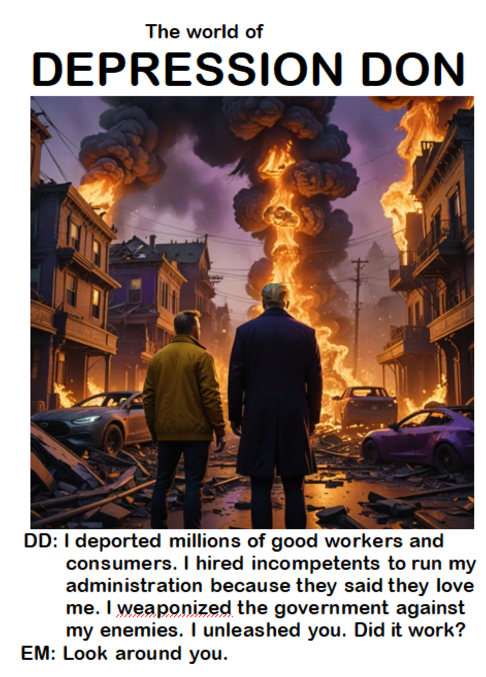
Under Biden, the economy grew massively. Under Depression Don Trump it will sink. My advice: Do what I have done. While Depression Don remains in office, convert a significant part of your asset portfolio to Treasuries.
Mitchell’s laws: The more budgets are cut and taxes inceased, the weaker an economy becomes. Austerity = poverty and leads to civil disorder. Those, who do not understand the differences between Monetary Sovereignty and monetary non-sovereignty, do not understand economics.
This is an update of a post that ran in 2009.
Kermit the frog famously said, “It isn’t easy being green.” It also isn’t easy convincing people that traditional economics not only is hypothetically wrong, not only is factually wrong, but is wrong to such a degree it is extremely harmful to our economy.
The more extreme debt hawks believe the U.S. federal government should run a balanced budget or even have no debt at all. The more moderate debt hawks feel some debt may be necessary at times, but to them, federal debt is like bitter medicine you take only when absolutely necessary.
All debt hawks, whether extreme or moderate, are long on twisted “facts” but short on evidence.
Their “facts” inevitably include federal deficit and debt measures, projections for the future, debt/GDP ratios, and spending on Medicare and Social Security.
However, when they interpret the facts, they provide no evidence that their interpretations reflect reality.
By contrast, here are facts and a few opinions, which you may interpret for yourself.
1. Fact: Money is the way modern economies are measured. By definition, a large economy has a larger money supply than does a small economy. Therefore, a growing economy requires a growing supply of money. QED
The graph below shows the essentially parallel paths of GDP vs. perhaps the most comprehensive measure of the money supply, Domestic Non-Financial Debt:
One could argue that money begets production or that production begets money, and both would be correct. The point is that money supply (i.e. debt) and GDP go hand-in-hand. Reduced debt growth results in reduced economic growth.
Gross Domestic Product = Federal Spending + NonFederal Spending + Net Exports.
Thus, by formula, a cut in federal spending cuts GDP.
2. Fact: All money is debt and all financial debt is money. In addition to being state-sponsored, legal tender, there are four criteria for modern money:
–Monetarily Sovereign money must be defined in a standard unit of currency.
–MS money has no, or limited, intrinsic value.
–The demand for money is determined by its risk (danger of default or devaluation, i.e., inflation) and its reward (interest rates).
–To have value, money must be owned by an entity other than the entity that created it.
The above criteria describe many forms of money, including currency, bank accounts, T-securities, corporate bonds, and money markets. All forms of money are debt, and a growing economy requires a growing supply of debt/money.
2.a. Fact: Federal “deficit” is a statement of the net amount of money the federal government has created in one year. Opinion: The word “deficit” is pejorative. A more neutral description would be money “created” or “added,” as in, “The government has created $1 trillion,” or “The government has added $1 trillion to the economy.”
Compare the psychological meaning of those statements with the current phrasing, “The government has run a $1 trillion deficit.”
3. Fact: U.S. depressions tend to come on the heels of federal surpluses.
1804-1812: U. S. Federal Debt reduced 48%. Depression began 1807. 1817-1821: U. S. Federal Debt reduced 29%. Depression began 1819. 1823-1836: U. S. Federal Debt reduced 99%. Depression began 1837. 1852-1857: U. S. Federal Debt reduced 59%. Depression began 1857. 1867-1873: U. S. Federal Debt reduced 27%. Depression began 1873. 1880-1893: U. S. Federal Debt reduced 57%. Depression began 1893. 1920-1930: U. S. Federal Debt reduced 36%. Depression began 1929. 1997-2001: U. S. Federal Debt reduced 15%. Recession began 2001.
4. Fact: Recessions tend to follow reductions in federal debt/money growth (See graph below), while debt/money growth has increased when recessions are resolving.
Taxes reduce debt/money growth. No government can tax itself into prosperity, but many governments tax themselves into recession.
Recessions repeatedly come on the heels of deficit growth reductions, and are cured with deficit growth increases.
5. Fact: On August 15, 1971, the federal government gave itself the unlimited ability to create debt/money by completely abandoning the gold standard. This ability is called Monetary Sovereignty.
Because the federal government now has the unlimited ability to create dollars, it neither taxes or borrows in order to obtain dollars. It simply creates them ad hoc. Tax dollars are destroyed upon receipt.
When you pay your taxes, you take dollars from your checking account. These dollars were part of the M2 money supply measure.
When they reach the Treasury, they cease to be part of any money supply measure. They effectively are destroyed. To pay its bills, the federal government creates new dollars, ad hoc.
6. Fact: Federal “debt” is the total of outstanding Treasury Securities. Here is how Treasury Securities, incorrectly termed “borrowing” come into existence.
–You tell the government to debit your checking account and credit your Treasury security account by the same amount. The process is similar to transferring money from your checking account to your bank savings account.
To “pay off” the Treasury Security, the government simply debits your T-security account and credits your checking account.
Thus, the government could pay off all its so-called “debt” tomorrow simply by debiting all T-security accounts and crediting the T-Security owners’ checking accounts.
The entire process neither adds nor subtracts money from the economy (but for interest paid).
Our Monetarily Sovereign government does not borrow the money it has already created but rather exchanges one form of U.S. money (T-securities) for another (dollars). The entire “borrowing” process is nothing more than an asset exchange.
Do T-securities have any benefit? Yes, federal interest payments add to the money supply, an economically stimulative event. Federal interest payments help the government control interest rates and the dollar’s value. (The higher the interest, the greater the value of the dollar, and the more the economy receives in growth dollars.)
The most important purpose of T-securities is to provide a safe place to store unused dollars. This stabilizes the dollar while increasing its value.
T-securities (debt) are not functionally related to the difference between taxes and spending (deficits). They are related only by laws requiring the Treasury to create T-securities in the amount of the deficit.
The Treasury can create T-securities (debt) without a deficit, and the government can run a deficit without creating T-securities. Federal debt is not functionally the total of federal deficits.
The federal government could pay off the entire so-called “debt” today, merely by returning the dollars to the T-security depositors.
7. Fact: Federal taxes, as a money-raising tool, are unnecessary, harmful and futile:
— unnecessary because since 1971 (when the U.S. government became fully Monetarily Sovereign), the government has had the unlimited ability to create money without taxes,
— harmful because taxes reduce the money supply, which reduction leads to recessions and depressions, and
–futile because tax money sent to the government is destroyed upon receipt by the U.S. Treasury.
When you send taxes to the government, you are sending M2 dollars, but when they reach the Treasury, they cease to be part of any money supply measure. They effectively are destroyed.
Our Monetarily Sovereign government does not store dollars for future use. It can create unlimited dollars ad hoc by paying bills.
The so-called “debt” merely accounts for the total outstanding T-securities created out of thin air by the federal government.
The government decides to create T-securities equal to the deficit, but this requirement became obsolete in 1971 when we went off the gold standard and became Monetarily Sovereign.
Today, the federal government creates money by spending, i.e. it credits checking accounts to pay its bills. This crediting of checking accounts adds dollars to the economy.
The federal “deficit” is the net money created in one year and the federal “surplus” is the net money destroyed in one year. In short, deficit spending creates money and taxing destroys money. If taxes fell to $0 or rose to $100 trillion, this would not affect by even one dollar, the federal government’s ability to spend.
Further, (opinion)all tax (money-destroying) systems are unfair. See: http://rodgermitchell.com/FairTaxes.html. For a country with the unlimited power to create money, spending is not related in any way to taxing.
8. Fact: Contrary to popular myth, there is no post-gold standard relationship between federal debt and inflation. (See graph, below)
Also, contrary to popular myth, inflation is not caused by “excessive federal spending.” Inflation is caused by shortages of crucial goods and services, most often oil and/or food. (See the graph, below)
In this regard, hyperinflations are not caused by “money-printing,” but rather by shortages. So-called “money printing” (ala Zimabwe and Germany), were the governments’ response to hyperinflation, not the cause.
The Zimbabwe inflation was caused by food shortages. (The government stole land from farmers and gave it to non-farmers.) Money “printing” was the faulty response to inflation, not the cause.
The most recent inflation was caused by COVID-related shortages of oil, food, shipping, computer chips, metal, housing, lumber, and labor, among other things. As the shortages have been reduced, so has the inflation.
WWII Context: During World War II, many consumer goods were in short supply because production was focused on the war effort. When the war ended, the supply of goods resumed, and the previously unmet demandwas suddenly able to be fulfilled.
Oil Crises: Similarly, during the oil crises of the 1970s, the reduced supply of oil caused prices to spike, not because of a sudden increase in demand, but because the existing demand couldn’t be met.
COVID-19 Pandemic: Supply chain disruptions and production bottlenecks during the pandemic created shortages in various goods, leading to price increasesonce supply constraints eased and the pent-up demand was met.
While the underlying demand might have been consistent, the ability to fulfill that demand was constrained by supply issues. When supply bottlenecks were removed, the previously suppressed demand could finally be expressed, leading to price increases.
Latent Demand: The concept of latent demand suggests that consumers’ desire for goods remains constant, but it is the availability of those goods that fluctuates.
Supply Constraints: Supply-side constraints create temporary mismatches between demand and supply, leading to inflationary pressures once those constraints are lifted.
Observing changes over time can reveal the true causes of economic phenomena. By examining what happens just before and during an inflationary period, we often find that supply-side disruptions are the primary drivers.
Gradual Demand Changes: Demand usually changes slowly, giving the economy time to adjust. This gradual change rarely leads to significant price fluctuations on its own.
Sudden Supply Changes: Supply-side shocks, such as natural disasters, geopolitical events, or production bottlenecks, can occur rapidly and unpredictably. The economy struggles to adjust quickly to these disruptions, leading to price increases as a balancing mechanism.
9. Fact: There is no post-gold standard relationship between federal debt and your taxes.
Unlike state/local governments, which are monetarily non-sovereign, the federal government does not use tax dollars to pay its bills. It creates new dollars, from thin air, every time it pays a creditor.
The sole purposes of federal taxes are:
–To control the economy by taxing what the government wishes to discourage and by giving tax breaks to what the government wishes to reward.
–To assure demand for the U.S. dollar by requiring all federal taxes to be paid in dollars.
Taxes do not pay for federal spending. Federal spending creates dollars.
9.a. Fact: Federal deficit spending does not use “taxpayers’ money.” Federal spending creates money ad hoc.
When the government spends it credits bank accounts. No taxes involved. By definition, deficit spending means taxes do not equal this year’s spending let alone previous year’s spending. Only surpluses use taxpayers’ money, by causing recessions.
For the above reasons, our children and grandchildren will not pay for today’s money creation. Still, they will benefit from today’s deficit spending — better infrastructure, army, education, R&D, safety, security, health, and retirement.
Any time you hear or read about the federal government spending “taxpayers’ money,” know that the person is ignorant about Monetary Sovereignty. The federal government doesn’t spend taxpayers’ money. Period.
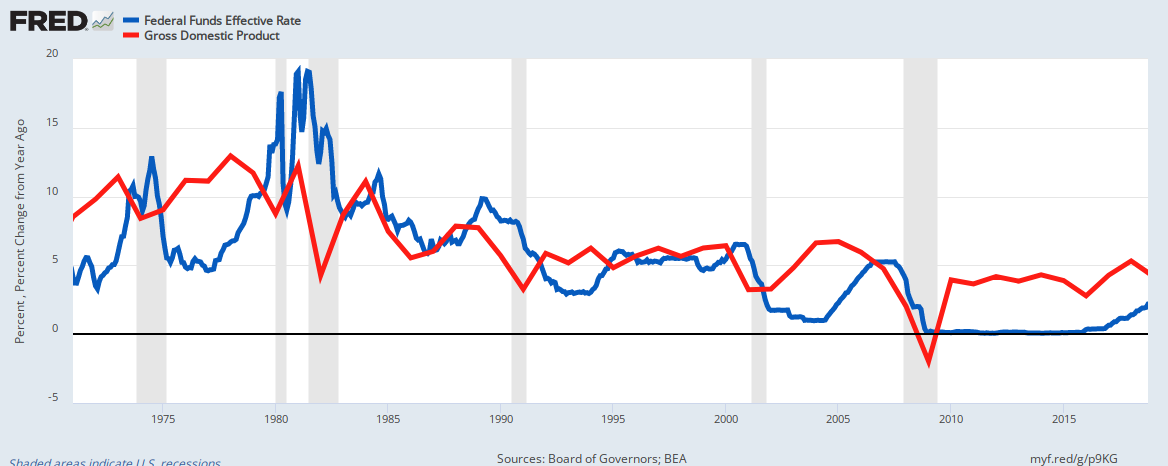
10. Fact: There is no post-gold standard relationship between low interest rates and high GDP growth. Opinion: The opposite seems true:
The interest rate and economic growth lines move in opposite directions.
Why do high interest rates stimulate? Opinion: High rates force the federal government to pay more interest, pumping more money into the economy.
The Fed increases interest rates to fight inflation. But increasing interest rates increases the prices of goods and services, i.e. causes inflation.
The Fed, in a sense, is using leeches to fight anemia.
11. Fact: The Federal debt/GDP ratio is a meaningless fraction, because it measures two, mathematically incompatible pieces of data. It’s an apples/oranges comparison. GDP is a one-year measure of output; federal debt is the net outstanding T-securities created since the nation’s birth.
The T-securities created years ago affect this year’s debt in the debt/GDP ratio, while even last year’s GDP does not affect this ratio. See: Debt/GDP
Because federal debt is the total of T-securities, and the federal government has the functional ability to stop creating T-securities at any time, the Debt/GDP ratio easily could fall to 0, depending on federal law.
11.a. Fact: The debt/GDP ratio does not measure the federal government’s ability to pay its bills. The government does not pay bills with GDP; it creates the money ad hoc to pay its bills.
Were GDP to be $0, the government still could pay bills of any size, simply by crediting the bank accounts of its creditors.
12. Facts: In 1979, gross federal debt was $800 billion. In 2009 it reached $12 trillion, a 1400% increase in 30 years. During that period, GPD rose 440% (annual rate of 5.5%>) with acceptable inflation. The same 1400% increase would put the debt at $180 trillion in 2039, a mean annual deficit of $5+ trillion.
This calculates to a 9.5% annual debt increase for the past 30 years. Repeating that growth rate would put the 2010 deficit at about $1.14 trillion, and the 2011 deficit at about $1.25 trillion. The deficit for year 2039 would be about $15.8 trillion.
Opinion: I know of no reason why the results would not be the same as they have been in the past 30 years. However, increasing the debt growth rate above 9.5% might show even better results:
In the 10 year period, 1980 – 1989, federal debt grew 210%, from $900 billion to $2.8 trillion (a 12% annual debt increase), while GDP grew .96% from $2.8 trillion to $5.5 trillion (a 7% annual increase). During that same period, inflation fell from 14.5% in 1980 to 5.2% in 1989. See graph, below.
The peaks and valleys of federal deficits (blue) generally correspond to the peaks and valleys of real (inflation adjusted) Gross Domestic Product growth. The reason: GDP = Federal Spending + Nonfederal Spending + Net Exports
Facts: In summary, large deficits have coincided with real (inflation adjusted) GDP growth
12. Facts: Any health insurance proposal that covers more people will cost more money. Extracting that money from doctors, hospitals, pharmaceutical companies, by necessity, would reduce the availability of health care.
Increasing taxes on any individuals (even the wealthy) or on businesses, will depress the economy by removing money from the economy. Only the federal government can supply additional money while stimulating the economy.
13. Fact: Social Security is supported neither by FICA nor by a trust fund. Were FICA eliminated, and benefits doubled, Social Security still would not go bankrupt unless Congress decided to make this happen.
In June, 2001, Paul O’Neill, Secretary of the Treasury said, “I come to you as a managing trustee of Social Security. Today we have no assets in the trust fund. We have promises of the good faith and credit of the United States government that benefits will flow.“
Yet, SS continues to pay benefits. Your Social Security check comes from a mythical trust fund that contains no money and receives no money.
Social Security (and Medicare) benefits are paid ad hoc by the U.S. government, not from a trust fund, and are not dependent on FICA taxes. which (opinion:) can and should be eliminated. See: FICA
14. Fact: The finances of the federal government are different from yours and mine and businesses’ and state, county and city government finances.
Unlike the federal government, which is Monetarily Sovereign, we cannot create unlimited amounts of money to pay our bills. We first need to acquire money, either by borrowing or by saving, to spend.
The federal government does not acquire money. It creates money by spending. As an accounting principle, the tax money you send to the government is destroyed upon receipt. Then the federal government creates new money to pay its bills. The government has no fund from which it pays bills.
Fact: Were taxes to decrease to zero, this would not change by even one penny, the federal government’s ability to spend.
Opinion: The failure to recognize the difference between the Monetarily Sovereign federal government and all other entities, which are monetarily non-sovereign, is the primary reason for recessions and depressions.
15. Fact: The federal government has the unlimited ability to create the dollars to pay any bill of any size. It never can run short of dollars; it never can go broke.
Opinion: The federal government should distribute dollars to each monetarily non-sovereign state, on a per capita basis.
The states would determine how they distribute the dollars (to counties, cities and/or taxpayers). I suggest a distribution of $5,000 per person or a total of $1.5 trillion.
Fact: In 1971, the U.S. went off the gold standard, thereby becoming a Monetarily Sovereign nation, and at that moment, all economics textbooks became obsolete. Sadly, mainstream economists, the politicians and the media have not yet caught up.
Summary: So there you have a list of facts, plus a few opinions, which I have noted. Read the facts and draw your own inferences.
You can find a great number of debt-hawk sites (i.e. Concord Coalition, Committee for a Responsible Federal Budget), which in essence are privately funded think tanks, paid to influence popular belief, with propaganda masquerading as data.
There, you will see data showing the size of the federal debt. These data are presented in a way designed to imply that the debt (money created) is too large.
But you will find no proof of these ideas. You will see no historical graphs equating debt with any negative economic outcome, simply because such graphs do not exist. Debt hawks believe federal deficits are so obviously bad, no proof is needed.
Yet, despite lacking proof, debt-hawks have foisted their opinions on the media, the politicians, weak-minded economists, and the public, much to the detriment of our economy.
The prevention and cure for a loss of democracy is an informed and energized electorate.
With Donald Trump ripping the government and the economy apart, here is what you should know during the two years before casting your vote in the next Congressional elections.
The June 12, 2019 issue of the Chicago Tribune contained an article explaining why the middle classes and the poor don’t need healthcare insurance.
Here are some excerpts and comments:
Medicare chief: ‘For all’ plan will cost more
By Lisa Schencker Chicago Tribune
The Tribune sat down with Seema Verma, head of the federal Centers for Medicare & Medicaid Services and an appointee of President Donald Trump.
Verma opposes Medicare for All, the idea of expanding Medicare to cover all Americans, and the administration said earlier this year it supports a Texas judge’s ruling that Obamacare is unconstitutional.
Just for clarity, Medicare for All and Obamacare are two separate issues that are related in only two ways:
Both “Medicare for All” and “Obamacare” would provide healthcare insurance for the middle classes and the poor
Trump and the Republican party, while opposing both plans, have not offered an alternative that would provide healthcare insurance to the non-rich.
Q: The doctors who support Medicare for All say it would allow doctors and hospitals to spend less money on administration because they wouldn’t be dealing with multiple insurance companies. What are your thoughts on that argument?
Virma: One of the things I hear a lot is we should go to Medicare for All because of the lower administrative costs.
The reality is we’re not spending enough on administration within Medicare. There’s a lot of bureaucracy that goes on with the Medicare program in terms of access to technology, protecting taxpayers against fraud and abuse and it’s because we haven’t made those investments in administering the program like you would see in the private sector.
The main issue with Medicare for All and having the government take over the entire program, is that we’re not going to see savings.
It’s actually going to cost more, which means taxpayers are going to pay more, and when they’re paying more, that’s going to lead to rationing of care and problems with access to care.
Bernanke & Greenspan: It’s our little secret. Don’t tell the people we don’t use their tax dollars.
The above arguments all have to do with costs: “Administrative costs,” “protecting taxpayers,” “not going to see savings,” and “taxpayers are going to pay more.”
But all are based on the deception that federal taxpayers pay for federal spending. They don’t.
The U.S. federal government is unlike state and local governments in that the federal government uniquely is Monetarily Sovereign.
The federal government invented the U.S. dollar, created the very first dollars from thin air, continues to create dollars from thin air, and never can run short of dollars.
Even if all federal tax collections fell to $0, the U.S. federal government could continue spending unlimited amounts, forever.
The U.S. government has a technology, called a printing press (or, today, its electronic equivalent), that allows it to produce as many U.S. dollars as it wishes at essentially no cost.
Unlike state and local governments, which keep their dollars in private banks, the federal government does not store tax dollars for future use.
Instead, when paying for goods and services, the federal government uniquely creates brand new dollars, ad hoc.
(If anyone disagrees with the above statements, I invite you to tell me how much money the federal government has. Take all the time you need.)
Q: According to some surveys, most Americans support a government-run health insurance system. How do you respond to that kind of public opinion?
A: When you dig a little bit deeper into those surveys and people understand that it means that they’re going to be stripped of their private coverage, that they’re not going to be able to make choices, that innovation is going to be impacted, that they may have longer wait times — when you put all those pieces together, Americans are not supportive of that.
This all is absolutely false.
Medicare does not “strip people of their private coverage,” nor would Medicare for All. No one is required to accept Medicare, and Medicare for All would require no one to give up their private health care insurance.
Central banks can issue currency effectively without limit. A government cannot become insolvent with respect to obligations in its own currency
However, Medicare users opt for the government’s Medicare plans because they are cheaper and more comprehensive than private insurance plans. Ask any Medicare user whether he wishes he still was paying for his private plan.
Virma doesn’t explain what “choices” would be taken away, but anyone who chooses not to accept Medicare can make that choice, and buy private health care insurance.
Medicare coverages are vast, and generally provide as much or more medical choices, as do private healthcare insurance policies.
Because a federal program does not need to worry about profits, Medicare for All has a far greater capability to pay for the most expensive medical treatments, as well as long term care.
As for “innovation,” Medicare simply is a payment method. Neither Medicare nor private insurance impact medical innovation, with the exception of coverages, and here Medicare has a huge advantage: Medicare is not guided by the need to make a profit.
The so-called “longer wait times” merely refer to the fact that more people, not just the rich, would be able to pay for healthcare.
With Medicare for All, more people would be able to visit doctors for periodic checkups. This, of course, is a good thing.
On the other side, fewer poor people would use the emergency room as their primary care source, which would free up that function for true emergencies.
As Medicare, and almost every other function in a capitalist society demonstrates, when demand goes up, supply goes up.
Medicare for All would result in more hospitals, doctors, etc. in more convenient locations.
Q: For a lot of people, the bottom line is that seniors look forward to being on Medicare. People are eager to turn 65 so they can be on Medicare and no longer have to have private insurance.
If seniors like it so much, why can’t it work for everyone?
Virma: We need to have a solution that provides affordable health care coverage and that all Americans have access to that.
But the Medicare program was uniquely designed for seniors and those seniors have paid into the program their entire lives, and we need to make sure that program is protected and preserved for those beneficiaries, and address access to affordable coverage for other Americans.
Virma, a Trump appointee, claims to want “a solution that provides affordable health care coverage and that all Americans have access to that” — in short, Medicare for All.
Sadly, Virma’s party has done everything in its power to cut and eliminate those very programs: Medicare, Medicaid and Obamacare.
In essence, the Republicans say, “I want everyone to be healthy, so let’s eliminate their healthcare.”
Salaried people (though not millions of others) have paid FICA taxes, but as we explained earlier, federal taxes do not fund federal spending (and in fact, onlyMedicare Part A is claimed to be funded by FICA).
Q: When it comes to the Affordable Care Act, a lot of people are unhappy with the way prices for health insurance have increased.
But they’re happy about the rules barring discrimination based on preexisting conditions and the disappearance of caps on how much insurers will pay for coverage.
There’s a feeling among some people that regulation is needed, that competition among insurers alone is not going to result in the best outcomes for people.
Virma: This administration supports protections for people with preexisting conditions and we understand there is some regulation that works well.
I think the issue is government overreach and going too far. While the (Affordable Care Act) has provided protection that we support, it has also driven up health insurance premiums.
This administration has given lip service to “protections for people with preexisting conditions,” but in reality, it has tried to eliminate the programs that provide those protections.
They call such protections, “government overreach” which is their description of any spending that does not benefit the rich.
Q: Should Americans continue to buy insurance through the Affordable Care Act exchange when the Trump administration has made it clear that it wants the law to disappear?
Virma: The law is not working. What we want to do is provide more affordable options for individuals.
Translation: “Not working” means, “Despite all our efforts to make the plan unworkable, it still is providing valuable benefits to low- and middle-income families and their children. Please ignore the fact that we have done nothing to ‘provide more affordable options for individuals.'”
Q: Would you encourage people to still buy on the exchange at this point?
Virma: For people that are eligible, we want to make sure they have as many options as possible, so if that works for them, then that’s certainly something that they might want to pursue.
Translation: We’ve tried to destroy all options for the non-rich, but we failed. Blame Senator McCain for saving Obamacare. So OK, go with what you have.
Q: When it comes to drug prices, insurers, pharmacy benefit managers and pharmaceutical companies all point the finger at one another.
Does the Trump administration believe in primarily directing its efforts toward the drug companies?
Virma: As we are talking about efforts to make health care more affordable, one of the things we’re looking at is drug pricing because that is one of the fastest growing areas of health care spending in the United States.
That being said, I do think there are fingers to be pointed in a lot of different directions. Some of the concerns we have with pharmaceutical companies is that Americans are not getting the best deals.
We also have a lot of concerns with the rebates that are going on in terms of (pharmacy benefit managers) and the rebates that are kind of behind the scenes deals that don’t result in seniors getting the best price possible.
One of the things we recently did was require pharmaceutical companies to actually put the prices of their drugs on TV ads. We’re tackling drug pricing from a lot of different angles.
“We’re tackling drug pricing from a lot of different angles.”
Translation: “We’ve done virtually nothing about drug prices, because drug companies’s profits go to our rich constituents. And sure, Medicare for All would pay for drugs, which would eliminate the cost issue, but we don’t want to mention that.”
Bottom line: Our Monetarily Sovereign federal government easily could fund a comprehensive, Medicare for All insurance plan that pays for doctors, nurses, hospitals, drugs, equipment, rehabilitation, and long-term care — with no deductions or tax collections.
But that plan would benefit the lower and middle-income people the most, which is exactly what the Republicans do not want.
So to prevent it, the Republicans say it’s “socialism” (it isn’t*), “unaffordable” (it isn’t*), “unworkable (it isn’t),” “government overreach” (it isn’t*), and it “strips away choices and takes away private insurance” (it doesn’t*).
“Socialism” is government ownership and control over production, distribution, land, etc. Medicare for All is just an insurance policy funded by the federal government.
Nothing is “unaffordable” for our Monetarily Sovereign federal government.
Medicare for All is merely an expansion of Medicare, which already has proved to be “workable.”
Rather than “overreach,” it is exactly what a government should be doing: Insuring the safety, health and wellbeing of the citizenry.
Medicare for all, rather than stripping away choices, would provide more choices, as it would make more medical procedures financially available to Americans.
The most important problems in economics involve the excessive income/wealth/power Gaps between the richer and the poorer.
Wide Gaps negatively affect poverty, health and longevity, education, housing, law and crime, war, leadership, ownership, bigotry, supply and demand, taxation, GDP, international relations, scientific advancement, the environment, human motivation and well-being, and virtually every other issue in economics.
Implementation of The Ten Steps To Prosperity can narrow the Gaps:
THE WEEK Magazine, January 19, 2018, contained an article titled, The national debt, explained, by The Week Staff. The article is filled with ignorance and treachery.
Here are excerpts and commentary.
The U.S. debt is $20.5 trillion and rising. Should Americans be worried? Here’s everything you need to know:
Why does the U.S. owe so much?
Immediately, we come to the first bit of ignorance: The question, “Why does the U.S. owe so much?”
That question, preceded by the question, “Should Americans be worried,” implies there is something negative about the federal debt.
But the so-called “debt” is nothing more than the total of deposits in T-security accounts, similar to bank savings accounts.
When you supposedly “lend” (misleading word) to the federal government, you instruct your bank to take dollars from your checking account and deposit them in your T-security account. You can do this online with a system called “TreasuryDirect.“
Quoting from the TreasuryDirect website:
In your TreasuryDirect account, you can purchase and hold Treasury bills, notes, bonds, Floating Rate Notes, Treasury Inflation-Protected Securities (TIPS), and savings bonds, and it’s available to you 24 hours a day, 7 days a week.
Contrary to popular wisdom, the federal government does not spend the dollars that are in your T-security account. The dollars stay in your T-security account until your securities mature, at which time your T-account is debited and your checking account is credited.
Thus, your T-security account is not paid off by taxes.
And again, contrary to what you have been told, your grandchildren will not pay the debt. The debt is paid by the dollars that already are in T-security accounts.
Returning to the article:
Apart from a four-year stretch during the economic boom of the late 1990s, the federal government has run a budget deficit every year since 1970. In 2017, the shortfall was $666 billion.
The national debt is now slightly larger than the size of the entire U.S. economy, equal to 106 percent of the country’s gross domestic product (GDP).
If the author believes there is something wrong with a debt greater than GDP, let’s consider that to be Ignorance.
Years ago, pundits claimed that a Debt/GDP ratio above 100% would spell doom for the economy. Yet here we are.
The debt has nothing to do with GDP. The debt (deposits in T-security accounts) is not paid by GDP. They are two separate, unrelated numbers.
Overall, the Congressional Budget Office (CBO) expects the national debt to surpass $30 trillion by 2028, as Medicare and Social Security costs soar to cover aging baby boomers.
Outgoing Federal Reserve Chair Janet Yellen has warned that the country’s growing debt load could eventually become unsustainable. “It’s the type of thing that should keep people awake at night,” she told Congress in November.
This is major Treachery. Surely the Federal Reserve Chair knows better.
Today, 78 years later it is $15 Trillion — a 37,500% increase — and that “time bomb” still hasn’t exploded.
Janet Yellen should be ashamed.
Why is it a problem? Like any credit card user, the government must pay interest on its debt. For much of the past decade that hasn’t been a major problem, because of historically low interest rates.
An example of Ignorance.
It hasn’t “been a major problem,” but not because interest rates are low. Rather it’s because the Federal government (unlike state & local governments, businesses, you & me) is Monetarily Sovereign. It is sovereign over the dollar.
When America began, its government created laws from thin air, and some of those laws created the U.S. dollar, also from thin air. Today, the federal government continues to create laws and dollars from thin air.
To pay an invoice, the federal government sends instructions (not dollars) to the creditor’s bank, instructing the bank to increase the numbers in the creditor’s checking account.
At the moment the bank does as instructed, brand new dollars are created, ad hoc. So long as the government doesn’t run short of instructions, it won’t run short of dollars.
The federal government simply cannot run short of dollars, unless it wants to.
For the government, paying any amount of interest requires nothing more than clicking a computer key.
Net interest payments on the debt represented 6.8 percent of the federal budget in 2017, or $276.2 billion, compared with more than 15 percent in the mid-1990s.
But with the Fed unwinding its post-recession stimulus campaign, interest rates are expected to rise steadily in the coming years.
As a result, the CBO estimates, the cost of servicing the national debt is expected to nearly triple by 2027 — leaving the government paying more on interest payments than on national defense.
Ignorance: Perhaps this is supposed to worry you. But why would you be worried about a government with the unlimited ability to create dollars, paying more in interest than on national defense?
It’s a meaningless comparison (interest vs. defense) and a meaningless concern. The federal government can create unlimited dollars for interest and for defense.
Is everyone worried?
No. Economists point out that debt can be used to fund important investments, such as stimulating the economy during a recession or fighting unavoidable wars.
The nation’s debt is also wildly different from a household’s budget, because the government can print its own money and has a theoretically infinite life span to pay off its obligations.
Some theorists even argue that deficits and the debt are mostly irrelevant. One emerging school of thought, known as Modern Monetary Theory, argues that inflation is the only obstacle standing in the way of the government creating and spending as much money as it wants.
“The national debt is not a national crisis,” says economist Stephanie Kelton, a former adviser to Sen. Bernie Sanders. “The fact that 21 percent of all children in the United States live in poverty — that’s a crisis.”
The above may be the only true paragraphs in the entire article, yet they are buried amidst the deceptions.
Who owns the debt?
About three-quarters is held by investors in the form of Treasury securities sold by the government to raise money.
Ignorance.The federal government, which has the unlimited ability to create its own sovereign currency, the dollar, has no need to “raise money.”
The rest is intragovernmental debt that comes from Washington borrowing against government trust funds, such as Social Security and Medicare.
Ignorance. A “trust fund” involves a grantor and a recipient. The grantor adds money or other assets to the fund, for later payment to the recipient. Once in the fund, the assets no longer belong to the grantor and don’t yet belong to the recipient.
The notion of a “trust fund” established by a Monetarily Sovereign nation, is senseless. Of what purpose is the fund, if the grantor has the unlimited ability to create assets, at any time and in any amount?
And if trust fund assets no longer belong to the grantor or to the recipient, to whom do the funds in a Social Security or Medicare “trust fund” belong?
In fact, there are no Social Security or Medicare trust funds. They are bookkeeping fictions, having zero purpose other than to deceive.
And the federal government has no need to borrow dollars, and indeed, does not borrow. It creates dollars, ad hoc, by paying bills.
Americans own most of the public debt, which means they benefit from the interest paid on it. That includes corporations, state and local governments, and individual investors, many of whom hold Treasury bonds in their retirement funds.
Foreign investors own about 30 percent of the nation’s total debt, or about $6.3 trillion. America’s biggest foreign creditor is China, which holds about 5 percent of the total debt, followed closely by Japan.
This could become a problem if the U.S. ever damaged its credit rating, but for now American debt is still considered one of the world’s safest assets.
This is a combination of Ignorance and Treachery. On August 5, 2011, Standard & Poors (S&P) reduced America’s credit rating from AAA (outstanding) to AA+ (excellent) on August 5, 2011.
Ignorance:Two companies, Microsoft and Johnson & Johnson, have a credit rating of AAA — higher than the American government!
Think of it. The U.S., being Monetarily Sovereign, pays its debts with its own sovereign currency, of which it has the unlimited ability to create.
Microsoft and Johnson & Johnson are monetarily non-sovereign, and though they use dollars to pay their bills, they do not have the unlimited ability to create dollars.
So how can their credit rating be higher than that of the U.S.?
More ignorance: If the U.S ever failed to pay its debts, the dollar would lose value, which would send Microsoft and Johnson & Johnson into financial shock — probably bankruptcy.
So why did S&P lower America’s credit rating? This is where the Treachery comes in. Congress has created the “debt ceiling,” an artificial limit to the amount of money the government can pay for existing obligations.
That limit is based on a lie, the “Big Lie,” that federal taxes pay for federal spending. (While state and local government taxes do pay for state and local government spending, federal taxes do not pay for federal spending.)
Even if all federal tax collections fell to $0, the federal government could continue spending, forever.
Congress is well aware of this, but continues its pretense that dollars are limited, to keep you from asking for benefits. The rich want to limit your benefits so as to widen the Gap between them and you. The wider the Gap, the richer they are.
The debt limit is one of America’s biggest con jobs. Neither prudent nor wise, it’s economically harmful.
Has the U.S. always been in debt?
President Andrew Jackson briefly paid off the national debt in 1835, partly with proceeds from lands seized from Native American tribes.
Treachery: The author hides the fact that this caused a depression.
U.S. depressions tend to come on the heels of federal surpluses.
1804-1812: U. S. Federal Debt reduced 48%. Depression began 1807.
1817-1821: U. S. Federal Debt reduced 29%. Depression began 1819. 1823-1836: U. S. Federal Debt reduced 99%. Depression began 1837.
1852-1857: U. S. Federal Debt reduced 59%. Depression began 1857.
1867-1873: U. S. Federal Debt reduced 27%. Depression began 1873.
1880-1893: U. S. Federal Debt reduced 57%. Depression began 1893.
1920-1930: U. S. Federal Debt reduced 36%. Depression began 1929.
1997-2001: U. S. Federal Debt reduced 15%. Recession began 2001.
Otherwise, the U.S. has been in hock for nearly every year of its existence, beginning with the bill for the Revolutionary War.
The debt peaked after World War II, ballooning to 119 percent the size of the GDP in 1946, but it swiftly shrank during the postwar economic boom. The debt load bottomed out at about 24 percent of GDP in 1974, and has been rising ever since.
But it was after the Great Recession in 2007 that the debt really began to explode. Tax revenues cratered while the government spent heavily trying to stave off economic collapse, including George W. Bush’s $700 billion bank bailout, known as TARP, and Barack Obama’s $787 billion economic stimulus package.
Probably, Ignorance: Apparently, the author doesn’t realize that while debt reduction leads to depressions and recessions, those depressions and recessions are cured by debt increases.
What can be done to pay it off?
Theoretically, paying down the debt is simply a matter of spending less and collecting more in taxes. But voters don’t like spending cuts or tax increases, so politicians who want to be re-elected avoid them.
Give this a Treacherous Ignorance grade.
It is tantamount to asking, “What can be done to completely destroy the U.S. economy?” The debt is $15 Trillion. Does any sane person really want to remove $15 trillion from the American economy?
Does any sane person want to remove even $1 Trillion, or any amount from the American economy? Surely the most stupid idea in this entire article, and that is saying something.
Depending on whether they’re in power or out, both Democrats and Republicans are conveniently inconsistent in their views on the debt. During the 2008 presidential campaign, Obama chided Bush for “unpatriotic” deficit spending on the Iraq War and tax cuts, which helped increase the total debt by 101 percent during the Bush years.
But Obama increased the debt by 68 percent during his own presidency, arguing that deficit spending was necessary to rescue the economy.
Likewise, Republicans who warned that Obama was spending away the country’s future have now embraced deficits, arguing that their $1.5 trillion tax plan will pay for itself by generating economic growth — a contention that most economists say is unrealistic.
Rep. Mark Walker (R-N.C.) says his party sees the dangers of debt as “a great talking point when you have an administration that’s Democrat-led. It’s a little different now that Republicans have both houses and the administration.”
The above is 100% Treachery. Both parties are well aware that federal deficit spending grows the economy, and federal surpluses shrink the economy.
And if any tax cut were to “pay for itself” by decreasing the federal deficit, that tax cut would cause a recession or a depression.
Other countries’ debt
In sheer dollars, the U.S. is the most indebted country in the world, followed by Japan ($11 trillion) and China ($5 trillion).
But in relation to the size of its economy, Japan’s debt is the biggest in the world by far. Japan’s debt is more than 240 percent the size of its economy, with Greece carrying the world’s second-largest debt load at 180 percent.
Probably Ignorance: The authors fail to mention the difference between a Monetarily Sovereign nation (the U.S., China, Japan) and a monetarily non-sovereign nation (Greece and all other euro-using nations).
While a Monetarily Sovereign government can pay any bill denominated in its sovereign currency, a monetarily non-sovereign government has no sovereign currency, so can run short of whatever currency it uses.
In Summary:
The THIS WEEK article is a damaging blend of Ignorance and Treachery, that serves only to promulgate the Big Lie.
It’s a disgrace, but a typical disgrace, for you will see articles like this every day, from many sources, both right and left.
The most important problems in economics involve the excessive income/wealth/power Gaps between the have-mores and the have-less.
Wide Gaps negatively affect poverty, health and longevity, education, housing, law and crime, war, leadership, ownership, bigotry, supply and demand, taxation, GDP, international relations, scientific advancement, the environment, human motivation and well-being, and virtually every other issue in economics.
Implementation of The Ten Steps To Prosperity can narrow the Gaps:
Ten Steps To Prosperity: 1. ELIMINATE FICA (Ten Reasons to Eliminate FICA ) Although the article lists 10 reasons to eliminate FICA, there are two fundamental reasons: *FICA is the most regressive tax in American history, widening the Gap by punishing the low and middle-income groups, while leaving the rich untouched, and *The federal government, being Monetarily Sovereign, neither needs nor uses FICA to support Social Security and Medicare. 2. FEDERALLY FUNDED MEDICARE — PARTS A, B & D, PLUS LONG TERM CARE — FOR EVERYONE (H.R. 676, Medicare for All ) This article addresses the questions:
*Does the economy benefit when the rich can afford better health care than can the rest of Americans?
*Aside from improved health care, what are the other economic effects of “Medicare for everyone?”
*How much would it cost taxpayers?
*Who opposes it?”
3. PROVIDE A MONTHLY ECONOMIC BONUS TO EVERY MAN, WOMAN AND CHILD IN AMERICA (similar to Social Security for All) (The JG (Jobs Guarantee) vs the GI (Guaranteed Income) vs the EB (Economic Bonus)) Or institute a reverse income tax.
This article is the fifth in a series about direct financial assistance to Americans:
Economic growth should include the “bottom” 99.9%, not just the .1%, the only question being, how best to accomplish that. Modern Monetary Theory (MMT) favors giving everyone a job. Monetary Sovereignty (MS) favors giving everyone money. The five articles describe the pros and cons of each approach.
4. FREE EDUCATION (INCLUDING POST-GRAD) FOR EVERYONE Five reasons why we should eliminate school loans
Monetarily non-sovereign State and local governments, despite their limited finances, support grades K-12. That level of education may have been sufficient for a largely agrarian economy, but not for our currently more technical economy that demands greater numbers of highly educated workers.
Because state and local funding is so limited, grades K-12 receive short shrift, especially those schools whose populations come from the lowest economic groups. And college is too costly for most families.
An educated populace benefits a nation, and benefitting the nation is the purpose of the federal government, which has the unlimited ability to pay for K-16 and beyond.
5. SALARY FOR ATTENDING SCHOOL
Even were schooling to be completely free, many young people cannot attend, because they and their families cannot afford to support non-workers. In a foundering boat, everyone needs to bail, and no one can take time off for study.
If a young person’s “job” is to learn and be productive, he/she should be paid to do that job, especially since that job is one of America’s most important.
6. ELIMINATE FEDERAL TAXES ON BUSINESS
Businesses are dollar-transferring machines. They transfer dollars from customers to employees, suppliers, shareholders and the federal government (the later having no use for those dollars). Any tax on businesses reduces the amount going to employees, suppliers and shareholders, which diminishes the economy. Ultimately, all business taxes reduce your personal income.
7. INCREASE THE STANDARD INCOME TAX DEDUCTION, ANNUALLY. (Refer to this.) Federal taxes punish taxpayers and harm the economy. The federal government has no need for those punishing and harmful tax dollars. There are several ways to reduce taxes, and we should evaluate and choose the most progressive approaches.
Cutting FICA and business taxes would be a good early step, as both dramatically affect the 99%. Annual increases in the standard income tax deduction, and a reverse income tax also would provide benefits from the bottom up. Both would narrow the Gap. 8. TAX THE VERY RICH (THE “.1%) MORE, WITH HIGHER PROGRESSIVE TAX RATES ON ALL FORMS OF INCOME. (TROPHIC CASCADE)
There was a time when I argued against increasing anyone’s federal taxes. After all, the federal government has no need for tax dollars, and all taxes reduce Gross Domestic Product, thereby negatively affecting the entire economy, including the 99.9%.
But I have come to realize that narrowing the Gap requires trimming the top. It simply would not be possible to provide the 99.9% with enough benefits to narrow the Gap in any meaningful way. Bill Gates reportedly owns $70 billion. To get to that level, he must have been earning $10 billion a year. Pick any acceptable Gap (1000 to 1?), and the lowest paid American would have to receive $10 million a year. Unreasonable.
9. FEDERAL OWNERSHIP OF ALL BANKS (Click The end of private banking and How should America decide “who-gets-money”?)
Banks have created all the dollars that exist. Even dollars created at the direction of the federal government, actually come into being when banks increase the numbers in checking accounts. This gives the banks enormous financial power, and as we all know, power corrupts — especially when multiplied by a profit motive.
Although the federal government also is powerful and corrupted, it does not suffer from a profit motive, the world’s most corrupting influence.
10. INCREASE FEDERAL SPENDING ON THE MYRIAD INITIATIVES THAT BENEFIT AMERICA’S 99.9% (Federal agencies)Browse the agencies. See how many agencies benefit the lower- and middle-income/wealth/ power groups, by adding dollars to the economy and/or by actions more beneficial to the 99.9% than to the .1%.
Save this reference as your primer to current economics. Sadly, much of the material is not being taught in American schools, which is all the more reason for you to use it.
The Ten Steps will grow the economy, and narrow the income/wealth/power Gap between the rich and you.




 It takes only two things to keep people in chains:
 #Monetary Sovereignty - Mitchell
