Fake News comes at us from all sides

It takes only two things to keep people in chains:
.

The ignorance of the oppressed
and the treachery of their leaders.

——————————————————————————————————————————————————————————————————————————————————————————–

The word of the past year is “fake.” President Trump calls everything with which he disagrees, “fake news,” and ironically, though not unexpectedly, he and the White House are the primary sources of “fake news.”Image result for coming from all directions

Sometimes it seems as though we are being bombarded with fake news coming at us from all directions, even from the most respected sources.

James C. Capretta is a resident fellow and holds the Milton Friedman Chair at the American Enterprise Institute (AEI), where he studies health care, entitlement, and US budgetary policy, as well as global trends in aging, health, and retirement programs.

Mr. Capretta wrote an article that was published by the American Enterprise Institute, ” . . . a public policy think tank dedicated to defending human dignity, expanding human potential, and building a freer and safer world.”

Given Mr. Capretta’s background, and that of the publisher, the article is stunning in the degree of misinformation — the “fake news” — it provides.

Image result for debt clock
Fake news. Your family does not owe the so-called “debt.”

Immediately, you notice a photo of the ridiculous, misleading “debt clock.”

This serves as a warning that the article is absolutely going to be filled with fakery.

But it only gets worse and worse. Begin with the title of Mr. Capretta’s article, “The coming challenge of servicing our national debt.

The federal government’s “debt” is nothing more than the total of deposits in T-security (T-bill, T-note, T-bond) accounts. When you purchase a T-security (aka “lend to the government”), you instruct your bank to take dollars from your checking account and deposit them into your T-security account.

There, your dollars remain. Prior to maturity, there never is a time when the dollars in your T-security account are removed. It always contains the dollars you put in, plus any interest dollars the federal government adds.  You can check your account balance any time, night or day, and your money always will be there.

To pay you back, when your T-security matures, the federal government returns your money, plus interest. The government takes the dollars from your T-security account and sends them back to your bank, to be re-deposited into your checking account. No tax dollars are involved.

No one’s family is liable for anything. The dollars that exist in the T-security “debt” accounts are returned.

The federal government has the power to pay off the entire “debt” today, if it chooses, simply by sending existing dollars from T-security accounts back to the checking accounts of T-security owners.

Now, let us see what Mr. Capretta writes. Here are some excerpts:

As the economy heats up, the federal government’s borrowing costs are set to soar.

The most recent budget projections from the Congressional Budget Office (CBO) show the government’s annual interest payments on federal debt more than doubling over the next decade — from 1.5 percent of GDP in 2018 to 3.1 percent of GDP in 2027.

Higher borrowing costs threaten to make the government’s already daunting fiscal challenges even more intractable.

The U.S. government, unlike state and local governments, is Monetarily Sovereign.  As such, it has the unlimited power to create its own sovereign currency, the U.S. dollar.

The very first dollars, created 240 years ago, were created from thin air by laws that were created from thin air.

So long as the federal government doesn’t run short of laws it never can run short of dollars. In fact, the ad hoc method by which it creates dollars, is to pay creditors:

The federal government sends instructions, not dollars, to the creditors’ banks, instructing the banks to increase the balances in the creditors’ checking accounts. When the banks do as instructed, brand new dollars instantly are created and added to the money supply.

Paying federal bills actually creates new money.

What then are the “daunting fiscal challenges” for a government that never can run short of money, and in fact, creates new money by the very act of paying bills?

From 2009 to 2016, the government ran a cumulative deficit of $7.3 trillion.

The $7.3 trillion deficit is supposed to shock you. Consider this: Back in 1940, the federal debt was $40 billion. At the time it was referred to as “a ticking time bomb.”

Every year thereafter, media “experts,” economists, and politicians called the federal debt “a ticking time bomb.” Today, the federal debt is $15 trillion  — a gigantic 37,500% increase —  and that “time bomb” hasn’t exploded.

The pundits have been wrong for 78 years, yet they still bemoan the debt.

At the end of 2016, federal debt reached 77 percent of annual GDP — up from 39 percent at the end of 2008.

This too is supposed to shock you, though:

a Debt/GDP ratio, for a Monetarily Sovereign nation, is meaningless.

Wikipedia says, “A low debt-to-GDP ratio indicates an economy that produces and sells goods and services sufficient to pay back debts without incurring further debt.”

But if debt doesn’t matter, as is the case with Monetarily Sovereign governments, then the Debt/GDP ratio has no significance. Consider a few typical Debt/GDP ratios:

Japan 240%
Canada 100%
United States 75%
India 55%
China 20%
Russia 13%
Libya 10%

Which nations are more likely to be unable to pay their bills? Which nations have the strongest economies? What does the Debt/GDP ratio tell you?

In 2008, the federal government made $253 billion in net interest payments on debt that was $5 trillion at the end of fiscal year 2007, for a 5 percent average interest rate on the debt. The government made only $240 billion in interest payments in 2016, although the debt had more than doubled to $13.1 trillion at the end of fiscal year 2015, for a 1.8 percent average interest rate.

It’s hard to know what point Mr. Capretta thinks he is making, but the more the federal government pays in interest, the more stimulus dollars it pumps into the economy.

As monetary stimulus ends, and interest rates move toward more normal levels, the federal government will be required to pay higher rates on the funds it borrows.

That’s a good thing. The more federal “debt,” and the higher the interest rates, the more stimulus the private sector receives. I don’t think Mr. Capretta understands this basic fact.

But even a partial normalization of interest rates would dramatically increase federal costs, making it even more difficult for policymakers to get the nation’s fiscal house in order.

The nation’s “fiscal house” (Does this mean federal debt??) always is “in order.” It was “in order” in 1940 when the debt was $40 billion; it is “in order” today when the debt is $15 trillion; it will be “in order” years from now, when the debt is many trillions higher.

Moreover, the added interest expense on the debt is likely to far exceed the added revenue from stronger economic growth.

Above, Mr. Capretta writes what has become known as “The Big Lie” — the fake news that federal spending is funded by federal taxing. While state and local taxes do fund state and local spending, federal taxes do not fund federal spending.

Even if all federal tax collections fell to $0 — all FICA, all payroll taxes, all business taxes, all sales taxes, all luxury taxes, all taxes — even then, the federal government could continue spending, forever.

The federal government was able to borrow liberally over the past decade on the cheap, thereby masking the severity of the nation’s fiscal problems. As interest rates rise, the full scale of the budgetary challenge will be more visible.

The federal government, having the unlimited ability to create dollars, has no need to borrow dollars, and indeed, does not borrow. It accepts deposits in T-security accounts, some of which actually are owned by an agency of the federal government, the Federal Reserve.

And now folks, what follows is the fundamental purpose of the Big Lies about federal finances:

The purpose of the Big Lie is to widen the Gap between the rich and the rest.

The keys to limiting future deficits and debt are gradual changes in spending on the major entitlement programs, to lower their costs over the medium and long term.

Social Security and Medicare should be modified for future entrants to encourage longer working lives, more reliance on private savings in retirement, and greater efficiency in how health services are delivered to patients.

Yes, the goal is to cut Social Security, cut Medicare, cut Medicaid, cut poverty aids, cut anything that benefits the lower-income groups, while giving tax breaks to the rich.,

Why do the media, the politicians, and the economists promulgate the Big Lie? A few might be ignorant of the facts, but most are bribed by the rich, who what the Gap widened.

The media are bribed by advertising dollars and by ownership. The politicians are bribed by campaign contributions and by promises of lucrative employment later. The economists are bribed by university contributions and by lucrative jobs in think tanks.

This post began with the statement, “Sometimes it seems as though we are being bombarded with fake news coming at us from all directions.” Well, here’s another bit of fake news, this time from Mary Wisniewski in the 1/29/17 Chicago Tribune:

The long-promised Trump plan to rebuild the nation’s roads, bridges, and other public works could finally be released in the next few weeks — the president is expected to tout his program in Tuesday’s State of the Union address, and more details may come in February.

Everyone likes better roads and water systems, but many Republicans will balk if a gas tax hike is needed to pay for it, and Democrats have expressed doubts about what they see as its over-reliance on local government and private dollars.

Our Monetarily Sovereign government neither needs nor uses taxes to pay for anything, nor does it need or use local governments and private dollars.

The federal government pays for everything by creating brand, new dollars, ad hoc. 

How to fund the program is the big unanswered question, both on the local and the federal side, noted Frank Manzo, policy director for the Illinois Economic Policy Institute, a nonpartisan think tank whose members include representatives from the construction industry.

“The devil is in the details …” said Manzo in an interview. “The actual funding side is going to be very difficult and even more difficult in the wake of a tax reform plan that will result in fewer resources for government spending, let alone infrastructure projects.”

Complete nonsense, just mere repetitions of the Big Lie. It comes at you from all directions.

The Trump plan wants 25 percent of the total appropriation to go to rural infrastructure programs, and requires that no individual state can receive more than 10 percent of the amount available.

See the illogic? States are monetarily non-sovereign. Dollars are not their sovereign currency. They do not have the unlimited ability to create dollars.

The federal government is Monetarily Sovereign. Dollars are its sovereign currency. It does have the unlimited ability to create dollars.

Yet the federal government wants the states to pay 90% of the infrastructure cost. Absolutely insane.

The administration has not said where the federal portion of the money would come from, other than unidentified budget cuts.

Another possible source is an increase in the federal gas tax, which has been 18.4 cents a gallon since 1994 and finances the Highway Trust Fund. Illinois’ gas tax is 19 cents and has not been raised since 1991.

In only two short paragraphs: Three misleading statements.

  1. The “unidentified budget cuts” already have been identified by the GOP. They would come from Medicare, Social Security, and other social benefits
  2. The increase in the federal gas tax not only is unnecessary, and would not fund any spending, but it is a regressive tax, falling most heavily on the 99%, thereby widening the Gap between the rich and the rest.
  3. There is no “Highway Trust Fund.” Federal Trust Funds (Social Security Trust Fund, Medicare Trust Fund, etc.) all are bookkeeping fictions. There can be no purpose of a trust fund for an entity having the unlimited ability to create dollars.

Illinois Congressman Dan Lipinski, the senior Illinois member on the House transportation committee, said relying on public-private partnerships, also known as PPP, has a limited usefulness.

It can work for toll roads because a private investor can get back his money, but would not work for projects like transit and rural roads, which benefit the people who use them but do not provide a source of income for investors, Lipinski said in an interview.

There is no use for a PPP, when one of the partners, the federal government, has the unlimited ability to pay for it all.

Another concern of Democrats is that the administration will find the $200 billion in federal money by taking it out of other infrastructure programs — robbing Peter to pay Paul, when Peter does not have much, to begin with.

Taking dollars out of “other infrastructure programs” does not pay for anything.

Ken Simonson, chief economist with the Associated General Contractors of America, said his organization has long supported indexing fuel tax rates for inflation and also trying to find other funding sources for road building including the broader use of tolls and legislation to allow states to do more public-private partnerships.

Mr. Simonson is an economist, who should know better. Federal fuel taxes do not pay for anything (though state and local fuel taxes do pay for state and local spending).

And so it goes. Fake news from all sides. It’s no wonder the public believes the Big Lie that spending by our government, having the unlimited ability to create its sovereign currency, relies on federal taxes.

It doesn’t take much thought to realize that is a ridiculous proposition. It’s as ridiculous as saying that if the U.S. passes laws, it’ll have to ask the public for some laws, before any more are passed.

Rodger Malcolm Mitchell
Monetary Sovereignty
Twitter: @rodgermitchell; Search #monetarysovereignty
Facebook: Rodger Malcolm Mitchell

………………………………………………………………………………………………………………………………………………………………………………………………………………………………………………………………………………………………………………………………………..

The most important problems in economics involve the excessive income/wealth/power Gaps between the have-mores and the have-less.

Wide Gaps negatively affect poverty, health and longevity, education, housing, law and crime, war, leadership, ownership, bigotry, supply and demand, taxation, GDP, international relations, scientific advancement, the environment, human motivation and well-being, and virtually every other issue in economics.

Implementation of The Ten Steps To Prosperity can narrow the Gaps:

Ten Steps To Prosperity:
1. ELIMINATE FICA (Ten Reasons to Eliminate FICA )
Although the article lists 10 reasons to eliminate FICA, there are two fundamental reasons:
*FICA is the most regressive tax in American history, widening the Gap by punishing the low and middle-income groups, while leaving the rich untouched, and
*The federal government, being Monetarily Sovereign, neither needs nor uses FICA to support Social Security and Medicare.
2. FEDERALLY FUNDED MEDICARE — PARTS A, B & D, PLUS LONG TERM CARE — FOR EVERYONE (H.R. 676, Medicare for All )
This article addresses the questions:
*Does the economy benefit when the rich can afford better health care than can the rest of Americans?
*Aside from improved health care, what are the other economic effects of “Medicare for everyone?”
*How much would it cost taxpayers?
*Who opposes it?”
3. PROVIDE A MONTHLY ECONOMIC BONUS TO EVERY MAN, WOMAN AND CHILD IN AMERICA (similar to Social Security for All) (The JG (Jobs Guarantee) vs the GI (Guaranteed Income) vs the EB (Economic Bonus)) Or institute a reverse income tax.
This article is the fifth in a series about direct financial assistance to Americans:

Why Modern Monetary Theory’s Employer of Last Resort is a bad idea. Sunday, Jan 1 2012
MMT’s Job Guarantee (JG) — “Another crazy, rightwing, Austrian nutjob?” Thursday, Jan 12 2012
Why Modern Monetary Theory’s Jobs Guarantee is like the EU’s euro: A beloved solution to the wrong problem. Tuesday, May 29 2012
“You can’t fire me. I’m on JG” Saturday, Jun 2 2012

Economic growth should include the “bottom” 99.9%, not just the .1%, the only question being, how best to accomplish that. Modern Monetary Theory (MMT) favors giving everyone a job. Monetary Sovereignty (MS) favors giving everyone money. The five articles describe the pros and cons of each approach.
4. FREE EDUCATION (INCLUDING POST-GRAD) FOR EVERYONE Five reasons why we should eliminate school loans
Monetarily non-sovereign State and local governments, despite their limited finances, support grades K-12. That level of education may have been sufficient for a largely agrarian economy, but not for our currently more technical economy that demands greater numbers of highly educated workers.
Because state and local funding is so limited, grades K-12 receive short shrift, especially those schools whose populations come from the lowest economic groups. And college is too costly for most families.
An educated populace benefits a nation, and benefitting the nation is the purpose of the federal government, which has the unlimited ability to pay for K-16 and beyond.
5. SALARY FOR ATTENDING SCHOOL
Even were schooling to be completely free, many young people cannot attend, because they and their families cannot afford to support non-workers. In a foundering boat, everyone needs to bail, and no one can take time off for study.
If a young person’s “job” is to learn and be productive, he/she should be paid to do that job, especially since that job is one of America’s most important.
6. ELIMINATE FEDERAL TAXES ON BUSINESS
Businesses are dollar-transferring machines. They transfer dollars from customers to employees, suppliers, shareholders and the federal government (the later having no use for those dollars). Any tax on businesses reduces the amount going to employees, suppliers and shareholders, which diminishes the economy. Ultimately, all business taxes reduce your personal income.
7. INCREASE THE STANDARD INCOME TAX DEDUCTION, ANNUALLY. (Refer to this.) Federal taxes punish taxpayers and harm the economy. The federal government has no need for those punishing and harmful tax dollars. There are several ways to reduce taxes, and we should evaluate and choose the most progressive approaches.
Cutting FICA and business taxes would be a good early step, as both dramatically affect the 99%. Annual increases in the standard income tax deduction, and a reverse income tax also would provide benefits from the bottom up. Both would narrow the Gap.
8. TAX THE VERY RICH (THE “.1%) MORE, WITH HIGHER PROGRESSIVE TAX RATES ON ALL FORMS OF INCOME. (TROPHIC CASCADE)
There was a time when I argued against increasing anyone’s federal taxes. After all, the federal government has no need for tax dollars, and all taxes reduce Gross Domestic Product, thereby negatively affecting the entire economy, including the 99.9%.
But I have come to realize that narrowing the Gap requires trimming the top. It simply would not be possible to provide the 99.9% with enough benefits to narrow the Gap in any meaningful way. Bill Gates reportedly owns $70 billion. To get to that level, he must have been earning $10 billion a year. Pick any acceptable Gap (1000 to 1?), and the lowest paid American would have to receive $10 million a year. Unreasonable.
9. FEDERAL OWNERSHIP OF ALL BANKS (Click The end of private banking and How should America decide “who-gets-money”?)
Banks have created all the dollars that exist. Even dollars created at the direction of the federal government, actually come into being when banks increase the numbers in checking accounts. This gives the banks enormous financial power, and as we all know, power corrupts — especially when multiplied by a profit motive.
Although the federal government also is powerful and corrupted, it does not suffer from a profit motive, the world’s most corrupting influence.
10. INCREASE FEDERAL SPENDING ON THE MYRIAD INITIATIVES THAT BENEFIT AMERICA’S 99.9% (Federal agencies)Browse the agencies. See how many agencies benefit the lower- and middle-income/wealth/ power groups, by adding dollars to the economy and/or by actions more beneficial to the 99.9% than to the .1%.
Save this reference as your primer to current economics. Sadly, much of the material is not being taught in American schools, which is all the more reason for you to use it.

The Ten Steps will grow the economy, and narrow the income/wealth/power Gap between the rich and you.

MONETARY SOVEREIGNTY

 

There is one thing the GOP is doing right, and they even don’t talk about it.

Twitter: @rodgermitchell; Search #monetarysovereignty
Facebook: Rodger Malcolm Mitchell

…………………………………………………………………………………………………………………………………………………………………………..
It takes only two things to keep people in chains: The ignorance of the oppressed and the treachery of their leaders..
………………………………………………………………………………………………………………………………………………………………………………

There is one big thing the Republicans are doing right (no pun intended), and not only don’t they talk about it, some of them may not even realize it:

IRS income tax audits plummet as agency faces budget cuts
Christian Science Monitor, Ben Rosen, March 6, 2017

Americans filing income tax returns this year can worry less about being audited, after the Internal Revenue Service said budget cuts and a reduced staff are to blame for it auditing the fewest number of people in 13 years in 2016.

The lower number of audits the IRS performed in 2016 – down 16 percent from the year – are part of a six-year trend started by Republicans in Congress.

After they took control of the House and Senate in the 2010 elections, Republicans shrunk the agency’s budget from $12.2 billion to $11.2 billion last year, citing the IRS alleged singling out conservative political groups for extra scrutiny when they applied for tax-exempt status in the 2010 and 2012 elections.

The Republicans hate federal taxes, as well they should. Unlike state and local tax dollars, which are recirculated through the economy, federal tax dollars are removed from the money supply the instant they are received.Image result for sucking dollars

By definition, federal taxes (i.e.sucking dollars from the economy) reduce Gross Domestic Product, and that is why federal taxes are recessionary. (GDP=Federal Spending + Non-federal Spending + Net Exports)

So the Republicans are right to cut IRS funding, as a way to reduce tax collections. It makes economic sense.

But the IRS Commissioner, not a part of the controversy, says the cuts are costing the federal government between $4 billion and $8 billion a year in uncollected taxes.

“We are the only agency if you give us more people and money, we give you more money back,” John Koskinen told the AP.

Translation: “If you give us more money, we will remove more dollars from the economy. Give us enough dollars and we will give you a depression.”

In the face of budget of cuts, the IRS lost more than 17,000 employees since 2010, nearly one-fifth of its total staff. This includes the loss of nearly 7,000 enforcement agents.

Losing employees does exacerbate unemployment. But collecting more taxes is really bad for the economy.

Republican lawmakers have defended the IRS cuts, mentioning the alleged mistreatment of conservative groups.

“Go look at all the areas where they’ve wasted money, mismanaged taxpayer resources,” said Rep. Jim Jordan (R) of Ohio. “Not to mention the fact that, you know, one of the reasons we went after them so hard is they did target people for their political views.”

See, it’s like this:

We, the GOP,  tell you that more taxes should be collected (to balance the budget) even though this isn’t true.

But, we’ll overlook what we tell you is good for the economy because we are angry at the IRS. So there!

We cut the IRS budget because they picked on conservatives, even though we want more taxes to “pay for” additional military spending. (O.K., federal taxes don’t pay for anything, but you don’t know that.)

So here is what we plan to do. We’ll cut spending for Social Security and Medicare benefits, because the rich don’t care about those, and we’ve convinced you the federal government is running short of dollars.

We also will cut spending for Medicaid, ACA, and all benefits for the poor, because the rich don’t collect those, either, and again, you think the federal government can run out of its own sovereign currency.

And we’ll cut tax ratesbecause the rich pay the highest rates, and because we know federal taxes don’t pay for anything. (We also will create more loopholes for the rich, because they give us lots of money.)

And you, the public, will go along with all this because we have brainwashed you into believing federal taxes are necessary to fund federal spending, and the rich supposedly are the “makers” while the poor are the “takers.”

If you go along with the GOP’s “reverse Robin Hood” (take from the middle and poor, and give to the rich), you are going to love the next four years.

Rodger Malcolm Mitchell
Monetary Sovereignty

………………………………………………………………………………………………………………………………………………………………………………………………………………………………………………………………………………………………………………………………………..

ECONOMICS LAWS

•Those, who do not understand the differences between Monetary Sovereignty and monetary non-sovereignty, do not understand economics.

•Any monetarily NON-sovereign government — be it city, county, state or nation — that runs an ongoing trade deficit, eventually will run out of money.

•The more federal budgets are cut and taxes increased, the weaker an economy becomes..

•No nation can tax itself into prosperity, nor grow without money growth.

•Cutting federal deficits to grow the economy is like applying leeches to cure anemia.

•A growing economy requires a growing supply of money (GDP = Federal Spending + Non-federal Spending + Net Exports)

•Deficit spending grows the supply of money

•The limit to federal deficit spending is an inflation that cannot be cured with interest rate control. The limit to non-federal deficit spending is the ability to borrow.

•Until the 99% understand the need for federal deficits, the upper 1% will rule.

•Progressives think the purpose of government is to protect the poor and powerless from the rich and powerful. Conservatives think the purpose of government is to protect the rich and powerful from the poor and powerless.

•The single most important problem in economics is the Gap between the rich and the rest.

•Austerity is the government’s method for widening the Gap between the rich and the rest.

•Until the 99% understand the need for federal deficits, the upper 1% will rule.

•Everything in economics devolves to motive, and the motive is the Gap between the rich and the rest..

MONETARY SOVEREIGNTY

Charade: More cuts to Social Security and Medicare

Twitter: @rodgermitchell; Search #monetarysovereignty
Facebook: Rodger Malcolm Mitchell

…………………………………………………………………………………………………………………………………………………

Here are the players in the charade: The Republicans are the aggressive “Party of the Rich,” and the Democrats are the “go-along and just pretend to be the Party of the Poor.”

Here is the plot of the charade:

First Draft of the GOP’s Plan to Overhaul Social Security
The Fiscal Times, by Eric Pianin, December 11, 2016

A senior Republican House chairman has begun circulating a proposal that would make major cuts and changes to the Social Security system, a move to contravene in (sic) President-elect Donald Trump’s repeated vow to leave the retirement program for 61 million retirees and their families unscathed.

The comprehensive proposal — already generating Democratic outrage – would put in place a series of highly controversial measures long debated by the two parties.

Those measures include gradually raising the retirement age for receiving full benefits from 67 to 69 and adopting a less generous cost of living index than the current one.

The proposal would also inaugurate means testing by changing the benefits formula to reduce payments to wealthier retirees. It would also eliminate the annual COLA adjustments for wealthier individuals and their families.

The plan – drafted by veteran Rep. Sam Johnson (R-TX), chair of the House Ways and Means subcommittee on Social Security — includes some measures that might attract Democratic interest.

One would increase retirement benefits for lower-income workers and another would increase the minimum benefit for low-income earners who worked full careers.

However, Johnson’s call late last week for the start of a “fact-based conversation” about ways to fix Social Security and assure its long-term solvency drew immediate fire from House Democratic Leader Nancy Pelosi of California, who warned that Johnson’s approach, if adopted, would cut current benefits by a third or more.

“Slashing Social Security and ending Medicare are absolutely not what the American people voted for in November,” Pelosi said in a statement. “Democrats will not stand by while Republicans dismantle the promise of a healthy and dignified retirement for working people in America.”

The announcement was jarring to many Democrats coming on the heels of the Republicans vow to move swiftly next month to repeal the Affordable Care Act but without a replacement plan in hand.

House Speaker Paul Ryan (R-WI) and House Budget Committee Chair Tom Price (R-GA), have also signaled interest in pursuing major changes to Medicare and Medicaid.

Many fiscal conservatives and deficit hawks may applaud the Republicans coming to terms with major entitlement programs that will contribute to the long-term debt.

The Social Security trust fund — which spends about $918 billion a year in benefits to retirees and their families, as well as disabled workers – is not in any imminent danger. However, the Trustees Report in March warned that the fund will begin running out of money in 2034 when beneficiaries will begin to face a 21 percent benefit cut.

Democrats including presidential nominee Hillary Clinton and Sen. Bernie Sander of Vermont, meanwhile, advocated changes in the law that would greatly expand retirement benefits, especially for widows and others struggling to make ends meet, by raising the cap on the federal payroll tax that goes to fund Social Security.

Late last week, Rep. Tom Cole of Oklahoma, an influential House Republican, and Rep. John Delaney of Maryland, a moderate Democrat, renewed their support for a plan to create a bipartisan, 13-member panel to recommend to Congress ways to prevent the massive trust fund from running out of money and extending its solvency for another 75 years.

1. This entire article, together with the ongoing efforts of the Republicans and the tacit accommodation by the Democrats, is based on the Big Lie, the lie that federal taxes pay for federal spending.

The United States government, being Monetarily Sovereign, is the absolute ruler over its own sovereign currency, the dollar. The U.S. government never can run short of dollars. Even if all federal tax collections, including FICA, fell to $0, the U.S. could continue spending, forever.

And being sovereign over the dollar, it has absolute control over the dollar’s value (i.e inflation.) The U.S. government has the power to make one dollar equal to a pound of gold, a pound of lead or a pound of cabbage. That is the power of Monetary Sovereignty.

2. Therefore, the so-called “trust fund” cannot run short of dollars, any more than the “White House trust fund,” the “Supreme Court trust fund” or the “Congress trust fund”  could run short of dollars.

3. And in fact, there are no “federal trust funds.” They are accounting fictions designed for one purpose and one purpose only: To make you believe your benefits must be cut and your taxes increased.  Even without FICA, and even with benefit increases, Social Security and Medicare cannot become insolvent unless Congress wills it.

4. This is not a case of ignorance by either party.  Both understand full well, the facts of Monetary Sovereignty. Stephanie Kelton, who teaches Monetary Sovereignty at the University of Missouri, Kansas City, was on Bernie Sanders’ staff, and was the chief economist for the Senate Democrats.

Yet you do not hear Bernie Sanders, or any other Democrat, much less a Republican, admitting that all this concern about federal agency insolvency is a charade.

Interestingly, the people who know finances best, occasionally have admitted the truth:

From Ben Bernanke when, as Fed chief, when he was on 60 Minutes:
Scott Pelley: Is that tax money that the Fed is spending?
Ben Bernanke: It’s not tax money… We simply use the computer to mark up the size of the account.

And here is a statement from the St. Louis Fed:
“As the sole manufacturer of dollars, whose debt is denominated in dollars, the U.S. government can never become insolvent, i.e., unable to pay its bills. In this sense, the government is not dependent on credit markets to remain operational.”

And Alan Greenspan:
“The United States can pay any debt it has, because it always can print more money.”

That last sentence about “credit markets” really means, “Not only does the government not depend on taxes; it doesn’t depend on borrowing.”

And here come the Democrats, the tacit accommodators.

How the Democratic and GOP Platforms Clash Over Social Security Reform
By Eric Pianin, July 27, 2016

The new Democratic national platform includes a substantial increase in the average benefits to seniors while requiring wealthier Americans to pay a much larger share of the overall cost.

The platform, heavily influenced by Sanders, who calls it the “most progressive” in the party’s history, in close collaboration with Hillary Clinton’s camp, rejects any notion that Social Security should be restructured to prevent a cash crisis or a federal debt crisis.

Instead, the newly minted campaign document would extend the Social Security trust fund’s solvency 50 years or more by lifting a cap on the payroll tax to force wealthier Americans to assume a much larger share of the program’s cost.

It would also increase average monthly benefits to seniors and recast cost-of-living adjustments to make it more advantageous to seniors with substantial medical expenses.

Sounds great, right? Sounds fair. More benefits to seniors and the rich paying more.

Not so fast. A little trick is buried in there. Notice that the Democrats do not deny that Social Security (and by extension, Medicare) could become insolvent. No, they still subscribe to the the Big Lie. 

Well, O.K., but still they want the rich to pay more. That should count for something, shouldn’t it?  Yes . . . except the rich run America, so it’s not going to happen.

Remember all those speeches the Clintons give — those speeches for which they are paid upwards of $200,000 plus lodging, transportation, and dinner, for two hours of work. These speeches were not made in front of poor people who want rich people to pay more.

And as for all those millions upon millions of campaign contribution dollars, they came from rich people, who are accustomed to a healthy return on their investments.

So what is going on here? It’s simple.  Remember Obama’s hoped-for “Grand Bargain,” in which he wanted to give away the store to the Republicans — i.e., unnecessarily cut spending on Social Security and Medicare and cut the debt?

It was all part of a Grand Ploy, in which the Republicans ask to totally screw the middle class and poor, and the Democrats ask only partly to screw the middle-class and poor. Then they get together in a “bipartisan agreement.”

(“Bipartisan” is a popular Washington word meaning: “It must be great because we all agreed on the amount to screw you. Our Party takes the credit for the good parts and the other Party gets the blame for the bad parts.”)

In a “bipartisan” agreement both parties get together and (wink, wink) agree to put on a charade for the public. Then they produce the document their financial supporters, the rich, really want.

Every time you see or hear the word, “bipartisan,” know this: The poor and middle are about to be screwed.

“Democrats are proud to be the party that created Social Security, one of the nation’s most successful and effective programs. Without Social Security, nearly half of America’s seniors would be living in poverty,” the platform document states.

“We will fight every effort to cut, privatize, or weaken Social Security, including attempts to raise the retirement age, diminish benefits by cutting cost-of-living adjustments, or reducing earned benefits.”

Except that is exactly what the Democrat, Obama, tried to do with his Grand Bargain and all during his administration: Cut, privatize, or weaken Social Security, including attempts to raise the retirement age, diminish benefits by cutting cost-of-living adjustments, and/or reducing earned benefits.”

And lest you think the Big Lie is told only by elected politicians:

Medicare and Social Security Worse than They Look: Trustees
By Rob Garver, July 22, 2015

The Medicare and Social Security trust fund trustees reported on the long-term solvency of the country’s two largest entitlement programs on Wednesday, and as usual, provided projected insolvency dates for the various funds under their supervision.

Medicare, it turns out, has enough in its Hospital Insurance Trust Fund to continue paying benefits at current levels until 2030, when it will run dry.

After that, dedicated tax revenues under current law would allow the program to pay out only 86 percent of scheduled benefits.

Its other major funds, which cover Part B and Part D, are projected to remain solvent indefinitely because they are funded automatically, but they are becoming increasingly costly.

Note the little weasel words, “under current law.” Very simply, this means that current law requires Medicare (and Social Security) to spend no more than the tax dollars dedicated to Social Security and Medicare.

This does not mean FICA taxes pay for Social Security and Medicare. It merely means that someone adds up tax dollars received in one column, and SS  and Medicare dollars spent in another column, and compares the two columns.

If the 2nd column is bigger than the first, they are supposed to cut spending.

This arbitrary law has nothing to do with affordability or solvency. It is just an arbitrary column comparison that could be changed tomorrow.

It just as well could read that SS and Medicare are allowed to spend no more than double, or triple, or ten times the amount of taxes received. Congress and the President have total control over that law.

And what is that little thing about Part B and Part D are projected to remain solvent indefinitely because they are funded automatically”?

Here is what that includes:

1. Funds authorized by Congress
2. Premiums from people enrolled in Medicare Part B (Medical Insurance) and Medicare prescription drug coverage (Part D)
3. Other sources, like interest earned on the trust fund investments

Forget #’s 2 and 3. The important one is #1, Funds authorized by Congress. Congress has the unlimited power to authorize funds to support Medicare parts B and D, as well as Part A

As there are no limits to what Congress can authorize, the Big Lie is exposed for what it is: A great big lie.

Bottom line: The United States of America, being Monetarily Sovereign, never can run short of its own sovereign currency, the dollar. Thus, no agency of the USA can run short of dollars, unless Congress and the President wish it.

There is absolutely no honest reason why Medicare and Social Security benefits should be reduced and/or taxes increased.

In fact, Medicare and Social Security should be provided free to you and to every other man, woman, and child in America. (See Steps #2 and #3 in the Ten Steps to Prosperity, below).

Do this now, while you’re thinking about it.  Contact both of your Senators, your Representative, and the President, and tell them you know the truth. You know the U.S. cannot run short of dollars, and there is no reason to cut benefits or increase taxes.

Tell them that unless they admit this publicly, and make it part of their personal platform, you will vote for their opponent in the next election.

Don’t be like the people who fail to vote, and then complain about how things are run. Contact your politicians, now, and expose the charade.

Rodger Malcolm Mitchell
Monetary Sovereignty

…………………………………………………………………………………………………………………………………………………………………….

The single most important problems in economics involve the excessive income/wealth/power Gaps between the rich and the rest.

Wide Gaps negatively affect poverty, health and longevity, education, housing, law and crime, war, leadership, ownership, bigotry, supply and demand, taxation, GDP, international relations, scientific advancement, the environment, human motivation and well-being, and virtually every other issue in economics.

Implementation of The Ten Steps To Prosperity can narrow the Gaps:

Ten Steps To Prosperity:
1. ELIMINATE FICA (Ten Reasons to Eliminate FICA )
Although the article lists 10 reasons to eliminate FICA, there are two fundamental reasons:
*FICA is the most regressive tax in American history, widening the Gap by punishing the low and middle-income groups, while leaving the rich untouched, and
*The federal government, being Monetarily Sovereign, neither needs nor uses FICA to support Social Security and Medicare.
2. FEDERALLY FUNDED MEDICARE — PARTS A, B & D, PLUS LONG TERM CARE — FOR EVERYONE (H.R. 676, Medicare for All )
This article addresses the questions:
*Does the economy benefit when the rich can afford better health care than can the rest of Americans?
*Aside from improved health care, what are the other economic effects of “Medicare for everyone?”
*How much would it cost taxpayers?
*Who opposes it?”
3. PROVIDE AN ANNUAL ECONOMIC BONUS TO EVERY MAN, WOMAN AND CHILD IN AMERICA, AND/OR EVERY STATE, A PER CAPITA ECONOMIC BONUS (The JG (Jobs Guarantee) vs the GI (Guaranteed Income) vs the EB) Or institute a reverse income tax.
This article is the fifth in a series about direct financial assistance to Americans:

Why Modern Monetary Theory’s Employer of Last Resort is a bad idea. Sunday, Jan 1 2012
MMT’s Job Guarantee (JG) — “Another crazy, rightwing, Austrian nutjob?” Thursday, Jan 12 2012
Why Modern Monetary Theory’s Jobs Guarantee is like the EU’s euro: A beloved solution to the wrong problem. Tuesday, May 29 2012
“You can’t fire me. I’m on JG” Saturday, Jun 2 2012

Economic growth should include the “bottom” 99.9%, not just the .1%, the only question being, how best to accomplish that. Modern Monetary Theory (MMT) favors giving everyone a job. Monetary Sovereignty (MS) favors giving everyone money. The five articles describe the pros and cons of each approach.
4. FREE EDUCATION (INCLUDING POST-GRAD) FOR EVERYONEFive reasons why we should eliminate school loans
Monetarily non-sovereign State and local governments, despite their limited finances, support grades K-12. That level of education may have been sufficient for a largely agrarian economy, but not for our currently more technical economy that demands greater numbers of highly educated workers.
Because state and local funding is so limited, grades K-12 receive short shrift, especially those schools whose populations come from the lowest economic groups. And college is too costly for most families.
An educated populace benefits a nation, and benefitting the nation is the purpose of the federal government, which has the unlimited ability to pay for K-16 and beyond.
5. SALARY FOR ATTENDING SCHOOL
Even were schooling to be completely free, many young people cannot attend, because they and their families cannot afford to support non-workers. In a foundering boat, everyone needs to bail, and no one can take time off for study.
If a young person’s “job” is to learn and be productive, he/she should be paid to do that job, especially since that job is one of America’s most important.
6. ELIMINATE CORPORATE TAXES
Corporations themselves exist only as legalities. They don’t pay taxes or pay for anything else. They are dollar-transferring machines. They transfer dollars from customers to employees, suppliers, shareholders and the government (the later having no use for those dollars).
Any tax on corporations reduces the amount going to employees, suppliers and shareholders, which diminishes the economy. Ultimately, all corporate taxes come around and reappear as deductions from your personal income.
7. INCREASE THE STANDARD INCOME TAX DEDUCTION, ANNUALLY. (Refer to this.) Federal taxes punish taxpayers and harm the economy. The federal government has no need for those punishing and harmful tax dollars. There are several ways to reduce taxes, and we should evaluate and choose the most progressive approaches.
Cutting FICA and corporate taxes would be a good early step, as both dramatically affect the 99%. Annual increases in the standard income tax deduction, and a reverse income tax also would provide benefits from the bottom up. Both would narrow the Gap.
8. TAX THE VERY RICH (THE “.1%) MORE, WITH HIGHER PROGRESSIVE TAX RATES ON ALL FORMS OF INCOME. (TROPHIC CASCADE)
There was a time when I argued against increasing anyone’s federal taxes. After all, the federal government has no need for tax dollars, and all taxes reduce Gross Domestic Product, thereby negatively affecting the entire economy, including the 99.9%.
But I have come to realize that narrowing the Gap requires trimming the top. It simply would not be possible to provide the 99.9% with enough benefits to narrow the Gap in any meaningful way. Bill Gates reportedly owns $70 billion. To get to that level, he must have been earning $10 billion a year. Pick any acceptable Gap (1000 to 1?), and the lowest paid American would have to receive $10 million a year. Unreasonable.
9. FEDERAL OWNERSHIP OF ALL BANKS (Click The end of private banking and How should America decide “who-gets-money”?)
Banks have created all the dollars that exist. Even dollars created at the direction of the federal government, actually come into being when banks increase the numbers in checking accounts. This gives the banks enormous financial power, and as we all know, power corrupts — especially when multiplied by a profit motive.
Although the federal government also is powerful and corrupted, it does not suffer from a profit motive, the world’s most corrupting influence.
10. INCREASE FEDERAL SPENDING ON THE MYRIAD INITIATIVES THAT BENEFIT AMERICA’S 99.9% (Federal agencies)Browse the agencies. See how many agencies benefit the lower- and middle-income/wealth/ power groups, by adding dollars to the economy and/or by actions more beneficial to the 99.9% than to the .1%.
Save this reference as your primer to current economics. Sadly, much of the material is not being taught in American schools, which is all the more reason for you to use it.

The Ten Steps will grow the economy, and narrow the income/wealth/power Gap between the rich and you.

MONETARY SOVEREIGNTY

The human cost of following the rich: Cutting Social Security

If you are not rich, the rich do not care about you. Nor do they care about your children and grandchildren. Nor do they care about poverty and hardship. As a group (and yes, there are some exceptions), they care solely about relative status, i.e. the Gap between the rich and the rest.

Without the Gap, no one would be rich, and the wider the Gap, the richer they are.

These are the people who will follow the rich by voting to cut Social Security. Look closely. Are you in there?

monetary sovereignty

A vote for billionaire Donald Trump is a vote to cut Social Security:

Trump Supports Cutting Social Security From A ‘Moral Standpoint:’ Report
The presumptive GOP presidential nominee has been saying the opposite on the campaign trail.
05/28/2016; Daniel Marans, Reporter, Huffington Post

Donald Trump supposedly told House Speaker Paul Ryan (R-Wis.) he supports cutting Social Security but will not admit it publicly because it would hurt his election chances, according to a report in Bloomberg BusinessWeek.

(Trump) reportedly made the comments during a May 12 meeting with Ryan aimed at mending ties between the two top Republican leaders, Bloomberg reported.

“From a moral standpoint, I believe in it,” Trump said of cutting Social Security. “But you also have to get elected. And there’s no way a Republican is going to beat a Democrat when the Republican is saying, ‘We’re going to cut your Social Security’ and the Democrat is saying, ‘We’re going to keep it and give you more.’ ”

Translation: For the rich, “morality” is cutting benefits to the non-rich.

“Morality” also is lying to the non-rich about one’s intentions, because lying to the ignorant masses is no worse than lying to your dog. They don’t care. No matter what you say, they just follow you around, wagging their tails.

Ryan, who repeatedly criticized Trump before the mogul effectively secured the GOP nomination, has made proposing dramatic reductions in the popular social insurance programs a defining feature of his congressional career.

Trump policy advisor Sam Clovis had already appeared to reverse course on May 11, indicating that Trump would be willing to consider cuts as president.

Of course, what Trump reportedly said to Ryan is consistent with what he told Fox News host Sean Hannity back in 2011: “Things have to be done, but it has to be done with both parties together,” Trump said at the time. “You can’t have the Republicans get too far ahead of this issue.”

Translation: “Things have to be done,” means, “We have to cut benefits to the poor, the middle-classes and the elderly.”

“. . . get too far ahead . .. ” means “We need to sneak it through so we don’t get the blame.”

“It is really clear: Donald Trump would 100 percent go along with the Republican donor class position of cutting Social Security,” said Alex Lawson, executive director of Social Security Works, a group that promotes benefits expansion. “He openly says he will lie to the people about it because he knows that the people are against it.”

“In his eyes the ‘moral’ thing to do is to steal people’s hard-earned benefits and not talk about it,” Lawson added.

Prediction: When asked about this Trump will “Do The Trump”:

  1. Deny it (“That’s not what I said. Do you have a tape? I’ll look into it. That’s not my voice. That doesn’t sound like my voice.”)
  2. Change the subject (Hillary’s Emails will cost us more than any cuts to Social Security. My wall will reduce the number of people who illegally receive Social Security. There’s a lot of fraud in Social Security; we have to cut the fraud.”)
  3. Lie (I will not cut Social Security. I will expand Social Security. I love poor people. I employ many poor people. Some of my best friends are poor people. I never promised not to cut Social Security.)

    The Democratic party has adopted steadily more progressive positions on Social Security in recent years, arguing not only that the shortfall should be closed entirely through revenue increases — such as lifting the cap on earnings subject to Social Security taxes — but also that benefits should be expanded to address a growing retirement income deficit.

    Trump isn’t the only liar in Congress. Social Security benefits should be given to every man, woman and child in America, without “revenue increases.” In fact, FICA could be eliminated, entirely, and Social Security benefits still could be increased. (See Step #1 in the Ten Steps to Prosperity, below)

    Contrary to popular myth, and what you repeatedly have been told, FICA does not fund Social Security. Federal taxes do not fund federal spending. (State and local taxes fund state and local spending, but the federal government’s finances are different from state and local government finances.)

    The United States government cannot run short of its own sovereign currency. It is Monetarily Sovereign over the U.S. dollar. It creates dollars, ad hoc, by spending dollars.

    Both Democratic presidential front-runner Hillary Clinton and her rival Sen. Bernie Sanders (I-Vt.) support increasing benefits and have pledged that they will not cut the program.

    Bernie’s chief economics adviser is Stephanie Kelton, who understands Monetary Sovereignty, and is well aware that federal taxes do not support federal spending. She also is aware that the federal government never can run short of dollars.

    Presumably, she will advise Democrats on this, after the election, when it is safer to educate the masses.

    Meanwhile, those ignorant of economics, believe the politicians who tell them Social Security is going broke, and benefits must be cut, in order to “save” Social Security.

    Now go look in the mirror and ask yourself:

    1. Do I believe it will help “make America great again,” to cut Social Security benefits and to increase FICA collections?
    2. Do I believe it is in my own best interests to cut Social Security and to increase FICA collections?
    3. Do I believe the U.S. federal government is running short of dollars?
    4. Do I believe the politicians, economists and media writers, who tell me my benefits must be cut to save Social Security?
    5. Do I believe the Email I received from that Nigerian prince?

    If you answered “Yes,” to any of those questions, vote for Trump. If you’re going to be lied to and screwed, you might as well choose the best.

    Rodger Malcolm Mitchell
    Monetary Sovereignty
    ===================================================================================
    Ten Steps to Prosperity:
    1. ELIMINATE FICA (Ten Reasons to Eliminate FICA )
    Although the article lists 10 reasons to eliminate FICA, there are two fundamental reasons:
    *FICA is the most regressive tax in American history, widening the Gap by punishing the low and middle-income groups, while leaving the rich untouched, and
    *The federal government, being Monetarily Sovereign, neither needs nor uses FICA to support Social Security and Medicare.
    2. FEDERALLY FUNDED MEDICARE — PARTS A, B & D, PLUS LONG TERM CARE — FOR EVERYONE (H.R. 676, Medicare for All )
    This article addresses the questions:
    *Does the economy benefit when the rich afford better health care than the rest of Americans?
    *Aside from improved health care, what are the other economic effects of “Medicare for everyone?”
    *How much would it cost taxpayers?
    *Who opposes it?”
    3. PROVIDE AN ECONOMIC BONUS TO EVERY MAN, WOMAN AND CHILD IN AMERICA, AND/OR EVERY STATE, A PER CAPITA ECONOMIC BONUS (The JG (Jobs Guarantee) vs the GI (Guaranteed Income) vs the EB) Or institute a reverse income tax.
    This article is the fifth in a series about direct financial assistance to Americans:

    Why Modern Monetary Theory’s Employer of Last Resort is a bad idea. Sunday, Jan 1 2012
    MMT’s Job Guarantee (JG) — “Another crazy, rightwing, Austrian nutjob?” Thursday, Jan 12 2012
    Why Modern Monetary Theory’s Jobs Guarantee is like the EU’s euro: A beloved solution to the wrong problem. Tuesday, May 29 2012
    “You can’t fire me. I’m on JG” Saturday, Jun 2 2012

    Economic growth should include the “bottom” 99.9%, not just the .1%, the only question being, how best to accomplish that. Modern Monetary Theory (MMT) favors giving everyone a job. Monetary Sovereignty (MS) favors giving everyone money. The five articles describe the pros and cons of each approach.
    4. FREE EDUCATION (INCLUDING POST-GRAD) FOR EVERYONEFive reasons why we should eliminate school loans
    Monetarily non-sovereign State and local governments, despite their limited finances, support grades K-12. That level of education may have been sufficient for a largely agrarian economy, but not for our currently more technical economy that demands greater numbers of highly educated workers.
    Because state and local funding is so limited, grades K-12 receive short shrift, especially those schools whose populations come from the lowest economic groups. And college is too costly for most families.
    An educated populace benefits a nation, and benefiting the nation is the purpose of the federal government, which has the unlimited ability to pay for K-16 and beyond.
    5. SALARY FOR ATTENDING SCHOOL
    Even were schooling to be completely free, many young people cannot attend, because they and their families cannot afford to support non-workers. In a foundering boat, everyone needs to bail, and no one can take time off for study.
    If a young person’s “job” is to learn and be productive, he/she should be paid to do that job, especially since that job is one of America’s most important.
    6. ELIMINATE CORPORATE TAXES
    Corporations themselves exist only as legalities. They don’t pay taxes or pay for anything else. They are dollar-tranferring machines. They transfer dollars from customers to employees, suppliers, shareholders and the government (the later having no use for those dollars).
    Any tax on corporations reduces the amount going to employees, suppliers and shareholders, which diminishes the economy. Ultimately, all corporate taxes come around and reappear as deductions from your personal income.
    7. INCREASE THE STANDARD INCOME TAX DEDUCTION, ANNUALLY. (Refer to this.)
    Federal taxes punish taxpayers and harm the economy. The federal government has no need for those punishing and harmful tax dollars. There are several ways to reduce taxes, and we should evaluate and choose the most progressive approaches.
    Cutting FICA and corporate taxes would be an good early step, as both dramatically affect the 99%. Annual increases in the standard income tax deduction, and a reverse income tax also would provide benefits from the bottom up. Both would narrow the Gap.
    8. TAX THE VERY RICH (THE “.1%) MORE, WITH HIGHER PROGRESSIVE TAX RATES ON ALL FORMS OF INCOME. (TROPHIC CASCADE)
    There was a time when I argued against increasing anyone’s federal taxes. After all, the federal government has no need for tax dollars, and all taxes reduce Gross Domestic Product, thereby negatively affecting the entire economy, including the 99.9%.
    But I have come to realize that narrowing the Gap requires trimming the top. It simply would not be possible to provide the 99.9% with enough benefits to narrow the Gap in any meaningful way. Bill Gates reportedly owns $70 billion. To get to that level, he must have been earning $10 billion a year. Pick any acceptable Gap (1000 to 1?), and the lowest paid American would have to receive $10 million a year. Unreasonable.
    9. FEDERAL OWNERSHIP OF ALL BANKS (Click The end of private banking and How should America decide “who-gets-money”?)
    Banks have created all the dollars that exist. Even dollars created at the direction of the federal government, actually come into being when banks increase the numbers in checking accounts. This gives the banks enormous financial power, and as we all know, power corrupts — especially when multiplied by a profit motive.
    Although the federal government also is powerful and corrupted, it does not suffer from a profit motive, the world’s most corrupting influence.
    10. INCREASE FEDERAL SPENDING ON THE MYRIAD INITIATIVES THAT BENEFIT AMERICA’S 99.9% (Federal agencies)Browse the agencies. See how many agencies benefit the lower- and middle-income/wealth/ power groups, by adding dollars to the economy and/or by actions more beneficial to the 99.9% than to the .1%.
    Save this reference as your primer to current economics. Sadly, much of the material is not being taught in American schools, which is all the more reason for you to use it.

    The Ten Steps will grow the economy, and narrow the income/wealth/power Gap between the rich and you.
    ========================================================================================================================================================================================================================================================================================================

    10 Steps to Economic Misery: (Click here:)
    1. Maintain or increase the FICA tax..
    2. Spread the myth Social Security, Medicare and the U.S. government are insolvent.
    3. Cut federal employment in the military, post office, other federal agencies.
    4. Broaden the income tax base so more lower income people will pay.
    5. Cut financial assistance to the states.
    6. Spread the myth federal taxes pay for federal spending.
    7. Allow banks to trade for their own accounts; save them when their investments go sour.
    8. Never prosecute any banker for criminal activity.
    9. Nominate arch conservatives to the Supreme Court.
    10. Reduce the federal deficit and debt

    THE RECESSION CLOCK

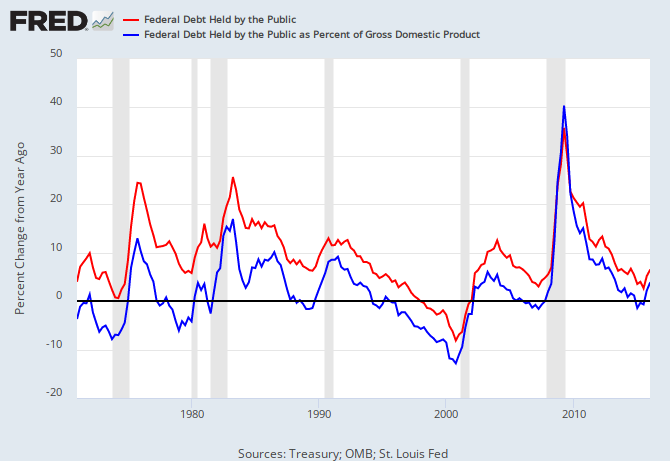
    Recessions begin an average of 2 years after the blue line first dips below zero. A common phenomenon is for the line briefly to dip below zero, then rise above zero, before falling dramatically below zero. There was a brief dip below zero in 2015, followed by another dip – the familiar pre-recession pattern.
    Recessions are cured by a rising red line.

    Monetary Sovereignty

    Vertical gray bars mark recessions.

    As the federal deficit growth lines drop, we approach recession, which will be cured only when the growth lines rise. Increasing federal deficit growth (aka “stimulus”) is necessary for long-term economic growth.

    ————————————————————————————————————————————————————————————————————————————————————————————————-

    Mitchell’s laws:
    •Those, who do not understand the differences between Monetary Sovereignty and monetary non-sovereignty, do not understand economics.
    •Any monetarily NON-sovereign government — be it city, county, state or nation — that runs an ongoing trade deficit, eventually will run out of money.
    •The more federal budgets are cut and taxes increased, the weaker an economy becomes..

    •No nation can tax itself into prosperity, nor grow without money growth.
    •Cutting federal deficits to grow the economy is like applying leeches to cure anemia.
    •A growing economy requires a growing supply of money (GDP = Federal Spending + Non-federal Spending + Net Exports)
    •Deficit spending grows the supply of money
    •The limit to federal deficit spending is an inflation that cannot be cured with interest rate control.
    •The limit to non-federal deficit spending is the ability to borrow.

    Liberals think the purpose of government is to protect the poor and powerless from the rich and powerful. Conservatives think the purpose of government is to protect the rich and powerful from the poor and powerless.

    •The single most important problem in economics is the Gap between rich and the rest..
    •Austerity is the government’s method for widening
    the Gap between rich and poor.
    •Until the 99% understand the need for federal deficits, the upper 1% will rule.
    •Everything in economics devolves to motive, and the motive is the Gap between the rich and the rest..

    MONETARY SOVEREIGNTY