A puzzle perhaps you can solve

The puzzle is, can something be too simple to be believed? In the mid-19th century, Dr. Ignaz Semmelweis discovered that washing hands with a chlorinated lime solution could significantly reduce the incidence of puerperal fever (childbed fever) among women in maternity wards. Despite his compelling evidence and efforts to convince his colleagues, many doctors ridiculed him and refused to adopt his practices.
From Wikipedia: Ignaz Philipp Semmelweis was a Hungarian physician and scientist who was an early pioneer of antiseptic procedures and was described as the “savior of mothers.” Postpartum infection, also known as puerperal fever or childbed fever, consists of any bacterial infection of the reproductive tract following birth, and in the 19th century was common and often fatal. Semmelweis discovered that the incidence of infection could be drastically reduced by requiring healthcare workers in obstetrical clinics to disinfect their hands. In 1847, he proposed hand washing with chlorinated lime solutions at Vienna General Hospital’s First Obstetrical Clinic, where doctors’ wards had three times the mortality of midwives’ wards. The maternal mortality rate dropped from 18% to less than 2%, and he published a book of his findings, Etiology, Concept and Prophylaxis of Childbed Fever, in 1861. Despite his research, Semmelweis’s observations conflicted with the established scientific and medical opinions of the time, and his ideas were rejected by the medical community. He could offer no theoretical explanation for his findings of reduced mortality due to hand-washing, and some doctors were offended at the suggestion that they should wash their hands and mocked him for it. In 1865, the increasingly outspoken Semmelweis allegedly suffered a nervous breakdown and was committed to an asylum by his colleagues. In the asylum, he was beaten by the guards. He died 14 days later from a gangrenous wound on his right hand that may have been caused by the beating.
I hope I won’t be similarly confined because, for 25 years, I have struggled to explain what seems to me to be the simple concepts of Monetary Sovereignty. The question: Is Monetary Sovereignty so simple, so obvious, that you believe “it can’t be that easy‘? (It is.) Or, “if it were that simple, someone else would have thought of it.” (Others have.) Or, “that’s not what schools, economists, and the media teach.” (That’s the problem.) Here are three simple facts about our economy. 1. Money is not a physical thing. Gold, silver, and paper are not money, but they can represent money.
A dollar bill is a title to a dollar, not a dollar itself. All forms of money merely are bookkeeping entries. For example, a $10 gold coin is just a title to $10. The coin always is worth exactly $10 as money, though it may be worth thousands as barter. As money, that gold coin is worth neither more nor less than a $10 paper bill or the $10 on your checking account bank statement. Thus, money is just government-approved numbers on a statement. The U.S. government has the infinite ability to create these bookkeeping entries simply by pressing computer keys. 2. A government having the infinite ability to create, spend, and control a specific currency is sovereign over that money and it is called “Monetarily Sovereign.”  The governments of the U.S., Japan, the UK, Canada, and Australia are examples of Monetary Sovereignty over their respective currencies.

Alan Greenspan: “There is nothing to prevent the federal government from creating as much money as it wants and paying it to somebody.”

The governments of Italy, France, Germany, and Greece are monetarily non-sovereign. They do not have their own sovereign currencies. Instead, they use the euro, over which the European Union (EU) is sovereign. These nations can run short of euros, while the EU cannot. The nations rely on taxes; the EU needs no taxes. The Monetarily Sovereign U.S. government  cannot unintentionally run short of its money. Given a creditor’s demand for a million, or a billion, or a trillion trillion dollars, the U.S. government could pay immediately, without collecting a single penny in taxes. What does that tell you about federal debt? Just as the U.S, cannot unintentionally run short of dollars, the EU cannot run short of euros. Contrast with any monetarily non-sovereign entities — euro nations, businesses or people — which do not have the infinite ability to pay bills and can run short of whatever currency they are using. 3. Government spending of its Monetarily Sovereign currency is not inflationary. Historically, all inflation is supply-based — i.e, shortage(s) of critical assets, usually oil and/or food — not demand-based. While government spending can increase demand for specific products, this doesn’t cause inflation, which is an overall increase in the prices of almost all products.
These three fundamentals seem simple and straightforward. Yet, for perhaps 25 years, I have failed to help most people understand them. #1 confuses those who mistakenly believe the pieces of green-printed paper in their wallet are actual dollars, not just titles to dollars. #2 is vaguely understood except by all those who believe federal finances are the same as personal finances.. #3 is denied outright by those whose vision of supply and demand makes them believe excessive demand caused inflation rather than a lack of supply. To help people understand, I have given examples of the Monopoly game, which can be played without physical paper “money”—just a balance sheet—and that, by rule, the Bank (a corollary for the federal government) cannot run short of money. I have presented graphs demonstrating how inflations are closely related to oil costs, not to federal spending. I have presented graphs showing that recessions occur immediately after reductions in federal deficit spending growth and are cured by increased federal deficit spending growth. I have shown that every depression in U.S. history has come shortly after the federal government reduced deficit spending.

1804-1812: U. S. Federal Debt reduced 48%. Depression began 1807. 1817-1821: U. S. Federal Debt reduced 29%. Depression began 1819. 1823-1836: U. S. Federal Debt reduced 99%. Depression began 1837. 1852-1857: U. S. Federal Debt reduced 59%. Depression began 1857. 1867-1873: U. S. Federal Debt reduced 27%. Depression began 1873. 1880-1893: U. S. Federal Debt reduced 57%. Depression began 1893. 1920-1930: U. S. Federal Debt reduced 36%. Depression began 1929. 1997-2001: U. S. Federal Debt reduced 15%. Recession began 2001.

I have published articles by thought leaders from 1940 to today who falsely claimed that the federal debt is a ticking time bomb. During those 84 years, the debt grew from $40 billion to $30 trillion, yet this so-called “debt bomb” never exploded. I encounter articles daily discussing the dangers of federal debt and deficits. Currently, Congress is struggling with the absurd federal debt limit, which ignores the government’s unlimited capacity to meet its financial obligations. Even this morning, I read again about how federal agencies like Social Security and Medicare are in danger of running short of money, though Congress could supply all the funds needed just by voting. Every day, dollars are deducted unnecessarily from paychecks to “pay for ” some federal expense when, in fact, federal taxes pay for nothing. The federal government already has infinite dollars. Think. With infinite dollars, why would it need taxes? A simple question with a simple answer, yet most people are stumped by it

The sole purposes of federal taxes are:

1. To control the economy by taxing what the government wishes to discourage and by giving tax breaks to what the government wishes to reward and

2. To assure demand for the dollar by requiring taxes to be paid in dollars.

3. To help the rich become more affluent by providing tax breaks not available to the rest of us.

The wealthy promote the idea of “small government,” not because they genuinely believe the unfounded claim that “government is the problem,” but because they recognize that government establishes regulations they prefer to avoid. These regulations regarding clean air, clean water, food safety, and fair treatment by banks and businesses hinder the wealthy’s relentless pursuit of power and wealth, often at the expense of the rest of society. Most Congresspeople understand all these points but continue disseminating disinformation for political reasons. (Wealthy political donors pay a lower percentage of their incomes than the rest of us, so useless tax collections widen the Gap between the rich and us. The Gap makes them rich; we all would be the same without it.) Sadly, while the rich don’t want us to understand, most of us blindly follow their lead, just as the unfortunate pregnant women followed the fatal lead of mid-19th century doctors. Through the years, I have provided examples, data, and proofs. At the same time, again, some disingenuous Congressperson, deceptive economist, misleading writer, or uninformed friend assures you that Social Security and Medicare will become insolvent without tax increases or benefit cuts. Monetary Sovereignty is not complicated. It’s not, as they say, “rocket science.” It’s dead simple. However, I do not know how to help the populace understand what will benefit them. Consider the suggestion: “Eliminate FICA.” Is that too difficult to contemplate, or is it too easy to believe? What is the psychology of the millions who cannot accept the often-proven fact that the federal government has infinite money while accepting the never-proven nonsense that a Presidential election was stolen? Would you be outraged if your local car dealer tried to overcharge you or if your favorite football team refused to honor your tickets? Where is your passion against paying thousands of dollars in unnecessary taxes? Where is your anger about billionaire Trump paying far less taxes (almost nothing, actually) than you do? Why aren’t you frothing at the mouth about your doctor bills when the federal government could and should fund comprehensive, no-deductible Medicare for every man, woman, and child in America without collecting a penny in taxes? Why aren’t you screaming on the phone about proposed cuts to Social Security? If you heard about a billionaire who refuses to give his infant child enough money for medical care, would you be outraged? Well, the government is a multiple trillionaire, and you are its child. Get outraged. If I can’t convince people to make meager efforts to contact their Congresspeople about something that will save them many thousands of dollars and their health, improve their lives and their children’s lives, all at no cost, what is the purpose of reason? You’ve gone through the effort of reading this far. Why not make it meaningful? Call your Senator and Representative. Today. Now. “Why not” is the puzzle. Rodger Malcolm Mitchell Monetary Sovereignty Twitter: @rodgermitchell Search #monetarysovereignty Facebook: Rodger Malcolm Mitchell; MUCK RACK: https://muckrack.com/rodger-malcolm-mitchell; https://www.academia.edu/

……………………………………………………………………..

The Sole Purpose of Government Is to Improve and Protect the Lives of the People.

MONETARY SOVEREIGNTY
Why the right-wing wants to cut benefits to the average American

The Libertarians (the cruel shills for the Republican Party) have a non-solution for a non-problem. The non-problem is that the U.S. federal government is running short of its sovereign currency, the U.S. dollar. The non-solution is to take dollars from the poor and middle-income people.

Welfare Cuts Are Inevitable Because Congress Won’t Touch Social Security Until Congress is willing to acknowledge that it makes no sense to send monthly checks to wealthy seniors, everything else will be on the chopping block. ERIC BOEHM | 9.27.2023 2:05 PM

The headline implies at least four lies: Lie #1. The federal government can’t afford to send money to the poor and middle-income people. Lie #2. The solution would be for the government to take dollars from Social Security. Lie #3. Congress doesn’t dare to take Social Security dollars from the poor and middle-income people. Lie #4. The only recourse is to take welfare dollars from the poor.

Amid the fractious debate over the federal budget, Speaker of the House Kevin McCarthy (R–Calif.) has outlined plans for cutting several prominent welfare programs to save about $150 billion annually.

According to The Washington Post, those cuts would affect a wide range of federal safety net programs, including food stamps and Meals on Wheels, which help feed needy families.

Other cuts would affect Federal Pell Grants for low-income college students, grants that help families afford housing, and a program that helps offset high heating bills.

Notice that none of the Libertarian non-solutions to the non-problem involve taking dollars from the rich by eliminating the kind of tax dodges that all people like Donald Trump to pay almost $0 federal taxes.

Regardless of whether you think the federal government should be in the business of funding any of those things in the first place, there’s no denying that sudden cuts to existing welfare programs can be disruptive to the individuals and families that have come to rely upon them.

Here, the Libertarian implies that the federal government should not help low-income college students, families that can’t afford housing, or low-income families that can’t pay their heating bills. This is typical for the heartless Libertarians and Republicans. They don’t give a damn about people but are concerned with just two things: Saving government money for a government that has infinite money and helping the rich grow richer.

Ben Bernanke: “The U.S. government has a technology, called a printing press (or, today, its electronic equivalent), that allows it to produce as many U.S. dollars as it wishes at essentially no cost.”

It’s also true that, as Reason’s Liz Wolfe points out in this morning’s newsletter, the proposed cuts reflect the reality of a government that has been living beyond its means for too long.

You and I can “live beyond our means.” but the federal government cannot. It has infinite “means.”

Alan Greenspan: “The United States can pay any debt it has because we can always print the money to do that.

“It’s not exactly a winning PR move to slash the programs that serve needy toddlers and first-generation college kids, but there’s an important fundamental truth at the heart of the fiscal hawks’ concerns: government spending simply cannot continue at current levels with no consequences,” Wolfe writes.

This lie has been told since at least 1940 and probably beyond. That was the first year I found that the federal debt, or deficit, was called a “ticking time bomb.” The phony bomb still is ticking after eighty-three years. And precisely what are the “consequences” to which Wolfe refers and Boehm agrees? You never will see that explained in any Libertarian screed. The reason: There are no consequences. Period.

That’s true. But here’s an element of this debate that doesn’t get talked about enough: Cutting welfare programs for needy families is necessary because Congress insists that relatively wealthy senior citizens get paid first.

And here it comes: The theory is that seniors are wealthy, and despite paying the useless FICA tax for their entire lives, they really don’t deserve anything for their investment. So, cut Social Security because that’s where the money — the infinitely available money — goes. And who cares about those old folks, anyway?

Budgeting is always, at its core, an exercise in priority-setting. That’s especially true when your budget is wildly out of whack, and you’ve been borrowing at an unsustainable rate, as Congress has done for years.

What part of budgeting is “wildly out of whack”? Would reducing the money going to the middle and the low be the best way to put the budget in “whack”? And then for two more lies in just five words (Is that a world record?) “Borrowing at an unsustainable rate.” Lie #5. The federal government borrows. No, the federal government does not borrow dollars. Why would it borrow when it has the infinite ability to create dollars?

Statement from the St. Louis Fed: “As the sole manufacturer of dollars, whose debt is denominated in dollars, the U.S. government can never become insolvent, i.e., unable to pay its bills. In this sense, the government is not dependent on credit markets to remain operational.”

The confusion arises because private sector bills, notes, and bonds differ entirely from T-bills, T-notes, and T-bonds The former have to do with borrowing. The latter have to do with depositing. A borrower receives from a lender money that the borrower uses. But the federal government doesn’t use or even touch the dollars deposited into T-security accounts. The federal government, unlike state/local governments, is Monetarily Sovereign. It pays all its creditors with newly created dollars, ad hoc. Despite Monetary Sovereignty being the single most important difference between federal and personal finances, you will never see those words in any discussion of federal budgeting being “unsustainable.” Lie #6. “Unsustainable rate.” No amount of spending is unsustainable for the federal government. It has the infinite ability to create dollars.

When there’s no longer enough money to go around, you’re faced with a difficult proposition: Who gets paid first, and who has to wait at the back of the line?

The federal government always has enough money to go around. It cannot run short of dollars. Ever. Boehm knows this.

Alan Greenspan: “There is nothing to prevent the federal government from creating as much money as it wants and paying it to somebody.”

In the federal budget, seniors get paid first. Everyone else has to wait.

Lie #7. No, the rich are paid first. They are paid by the tax loopholes that allow them not to pay taxes in the first place.

McCarthy and his fellow Republicans are not proposing any cuts or changes to Social Security and Medicaid, the Post notes. That’s despite the fact that the two major entitlement programs are driving most of the federal government’s long-term deficit.

The federal deficit is the government’s method for pumping growth dollars into the economy. If the government did not run deficits, we would have yearly recessions and depressions.

U.S. depressions tend to come on the heels of federal surpluses.

1804-1812: U. S. Federal Debt reduced 48%. Depression began 1807. 1817-1821: U. S. Federal Debt reduced 29%. Depression began 1819. 1823-1836: U. S. Federal Debt reduced 99%. Depression began 1837. 1852-1857: U. S. Federal Debt reduced 59%. Depression began 1857. 1867-1873: U. S. Federal Debt reduced 27%. Depression began 1873. 1880-1893: U. S. Federal Debt reduced 57%. Depression began 1893. 1920-1930: U. S. Federal Debt reduced 36%. Depression began 1929. 1997-2001: U. S. Federal Debt reduced 15%. Recession began 2001.

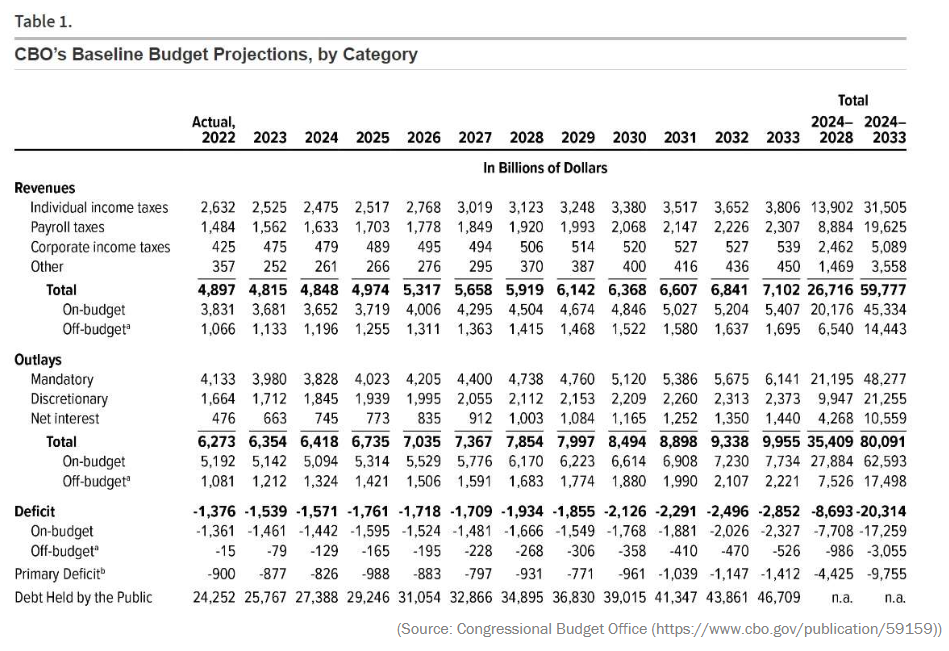
Over the next decade, discretionary spending—including those welfare programs the GOP aims to cut—is projected to decline relative to the size of the U.S. economy, according to the Congressional Budget Office’s (CBO) projections.

Meanwhile, Social Security and Medicare are growing, fast. By 2030, the CBO expects so-called “mandatory spending” on entitlement programs to consume more than 60 percent of the federal budget.

The federal budget is what Congress wishes it to be. If 60% is too much, the government merely can increase discretionary spending. This would reduce the meaningless percentage and increase the Gross Domestic Product. Economic growth is both a direct and indirect result of federal spending.  GDP=Federal Spending + Nonfederal Spending + Net Exports

Of course, because those programs are funded with a separate revenue stream—payroll taxes—it would be complicated for Congress to cut spending on Social Security to offset cuts on welfare programs.

Unlike state and local governments, the federal government does not fund programs via “revenue streams.” It supports all programs by creating new dollars, ad hoc. Tax dollars are destroyed upon receipt. Even if all federal tax collections totaled #0, the federal government could continue spending forever.

Even so, the ongoing refusal of either major party to consider any long-term changes to the two major entitlement programs tells you all you need to know about the priorities in Washington.

What tells me all I need to know about priorities in Washington is the failure of either party to get rid of tax dodges by the rich.

There is no shortage of alternative ideas out there.

Congress could fiddle with the specifics of Social Security to make the program less expensive over the long term—raising the retirement age, for example, or changing how contributions and disbursements work.

Yes, soaking the elderly is the Libertarian mantra. But they don’t ask the rich to pay more by closing tax loopholes. That would reduce those luscious political contributions the politicians love so much.

It could (and should) allow younger Americans to opt out of the system retirement.

Boehm exceeds his stupidity allowance by suggesting that younger Americans opt out of Social Security. I can’t even go into how cruel and ignorant that idea is other than saying it does not surprise me coming from Libertarian Eric Boehm. A pox on him and his descendants ten generations, hence. Rodger Malcolm Mitchell Monetary Sovereignty Twitter: @rodgermitchell Search #monetarysovereignty Facebook: Rodger Malcolm Mitchell

……………………………………………………………………..

The Sole Purpose of Government Is to Improve and Protect the Lives of the People.

MONETARY SOVEREIGNTY
Encouraging the public to commit financial suicide. “Work ’til you drop.”

REASON Magazine is a Libertarian publication that disseminates false information encouraging Americans to vote against their best interests.

Here is another example from this shameful publication.

Congress can reduce the deficit by $7.7 Trillion in 10 Years
The Congressional Budget Office projects that future deficits will explode. But there’s a way out.
VERONIQUE DE RUGY, REASON MAGAZINE

With public debt at an all-time high, the government should do the same.

Immediately, Veronique de Rugy reveals her abject ignorance of economics. She equates federal financing with personal financing.

The two are diametrically different. The federal government is Monetarily Sovereign. It has the unlimited ability to create new dollars. It never can run short of dollars and never can be unable to pay any debts denominated in dollars.

The public is none of those things. It is monetarily non-sovereign. It has a limited ability to create new dollars. It can, and often does, run short of dollars. It can, and often is, unable to pay its debt denominated in dollars.

Yet astoundingly, Veronique says the government “should do the same.” This unforgivable ignorance is responsible for every recession and depression in U.S. history.

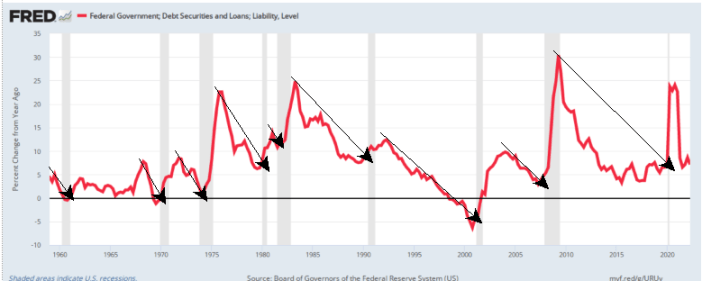
Recessions (gray bars) are caused by reduced debt growth and are cured by increased debt growth. By mathematical formula, Gross Domestic Product growth requires federal spending growth and federal debt growth.

GDP = Federal Spending + Non-federal spending + Net Exports.

This feat isn’t that hard now that the Congressional Budget Office (CBO) has released a series of budget options showing Congress how to do it.

In Libertarian terms, “how to do it” invariably requires reducing benefits to the public — specifically, the part of the public that is not rich.

It’s worth repeating that maintaining spending at the current level is not a viable option.

Given the dramatic increase in annual federal government spending over the next 30 years—from 22.3 percent of GDP to 30.2 percent—combined with federal tax revenues that have remained fairly constant at around 19 percent, CBO projects that future deficits will explode.

It’s forecasted to triple from 3.7 percent of GDP today to 11.1 percent in 2052. Over the next 10 years, primary deficits (deficits excluding interest payment on the debt) amount to $7.7 trillion. Meanwhile, deficits with interest payments total $15.8 trillion—roughly $1.6 trillion a year.

You’ll notice that Veronique never says why maintaining spending is “not a viable option.” All she does is quote large numbers to shock you.

In effect, she claims that Monetary Sovereignty is not a viable option, because it allows the government to create dollars. 

The “not a viable option” claim resembles the “ticking time bomb” claim about the federal debt, that has been wrong for more than 80 years. In that time, the federal debt has grown more than 55,000%, yet the nation survives quite well, thank you.

Sadly, Libertarians refuse to learn from actual experience. They cling to the myth that a Monetarily Sovereign government should impose austerity, despite the repeated and inevitable failures of such a system.

Note, by the way, that half of our future total deficits will be driven by interest payments on the debt. This fact isn’t surprising considering the size of our deficits and the rise in interest rates.

Federal interest payments, which the government has the infinite ability to make, add growth dollars to the economy.

The U.S. federal government daily demonstrates that interest payments pose no burden on a government having the infinite ability to create the dollars with which it makes the payments. And for the same reason, interest payments pose no burden on federal taxpayers.

Given these realities, no one will be surprised that the ratio of debt to GDP, now roughly 100 percent, will, under the most conservative estimations, jump to 110 percent in 10 years.

In the next 30 years it will likely double. More realistically, in 2052 debt as a share of GDP will be 260 percent. And that’s assuming no major recessions or emergencies.

As we have seen here, and other places on this blog, the debt / GDP ratio is meaningless. Neither a low nor a high ratio indicates the health of an economy. The ratio predicts or demonstrates nothing.

Any time you read or hear about the “dangers” of a high debt / GDP ratio, you will know you are reading ignorance and lies.

GDP does not fund debt. Further, GDP is one-year figure while debt is a cumulative-over-many-years figure. No comparability at all.

Low ratios and high ratios can be seen equally among the world’s most and least healthy economies.

Despite these awful numbers, legislators in both parties are currently debating how best to add trillions more to the country’s credit card balance.

The federal government does not have anything comparable to a “credit card balance.” Libertarians use that term to trick you into believing that the federal government is about to go bankrupt. It isn’t and it can’t. 

Many, for instance, want to add a new entitlement program in the form of the extended child tax credit.

The rich hate entitlement programs like Medicare, Medicaid, and Social Security because such programs benefit the poor and the middle, thereby closing the Gap between the rich and the rest.

Libertarians argue for the rich by feigning a brand of frugality that widens the Gap. 

It is in this setting that the CBO published its report on budget options. The two-volume document highlights options for deficit reduction.

One volume details large possible spending reductions while the other lays out small ones—so the options are plenty. They include important reforms of some of the major drivers of future debt: Medicare, Medicaid, and Social Security.

The misnamed “reforms” actually are reductions in benefits to the poor and middle classes. The rich love cutting Medicare, Medicaid, and Social Security, while boosting dollars for the military and cutting taxes on the rich.

And heaven forbid there be a new benefit for the not-rich, extended child tax credit. 

Ms. de Rugy, as a tool of the rich, dishonestly calls these cuts “reforms,” to dissuade you from objecting.

All told, it’s possible to achieve deficit reduction of $7.7 trillion over 10 years.

The mathematics are clear: A deficit reduction of $7.7 trillion will reduce GDP by about $7.7 trillion and lead to a recession if we a lucky, and a depression if we are not.

That’s enough to accomplish what some people mistakenly believe to be out of reach: balancing the budget without raising taxes.

While “balancing the budget” is prudent for people, businesses and local governments, it is a disaster for the federal government. Sadly, Ms. de Rugy, being ignorant of economics, doesn’t understand this.

There are also a few options to simplify the tax code by removing or reducing unfair individual tax deductions and by cutting corporate welfare.

Lest you believe the previous sentence indicates the Libertarians are willing to crack down on the rich, read the next sentence.

For instance, it’s high time for Congress to end tax deductions for employer-paid health insurance. This tax deduction is one of the biggest of what we wrongly call “tax expenditures.”

Get it? First Ms. de Rugy wishes to cut Medicare and Medicaid. Then, to further “balance the budget,” she wishes to cut employer paid health insurance. 

See the pattern? Starve the poor and middle classes to achieve a recession or depression. The very rich couldn’t be happier. They love widening the Gap between the rich and the rest. The wider the Gap, the richer they are.

It’s responsible for many of the gargantuan distortions in the health care market and the resulting enormous rise in health care costs.

The CBO report doesn’t eliminate this deduction; instead, it limits the income and payroll tax exclusion to the 50th percentile of premiums (i.e. annual contributions exceeding $8,900 for individual coverage and $21,600 a year for family coverage).

The savings from this reform alone would reduce the deficit by roughly $900 billion.

Why the limit? Why 50th percentile? No reason other than perhaps it seems more “generous” than eliminating the entire deduction.

A second good option is to cap the federal contribution to state-administered Medicaid programs.

Ah, more cuts to programs that help the poor. Ask Ms. de Rugy why not simply eliminate Social Security, Medicare, Medicaid, and all poverty aids. That would really “balance the budget.”

That federal block grant encourages states to expand the program’s benefits and eligibility standards—unreasonably in some cases—since they don’t have to shoulder the full bill.

CBO estimates that this reform would save $871 billion.

There is no reason for a Monetarily Sovereign nation to save $871 billion of the same dollars it has the infinite ability to create.

Ben Bernanke: “The U.S. government has a technology, called a printing press (or, today, its electronic equivalent), that allows it to produce as many U.S. dollars as it wishes at essentially no cost.”

The states are monetarily non-sovereign and are supported by taxpayers. The federal government is Monetarily Sovereign and is not supported by taxpayers.

To pay its bills, the federal government creates new dollars, ad hoc. All federal tax dollars are destroyed upon receipt by the U.S. Treasury.

Ms. de Rugy wishes unnecessarily to balance the budget by punishing the poorest Americans. One wonders about the kind of person who would recommend such cruelty.

CBO also projects that Uncle Sam could reduce the budget deficit by $121 billion by raising the federal retirement age.

CBO’s option would up this age “from 67 by two months per birth year for workers born between 1962 and 1978.

As a result, for all workers born in 1978 or later, the FRA would be 70.” Considering that seniors today live much longer than in the past and can work for many more years, this reform is a low-hanging fruit.

In yet another disgrace, Ms. de Rugy wishes to cut Social Security by raising the retirement age. This has scant effect on the rich, but would be a hardship for the poor.

Her “solution” involves moving retirement three years away for working people, in short to keep them working ’til they drop.

The rich, of course, can retire at will.

Congress could save another $184 billion by reducing Social Security benefits for high-income earners. I support a move away from an age-based program altogether since seniors are overrepresented in the top income quintile.

Social Security should be transformed into a need-based program (akin to welfare).

Nevertheless, the CBO’s option would be a step in the right direction.

A not-so-clever suggestion by Ms. de Rugy to make Social Security “akin to welfare.” The political right hesitates to cut Social Security directly, but would do it by making it “welfare,” and then cutting welfare.

As right wingers “know,” people accepting welfare are lazy takers, not worthy of help.

Further, with inflation, the need-based option falls ever more heavily on the poor, exactly what REASON wants.

There are so many more options for long-term deficit reduction. All Congress needs is a backbone. Considering the end-of-year spending bill going through Congress right now, I am not holding my breath.

SUMMARY

The article, which appeared in Reason.com, is a breathtaking litany of anti-poor, anti-middle, pro-rich recommendations to widen the Gap between the rich and the rest.

It is disgusting in its ignorance and cruelty, it’s lack of facts and its dissemination of false beliefs.

The sole purpose is to make the rich richer by widening the Gap between them and the rest of us. 

Lacking any recognition of Monetary Sovereignty, the author promulgates the usual right-wing austerity that punishes all but the rich. It is an inexcusable exercise in dishonor and immorality by Ms. de Rugy and her Libertarian accomplices.

The Relentless Con Job By The Rich. The Big Lie In Economics

The efforts of the rich to become even richer never end.

The rich incessantly promulgate lies about our economy. More importantly, they bribe the primary influencers — the politicians, the media, and the economists — to spread the Big Lie that federal spending is funded by federal taxes.

File:Scottpelley.jpg - Wikimedia Commons
Bernanke: “It’s not tax money… We simply use the computer to mark up the size of the account.”

In reality, federal spending is funded by ad hoc federal money creation, not taxes.

Unlike state and local government taxes, all federal tax dollars are destroyed upon receipt.

The tax dollars no longer exist in the economy (the private sector), and since the federal government has infinite dollars, the tax dollars no longer exist anywhere.

The Big Lie convinces the populace that the federal government’s ability to provide benefits is financially limited by tax receipts.

(Politicians are bribed via campaign contributions and promises of lucrative jobs. The media are bribed via advertising dollars and actual ownership. Economists are bribed via gifts to universities and lucrative positions on “think tanks.”) 

Whenever you hear about a federal benefit, and someone asks, “Who will pay for it?” you should know you are about to listen to the Big Lie. The answer is: “The federal government will pay for it by creating dollars.”

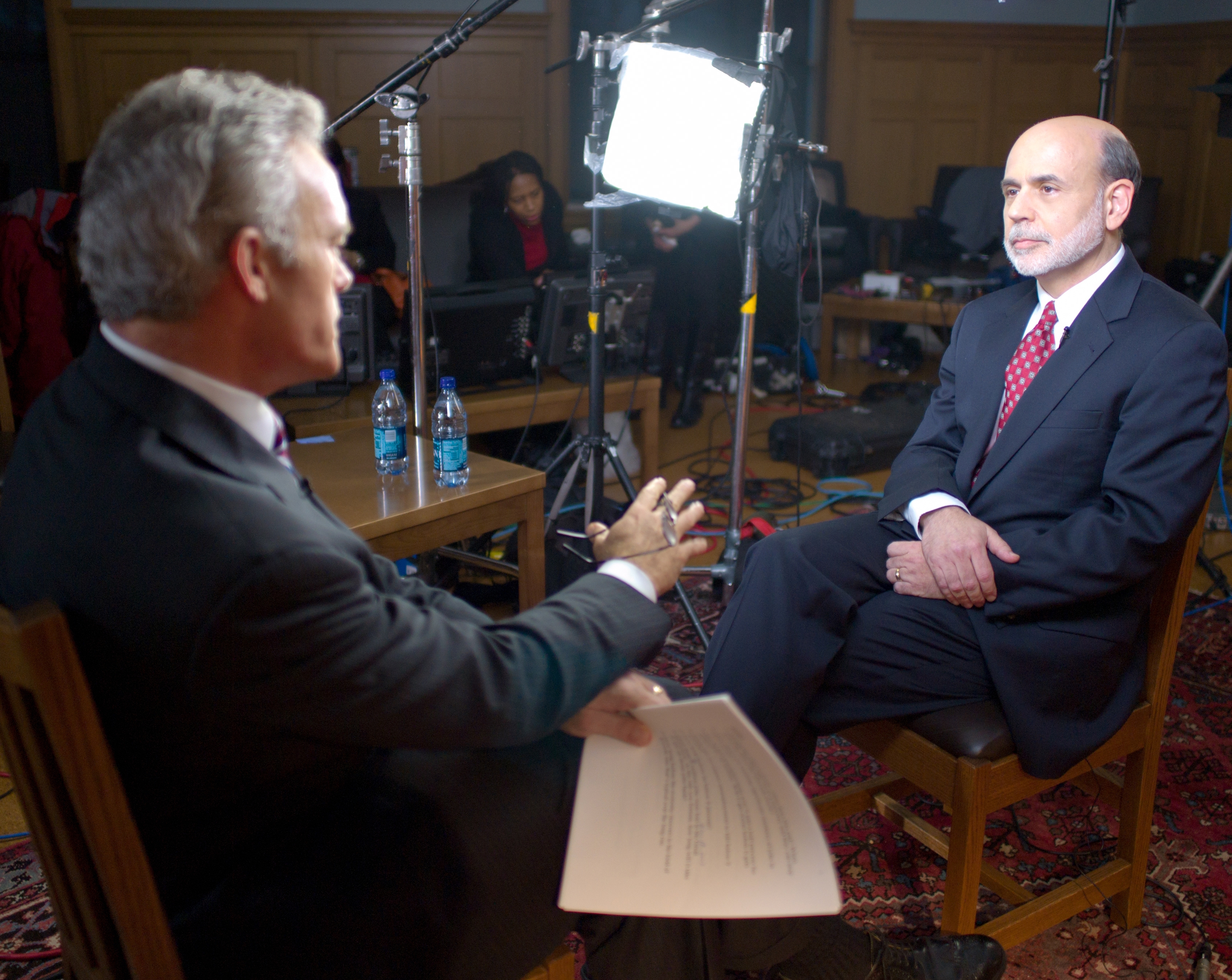
Quote from former Fed Chairman Ben Bernanke when he was on 60 Minutes:
Scott Pelley: Is that tax money that the Fed is spending?
Bernanke: It’s not tax money… We simply use the computer to mark up the size of the account.

“Social Security and Medicare are about to become insolvent” is an example of the Big Lie, the purpose of which is to distance the rich from the rest of us.

“Rich” is a comparative, not an absolute. If you have a million dollars, you are rich if most others have less than a million. But you are not wealthy if everyone else has ten million.

That leaves you two ways to become richer: Get more for yourself or make the others have less. The rich in America have chosen both courses.

They try to grab more for themselves; their efforts to force you to have less are not as obvious.

The rich receive most of their income from sources other than salaries. Consider FICA. Congress has deemed FICA should be collected only from salaries, not from other forms of income.

Further, Congress has decided FICA is to be collected on salaries less than $142,800. Anything above that is not taxed.

The FICA limit is just one of the thousands of tax breaks the rich have “encouraged” Congress to give them. The purpose: To widen the Gap between them and you. Widening the Gap makes them richer.

U.S. federal finances are unlike state & local government finances, business finances, and euro nation finances.

The Map and the Territory, by Alan Greenspan | Financial Times
Former Fed Chairman Alan Greenspan: “A government cannot become insolvent with respect to obligations in its own currency.”

The U.S. government is Monetarily Sovereign. It has the unlimited ability to create its own sovereign currency.

It never unintentionally can run short of dollars.

Yet we see organizations funded by the rich claiming that federal spending, which goes to the middle- and lower-income people, is detrimental to the middle- and lower-income people.

They want you to believe you should receive lower benefits and pay more taxes.

If they can cement that belief in your minds, you’ll vote for the very people who take money from your pocket.

Here is the entirety of a page posted by the Committee For A Responsible Budget, one of the organizations that continually tries to foist on you the false idea that you should have less.

Every single sentence, including the headline, is false and/or an outright lie:

Why High and Rising National Debt is a Problem

FALSE. High and rising National (i.e., federal) Debt is not a problem. It is not even Debt. It is the total of deposits into Treasury security accounts at the Federal Reserve.

These accounts resemble safe-deposit boxes. When you buy a T-bill, T-note, or T-bond, you open an account at the Federal Reserve and deposit your dollars into it.

The federal government never touches those dollars. It has no need to.

The government can pay off the so-called “debt” merely by returning to you the dollars in your account.

This is no burden on the government, taxpayers, or the economy. There is no “Problem.”

High and rising national Debt will threaten economic growth and the standard of living for all Americans. High Debt will slow the growth of the economy and wages.

FALSE. Federal “debt,” i.e., the total of deposits in T-securities, is set by law to equal the cumulative total of federal deficits.

Bernanke sees decent chance for Fed to pull off a 'soft-ish landing' | The  Hill
Bernanke: “The U.S. government has a technology, called a printing press (or, today, its electronic equivalent), that allows it to produce as many U.S. dollars as it wishes at essentially no cost.”

Deficits are the difference between the amount of money the government takes out of the economy vs. the amount it puts in (with some going to foreign nations).

Rising national “debt” occurs when the federal government puts more dollars into the economy than it takes out.

There is no mechanism by which adding money to the economy can “slow the growth of the economy and wages.”

On the contrary, when economic growth slows, the government adds more stimulus dollars (increases the “debt”) to prevent or cure a recession.

The “debt” has no direct effect on wages, which are a function of business profits (stimulated by federal deficit spending) and labor supply.

As Debt rises, higher interest payments will crowd out important investments in areas like education, infrastructure, and research that can help grow the economy.

FALSE. Federal Debt does not force higher interest rates. Interest rates are set arbitrarily by the Federal Reserve to control inflation.

The peaks and valleys of changes for Federal deficits (blue) neither correspond to changes in Interest rates (red) nor are they a leading indicator. Note the 12 years 2008 – 2020, when federal deficit spending grew massively while interest rates neared zero.

Federal interest payments do not “crowd out” other federal payments for “education, infrastructure, and research. The federal government has infinite money with which to pay for anything.

During periods of high deficit spending, interest rates have been low.

Getting the Debt under control once the crisis is over will be very beneficial for generations to come, from higher wages to increased investment to lower borrowing costs for families and businesses.

FALSE. This paragraph is just a restatement of the previous section. There is no mechanism by which fewer dollars coming into the economy can cause “higher wages, increased investment, and lower borrowing costs.

The last decade shows the opposite: Higher deficits along with higher wages, increased investment, and low borrowing costs.

The Congressional Budget Office predicts that the economy will grow faster with Debt on a declining path as opposed to a rising one.

FALSE: History shows that declining Debt leads to depressions and recessions.

1804-1812: U. S. Federal Debt reduced 48%. Depression began 1807.
1817-1821: U. S. Federal Debt reduced 29%. Depression began 1819.
1823-1836: U. S. Federal Debt reduced 99%. Depression began 1837.
1852-1857: U. S. Federal Debt reduced 59%. Depression began 1857.
1867-1873: U. S. Federal Debt reduced 27%. Depression began 1873.
1880-1893: U. S. Federal Debt reduced 57%. Depression began 1893.
1920-1930: U. S. Federal Debt reduced 36%. Depression began 1929.
1997-2001: U. S. Federal Debt reduced 15%. Recession began 2001.

The reason is quite simple. Reducing federal Debt requires taking dollars out of the economy. 

Just as adding stimulus dollars to the economy prevents and cures recessions and depressions, taking dollars out of the economy causes recessions and depressions.

The rich do not fear recessions and depressions. They are less harmed than the rest of us. They have more cushion to weather the hard times.

During recessions and depressions, workers become more desperate for jobs, giving the rich the opportunity to cut wages and increase their own relative incomes.

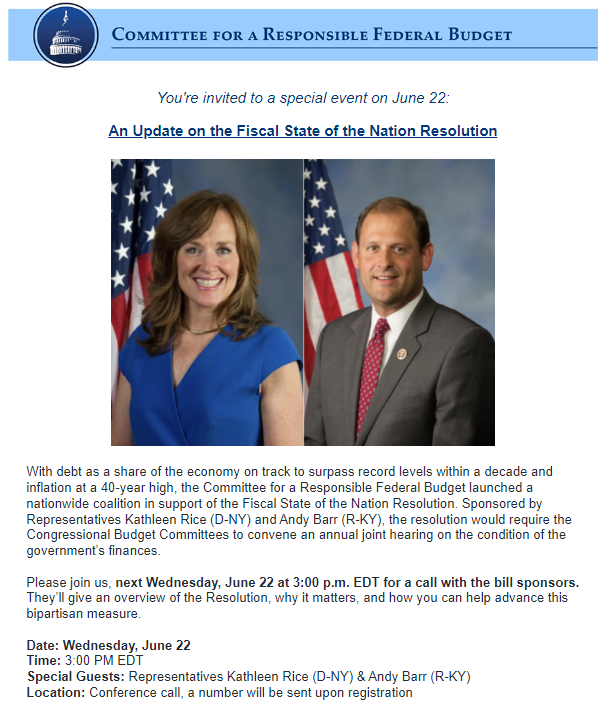
In addition to publishing the completely non-sensical paragraphs just discussed, The rich-run CRFB runs “hearings” on the condition of the government’s finances.”

These hearings contain nothing more than recitations of the Big Lie — false propaganda we have just discussed. The purpose will be to give Congress excuses to:

    • Cut Social Security benefits
    • Cut Medicare benefits
    • Eliminated Obamacare
    • Increase FICA taxes
    • Cut other benefits for the poor and middle-classes
    • Widen the income/wealth/power Gaps between the rich and the rest 

The drumming of lies and misstatements from the rich and toadies for the rich is relentless. So long as it works to indoctrinate the public, it never will end.

The attempts at indoctrination end only when you, the public, demonstrate your understanding of the lies and your willingness to punish the liars.

Fool you once; shame on them. Fool you thousands of times, over and over and over; shame on you.

[No rational person would take dollars from the economy and give them to a federal government that has the infinite ability to create dollars.]

Rodger Malcolm Mitchell Monetary Sovereignty Twitter: @rodgermitchell Search #monetarysovereignty Facebook: Rodger Malcolm Mitchell

……………………………………………………………………..

THE SOLE PURPOSE OF GOVERNMENT IS TO IMPROVE AND PROTECT THE LIVES OF THE PEOPLE.

The most important problems in economics involve:

  1. Monetary Sovereignty describes money creation and destruction.
  2. Gap Psychology describes the common desire to distance oneself from those “below” in any socio-economic ranking, and to come nearer those “above.” The socio-economic distance is referred to as “The Gap.”

Wide Gaps negatively affect poverty, health and longevity, education, housing, law and crime, war, leadership, ownership, bigotry, supply and demand, taxation, GDP, international relations, scientific advancement, the environment, human motivation and well-being, and virtually every other issue in economics. Implementation of Monetary Sovereignty and The Ten Steps To Prosperity can grow the economy and narrow the Gaps: Ten Steps To Prosperity:

  1. Eliminate FICA
  2. Federally funded Medicare — parts A, B & D, plus long-term care — for everyone
  3. Social Security for all
  4. Free education (including post-grad) for everyone
  5. Salary for attending school
  6. Eliminate federal taxes on business
  7. Increase the standard income tax deduction, annually. 
  8. Tax the very rich (the “.1%”) more, with higher progressive tax rates on all forms of income.
  9. Federal ownership of all banks
  10. Increase federal spending on the myriad initiatives that benefit America’s 99.9% 

The Ten Steps will grow the economy and narrow the income/wealth/power Gap between the rich and the rest.

MONETARY SOVEREIGNTY