Twitter: @rodgermitchell; Search #monetarysovereignty
Facebook: Rodger Malcolm Mitchell
============================================================================================================================================================================================================================================================
The notorious bank robber, Willie Sutton, was (probably falsely) reported to have answered the question, “Why do you rob banks?” with: “Because that’s where the money is.”
And whether he said it or not (He denied it), the answer is correct. Banks indeed are where the money is, and wherever there is money, there will be fraud. And wherever there is big money, there will be big fraud.
Big money and big fraud go together like a man and woman dancing, with the big money leading and the big fraud closely following.
Not only does big money create big temptation, but big money gives big bribes to crooked politicians and a crooked legal system to look the other way. Examples: President Barack Obama and his Department of Justice (DOJ), who to date, have not prosecuted, let alone convicted, even one CEO of a bank criminal enterprise.
In Obama-world, a shoplifter of $25 may go to jail; the CEO of a major bank criminal enterprise, who has stolen billions of dollars, and personally received hundreds of millions, keeps his job, receives bonus money and otherwise is punished not at all.
Bank criminals have well-bribed friends in the White House.
Bill Black, the author of The Best Way to Rob a Bank is to Own One and an associate professor of economics and law at the nation’s best economics department — The University of Missouri-Kansas City — may be the most informed economist when describing bank fraud.
In addition to his book, he has written many articles on the subject. I recommend you read him whenever you can. To give you just a taste of his writing, here are a few excerpts:
The Inaugural Financial Fraud Lemons of the Week Award Goes to DOJ
This first column in a series we will do on DOJ’s refusal to prosecute the scores of senior bankers that led Morgan Stanley’s criminal enterprise will focus on DOJ’s press release.
Morgan Stanley was one of the largest criminal enterprises in the world and committed tens of thousands of acts of fraud that cost the American people billions of dollars in losses.
DOJ refused to make clear statements about Morgan Stanley’s massive fraud schemes. This column focuses on only four, spectacularly dishonest aspects of DOJ’s press release (regarding Morgan Stanley’s “punishment” of a $3.2 billion fine):
“Today’s settlement holds Morgan Stanley appropriately accountable for misleading investors about the subprime mortgage loans underlying the securities it sold,” said Acting Associate Attorney General Stuart F. Delery.
“The Department of Justice will not tolerate those who seek financial gain through deceptive or unfair means, and we will take appropriately aggressive action against financial institutions that knowingly engage in improper investment practices.”
How can a bank be held “appropriately accountable” for tens of billions of dollars in fraudulent mortgage sales? We can’t imprison a bank or shame it.
The bank is inherently incapable of being held “appropriately accountable” because that is a moral concept and a bank has no soul to damn.
“Those who contributed to the financial crisis of 2008 cannot evade responsibility for their misconduct,” said Principal Deputy Assistant Attorney General Benjamin C. Mizer, head of the Justice Department’s Civil Division.
“This resolution demonstrates once again that the Financial Institutions Reform, Recovery and Enforcement Act is a powerful weapon for combatting financial fraud and that the department will not hesitate to use it to hold accountable those who violate the law.”
DOJ held no Morgan Stanley official “appropriately accountable” while claiming that its settlement did the opposite.
Delery claims that DOJ “will not tolerate those who seek financial gain through deceptive or unfair means.”
The settlement proves the opposite, for DOJ “tolerated” Morgan Stanley’s senior officers being made wealthy through leading a massive fraud scheme – with zero accountability imposed on those officers.
Delery claims DOJ “will take appropriately aggressive action against financial institutions that knowingly engage” in fraud.
A “financial institution,” cannot “knowingly engage” in fraud except through vicarious liability for the actions of its officers.
Delery is admitting that Morgan Stanley’s officers “knowingly engage[d]” in fraud and became wealthy by doing so, but DOJ took no “action against” those officers, much less “aggressive” prosecutions.
Mizer’s claim that DOJ’s settlement with Morgan Stanley proves that “those who contributed to the financial crisis of 2008 cannot evade responsibility for their misconduct.”
DOJ, once more, refused to prosecute these elite frauds, did not require that they be fired, did not require them to give back their bonuses and other compensation that they received due to fraud, did not sue them, and did not even name them.
Mizer then extended his lie by claiming that “the department will not hesitate to use [the law] to hold accountable those who violate the law.”
Today’s settlement is part of the ongoing efforts of President Obama’s Financial Fraud Enforcement Task Force’s RMBS Working Group, which has recovered billions of dollars arising from misconduct related to the financial crisis.
The RMBS Working Group is a federal and state law enforcement effort focused on investigating fraud and abuse in the RMBS market that helped lead to the 2008 financial crisis.
We have agreement from DOJ, collectively through its pathetic settlements, that Bernie Sanders’ charge is correct. Agencies of the United States, after investigation, have confirmed at virtually every enormous bank that the business plan was fraud.
Moreover, DOJ admits that the fraud epidemics by the world’s largest banks were leading causes of the financial crisis and the Great Recession.
All of Professor Black’s articles, and his book, say essentially the same things: The major banks are criminal enterprises, perhaps the biggest the world ever has known, making Bernie Madoff look like a piker.
They have stolen billions from the public.
The gangsters, who run these criminal enterprises, reaped billions, but having bribed our political leaders, they received rewards rather than punishment.
And the public neither knows nor cares what has been done to them.
You’ll notice that during the political debates, neither party and no candidate (perhaps with the exception of Bernie Sanders) has made an issue of these crimes. The reason: Both parties and all candidates have been bribed.
Consider the Clintons:
$153 million in Bill and Hillary Clinton speaking fees, documented
Hillary Clinton and her husband, former President Bill Clinton, combined to earn more than $153 million in paid speeches from 2001 until Hillary Clinton launched her presidential campaign last spring, a CNN analysis shows.
In total, the two gave 729 speeches from February 2001 until May, receiving an average payday of $210,795 for each address.
The two also reported at least $7.7 million for at least 39 speeches to big banks, including Goldman Sachs and UBS, with Hillary Clinton, the Democratic 2016 front-runner, collecting at least $1.8 million for at least eight speeches to big banks.
The analysis was made at a time when Hillary Clinton has been under scrutiny for her ties to Wall Street, which has been a major focus of Vermont Sen. Bernie Sanders on the campaign trail.
If you believe the banks gave Hillary $1.8 million just to hear her talk eight times, then I have some costume jewelry I’d like to sell you.
The banksters use money stolen from the public, to bribe the politicians. Do the Democrat or Republican candidates for President of the United States care about your losses? Not that you would notice.
What the politicians do care about is your vote, and they think your vote depends on such issues as gay couples marrying, and Mexican children coming here, and poor mothers receiving food stamps.
Your politicians believe you are oblivious to the billions being stolen from you, and that you are more concerned with cutting the (necessary) federal deficit and the (meaningless) federal debt.
Now, eight years after having caused one of the greatest recessions in American history, the unpunished banksters have learned not to fear the DOJ or the public.
As you read this article, they repeat their crimes, while bribing politicians to weaken any remaining laws that might prevent such criminality.
The Ten Steps to Prosperity, listed at the bottom of every post on this blog, include as #9. “Federal ownership of all banks” Here are some excerpts from the various posts on this subject:
The end of private banking: Why the federal government should own all banks.
Global Economic Intersection:
Dallas Fed: Break Up the TBTF
March 30th, 2012
The Federal Reserve Bank of Dallas and its president Richard Fisher are generally known as conservative, hard money proponents. Often conservative economic thinkers are strong laissez-faire proponents.
That is why the 2011 annual report of the Dallas Fed, released this month, has been such a surprise.
A focal point of the report is very interventionist, calling for direct government action to force the break-up of the nation’s largest banks, the so-called TBTF (Too Big To Fail) institutions.
The focus of the report is an essay by Harvey Rosenblum, Executive Vice President and Director of Research. Key points by Rosenblum include:
[Dodd-Frank] may not prevent the biggest financial institutions from taking excessive risk or growing ever bigger.
TBTF institutions were at the center of the financial crisis and the sluggish recovery that followed. If allowed to remain unchecked, these entities will continue posing a clear and present danger to the U.S. economy.
Here, the FRB Dallas attributes bank problems to bank size. But even dividing the monstrous banks into mere big banks is unlikely to solve the basic problem: Greed, the profit motive and the access to punishment-free stealing.
TBTF undermines equal treatment, reinforcing the perception of a system tilted in favor of the rich and powerful.… virtually nobody has been punished or held accountable for their roles in the financial crisis.
… zero interest rates are taxing savers to pay for the recapitalization of the TBTF banks whose dire problems brought about the calamity that created the original need for the zero interest rate policy.
The final paragraph makes an interesting point. With zero interest rates, savers receive nothing so virtually are taxed.
But the more important point is that privately held banks control vast sums of money, and the profit motive provides vast temptations to steal.
Federal bank ownership would all but eliminate this problem. (I’ve not heard of the Federal Reserve Banking system, which also controls vast sums of money, engaging in criminal practices.)
While federal employees are fundamentally no more honest than private employees, the opportunities and desire for theft decrease markedly with a federally owned bank that has little-to-no profit motive.
Some people believe the banking problem can be solved with effective and strictly enforced laws and supervision. That may partially be true, but the ultimate in effective and strictly enforced laws and supervision is federal ownership and management.
Some people believe banks should be public utilities. I suggest that solves few problems. “Public” utilities actually are private enterprises. Making banks public utilities merely would move banks from their current set of government regulators to a different set of government regulators.
There is no public purpose being served by private banking. None. All banks should be federally owned.
For more thorough discussions, I recommend you read the various posts listed https://mythfighter.com/, with the word “Bank” in their title.
Rodger Malcolm Mitchell
Monetary Sovereignty
=======================================================================================================================================================================================================================================================================================================
===================================================================================
Ten Steps to Prosperity:
1. Eliminate FICA (Click here)
2. Federally funded Medicare — parts A, B & D plus long term nursing care — for everyone (Click here)
3. Provide an Economic Bonus to every man, woman and child in America, and/or every state a per capita Economic Bonus. (Click here) Or institute a reverse income tax.
4. Free education (including post-grad) for everyone. Click here
5. Salary for attending school (Click here)
6. Eliminate corporate taxes (Click here)
7. Increase the standard income tax deduction annually Click here
8. Tax the very rich (.1%) more, with higher, progressive tax rates on all forms of income. (Click here)
9. Federal ownership of all banks (Click here and here)
10. Increase federal spending on the myriad initiatives that benefit America’s 99% (Click here)
The Ten Steps will grow the economy, and narrow the income/wealth/power Gap between the rich and you.
========================================================================================================================================================================================================================================================================================================
10 Steps to Economic Misery: (Click here:)
1. Maintain or increase the FICA tax..
2. Spread the myth Social Security, Medicare and the U.S. government are insolvent.
3. Cut federal employment in the military, post office, other federal agencies.
4. Broaden the income tax base so more lower income people will pay.
5. Cut financial assistance to the states.
6. Spread the myth federal taxes pay for federal spending.
7. Allow banks to trade for their own accounts; save them when their investments go sour.
8. Never prosecute any banker for criminal activity.
9. Nominate arch conservatives to the Supreme Court.
10. Reduce the federal deficit and debt

No nation can tax itself into prosperity, nor grow without money growth. Monetary Sovereignty: Cutting federal deficits to grow the economy is like applying leeches to cure anemia.
1. A growing economy requires a growing supply of dollars (GDP=Federal Spending + Non-federal Spending + Net Exports)
2. All deficit spending grows the supply of dollars
3. The limit to federal deficit spending is an inflation that cannot be cured with interest rate control.
4. The limit to non-federal deficit spending is the ability to borrow.
THE RECESSION CLOCK
Recessions begin an average of 2 years after the blue line first dips below zero. A common phenomenon is for the line briefly to dip below zero, then rise above zero, before falling dramatically below zero. There was a brief dip below zero in 2015, followed by another dip – the familiar pre-recession pattern.
Recessions are cured by a rising red line.
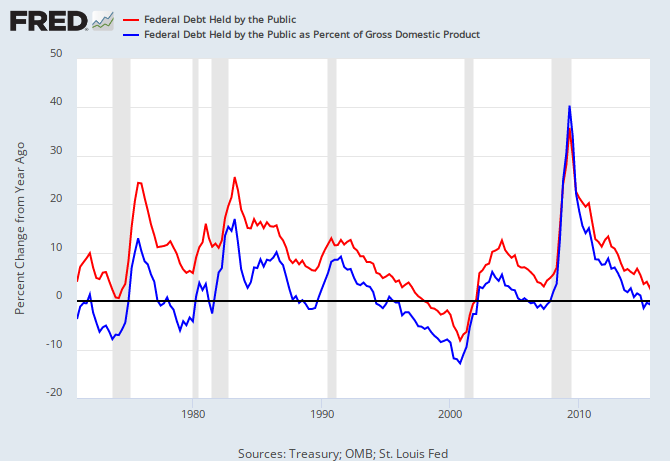
Vertical gray bars mark recessions.
As the federal deficit growth lines drop, we approach recession, which will be cured only when the growth lines rise. Increasing federal deficit growth (aka “stimulus”) is necessary for long-term economic growth.
————————————————————————————————————————————————————————————————————————————————————————————————-
Mitchell’s laws:
•Those, who do not understand the differences between Monetary Sovereignty and monetary non-sovereignty, do not understand economics.
•Any monetarily NON-sovereign government — be it city, county, state or nation — that runs an ongoing trade deficit, eventually will run out of money.
•The more federal budgets are cut and taxes increased, the weaker an economy becomes..
•Liberals think the purpose of government is to protect the poor and powerless from the rich and powerful. Conservatives think the purpose of government is to protect the rich and powerful from the poor and powerless.
•The single most important problem in economics is the Gap between rich and the rest..
•Austerity is the government’s method for widening the Gap between rich and poor.
•Until the 99% understand the need for federal deficits, the upper 1% will rule.
•Everything in economics devolves to motive, and the motive is the Gap between the rich and the rest..
MONETARY SOVEREIGNTY


 #Monetary Sovereignty - Mitchell