Historical claims the Federal Debt is a “ticking time bomb.” From Sept. 26, 1940, to June 21, 2024

This is an update of previous posts showing the seemingly never-ending warnings about “federal debt” (that isn’t federal and isn’t debt).

The Big Lie in economics is: “Federal taxes fund federal spending.” The truth is that federal taxes fund nothing. They are destroyed upon receipt by the Treasury.

The U.S. federal government is not like state/local governments, not like euro governments, not like businesses, and not like you and me.

It uniquely is Monetarily Sovereign. It cannot, unwillingly, run short of its own sovereign currency, the U.S. dollar. As real experts have said:

Former Federal Reserve Chairman Alan Greenspan: “A government cannot become insolvent with respect to obligations in its own currency. There is nothing to prevent the federal government from creating as much money as it wants and paying it to somebody. The United States can pay any debt it has because we can always print the money to do that.

Former Fed Chairman Ben Bernanke: “The U.S. government has a technology, called a printing press (or, today, its electronic equivalent), that allows it to produce as many U.S. dollars as it wishes at essentially no cost. It’s not tax money… We simply use the computer to mark up the size of the account.”

Statement from the St. Louis Fed: “As the sole manufacturer of dollars, whose debt is denominated in dollars, the U.S. government can never become insolvent, i.e., unable to pay its bills. In this sense, the government is not dependent on credit markets to remain operational.

Press Conference: Mario Draghi, President of the Monetarily Sovereign ECB, 9 January 2014 Question: can the ECB ever run out of money? Mario Draghi: Technically, no. We cannot run out of money.

Because the U.S. federal government has the infinite ability to create its sovereign currency, the U.S. dollar, it never borrows dollars.

Contrary to popular wisdom, T-bills, T-notes, and T-bonds do not represent borrowing. They simply are deposits, the purpose of which is to provide a safe place to store unused dollars and to help the Fed control interest rates.

The government never touches those dollars, which remain the property of the depositors. Not only can our Monetarily Sovereign government not run short of dollars, but federal deficits are necessary to grow the economy, as evidenced by the formula: GDP = Federal Spending + Nonfederal Spending + Net Exports.

When we don’t have sufficient federal deficits, we have depressions and recessions:

U.S. depressions tend to come on the heels of federal surpluses.

        1. 1804-1812: U. S. Federal Debt reduced 48%. Depression began 1807.
        2. 1817-1821: U. S. Federal Debt reduced 29%. Depression began 1819.
        3. 1823-1836: U. S. Federal Debt reduced 99%. Depression began 1837.
        4. 1852-1857: U. S. Federal Debt reduced 59%. Depression began 1857.
        5. 1867-1873: U. S. Federal Debt reduced 27%. Depression began 1873.
        6. 1880-1893: U. S. Federal Debt reduced 57%. Depression began 1893.
        7. 1920-1930: U. S. Federal Debt reduced 36%. Depression began 1929.
        8. 1997-2001: U. S. Federal Debt reduced 15%. Recession began 2001.

Periodically, we publish yet another shrieking claim that the U.S. federal debt is “unsustainable” and a “ticking time bomb.”

This lie has been told to you every year (really, almost every day) since 1940, and that bomb has never exploded, nor will it.

Rather than repeat the entire list of the thousands of lies to which you have been subject, I will list samples here as a reference and add periodically, at the end, new “federal debt is a ticking time bomb lies as I encounter them.

Read these and see that even respected economists replace facts with intuition:

 ————————//—————————

September 26, 1940, New York Times: The federal budget was a “ticking time-bomb which can eventually destroy the American system,” said Robert M. Hanes, president of the American Bankers Association.

September 26, 1940, New York Times: The federal budget was a “ticking time-bomb which can eventually destroy the American system,” said Robert M. Hanes, president of the American Bankers Association. 
By 1960, the debt was “threatening the country’s fiscal future,” said Secretary of Commerce Frederick H. Mueller. (“The enormous cost of various Federal programs is a time-bomb threatening the country’s fiscal future, Secretary of Commerce Frederick H. Mueller warned here yesterday.”)

By 1983“The debt probably will explode in the third quarter of 1984,” said Fred Napolitano, former National Association of Home Builders president.

In 1984: AFL-CIO President Lane Kirkland said. “It’s a time bomb ticking away.”

In 1985“The federal deficit is a ticking time bomb, and it’s about to blow up,” U.S. Sen. Mitch McConnell. (Remember him?)

Later in 1985: Los Angeles Times: “We labeled the deficit a ‘ticking time bomb that threatens to permanently undermine the strength and vitality of the American economy.”

In 1987: Richmond Times-Dispatch – Richmond, VA: “100TH CONGRESS FACING U.S. DEFICIT’ TIME BOMB‘”

Later in 1987: The Dallas Morning News: “A fiscal time bomb is slowly ticking that, if not defused, could explode into a financial crisis within the next few years for the federal government.”

In 1989: FORTUNE Magazine: “A TIME BOMB FOR U.S. TAXPAYERS

In 1992: The Pantagraph – Bloomington, Illinois: “I have seen where politicians in Washington have expressed little or no concern about this ticking time bomb they have helped to create, that being the enormous federal budget deficit, approaching $4 trillion.

Later in 1992, Ross Perot said, “Our great nation is sitting right on top of a ticking time bomb. We have a national debt of $4 trillion.”

In 1995: Kansas City Star: “Concerned citizens. . . regard the national debt as a ticking time bomb poised to explode with devastating consequences at some future date.”

In 2003: Porter Stansberry, for the Daily Reckoning: “Generation debt is a ticking time bomb . . . with about ten years left on the clock.”

In 2004: Bradenton Herald: “A NATION AT RISK: TWIN DEFICIT A TICKING TIME BOMB

In 2005: Providence Journal: “Some lawmakers see the Medicare drug benefit for what it is: a ticking time bomb.”

In 2006: NewsMax.com, “We have to worry about the deficit . . . when we combine it with the trade deficit, we have a real ticking time bomb in our economy,” said Mrs. Clinton.

In 2007: USA Today: “Like a ticking time bomb, the national debt is an explosion waiting to happen.

In 2010: Heritage Foundation: “Why the National Debt is a Ticking Time Bomb. Interest rates on government bonds are virtually guaranteed to jump over the next few years.

In 2010: Reason Alert: “. . . the time bomb that’s ticking under the federal budget like a Guy Fawkes’ powder keg.”

In 2011: Washington Post, Lori Montgomery:”. . . defuse the biggest budgetary time bombs that are set to explode.”

June 19, 2013Chamber of Commerce: Safety net spending is a ‘time bomb’, By Jim Tankersley: The U.S. Chamber of Commerce is worried that not enough Americans are worried about social safety net spending. The nation’s largest business lobbying group launched a renewed effort Wednesday to reduce projected federal spending on safety-net programs, labeling them a “ticking time bomb” that, left unchanged, “will bankrupt this nation.”

On June 15, 2014: CBN News: “The United States of Debt: A Ticking Time Bomb

On June 18, 2015The ticking economic time bomb that presidential candidates are ignoring: Fortune Magazine, Shawn Tully,

On February 10, 2016The Daily Bell“Obama’s $4.1 Trillion Budget Is Latest Sign of America’s Looming Collapse”

On January 23, 2017Trump’s ‘Debt Bomb‘: Deficit May Grow, Defense Budget May Not, By Sydney J. Freedberg, Jr.

On January 27, 2017: America’s “debt bomb is going to explode.” That’s according to financial strategist Peter Schiff. Schiff said that while low interest rates had helped keep a lid on U.S. debt, it couldn’t be contained for much longer. Interest rates and inflation are rising, creditors will demand higher premiums, and the country is headed “off the edge of a cliff.”

On April 28, 2017Debt in the U.S. Fuel for Growth or Ticking Time Bomb?, American Institute for Economic Research, by Max Gulker, PhD – Senior Research Fellow, Theodore Cangeros

February 16, 2018 America’s Debt Bomb By Andrew Soergel, Senior Reporter: Conservatives and deficit hawks are hurling criticism at Washington for deepening America’s debt hole.

April 18, 2018 By Alan Greenspan and John R. Kasich: “Time is running short, and America’s debt time bomb continues to tick.”

January 10, 2019Unfunded Govt. Liabilities — Our Ticking Time Bomb. By Myra Adams, Tick, tick, tick goes the time bomb of national doom.

January 18, 2019; 2019 Is Gold’s Year To Shine (And The Ticking U.S. Debt Time-Bomb) By Gavin Wendt

April 10, 2019, The National Debt: America’s Ticking Time Bomb. TIL Journal. Entire nations can go bankrupt. One prominent example was the *nation of Greece which was threatened with insolvency a decade ago. Greece survived the economic crisis because the European Union and the IMF bailed the nation out.

July 11, 2019National debt is a ‘ticking time bomb: Sen. Mike Lee

SEP 12, 2019Our national ticking time bomb, By BILL YEARGIN SPECIAL TO THE SUN SENTINEL | At some point, investors will become concerned about lending to a debt-riddled U.S., which will result in having to offer higher interest rates to attract the money. Even with rates low today, interest expense is the federal government’s third-highest expenditure following the elderly and military. The U.S. already borrows all the money it uses to pay its interest expense, sort of like a Ponzi scheme. Lack of investor confidence will only make this problem worse.

JANUARY 06, 2020, National debt is a time bomb, BY MARK MANSPERGER, Tri City Herald | The increase in the U.S. deficit last year was about $1.1 trillion, bringing our total national debt to more than $23 trillion! This fiscal year, the deficit is forecasted to be even higher, and when the economy eventually slows down, our annual deficits could be pushing $2 trillion a year! This is financial madness. there’s not going to be a drastic cut in federal expenditures — that is, until we go broke — nor are we going to “grow our way” out of this predicament. Therefore, to gain control of this looming debt, we’re going to have to raise taxes.

February 14, 2020, OMG! It’s February 14, 2020, and the national debt is still a ticking time bomb! The national debt: A ticking time bomb? America is “headed toward a crisis,” said Tiana Lowe in WashingonExaminer.com. The Treasury Department reported last week that the federal deficit swelled to more than $1 trillion in 2019 for the first time since 2012. Even more alarming was the report from the bipartisan Congressional Budget Office (CBO) predicting that $1 trillion deficits will continue for the next 10 years, eventually reaching $1.7 trillion in 2030

April 26, 2020, ‘Catastrophic’: Why government debt is a ticking time bomb, Stephen Koukoulas, Yahoo Finance  [Re. Monetarily Sovereign Australia’s debt.]

August 29, 2020LOS ANGELES, California: America’s mountain of debt is a ticking time bomb  The United States not only looks ill, but also dead broke. To offset the pandemic-induced “Great Cessation,” the U.S. Federal Reserve and Congress have marshalled staggering sums of stimulus spending out of fear that the economy would otherwise plunge to 1930s soup kitchen levels. Assuming that America eventually defeats COVID-19 and does not devolve into a Terminator-like dystopia, how will it avoid the approaching fiscal cliff and national bankruptcy?

April 16, 2021NATIONAL POLICY: ECONOMY AND TAXES / MARK ALEXANDER / The National Debt Clock: A Ticking Time Bomb: At the moment, our national debt exceeds $28 TRILLION — about 80% held as public debt and the rest as intragovernmental debt. That is $225,000 per taxpayer. Federal annual spending this year is almost $8 trillion, and more than half of that is deficit spending — piling on the national debt.

June 17, 2022 Time Bomb On National Debt Is Counting Down Faster Thanks To Fed’s Rate Hike,  Tim Brown /We are now staring down the barrel of the end of the U.S. economy based on fiat money, printed out of thin air but charged back to the people at ridiculous interest rates.

Now, the national debt is approaching $31 trillion, which is $12 trillion more than when Donald Trump took office in 2017 and more than half of that debt was tacked on in his final year. Then we’ve had the disastrous year and a half of Joe Biden.

Now, the Fed is now hiking its rates and that spells even more trouble for the national debt and the economy at large.

December 4, 2022 America’s ticking time bomb: $66 trillion in debt that could crash the economy By Stephen Moore, The national debt is $31 trillion when including Social Security’s and Medicare’s unfunded liabilities. Wake up, America.

That ticking sound you’re hearing is the American debt time bomb that with each passing day is getting precariously close to detonating and crashing the US economy.

January 13, 2023. A ticking time bomb in the U.S. economy is running perilously close to detonation. Long considered a harbinger of bad luck, Friday, Jan. 13 came with a warning for Congress that the country could default on its debt as soon as June. 

With the U.S. reaching its debt limit of $31.4 trillion on Jan. 19, Treasury Secretary Janet Yellen urged lawmakers to increase or suspend the debt ceiling.

February 5 2023 ‘The world’s largest Ponzi scheme’: Peter Schiff just blasted the US debt ceiling drama. Here are 3 assets he trusts amid major market uncertainty Story by Bethan Moorcraft, A ticking time bomb in the U.S. economy is running perilously close to detonation. With the U.S. reaching its debt limit of $31.4 trillion on Jan. 19, Treasury Secretary Janet Yellen urged lawmakers to increase or suspend the debt ceiling.

April 22, 2023 The Debt Ceiling Debate Is About More Than Debt, Jim Tankersley, WASHINGTON — Speaker Kevin McCarthy of California has repeatedly said that he and his fellow House Republicans are refusing to raise the nation’s borrowing limit, and risking economic catastrophe, to force a reckoning on America’s $31 trillion national debt. “Without exaggeration, America’s debt is a ticking time bomb that will detonate unless we take serious, responsible action,” he said this week.

November 3, 2023 The Fuse on America’s Debt Bomb Just Got Shorter, J Antoni Heritage Organization. The Treasury is now on track to borrow almost as much in just six months as it did in the previous 12 months. That’s nearly a doubling of the deficit. Because the federal debt is $33.7 trillion, just a 1 percent increase in yields adds $337 billion to the annual cost of servicing the debt over time. Absent spending reform, eventually no one will be willing to hold the bomb anymore, and the yields on U.S. debt will begin to resemble those in Argentina.

February 2, 2024 How Florida can help defuse the nation’s debt bomb By  professor emeritus of economics at the University of Colorado Boulder and  former comptroller general of the United States. Washington’s out-of-control spending, combined with fiscal and monetary policies have resulted in trillion-dollar-plus annual deficits, over $34 trillion in federal debt, over $125 trillion in total federal liabilities and unfunded obligations, and excess inflation. Excessive spending and loose monetary policy increase inflation in the short term, and mounting debt burdens serve to reduce future economic growth and shift the economic burden and consequences of mounting debt burdens to future generations.

February 8, 2024 Legendary investor Paul Tudor Jones says a ‘debt bomb’ is about to go off in the U.S.: ‘We’re fast-pouring consumption like crazy’. The U.S. economy may seem like it’s firing on all cylinders, but underneath the surface, a “debt bomb” could be on the verge of exploding, according to billionaire hedge fund manager Paul Tudor Jones. The esteemed investor said in an interview with CNBC that he couldn’t deny the economy was strong, but that it was actually “on steroids” due to massive government spending and borrowing.

Jones is not the only one to call attention to the growing deficit issue in the U.S. On Sunday, Federal Reserve Chairman Jerome Powell took a rare dive into politics, telling CBS’s 60 Minutes that the national debt was “growing faster than the economy,” and calling for lawmakers to get the federal government “back on a sustainable fiscal path.” Meanwhile, U.S. Treasury Secretary Janet Yellen has said she is not yet worried about the increasing national debt as long as the government keeps in check the net payments it makes on its debt relative to GDP.

Those payments are projected to rise from 2.5% last year to 2.9% next year, according to the Office of Management and Budget—below their level in the early 1990s. Jones told CNBC that the strong economy could postpone the effects of the government’s deficit spending, but only for a little while. “The only question is … when does that manifest itself in markets?” he added.

“It could be this year, it could be next year. Productivity may mask and it might be three or four years from now. But clearly, clearly we’re on an unsustainable path.”

June 21, 2024 My Weekly Column: Our debt crisis is a ticking time bomb by Randy Feenstra: On June 18th, the nonpartisan Congressional Budget Office (CBO) – the government agency tasked with monitoring our nation’s fiscal health – confirmed my serious concerns with President Biden’s reckless spending agenda.

His administration’s fiscal policies have not only caused cumulative inflation to skyrocket by over 20% since he took office, but they have also accelerated our accumulation of debt to levels that are beyond unsustainable. Instead of changing course, he recently released his budget for Fiscal Year 2025, which has a $ 7.3 trillion price tag and looks to raise taxes on our families, farmers, and businesses to the tune of $5.5 trillion.

The CBO estimates that his debt “cancelation” policies will cost taxpayers nearly $400 billion over the next ten years. I strongly oppose these bailouts. Iowans who never attended college entered the workforce early or helped put their kids through school should not be forced to pick up the tab for President Biden’s costly and unfair executive orders. 

———————–//———————–

The latest installment contains the same old lies (“unsustainable,” “cost taxpayers” 0they’ve been telling since 1940.

They have been wrong for all those years. If we wait long enough, something will happen to prove them right, perhaps in a thousand years?

Today, this makes “only” 84 years of the debt nuts be ignorant. 

The federal deficit yields economic growth year after year. When deficits are insufficient, we have had recessions, which were cured by increased deficits.
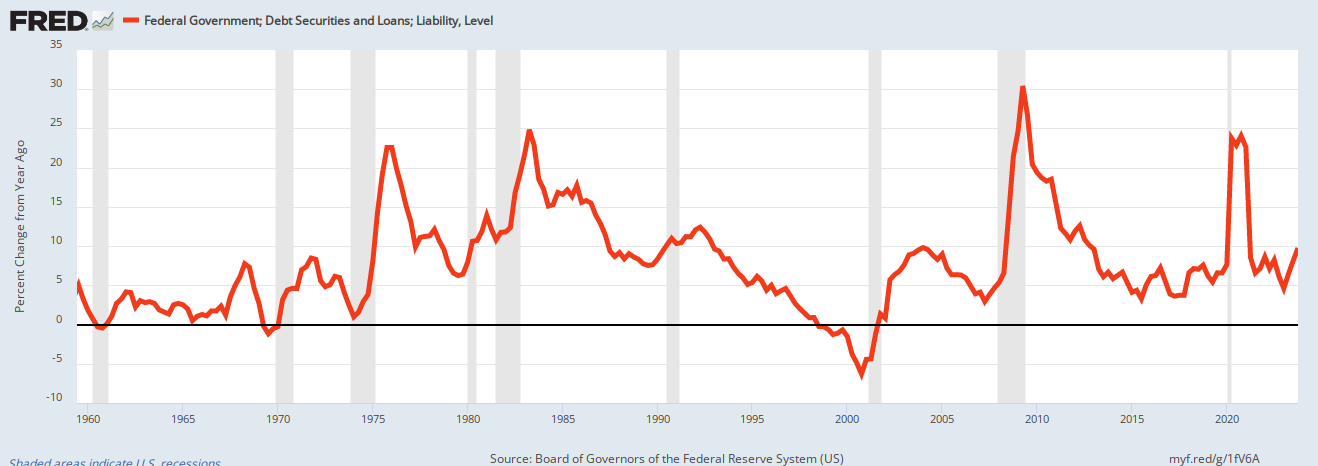
When deficits decline, we have recessions (vertical gray bars), which are cured by increased deficits.

If respected economists keep predicting something terrible is imminent year after year, yet exactly the opposite happens, at what point do they reexamine their beliefs?

At what point does the public say, “Fool me once; shame on you. Fool me repeatedly for 84 years; shame on me”?

Rodger Malcolm Mitchell

Monetary Sovereignty Twitter: @rodgermitchell Search #monetarysovereignty Facebook: Rodger Malcolm Mitchell

……………………………………………………………………..

THE SOLE PURPOSE OF GOVERNMENT IS TO IMPROVE AND PROTECT THE LIVES OF THE PEOPLE.

The most important problems in economics involve:

  1. Monetary Sovereignty describes money creation and destruction.
  2. Gap Psychology describes the common desire to distance oneself from those “below” in any socio-economic ranking, and to come nearer those “above.” The socio-economic distance is referred to as “The Gap.”

Wide Gaps negatively affect poverty, health and longevity, education, housing, law and crime, war, leadership, ownership, bigotry, supply and demand, taxation, GDP, international relations, scientific advancement, the environment, human motivation and well-being, and virtually every other issue in economics.

A Libertarian tells “the truth” about federal debt.

What follows is an article by a Libertarian, interspersed with a few whiffs of reality.

The national debt is over $34 trillion. It’s time to tell the truth about the U.S. government’s finances Story by Libertarian Alvaro Vargas Llosa

Yes, Mr. Vargas Llosa, it is time to tell the truth about government finances. Some might say, “Well, past time. Sadly, your article does not do it. The purpose of government financing is not to give the government more money. Because the U.S. federal government is Monetarily Sovereign, it already has infinite money.

Former Federal Reserve Chairman Alan Greenspan: “A government cannot become insolvent with respect to obligations in its own currency. There is nothing to prevent the federal government from creating as much money as it wants and paying it to somebody. The United States can pay any debt it has because we can always print the money to do that.”

Former Federal Reserve Chairman Ben Bernanke: “The U.S. government has a technology, called a printing press (or, today, its electronic equivalent), that allows it to produce as many U.S. dollars as it wishes at essentially no cost. It’s not tax money… We simply use the computer to mark up the size of the account.

The purpose of the federal government — any government, in fact — is to improve the lives of the people. One measure of the improvement is Gross Domestic Product, the total amount of spending in an economy. Here is what federal deficit spending has done to Gross Domestic Product.
As deficit spending increasingly adds dollars to the economy, the economy grows.
While the self-proclaimed “truth-tellers” complain about federal deficits and debt (red), America’s Gross Domestic Product (blue) has risen enormously. “Ah,” they say, “but all that “money printing” has caused inflation, so Americans really are poorer now.” I call the “truth-tellers” attention to the following graph.
Real (inflation-adjusted) GDP per person has risen enormously for the past 90 years.
That graph shows that the average American is wealthier today than at any time in history. Federal deficit spending enriches Americans. But—and it’s a big “but”— averages don’t tell the full story because of the income/wealth/power Gap, You can read more about that at the link.

If anyone living in the United States in the decades immediately after the Second World War had predicted the self-inflicted financial mess the U.S. government now finds itself in, nobody would have taken that person seriously.

A normal human would say that a “financial mess” is a situation in which a person has difficulty paying his/her financial obligations. But as Messrs. Greenspan and Bernanke explain, the Monetarily Sovereign U.S. government has no such difficulty. It pays all its financial obligations simply by creating more dollars. So what does Mr. Vargas Llosa mean by “financial mess“? Nowhere in his article does he explain. Typical for “debt- truth tellers” who use frightening words to deceive.

For most of American history, until the mid-1970s, annual federal spending and revenue were roughly in balance—the exceptions being in wartime.

Contrast that with the federal deficit in fiscal year 2023, which topped $1.7 trillion, an amount larger than Mexico’s total economy (the 12th largest in the world).

It exceeded $1 trillion again in the first eight months of the current fiscal year and, according to the Congressional Budget Office’s latest forecast, released on June 18, will approach $2 trillion by the end of fiscal 2024.

Translation: In 2023, the federal government pumped 1.7 trillion growth dollars into the economy. In the first eight months of the current fiscal year, it pumped another 1 trillion growth dollars into the economy and expects to pump 2 trillion growth dollars into the economy by the end of fiscal 2024. These are dollars that go into the pockets of Americans at no cost to anyone — not to you, not to your friends and family, not to your neighbors. Why? Because federal taxes don’t fund federal spending. Even if federal tax collections totaled $0, the federal government could continue spending forever. The Monetarily Sovereign U.S. federal government neither needs nor uses income. (It is different for state and local governments, businesses, and euro governments, all of which are monetarily non-sovereign, and they do need and use income to fund spending.) The U.S. federal government destroys all the income it receives. Paying creditors is the primary process by which the federal government creates dollars. To pay a creditor, the federal government first creates instructions (checks, wires, etc.) instructing the creditor’s bank to increase the balance in the creditor’s checking account. The instant the creditor’s bank obeys those instructions, new dollars are added to the creditor’s checking account and to the M2 money supply measure. Those dollars are not deducted from the M2 money supply. The bank clears those instructions through the Federal Reserve. Thus the federal government approves its own instructions, which is why it never can run short of dollars. By contrast, when a local government sends instructions, M2 dollars are deducted from the local government’s checking account in a bank and added to a creditor’s bank account. No net dollars are created. They merely are transferred. Not understanding the differences between Monetary Sovereignty and monetary non-sovereignty marks one as ignorant about economics.

This has fueled a massive increase in the federal debt, which now totals $34 trillion, about $6 trillion more than America’s gross domestic product (GDP), the value of all the goods and services produced by America’s 330 million residents in a year.

If we count Social Security and Medicare liabilities, total debt is several times larger than GDP.

The debt/GDP ratio is meaningless. Those who quote it hope to scare you with irrelevant numbers. Federal debt is not a burden on the government or on taxpayers. It is nothing like private sector debt. Neither you nor anyone else pays for the federal debt—never has, never will. The so-called “debt” is nothing more than dollars deposited into T-security accounts. The contents of these accounts are wholly owned by the depositors and never used by the federal government. The purpose of T-accounts is not to provide spending money to the government. The purpose is to stabilize the dollar by:
  1. Providing a storage place for unused dollars that is safer than any private bank account.
  2. To help the Fed control interest rates by providing a “floor” rate.
Upon request by the owners, the dollars in T- accounts are transferred back to their owners. This is not a financial burden on the federal government, and no tax dollars are involved.

The consequences are sobering. Politicians like to use euphemisms to describe what they’re doing. Government spending, in the current vernacular, is referred to as “investment.”

Government spending, however, crowds out investment, which explains why private investment, the equivalent of 4.8% of GDP, is 30% lower than in 2000.

Government spending is more properly termed “investments,” not “debt. The economy doesn’t care where he investments come from. In fact, federal spending creates new growth dollars, while private investment only moves existing dollars. The “truth tellers” prefer the government to reduce its spending under the false narrative that this somehow will grow the economy. But:

GDP = Federal Spending + Non-federal Spending + Net Exports.

I have yet to communicate with a debt “truth-teller” who can explain the math of how cuts to federal spending will increase GDP.

At the same time, the purchasing power of the U.S. dollar, a reflection of both the federal government’s finances and the Federal Reserve’s money printing, also is down: by more than 50% since 2000.

That’s called “inflation,” and as we have seen, the economy has enjoyed real (inflation-adjusted) growth.

As a result of this economic mismanagement, the U.S. government will pay close to $900 billion this year just in interest payments on the national debt—and, according to Congressional Budget Office (CBO) projections, which assume an idyllic scenario of no major wars, no recessions, and no financial crises, debt service will steadily increase to some $5.3 trillion by 2054.

Translation: This year, at no cost to anyone, the government will pump 900 billion growth dollars into the economy in interest payments alone. In 2054, the government will pump 5.3 trillion growth dollars into the economy — also at no cost to anyone. Most of those dollars will go into the pockets of the American people.

It was hard enough sustaining a debt that stood at 106% of GDP during WWII, when the country’s savings rate was 24%, but sustaining a much higher level of indebtedness with today’s 3% savings rate defies the imagination.

Oh, Mr. Vargas Llosa, I’ll bet you’re not even trying to use your imagination.  The only difficulty in “sustaining” the debt came from being on a gold standard, which limited the government’s ability to create dollars. But Nixon took us off the gold standard in 1971 (Roosevelt did it for domestic us in 1933), and since then the federal government has had the infinite ability to “sustain” any level of deficit spending. It never can run short of dollars. Private savings and the debt/GDP ratio are irrelevant to the government’s ability to “sustain.” but one must assume Mr. Vargas Llosa tosses in those numbers for fear effect, not because they make any sense whatsoever.

This catastrophe has been a long time in the making. In 1993, for instance, the annual deficit amounted to 3.8% of GDP, and the debt, which seemed astronomically high at a “mere” $4.4 trillion, was Lilliputian by today’s standards.

The U.S.’s real GDP was approximately $7.1 trillion in 1993. In 2023, it increased to approximately $21.6 trillion. And this is a “catastrophe”?? One hopes we continue to have “catastrophes” like that.

The trend goes back longer than that. The growth of the U.S. government in modern times is the story of post-WWII America.

President Dwight Eisenhower seems to have been the last guy in the post-WWII era who understood that the welfare state, the warfare state, and tax cuts not backed by tough spending cuts are incompatible with fiscally responsible government, or at least with reasonably-sized government.

During Eisenhower’s term, we suffered, not one, not two, but three recessions. One, called the “Eisenhower Recession,” occurred between 1957 and 1958. We had a sharp contraction in economic activity, high unemployment, and a decline in industrial production. Is that an example of “fiscal responsibility?”
The “wonderful” Eisenhower years. Three recessions. When federal deficit spending declined, GDP declined into recessions,
The 1953-54 recession was caused by the reduced deficit spending for the Korean War. This is a regular pattern: Reduced deficit spending leads to a recession, which is cured by increased deficit spending.  See below.
A. Economic growth = B. Federal deficit growth + C. private sector spending. Cut B and C, and A declines into recession. Simple math.
The reason for the pattern is clear. Reduced deficit spending adds fewer growth dollars to the economy, so the economy sinks into recession. Curing the recession requires increased growth dollars.

Between 1950 and 1970, total debt (including government, household, corporate, and financial) was stable at about 150% of GDP. After Nixon did away with what was left of the gold standard in 1971, it was off to the races. Since then, total debt has grown by nearly 5,600%, more than double the U.S. economic growth rate.

This is another sleight-of-hand debt/GDP comparison that is meaningless. Nothing can be learned from comparing federal debt (i.e., the net cumulative total of deposits into Treasury Security accounts) vs. GDP (the total of all government and private spending in any given year). They are akin to comparing tons of butter eaten in the past 10 years with the number of butterflies born this year. Totally meaningless. If you don’t believe me, see Debt To GDP Ratio By Country. Scroll down to the middle of the page, where you will see every nation’s Debt/GDP ratio, from the highest (Japan) to tied for the lowest (Taiwan and several others). Look at those ratios, and you will see they tell you nothing about a nation’s ability to pay its bills.

There was a time, even in the middle of the Cold War, when government leaders, despite their international responsibilities and the onerous legacy of the New Deal and Great Society that nobody dared reverse, understood the need for fiscal discipline and containing the growth of government.

And there it is: The Libertarian belief in an “onerous legacy” of programs designed to aid middle and lower-income groups. That is the “onerous legacy” that gave us Social Security, Medicare, the War on Poverty, the Office of Economic Opportunity and the Economic Opportunity Act, a Job Corps for disadvantaged individuals, established work-study programs and community action initiatives, provided health insurance for elderly Americans, improving access to medical care, legislation addressing environmental concerns and conservation efforts, supported education, and Civil Rights Laws, focused on reducing racial injustice and promoting equality. Is it any wonder that a right-wing Libertarian should consider those “onerous?” After all, they cost dollars the government creates at the touch of a computer key, and much to Libertarian dismay, narrow the Gap between the rich and the rest.

The 12 years under Presidents Ronald Reagan and George H. W. Bush averaged a 4% deficit due to defense spending increases, abandonment of domestic restraint—a legacy of Johnson’s “bread and butter” years and the Nixon-Ford presidencies’ about-face on most of the economic principles they previously had espoused—and the unfunded tax cuts influenced by Arthur Laffer’s notion that tax cuts would pay for themselves.

Oh, yes, cut defense spending to weaken the military at a time when we are the last hope for democracy. And eliminate the “bread and butter” for the poor and disadvantaged. Perfect. And then there were the “unfunded tax cuts,” which is an oxymoron. Taxes need to be funded by the people. No one needs to fund tax cuts. They don’t need to be paid for, and the government doesn’t need or use taxes. In fact, it destroys all tax dollars it receives.

The new millennium distorted matters even further, with the annual deficit from 2002 to 2023 averaging 5% over the two decades, 20% higher than nominal economic growth, which averaged 4.2%.

And yet again he mentions the meaningless debt/GDP ratio. It never ends for the Libertarians.

President Obama, under whom the deficit was double the Congressional Budget Office’s original projections, got the spending spree started, with Presidents Trump and Biden taking it to new levels.

And the economy grew massively.

It’s now come down to this. Unless a new generation of leaders has the courage to cut such “untouchables” as the defense, education, justice, and homeland security budgets, and privatize the Social Security program (as more than 40 countries wisely have done), sooner or later, the current trajectory of federal finances will lead to an extremely ugly place.

The above is a perfect description of the effort to widen the Gap between the rich and the rest, while weakening our economy and our national defense.

If you think things are bad now, just wait.

If we ever elect a right-wing, Libertarian fool to be President, along with our current, right-wing SCOTUS, and right-wing governors, things can get much worse. Rodger Malcolm Mitchell Monetary Sovereignty Twitter: @rodgermitchell Search #monetarysovereignty Facebook: Rodger Malcolm Mitchell; MUCK RACK: https://muckrack.com/rodger-malcolm-mitchell

……………………………………………………………………..

The Sole Purpose of Government Is to Improve and Protect the Lives of the People.

MONETARY SOVEREIGNTY

Translation of what you were told last year

Here is an article from last year, expressing the common sentiment. I’ve translated it for you so you can evaluate that common sentiment.

The US is paying a record amount of interest on its debt. It’s only going to get worse By Tami Luhby, CNN, Tue February 14, 2023

Translation: The US is pumping a record amount of growth dollars into the economy. It’s only going to get better.

Powell urges Congress to solve growing US debt ‘sooner, rather than later’

Translation: Powell urges Congress to blame federal “debt” for the inflation, so he doesn’t get blamed. We’ve had massive “debt” (See: The “National Debt” isn’t national, and it isn’t a debt) in the past without inflation. Powell doesn’t tell you that because he is a member of the “Federal Debt is a Ticking Time Bomb” culture.

Like many Americans, the federal government is shelling out a lot more money to cover interest payments on its debt after a series of Federal Reserve rate hikes over the past year.

Translation: The federal government is nothing “like many Americans.” The federal government is Monetarily Sovereign, while the American people are monetarily non-sovereign. But we want you to believe the government is just like you.

The Treasury Department paid a record $213 billion in interest payments on the national debt in the last quarter of 2022, up $63 billion from the same period a year earlier.

Translation: The Treasury Department pumped a record $213 billion growth dollars worth of interest payments in the last quarter of 2022. That is $64 billion added to Gross Domestic Product (GDP)from the same period a year earlier.

The fourth-quarter tab was also nearly $30 billion more than in the prior quarter, which is the largest quarterly increase on record, said Jerry Dwyer, an economics professor emeritus at Clemson University.

Translation: The fourth-quarter addition to GDP was nearly $30 billion more than in the prior quarter, the largest stimulus to the economy on record.

Borrowing costs are expected to become an increasingly heavy burden in coming years. The Congressional Budget Office is set to provide its latest estimate on Wednesday.

The surge is due mainly to the Federal Reserve raising interest rates by 4.25% between March and December. The central bank increased the rate another quarter point in February.

Translation: The Federal Reserve is raising interest rates by 4.25%, which will increase the price of everything, in its effort to combat increased prices. Think about that.

Until recently, it cost the federal government very little to issue debt to finance its operations.

Translation: Until recently, it cost the federal government very little to create the dollars to finance its operations. Just the press of a few computer keys.

“It was almost free money,” Dwyer said. “You could borrow a trillion dollars, and if you financed it with Treasury bills, you paid almost no interest.”

Translation (courtesy of former Fed Chairman Ben Bernanke): “The U.S. government has a technology, called a printing press (or, today, its electronic equivalent), that allows it to produce as many U.S. dollars as it wishes at essentially no cost.” Translation (courtesy of former Fed Chairman Alan Greenspan): “There is nothing to prevent the federal government from creating as much money as it wants and paying it to somebody.” So, why would the government borrow dollars? It doesn’t.

“But interest rates weren’t going to stay there forever.”

Translation: The Fed raises rates, which increases all prices, i.e., causes inflation, to fight inflation. It’s like a doctor bleeding a patient to cure anemia.

The national debt is once again in the spotlight now that the US has hit its $31.4 trillion debt ceiling, forcing Congress to take action or risk a catastrophic default. 

Translation: The US has hit its $31.4 debt ceiling, which actually isn’t a “debt” ceiling. Everything has already been paid for, and nothing is owed. There is no debt. The dollars exist in T-security accounts. To  pay off those accounts, the government merely returns the existing dollars. Congress created the fake “debt” ceiling to make itself look prudent to an ill-informed electorate.
Decreases in federal deficits (red) cause recessions (vertical gray bars), which are cured by increases in federal deficits.
Those who call for a decrease in deficit spending ignore the fact that economic growth relies on the federal government continuing to pump money into the economy.

The Treasury Department is taking extraordinary measures to allow the government to continue paying its bills in full and on time, which it expects to last at least until early June.

Translation (Courtesy of Alan Greenspan): “The United States can pay any debt it has because we can always print the money to do that.” so the “extraordinary measures” are a bunch of hokum. And so is the fake “debt ceiling.”

The spike in interest payments also contributed to the federal government hitting the debt ceiling that much faster.

And it adds to the pressure on Congress to raise taxes, cut spending or allow the government to borrow more to meet all its obligations.

Translation: The spike in interest payments added growth dollars to GDP much faster. This adds unnecessary pressure on Congress to take dollars out of the economy, thereby causing a recession.

Even if the Federal Reserve slows or stops raising rates this year, as many economists expect, the nation’s borrowing costs will continue to increase.

That’s because as the existing debt matures, the government issues new debt with the higher prevailing interest rates.

Translation: As existing Treasury Securities mature, the government will increase the amount of growth dollars it pumps into the economy.

The higher rates could increase the net interest cost on the national debt to about $9 trillion over the next decade, according to estimates by the Peter G. Peterson Foundation, a nonpartisan organization that seeks to raise awareness of America’s long-term fiscal challenges.

Translation: The higher rates could increase the amount of growth dollars pumped into GDP to about $9 trillion, according to the Peter B. Peterson Foundation, a right-wing organization that, on behalf of the rich, seeks to spread disinformation about America’s finances.

That’s up from the record $8.1 trillion that the CBO projected in May 2022 and the $5.4 trillion it projected in July 2021.

Translation: That’s up from a record $8.1 trillion growth dollars the CBO projected in May 2022, and the $5.4 growth dollars it tried to scare you about in July 2021.

By 2032, interest costs will triple to more than $3 billion per day and to at least $9,400 per household, on average, according to the foundation.

Translation: (Courtesy of Ben Bernanke) “It’s not tax money… We simply use the computer to mark up the size of the account.” By 2032, growth dollars will triple to more than $3 billion per day, and not costing any household a single penny. The federal government creates ad hoc every dollar it spends by pressing computer keys. No tax dollars are used.

They are on track to become the largest federal budget item, surpassing Social Security and Medicare by the middle of the century.

Translation: The government justifies paying too little to Social Security and Medicare by pretending it is short of money when, in fact, it has infinite money.

“Having rapidly growing interest makes it much more difficult for government to fund all the things that are important to our society,” said Michael Peterson, the foundation’s CEO.

Translation: To keep you from asking for benefits, we pretend that “Having rapidly growing interest makes it much more difficult for the government to fund all the things that are important to our society.” Why do we do that? Because the rich tell us to widen the income/wealth/power Gap between them and you. The wider the Gap, the richer they are. So, they bribe the main information sources to tell you the government can afford tax loopholes for the rich, but not Social Security and Medicare increases for the rest of you. Economists are bribed with university grants and promises of lucrative employment later. The media are bribed with advertising dollars and ownership. Politicians are bribed with political contributions and lucrative jobs in “think tanks.” All are bribed to tell you that increasing your benefits is unaffordable. SUMMARY The rich get richer when the income/wealth/Gap widens. So they promulgate the lie that your taxes pay for benefits, and your federal deficits are unsustainable. Rodger Malcolm Mitchell Monetary Sovereignty Twitter: @rodgermitchell Search #monetarysovereignty Facebook: Rodger Malcolm Mitchell; MUCK RACK: https://muckrack.com/rodger-malcolm-mitchell

……………………………………………………………………..

The Sole Purpose of Government Is to Improve and Protect the Lives of the People.

MONETARY SOVEREIGNTY

The easy we make difficult, but it takes a long time.

The U.S. military has a motto: The difficult we do immediately. The impossible takes a little longer.

I suggest a motto for the science of economics: “The easy we make impossible, but it takes forever.”

I say that because of my 25 years critiquing economics articles, and most recently because of an article titled, “Do Budget Deficits Cause Inflation?”

The answer to the question is, “No, not for Monetarily Sovereign nations,” and the article comes to that “No” conclusion. Except:

  1. It never differentiates between Monetarily Sovereign governments (which create and control the value and supply of the money they use) and monetarily non-sovereign governments (cities, counties, states, euro nations, nations that use another nation’s currency, and nations that peg their currency to another nation’s currency}.
  2. It never mentions shortages of critical goods and services, most commonly oil, food, and labor, which are the real causes of inflation.
  3. It complexifies a straightforward solution: To cure a problem, eliminate the cause of the problem. In the case of inflation, the cause is shortages. To cure inflations, eliminate the shortages.
Keith Sill
Keith Sill, Senior Vice President of Research and Director of the Real-Time Data Research Center. keith.sill@phil.frb.org (215) 574-3815

Here are some examples from  “Do Budget Deficits Cause Inflation?”, by Keith Sill.

In 2004, the federal budget deficit stood at $412 billion and reached 4.5 percent of gross domestic product (GDP).

Though not at a record level, the deficit as a fraction of GDP is now the largest since the early 1980s.

Moreover, the recent swing from surplus to deficit is the largest since the end of World War II.

Comment: The deficit as a fraction of GDP is irrelevant to inflation. Federal deficits are beneficial because they add GDP growth dollars to the economy.

Federal surpluses take dollars from the economy, causing depressions and recessions. Mr. Sill could have answered the title question with two simple graphs:

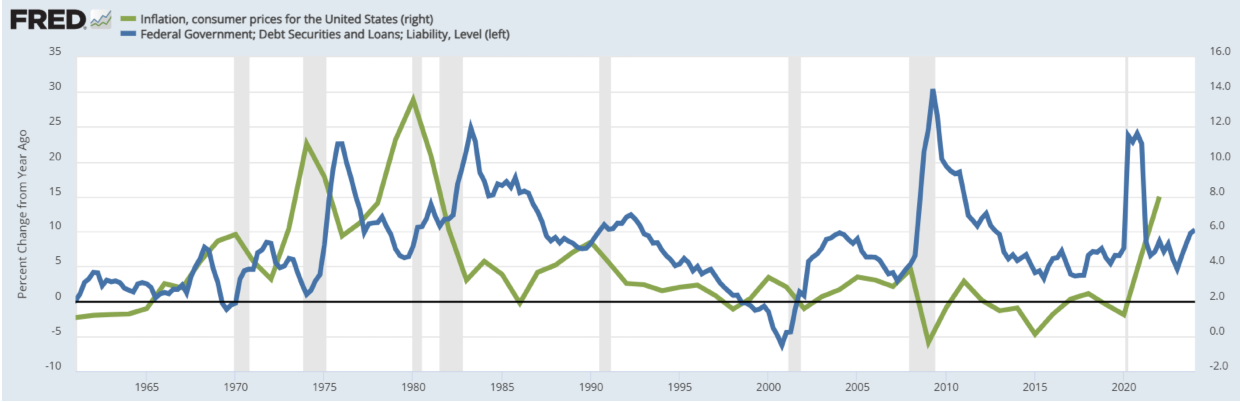
There is no relationship between federal deficit spending (blue line) and inflation.
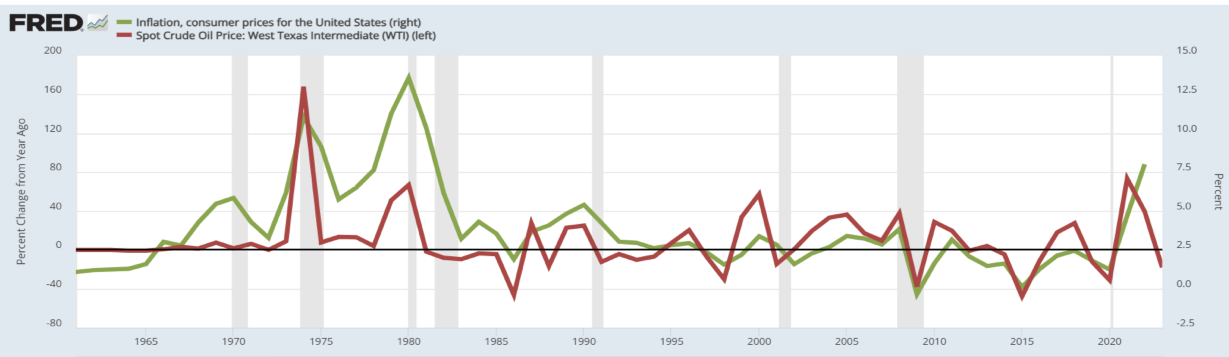
There is a strong relationship between the oil supply (red line) and inflation.

Inflation is caused by shortages of critical goods and services, most often oil, food, and labor.

The flip side of deficit spending is that the amount of government debt outstanding rises: The government must borrow to finance the excess of its spending over its receipts.

Comment: The federal government, being Monetarily Sovereign, never borrows. Why would it? It has the infinite ability to create its sovereign currency, the U.S. dollar, at virtually no cost (aka, “seigniorage”).

Further, unlike state/local government taxes, which fund state/local spending, federal taxes do not fund federal spending.

Federal taxes are destroyed upon receipt, while state and local tax dollars remain in the economy’s private banks. To finance all its spending, the federal government creates new dollars ad hoc.

It does this regardless of taxes collected. Even if federal tax collection totaled $0, the government could continue spending forever.

For the U.S. economy, the amount of federal debt held by the public as a fraction of GDP has been rising since the early 1970s. It now stands at a little over 37 percent of GDP.

The debt/GDP fraction is meaningless. It has no predictive or analytical power and does not tell anything about an economy’s health.

Do government budget deficits lead to higher inflation? When looking at data across countries, the answer is: it depends. Some countries with high inflation also have large government budget deficits. This suggests a link between budget deficits and inflation.

Yet for developed countries, such as the U.S., which tend to have relatively low inflation, there is little evidence of a tie between deficit spending and inflation.

Mr. Sill falsely equates “developed” with Monetary Sovereignty. However, there are “developed” nations – for example, Italy, France, Greece, etc. that are monetarily non-sovereign. They use the euro.

Why are budget deficits are associated with high inflation in some countries but not in others? Government deficit spending is linked to the quantity of money circulating in the economy through the budget restraint, i.e. the relationship between resources and spending.

Money spent has to come from somewhere: In the case of local and national governments, from taxes or borrowing.

But, national governments can also use monetary policy to help finance the government’s deficits.

I believe that Mr. Sill’s use of “resources” means the amount of money a government can spend, which it gets from taxes or borrowing.

Since he doesn’t differentiate among Monetarily Sovereign, monetarily non-sovereign, and “nationally,” his comments are either partially or totally wrong. First, a reminder about the differences between monetary policy and fiscal policy:

  • Monetary policy involves changing the interest rate and influencing the money supply.
  • Fiscal policy involves the government changing tax rates and spending levels to influence aggregate economic demand. (“Aggregate demand” is Gross Domestic Product at a specific time.)

Here are the sources of confusion:

1. Raising interest rates causes prices to rise. The cost of every product includes the cost of interest. Amazingly, this is the Fed’s tool to combat inflation. The Fed’s theory seems to be that raising prices will reduce demand, causing a recession that supposedly will cure inflation.

In short, the Fed causes inflation to cure inflation while claiming to hope a recession doesn’t occur but secretly relies on recession to cure inflation. (Clear?)

Of course, a result can also be stagflation, a combination of recession and inflation, at which point Fed Chairman Jerome Powell, having no solutions, will hide in his closet and pray. (The cure for stagflation is federal deficit spending to obtain and distribute the scarce products while adding growth dollars to the economy.)

2. As the issuer of its money, only a Monetarily Sovereign government can change interest rates by fiat. It sets the lowest rate on its Treasury Securities.

Because a monetarily non-sovereign government is not an issuer of money, it cannot unilaterally change interest rates. It must rely on markets or the issuer of its money.

For example, Italy cannot arbitrarily raise interest rates on euro-based loans. It uses the euro but is not the issuer.

3. Monetarily Sovereign governments don’t borrow their own currency. The above-mentioned Italy, being monetarily non-sovereign, borrows euros.

In short, Sill, an economist at the Fed (!), is confused about what different kinds of governments can do. Next, he confuses households with our Monetarily Sovereign government:

Budget constraints are a fact of life we all face. We’re told we can’t spend more than we have or more than we can borrow.

The U.S. government “has” infinite dollars, so it does not borrow dollars. Those federal T-securities are not a form of borrowing, which is what a monetarily non-sovereign government does when it needs money.

Rather than providing the U.S. government with dollars, T-securities:

  1. Provide a safe parking place for unused dollars — safer than any other storage place (i.e., bank accounts, safe deposit boxes, etc.) The government never touches those dollars. They remain the property of the depositors.
  2. Assist the Fed in controlling interest rates by setting a floor rate.

In that sense, budget constraints always hold: They reflect the fact that when we make decisions, we must recognize we have limited resources.

See the confusion? “We” and the Italian government have limited resources (money), but the U.S. government does not. It has unlimited money. Next, Mr. Sill expressly shows us his confusion between federal finance and personal finance:

Imagine a household that gets income from working and from past investments in financial assets. The household can also borrow, perhaps by using a credit card or getting a home-equity loan.

The household can then spend the funds obtained from these sources to buy goods and services, such as food, clothing, and haircuts.

It can also use the funds to pay back some of its past borrowing and to invest in financial assets such as stocks and bonds.

The household’s budget constraint says that the sum of its income from working, from financial assets, and from what it borrows must equal its spending plus debt repayment plus new investment in financial assets. 

Not one word of the above applies to the U.S. government.

The government does not borrow or use dollars obtained from any source. It creates ad hoc all the funds it spends. Any income the federal government receives is destroyed upon receipt. (See: “Does the U.S. government really destroy your tax dollars?“)

The only federal budget constraint is not a budget constraint at all. Federal agencies routinely exceed budgets. The restraint is whatever Congress and the President say it is at any given moment.

Congress and the President have the unlimited ability to create dollars and stimulate the economy, plus a strong, though not unlimited, ability to obtain and distribute the scarcities causing inflation.

Mr. Sill continues with an explanation that is irrelevant to federal financing.

The household’s sources of funds and spending are all accounted for, and the two must be equal. The household may use borrowing to spend more than it earns, but that funding source is accounted for in the budget constraint.

If the household has hit its borrowing limit, fully drawn down its assets, and spent its work wages, it has nowhere else to turn for funds and would, therefore, be unable to finance additional spending.

I have no idea what Mr. Sills hoped to accomplish by giving household finances as his explanation for federal finances. The two are fundamentally opposite.

Here, Mr. Sills makes sure to show you that he doesn’t understand the difference between the federal government’s Monetary Sovereignty and your household’s monetary non-sovereignty:

Just like households, governments, face constraints that relate spending to sources of funds.

Governments can raise revenue by taxing their citizens, and they can borrow by issuing bonds to citizens and foreigners. In addition, governments may receive revenue from their central banks when new currency is issued.

Governments spend their resources on such things as goods and services, transfer payments such as Social Security to its citizens, and repayment of existing debt.

Central banks are a potential source of financing for government spending, since the revenue the government gets from the central bank can be used to finance spending in lieu of imposing taxes or issuing new bonds.

No, the U.S. government is not “just like households. It does not raise revenue by taxing you. It doesn’t borrow from the central bank. It doesn’t have an existing debt to repay.

And it finances its spending not with taxes or bonds but by creating new money ad hoc. Who says so, Mr. Sill? Your former bosses:

Former Fed Chairman Alan Greenspan: “A government cannot become insolvent with respect to obligations in its own currency. There is nothing to prevent the federal government from creating as much money as it wants and paying it to somebody. The United States can pay any debt it has because we can always print the money to do that.”

Former Fed Chairman Ben Bernanke: “The U.S. government has a technology, called a printing press (or, today, its electronic equivalent), that allows it to produce as many U.S. dollars as it wishes at essentially no cost. It’s not tax money… We simply use the computer to mark up the size of the account.”

Mr. Sill’s article continues for many more paragraphs, so I will just quote one more thought:

There may be limits on the government’s ability to borrow or raise taxes. Obviously, if there were no such limits, there would be no constraint on how much the government could spend at any point in time.

Congress and the president are the only constraints on federal spending. Unlike your checking account, There are no financial constraints. That is why net spending (spending vs. taxing) has risen to $32 trillion.

Certainly governments are limited in their ability to tax citizens. (That is, the government can’t tax more than 100 percent of income.) But are governments constrained in their ability to borrow?

Monetarily non-sovereign governments are constrained by their full faith and credit, i.e., their credit rating. Monetarily Sovereign governments have no need to borrow, so there is no constraint.

Indeed they are. Informally, the value of government debt outstanding today cannot be more than the value of the government’s resources to pay off the debt.

The U.S. government has the infinite ability to pay for anything. Just ask Fed Chairmen Greenspan and Bernanke.

How do governments pay their current debt obligations? One way is for the government to collect more tax revenue than it spends. In this case, the surplus can be used to pay bondholders.

Wrong. All a federal surplus does is reduce Gross Domestic Product, i.e., cause a recession or depression.

Another way to finance existing debt is to collect seigniorage revenue and use that to pay bondholders.

Half right, half wrong. “Collect seigniorage” is a fancy way to say “print money.”

Seigniorage is the difference between the face value of dollars and the cost of creating them, which comes close to zero. However, holders of U.S. Treasury bonds are paid in two ways: Seigniorage pays the interest, and the principal is paid by returning the bondholder’s deposit.

Finally, the government can borrow more from the public to pay existing debt holders.

Wrong again. The federal government does not borrow, though monetarily non-sovereign governments do borrow.

SUMMARY

It is discouraging to read an article written by the Senior Vice President of Research and Director of the Real-Time Data Research Center for the Federal Reserve that displays so little understanding of Monetarily Sovereign finance.

The article claims that federal finance is similar to personal finance, but it does not demonstrate any knowledge of the vast differences.

Cities, counties, states, businesses, and euro nations can run short of money. The federal government cannot, and a key figure in the Federal Reserve seems to not understand that.

The answer to the title question is, “No, deficits do not cause inflation. Inflation is caused by shortages of key goods and services, most often oil, food, and labor.

Deficit spending can cure inflation by paying for scarce goods and services and ending shortages.

Rodger Malcolm Mitchell

Monetary Sovereignty Twitter: @rodgermitchell Search #monetarysovereignty Facebook: Rodger Malcolm Mitchell; MUCK RACK: https://muckrack.com/rodger-malcolm-mitchell

……………………………………………………………………..

The Sole Purpose of Government Is to Improve and Protect the Lives of the People.

MONETARY SOVEREIGNTY