How not to debate a conservative.

If you plan to debate a conservative, understand first that in today’s conservative world, the important people are rich, and the rest of us are a drag on the economy.
Lew Uhler
LEWIS K. UHLER
So when today’s conservatives present their “alternative facts,” be prepared for an onslaught of deliberately wrong, ignorantly wrong, passionately wrong, and humorously wrong gibberish, masquerading as facts. The success in the conservative world of QAnon, Tucker Carlson, and many conspiracy theories is a testament to the strange thought processes rampant. And with that introduction, I present Lewis K. Uhler, of the Heartland Institute. In case you’ve not heard of the Heartland Institute, let me give you a couple of quotes:
“Uhler has been at the forefront of the national movements for a Tax Limitation/Balanced Budget Amendment to the United States Constitution””Most scientists do not believe human greenhouse gas emissionsare a proven threat to the environment or to human well-being, despite a barrage of propaganda insisting otherwise coming from the environmental movement and echoed by its sycophants in the mainstream media.” “The claim of “scientific consensus” on the causes and consequences of climate change is without merit. There is no survey or study showing “consensus” on any of the most important scientific issues in the climate change debate.”
By “most”, we assume Uhler is referring to approximately 1% of the world’s climatologists, who think, as Trump does, that global warming is a Chinese hoax. Balanced federal budgets always lead to recessions
“Every dollar spent by Washington is a dollar earned somewhere else. It matters not that the dollar was earned in Idaho, it is still a dollar extracted from taxpayers who are already shouldering a $28 trillion national debt.”
(Here, the Heartland writer demonstrates its ignorance about the differences between federal funding vs. state/local/personal funding. Federal spending is not extracted from federal taxpayers.) Now that you understand the Heartland, right-wing mentality, Check out the following article, ostensibly written by Uhler, that is guaranteed to get a hearty laugh from anyone who actually understands economics. Begin with the hilarious headline:
We need a Reagan tax revolt to counter today’s big-government spending Lewis K. Uhler Jack Kemp (R-N.Y.) and Sen. Bill Roth (R-Del.) – significantly cut the top income tax rates from 70 percent to 50 percent, reduced and indexed for inflation business and capital gains, and ushered in more than two decades of unprecedented economic prosperity.
How do the Reagan tax cuts for the rich (aka “tax revolt”) reduce federal spending? They don’t, of course. But Uhler uses the right-wing’s alternative facts, which are based on how he wants the world to have been, not how the world really was. It’s the typical, GOP, right-wing “trickle-down” theory: Give money to the rich and claim it will trickle down to the rest. Sadly, the “trickle” seems to stop at the top, and the Gap between the rich and poor widens — just as the rich want. And yes, there was “economic prosperity,” but only if you eliminate Reagan’s first and last years — the 15-month recession that came at the beginning of Reagan’s two terms, and the 9-month recession that came at the end.
Reagan served from January 20, 1981, until January 20, 1989 (vertical gray bars.)
By widening the Gap between the rich and the rest, Reagan effectively made the rich richer and the poor poorer. (“Rich” is a comparative. The wider the Gap, the richer are the rich). And that “big-government spending,” Uhler hates: It was for benefits (Medicare, Social Security, poverty aids) to the middle and the lower-income groups. Being a GOP right-winger, Uhler despises giving these groups anything.
These achievements were founded initially in the crucible of the California Tax Revolt which then-Gov. Reagan led. He understood the power of (state) tax cuts and the resultant unleashing of American capital and innovation. In the early ’70s, Reagan asked me to lead a group to devise a California government spending and tax reform measure, which eventually became Proposition 1 on the 1973 state ballot.
Here, Uhler reveals his intentional or unintentional ignorance of Monetary Sovereignty and the differences between federal government and local government finances. While there is a direct connection between monetarily non-sovereign finances and taxes — taxes fund state/local spending — there is no connection at all between federal finances and taxing. Federal taxes do not fund federal spending. Even if all federal taxes were eliminated, the federal government could continue spending, forever, even at double or triple the current level. In fact, all federal tax dollars are destroyed the instant they are received by the U.S. Treasury. Uhler’s references to “tax revolts” are completely irrelevant to federal finances.
That citizen initiative was our first attempt at reining in government’s penchant for out-of-control spending and tax increases, and although this initiative fell short of passage, it touched a political undercurrent that sparked a much larger (state) taxpayer movement, ultimately leading to the passage of Proposition 13 to limit (state) property taxes and Proposition 4, the Gann Limit, which indexed (state) government growth to population and inflation.
Uhler demonstrates the single biggest problem in economics: The failure to understand the financial differences between the finances of the Monetarily Sovereign federal government vs. the finances of monetarily non-sovereign entities like state/local governments, businesses, and individuals. If you don’t know the difference between butter and a butterfly, your articles about cooking are apt to be quite wrong-headed, just as Uhler’s article is. And here, Uhler succinctly displays that ignorance:
More importantly, these achievements had the profound impact of proving the truth of supply-side economics and the power that a national tax revolt can provide to a nation. Reagan instinctively understood, first as governor of California and then as president, the nature of government spending and its potentially ill effects on people.
Because there is no connection between federal taxes and federal spending, Uhler is half right and half wrong. A national tax revolt to would reduce federal taxes on the middle- and lower-wealth groups would benefit America. But, of course, that is not what Uhler wants. Being a right-winger, he wants tax cuts on the wealthy. Rather than doing what is best for the nation — for example, eliminating FICA, America’s most regressive tax– Uhler wants to cut top-level taxes. And his complaints about government spending and “big government” are directly aimed at benefits for the middle- and lower-wealth groups. In short, Uhler is trying to convince you that making the richer richer and the poorer poorer will benefit you and all of America. That is exactly what “trickle-down economics” aka “big government” aka “out-of-control spending” aka “supply-side economics” all mean. Each time you read any of those terms, realize this: The author is talking about a system that enriches the rich, impoverishes the rest, and so widens the Gap.
I am often reminded of his quote on the dangerous essence of government spending: “No government ever voluntarily reduces itself in size. Government programs, once launched, never disappear. Actually, a government bureau is the nearest thing to eternal life we’ll ever see on this earth.”
In the right-wing Uhler-world, the federal government is bad (except when it gives tax breaks to the rich).
Big-government advocates, Reagan also once remarked, must be forced to curb their profligate ways.
Why must the federal government be forced to curb spending? No reason is given and none can be given, especially since by formula all federal spending increases Gross Domestic Product.

GDP = Federal Spending + Nonfederal Spending + Net Exports

That was the precept under which we lived as we launched the tax revolt – and we should be reminded of now, as we ponder a modern-day correction to the reckless economic course that Joe Biden’s administration has set for America. It’s no surprise that big-government tax-and-spenders once again have led our nation into high inflation and economic malaise with outrageous spending. Yet, Reagan’s work charted a course to follow that would steer clear of the rocky shoals into which the left is determined to lead us.
Contrary to popular myth, federal spending never causes inflation. Inflation, and its big brother, hyperinflation always are caused by shortages, most often a scarcity of food and energy. In short, inflation is not caused by “too much money chasing too few goods and services” as the saying goes. Inflation always is caused by too few goods and services. Period. How is inflation cured? Not by federal deficit cuts, which actually lead to recessions. Inflations are cured by federal deficit spending to obtain and distribute to scarce goods.
On Aug. 13, we celebrated the undeniable economic prosperity evidenced by Reagan’s signing of the Economic Recovery Tax Act. This anniversary ironically came in the same month that Senate Democrats were moving us in the opposite economic direction with a $1 trillion infrastructure bill and $3.5 trillion budget.
What Uhler “forgets” to mention is that Reagan’s “Economic Recovery Tax Act marked the beginning of the 15-month recession, started in the 3rd Quarter of 1981 and didn’t end until the 4th Quarter of 1981, when increased federal deficit spending cured finally cure the recession.
Gray area is the 15-month recession that began with Reagan’s Economic Recovery Act.
One of the most important legacies of the Reagan tax reform effort were follow-up state pro-growth policies, which are alive and well in many places.
Again, Uhler demonstrates that he does not understand the differences between federal financing and state financing. The two are opposite in that states use tax dollars for spending and can run short of dollars, while the federal government does not use tax dollars for anything, and never can run short of dollars. In essence, Uhler is using butterflies, when the recipe calls for butter.
“Simple fairness dictates that government must not raise taxes on families struggling to pay their bills,” Reagan said on many occasions. “You can’t be for big government, big taxes and big bureaucracy and still be for the little guy.” These are words that Democrats would be wise to pay attention to. The supply-side movement he championed 40-some years ago is still right for our nation today – and some would argue, even more urgent.
The differences are that:
  1. Big federal government costs taxpayers nothing.
  2. Big federal taxes on the not-rich are bad for the economy, but big taxes on the upper .1% would help narrow the Gap between the rich and the rest.
  3. And big federal bureaucracy is needed for a big economy. Further, federal payments to all those government workers help stimulate the economy, while costing taxpayers nothing.
In short, Uhler is a mouthpiece for the very rich, and virtually everything he says is a lie directed to that purpose. Otherwise, he may be a nice guy. Rodger Malcolm Mitchell Monetary Sovereignty Twitter: @rodgermitchell Search #monetarysovereignty Facebook: Rodger Malcolm Mitchell

……………………………………………………………………..

THE SOLE PURPOSE OF GOVERNMENT IS TO IMPROVE AND PROTECT THE LIVES OF THE PEOPLE.

The most important problems in economics involve:
  1. Monetary Sovereignty describes money creation and destruction.
  2. Gap Psychology describes the common desire to distance oneself from those “below” in any socio-economic ranking, and to come nearer those “above.” The socio-economic distance is referred to as “The Gap.”
Wide Gaps negatively affect poverty, health and longevity, education, housing, law and crime, war, leadership, ownership, bigotry, supply and demand, taxation, GDP, international relations, scientific advancement, the environment, human motivation and well-being, and virtually every other issue in economics. Implementation of Monetary Sovereignty and The Ten Steps To Prosperity can grow the economy and narrow the Gaps: Ten Steps To Prosperity:
  1. Eliminate FICA
  2. Federally funded Medicare — parts A, B & D, plus long-term care — for everyone
  3. Social Security for all
  4. Free education (including post-grad) for everyone
  5. Salary for attending school
  6. Eliminate federal taxes on business
  7. Increase the standard income tax deduction, annually. 
  8. Tax the very rich (the “.1%”) more, with higher progressive tax rates on all forms of income.
  9. Federal ownership of all banks
  10. Increase federal spending on the myriad initiatives that benefit America’s 99.9% 
The Ten Steps will grow the economy and narrow the income/wealth/power Gap between the rich and the rest.

MONETARY SOVEREIGNTY

Rick Scott shovels the myth

Senator Rick Scott is a Floridian. He is a Republican. And he is a Trumper.
Official Portrait of Senator Rick Scott (R-FL).jpg
Would this face lie to you?
He sent me a form letter telling me how he is going to improve my life:
(Republican) Senator Rick Scott led his colleagues in introducing the Federal Debt Emergency Control Act to rein in Washington’s out-of-control spending and provide a concrete path forward to tackle the nation’s nearly $30 trillion debt.
“Out-of-control” is a synonym for “Gosh, that’s a lot of money to waste on the poor.” In fact, the “Out-of-control” spending is controlled by Congress, of which Republican Senator Rick Scott is a part. This is the same Republican Congress that gave the rich a vast, over-budget tax reduction, without a whimper from Senator Rick Scott. Suddenly, with a Democratic majority Congress and Presidency, the Republicans have re-discovered federal deficits. And they are “shocked, shocked I tell you.” “Out of control” also is a synonym for “ticking time bomb,” about which we have written several times. It’s the bomb that for 80+ years, debt haters have been telling you is ready to explode. Yet, here we are. No explosion. Economic growth. Decades of low inflation.
The Federal Debt Emergency Control Act requires the Office of Management and Budget to declare a “Federal Debt Emergency” in any fiscal year where the federal debt exceeds 100% of that year’s Gross Domestic Product (GDP).
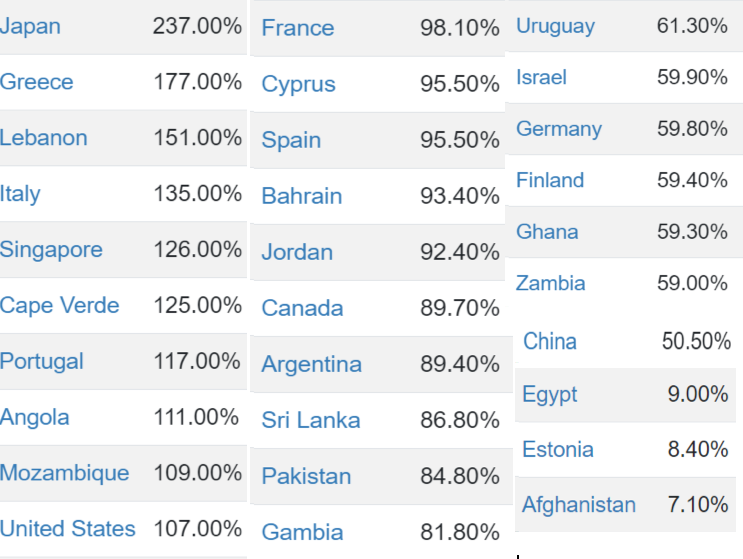
Why the 100% figure? There’s no reason for it other than ignorance. The ratio of federal debt to GDP has absolutely no significance regarding the health of the U.S. economy. It’s a useless, meaningless ratio that gets fire-breathed with alarm by those who either know nothing about economics, or worse, want you to know nothing about economics. If (Republican) Senator Rick Scott is right, you would expect the sickest, weakest economies to have the highest Debt/GDP ratios, while the healthiest, weakest economics have the lowest Debt/GDP ratios. But what do we find? Here are some examples:

Sample Nations: DEBT / GDP Ratios

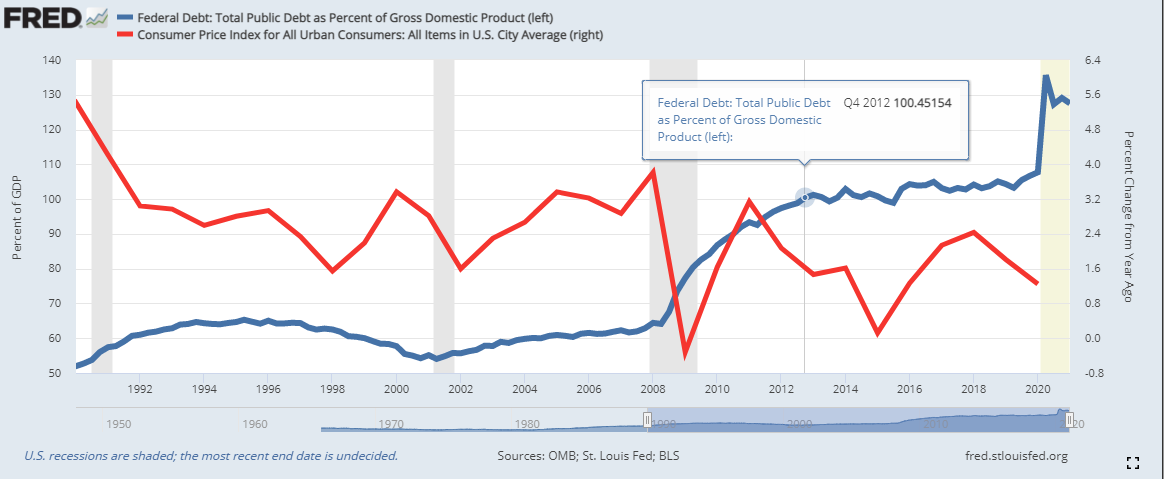
Based on the above ratios, which nations would you say have the strongest, healthiest economies, and which have the weakest, sickest economies? Right. The Debt/GDP ratio tells you exactly nothing about the health or strength of a nation’s economy. But Republican Senator Rick Scott wants to cut federal spending as soon as our ratio hits the arbitrary and meaningless number: 100% (which it already did way back in the 4th qtr of 2012 — blue line). And by the way, inflation (red line), the current Republican excuse for cutting benefits for the poor, has averaged below the Fed’s 2% target.
This emergency designation would trigger several provisions to help control and reduce the federal debt to levels below 100% of GDP, including: Terminating any unobligated funding from the American Rescue Plan Act, and any previous stimulus bills, and sending it back to the Treasury General Fund immediately for deficit reduction.
He’s not specific about what should be cut. He just wants to cut “any unobligated funds,” no matter how vital to the economy and the people they may be. Exactly what is supposed to happen in the Treasury General Fund for deficit reduction? What is the “it” he wants to send back? Which dollars are not to be spent? The whole thing is financially senseless, but it is a classic right-wing approach. The American Rescue Plan Act and the previous stimulus bills rescued America from the severe recession that was exacerbated by Donald Trump’s incompetent and deadly COVID denial along with his economically damaging trade duty war against China. Scott is silent about that. Scott never says. Why? Because, being a Republican, he would cut all the spending that benefits the poor and middle classes, while falsely claiming that the rich are “job makers” who should be rewarded even more than they already are.
Requiring all legislation that increases the federal deficit, as determined by the Congressional Budget Office, to carry its own offsets.
This means running a balanced budget, perhaps the least intelligent idea ever to come out of any Congressperson’s mouth because: A balanced federal budget is absolutely, positively guaranteed to cause a deep recession if we are lucky, or a deep depression if we are not lucky. If you can find anyone on this planet who can demonstrate how running a balanced federal budget would allow for economic growth and/or prevent a depression, I would love to see the evidence. Perhaps the same person also can prove that global warming is a Chinese myth, and that Donald Trump actually won the election — two equally nutsy claims coming from the GOP.
If it does not, the legislation shall be considered out of order and will require at least two-thirds of all Senators to vote to increase federal debt before even being able to consider the bill.
Wait! What if two-thirds of all Senators were, by some miracle, to vote to increase the federal debt, would that mean it then becomes OK? Suddenly it would be within the government’s “means”? And, don’t we already have the ridiculous federal “debt limit,” that not only does the same thing, but is raised every time it’s reached? And why is the debt limit always raised? Because, Congress is well aware that limiting federal debt would destroy the U.S. economy.
Fast-tracking any legislation that would reduce the federal deficit by at least 5 percent over ten years.
Where did that 5% number come from? It surely wasn’t derived by any scientific method. Scott apparently thinks it’s a nice number, so he uses it. It reminds one of dearly departed Herman Cain’s meaningless “9-9-9” tax plan. Just numbers with no real reason. And where is the math that says reducing the federal deficit would benefit the economy in some way? Non-existent.
Senator Rick Scott said, “America is in a debt crisis. Our nation is barreling toward $30 trillion in debt – an unimaginable $233,000 in debt for every family in America.
It’s not that families owe that debt. The government does. But Scott tries to imply, falsely, that your family will have to pay for that debt.
It’s a crisis caused by decades of wasteful and reckless spending by Washington politicians. Now, President Biden is continuing this way of governing by pushing for trillions in wasteful spending, raising the U.S. federal debt by 60% to $39 trillion and the debt-to-GDP ratio to 117% in 2030, the highest level ever recorded in American history.
And what has been the result of all this “wasteful and reckless spending? Taxes are down and GDP is up. But Scott wants to fix that, by raising taxes and/or reducing GDP.
Spending beyond our means has consequences.
The federal government, being Monetarily Sovereign, has no “means.”
We’re already seeing rising inflation, which disproportionately hurts the poorest families, like mine growing up.
The “rising inflation,” which for decades has been below Federal goals, is the result of the pandemic, not the result of federal spending. It was the pandemic, and Trump’s atrocious handling of it, that led to the shortages of goods and services, that resulted in a thoroughly predictable inflation. Someone, please ask Sen. Scott, “Where was the inflation last year and the year before, and the decades before, when deficit spending was massive?” And yes, we caught that “I grew up poor” disgusting attempt at ingratiating yourself with the people you are trying to screw. But hey, as long as you’re talking about your history, let’s get into where your calculations might have come from:
In 1987, after serving in the United States Navy and becoming a law firm partner, Scott co-founded Columbia Hospital Corporation. Columbia later merged with another corporation to form Columbia/HCA, which eventually became the nation’s largest private for-profit health care company. Scott was pressured to resign as chief executive of Columbia/HCA in 1997. During his tenure as chief executive, the company defrauded Medicare, Medicaid and other federal programs. The Department of Justice ultimately fined the company $1.7 billion in what was at the time the largest health care fraud settlement in U.S. history.
And this fraudster is the guy who suddenly has become so concerned about the federal government’s “means” and its ability to pay its bills. No wonder this criminal is a Trumper. “Birds of a feather,” as they say. He must have envied Trump University.
I look forward to every fiscally responsible Republican and Democrat working with me to quickly pass the Federal Debt Emergency Control Act.”
Yes, do vote for good old “fiscally responsible” Rick Scott, who can hardly wait to cut benefits to the poor, while driving the economy into a depression, thus allowing his rich backers to buy up property and businesses at discount prices, while paying workers depression-era wages. And, there are people who actually believe this guy! Strange. Fortunately, with a currently Democratic Congress and President, this idiotic ploy has no chance to pass, and least not in the near future. And it wasn’t meant to pass. There isn’t a new idea in the entire proposal. It’s a rehash of all the discredited nonsense that has been floated by populists for decades.  It was assembled in a half-hour as a political stunt to show how fiscally sound is the do-nothing, historically crooked Senator from Columbia/HCA. Rodger Malcolm Mitchell Monetary Sovereignty Twitter: @rodgermitchell Search #monetarysovereignty Facebook: Rodger Malcolm Mitchell ………………………………………………………………………………………………………………………………

THE SOLE PURPOSE OF GOVERNMENT IS TO IMPROVE AND PROTECT THE LIVES OF THE PEOPLE.

The most important problems in economics involve:
  1. Monetary Sovereignty describes money creation and destruction.
  2. Gap Psychology describes the common desire to distance oneself from those “below” in any socio-economic ranking, and to come nearer those “above.” The socio-economic distance is referred to as “The Gap.”
Wide Gaps negatively affect poverty, health and longevity, education, housing, law and crime, war, leadership, ownership, bigotry, supply and demand, taxation, GDP, international relations, scientific advancement, the environment, human motivation and well-being, and virtually every other issue in economics. Implementation of Monetary Sovereignty and The Ten Steps To Prosperity can grow the economy and narrow the Gaps: Ten Steps To Prosperity:
  1. Eliminate FICA
  2. Federally funded Medicare — parts A, B & D, plus long-term care — for everyone
  3. Social Security for all
  4. Free education (including post-grad) for everyone
  5. Salary for attending school
  6. Eliminate federal taxes on business
  7. Increase the standard income tax deduction, annually. 
  8. Tax the very rich (the “.1%”) more, with higher progressive tax rates on all forms of income.
  9. Federal ownership of all banks
  10. Increase federal spending on the myriad initiatives that benefit America’s 99.9% 
The Ten Steps will grow the economy and narrow the income/wealth/power Gap between the rich and the rest. MONETARY SOVEREIGNTY    

Translating the absurd. Does having less money make the nation wealthier?

The Mueller /Barr report did not cover: Trump’s secret taxes, excusing Nazis and white supremacists, the fake Trump Foundation, the fake Trump University, paying Stormy Daniels et al, groping women, obstruction of justice, loving dictators Putin and Kim, phony loans from Deutsche Bank, Donald Trump, Jr., Jared Kushner, inauguration committee, emoluments, security clearances, 10,000 lies, Trump’s refusal to testify under oath, nepotism, secret Saudi deals, campaign expenses, Trump Tower Moscow, secret meetings with Putin, and the GOP’s trying to keep the “exonerating” report a secret.

So, now that all those things are forgotten by the press, by the public and especially by the GOP, we can return to the federal budget.

……………………………………………………………………………………………………………………………………………………..

Image result for ben bernanke
Ben Bernanke: “The U.S. government has a technology, called a printing press (or, today, its electronic equivalent), that allows it to produce as many U.S. dollars as it wishes at essentially no cost.”

The following is yet another misleading article, meant to make you think the Monetarily Sovereign federal budget is like your monetarily non-sovereign household budget.

(The idea is to get you to accept reductions in such federal benefits as Medicare, Medicaid, Social Security and other aids important to the non-rich.)

A translation of each section follows immediately after the section.

February’s Budget Deficit Was the Largest in American History
The feds are $234 billion in the red. Looking for hope? Sen. Mike Enzi has some ideas.
Eric Boehm, Mar. 25, 2019

The Treasury announced Friday that the federal government spent $234 billion more than it brought in during February, breaking the record for the largest monthly budget deficit.

Translation: In February, the federal government added more stimulus dollars to the U.S. economy than ever — $234 billion in economic stimulus.

Barack Obama’s Treasury Department set the previous record in February 2012 , with a deficit of $231 billion.

At that time, President Obama anticipated $1 trillion annual deficits for the rest of the decade 

Translation: Barack Obama’s government set the previous record in February 2012, by pumping $231 into the economy, which was necessary grow the economy after the Great Recession of 2008.

At that time, President Obama anticipated $1 trillion annual private sector surpluses for the rest of the decade —almost identical to the projections offered by Donald Trump in his 2019 budget proposal, delivered earlier this month..

That Obama budget was roundly criticized by Republicans in Congress, who railed against the president’s “failure to control spending.”

Obama’s record deficit helped organize Republican policymaking around plans to cap spending growth and balance the budget.

The Republican Congress slowed the growth in government spending and as a recovering economy boosted tax returns.

Image result for alan greenspan
Alan Greenspan: “A government cannot become insolvent with respect to obligations in its own currency.”

Translation: That Obama budget was roundly criticized by Republicans in Congress, who railed against the president’s “failure to impose austerity on the economy.” 

Obama’s record money creation helped organize Republican policymaking around plans to cap economic growth by balancing the budget. 

The Republican Congress slowed money growth, which starved the recovering private sector of dollars.

The current record-high deficit is largely the fault of the same Republicans who once attacked Obama for spending too much.

Translation: The current record-high private sector is largely the success of the same Republicans who once attacked Obama for giving the private sector too much.

According to an analysis from the nonpartisan Committee for a Responsible Federal Budget, about 60 percent of this year’s expected deficit is the result of policies—mostly last year’s huge increase in spending that shattered those Obama-era budget caps—put in place by current legislators and signed by the current president.

Translation: According to an analysis from the extremely partisan Committee for a Responsible Federal Budget, about 60 percent of this year’s expected economic growth is the result of policies—mostly last year’s huge increase in spending that shattered those Obama-era growth caps—put in place by current legislators and signed by the current president.

They can’t blame a recession. They can’t blame Obama. After years of solid if not mind-blowing growth, the budget deficit should be shrinking, not expanding.

Failing to fix the budget now will have consequences for years to come.

Over the next 30 years, Social Security and Medicare are expected to run a combined $100 trillion deficit.

Image result for federal reserve bank
St. Louis Federal Reserve: “As the sole manufacturer of dollars, whose debt is denominated in dollars, the U.S. government can never become insolvent, i.e.,unable to pay its bills. In this sense, the government is not dependent on credit markets to remain operational.

Translation: They can’t credit the recession. They won’t credit Obama. After years of solid if not mind-blowing growth, the stimulus should be expanding, not shrinking.

Failing to increase the budget now will have consequences for years to come.

Over the next 30 years, Social Security and Medicare are expected to run a combined $100 trillion deficit, that the federal government can and should pay for.

If you’re looking for a glimmer of hope, it might be found in the budget plan recently released by Senate Budget Committee Chairman Mike Enzi (R–Wyo.).

Translation: If you’re looking for a flash of terror, it might be found in the budget plan recently released by Senate Budget Committee Chairman Mike Enzi (R–Wyo.).

Enzi’s budget is supposed to reduce the deficit by $538 billion over five years by cutting spending—and also, alas, by projecting probably unrealistic economic growth in the next half-decade.

Translation: Enzi’s budget is supposed to reduce the economic stimulus by $538 billion over five years by cutting spending—and also, alas, by projecting probably unrealistic economic growth (because of Enzi’s disastrous austerity) in the next half-decade.

His proposal includes cuts to Medicare and Medicaid, which make up more than 60 percent of the federal budget in a single year.

Enzi’s proposal is a serious attempt to bring the deficit back under control, even though it would not balance the budget.

Translation: His proposal includes cuts to Medicare and Medicaid, which make up more than 60 percent of the federal budget in a single year. The rich always look for ways to cut benefits to the middle classes and the poor.

Enzi’s proposal is a serious attempt to widen the Gap between the rich and the rest, even though it might not completely destroy the middle- and poorer classes. 

…………………………………………………………………………………………………………………………………………………….

In Economics, everything devolves to Monetary Sovereignty and Gap Psychology.

  1. Economics studies the relationships among wealth, money, and human psychology.
  2. Monetary Sovereignty studies a money issuer’s power over the money it issues.
  3. Gap Psychology describes the human desire to widen the Gap below you on any economic or social measure, and to narrow the Gap above you.

The very rich control American politics. They never stop trying to widen the Gap between them and you.

Essential to that effort is convincing you of the lies that federal “debt” (deposits into T-security accounts) and “deficits” (private sector surpluses) are a threat to the U.S. economy and to future taxpayers.

The rich want you to accept the false notion that your federal benefits should be cut.

So long as their misstatements work, they will continue to promulgate those lies, and indeed, your benefits will be cut.

Only when you first understand the facts, and then protest the lies, will you be safe from the rich.

Rodger Malcolm Mitchell
Monetary Sovereignty
Twitter: @rodgermitchell
Search #monetarysovereigntyFacebook: Rodger Malcolm Mitchell

…………………………………………………………………………………………………………………………………………………………………………………………………………………………………………………………………………………………..

The most important problems in economics involve the excessive income/wealth/power Gaps between the richer and the poorer.

Wide Gaps negatively affect poverty, health and longevity, education, housing, law and crime, war, leadership, ownership, bigotry, supply and demand, taxation, GDP, international relations, scientific advancement, the environment, human motivation and well-being, and virtually every other issue in economics.

Implementation of The Ten Steps To Prosperity can narrow the Gaps:

Ten Steps To Prosperity:

1. Eliminate FICA

2. Federally funded medicare — parts a, b & d, plus long-term care — for everyone

3. Provide a monthly economic bonus to every man, woman and child in America (similar to social security for all)

4. Free education (including post-grad) for everyone

5. Salary for attending school

6. Eliminate federal taxes on business

7. Increase the standard income tax deduction, annually. 

8. Tax the very rich (the “.1%) more, with higher progressive tax rates on all forms of income.

9. Federal ownership of all banks

10. Increase federal spending on the myriad initiatives that benefit America’s 99.9% 

The Ten Steps will grow the economy, and narrow the income/wealth/power Gap between the rich and you.

MONETARY SOVEREIGNTY


You live on the edge of insolvency, though you may not realize it.

mTwitter: @rodgermitchell; Search #monetarysovereignty
Facebook: Rodger Malcolm Mitchell

…………………………………………………………………………………………………………………………………………………………………………..
It takes only two things to keep people in chains: The ignorance of the oppressed and the treachery of their leaders..
………………………………………………………………………………………………………………………………………………………………………………

The U.S. federal government is Monetarily Sovereign, which simply means it has the unlimited ability to create its own sovereign currency, the dollar.

The federal government never can run short of dollars, which it creates ad hoc, every time it pays a creditor. The federal government needs no income. Even if federal tax collections were $0, the federal government could continue spending, paying its bills, and creating dollars, forever.

Those are the fundamental truths of Monetary Sovereignty.

By contrast, your state, county, city, business, you and me all are monetarily non-sovereign. The dollar is not our sovereign currency.  We can run short of dollars. We all need income to pay our bills.

I live in Illinois. It is insolvent. It is so broke it can’t even pay its Lotto winners their prize money.  So it discontinued its Lotto, which makes it even more broke.

Illinois isn’t the only state with financial problems. Maine and New Jersey are in the news for similar situations. And not just Illinois, Maine, and New Jersey, but thousands of monetarily non-sovereign governments — villages, cities, counties, and states — are on the edge of insolvency, if not already insolvent.

And there is a reason.

To remain solvent, a monetarily non-sovereign entity must have more dollars flowing in than flow out.

Imagine the fictional town of Mini. The entire town consists of one house. The sole resident is one man, the Mayor of Mini.

The Mayor receives all his income from his Mini salary, and Mini receives all its income from the Mayor’s taxes. No dollars flow across Mini’s borders, either in or out. The same dollars just keep flowing back and forth.

Image result for endless loop
For one to have a surplus, the other must have a deficit.

Immediately you see the problem. The Mayor has no dollars left for food, clothing, etc. And Mini has no dollars left over for any town functions.

The only way Mini and the Mayor both can survive is if they both receive additional dollars from outside.

If for instance, a tourist comes by with dollars, and rents a room in the Mayor’s house, the influx of dollars allows the Mayor to survive financially, and even to increase his tax payments, which allows Mini to survive.

While a Monetarily Sovereign entity never can be unwillingly insolvent, a monetarily non-sovereign entity long-term must have more dollars coming in than going out.

Similarly, to financially survive long-term,  not only you but your village, your county, and your state all must be net exporters of goods and services, i.e. net importers of dollars.

But, there is a problem. In a closed system, not everyone can be a net exporter or net importer of anything. For one entity to be a net importer, another must be a net exporter.

(The monetarily non-sovereign euro nations struggle because the Monetarily Sovereign European Union is too stingy with euros. The individual nations all must be net exporters of goods and services to survive — a practical impossibility.)

When that tourist to Mini showed up, the Mayor became a net importer of dollars (a net exporter of a service), and Mini also became a net importer of dollars (from the Mayor’s extra dollars).

But where did the tourist obtain his dollars? 

For the tourist, and for villages, cities, counties, states, you and me all to survive financially long-term, every single one of us must run a long-term surplus of dollars, and some other entity must be able to run a long- term deficit without becoming insolvent.

Ultimately, that entity is the U.S. federal government. It uniquely has the unlimited ability to run deficits forever. That’s what makes it Monetarily Sovereign.

The implication is clear: When the federal government shifts any financial burden to a state, county, or village, it moves that entity toward insolvency.

Some politicians will tell you that the states, counties, and villages can do a “better job” serving the public, because of being “nearer” to the public, and for that reason, some of the costs should be transferred from the federal government to the states, counties, and villages.

Do you see what’s wrong with that idea?

  1. It’s wrong on the face of it, because the states are not “nearer” to anyone. Southern Illinois, for instance, is solid Republican, and Chicago is solid Democrat, with each suburb of Chicago varying between left and right. So, to whom, is Illinois “closer”?
  2. Illinois is broke. Forcing it to pay even more costs is ludicrous. The federal government never can be “broke.”

And then there are the politicians who tell you that the federal deficit is “too high” and “unsustainable.” But as we have seen, the deficit is necessary to fund all those monetarily non-sovereign entities, the states, counties, villages, businesses, you, and me.

Dollars have to come from somewhere, and ultimately that “somewhere” is the federal government that originally created them.

Now it’s true that new dollars also come from banks in the form of loans, but those new dollars must be paid back, and when they are paid back, the loans and the new dollars disappear.

The only dollars that never need to be paid back are the deficit dollars created by the Monetarily Sovereign federal government.

Return now to the title of this post, “You live on the edge of insolvency, but may not realize it.”

If not for the dollars you receive as income, you would be insolvent. In essence, you live on the edge of insolvency.

You cannot rely solely on other monetarily non-sovereign entities to supply you with dollars. They all have the same problem. They too need a continual inflow of dollars. They all need income.

Only the federal government doesn’t have that problem. It neither needs nor uses income. Tax dollars sent to the federal government cease to be a part of the money supply the instant they are received. In short, tax dollars are destroyed upon receipt.

Image result for sun rays and planets
The earth is warmed only if it receives more heat than it emits.

Think of the federal government as the sun, and any individual state as a planet.

Every second, the sun runs a “deficit” of heat rays. It sends out more heat than it receives.

The planet is kept warm only if it receives more heat than it gives off.

An individual state is solvent only if it receives more dollars than it spends.

Think of what would happen if the “politicians” of the universe decided that the sun’s heat deficit was “unaffordable” and “unsustainable,” and the earth would have to do with less heat from the sun.

Think of what would happen if the “politicians” of the universe were to decide that the sun must run a balanced budget, meaning the heat it sends out must be balanced by the heat it receives from the rest of the solar system.

Everything in the solar system would become heat insolvent, and the entire solar system would turn to ice.

Today, our politicians tell us the federal government’s dollar deficits are “unaffordable” and “unsustainable.” So the states will be forced to do with fewer dollars, and the government will need to run a balanced budget.

If that happens, we all will be dollar insolvent and our economy will turn to ice.

And that is exactly what history reveals to us:

U.S. depressions tend to come on the heels of federal surpluses.
1804-1812: U. S. Federal Debt reduced 48%. Depression began 1807.
1817-1821: U. S. Federal Debt reduced 29%. Depression began 1819.
1823-1836: U. S. Federal Debt reduced 99%. Depression began 1837.
1852-1857: U. S. Federal Debt reduced 59%. Depression began 1857.
1867-1873: U. S. Federal Debt reduced 27%. Depression began 1873.
1880-1893: U. S. Federal Debt reduced 57%. Depression began 1893.
1920-1930: U. S. Federal Debt reduced 36%. Depression began 1929.

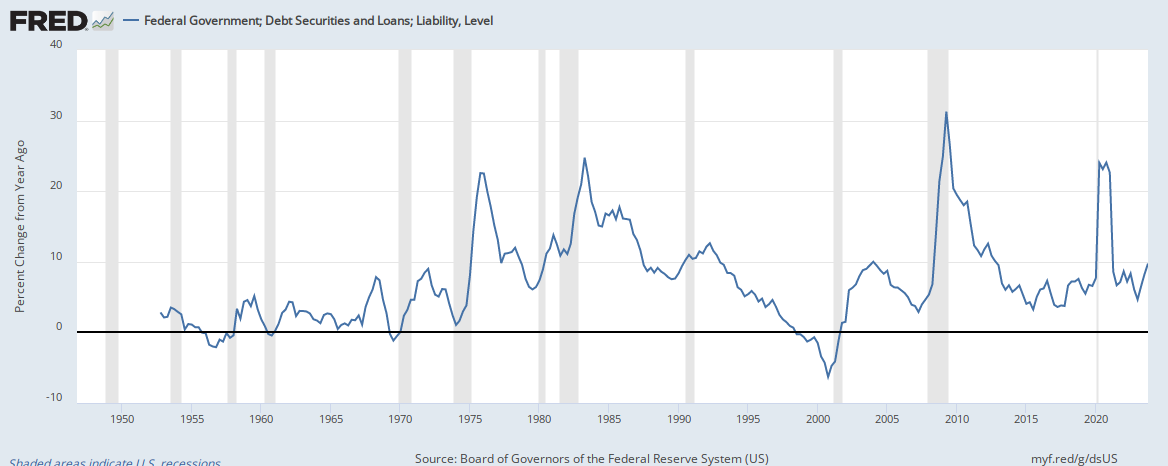
U.S. recessions tend to come on the heels of deficit growth reductions:

Monetary Sovereignty
Deficits are vertical gray lines. As the federal deficit growth line drops, we approach recessions, which are cured only when deficit growth rises.

Federal deficit growth is necessary for economic growth.

All of us — the states, counties, villages, businesses, you, and me — we all live on the edge of insolvency. Only the Monetarily Sovereign federal government can save us.

Remember this the next time a politician or blogger tells you the federal government “can’t afford” something, and the deficit and debt are “unsustainable,” and the government should run a balanced budget.

At the behest of the rich, the politicians try to make you insolvent and turn your world into ice, so the rich can make you their desperate slave.

Rodger Malcolm Mitchell
Monetary Sovereignty

………………………………………………………………………………………………………………………………………………………………………………………………………………………………………………………………………………………………………………………………………..

The single most important problems in economics involve the excessive income/wealth/power Gaps between the have-mores and the have-less.

Wide Gaps negatively affect poverty, health and longevity, education, housing, law and crime, war, leadership, ownership, bigotry, supply and demand, taxation, GDP, international relations, scientific advancement, the environment, human motivation and well-being, and virtually every other issue in economics.

Implementation of The Ten Steps To Prosperity can narrow the Gaps:

Ten Steps To Prosperity:
1. ELIMINATE FICA (Ten Reasons to Eliminate FICA )
Although the article lists 10 reasons to eliminate FICA, there are two fundamental reasons:
*FICA is the most regressive tax in American history, widening the Gap by punishing the low and middle-income groups, while leaving the rich untouched, and
*The federal government, being Monetarily Sovereign, neither needs nor uses FICA to support Social Security and Medicare.
2. FEDERALLY FUNDED MEDICARE — PARTS A, B & D, PLUS LONG TERM CARE — FOR EVERYONE (H.R. 676, Medicare for All )
This article addresses the questions:
*Does the economy benefit when the rich can afford better health care than can the rest of Americans?
*Aside from improved health care, what are the other economic effects of “Medicare for everyone?”
*How much would it cost taxpayers?
*Who opposes it?”
3. PROVIDE A MONTHLY ECONOMIC BONUS TO EVERY MAN, WOMAN AND CHILD IN AMERICA (similar to Social Security for All) (The JG (Jobs Guarantee) vs the GI (Guaranteed Income) vs the EB (Economic Bonus)) Or institute a reverse income tax.
This article is the fifth in a series about direct financial assistance to Americans:

Why Modern Monetary Theory’s Employer of Last Resort is a bad idea. Sunday, Jan 1 2012
MMT’s Job Guarantee (JG) — “Another crazy, rightwing, Austrian nutjob?” Thursday, Jan 12 2012
Why Modern Monetary Theory’s Jobs Guarantee is like the EU’s euro: A beloved solution to the wrong problem. Tuesday, May 29 2012
“You can’t fire me. I’m on JG” Saturday, Jun 2 2012

Economic growth should include the “bottom” 99.9%, not just the .1%, the only question being, how best to accomplish that. Modern Monetary Theory (MMT) favors giving everyone a job. Monetary Sovereignty (MS) favors giving everyone money. The five articles describe the pros and cons of each approach.
4. FREE EDUCATION (INCLUDING POST-GRAD) FOR EVERYONE Five reasons why we should eliminate school loans
Monetarily non-sovereign State and local governments, despite their limited finances, support grades K-12. That level of education may have been sufficient for a largely agrarian economy, but not for our currently more technical economy that demands greater numbers of highly educated workers.
Because state and local funding is so limited, grades K-12 receive short shrift, especially those schools whose populations come from the lowest economic groups. And college is too costly for most families.
An educated populace benefits a nation, and benefitting the nation is the purpose of the federal government, which has the unlimited ability to pay for K-16 and beyond.
5. SALARY FOR ATTENDING SCHOOL
Even were schooling to be completely free, many young people cannot attend, because they and their families cannot afford to support non-workers. In a foundering boat, everyone needs to bail, and no one can take time off for study.
If a young person’s “job” is to learn and be productive, he/she should be paid to do that job, especially since that job is one of America’s most important.
6. ELIMINATE FEDERAL TAXES ON BUSINESS
Businesses are dollar-transferring machines. They transfer dollars from customers to employees, suppliers, shareholders and the federal government (the later having no use for those dollars). Any tax on businesses reduces the amount going to employees, suppliers and shareholders, which diminishes the economy. Ultimately, all business taxes reduce your personal income.
7. INCREASE THE STANDARD INCOME TAX DEDUCTION, ANNUALLY. (Refer to this.) Federal taxes punish taxpayers and harm the economy. The federal government has no need for those punishing and harmful tax dollars. There are several ways to reduce taxes, and we should evaluate and choose the most progressive approaches.
Cutting FICA and business taxes would be a good early step, as both dramatically affect the 99%. Annual increases in the standard income tax deduction, and a reverse income tax also would provide benefits from the bottom up. Both would narrow the Gap.
8. TAX THE VERY RICH (THE “.1%) MORE, WITH HIGHER PROGRESSIVE TAX RATES ON ALL FORMS OF INCOME. (TROPHIC CASCADE)
There was a time when I argued against increasing anyone’s federal taxes. After all, the federal government has no need for tax dollars, and all taxes reduce Gross Domestic Product, thereby negatively affecting the entire economy, including the 99.9%.
But I have come to realize that narrowing the Gap requires trimming the top. It simply would not be possible to provide the 99.9% with enough benefits to narrow the Gap in any meaningful way. Bill Gates reportedly owns $70 billion. To get to that level, he must have been earning $10 billion a year. Pick any acceptable Gap (1000 to 1?), and the lowest paid American would have to receive $10 million a year. Unreasonable.
9. FEDERAL OWNERSHIP OF ALL BANKS (Click The end of private banking and How should America decide “who-gets-money”?)
Banks have created all the dollars that exist. Even dollars created at the direction of the federal government, actually come into being when banks increase the numbers in checking accounts. This gives the banks enormous financial power, and as we all know, power corrupts — especially when multiplied by a profit motive.
Although the federal government also is powerful and corrupted, it does not suffer from a profit motive, the world’s most corrupting influence.
10. INCREASE FEDERAL SPENDING ON THE MYRIAD INITIATIVES THAT BENEFIT AMERICA’S 99.9% (Federal agencies)Browse the agencies. See how many agencies benefit the lower- and middle-income/wealth/ power groups, by adding dollars to the economy and/or by actions more beneficial to the 99.9% than to the .1%.
Save this reference as your primer to current economics. Sadly, much of the material is not being taught in American schools, which is all the more reason for you to use it.

The Ten Steps will grow the economy, and narrow the income/wealth/power Gap between the rich and you.

MONETARY SOVEREIGNTY