After 1/6/2021 I thought I heard Donald Trump telling people to “fight like hell” to overturn the election. Then I thought I saw thousands of crazed Trump followers, violently attempt to attack Congress, to overturn the election.
I thought I saw police being beaten with flagpoles, kicked, punched, crushed and otherwise physically and verbally abused, by Trump followers who were attempting a coup.
Then, it was my understanding, that despite pleas from Republicans, Democrats and Trump’s own family, to tell the rioters to stop, Trump did nothing for several hours, instead relishing in the attempted coup.
I was wrong. I did not see or hear any of those things.
How do I know? Fox told me. McConnell told me. Jordan told me. Hannity told me. Carlson told me. Ingraham told me. And the former (self-proclaimed current) President of the United States told me.
Even a few of my right-wing friends told me the whole thing was overblown, a figment of my imagination that never really happened.
And anyway, that thing that never happened was: The fault of Antifa. Or communists. Or Democrats. Or the left-wing media. Or the Capital police. Or just a peaceful visit to the Capital.
Yes, The attempted coup never happened. I must have been wrong. And so are all you people who insist on believing actual facts instead of the “truths” that Donald Trump tells you.
This fall, vote for what our former (really “current”) President tells you. Ignore facts. And please join the cult of ignorance.
Oh, and if you are a real MAGA, don’t vaccinate. No one can tell us what to do. Win a Darwin Award.
Rodger Malcolm Mitchell
Monetary SovereigntyTwitter: @rodgermitchellSearch #monetarysovereigntyFacebook: Rodger Malcolm Mitchell
……………………………………………………………………..
THE SOLE PURPOSE OF GOVERNMENT IS TO IMPROVE AND PROTECT THE LIVES OF THE PEOPLE.
Gap Psychology describes the common desire to distance oneself from those “below” in any socio-economic ranking, and to come nearer those “above.” The socio-economic distance is referred to as “The Gap.”
Wide Gaps negatively affect poverty, health and longevity, education, housing, law and crime, war, leadership, ownership, bigotry, supply and demand, taxation, GDP, international relations, scientific advancement, the environment, human motivation and well-being, and virtually every other issue in economics.Implementation of Monetary Sovereignty and The Ten Steps To Prosperity can grow the economy and narrow the Gaps:
Ten Steps To Prosperity:
The United States seemingly has puzzled with the problem of the growing Gaps between the rich and the rest of us. I say, “seemingly” because of the spectacular lack of success any remedial effort has had.
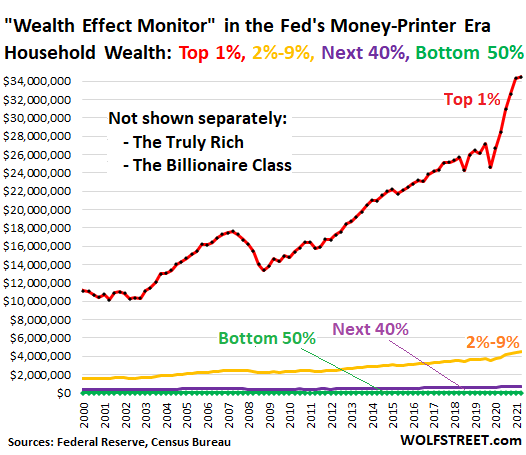
In 20 years, the share of American Net Worth held by the top 1% has risen from above 22% to above 32%.
Not only have the Gaps widened dramatically in the past 40 years, but there has been a stunning increase in just the past year.
To combat the economy-crushing effects of COVID, the government has pumped trillions into the private sector. An inordinate share seems to have benefited the upper 1%.
Although virtually all politicians pretend to bemoan the growing income/wealth/power Gap, the Democrats seem unable to enact a solution and the Republicans actively oppose one.
We are not alone in this conundrum. Japan faces a similar problem, as excerpts from the following article show:
Big tax break not enough for Japan’s employers to hike payJapan’s government wants employers to raise wages.By Ben Dooley and Hisako Ueno The New York Times
TOKYO — Over the past two years, Masataka Yoshimura has poured money into the custom-suit business his family founded over 100 years ago. He has upgraded his factory, installed automated inventory management systems and retrained workers who have been replaced by software and robots.
Japan’s prime minister wants him to do one more thing: Give his employees a substantial raise.
Wage growth has been stagnant for decades in Japan, the wealth gap is widening and the quickest fix is nudging people like Yoshimura to pay their employees more.
Higher wages, the thinking goes, will jump-start consumer spending and lift Japan’s sputtering economy.But raises are a nonstarter for Yoshimura. Increasing wages would be “truly fatal,” he said last month from his office at Yoshimura & Sons in Tokyo.
And he is far from alone in his thinking. Business groups, union leaders and others have questioned the feasibility of a plan by Prime Minister Fumio Kishida to offer sizable tax deductions to companies that raise pay.
That businesses would resist increasing wages even when essentially paid to do so shows just how intractable the problem is. Years of weak growth and moribund inflation rates have left companies little room to raise prices.
The prime minister is calling on employers to increase pay as much as 4% in 2022. Companies that comply will be allowed to increase their overall corporate tax deductions up to 40%.
Japan has many differences from the U.S. — cultural, economic, historical — but both nations seem to agree that the growing Gaps are a bad thing. They are bad, morally. They are bad, economically. They lead to oligarchy.
From Wikipedia:
Oligarchy is a form of power structure in which power rests with a small number of people. These people may or may not be distinguished by one or several characteristics, such as nobility, fame, wealth, education, or corporate, religious, political, or military control.
Throughout history, oligarchies have often been tyrannical, relying on public obedience or oppression to exist.
Aristotle pioneered the use of the term as meaning rule by the rich, for which another term commonly used today is plutocracy.
In the early 20th century Robert Michels developed the theory that democracies, like all large organizations, have a tendency to turn into oligarchies.
In his “Iron law of oligarchy” he suggests that the necessary division of labor in large organizations leads to the establishment of a ruling class mostly concerned with protecting their own power.
Thus, we have a problem (the Gaps), as viewed by the nation as a whole, divorced from those who seemingly can solve the problem (businesses), who don’t see it as a problem at all.
Leaving the solution to a problem in the hands of those who don’t view it as a problem, or even who benefit from the problem, can lead only to today’s outcome: The problem grows worse.
It’s like telling a woman the “problem” is that her sexy dress attracts too many men, when that is exactly what she wants. She is unlikely to solve the “problem.”
Business is unlikely to solve the problem of the widening Gaps when that is exactly what business leaders want.Gap Psychology dictates that people generally wish to widen the Gap below them.
Reality dictates that the rich wish to become richer, and the term “richer” implies a growing difference vs. “poorer.”
Without the Gaps, no one would be rich, and the wider the Gaps, the richer they are.
So both the motivation and the power to narrow the Gaps lies not with business, but with government, the sole question being how government should accomplish the narrowing process.
Some economists have suggested minimum wage laws, but clearly, these have failed even to approach the goal. The main problem is that wages are a business expense, and successful businesses devote themselves to minimizing expenses.
The undeniable fact that wage increases cut profits, stands as a concrete barrier to a business solution.
THE SOLUTION
The one entity that needn’t worry about profits is the federal government, and it has the perfect Gap-narrowing tool: Tax policy.
We must remember that unlike state/local taxes, which fund state/local government spending. federal taxes do not fund federal spending. In fact, the federal governmentdestroys all tax dollars it receives.
The federal government pays all of its bills with newly created dollars, ad hoc. It can do this endlessly. No limits.
Why then does the federal government collect taxes? The primary purpose of federal tax collection is to control the economy. The federal government taxes what it wishes to discourage and gives tax breaks to what it wishes to encourage.
Example: The federal government long has wished to encourage home building and ownership, so it provides to homeowners, manytax breaks that are not available to renters. (The rich mostly are owners, not renters.)
Think of tax breaks for: Property taxes, mortgage interest, certain home improvements, mortgage insurance, and deductions from capital gains when you sell your house.
The government’s use of tax laws to benefit those the government favors is the primary reason why the rich benefit from tax breaks not available to you.
If the government really wanted to narrow the income Gap between the rich and the rest, it first would eliminate the FICA tax. This ultimately regressive tax applies only to the first $137.7K of salary, and not to anything above that level.
The person have a salary of $150,000 pays exactly the same amount of FICA as does the person whose salary is $1 million. Half of FICA is deducted directly from paychecks and half ostensibly is paid by the employer.
In reality, however, all of FICA comes out of paychecks, because employers figure this cost when deciding what to pay workers.
The elimination of FICA (which contrary to popular wisdom, does not fund Social Security or Medicare), immediately would help narrow some of the income and wealth Gaps, particularly the Gaps between lower and middle-income salaried workers vs. upper income workers.
Second, the government could provide free, no-deductible Medicare for All. This is an expense ostensibly borne by those companies that provide health care insurance to workers. I say “ostensibly,” because it is a cost that companies consider when determining salaries.
Some other Gap-narrowing steps the federal government could take include:
Free college for All.
Social Security for All
Tax deductions for renters
Federally paid salary for attending school, grades K+
Eliminate income tax for all those earning less than $500K per year, adjusted annually for inflation
A reverse sales tax on food and clothing.
Free life insurance policies for all
A wealth tax
Tax the annual value appreciation of stocks and other capital
No-exception tax on inheritance.
In short, there are many steps the federal government easily could take, to narrow the Gap between the rich and the rest.
The sole problem is the rich. They don’t want the Gaps narrowed. The Gaps are what makes them rich. Without the Gaps, no one would be rich; we all would be the same. And the wider the Gaps, the richer they are and the poorer we are.
So, they use their massive financial power to bribe the politicians and to convince the populace, that these steps would be “unaffordable,” “unsustainable,” “socialism,” “undeserved” by the underclasses, and/or “inflationary.”
In truth, the federal government, being Monetarily Sovereign is unique in that it can afford and sustain any financial obligation. It never unintentionally can run short of dollars.
None of the above-mentioned steps are socialism, which involves government ownership and control, not just spending. Sadly, the people who cry loudest about “socialism” have the least idea about what socialism is.
The less-than-rich deserve the same kind of federal help as do the rich, who like Donald Trump, have found ways to pay zero taxes despite massive earnings.
And inflation always is caused by shortages of key goods and services, never by government spending.
The currently wide and widening Gaps are not inevitable. They are a choice, an insidious and harmful choice foisted on us by the rich.
The sole cure is to find, then elect, someone who understands the problem and the solutions, and who is not under the thumb of the rich — if such people actually exist.
Rodger Malcolm Mitchell Monetary SovereigntyTwitter: @rodgermitchellSearch #monetarysovereigntyFacebook: Rodger Malcolm Mitchell
……………………………………………………………………..
THE SOLE PURPOSE OF GOVERNMENT IS TO IMPROVE AND PROTECT THE LIVES OF THE PEOPLE.
Gap Psychology describes the common desire to distance oneself from those “below” in any socio-economic ranking, and to come nearer those “above.” The socio-economic distance is referred to as “The Gap.”
Wide Gaps negatively affect poverty, health and longevity, education, housing, law and crime, war, leadership, ownership, bigotry, supply and demand, taxation, GDP, international relations, scientific advancement, the environment, human motivation and well-being, and virtually every other issue in economics.Implementation of Monetary Sovereignty and The Ten Steps To Prosperity can grow the economy and narrow the Gaps: Ten Steps To Prosperity:
All too seldom, you come across an article that is so on target and so well written, you feel pangs of envy. This is one of them.
As if to demonstrate its perfection, the article contains, among a multitude of brilliant observations, just one tiny error, which I will mention at the end.
Farewell to 2021, the stupidest year in American historyMichael Hiltzik,Los Angeles TimesOne year ago, we were looking forward to a safer and sounder 2021.The Food and Drug Administration had granted emergency authorization to the Pfizer-BioNTech and Moderna vaccines against COVID-19.A new presidential administration was poised to take office in the next month, armed with a commitment to bring together a nation cleaved by four years of divisive policymaking.It was not to be.Instead of unity and immunity, this year has brought us stupidity and insanity on an unimaginable scale. In the categories of public health, education policy, fiscal policy and investment options, we appear to have taken leave of our collective senses.Certainly there are other years or periods in which stupidity or heedlessness brought civilization in general close to eradication.Consider 1914, when most of Europe dived hellbent to war for no discernible reason. (Read Barbara Tuchman’s book “The Guns of August” for the full horrific picture.) The Dark Ages were a period benighted by scientific ignorance.Some individual countries and national leaders stand out for tempting fate, to their and their citizens’ misfortune. Britain in 1938 under Neville Chamberlain. Russia’s warmongering with Japan in 1904-1905. Louis Napoleon poking a stick into the Prussian bear’s cage in 1870-1871. Saddam Hussein invading Kuwait in 1990.The perpetrators of some of these errors might assert in their defense that they were brought low by circumstances they didn’t know at the time.But America in 2021 can’t plead that it didn’t know. Didn’t know that vaccines representing stupendous scientific achievements were the solution to the COVID-19 pandemic?America’s worst governor?Didn’t know that Donald Trump wasn’t joking when he demanded that government officials overturn a fair presidential election? Didn’t know that bitcoin, NFTs, SPACs and meme stocks were destined, even designed, to take unwary investors to the cleaners?Of course we knew, and know. We don’t seem to care.In reviewing the most intellectually demoralizing events of 2021, I’ll leave aside a few discrete outbursts of asininity.So I won’t go into detail about the conservative movement’s lionizing of Kyle Rittenhouse, the self-confessed but acquitted killer of two unarmed men at a protest rally in Kenosha, Wis. Or the openly antisemitic ravings by former President Trump. Or the ugly, dishonest attacks that forced the withdrawal of Saule Omarova, one of the most qualified nominees for a federal banking regulatory job in memory.Or the shameful behavior of congressional Republicans, who cowered in safety during the Jan. 6 insurrection, pleading with Trump to help quell the riot, only to claim ever since that the violence of the crowd was no big deal.Or the posting of Christmas cards by politicians showing their families hoisting assault weapons, as Rep. Thomas Massie (R-Ky.) did just four days after a gunman killed four students at a Michigan high school. He was followed by Rep. Lauren Boebert (R-Colo.).The right-wing spirit of Christ’s birth.Instead, we’ll focus on a few of the bigger pictures. So, as Virgil said to Dante before guiding him into the Inferno, “Let us descend now into the blind world.”COVID-19The pandemic is surely the focus of the most obtuse and ignorant public reactions and state and local policy responses to any crisis in American history. It’s as if the grown-ups have all been beamed up, and we are left in the hands of people like Florida Gov. Ron DeSantis. (I am paraphrasing a line from the great pandemic movie “Together.”)In any rational world, the refusal or failure by some 50 million adult Americans to take a vaccine of known efficacy against a deadly disease would be inexplicable. But this is not a rational world, and the situation is even worse.Vaccine refusal is seen in many benighted corners of the United States not merely as the exercise of personal choice for personal reasons but as a means of showing moral superiority over the vaccinated.A conservative critic of anti-pandemic measures writing from rural southwest Michigan for the Atlantic bragged absurdly and selfishly, “I am now closer to most of my fellow Americans than the people, almost absurdly overrepresented in media and elite institutions, who are still genuinely concerned about this virus.”The author may think he’s remote from virus concerns, but that’s not the case at a hospital visited by CNN in Lansing, Mich., which can’t be much more than 100 miles from his location and where “the latest COVID-19 surge is as bad as health care workers there have seen.”
Its effectiveness is scarcely disputable: The Commonwealth Fund estimates that the vaccine averted about 1.1 million American deaths from COVID-19 and more than 10.3 million hospitalizations this year.The answer lies in politics.Dramatically removes mask after surviving COVID and denying its seriousness.Trump drew the line first, dismissing social distancing steps and refusing to speak up for vaccination. He established these steps as partisan choices, and his political acolytes followed him over the cliff.DeSantis has been a leader in this descent into the Inferno. He’s chosen to make Dr. Anthony Fauci, head of the National Institute of Allergy and Infectious Diseases and America’s most respected authority on the pandemic, a target of partisan calumny. He’s appointed a vaccine doubter as his state’s top public health official.What is the outcome? Florida currently ranks eighth-worst among states in its COVID-19 death rate, with more than 62,000 Floridians having perished from the virus. Of the seven states with worse records, six are red states like Florida.Corporate America has not showered itself in glory. On Dec. 18, Boeing announced that it was dropping its requirement that all U.S. employees be vaccinated. Its explanation was that a federal judge had blocked the enforcement of a federal executive order that employees of government contractors be vaccinated.This is absurd. Nothing in the ruling required Boeing to drop its requirement. The company announced its step back just as the omicron variant was about to produce a surge in infections. The pusillanimity of American corporations on this subject continues to astound. (The Times, which is owned by a physician and biomedical entrepreneur, is requiring all employees to be fully vaccinated by Jan. 31.)To its credit, on Dec. 17 the Biden White House issued an uncompromising warning about the dangers of remaining unvaccinated.“For the unvaccinated, you’re looking at a winter of severe illness and death for yourselves, your families and the hospitals you may soon overwhelm,” White House Chief of Staff Ron Klain said. “So, our message to every American is clear…. Wear a mask in public indoor settings. Get vaccinated, get your kids vaccinated, and get a booster shot when you’re eligible.”Investment folliesIn May, I asked whether we were experiencing a peak in investment absurdity. The examples then were bitcoin, dogecoin and nonfungible tokens (NFTs), as well as meme stocks, the prices of which were not tied to sober reflections about their issuers’ business prospects but to internet-fueled speculation.Assets like these, which are priced in accordance with the “greater fool” theory (they have no intrinsic value beyond what you can cadge from a bigger fool than yourself), have only proliferated since then. Or perhaps it’s only the absurdity that has ballooned.NFTs, for instance, are tradable digital files that confer no ownership to anything but the digital file, which may be an image of an object that is actually owned by someone else. Someone has parodied the NFT market by purporting to sell NFTs of images of individual Olive Garden restaurants, but it’s the kind of parody that gets at the essential truth of the target.You don’t get to own the restaurant or the photo. You don’t get a discount on menu items or a guarantee that the photo is even accurate. You supposedly get to own something on the Non-fungible Olive Garden Metaverse, whatever that is, and you can try to find a greater fool to sell it to.NFTs generally don’t confer ownership of the underlying asset or even the digital representation of the asset. The market doesn’t exist for any reason except to produce activity to suck in greater fools.The best clue that there’s something hinky about these markets is that the Trump family is going all in. A purported media company started by Donald Trump, for instance, is merging with a special purpose acquisition company, or SPAC.As I reported, the deal promptly came under the scrutiny of financial regulators. In any case, no discernible business plan of any substance has emerged for the Trump company. People appear to have invested because of his name.Now Melania Trump has gotten into the act, hawking NFTs of paintings of her eyes — “an amulet to inspire,” the pitch says, though obviously you don’t get to own the eyes or even the original watercolor.Software developer Stephen Diehl, an established skeptic of these things, writes that we are entering upon “a hustler’s paradise … where the market now provides a financial token game for every meme, every celebrity, every political movement, and every bit of art and culture.” The old saw applies about how if you’re looking around the poker table and can’t identify the mark, it’s you.Inflation and Build Back BetterRepublicans and conservatives have never cottoned to spending on programs that assist the middle and working class. President Biden’s Build Back Better program was destined to get their backs up.How could they attack a program that provides for universal prekindergarten education, assistance with child care, caps on the price of drugs such as insulin and better access to health care? Simple: Raise the old bugaboo of inflation.That’s been the approach of Sen. Joe Manchin III (D-W.Va.), who recently announced — via Fox News, of course — that he couldn’t support the plan in any way. He’s since backed off a bit from his adamantine opposition, but the core of his position was concern that the measure would add to inflation.As we’ve reported, that’s just wrong. Not even former Treasury Secretary Lawrence Summers, who sounded an inflation alarm about the pandemic relief package enacted this year, thinks it applies to this measure. The provisions of Build Back Better are paid for and represent investments in the economy, so they’re anything but inflationary.Indeed, Wall Street views Manchin’s resistance as an economic negative. According to MarketWatch, Goldman Sachs cut its growth forecast for the first quarter of next year to 2% from 3%, for the second quarter to 3% from 3.5% and for the third quarter to 2.75% from 3%.That’s not counting the direct impact of Build Back Better on Manchin’s own state, which is among the poorest in the nation and one in which government programs are crucial. That’s well understood on the ground: The United Mine Workers union publicly urged Manchin to reconsider his opposition to a program that would have “a meaningful impact on our members, their families, and their communities.”Much more happened in 2021 that prompts one to hold head in hands. To be fair, however, there were also glimmers of hope.Biden on Dec. 21 announced steps to strengthen the country’s response to the Omicron variant, including mobilizing troops to help staff overwhelmed hospitals, opening thousands of vaccine sites and sending 500 million free testing kits to households. The Build Back Better plan is not entirely dead, and a revival effort will start in January.Whether 2022 will be as stupid and insane as 2021 won’t be known until we can view it in a rearview mirror 12 months from now. We can only hope.____Michael Hiltzik is a columnist for the Los Angeles Times.
Brilliant in all respects.
As for the tiny error, it comes in the sentence, “The provisions of Build Back Better are paid for and represent investments in the economy, so they’re anything but inflationary.”
Mr. Hilzik is correct that BBB is not inflationary (Inflation is caused by scarcity, not by spending), but the “paid for” phrase seems to hint that taxes fund the spending.
Otherwise, why specify “The provisions of Build Back Better” as being paid for, when in fact, every penny of federal spending always is and always has been paid for, not by taxes, but by newly created dollars.
But my comment is like complaining about the impurity of one raindrop in a rainstorm.
Mr. Hiltzik’s article is, in my view, a masterpiece.
Rodger Malcolm Mitchell
Monetary SovereigntyTwitter: @rodgermitchellSearch #monetarysovereigntyFacebook: Rodger Malcolm Mitchell
……………………………………………………………………..
THE SOLE PURPOSE OF GOVERNMENT IS TO IMPROVE AND PROTECT THE LIVES OF THE PEOPLE.
Gap Psychology describes the common desire to distance oneself from those “below” in any socio-economic ranking, and to come nearer those “above.” The socio-economic distance is referred to as “The Gap.”
Wide Gaps negatively affect poverty, health and longevity, education, housing, law and crime, war, leadership, ownership, bigotry, supply and demand, taxation, GDP, international relations, scientific advancement, the environment, human motivation and well-being, and virtually every other issue in economics.Implementation of Monetary Sovereignty and The Ten Steps To Prosperity can grow the economy and narrow the Gaps:
Ten Steps To Prosperity:
America — at least, the America we like to dream exists — has been destroyed, if it ever really existed.
It is not the America of the common person, but rather it is the America of royalty, the same kind of imperial royalty we fought against during the Revolutionary war.
King George was a piker compared to our America’s rich.
Today’s America is more financially stratified, and therefore power-stratified than at any time in our history. We have kings, princes and serfs, just as surely as existed during medieval times. Worse, perhaps.
Nothing will change while Americans believe these five lies:
The federal “debt” is too high (It isn’t even “debt,” and it isn’t too high.)
Federal taxes fund federal spending. (Unlike state & local government taxes, federal taxes fund nothing. In fact, federal tax dollars are destroyed upon receipt by the Treasury. That is why no one can say how much money the Treasury has. It has infinite dollars.)
The federal government can’t affordMedicare for all, Social Security for All, housing for all, college for all, or food for all. (The federal government can afford anything.)
Federal spending causes inflation. (It doesn’t. Inflation is caused by shortages of key goods and services, i.e. food, energy, computer chips, labor, shipping. In fact, federal spending cures inflation when it facilitates obtaining the scarce items)
If the government provides the necessities, the poor won’t work. (The “starve ‘em ‘til they slave” system works only for the rich. People always will work to improve their situation, whatever that situation may be.)
Lie I. The Federal Debt Is Too High
The federal “debt” is many things, but it is not “debt” and it is not “too high.
The federal debt is the total of deposits into Treasury Security accounts (i.e. T-bills, T-notes, T-bonds). The purpose of these accounts is not to provide the federal government with spending money but rather:
To provide a safe, interest-paying storage place for unused dollars.
To assist the Fed in setting interest rates.
Treasury Security accounts, which resemble safe-deposit accounts, are owned by depositors. The federal government does not need, use, or touch the dollars in the accounts.
As with safe-deposit accounts, the deposits in the T-security accounts are not a true debt of the federal government, which merely safeguards the money. Think of the federal government as the uniformed guard who stands outside the safe deposit room, and checks signatures. He doesn’t owe the money, either.
When the T-securities mature, the government pays them off simply by returning the dollars in the accounts, which is no burden at all on the federal government. The government merely debits the accounts and credits the checking accounts of the T-security owners.
No tax dollars are involved. Contrary to popular myth, your grandchildren will not owe the federal debt.
Confusion in the minds of the public arises because, by law, the total of these accounts equals the net total of all federal deficit spending through history.
Thus, the public is made to believe wrongly that federal deficits must be “paid back” by taxpayers. But, federal deficits merely are the arithmetic difference between spending and taxing, which gives the wrong appearance that federal taxes actually fund federal spending.
This, in turn, gives the wrong appearance that federal taxpayers owe the federal debt.
Federal deficits never are “paid back.” Federal taxes don’t fund federal spending. And taxpayers do not owe the federal debt.
Lie II. Federal taxes fund federal spending.
Unlike state/local governments, and unlike euro-nation governments, and unlike businesses, and unlike you, and me, the federal government is Monetarily Sovereign.
In the 1780s, the federal government created an arbitrary group of laws from thin air, that created an arbitrary number of dollars — from thin air — and they gave these dollars an arbitrary value.
The government still retains the power to create more arbitrary laws and arbitrarily more dollars — again from thin air — and again give them any value it chooses. Thus, it has the unlimited power to cure inflation at the stroke of a pen, although it prefers to use market-oriented methods (interest rate changes0.
The federal government pays all its creditors by sending instructions (not dollars) to the creditors’ banks instructing the banks to increase the balances in the creditors’ checking accounts.
When the bank obeys those instructions, new dollars instantly are created. That is how the federal government “prints” most of its dollars, not with a printing press but with a computer key.
Ben Bernanke, Former Federal Reserve Chairman: “The U.S. government has a technology, called a printing press (or, today, its electronic equivalent), that allows it to produce as many U.S. dollars as it wishes at essentially no cost.”
None of this is related in any way to the tax dollars that are created and destroyed every day. Tax dollars are paid with checking account money from the M1 money supply measure, but when they reach the Treasury, they cease to be part of any money supply measure.
They effectively are destroyed. Even if the federal government collected $0 in taxes, it could continue spending and running deficits, forever.
Lie III.The federal government can’t afford Medicare for all, Social Security for All, housing for all, college for all, or food for all.
The grantorestablishes the trust fund, donates the thing of value to it, and decides the management terms.
The beneficiary is the person for whom the trust fund was established. The assets in the trust will be managed per the specific instructions and rules laid out by the grantor when the trust fund was created.
The trustee makes sure the trust fund maintains its duties as laid out in the trust documents and according to applicable law.
The Social Security “trust fund” is nothing like the above. It merely is a bookkeeping device that may or may not pay a beneficiary an unknown amount of money at the whim of Congress and the President.
If you collect Social Security, you are the ostensible “grantor” who pays a FICA tax that supposedly is the “thing of value,” but you do not “establish the trust fund,” and you do not decide the management terms, and FICA is just another tax that pays for nothing.
You also are the beneficiary, but the rules can change without warning. And the government is the supposed “trustee,” but it has the power to change the “trust documents” at will, a power no real trustee has.
Social Security is a federal agency. No agency of the federal government can run short of money unless that is what Congress wants.
Former Federal Reserve Chairman Alan Greenspan: “A government cannot become insolvent with respect to obligations in its own currency.”
The so-called “trust fund” is completely under the control of Congress, and it only can run short of money if Congress wants it to run short of money. Period.
Another related lie is that federal benefits must be “paid for.” We have heard this lie repeatedly from Sen. Manchin and other politicians regarding the Democrats’ “Build Back Better” proposal. It is supposed to mean that federal taxes must pay for federal spending.
Fact: All federal spending has been “paid for,” not by taxes but by money creation.
Federal taxes pay for nothing. Manchin and the other politicians know this, but their constituents don’t, so the lie is repeated for political purposes.
Lie IV: Federal spending causes inflation. You undoubtedly have seen hyperinflation photos of people forced to tote wheelbarrows filled with nearly worthless currency, or have seen pictures of such bills. These photos may have given you the false impression that it is the printing of such currency that caused the inflation.
The famous Zimbabwe hyperinflation was caused not by money “printing,” but rather by a shortage of food. The government took farmland from experienced farmers and gave it to people who did not know how to farm.
But that impression confuses cause and effect.
The real cause of all inflations is shortagesof key goods and services.
Today’s inflation is caused not by federal spending but rather by shortages of oil, food, labor, computer chips, and shipping.
In fact, federal spending can actually halt inflation if the spending helps create and distribute the scarce items.
A food shortage can be cured by federal aid to farmers. An oil shortage can be cured by federal aid to drillers and processors.
A labor shortage can be cured by ending FICA deductions from pay, and providing free Medicare for All, so that employers are better able to raise payrolls.
Lie V. If the government provides the necessities, the poor won’t work. This is the most insidious lie of all. It is eagerly believed by the richer about the poorer. Its purpose is to widen the income/wealth/power Gap between the rich and the rest.
Ironically, the poorer on balance, work harder than do the richer. The poorer must work while doing everything for themselves. The richer can afford to hire people to do for them.
The richer sneer at the poorer as “takers,” to separate themselves from those who have less. This is known as “Gap Psychology,” the human desire to widen the Gap below you and to narrow the Gap above you.
Widening the Gap is the method by which the rich make themselves richer. (If there were no Gap, no one would be rich. We all would be the same).
Virtually everyone wants to improve their lives, and this applies even to the very wealthy, who seemingly have everything but still want more.
There is no evidence that people will refuse to work when given basic benefits. People did not refuse to work when given Social Security and Medicare.
SUMMARY
Five, widely believe lies, are responsible for the decline and loss of the “American dream,” the dream that if you work hard in this “land of opportunity,” you will get ahead and your children will lead better lives.
Note however, the word “ahead.” Ahead of what? Ahead of those near you. It is the basis for Gap Psychology.
The federal “debt” is too high
Federal taxes fund federal spending.
The federal government can’t afford basic benefits for all.
Federal spending causes inflation.
If the government provides the necessities, the poor won’t work.
These lies are promulgated by the rich, who run America, to make themselves even richer, by widening the income/wealth/power Gap below them.
Because of Gap Psychology, even the middle classes parrot the lies, as a way to distance themselves from those below them. It’s the fastest way to “get ahead.”
Gap Psychology describes the common desire to distance oneself from those “below” in any socio-economic ranking, and to come nearer those “above.” The socio-economic distance is referred to as “The Gap.”
Wide Gaps negatively affect poverty, health and longevity, education, housing, law and crime, war, leadership, ownership, bigotry, supply and demand, taxation, GDP, international relations, scientific advancement, the environment, human motivation and well-being, and virtually every other issue in economics.Implementation of Monetary Sovereignty and The Ten Steps To Prosperity can grow the economy and narrow the Gaps: Ten Steps To Prosperity: