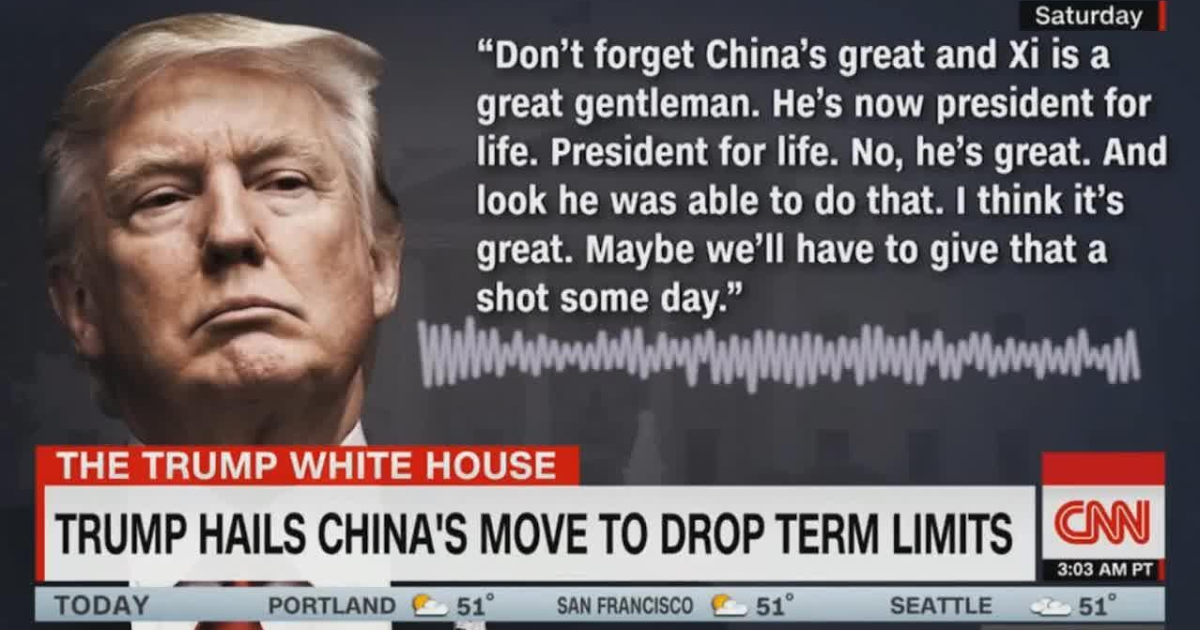
Be sure to tell your grandchildren how you let this happen.

Trump smiling
What, me worry?
Image result for alfred e neuman
It’s a Chinese hoax. Eliminate all regulations to reduce CO2 emissions. Bad for my businesses.

.
.
.
.
.
.
.
.
.
.
.
.
.
.
.
.
.
.
.
.
.
.
.
.

http://www.theweek.com

Diminishing tropical forests mean climate breakdown is ‘decades ahead of even the most pessimistic’ models, carbon study shows

As tropical forests dwindle as a result of deforestation and climate change, the Earth is losing one of its strongest safeguards against pollution.

Tropical forests can serve as something The Guardian describes as “carbon sinks,” meaning they absorb carbon from the atmosphere. But those forests, including the Amazon, are diminishing and have been absorbing fewer and fewer pollutants as the years go by.

The reduction in tropical forests will likely accelerate a climate breakdown in a manner similar to melting ice sheets and permafrost.

“We’ve found that one of the most worrying impacts of climate change has already begun,” said Simon Lewis, a professor in the school of geography at Leeds University in the United Kingdom and one of the senior authors of the research. “This is decades ahead of even the most pessimistic climate models.”

Lewis said forests can’t keep “mopping up” pollution forever, but he did suggest that there is time for people to intervene “before the global carbon cycle starts working against us.” The caveat, he said, is that time is now.

Read more at The Guardian. Tim O’Donnell

If you are a Trump supporter, be sure to tell your grandchildren it was you who voted to let this happen to them.

Rodger Malcolm Mitchell
Monetary Sovereignty
Twitter: @rodgermitchell
Search #monetarysovereignty Facebook: Rodger Malcolm Mitchell

The wrongheaded dependence on the Fed. The real (only) way to prevent a recession.

From CNN and “Before the Bell”

The Federal Reserve’s decision to cut interest rates by half a percentage point outside of a scheduled meeting — the first time it’s made such a move since the 2008 financial crisis — was aimed at easing financial conditions and restoring confidence as the coronavirus outbreak spreads globally. Investors weren’t impressed.CNN BUSINESS - BEFORE THE BELL

The S&P 500 closed down 2.8%, while the Dow shed 786 points, or 2.9%. The yield on benchmark 10-year US Treasury notes fell below 1% for the first time in history as investors rushed into safe haven assets. Those are big slides on a day that was meant to be about reassurance.

What happened: Traders saw the move and wondered if the Fed Reserve knew something that everyone else didn’t. Instead of assuaging fears about how the virus would hit economic growth, it amplified them.

“Confidence matters in volatile times. It would have been better for the Fed to cut by 25 [basis points] and let markets hope for more,” Holger Schmieding, chief economist at Berenberg Bank, told clients on Wednesday.

The Fed’s primary job is to run the banking system and to stabilize the value of the U.S. dollar via interest rate control.

The Fed’s primary job is not to stimulate economic growth, prevent and cure recessions, prevent or cure large inflationary moves, or to eliminate poverty. Those are the jobs of Congress and the President.

Remember that as you continue reading.

US Treasury yields plummet chart

Some observers are also concerned that the Fed is prematurely running down its already depleted arsenal.

The central bank could still cut interest rates four times, assuming each cut is a more standard 25 basis points, before reaching zero.

But it has far less powder than investors would generally like to see in uncertain times.

Other central banks are in even worse positions.

The European Central Bank and the Bank of Japan, for example, have already pushed their benchmark interest rates into negative territory.

Central banks can still help: Satyam Panday, senior US economist at S&P Global Ratings, points out that while interest rate cuts don’t directly address some of the problems caused by the coronavirus, such as snarled supply chains, they could still prove useful.

The cuts could “offset some of the tightening that has occurred in financial markets” and keep credit flowing, while helping to speed up an economic recovery in the second half of the year, he said.

Cutting interest rates weakens the U.S. dollar, which is mildly inflationary. Inflation and economic growth are not the same thing. So trying to use one tool for two completely different effects will not work.

In short, don’t use a screwdriver to set nails.

What is the right tool to prevent and cure market slumps? What should Congress and the President do?

The Answer: Identify and cure the problems. Right now, many industries are suffering. Anything related to travel — and not just airlines and cruise ships, but anything related to traveling will be hurt — and that includes most businesses to some degree.

When businesses are hurt, what do they do? They lay off workers, and not the top-level executives, but the mid- and low-level workers, who cannot afford to take a hit to their incomes.

These are the great mass of American consumers who make the American economy run.

The fundamental problem is that American consumers will run short of money, so the fundamental solution is to provide them with money. It’s that simple.

Who should implement that solution, and how?

The Answer: Congress and the President should begin to pump dollars into the economy by instituting the Ten Steps to Prosperity (below). Put dollars into people’s pockets, so that the impoverishment caused by the loss of jobs will be softened.

Start with step 1: Eliminate FICA. That would put billions of dollars into the pockets of consumers.

That would help consumers, who don’t lose their jobs, to keep spending, which would help more businesses stay open and not need to lay off people.

Step 2. Free medical care, which would prevent economic disaster, especially for people who lose their jobs.

Step 3. A monthly bonus to everyone, really important for those who lose their jobs.

Go down through all the steps and you’ll see that the Ten Steps to Prosperity can help prevent a recession or a  depression — something the Fed simply does not have the tools to address.

In the near term, investors aren’t satisfied, with markets now clamoring for the Fed to cut rates again at its scheduled meeting later this month.
“The Fed seems committed to frontloading cuts, acting aggressively and forcefully,”

“The market is also pressuring the Fed by pricing in over a 70% probability of a March cut; the Fed won’t fight it.”

The above follows the failed philosophy, “If it doesn’t work, do it again, and if that doesn’t work, keep doing it.”

Sorry “market,” but interest rate cuts, even (God forbid) negative interest rates, will not prevent a recession or a depression.

Only the kind of money supply increases offered by the Ten Steps to Prosperity can do that.

But for investors, the moderate Biden’s surge was a welcome event.

“Investors fear Bernie because he wants to cut off the head of capitalism by raising taxes significantly on the rich and using the funds to provide free everything to everybody else.

He also wants to regulate everyone,” Ed Yardeni, president of Yardeni Research, told clients on Wednesday.

Should Sanders secure the nomination, analysts have predicted that health care, energy and financial stocks would take a hit.

“The policy proposals outlined primarily by Senator Sanders could have negative implications for a significant section of the equity market,” Mislav Matejka, JPMorgan’s head of global and European equity strategy, told clients this week.

Investors understand that if it’s bad for business, it’s bad for the economy. The economy is business.

To grow the economy, we must help grow business, and to grow business we must help consumers consume.

Unfortunately, Ed Yardeni doesn’t understand federal financing. He believes that federal government spending relies on federal taxes. It doesn’t.

The federal government, being Monetarily Sovereign, could institute the Ten Steps to Prosperity without collecting a penny in taxes, and that is exactly what the government should do.

We must not rely on the Fed to prevent/cure a recession or depression. That job belongs to Congress and the President.

Rodger Malcolm Mitchell
Monetary Sovereignty
Twitter: @rodgermitchell
Search #monetarysovereignty Facebook: Rodger Malcolm Mitchell

…………………………………………………………………………………………………………………………………………………………………………………………………………………………………………………………………………………………..

THE SOLE PURPOSE OF GOVERNMENT IS TO IMPROVE AND PROTECT THE LIVES OF THE PEOPLE.

The most important problems in economics involve:

  1. Monetary Sovereignty describes money creation and destruction.
  2. Gap Psychology describes the common desire to distance oneself from those “below” in any socio-economic ranking, and to come nearer those “above.” The socio-economic distance is referred to as “The Gap.”

Wide Gaps negatively affect poverty, health and longevity, education, housing, law and crime, war, leadership, ownership, bigotry, supply and demand, taxation, GDP, international relations, scientific advancement, the environment, human motivation and well-being, and virtually every other issue in economics.

Implementation of Monetary Sovereignty and The Ten Steps To Prosperity can grow the economy and narrow the Gaps:

Ten Steps To Prosperity:

1. Eliminate FICA

2. Federally funded Medicare — parts A, B & D, plus long-term care — for everyone

3. Provide a monthly economic bonus to every man, woman and child in America (similar to social security for all)

4. Free education (including post-grad) for everyone

5. Salary for attending school

6. Eliminate federal taxes on business

7. Increase the standard income tax deduction, annually. 

8. Tax the very rich (the “.1%”) more, with higher progressive tax rates on all forms of income.

9. Federal ownership of all banks

10. Increase federal spending on the myriad initiatives that benefit America’s 99.9% 

The Ten Steps will grow the economy and narrow the income/wealth/power Gap between the rich and the rest.

MONETARY SOVEREIGNTY

The unholy alliance of Trump, Barr, and religion

The February 28, 2020 issue of THE WEEK magazine ran an article that began:

Attorney General William Barr was under fire from all directions this week, as more than 2,000 former Department of Justice officials from both parties called on him to resign and accused him of repeatedly flouting the department’s “sacred obligation” to administer equal justice under the law.

The extraordinary open letter came after the nation’s top lawman watered down the department’s sentencing recommendation of seven to nine years in prison for President Trump’s longtime friend and political fixer Roger Stone, 67.

Barr’s intervention led four federal prosecutors to resign from the case, with one quitting the DOJ entirely.

In their letter, the ex–U.S. attorneys, trial lawyers, and other DOJ officials accused Barr of blatantly politicizing the department.

“Governments that use the enormous power of law enforcement to punish their enemies and reward their allies are not constitutional republics; they are autocracies,” they wrote.

Meanwhile, the Federal Judges Association, a collection of 1,100 jurists devoted to an independent judiciary, called “an emergency meeting” to discuss what it called “a deepening crisis” caused by Barr and Trump’s intervention in politically sensitive cases.

Trump had congratulated Barr for changing the sentencing recommendations on Stone, saying they were “a disgrace” and a “miscarriage of justice.”

Barr said in a televised interview that Trump should “stop the tweeting” about DOJ cases because his comments “make it impossible for me to do my job.”

But Trump continued tweeting over ensuing days, and Barr reportedly told sources close to the president that if he didn’t stop, he’d resign.

“Resign?” Oh, sure.Image result for Trump and Barr

The notion that Barr couldn’t “do his job” falls somewhere between humorous and traitorous.

Clearly, Barr always has felt that his job is not to be impartial and independent, but rather as a tool of Trump the wannabe American emperor.

That, after all, is the way Barr obtained his job — by writing a document which, in essence said, an American President can do anything he wants to do, legal, illegal, questionable, immoral, unprecedented, or scummy — anything.

That is just the kind of Attorney General that Emperor Trump wants. Barr learned that from Trump’s sadistic treatment of Barr’s predecessor, Jeff Sessions, who worshipped Trump — but not enough.

Sessions made the mistake of trying to be moral (on one occasion), and Trump never forgave him for that misdeed. Sessions endured endless ridicule until even his groveling and lack of pride could not save him.

So for Barr to complain that he can’t do his job, when he knows that is exactly what his job is, the job he applied for: Protector and Defender of Donald J. Trump, the law be damned — that complaint is the ultimate of dishonesty and hypocrisy.

Barr’s involvement in the Stone sentencing was only the latest example of the attorney general taking charge of cases important to Trump.

On Barr’s orders, the department is pursuing investigations of former FBI and CIA officials involved in the Russia investigation.

Barr has also set up a process to receive and vet information about Democrat Joe Biden that Trump’s personal attorney Rudy Giuliani is digging up from dodgy, pro-Russia sources in Ukraine.

Two weeks ago, federal prosecutors changed their recommendation of six months in prison for former national security adviser Michael Flynn to probation.

Last week, Barr tapped outside prosecutors to review not only Flynn’s case but also a number of others described as politically sensitive.

He whitewashed special counsel Robert Mueller’s report, attacked the DOJ’s inspector general for finding no political bias in the original FBI investigation of Trump’s campaign, and is now working fist-in-glove with Giuliani as he hunts for political dirt in Ukraine.

With his reckless need to settle scores, Trump “is making millions of voters ask if they really want to take a risk on giving him so much power for another four years.”

Since becoming attorney general, Barr has transformed the Justice Department into Trump’s “own private detective agency.” But Barr understands that using the law to punish political adversaries and reward allies “requires a sheen of public legitimacy.” That’s why he took issue with Trump’s tweets—the president keeps exposing the fact that he’s “turned the legal system into a personal weapon.”

In chilling terms,” Barr has repeatedly stated that the Constitution endows the president with “nearly autocratic powers,” with total authority over the Justice Department and the right to order and end investigations.

Barr’s (and Trump’s) America would be “a banana republic,” and “it is not a place that anyone, including Trump voters, should want to go.”

Apparently, that is exactly where Trump’s oh-so-religious voters do want to go. The Trump cult is based on hatred; he claims to hate the same people his religious followers hate: Immigrants, the poor, people of color, foreigners, gays — really anyone who is not old, white, and Christian.

So long as Trump keeps hating, his religious followers will keep following, and no one can hate like the self-proclaimed “religious” can hate.

Religion has nothing to do with morality. The long, gruesome history of religion is a document to hatred. The evils in God’s name are legendary.

Moral people do not need religion to be moral.

Those who are surprised at the recently publicized immorality of the Catholic clergy in the treatment of young, vulnerable boys should wake up to the history of tortures by all clergy,  of every denomination,  down through the ages, all to punish supposed “heresy,” as though rape, torture, and murder were not, in themselves, a greater heresy.

Religion preaches morality, but the fundamental purpose of religion is not morality. It is separation. Religion is a pseudo-moral, socially acceptable way to lift oneself by demeaning others.

It is a method of induced Gap Psychology, the common desire to distance oneself from those deemed “lower” and to come closer to those deemed “higher,” all for self-glorification.

So Trump does his hatred act while his “religious” followers cheer at the loss of American justice, liberty, and compassion.

He hates Muslims; his followers hate Muslims.

He hates people of color. His followers hate people of color. He hates gays and people from “shithole countries. His followers do the same.

He tortures innocent children at our border, separates families, consorts with criminals, cheats on three wives, runs criminal enterprises and lies, oh does he lie, and not a word of objection is heard from the religious right (who object to abortion but refuse to aid the impoverished unwanted children, once they are born).

Trump has tapped into the basest instincts of people who have learned hatred at their parents’ knees. It is no accident that Trump’s base is among the descendants of Southern slaveowners. They are experts at hatred, having been taught to hate upon emergence from the womb.

And guns. Guns and bigotry are like cake and frosting. Mention any, ANY control over gun ownership and you will be met with the vilest, hate-filled threats from the religious right.

In all the history of the world, the most horrifying evils have been done by men of the cloth and their acolytes.

For Trump, and Barr, and McConnell it all an act. It is performance art to appeal to the herd, the powerless who need someone to blame for their failings.

So when Trump refuses to accept blame for anything, anything at all, his followers recognize him as a kindred spirit. His blame refusal is their blame refusal, and that makes it all right.

Trump’s followers need a champion who will crack down on “them,” the great, dark boogymen at whom Trump lashes daily. In their eyes, the draft-dodging bully is “strong.”

So like Hitler, and Putin, and Kim, and Amin, and Stalin, and Mao, and every other dictator, Trump feigns endless anger and the need for punishment of “them” on behalf of “us,” the white “real Americans.”

Who cares that Trump is a lying, stealing, ignorant, cheating, inept, evil monster, who has hurt so very many innocent people, as long as he is getting “them,” and building a wall to keep “them” out.

Trump does his anger act, and Barr does his righteous act, and McConnell does his “it’s just politics” act, all to the delight of the bigoted weak,  while good people wonder, “How can they follow him?” “Don’t they see what he is?”

Yes, they see exactly what he is, and these phony followers of a moral God, enjoy what he is. And Trump knows that if ever he begins to show honesty, morality, and compassion for “them” he is finished.

To Trump followers, those are signs of weakness, signs that “they” are closing in on “us.” Gap Psychology will not allow it.

Godless Trump, pious Barr, and the religious right, a marriage made in heaven.

Rodger Malcolm Mitchell
Monetary Sovereignty
Twitter: @rodgermitchell
Search #monetarysovereignty Facebook: Rodger Malcolm Mitchell

…………………………………………………………………………………………………………………………………………………………………………………………………………………………………………………………………………………………..

THE SOLE PURPOSE OF GOVERNMENT IS TO IMPROVE AND PROTECT THE LIVES OF THE PEOPLE.

The most important problems in economics involve:

  1. Monetary Sovereignty describes money creation and destruction.
  2. Gap Psychology describes the common desire to distance oneself from those “below” in any socio-economic ranking, and to come nearer those “above.” The socio-economic distance is referred to as “The Gap.”

Wide Gaps negatively affect poverty, health and longevity, education, housing, law and crime, war, leadership, ownership, bigotry, supply and demand, taxation, GDP, international relations, scientific advancement, the environment, human motivation and well-being, and virtually every other issue in economics.

Implementation of Monetary Sovereignty and The Ten Steps To Prosperity can grow the economy and narrow the Gaps:

Ten Steps To Prosperity:

1. Eliminate FICA

2. Federally funded Medicare — parts A, B & D, plus long-term care — for everyone

3. Provide a monthly economic bonus to every man, woman and child in America (similar to social security for all)

4. Free education (including post-grad) for everyone

5. Salary for attending school

6. Eliminate federal taxes on business

7. Increase the standard income tax deduction, annually. 

8. Tax the very rich (the “.1%”) more, with higher progressive tax rates on all forms of income.

9. Federal ownership of all banks

10. Increase federal spending on the myriad initiatives that benefit America’s 99.9% 

The Ten Steps will grow the economy and narrow the income/wealth/power Gap between the rich and the rest.

MONETARY SOVEREIGNTY

The 2nd dumbest, most overused word in economics

Here are a few excerpts from a February 11, 2020 article in the Washington Post.

Economy
Fed Chair Powell warns Congress that $1 trillion budget deficits are unsustainable
Powell also said it is ‘very likely’ the coronavirus will impact the U.S. economy, but it is too early to tell how much or for how long
By Heather Long, an economics correspondent, former senior economics reporter at CNN and a columnist and deputy editor at the Patriot-News in Harrisburg, Pa. Also worked at an investment firm in London.

Federal Reserve Board Chair Jerome H. Powell told Congress on Tuesday that now would be a good time to reduce the federal budget deficit, which is expected to top $1 trillion this year.

Think about it. Powell told Congress two things:

  1. It is ‘very likely’ the coronavirus will impact the U.S. economy. By “impact,” he doesn’t mean “stimulate growth.” He means that to some degree, he doesn’t know how much, the coronavirus will reduce economic growth.
  2. Now would be a good time to reduce the federal budget.

Consider those two opposing ideas coming from one mouth on one day to one audience.

Is it possible the Chairman of the Federal Reserve Board doesn’t know that the only way to overcome the recessionary effects of the virus is with federal deficit spending?

Yes sadly, it is possible.

Equally sad is his repeated use of the 2nd dumbest, most overused word in economics, and that word is “unsustainable,” when referring to federal deficit spending.

(The dumbest word, or rather three words, are “ticking time bomb” also when referring to federal deficit spending. We have discussed these three dumb words on several occasions, most recently on February 14th.)

“Ticking time bomb” and “unsustainable” are proven wrong. The federal debt, a consequence of the federal deficits, has risen more than 50,000% — from $40 Billion to $20 Trillion in the past 80 years, and the government has “sustained” quite well, thank you, and no “ticking time bomb” has exploded.

One might think (hope) the self-anointed Experts would take their prediction failures as clues.

The words are dumb and not explained, coherently. That is, the dire warnings never come with this simple sentence, “If we don’t cut deficits the federal government will run out of dollars.”

Why don’t we see those sentences? Because they would be so obviously and patently wrong, that to proffer them would be to admit stupidity. Better to just stick with vague “bomb” and “sustainability” comments, and let people believe you are an Expert.

Continuing the article:

“Putting the federal budget on a sustainable path when the economy is strong would help ensure that policymakers have the space to use fiscal policy to assist in stabilizing the economy during a downturn,” Powell said in testimony to the House Financial Services Committee.

Let’s translate, ” . . .  have the space to use fiscal policy to assist in stabilizing the economy during a downturn” is mumbo jumbo.

He means, but won’t say, “Have the money to use deficit spending to help grow the economy if it begins to shrink.”

So, this Chairman of the Fed, the world’s most important financial officer, nominated by the President of the United States and approved by the Republican Senate, this financial guru, has wrongly implied (but not said) that the federal government can run short of money, while simultaneously admitting that deficit spending grows the economy.

Back to the article:

In past recessions, the Fed has played a large role in reviving the economy by sharply cutting interest rates.

But Powell has been warning lawmakers that the central bank won’t have much ammunition left to fight the next downturn because interest rates are so low (the benchmark rate is just below 1.75 percent, far below rates above 5 percent in the past).

More government spending is likely to be needed to aid the economy in the next recession.

The effect of interest rate cuts is minimal because it’s a mixed effect. Cuts encourage borrowing, but they discourage lending. Can’t have one without the other. So, mixed.

And while low rates leave dollars in consumers’ pockets, they cause the government to pump fewer T-security interest dollars into the economy. Again, mixed.

The real economic stimulus is federal government spending, and not just spending, but deficit spending. It’s deficit spending that adds net stimulus dollars to the economy.

Very simply:

Federal deficits are stimulative; surpluses are recessive.

The Fed chair’s warning comes as the U.S. federal debt has grown by about $3 trillion since President Trump took office, and the president’s latest budget proposal submitted this week would add another $5 trillion to the debt over the coming decade.

“Add another $5 trillion to the debt” is just another way of saying, “Add 5 trillion growth dollars to the economy” thereby assuring that we won’t have a recession (unless we have a worldwide crisis like a huge meteor impact or the most serious effects of a pandemic),.

Economists worry that so much U.S. government debt can dampen private investment by driving investors to buy public bonds instead of private ones.

The above sentence is short, but it packs into few words a great deal of misinformation  The sentence wrongly implies:

  1. The federal government needs to sell T-bonds. NO.  Being Monetarily Sovereign, the federal government does not need to sell T-bonds. It never can run short of its own sovereign currency, the U.S. dollar. Who says so?
    Image result for greenspan
    Greenspan

    Alan Greenspan: “A government cannot become insolvent with respect to obligations in its own currency.”
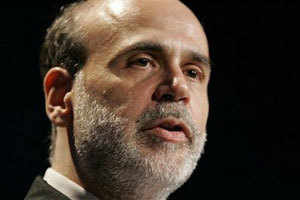
    Ben Bernanke: “The U.S. government has a technology, called a printing press (or, today, its electronic equivalent), that allows it to produce as many U.S. dollars as it wishes at essentially no cost.”
    St. Louis Federal Reserve: “As the sole manufacturer of dollars, whose debt is denominated in dollars, the U.S. government can never become insolvent, i.e., unable to pay its bills. In this sense, the government is not dependent on credit markets to remain operational.”

  2.  The federal government will need to raise interest rates to sell its T-bonds. NO. Not only does the federal government not need to sell T-bonds, but when it wants to sell them, the Fed can and does buy them, via regular open market operations or  “quantitative easing,” both of which reduce interest rates
  3. Deficit spending dampens private investment. NO. Deficit spending adds investment dollars to the economy, thus stimulating private investment.

The most concerning part of all this is that Powell surely must know it, or at least he should know it.

Yet, he persists in disseminating misinformation. Or could it be intentional disinformation?

“A more sustainable federal budget could also support the economy’s growth over the long term,” said Powell, who spent time before he joined the Fed educating Congress about the debt limit as a Bipartisan Policy Center scholar.

The debt limit?? “Scholar” Powell was educating Congress about the phony debt limit, which not only is harmful, but unnecessary, and it isn’t even a debt limit.

It’s a limit on the federal government paying for its existing debts. The next time you receive a credit card bill, call them to say, “Sorry, but I can’t pay you. I have a debt limit.”

See how well that goes.

Trump blasted Powell, tweeting in the middle of the congressional hearing that the Fed chair was keeping interest rates too high.

“When Jerome Powell started his testimony today, the Dow was up 125, & heading higher. As he spoke it drifted steadily downward, as usual, and is now at -15.

Germany & other countries get paid to borrow money.

We are more prime, but Fed Rate is too high, Dollar tough on exports,” Trump wrote on Twitter.

The Dow Jones  industrial average ended the day flat.

Donald Trump doesn’t know what he is talking about. You might think that a rich man would understand finance, but he seems clueless.

He tweeted that the Fed “should get our interest rates down to ZERO, or less,” allowing the federal government to refinance its massive debt at a lower cost.

Why would anyone think the federal government, which creates dollars at the touch of a computer key, needs or even wants to “refinance its massive debt at a lower cost?” It makes no sense at all.

As we discussed earlier, low rates have a mixed effect on the economy.

And as for exports, the supposed benefit is that America gets to trade precious goods and services for dollars. But, the U.S. government has the unlimited ability to create dollars. So what is the purpose of sending precious goods, created by the sweat of American workers, overseas while we create unlimited dollars at the touch of a computer key?

All that exports accomplish is to add dollars to the U.S. private sector, which the federal government can do directly, at no cost, either by eliminating taxes or by direct contribution.

For a Monetarily Sovereign nation like the U. S., exports are unnecessary, and somewhat harmful, and at least dramatically overrated.

Even if U.S. exports totaled $0, the federal government could support the private sector, while not wasting precious resources or adding CO2 to the climate.

The United States has never had a negative interest rate. When asked about that possibility on Tuesday, Powell said that’s “not a tool we are looking at.”

Economists widely view negative interest rates as only worth doing when the economy is in a terrible situation. Trump keeps calling for lower interest rates to further boost growth and the stock market.

A negative interest rate would mean you would pay a bank to store your dollars. The belief is that you would prefer not to pay the bank but instead go out and spend and invest all your dollars, thus stimulating the economy.

Not only doesn’t that work but more realistically, why would any administration want the citizenry to have no cash reserves in the bank, while wildly spending on stocks and “stuff”?

And why would any administration want to cut bank deposits (i.e. reserves) and bank profits against which banks lend?

Any economists who would use negative rates “when the economy is in a terrible situation” are the same boobs who would apply leeches to cure anemia, or who think cuts to deficit spending will stimulate the economy.

In summary:

Chairman Powell acts as though he doesn’t understand the federal government is Monetarily Sovereign.

He acts as though he is the bookkeeper for a monetarily non-sovereign town, wondering where the next dollar will come from and how they can borrow enough to spend. For that bookkeeper, the debt truly might be “unsustainable.”

Not for the federal government.

The next time you read that the federal debt is “unsustainable,” know that the author either is lying or ignorant about federal economics.

Rodger Malcolm Mitchell
Monetary Sovereignty
Twitter: @rodgermitchell
Search #monetarysovereignty Facebook: Rodger Malcolm Mitchell

…………………………………………………………………………………………………………………………………………………………………………………………………………………………………………………………………………………………..

THE SOLE PURPOSE OF GOVERNMENT IS TO IMPROVE AND PROTECT THE LIVES OF THE PEOPLE.

The most important problems in economics involve:

  1. Monetary Sovereignty describes money creation and destruction.
  2. Gap Psychology describes the common desire to distance oneself from those “below” in any socio-economic ranking, and to come nearer those “above.” The socio-economic distance is referred to as “The Gap.”

Wide Gaps negatively affect poverty, health and longevity, education, housing, law and crime, war, leadership, ownership, bigotry, supply and demand, taxation, GDP, international relations, scientific advancement, the environment, human motivation and well-being, and virtually every other issue in economics.

Implementation of Monetary Sovereignty and The Ten Steps To Prosperity can grow the economy and narrow the Gaps:

Ten Steps To Prosperity:

1. Eliminate FICA

2. Federally funded Medicare — parts A, B & D, plus long-term care — for everyone

3. Provide a monthly economic bonus to every man, woman and child in America (similar to social security for all)

4. Free education (including post-grad) for everyone

5. Salary for attending school

6. Eliminate federal taxes on business

7. Increase the standard income tax deduction, annually. 

8. Tax the very rich (the “.1%”) more, with higher progressive tax rates on all forms of income.

9. Federal ownership of all banks

10. Increase federal spending on the myriad initiatives that benefit America’s 99.9% 

The Ten Steps will grow the economy and narrow the income/wealth/power Gap between the rich and the rest.

MONETARY SOVEREIGNTY