More scare nonsense from the CRFB.

The nation’s leading supplier of federal debt lies, the Committee for a Responsible Federal Budget, has released its latest salvo of utter nonsense:

Here are a few of their baseless claims:

1. The Deficit Could Hit $1 Trillion This Year and $2 Trillion Within a Decade
Although deficits decreased from Fiscal Year (FY) 2011 to FY 2015, they’ve been rising ever since.

We now expect deficits to return to nearly $1 trillion this fiscal year (2019) and stay above that level indefinitely.

In fact, if lawmakers extend the costly tax cuts and spending increases indefinitely, deficits will be more than $2 trillion by 2028.

Although the above claims themselves are not baseless, the implication that somehow increases in the federal deficit are bad — that is baseless.

An increasing deficit merely means that the federal government pumps more dollars into the economy that it removes. That is a good thing. It is what grows the economy.

In fact, the opposite of deficits — i.e. surpluses — have been the cause of every depression in U.S. history.

1804-1812: U. S. Federal Debt reduced 48%. Depression began 1807.
1817-1821: U. S. Federal Debt reduced 29%. Depression began 1819.
1823-1836: U. S. Federal Debt reduced 99%. Depression began 1837.
1852-1857: U. S. Federal Debt reduced 59%. Depression began 1857.
1867-1873: U. S. Federal Debt reduced 27%. Depression began 1873.
1880-1893: U. S. Federal Debt reduced 57%. Depression began 1893.
1920-1930: U. S. Federal Debt reduced 36%. Depression began 1929.
1997-2001: U. S. Federal Debt reduced 15%. Recession began 2001.

A growing economy requires a growing supply of money. Austerity (i.e. reduced deficit spending) invariably leads to recessions and depressions.

2. The Long-Term Debt Outlook is Terrifying
This fall, CRFB released its own 75-year budget outlook, which projected an unsustainable fiscal outlook.

Under current law, debt will rise from 78 percent of Gross Domestic Product (GDP) in 2018 to 160 percent by 2050 and nearly 360 percent by 2093. Under the Alternative Fiscal Scenario, debt will exceed 600 percent of GDP by 2093.

Why is the high debt/GDP ratio “unsustainable”? It isn’t. 

There is no relationship between federal debt and GDP. The debt is not serviced by GDP, nor is it serviced with taxes, exports, or any other form of income.

The federal government is Monetarily Sovereign. It has the unlimited ability to service any amount of debt. It never can run short of dollars.

Japan, for example, carries a debt/GDP ratio exceeding 250%, and no one claims this debt is “unsustainable.” See graph, below.
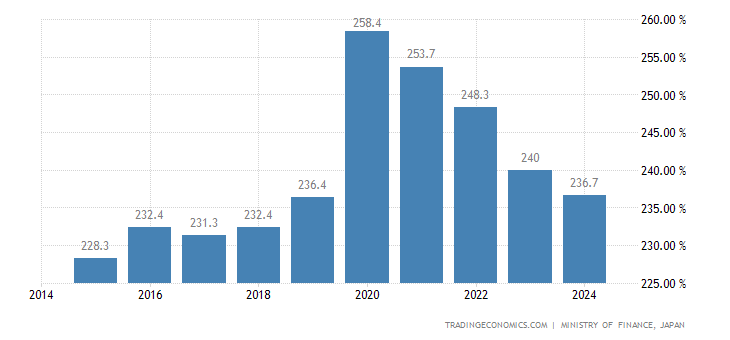
Japan General Government Gross Debt to GDP

3. “Debt-Financed Laws” Offered a Temporary Stimulus
While the economy has grown by about 3 percent over the past year, our analysis Can America Sustain the Recent Economic Boost? showed that the growth rate would likely return to 2 percent per year.

As we illustrated, near-term growth was largely driven by one-time stimulus and other effects from the Tax Cuts and Jobs Act (TCJA), the 2018 Bipartisan Budget Act, and other deficit-financed legislation.

Unfortunately, the economic boost from these laws will be temporary – but the debt will be permanent.

The CRFB admits that economic growth is driven by deficit stimuli. 

They also admit that continuing economic growth requires continuing deficit stimuli, which our Monetarily Sovereign government has the infinite ability to provide.

The U.S. government never unintentionally can run short of U.S. dollars. Never. Even if the federal government collected zero taxes, it could continue spending, forever.

So, exactly what is the problem? The CRFB never says.

4. Rapid Economic Growth is Unlikely to Last
In the analysis of America’s recent economic boost, we showed that nearly all forecasters agree that current rapid rates of economic growth are unlikely to last.

For example, the Congressional Budget Office (CBO) projects that the economy will grow by 3 percent in 2018 and 2.8 percent in 2019, but then grow by between 1.6 and 1.9 percent per year for the remainder of the decade.

A primary factor in predicting economic growth is federal debt growth. Debt growth creates the dollars that stimulate economic growth.
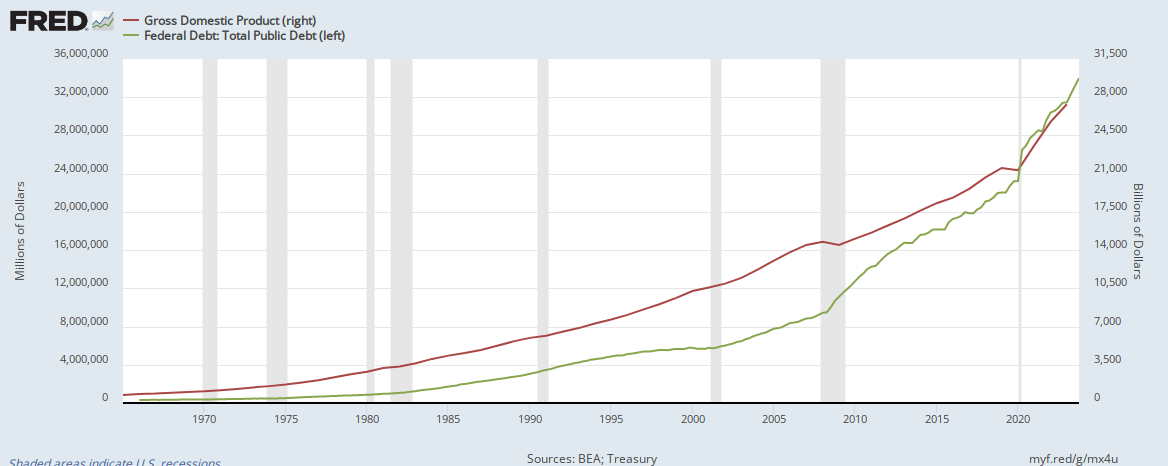
Economic growth (red) parallels federal debt growth (green).

5. Deficits Shouldn’t Rise When the Economy is This Strong
Typically, a strong economy is paired with low deficits (or even surpluses) – both because strong economic performance produces more revenue and because it creates the economic space for deficit reduction.

Yet despite the economy performing at or even above its potential, deficits are widening.

In a recent analysis of deficits and the economy, we showed that the deficit has never been this high when the economy was this strong. 2018 and 2019 are extremely abnormal in that we are running high and rising deficits despite low unemployment, no significant output gap, no recession, and strong economic growth.

The above is a lie of Trumpian proportions. Rising deficits make the economy strong by adding dollars to the economy.

Reduced deficit growth leads to recessions, which are cured by increased deficit growth:

Reduced federal deficit growth leads to recessions (vertical bars) which are cured by increased deficit growth.

And as you have seen, federal surpluses do not create strong economies. Quite the opposite. Federal surpluses create depressions.

It is true that economic growth brings in higher taxes, but that does not create “economic space for deficit reduction.”

The term “economic space for deficit reduction” is gobbledegook. As long as there are deficits, they always can be reduced, so long as one wishes to experience recessions and depressions.

6. Policymakers are Responsible for More than Half of This Year’s Deficit
This year, the deficit will approach $1 trillion – and policymakers have no one to blame but themselves.

We estimate that 55 percent of this year’s projected deficit is the result of deficit-financed legislation enacted since 2015.

Recent spending hikes and tax cuts will cost $540 billion this year. Had these laws been offset or not enacted, the deficit would be $440 billion rather than $981 billion, as CBO projects.

Said more accurately, “Policymakers are Responsible for More than Half of This Year’s Economic Growth, simply because deficits create the dollars necessary for economic growth.”

7. Recent Tax and Spending Bills Both Cost Trillions, If Extended
The Tax Cuts and Jobs Act of 2017 and the Bipartisan Budget Act of 2018 both added tremendously to the national debt.

And while the tax cuts will cost significantly more ($1.9 trillion versus $435 billion) over ten years, that is largely an artifact of the most of the tax cuts enacted for eight years, while the spending boost was a two-year deal.

We found that if lawmakers extend both laws indefinitely, the tax cuts will cost about $2.7 trillion over a decade while the spending bill will cost $2.4 trillion. That’s $5 trillion of additional debt that this country simply cannot afford.

The CRFT prays that you not understand Monetary Sovereignty, otherwise you would know that:

8. Revenue Has Dropped, Not Risen
While some have claimed that revenue grew over the past year  . . . we estimated that actual revenue fell by 3.6 percent between tax year 2017 and tax year 2018. Revenue fell by 5.4 percent after inflation, and by 8.1 percent relative to GDP.

Said more accurately,  . . . “we estimated that 3.6 fewer dollars were taken from the economy between tax year 2017 and tax year 2018.”

Taking fewer dollars out of the economy helps the economy grow, and the government has no need for those dollars.

And now we come to the real reason why the CRFB exists, why it devotes all its resources to promulgating the “Big Lie”: The Committee for a Responsible Federal Budget is paid by the rich to convince you that your federal benefits should be reduced.

The single, biggest economic problem facing the U.S. and the world is widening Gaps between the richer and the poorer.

9. Entitlements and Interest Explain Long-Term Debt Growth
While near-term deficits are largely self-imposed, medium- and long-term debt growth are driven primarily by growing costs of Social Security, federal health spending, and interest on the debt. Indeed, these three categories of spending are responsible for over four-fifths of all nominal spending growth over the next decade alone.

Yes, nothing irritates the rich more than you receiving money. This irritation is “Gap Psychology,”   the human desire to widen the Gap below you on any economic or social measure, and to narrow the Gap above you.

Gap Psychology drives the appeal of expensive jewelry, cars, homes, and designer clothing. Gap Psychology drives the resentment some have for anti-poverty aids like food stamps and college preferences, as well as immigration.

10. Social Security is Hurdling Toward Insolvency
Social Security costs continue to grow faster than dedicated revenue, and its trust fund is running out.

CBO projected that just 13 years from now – when today’s 54-year-olds reach the normal retirement age and today’s youngest retirees turn 75 – the Social Security trust fund will be depleted.

The Trustees project insolvency in 16 years, when today’s 51-year-olds reach the normal retirement age and today’s youngest retirees turn 78. At that point, the law calls for a deep automatic across-the-board cut in benefits.

It is a perfect example of the “Big Lie.”

The federal government cannot run short of dollars, and because the federal government cannot run short of dollars, no agency of the federal government can run short of dollars unless that is what the federal government wants.

The rich run the federal government. The rich want you to believe Medicare and Social Security and Medicaid and every other government program that benefits the not-rich must cut spending. 

Image result for bernanke and greenspan
It’s our little secret. Don’t tell the people we don’t use their tax dollars.

Ben Bernanke: “The U.S. government has a technology, called a printing press (or, today, its electronic equivalent), that allows it to produce as many U.S. dollars as it wishes at essentially no cost.”

Alan Greenspan: “Central banks can issue currency, a non-interest-bearing claim on the government, effectively without limit. A government cannot become insolvent with respect to obligations in its own currency.”

St. Louis Federal Reserve: “As the sole manufacturer of dollars, whose debt is denominated in dollars, the U.S. government can never become insolvent, i.e.,unable to pay its bills. In this sense, the government is not dependent on credit markets to remain operational.

There is no “Social Security trust fund.” It is a bookkeeping fiction. The federal government could, if the rich wished, supply unlimited funds to support Social Security and Medicare for every man, woman, and child, of all ages, forever.

11. Rising Health Costs Are Driving Up the Debt
Health care spending is rising even faster than Social Security spending – both as a result of population aging and rising per-person health care costs.

In our analysis of health spending and the federal budget, we found that If health spending were held constant at today’s level, debt would stabilize around 90 percent of GDP; if it had been held constant in 2010, debt would peak in about a decade and return to today’s level by 2040.

Said more accurately, “If only you people would spend more out of your own pockets on health care, and take less from the government, the federal debt would be lower, the economy would decline and the Gap between you and the rich would widen.”

12. Tax Expenditures Remain Costly
While Social Security, Medicare, and Medicaid are the fastest growing federal programs, tax breaks remain costly.

According to the Joint Committee on Taxation, income tax expenditures will cost about $1.5 trillion per year in lost revenue.

While one goal of tax reform was to dramatically shrink the size and number of these tax breaks, the Tax Cuts and Jobs Act actually only eliminated one significant tax expenditure, and it did little to reduce the overall cost of tax preferences.

In the misleading world of the Committee for a Responsible Federal Budget, the words “Tax Expenditures” are not expenditures at all. They are economic savings.

Those are the dollars not taken from your pockets. Those are the growth dollars that remain in the economy.

Then after telling us that Social Security, Medicare, Medicaid and other benefits to you should be cut, the CRFB suddenly expresses false concern for your future generations:

13. Policymakers are Prioritizing the Past Over the Future
Instead of leaving future generations better off, we’re leaving them with a stack of large bills.

Interest payments on the debt are expected to exceed federal spending on children by 2020 and all federal support for children (including tax expenditures and spending) by 2021.

That means we’ll soon be spending more financing the consumption of past generations than investing in our future.

All lies. Future generations will not pay for future federal deficit and debt, any more than current generations pay for current deficits and debt.

Who pays? The government pays for its deficits by creating dollars from thin air, just as it has done ever since it created the very first dollar, way back in the 1780s.

Federal taxes do not fund federal spending. All tax dollars are destroyed upon receipt, and brand-new dollars are created, ad hoc, each time the government pays a creditor.

If interest payments exceed federal support for children, the government could solve that “problem” simply by spending more on children.

Meanwhile, federal interest payments add growth dollars to the economy.

And finally, we come to the biggest whopper of them all:

14. Reducing Debt Would Increase the Size of the Economy
One consequence of a rising national debt is that it crowds out productive investment, which in turn slows income growth.

The corollary is that lower debt can actually boost income growth.

CBO estimates that if debt were reduced to its historic average of about 41 percent of GDP by 2048, per-capita GNP (a rough parallel for average income) would be about $6,000 (6.5 percent) higher than under current law.

Simply holding debt at current levels would boost income per person by $4,000 per year in 2048.

This is so laughably wrong, that one wonders how anyone with an IQ above 50 could possibly believe it.

Federal debt, by law and not by necessity, results from federal deficits. Federal deficits are economic surpluses. When the government runs a deficit, the economy runs a surplus — more money enters the economy than leaves it.

It takes a peculiar sort of illogic to claim that adding dollars to the economy “crowds out productive investment, which slows income growth.”

In short, the CRFB and its rich patrons want you to believe that cutting your federal benefits and/or increasing your federal taxes actually increases your income. 

If the people who wrote this nonsense actually believe it, they are woefully ignorant of basic economics, and if they don’t believe it, they are shameless liars.

Take your pick.

Rodger Malcolm Mitchell
Monetary Sovereignty
Twitter: @rodgermitchell; Search #monetarysovereignty
Facebook: Rodger Malcolm Mitchell

…………………………………………………………………………………………………………………………………………………………………………………………………………………………………………………………………………………………..

The single most important problems in economics involve the excessive income/wealth/power Gaps between the have-mores and the have-less.

Wide Gaps negatively affect poverty, health and longevity, education, housing, law and crime, war, leadership, ownership, bigotry, supply and demand, taxation, GDP, international relations, scientific advancement, the environment, human motivation and well-being, and virtually every other issue in economics.

Implementation of The Ten Steps To Prosperity can narrow the Gaps:

Ten Steps To Prosperity:
1. Eliminate FICA

2. Federally funded medicare — parts a, b & d, plus long-term care — for everyone

3. Provide a monthly economic bonus to every man, woman and child in America (similar to social security for all)

4. Free education (including post-grad) for everyone

5. Salary for attending school

6. Eliminate federal taxes on business

7. Increase the standard income tax deduction, annually. 

8. Tax the very rich (the “.1%) more, with higher progressive tax rates on all forms of income.

9. Federal ownership of all banks

10. Increase federal spending on the myriad initiatives that benefit America’s 99.9% 

The Ten Steps will grow the economy, and narrow the income/wealth/power Gap between the rich and you.

MONETARY SOVEREIGNTY

 

What is the difference between socialized medicine and true Medicare for all?

What is the difference between socialized medicine and true Medicare for all? Quite a bit.

Britain has socialized medicine. Socialism is government ownership and control of business, with the key word being “ownership.”

Here are excerpts from an article describing the British health care system.

First the good :

The good, the bad, and the ugly of England’s universal health-care system
The National Health Service, or NHS, is the United Kingdom’s public universal health system. It sees a million patients every day.

It employs 1.7 million people, which makes it the fifth biggest employer in the entire world. And of course, it is free at the point of use for U.K. residents.

If you walk into an NHS hospital with a broken arm, you’ll walk out with a cast, a few x-rays, and zero bills to pay.

While the NHS has long been the subject of some scorn in America, it is also often heralded elsewhere as a shining example of how universal health care can succeed.

British citizens are fiercely protective of it. One survey found that Brits list the NHS as the number one reason they are proud to be British.

Then the bad:

Many recent surveys have found the NHS to be drastically understaffed, and doctors in particular are desperately needed.

Last year, the British Medical Association called the NHS’s doctor shortage “chronic” and warned that if something wasn’t done to stem the problem, “patient care will suffer.”

Then the author describes a personal experience with Britain’s medical system that at best was horrible, and at worst, close to fatal.

Our (newborn) son was out of the NICU, but the medical team still didn’t know if he had an infection, and face-to-face consultations with the pediatricians treating him were rare.

When we did get a moment with a doctor, it was brief and hurried.

Our (room) seemed like (it) hadn’t been cleaned in days; the bathroom smelled of sewage and the floor was littered with trash.

We felt abandoned, forgotten. And the longer we stayed, the more invisible we became: Multiple times I went long stretches without a meal, only to find out that dinner was hours ago and the staff had accidentally neglected to bring me any.

We were just another disgruntled, weary family clutching our newborns and waiting to be released.

That’s the thing: When you take the money out of medicine, when you’re no longer a paying customer with alternative options, you lose your leverage. You are at the mercy of the system.

I don’t want to seem ungrateful. After all, it’s very possible the NHS saved my son’s life.

And my husband and I often talk about how different things would be if he’d been born in the U.S.: No doubt we’d be dealing not only with a new baby, but insurance claims and possibly crippling debt.

I walked out of that hospital with a healthy child and not a penny owed. I am very thankful.

It’s also an incredibly complex problem that experts across the country are struggling to solve. Politics plays a large role, as does an aging population. Some people call for more funding. Others insist on shifting the focus to preventive care.

Still others say technological innovations could hoist the NHS out of the past and propel it into the digital age. Probably what’s needed is some combination of all of these improvements.

I don’t know how to fix Britain’s universal health-care system, just like I don’t know how to lower the costs of America’s privatized system.

But I do know that, while the price of good health care shouldn’t be astronomical medical bills, it shouldn’t be emotional trauma, either.

The fundamental problem with Britain’s system is that it is socialized medicine, i.e.  owned and operated by the government.

In that sense, it resembles America’s giant Veteran’s Administration.

And while the government is very good at paying for medical care, it is awful at providing medical care.

With America’s Medicare, by contrast, the government does not own and operate the hospitals and all the other medical services.

It merely pays the hospitals and other medical services. It takes the place of private insurance.

Thus, Americans receive the best of two worlds: A payer having unlimited money and a privately run medical system: Medicare.

The problem with Medicare is that it collects taxes unnecessarily, and it doesn’t cover enough.

Medicare for All (Step #2 of the Ten Steps to Prosperity, below) would provide the best of all worlds:

  1. Covering all Americans of all ages, not just the elderly and those with specific afflictions.
  2. Comprehensive:  No deductibles or need for supplementary insurance. All medical services covered.
  3. All prescription pharmaceuticals 100% covered.
  4. No taxes needed. (See: Step #1: Eliminate FICA).

Our Monetarily Sovereign government can pay for all of this, without raising taxes.

Despite what you have been told, increasing the debt and deficit do not cause inflation and are not “unsustainable.”

The public is being told lies because of “Gap Psychology.” Don’t allow the debt “Henny Pennys” to scare you.

Rodger Malcolm Mitchell
Monetary Sovereignty
Twitter: @rodgermitchell; Search #monetarysovereignty
Facebook: Rodger Malcolm Mitchell

…………………………………………………………………………………………………………………………………………………………………………………………………………………………………………………………………………………………..

The single most important problems in economics involve the excessive income/wealth/power Gaps between the have-mores and the have-less.

Wide Gaps negatively affect poverty, health and longevity, education, housing, law and crime, war, leadership, ownership, bigotry, supply and demand, taxation, GDP, international relations, scientific advancement, the environment, human motivation and well-being, and virtually every other issue in economics.

Implementation of The Ten Steps To Prosperity can narrow the Gaps:

Ten Steps To Prosperity:
1. Eliminate FICA

2. Federally funded medicare — parts a, b & d, plus long-term care — for everyone

3. Provide a monthly economic bonus to every man, woman and child in America (similar to social security for all)

4. Free education (including post-grad) for everyone

5. Salary for attending school

6. Eliminate federal taxes on business

7. Increase the standard income tax deduction, annually. 

8. Tax the very rich (the “.1%) more, with higher progressive tax rates on all forms of income.

9. Federal ownership of all banks

10. Increase federal spending on the myriad initiatives that benefit America’s 99.9% 

The Ten Steps will grow the economy, and narrow the income/wealth/power Gap between the rich and you.

MONETARY SOVEREIGNTY


Predicting Trump, and words for the religious right


Fact Check

H. R. Mencken

Writing for the Baltimore Evening Sun on 26 July 1920, in an article entitled “Bayard vs. Lionheart,” Mencken cynically opined on the difficulties of good men reaching national office when the scale of their campaigns precluded them from directly reaching out to large segments of the voting public:

The larger the mob, the harder the test. In small areas, before small electorates, a first-rate man occasionally fights his way through, carrying even the mob with him by force of his personality.

But when the field is nationwide, and the fight must be waged chiefly at second and third hand, and the force of personality cannot so readily make itself felt, then all the odds are on the man who is, intrinsically, the most devious and mediocre — the man who can most easily adeptly disperse the notion that his mind is a virtual vacuum.

The Presidency tends, year by year, to go to such men.

As democracy is perfected, the office represents, more and more closely, the inner soul of the people.

We move toward a lofty ideal. On some great and glorious day the plain folks of the land will reach their heart’s desire at last, and the White House will be adorned by a downright moron.

And now, a reminder for those of you among the religious right, who have wished to close the gates to immigrants:

Matthew 25:35 I was hungry and you gave me food, I was thirsty and you gave me drink, I was a stranger and you welcomed me,

Leviticus 19:33-34 “When a stranger sojourns with you in your land, you shall not do him wrong. You shall treat the stranger who sojourns with you as the native among you, and you shall love him as yourself, for you were strangers in the land of Egypt.

Romans 15:7 Therefore welcome one another as Christ has welcomed you, for the glory of God.

Exodus 23:9 “You shall not oppress a sojourner. You know the heart of a sojourner, for you were sojourners in the land of Egypt.

Galatians 3:28 There is neither Jew nor Greek, there is neither slave nor free, there is no male and female, for you are all one in Christ Jesus.

Psalm 146:9 The Lord watches over the sojourners

Leviticus 19:33 “When a stranger sojourns with you in your land, you shall not do him wrong.

Hebrews 13:1-25 Do not neglect to show hospitality to strangers, for thereby some have entertained angels unawares.

Deuteronomy 27:19 “Cursed be anyone who perverts the justice due to the sojourner, the fatherless, and the widow.”

Matthew 22:39 You shall love your neighbor as yourself.

Colossians 3:11 Here there is not Greek and Jew, circumcised and uncircumcised, barbarian, Scythian, slave, free; but Christ is all, and in all.

Zechariah 7:10 Do not oppress the widow, the fatherless, the sojourner, or the poor, and let none of you devise evil against another in your heart.”

If you have been led astray by the words of a corrupt and godless man, this would be a good time to return to Jesus. The gates of heaven will open to you.

Rodger Malcolm Mitchell
Monetary Sovereignty
Twitter: @rodgermitchell; Search #monetarysovereignty
Facebook: Rodger Malcolm Mitchell

The real reasons why Trump’s incessant lying works so well.

President Trump may tell more lies than anyone, even any politician, in U.S. history. Yet his followers don’t seem to mind.

This phenomenon has the rational people of America puzzled and infuriated. “How can they not see or care what a liar he is?”.

My long-time explanation has been:

Trump hates the same people his followers hate.

Trump hates foreigners, especially non-white foreigners who come from “shithole countries: Mexicans, South and Central Americans, and Muslims, blacks, browns, yellows, reds, gays, and anyone who tells the truth about him.

His followers hate the same people, so though Trump lies about virtually everything, his followers remain loyal, as long as he continues to spew bigoted hatred.

So when Trump said, “I will be proud to shut down the government. I will take the mantle. I will not blame you (Democrats) for it” yesterday, and then today wrote, “Democrats own the shutdown,” Trump’s followers were not troubled.

One may ask, “Are these people stupid?” Perhaps they are, but I suspect there is something in addition to the above-mentioned, stupid bigotry going on:

How a powerful Russian propaganda machine chips away at Western notions of truth
By Joby Warrick and Anton Troianovski

The initial plan was a Cold War classic — brutal yet simple. Two Russian agents would slip onto the property of a turncoat spy in Britain and daub his front door with a rare military-grade poison designed to produce an agonizing and untraceable death.

But when the attempted assassination of Sergei Skripal was botched, the mission quickly shifted. Within hours, according to British and U.S. officials who closely followed the events, a very different kind of intelligence operation was underway — an elaborate fog machine to make the initial crime disappear.

False narratives and conspiracy theories began popping up almost immediately, the first of 46 bogus storylines put out by Russian-controlled media and Twitter accounts and even by senior Russian officials, all of them sowing doubt about Russia’s involvement in the March 4 assassination attempt.

Ranging from the plausible to the fantastical, the stories blamed a toxic spill, Ukrainian activists, the CIA, British Prime Minister Theresa May, and even Skripal himself.

Variations on the technique existed during the Cold War, when the Soviet Union used propaganda to create alternative realities [What Trump’s mouthpiece, Kellyanne Conway, termed, “alternative facts.”]

But the disinformation campaigns now emanating from Russia are of a different breed, said intelligence officials and analysts.

Engineered for the social media age, they fling up swarms of falsehoods, concocted theories, and red herrings, intended not so much to persuade people as to bewilder them.

And that is the secret to the power of Trump’s constant lying. It is done, not so much to persuade his people, but rather to bewilder them.Image result for trump pinocchio

(After all these months, who would be persuaded by anything Trump says? Who can even remember what he has said?)

Did he say he would or would not take the blame for the shutdown? Did he admit or deny having an affair with Stormy Daniels and numerous other women? Did he, or did he not, claim the purpose of a Russian meeting was to discuss the adoption of Russian children. Is Michael Cohen a “good man” or “a liar”?

The list of lies and contradictions is endless. Like cockroaches, as soon as one is stomped down, ten more appear.

What did Trump say last about Manafort, about Gates, about Flynn?  Can you keep track of the criminals, miscreants, traitors, flimflam artists, and swamp creatures with whom Trump has surrounded himself and foisted on us?

And this doesn’t even include the other criminals that Trump once claimed were “unbelievable,” until they were found to be actually unbelievable: Shulkin, Porter, Manigault-Newman, Price, Bannon, Scaramucci, Yates, Pruitt, et al — all of whom were great until they weren’t.

Can you even remember all those names?

“The mission seems to be to confuse, to muddy the waters,” said Peter Pomerantsev, a former Russian-television producer and author of Nothing Is True and Everything Is Possible, a memoir that describes the Kremlin’s efforts to manipulate the news.

The ultimate aim, he said, is to foster an environment in which “people begin giving up on the facts.”

Most people, even those intelligent enough to see that Trump is both incompetent and untrustworthy, are confused by his lies.

When pro-Russian separatists shot down Malaysia Airlines Flight 17 over eastern Ukraine, killing 298 passengers and crew members, Russian officials and media outlets sought to pin the blame on the Ukrainian government, suggesting at one point that corpses had been trucked to the crash site to make the death toll appear higher.

In October 2015, months after U.S. and European investigators concluded that Flight 17 had been brought down by a Russian missile fired by separatists, then–presidential candidate Donald Trump told CNN that the culprit was “probably Russia” but suggested that the truth was unknowable.

“To be honest with you, you’ll probably never know for sure,” he said.

The effect of Trump’s constant lies is buttressed by his using the old Hitlerian trick of blaming the opposition for his own faults.

Thus, the crooked owner of the scam operation, Trump University, and the criminal head of the illegal Trump Foundation got away with referring to “Crooked Hillary.”

And the unindicted co-conspirator was able to get his followers to chant, “Lock her up! Lock her up! Lock her up!”

And the draft dodger with phony “bone spurs,” was able to convince his followers that Senator John McCain was “no hero” because he was captured.

And the ultimate liar was able to get away with calling Ted Cruz, “Lyin’ Ted,” perhaps assisted by the fact that Cruz really is a liar.

And the crook with multiple bankruptcies of casinos (who could bankrupt a casono) gets away with “Failing NY Times.”

And the man of infinite lies gets away with “Sneaky Dianne Feinstein.”

Putin brought Russia’s privately owned, freewheeling TV networks to heel in one of his first major moves as president.

The Kremlin now controls all of Russia’s main national television channels.

They deliver a strident, conspiratorial, pro-Kremlin message in hours of lavishly produced talk shows and newsmagazine programs every night.

This is what Trump has said he wants to do: Sue and destroy any “fake media” that tell “fake news” he doesn’t like.

Providing further amplification are social media “troll” factories where hundreds of workers are paid to disseminate false stories on the internet, under official direction.

The U.S. version of “troll factories” is Trump himself, aided and abetted by Fox “News,” Rush Limbaugh, and Breitbart.

Russian politicians and diplomats then chime in, often ridiculing any official investigation and denouncing claims of Russian involvement.

The U.S. version of the above is the GOP, who despite repeated indictments and convictions of Trump’s traitorous associates, continue to parrot the claim that Mueller’s investigation is a witchhunt that should end.

As for who to believe, who you can’t believe, can you believe at all?” Putin mused, before answering his own questions: “You can’t believe anyone.

Certainly, not Donald J. Trump.

In short, Trump’s firehose stream of lies is designed to exhaust the listener, so that everything blends into a fog. He relies on false equivalences to confuse among “bad” lies, “white” lies, exaggerations, the truth.

When he is accused of lying, his acolytes mention some other person, usually “Hillary, “Obama,” or “the Democrats,” who may or may not have done something bad, and whatever that may be, excuses everything Trump does.

“Trump separates children from their parents” is equated with the myth of “Benghazi.” “Trump has told more than 3,000 lies this year,” is excused by “Well, Obama lied too.” Every Trump failing is excused, most often by a false reference.

And because he has so many failings, nothing stands out, and everything is excused by his followers, with references to “Hillary, Obama, the Democrats.”

That is the genius of the man: Confusing his followers with volume.

Rodger Malcolm Mitchell
Monetary Sovereignty
Twitter: @rodgermitchell; Search #monetarysovereignty
Facebook: Rodger Malcolm Mitchell

…………………………………………………………………………………………………………………………………………………………………………………………………………………………………………………………………………………………..

The single most important problems in economics involve the excessive income/wealth/power Gaps between the have-mores and the have-less.

Wide Gaps negatively affect poverty, health and longevity, education, housing, law and crime, war, leadership, ownership, bigotry, supply and demand, taxation, GDP, international relations, scientific advancement, the environment, human motivation and well-being, and virtually every other issue in economics.

Implementation of The Ten Steps To Prosperity can narrow the Gaps:

Ten Steps To Prosperity:
1. Eliminate FICA

2. Federally funded medicare — parts a, b & d, plus long-term care — for everyone

3. Provide a monthly economic bonus to every man, woman and child in America (similar to social security for all)

4. Free education (including post-grad) for everyone

5. Salary for attending school

6. Eliminate federal taxes on business

7. Increase the standard income tax deduction, annually. 

8. Tax the very rich (the “.1%) more, with higher progressive tax rates on all forms of income.

9. Federal ownership of all banks

10. Increase federal spending on the myriad initiatives that benefit America’s 99.9% 

The Ten Steps will grow the economy, and narrow the income/wealth/power Gap between the rich and you.

MONETARY SOVEREIGNTY