Every so seldom, a new weapon comes along, that changes the world. Weapons that change the world can be measured by ease of use, cost, killing power, and anonymity.
1. Gunpowder changed the world.
Gunpowder made guns and bombs possible, which made killing many people by individual people, easy.
Prior to the invention of gun powder, killing was a mano a mano battle, requiring close, individual combat between (usually) men.
Today, an individual gun nut can kill 20, 40, 50 or more innocent people, at a distance, in a matter of seconds, using a rapid-fire gun. Or toss a grenade into a crowd.
Drive-by shootings are much easier to accomplish than, say, drive-by stabbings or poisonings.
2. The atomic bomb changed the world.
It allowed many thousands of innocent peopleto be killed by one person — the person who pushes the button.
The atomic bomb, in a strange irony, has helped prevent major wars, because to any but the most evil, suicide-driven, madman (or woman), the notion of atomic war is unthinkable.
And atomic weapons are sophisticated and expensive, so are unlikely to be controlled by an individual.
Thus, another world war has become slightly less likely, though not impossible, considering the type of tyrants that now rule many nations.
(Donald Trump asked, “If we have nuclear weapons why can’t we use them?” but he’s Trump.)
3. The Internet changed the world.
It currently is a powerful weapon, though it wasn’t designed to be a weapon. But it has made it possible for one person to change the lives of millions of innocent people, easily, quickly, cheaply, and often even anonymously.
And now for thenewweapon that has changed the world:
4. The drone makes it possible for an individual to deliver death to anyone on earth, and destruction to any infrastructure on earth, quickly, silently, and cheaply, and possibly anonymously.
And there is no practical way to stop drones.
A real product: TF-19 WASP Flamethrower Drone Attachment. 25ft range, 1-gallon fuel capacity, 100 seconds of firing time
Bloomberg Opinion Saudi Arabia Drone Attack Is a Strike at Oil’s Future The audacious assault promises major disruption and sets the stage for a new and dangerous period for world oil markets.
By Liam Denning, September 14, 2019, 4:58 PM CDT
The oil market has shrugged off sanctions on Iran, exploding tankers and drones getting shot down over the Strait of Hormuz. But this weekend’s strike against Saudi Arabia’s Abqaiq processing facility – perhaps the single most important piece of oil infrastructure on the planet – is of a different order.
Saudi Arabia said the attack affected 5.7 million barrels a day of output, or roughly half their production.
It is unclear whether the strike involved drone-fired weapons or missiles or a combination of them.
The prevailing mood in the markets before Saturday was one of uncertainty weighing on prices, largely related to the swings of the trade war and – with the sudden absence of John Bolton from President Donald Trump’s ear – whether sanctioned Iranian barrels would find their way back to the market.
Now, with Iranian-sponsored Houthi fighters in Yemen claiming responsibility for a strike at the heart of the Saudi Arabian economy – and U.S. Secretary of State Michael Pompeo directly blaming Iran for the attack – a meaningful thaw that allows Iranian barrels to replace disrupted Saudi ones seems inconceivable.
What is clear is that the oil market has entered a new and dangerous period. Crown Prince Mohammed bin Salman, who spearheaded Saudi Arabia’s intervention in Yemen, will almost certainly have to respond, especially if the attack really has knocked out a lot of oil supply for an extended period.
This escalation could be interpreted as Iran’s response to Washington’s “maximum pressure” campaign – if Tehran can’t export, then neither should Saudi, may be the zero-sum thinking at play here. The chance of miscalculation and further escalation is very high.
Trump’s sensitivity to pump prices was established during 2018’s midterms, so a conflict-driven spike in the coming weeks and months could mean a flock of black swans for the oil market, ranging from releases of strategic reserves (Trump already called for this) to outright bans on oil exports.
There is a more existential issue to consider, too. One of the big themes being debated among Democrats ahead of Iowa is climate change. Yet, while polling suggests the issue resonates with an increasing proportion of Americans, history suggests it is pretty tough to get them to focus on energy issues unless, as in 2008, prices are high.
That could end up being the case in 2020, if it plays out against a backdrop of Middle Eastern conflict, high pump prices and consequent damage to economic growth.
You are not safe from a drone, not in your home, not in your car, not in a “good” neighborhood, nowhere.
If for whatever reason, or for no reason at all, someone wants to kill you or to damage your property, they simply could send a cheap drone over you and drop whatever — a bomb, a canister of poison gas, a toxic liquid, even political leaflets. Anything, even a flamethrower.
Any day, any time, any place. And do it anonymously.
You have lost all security.
Oh, you say you moved to an expensive, safe suburb, with good schools and clean streets, and your house is equipped with the latest alarm systems, and plenty of police protection, and for years, there hasn’t been any violent crime within miles.
Sorry, but you no longer are safe. Any fool can buy a drone that will drop an incendiary on your roof, and burn your house to ashes — without his being seen anywhere near you.
Remember that waiter you undertipped five years ago? No, you don’t remember, but he does. And he’s been nursing the grievance ever since, and now he’s going to get even. You are about to be “droned.”
The drone is beyond even the AK-47, that turns cowards into killers. It essentially is invisible, remote, and accurate.
Don’t be surprised if the National Rifle Association tries to include “drone rights” as a Constitutional prerogative, and politicians begin to promise Texans that their drones never will be taken from their “cold dead hands.”
Don’t be surprised if a “drone magazine” (there already are a half dozen of them) promotes drones by their lethality (like the flamethrower drone.)
And there is nothing you can do about it. You can’t hide from it.
The most important problems in economics involve the excessive income/wealth/power Gaps between the richer and the poorer.
Wide Gaps negatively affect poverty, health and longevity, education, housing, law and crime, war, leadership, ownership, bigotry, supply and demand, taxation, GDP, international relations, scientific advancement, the environment, human motivation and well-being, and virtually every other issue in economics.
Implementation of The Ten Steps To Prosperity can narrow the Gaps:
While state taxes fund state spending and local taxes fund local spending, federal taxes do not fund federal spending. Even if all federal tax collections fell to $0, the federal government still continue to spend, forever.
Economics is one of those sciences everyone has mastered — or at least, everyone thinks they have mastered — simply by reading an occasional newspaper or by watching the TV news.
In that vein, allow me to introduce you to Jeff Spross:
Income tax brackets have been indexed to inflation since the 1980s (meaning that as incomes gradually rise due to inflation, taxpayers aren’t pushed into paying higher and higher tax rates), and the White House was considering extending that same benefit to people who pay capital gains taxes. It ultimately demurred.
But Democrats — or anyone, really — should take a hint from Trump’s decision. It’s not just that capital gains shouldn’t be indexed to inflation; income taxes shouldn’t be either.
Doing away with that indexing would raise plenty of new revenue for the government. But more fundamentally, it would fix a basic misunderstanding about good macroeconomic policy.
Mr. Spross is one of the many writers who strangely seems to think your Monetarily Sovereign federal government is running short of dollars, but you aren’t.
So he advocates you sending more of your hard-earned money to a government that never has, and never can, run short of dollars.
If you think that sounds nuts, you’re right.
The U.S. income tax has several brackets, each with its own tax rate. When you pay taxes in 2021, the rates will be the same, but the income thresholds — where each bracket ends and the next one begins — will have risen. That’s inflation indexing at work.
The Economic Recovery Tax Act of 1981, passed under President Reagan, was primarily a massive tax cut. But it also introduced inflation indexing into the tax code. Before that, the cutoff for each tax bracket would remain the same year after year until Congress explicitly changed it. Thanks to the Economic Recovery Tax Act, those brackets have automatically adjusted with inflation every year since 1985.
Had Congress not introduced income tax indexing, everyone in America now would pay at the highest tax rate.
Mr. Spross seems to think that would be just fine:
Congress should go back to the old, pre-1985 way of doing business. Doing so would have two advantages.
First off, it would bring in a lot of new tax revenue without having to do the politically unpopular thing of actually hiking rates.
President Trump and the Republicans didn’t end inflation indexing, but they did change the measure of inflation in the tax code to a new version that tends to rise more slowly — thus, the tax bracket thresholds will rise more slowly in the future as well.
According to one estimate, that change will net the government an extra $134 billion in tax revenue over the next 10 years.
Thus, while an exact figure is beyond my abilities to calculate, the revenue brought in over a decade by simply getting rid of inflation indexing entirely should be several times that $134 billion haul.
Mr. Spross opts for taking not just $134 billion from the economy, but “several times that $134 billion haul.”
But, taking “several times $134 billion” from the economy would cause a recession if we are lucky and a depression if we aren’t.
Federal surpluses take money from the economy. Here is what they do to the economy:
I. U.S. depressions are caused by federal surpluses.
1804-1812: U. S. Federal Debt reduced 48%. Depression began 1807.
1817-1821: U. S. Federal Debt reduced 29%. Depression began 1819.
1823-1836: U. S. Federal Debt reduced 99%. Depression began 1837.
1852-1857: U. S. Federal Debt reduced 59%. Depression began 1857.
1867-1873: U. S. Federal Debt reduced 27%. Depression began 1873.
1880-1893: U. S. Federal Debt reduced 57%. Depression began 1893.
1920-1930: U. S. Federal Debt reduced 36%. Depression began 1929.
1997-2001: U. S. Federal Debt reduced 15%. Recession began 2001.
II. U.S. recessions come on the heels of reductions in federal debt/money growth (See graph, below), while debt/money growth has cured recessions. Taxes reduce debt/money growth. That is why tax cuts stimulate economic growth.
Recessions show vertical gray bars. Blue line shows changes in federal debt.
No government can tax itself into prosperity, but many governments have taxed themselves into recessions. Tax increases (aka “austerity”), cause recessions and depressions.
Plenty of economists and experts argue bracket creep damages the economy: By shoving people into higher tax rates, even though their pay hasn’t increased, bracket creep discourages economic activity and slows down growth.
Here’s the problem with that logic: If your economy is experiencing high inflation, like what we went through in 1980, then it needs to slow down.
No, the economy does not need to “slow down.” Economic growth and inflation are completely different, having no relationship. It is most common to have one without the other.
Mainstream macroeconomics assumes that high inflation is evidence of an overheating economy: too much demand chasing too little supply. In which case, to cool inflation off, money needs to be taken out of the economy. And taxes are one tool for doing just that.
The above may be popular wisdom but is completely false. As shown in number I. above, every depression in U.S. history has been caused by taking money out of the economy.
Depression is not a cure for inflation. In fact, nearly all hyper-inflations have occurred simultaneously with a depressed economy.
The notion of cutting demand by impoverishing the populace is incredibly wrongheaded.
Inflations never are caused by federal deficit spending. Inflations are caused by shortages: Most often shortages of food, and sometimes shortages of energy (oil).
The illusion that inflations are caused by money “printing” comes when a government prints money inresponse to inflation. That is, the inflation causes the money-“printing,” and not the other way around.
In other words, a system of income tax brackets that isn’t indexed to inflation would act as a kind of natural thermostat for an overheating economy.
As inflation rates rise, bracket creep would shove more people into higher rates more quickly.
As a result, the same set of tax brackets and rates would take more money out of the economy than it did before, and help to cool the economy off and bring inflation back down. Bracket creep is a feature, not a bug.
I do not have the words to describe how incredibly wrong is the notion of impoverishing the economy to cure inflation.
The belief that an economy should be “cooled” (i.e. kept from growing) is utter nonsense. Inflation is not caused by a so-called “overheated” economy. Overall price increases (inflation) are caused by shortages of food and energy.
The problem is not that you are demanding too much food and energy; the problem is that these commodities have become in too-short supply, because of some exterior circumstance.
The notorious Zimbabwe hyperinflation came when its President Robert Mugabe stole farmland from white farmers and gave it to blacks, who did not know how to farm.
The inevitable food shortage caused hyperinflation.
The green line is federal deficit spending. The red line is inflation.
While federal deficit spending has increased massively, inflation has remained modest.
Do you see how the dramatic increase in deficit spending that began in 2008 did not change inflation, as Mr. Spross’s hypotheses demands?
Ironically, the shortages of food and energy, which cause inflation, can be cured by increased federal deficit spending to increase food and energy production.
Russel Long, a Democratic senator from Louisiana at the time, made this exact point, arguing indexing would “make inflation worse by pumping more money into circulation at a time inflation is at its worst.”
Clearly, Russel Long does not understand economics.
There are, of course, other ways to remove money from the economy when it overheats.
Over the last few decades, we’ve primarily relied on the Federal Reserve to do that, through interest rate hikes.
Wrong again: Interest rate hikes do not remove money from the economy. In fact, higher interest rates require the federal government to spend more on interest, which adds dollars to the economy.
Interest rate hikes combat inflation by increasing the demand for dollars.
But the social and human costs of interest rate hikes fall disproportionately on the poor, the uneducated, and minorities, through lower employment rates and lower wage growth.
Bracket creep hits people at all income levels, and thus its pain can be spread a lot more evenly across the whole population. This would be even more true if Congress went back to having 30 or so tax brackets, as opposed to the current seven.
Bracket creep does not “hit people at all income levels.” Bracket creep hits the lower-income groups hardest.
The very rich pay at the highest levels, whether or not there is bracket creep. The current highest level is 37%, which begins at an income of about $500,000 (depending on marital status).
For someone earning $1 million a year, bracket creep is pocket change. However, for someone earning $100 thousand a year, bracket creep can constitute a significant tax hit.
We’ll end with the article’s final bit of foolishness:
For the sake of the government’s coffers, for the sake of better macroeconomic management, and for the sake of economic justice, inflation indexing for the income tax should go.
Reducing the economy’s money supply does not constitute “better macroeconomic management.” It is a formula for recessions and depressions.
“Economic justice” is not achieved by raising the tax rates for the non-rich to the tax rate the rich pay. Quite the opposite.
Aside from being wrong on every point, Mr. Spross’s article serves as a valuable lesson — in how economic ignorance could drive us to economic disaster.
The most important problems in economics involve the excessive income/wealth/power Gaps between the richer and the poorer.
Wide Gaps negatively affect poverty, health and longevity, education, housing, law and crime, war, leadership, ownership, bigotry, supply and demand, taxation, GDP, international relations, scientific advancement, the environment, human motivation and well-being, and virtually every other issue in economics.
Implementation of The Ten Steps To Prosperity can narrow the Gaps:
“Ignorance is the parent of fear.” Herman Melville “Instead of worrying about what people say of you, why not spend time trying to accomplish something they will admire.” Dale Carnegie “The only thing we have to fear is fear itself.” Franklin D. Roosevelt “Avoiding danger is no safer in the long run than outright exposure. The fearful are caught as often as the bold.” Helen Keller “Fear is the lengthened shadow of ignorance.” Arnold Glasow “Fear defeats more people than any other one thing in the world.” Ralph Waldo Emerson “The cave you fear to enter holds the treasure you seek.” Joseph Campbell “Everything you want is on the other side of fear.” Jack Canfield “Don’t fear failure so much that you refuse to try new things. The saddest summary of a life contains three descriptions: could have, might have, and should have.” Louis E. Boone
Yet they are afraid to say it. They cower at the notion that voters will not believe them. They fear even to hint at the truth.
So despite offering great ideas, they won’t tell you exactly how these ideas will be paid for. And that, more than any other thing, will destroy what they propose.
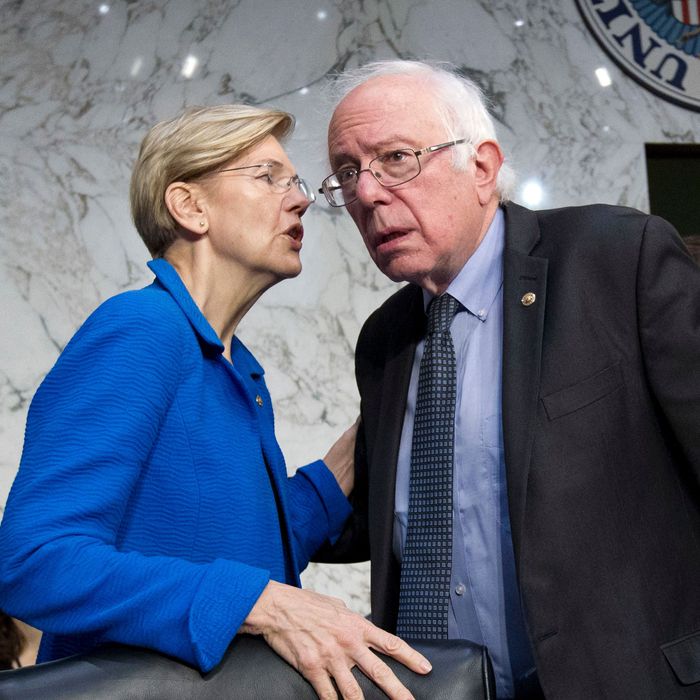
A majority of voters support the bold proposals for free college tuition and the wiping out of student debt put forward by Sens. Bernie Sanders and Elizabeth Warren, according to a new Hill-HarrisX poll out Friday.
The survey found that out of more than 1,000 respondents, 58 percent of people said they support government-funded public college tuition and the cancellation of student debt for the more than 44 million Americans who currently hold it.
“We will make public colleges and universities and HBCUs debt-free. And what we will always also do, because this is an incredible burden on millions and millions of young people who did nothing wrong except try to get the education they need, we are going to cancel all student debt in this country.” —Sen. Bernie Sanders (I-Vt.)
The student debt crisis has left young Americans as a group owing more than 1.5 trillion for their college and graduate educations, and is largely blamed for keeping millennials from being able to buy homes and start families.
“What we will also do is not only have universal pre-K, we will make public colleges and universities and HBCUs debt-free,” the Vermont independent senator said. “And what we will always also do, because this is an incredible burden on millions and millions of young people who did nothing wrong except try to get the education they need, we are going to cancel all student debt in this country.”
According to the Hill-HarrisX poll, 72 percent of Democrats and 58 percent of independent voters support free college tuition and student debt cancellation, while 40 percent of Republicans back the plans.
Free college. Eliminate student debt. They are excellent ideas. But . . .
While both Sanders and Warren have proposed offering free public college to all Americans, Warren’s debt cancellation program would only be offered to families who earn under $250,000 per year—the bottom 95 percent of earners. Sanders has proposed wiping out student debt for all those who carry it.
Sanders would fund his plan by imposing a speculation taxon stock trades, raising an estimated $2.4 trillion over 10 years, while Warren’s Ultra-Millionaires Tax would fund her proposal.
Question: Why $250K? Why not offer it to everyone?
Answer: It’s an unnecessary attempt to reduce the cost.
More importantly, why propose a “speculation tax” and why propose an “Ultra-Millionaires tax”? Elizabeth, Bernie, and the rest of the Democrats (and the Republicans, too) know full well that:
A politician who offers brave ideas, should not fear to tell how these ideas will be paid for.
At the Democratic debate, Sen. Amy Klobuchar (D-Minn.) suggested progressive candidates are “extreme” and have made “promises [they] can’t keep,” while South Bend, Indiana Mayor Pete Buttigieg said in an earlier debate only that he supports “reducing” student debt and addressing college “affordability.”
“Promises they can’t keep”? Oh, the trepidation. Why can’t those promises be kept? Only fear stands in the way.
On MSNBC Thursday, Sanders campaign co-chair Nina Turner said that while poll numbers have fluctuated slightly for the top candidates in recent weeks, surveys have consistently shown that Americans support free college tuition and student debt forgiveness.
The ideas are good. The voters are in favor. Why the fear by the politicians?
Turner told Katy Tur, Sanders “understands the cries, the fears, the needs, and the dreams of the American people in this country. Hello Green New Deal, hello college for all, canceling student debt, standing up for the working people of this country.”
We don’t dare tell them the truth about paying for our ideas.
Yes, he understands the needs full well. He also understands how the proposed solutions easily could be funded.
Finally, he knows how to explain Monetary Sovereignty.
If only he and Warren and the rest of the Democrats had the courage.
The most important problems in economics involve the excessive income/wealth/power Gaps between the richer and the poorer.
Wide Gaps negatively affect poverty, health and longevity, education, housing, law and crime, war, leadership, ownership, bigotry, supply and demand, taxation, GDP, international relations, scientific advancement, the environment, human motivation and well-being, and virtually every other issue in economics.
Implementation of The Ten Steps To Prosperity can narrow the Gaps:
Background: The Cato Institute is an American libertarian think tank, founded as the Charles Koch Foundation.
It supports lowering or abolishing most taxes, opposition to the Federal Reserve system, the privatization of numerous government agencies and programs including Social Security, the Affordable Care Act, and the United States Postal Service, along with adhering to a non-interventionist foreign policy.
Reason is an American libertarian monthly magazine published by the Reason Foundation. Peter Suderman works for Reason.
Libertarianism tends toward anarchy; seemingly any level of government ownership or control, no matter how small, is considered too large by libertarians.
The following article perfectly illustrates the libertarian worldview:
The Warren worldview of ill-founded economic pessimism is both bloodless and moralizing.
PETER SUDERMAN | FROM THE OCTOBER 2019 ISSUE OF REASON
At the heart of Elizabeth Warren’s campaign for president—and of her entire career as a politician and public intellectual, are two simple ideas.
The first is that the economy is fundamentally broken. She declared that “millions and millions of American families are also struggling to survive in a system that has been rigged by the wealthy and the well-connected” and in which she insisted that the only response was to fight for “big structural change.”
She inveighed against corporate profits and monopolistic businesses and corrupt lawmakers who have “made this country work much better for those who can make giant contributions, made it work better for those who hire armies of lobbyists and lawyers, and not made it work for the people.”
It was present in the 2007 essay that imagined what would eventually become the Consumer Financial Protection Bureau, a federal agency premised on the notion that American families were being “steered into overpriced credit products, risky subprime mortgages, and misleading insurance plans'”
She proposed an array of economic policies, from a $15 minimum wage to enforcing restrictions on certain bank loans, that she argued could stave off the crisis.
(She issued a) slew of white papers and policy proposals that have poured forth from Warren’s campaign as if she were running a think tank rather than a presidential bid.
It’s her own fault. Don’t ask for government help.
Apparently, libertarian Suderman doesn’t believe that “millions of American families are also struggling to survive in a system that has been rigged by the wealthy and the well-connected” and “this country works much better for those who can make giant contributions, and for those who hire armies of lobbyists and lawyers.”
He is living in a libertarian dream world.
He doesn’t like that Warren has proposed a $15 minimum wage, up from the current federal minimum of $7.25 hour — barely survivable for a single person, and poverty-level for supporting a family.
Libertarian Suderman doesn’t like that Warren wants to restrict the terrible bank loans that contributed to the “Great Recession of 2008.”
Suderman doesn’t like that Warren has issued “white papers and policy proposals,” rather than merely promising generalities and American greatness.
In the space of just a few months this year, Warren released plans for everything from ending drilling on public lands to breaking up Facebook and Amazon.
And she has proposed paying for these costly programs with wealth taxes designed not only to offset the price tag of new government spending but to help reduce economic inequality by shrinking large stores of wealth.
To Suderman, ending drilling on public lands, providing affordable housing, canceling student debt, and offering free college tuitions — i.e. ideas to narrow the Gap between the rich and the rest — are terrible.
Unworkable, because “wealth” is far too easy for the truly wealthy to hide.
Warren’s penchant for wonky policy detail has defined her candidacy: “Elizabeth Warren has a plan for that” has become a rallying cry and a slogan, one her fans have plastered across an array of T-shirts and campaign signs.
Warren has happily embraced this persona, joking with crowds that her focus on the details of federal agencies would turn them all into nerds.
Heaven forbid that a candidate supplies plans and details. To Suderman, it would be far better to offer bland Trump-like generalities, like “Repeal and replace ACA”” and “Build the wall” than to provide specific, people-friendly details.
Warren wants the federal government to be the American economy’s hall monitor, telling individuals and companies what they can and can’t sell or buy and making some of the nation’s most successful businesses answer to her demands.
Being the economy’s “hall monitor,” i.e. preventing miscreants from stealing, is exactly what the federal government should do.
And oh, horrors, telling the nation’s most successful businesses what dishonesty not to commit, is unthinkable to Suderman, who seems to believe that “liberty” means allowing big business to do whatever it pleases.
It seems to be working. During the first six months of 2019, this strategy vaulted Warren into the top tier of Democratic primary contenders, helping her raise more than $19 million during the year’s second quarter and placing her among the top three or four candidates in the party’s crowded field.
Focus groups and political reporting have consistently found that Democratic voters are warming not only to the substance of Warren’s ideas but to the very fact that she has them.
Well yes. Having ideas and detailing them, not only is good politics, but it is good governance. Would that more politicians did it.
Although she has received kudos for the volume and specificity of her plans, Warren has a history of pushing misleading research and cherry-picked data designed to support politicized conclusions.
Warren first rose to prominence as the co-author of a pioneering study of consumer bankruptcy, which was published in book form in 1989 under the title As We Forgive Our Debtors: Bankruptcy and Consumer Credit in America.
Warren and her co-authors based the book on a trove of court data from about 1,500 bankruptcy cases in Pennsylvania, Illinois, and Texas during 1981.
The book relied on real-world case studies. Warren statistically analyzed a trove of unique data. She was telling a story to make an argument about politics and policy.
The story was that rapacious credit card companies, rather than consumer overspending, were primarily responsible for a run-up in consumer debt and the resulting sense that household budgets had grown more precarious.
The book’s authors saw bankruptcy in broadly sympathetic terms, as a financial safety net for struggling families. In the years that followed, Warren would go on to become one of the nation’s most prominent advocates of making bankruptcy easier, more lenient, and more accessible.
But that story had some notable problems. Among others, it was based on cases from 1981, a recession year when consumers would have looked worse off than usual. It was released years later, after a significant reform to the bankruptcy code in 1984 rendered its picture of American bankruptcy somewhat out of date.
Here, Suderman criticizes the currency of Warren’s bankruptcy research, none of which has anything to do with the currency of her above-mentioned economic recommendations.
It’s as though Suderman would hate her ideas for child-rearing because her book on auto repair is out of date. In short, Suderman’s criticism is inane and utter nonsense.
And note the words, “rather than consumer overspending.” They illustrate the libertarian belief that poor people are responsible for their own misfortune.
Warren drew on her bankruptcy research to argue that the middle class had been given a raw deal.
The number of households filing for bankruptcy had shot up dramatically, she said, and it wasn’t because they were spending too much.
Instead, the increasingly high cost of housing, driven heavily by competition for access to good schools, and the pile-up of medical debt were driving families into dire straits.
It is the high cost of living, not just housing, has driven families into dire straights.
Again, Suderman wants to “prove” Warren is completely wrong, by trying to nit-pick a point of data, when her overall conclusion (that the Gap between rich and poor has widened, and many families are in financial trouble and need protection) is correct.
These effects were compounded by the movement of women into the workforce.
Where stay-at-home wives had once served as a safety net—the earners of last resort should a breadwinner husband lose his job—the rise of the working mother had increased financial risk for two-earner families.
The book’s findings were marked by controversy and unanswered questions about the soundness of her methodology. In particular, Warren’s notion that housing prices have been pushed upward by school competition doesn’t fully stand up to scrutiny.
Although research has found that school quality does impact housing prices, the effect is fairly modest. A 2006 study in the Quarterly Journal of Economics found a 2.5 percent increase in home prices for every 5 percent increase in test scores.
And in what way does the so-called “fairly modest” difference in home prices negate Warren’s position on student debt, mortgage supervision, family bankruptcy, the minimum wage, and the prevention of financial cheating by large companies?
It doesn’t, but Suderman tries to make his point by fixating on minutia to distract you from the main point, that middle-class families are struggling, and the very purpose of government is to improve the lives of its citizens.
And then there’s the role of taxes. In the book’s hypothetical comparison budgets, Warren presents taxes as a percentage of household income—24 percent in the 1970s, 33 percent in the 2000s—which the book describes as a 35 percent change.
Yet as George Mason University law professor and consumer finance scholar Todd Zywicki has noted, the choice to render taxes only as a percentage of income has the effect of masking the total dollar value.
Using Warren’s own figures, Zywicki calculated that the tax increase—owing partly to the hypothetical family hitting a new tax bracket and partly to the imposition of additional state, local, and property taxes over time—was by far the largest factor affecting the modern family’s budget.
Warren’s numbers, in other words, showed that families had been strapped not by increased spending on homes or health insurance but by a bigger tax bill.
Yes, taxes on the middle classes are too high. So, how does that eliminate the need to follow Warren’s proposals? Again, it doesn’t. It’s just another Suderman diversion.
Zywicki is among Warren’s most outspoken critics, and he has made this case—that Warren’s data do not show what she claims they do about the plight of the middle class—on multiple occasions over the span of more than a decade.
What Suderman fails to mention is that Zywicki is a senior fellow, paid by the Cato Institute, that aforementioned libertarian think tank, which spends its time and money trying to prove that government not only is unnecessary but a hindrance to America.
Zywick is not exactly an impartial commenter.
Warren co-authored a Health Affairs study purporting to show that at least 46 percent of the nation’s bankruptcies were a result of medical bills, a figure she subsequently updated to 62 percent.
Her research claimed that medically induced bankruptcies had increased a shocking 23-fold since 1981.
President Barack Obama warned that sky-high medical costs had forced many Americans to “live every day just one accident or illness away from bankruptcy.”
One wonders, what is the fundamental point Suderman is trying to demonstrate? That sky-high medical costs are not a serious financial problem for millions of Americans?
The response by Warren and her co-authors was revealing. In one sense, they were engaged in a conventional academic dispute about interpreting bankruptcy data. But what they were really fighting about—what was really at stake—was public policy.
Warren clearly believed that the value of her research was in the story it told and the way that story informed and influenced the real world of politics and public affairs.
Yes, that exactly is the point. What does it matter whether housing prices, or school costs, or medical costs are most responsible for bankruptcies or other forms of financial distress?
The point that Suderman doesn’t want you to understand is that these are problems the federal government can and should address. It has the means, if only it had the will.
Sadly, the Sudermans of the world would rather quibble about differences in data than to solve the clear and obvious problems that plague us.
Yes, some things are more troublesome than others, but that does not mean we should stall. while people suffer, debating how much more troublesome school costs are than medical costs.
But perhaps, stalling is what Suderman wants.
In the aftermath of the 2007–08 financial crisis, Congress, then controlled by Democrats, passed the Dodd-Frank Wall Street Reform and Consumer Protection Act, which was billed as a direct response to the economic meltdown and an attempt to make sure it never happened again.
A centerpiece of the bill was the creation of a new federal agency, the Consumer Financial Protection Bureau (CFPB), which was modeled on Warren’s original proposal.
The bureau, as imagined by Warren, was premised on the notion that consumers did not and in some cases could not understand the financial services they relied on, and that only an army of unusually powerful government bureaucrats could save them from blundering into the tricks and traps set by lenders.
And that is absolutely correct. Left to their own designs, the banks created the most convoluted, complex financial products, that no one, not even Suderman, could understand, then sold them to the public, with disastrous results.
The CFPB’s mission, meanwhile, was far more expansive than its origin story might imply. From payday lenders to cash advance services, many of the financial products it was given the power to regulate had little or nothing to do with the financial crisis.
Suderman’s senseless point seems to be that if a financial scam had nothing to do with the Great Recession, it should be ignored.
The CFPB was the culmination of decades of research and advocacy on Warren’s part. She had imagined it, fought for its creation, and then, from her perch in the administration, ushered it into being.
And yet there was a kind of victory as well, in the simple fact of the CFPB’s creation. Warren would not be its leader—that role would eventually go to former Ohio Attorney General Richard Cordroy, who was given a recess appointment that caused its own controversy—but she had willed it into being and would continue to provide spiritual guidance.
She did not achieve her political ambitions, but on the policy question, she had triumphed.
In the years that followed, something strange happened: Warren, the icon of progressivism whose political brand had proven too toxic to move through the CFPB nomination process, became the object of a strange new respect from the right.
Apparently, being respected by some right-wingers is a curse for Suderman.
Under President Donald Trump, in July, The American Conservative, long a bastion of immigration-skeptical conservative nationalism, ran an essay extolling Warren’s economics, particularly her plans for a new bureaucracy dedicated to “defending good-paying American jobs,” and saying that in some respects, “Warren may be a bigger economic nationalist than even Trump himself.”
A paragraph of utter nonsense, but what else can one expect in political discourse?
Nor is Warren’s popularity limited to small opinion journals.
In June, Fox News’ Tucker Carlson, among the most-watched hosts on cable news and an influence on the Trump administration, opened his show with an extended monologue praising Warren’s domestic jobs plan and its elevation of “economic patriotism,” which calls for, in the senator’s words, “aggressive new government policies to support American workers.”
“Many of Warren’s policy prescriptions make obvious sense,” Carlson said. “She sounds like Donald Trump at his best.” Later, at a conference in July, he praised The Two-Income Trap as “one of the best books I’ve ever read on economics.”
Suderman’s position is if a right-winger likes any of her recommendations that is prima facie evidence she is not a progressive. It’s wrong and a bit goofy, but it’s Suderman.
But then, the quick reversal:
It is hard to imagine the Republican Party ever embracing Elizabeth Warren. Trump frequently mocks her claims of Native American heritage, and the congressional GOP continues to view her with deep hostility. She’ll never be an ally to the party.
But in some increasingly influential corners of the right, her ideas and her outlook are winning.
The rest of Suderman’s long article is a rehash of his “unaffordability” claim about her proposals, and his dislike of the detail with which she presents them.
But “unaffordability” is a false claim concerning federal spending, and quibbling about the details rather than solving the big-picture problems solves nothing.
SUMMARY Government is created by the governed to improve their lives. That is the purpose of government.
Peter Suderman is a classic libertarian, a hater of government. As a libertarian, he wastes more than 6,000 words denying the obvious — that for many people, good schooling, good housing, good food, and good medical care are unaffordable and that the banking industry has cheated millions of innocent people.
Suderman denies that many families are driven into bankruptcy by trying to pay for the abovementioned schooling, housing, food, and medical care, or eschewing bankruptcy, they must forego these life necessities.
Suderman also hints at the libertarian’s “bootstraps” theory, in which the victim is blamed for not earning enough, or being frugal enough, or smart enough to pay for their own needs.
To libertarians, “liberty” means freedom from government help. People should pull themselves up by their bootstraps, rather than depending on the government.
Then he applies the libertarian, “Catch 22” objection to deny people those bootstraps by implying that the $15 minimum wage is a bad idea. “Gotcha!”
In the real world, our “bootstraps” consist of things like a good education, good health, good housing, and money — all of which the federal government can and should provide — and all of which libertarian Suderman would not provide.
Why does libertarian Suderman deny the obvious?
Because to admit it would require him to offer solutions, and those solutions inevitably require federal spending — an anathema to libertarians.
Warren’s proposals are fact-driven and logical, which Suderman dismisses as “bloodless.” Her proposals also benefit the poor and middle classes, which Suderman dismisses as “moralizing.”
Suderman and the libertarians live in a harsh mythical world, where there is no allowance for poverty, people are expected to be born with all they need to succeed, and it only is laziness that prevents them from realizing their dreams.
Asking for help from the government supposedly is a moral and financial imposition on the rest of us who, of course, are self-sufficient.
It is the ultimate expression of Gap Psychology, in which people wish to widen the income/wealth/power Gap below them.



 “Ignorance is the parent of fear.” Herman Melville

 #Monetary Sovereignty - Mitchell