The real reason why Congress failed to act. The Broken Generation.

The United States, being Monetarily Sovereign, has the unlimited ability to create its own sovereign currency, the U.S. dollar.

Thus, the federal government has the unlimited financial ability to eliminate poverty in America.

It has the unlimited ability to provide healthcare to every man, woman, and child.

The federal government has the unlimited ability to provide education, all the way up through doctorates, for everyone in America who wants it.

The federal government could pay to repave every road, to fix every failing dam, to rebuild every unsound school, to provide good housing for every family, and to feed every hungry child.

It could pay to provide renewable energy, while saving the world from global warming, forest depletion, and air and water pollution.

It could fund colonies on the moon and Mars, and search for life on Europa.

And it could do all this without collecting a penny in federal taxes or allowing the nation to suffer from recession, depression, inflation or deflation.

That is how absolute the federal government’s financial power is.

Yet, this is what we have:

Yahoo Money
Coronavirus stimulus: Extra unemployment benefits cannot restart for at least several weeks, experts warn
Denitsa Tsekova·Reporter

Whether Congress agrees to resume the extra $600 per week or decreases the amount to $200 — as some Republicans propose — experts say that roughly 30 million jobless Americans collecting benefits will not receive any extra stimulus for several weeks.

Unemployed Americans will see a drop in their unemployment benefits between 52% to 72%, according to an analysis by Evercore ISI. Graphic: David Foster / Yahoo Finance

To simply restart the extra $600 now that they’ve expired would take up to five weeks, according to an estimate by the National Association of State Workforce Agencies (NASWA).

The Democrat-controlled House of Representatives passed the $3 trillion HEROES Act, which would have extended extra UI benefits among other stimulus measures, through the end of the year.

The Senate never considered the HEROES Act.

“Republicans just came to the table in the middle to the end of July to start the negotiations,” Ajilore. “The question is what the Republicans and the White House were doing all the month of June and early July.”

Even the Democrats’ $600 per month is inadequate, but the Republicans claim it is too much. They want to keep the working class in poverty, as an incentive to return to work.

But the problem is not a lack of incentive. The problem is a lack of jobs.

Heidi Shierholz, senior economist and director of policy for the left-leaning Economic Policy Institute said, “Concerns about the work disincentive simply ignore the realities of the labor market for working people, who will be very unlikely to turn down a job for a temporary boost in benefits, particularly when it is now clear that jobs are going to be scarce for a very long time.”

“Cutting off the $600 cannot incentivize people to get jobs that aren’t there.’’

The Republicans’ “incentive” claim is a lie. The real reasons for their reluctance to support the poor and middle classes are:

  1. The rich, who run America, and especially run the Republican Party, have not been hurt financially. The stock markets are doing just fine, thank you.

Until the rich begin to feel the pinch, the Republicans will find reasons for not acting.

Even during the current recession, the S&P 500 index, has returned nearly to its highest level, ever.

2.  The rich actually want the poor and middle classes to suffer, so they will be desperate for income, and will be willing to accept low-income jobs with poor working conditions and low benefits.

The real concern of the rich is that the poor and middle classes won’t be desperate enough. That is what the Republicans’ misleading “incentive” claim is all about.

Though federal support for the poor and middle classes would protect the economy, and Donald Trump would benefit politically from a healthy economy, the rich do not care about Trump. 

They know that Trump will be gone, probably in three months, or at worst, in four years.

The rich know how to take the long view.

The current recession will have lasting effects, probably for decades. Millions of American families will feel these effects all during the lives of current wage-earners and even beyond.

Young people will forego education just to eke out a living in a limited job market. Their economic futures will be dim. They will become “The Broken Generation.”

Jobs will disappear, as small businesses disappear. Large companies will have learned they don’t need as many full-time people as they did in the past, and in the “Zoom world,” part-time, work-from-home will become a much larger part of the economy.

As desperate demand for the remaining jobs continues to exceed the supply, salaries will shrink. Job-related benefits will shrink or disappear.

Company profits will grow. The top will disassociate further from the middle.

The rich want to become richer. Since “rich” is a comparative term. there are only two ways to become richer: Have more, and/or force those below to have less. 

That is the lesson of Gap Psychology, the desire to distance oneself from those “below.” It is that distance that makes one rich, and the distance has been growing.
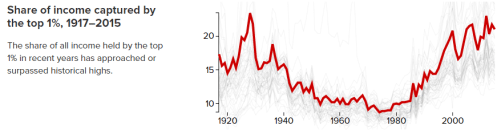
Share of income.png
Economic Policy Institute

The current recession gives the rich their opportunity to do both — have more, and force those below to have less — simply by allowing America to starve.

Each day of the recession, the rich will grow ever richer by comparison with middle-class America, who will see wages and benefits stagnate.

And that is why Congress, and especially the Republicans, do not do what obviously needs to be done: They do not sufficiently support the economy by supporting the working class.

They offer crumbs to the starving, and hope the starving will not notice the loaves of bread the rich carry.

This is the disgrace of America, and the real reason why Congress failed to act.

Rodger Malcolm Mitchell

Monetary Sovereignty Twitter: @rodgermitchell Search #monetarysovereignty Facebook: Rodger Malcolm Mitchell …………………………………………………………………………………………………………………………………………………………………………………………………………………………………………………………………………………………..

THE SOLE PURPOSE OF GOVERNMENT IS TO IMPROVE AND PROTECT THE LIVES OF THE PEOPLE.

The most important problems in economics involve:

  1. Monetary Sovereignty describes money creation and destruction.
  2. Gap Psychology describes the common desire to distance oneself from those “below” in any socio-economic ranking, and to come nearer those “above.” The socio-economic distance is referred to as “The Gap.”

Wide Gaps negatively affect poverty, health and longevity, education, housing, law and crime, war, leadership, ownership, bigotry, supply and demand, taxation, GDP, international relations, scientific advancement, the environment, human motivation and well-being, and virtually every other issue in economics. Implementation of Monetary Sovereignty and The Ten Steps To Prosperity can grow the economy and narrow the Gaps:

Ten Steps To Prosperity:

1. Eliminate FICA

2. Federally funded Medicare — parts A, B & D, plus long-term care — for everyone

3. Social Security for all or a reverse income tax

4. Free education (including post-grad) for everyone

5. Salary for attending school

6. Eliminate federal taxes on business

7. Increase the standard income tax deduction, annually. 

8. Tax the very rich (the “.1%”) more, with higher progressive tax rates on all forms of income.

9. Federal ownership of all banks

10.Increase federal spending on the myriad initiatives that benefit America’s 99.9% 

The Ten Steps will grow the economy and narrow the income/wealth/power Gap between the rich and the rest.

MONETARY SOVEREIGNTY

Donald Trump’s complete and detailed plan for how Americans should deal with COVID-19

.

.

.

.

.

.

.

Die..png

.

.

.

.

.

.

The above is Trump’s entire plan. If you know any details that have been omitted, please contact us in the “Leave a Reply” section.

Thank you.

Rodger Malcolm Mitchell

Monetary Sovereignty Twitter: @rodgermitchell Search #monetarysovereignty Facebook: Rodger Malcolm Mitchell …………………………………………………………………………………………………………………………………………………………………………………………………………………………………………………………………………………………..

THE SOLE PURPOSE OF GOVERNMENT IS TO IMPROVE AND PROTECT THE LIVES OF THE PEOPLE.

The most important problems in economics involve:

  1. Monetary Sovereignty describes money creation and destruction.
  2. Gap Psychology describes the common desire to distance oneself from those “below” in any socio-economic ranking, and to come nearer those “above.” The socio-economic distance is referred to as “The Gap.”

Wide Gaps negatively affect poverty, health and longevity, education, housing, law and crime, war, leadership, ownership, bigotry, supply and demand, taxation, GDP, international relations, scientific advancement, the environment, human motivation and well-being, and virtually every other issue in economics. Implementation of Monetary Sovereignty and The Ten Steps To Prosperity can grow the economy and narrow the Gaps:

Ten Steps To Prosperity:

1. Eliminate FICA

2. Federally funded Medicare — parts A, B & D, plus long-term care — for everyone

3. Social Security for all or a reverse income tax

4. Free education (including post-grad) for everyone

5. Salary for attending school

6. Eliminate federal taxes on business

7. Increase the standard income tax deduction, annually. 

8. Tax the very rich (the “.1%”) more, with higher progressive tax rates on all forms of income.

9. Federal ownership of all banks

10.Increase federal spending on the myriad initiatives that benefit America’s 99.9% 

The Ten Steps will grow the economy and narrow the income/wealth/power Gap between the rich and the rest.

MONETARY SOVEREIGNTY

Why the GOP Senate fiddles while America dies. “I don’t know what we’re trying to accomplish.”

Imagine you are Jeff Bezos, the $175 billion man. Your children are starving. They ask you for $10 so they can buy some food. You debate about whether to offer even $2.

That is the GOP Senate, today.

Parties remain divided over virus aid package
Some Republicans balk over price tag as deadline looms
By Lisa Mascaro Associated Press

WASHINGTON — The differences over the next coronavirus aid package are vast: Democrats propose $3 trillion in relief and Republicans have a $1 trillion counteroffer. At stake are millions of Americans’ jobless benefits, school reopenings and eviction protections.

Given that the federal government already has demonstrated it has unlimited money, and that infusions of money protect the economy and the people of America, why the reluctance to spend?

Striking any agreement between Congress and President Donald Trump by Friday’s deadline for expiring aid will be daunting.

“We cannot afford to fail,” Senate Democratic leader Chuck Schumer said.

The outcome will be a defining one for the president and the parties heading into the November election as an uneasy nation is watching and waiting for Washington to bring some end to the health crisis and devastating economic fallout.

Given that adding dollars to the economy will stimulate economic growth, and a growing economy will benefit Trump’s re-election chances, why is it the Democrats who wish to spend and the Republicans who are reluctant?

Key to the debate is the $600 weekly unemployment benefit bump that is expiring for millions of jobless Americans.

Republicans want to slash it to $200 a week as an incentive to push people back to work.

Given that millions of people are out of work, not because they quit, but were fired, and there are not enough jobs available to hire them back, why do Republicans insist there is a need or even a way to “push people back” to non-existent jobs?

Defending cuts to unemployment assistance, Republicans said the federal supplement is too generous, on top of state benefits, and people should not be paid more while they are at home than they would if they were on the job.

Given that giving Americans more money will allow them to spend more, which will help American businesses survive, why are Republicans concerned that the federal supplement is “too generous”?

With the virus death toll climbing and 4.2 million infections nationwide, both parties are eager for relief.

There is some agreement that more money is needed for virus testing, to help schools prepare to open in the fall and to shore up small businesses.

Half the Republican senators are expected to oppose any bill.

They warned against caving to liberal demands and worried the price tag will balloon past $1 trillion.

The Republicans come to the negotiating table hobbled by infighting and delays. Conservative Republicans quickly broke ranks, arguing the spending was too much and priorities misplaced.

“It’s a mess,” said Sen. Josh Hawley, R-Mo. “I don’t know what we’re trying to accomplish.”

Those words, “I don’t know what we’re trying to accomplish,” will live in infamy, for that is exactly the situation. Here are what seem to be the Republican goals.

  1. Re-elect themselves.
  2. Re-elect Trump.
  3. Grow the economy.
  4. “Open” the economy.
  5. Get people back to work.

But they want to accomplish the above without:

  1. Aiding consumers so they will spend more.
  2. Aiding schools so they can create virus-free environments.
  3. Aiding states so they can, in turn, aid their counties and cities.
  4. More virus testing.
  5. Demanding mask-wearing.
  6. Offering any kind of unified recovery plan.
  7. Doing anything liberals might like.
  8. Benefitting the poor and middle-income groups.

When you don’t know what you are trying to accomplish, there is no hope you ever will accomplish it.

There are two steps Congress and the President could take that very quickly would return America to some semblance of normal:

  1. Pump dollars into the pockets of consumers.Your maks protects me.png
  2. Universal mask-wearing.

With regard to mask-wearing, the fault lies directly at the feet of the President. Recently there appeared an article that read like this:

Shops: No shoes, no shirt, no service.
People: OK. No problem.

Traffic Laws: Wear a seatbelt in a car or be ticketed. No drinking and driving.
People: OK. No problem.

OSHA; At work in a dangerous place you must wear safety gear.
People: OK. No problem.

Airlines: You must be seated, with your seatbelt buckled and your tray table up. No smoking.
People: OK. No problem.

Do not go down the “up” escalator.
People: OK. No problem.

TSA: Remove your shoes & belt; empty your pockets; put your luggage on the belt; and go through the X-ray machine.
People: OK. No problem.

Schools: Children are not allowed to bring guns into the school.
People: OK. No problem.NO ANIMALS ALLOWED IN A FOOD FACILITY SIGN (ALUMINUM SIGN) | HPD ...

Food processor: No animals allowed in a food facility.
Workers: OK. No problem.

Today’s stores: Please wear a mask to reduce the risk of infecting others and yourself with the deadly CORONA virus.
People: Don’t try to take away my rights and freedoms. If the President doesn’t have to wear a mask, neither do I.

Way back, on May 5th, 2020, we published:

The surprisingly simple way to open America in 14 days and avoid a depression.
COVID-19 transmits primarily through the air by droplets. Stop the droplets and you stop the transmission. The incubation period is 14 days. If everyone wore a mask, even just a simple cloth mask, the virus would cease to be transmitted in two weeks.

The was 2 1/2 months ago, and nothing that has happened since, to change the prescription.

Even without social distancing, even with handwashing, even without scrubbing down facilities, even without a cure or a vaccine, the simple act of universal mask-wearing would create a kind of “herd immunity” that would end the disaster.

Yet here we are, still fiddling. And America is burning.

Rodger Malcolm Mitchell

Monetary Sovereignty Twitter: @rodgermitchell Search #monetarysovereignty Facebook: Rodger Malcolm Mitchell …………………………………………………………………………………………………………………………………………………………………………………………………………………………………………………………………………………………..

THE SOLE PURPOSE OF GOVERNMENT IS TO IMPROVE AND PROTECT THE LIVES OF THE PEOPLE.

The most important problems in economics involve:

  1. Monetary Sovereignty describes money creation and destruction.
  2. Gap Psychology describes the common desire to distance oneself from those “below” in any socio-economic ranking, and to come nearer those “above.” The socio-economic distance is referred to as “The Gap.”

Wide Gaps negatively affect poverty, health and longevity, education, housing, law and crime, war, leadership, ownership, bigotry, supply and demand, taxation, GDP, international relations, scientific advancement, the environment, human motivation and well-being, and virtually every other issue in economics. Implementation of Monetary Sovereignty and The Ten Steps To Prosperity can grow the economy and narrow the Gaps:

Ten Steps To Prosperity:

1. Eliminate FICA

2. Federally funded Medicare — parts A, B & D, plus long-term care — for everyone

3. Social Security for all or a reverse income tax

4. Free education (including post-grad) for everyone

5. Salary for attending school

6. Eliminate federal taxes on business

7. Increase the standard income tax deduction, annually. 

8. Tax the very rich (the “.1%”) more, with higher progressive tax rates on all forms of income.

9. Federal ownership of all banks

10.Increase federal spending on the myriad initiatives that benefit America’s 99.9% 

The Ten Steps will grow the economy and narrow the income/wealth/power Gap between the rich and the rest.

MONETARY SOVEREIGNTYFchilde

A wonderful article that makes two points the American politicians do not understand.

The two points the American politicians (and much of the public) do not understand are:

  1. Monetary Sovereignty can prevent and solve any financial ill, any recession, any depression, any inflation, any shortage, almost any national need.
  2. Donald Trump, by intent or ignorance, is destroying our American way of life and attempting to install a dictatorship.

An excellent article by Noah Millman describes both points.

As today’s post will provide only excerpts, I urge you also to click the link and to read his article in its entirety.

America is coming apart. Europe is coming together.
Noah Millman, July 25, 2020

Why do some societies, like some couples, fall apart under pressure, while others band together?

Portland protests: Neither side is backing down as federal agents ...
Today, Portland. Who’s next?

If a crisis brings them together, will that make them stronger in the future?

And if they come apart, is that a sign that they should never have been together in the first place?

This week’s exemplar for “banding together” is the European Union (EU), whose leaders agreed to extraordinary new measures to promote a broad economic recovery in the wake of the novel coronavirus.

The agreement represents an about-face from the stance the EU took in the wake of the financial crisis of the last decade, which emphasized austerity rather than stimulus.

More importantly it broke two key structural taboos: the European Commission will, for the first time, be authorized to borrow significant sums of money; and a large portion of that sum will be disbursed to member governments in the form of grants.

The EU bears a cursory similarity to the United States of America. Both groups are composed of individual state governments.

Both the U.S. and the EU themselves are Monetarily Sovereign. They each own sovereign currencies, which they have the unlimited power to create.

The U.S. cannot run short of dollars; the EU cannot run short of euros.

For the EU, most of those governments are monetarily non-sovereign, meaning they don’t have their own sovereign currency. For the U.S., all the constituent state governments are monetarily non-sovereign.

Pepper spray everyone.

You and I also are monetarily non-sovereign entities. So are counties, cities, and businesses. None of us owns a sovereign currency.

To survive long-term we monetarily non-sovereign entities must have a net inflow of money.

Even “break-even,” i.e. a balanced budget, is not sufficient because, with even the most modest amount of inflation, a balanced budget would cause us monetarily sovereign entities to lose real wealth.

For the monetarily non-sovereign states of the U.S. and the EU, this net inflow must come from net exports or grants from their Monetarily Sovereign U.S. or EU governments.

But within any group, it is mathematically impossible for all members to be net exporters, and it is unlikely they all will be net exporters to the rest of the world.

So there are periods when the states of the U.S. and the states of the EU run short of money.

Typically then, these states must borrow money, and when borrowing has reached its limit, they must levy increased taxes on their citizens.

But, because the citizens are monetarily non-sovereign, they too can run short of money. Increased taxes impoverish the citizens, who subsequently are unable to pay further taxes.

This is known as “austerity,” which always leads to an endless, downward helix of impoverishment, which only can be solved when the Monetarily Sovereign U.S. or EU creates new money and distributes it as grants, not loans, to the needy states.

The U.S. federal government impoverishes its states by unnecessarily taxing the states’ citizens — “unnecessarily” because the U.S. government, having the unlimited ability to create dollars, has no need for taxes.

And indeed, all your tax dollars are destroyed upon receipt.

It is federal deficit spending that enriches the populace, grows the economy, and makes state, county, and city survival possible.

Contrary to popular wisdom, it is the insufficiency of federal deficit spending that invariably leads to recessions and depressions.

Sadly, many state citizens pay more money to the federal government than their state receives from the federal government, which causes an erosion of those states’ finances.

(See: “Eleven states pay more in federal taxes than they get back”)

Over time, these states must receive money from the federal government or they will become insolvent, and be unable to service their debts. EU Budget.png

This bit of simple arithmetic is not well understood in America.

The U.S. federal government levies taxes it neither needs nor even uses.

Indebted states struggle to provide basic benefits to their citizens.

A similar situation exists in the EU.

Of the 28 EU states, 12 do not have a positive balance of payments vs. the EU.

But of those 12, three are Monetarily Sovereign — UK, Sweden, and Denmark.

Those three cannot run short of their own sovereign currencies, and so long as those currencies have widespread acceptance, those countries always will be able to pay their bills.

The others have been, and it was feared always would be, struggling to stay afloat financially.

But Mr. Millman’s phrase, ” . . . a large portion of that sum will be disbursed to member governments in the form of grants.” seems to indicate that the EU just possibly may finally have discovered its own Monetary Sovereignty. 

If so, the heretofore lagging EU will rocket ahead of the U.S. in growth and prosperity for its members and its people.

One hopes that the U.S. federal government’s current, proven ability to create trillions of stimulus dollars, with none of the bad effects predicted by deficit and debt critics, may awaken the realization that yes, the U.S. federal government is Monetarily Sovereign, and so has the unlimited power to support the states and the residents of America. 

Which brings me to the union that seems to be coming apart: (America).

The primary characteristic of the American response to the coronavirus has been the lack of any national policy to speak of.

Individual states have been responsible for setting up their own testing infrastructure and contact-tracing apparatus, setting their own policies with regard to non-pharmaceutical interventions from lockdowns to mandatory masking, and even placed in competition with one another for personal protective equipment.

The federal government (has been) derelict in either building essential common infrastructure or promoting an agreed upon set of best practices.

It (has refused) to provide necessary funding to facilitate the opening of schools, and then threatening districts that don’t open with financial ruin.

President Trump has evinced a complete lack of interest in achieving meaningful collective goals, even those he ostensibly favors (like building a wall with Mexico).

Trump is interested in using power for pure assertion of prerogative, as he has demonstrated through his abuse of the pardon power and, most recently, by sending federal agents to Portland in response to ongoing protests and damage to federal property.

The purpose of his intervention is precisely to create the very chaos that he claims to want to quell, on the theory that public disorder ultimately helps the candidate promising a strong hand.

But it is also intended to demonstrate a willingness to use force against those who, in the view of his core supporters, deserve such treatment.

We frequently have noted Trump’s dictatorial, even Hitlerian bent ( here, and here, and here) which, along with his proven psychopathy, has been an ever-growing disaster for America.

Legality of federal agents in Portland scrutinized as protests ...
A “calming” influence?

Rather than merely protecting federal property, Trump’s storm troopers are dragging innocent protestors, even onlookers, off the streets, in clear violation of the Constitution’s guarantees of “the right of the people peaceably to assemble, and to petition the government for a redress of grievances.”

In the eyes of Trump, Trump’s supporters, and all dictators throughout history, merely assembling and petitioning the government for a redress of grievances are adequate reasons for harsh retaliatory measures.

The consequences to national cohesion of this approach to federal governance — neglect coupled with brutality — are likely to be felt long after this administration has ended.

A progressive prosecutor in Pennsylvania is already on record as saying he will order the arrest of federal agents if they break the law in his jurisdiction, as they did in Oregon.

Even if he never has to make good on that threat, a line has been drawn, and the prospect of direct confrontation between state and federal authorities in some future contingency is real.

Meanwhile, states (such as in the northeast) that banded together to combat the coronavirus, and that are now requiring visitors from the rest of the country to quarantine upon entry, will undoubtedly find new ways to work together without waiting for the federal government. 

rifle in face.png
“Brave” Trump stormtrooper faces “dangerous rioter.”

The nation has not been so divided since the civil war, and it is no coincidence that one of the innumerable points of contention involves rebel flags and names.

One part of the nation still considers those who fought against America to be heroes, and rather than feeling freed of the onerous yoke of slavery, they feel subjugated and resentful for having lost their freedom– their freedom to enslave.

For his own purposes, Trump has picked at this lingering wound and made if fester more than it has in over 15 decades.

Rather than “Make America Great, Again,” Trump has Made America Hate, Again.”

Trump has finally united the center of the country against him, and a decisive repudiation will restore Americans’ faith in the possibility of collective action.

The first part may prove true in November, but I wonder about the second, and not only because I remember how quickly the overwhelming Democratic majority of a dozen years ago curdled into endless partisan trench warfare.

We discussed the Democrats’ propensity for “endless partisan trench warfare” in “The left’s suicidal insistence on purity” and “The left’s suicidal insistence on purity II

Perhaps it behooves all of us who are appalled by the Trump years, and by what has happened to the party he purports to lead, to devote at least some of our energy to thinking outside the box.

How much do we actually want our states and cities to depend on the federal government, versus how much freedom do we want to chart our own course?

Do we want the battle against climate change to depend on which party controls the EPA — or do we want California to be able to use its economic clout to muscle the rest of the country along? 

The rest of Mr. Millman’s article is devoted to his “outside the box” suggestion that we should consider the various states seceding from the union, just to scare people into thinking seriously about coming together.

But, our current divisions are not simply geographical. Trump also has made our nation’s divisions moral, theological, ethical, and national.

Good heavens, he even has divided us about something so obvious and basic as wearing masks to protect each other. How can there even be an argument about that?

Yet, there it is, another Trump division.

Thinking outside the box, seems to me, to begin with an acknowledgement of:

  1. The benefits of Monetary Sovereignty, and the federal government’s unlimited ability to give virtually everyone virtually everything they want.
  2. The dangers inherent in Gap Psychology, the desire to advance by making others fall behind.

Life is not a zero-sum game.

If the evil Trump has wrought doesn’t scare Americans sufficiently, then nothing will, and there is no hope for our future as one nation. We forever will be divided and weak.

It will be the end of the American experiment.

Rodger Malcolm Mitchell

Monetary Sovereignty Twitter: @rodgermitchell Search #monetarysovereignty Facebook: Rodger Malcolm Mitchell …………………………………………………………………………………………………………………………………………………………………………………………………………………………………………………………………………………………..

THE SOLE PURPOSE OF GOVERNMENT IS TO IMPROVE AND PROTECT THE LIVES OF THE PEOPLE.

The most important problems in economics involve:

  1. Monetary Sovereignty describes money creation and destruction.
  2. Gap Psychology describes the common desire to distance oneself from those “below” in any socio-economic ranking, and to come nearer those “above.” The socio-economic distance is referred to as “The Gap.”

Wide Gaps negatively affect poverty, health and longevity, education, housing, law and crime, war, leadership, ownership, bigotry, supply and demand, taxation, GDP, international relations, scientific advancement, the environment, human motivation and well-being, and virtually every other issue in economics. Implementation of Monetary Sovereignty and The Ten Steps To Prosperity can grow the economy and narrow the Gaps:

Ten Steps To Prosperity:

1. Eliminate FICA

2. Federally funded Medicare — parts A, B & D, plus long-term care — for everyone

3. Social Security for all or a reverse income tax

4. Free education (including post-grad) for everyone

5. Salary for attending school

6. Eliminate federal taxes on business

7. Increase the standard income tax deduction, annually. 

8. Tax the very rich (the “.1%”) more, with higher progressive tax rates on all forms of income.

9. Federal ownership of all banks

10.Increase federal spending on the myriad initiatives that benefit America’s 99.9% 

The Ten Steps will grow the economy and narrow the income/wealth/power Gap between the rich and the rest.

MONETARY SOVEREIGNTY