The word “need” too often is used as a synonym for “want,” as in, “I need a hug,” or “I need a drink.”
I may need oxygen, but I don’t need a hug. I may need a blood transfusion, but I don’t need a drink, at least, not a drink of alcohol.
It happens, however, that we are ruled by language, so we tend to believe the synonyms literally are true. So, for instance, when a loved one dies, you may proclaim, “I needed her,” when in fact, you merely wanted the feelings you had when she was with you.
The face that began a 67-year love story.
My loved one didn’t “give” me those feelings. I created the feelings within my own mind and body. The feelings were mine, not hers. She gave me a platform for them.
Way back in 1953, I met Phyllis, the woman who was to become my wife. I fell in love with her face at the proverbial first sight. (It probably wasn’t real love so soon, but it felt like love, and it soon turned into real love.)
Anyway, three years later we married and remained married and in love until she died this year. So, for 67 years I was smitten.
She was the finest human being I ever have known: She was both wise and intelligent, compassionate and loving, beautiful, and talented in so many different ways.
I often wondered how one person could be so gifted.
I loved her with all my heart and soul, and when she died, I experienced the worst pain of my life.
But I did not need her. That is, I did not burden her with the obligation to make me happy. I did not assume that her job was to provide my contentment. She only could be herself, and it was up to me to be happy with that.
My two daughters idolized my wife. Their personal maxim, when faced with an important, or even not so important, decision, is “What would Mother do?” WWMD: What Would Mother Do
I too, follow that script to the degree that one of my grandsons made a medallion for me to wear. It contains my wife’s initials, and on the other side, the letters “W W M D.” What Would Mother Do?
We all respected, loved, and followed her advice, even to some degree worshipped her. But we did not need her.
The terrible sorrow we felt at her death was not for a loss of our personal needs, but rather the grief we felt for her loss, that she did not manage to live longer, though she tried so hard and wanted to so much.
Our sadness was sympathy for her struggle, not for our loss. Can you see the difference?
She desperately wanted to live longer. We were sad that she didn’t see her grandchildren marry. She didn’t see any great-grandchildren. She had so much life left to live and enjoy.
In short, it was good that we felt heartbreak for her, but let us not confuse that emotion with pity for ourselves.
For that is what “need” really means: Pity for ourselves.
My wife has been gone for nine months. My life has gone on. My daughters and I miss her terribly, but mostly we have continued as before.
Some things have changed, but not a great deal. There is a massive irony in the fact that because we no longer worry about her failing health, our total worries have lessened.
We loved her and miss her. But we didn’t need her in order for us to be happy. We have retained for ourselves, the right to continue living and to feel joy.
True story: I knew a girl who was in love with a boy. She knew him in high school, and for years they had planned to be married. They went through college together, and after graduation, when the girl thought they would marry, the boy dropped her and married another woman.
The girl was traumatized because she believed she needed the boy. Her hopes for a happy life had evaporated.
She was wrong.
She was a smart, healthy, attractive person, who could have continued her life without this man. Instead, she placed the responsibility for her happiness on his shoulders, and believed that because he left her, she never could be happy.
She fell into a funk from which she did not recover for many years — perhaps ever. She never married.
She did not understand that ultimately her job in life is the same as all our jobs: To create our own happiness. It was utterly wrong to lay that responsibility on someone else.
If she failed to create her happiness, that was her own error. It was not the boy’s fault.
He could not implant happiness into her brain. He could not “make“ her happy. The common phrase, “You make me happy” is incorrect.
You can be kind, gentle, thoughtful, sexual, generous, humorous, and helpful, but you cannot make someone happy.
So long as I am gifted with the ultimate blessing — life — I must assume responsibility for my life.
Considering the trillions of sperms and the billions of eggs, I already have won the life lottery. And with that victory comes a responsibility: To make my life good in my own view.
Others can take away some of the things I love. They can give me pain. They can cripple me. They can take my money and my possessions. They can disappoint me.
But when I was born, I was granted the special gift of life, along with the responsibility to safeguard it.
When my parents took me to Kiddieland, and I cried because I didn’t want to go home, did my parents ruin my life? No, I still had my life, my most precious possession, and the memory of Kiddieland, and the joy it brought me.
My life was not spoiled because I “needed” Kiddieland. I am in charge of my attitudes.
It is rare for anyone to need another person. Even a baby doesn’t need its mother. A baby needs care, but that care could come from another person or persons. The entire adoption process relies on that truth.
And this is the point. When faced with the loss of a loved one, no matter how emotionally devastated I may be, I have a choice: I can blame my grief on the other person’s leaving me, or I can choose to survive. I can choose happiness.“Need is a selfish emotion.” My need is all about me. Need has nothing to do with love or compassion. My need is created within me and under my control.
My single most important need is to live. Without life, nothing else is possible. And no one can give me life. I have been given the most precious of all gifts for which I have paid nothing. I didn’t earn it. It simply was given to me.
Sometimes, when a person loses a loved one to death, they feel guilty about their emotions. They think, “What would people say of me if I laugh, now? Don’t I need to wait for three months, six months, a year, five years before I can feel and display happiness?”
So they mourn as some sort of false penance, though their mourning benefits no one.
All forms of public morning — wearing dark veils and black clothing, sackcloth and ashes — all are performance mourning, done strictly for the ego of the mourner. All are meant to announce, “Admire me for my strength and pity me for my loss.”
They are a waste of our most treasured asset: Our remaining time.
I was given life for only a limited number of years. I can try to make good use of those few years or bad use. I can try to be happy or I can allow myself to be sad. I can choose to live my life as I prefer or choose to live it as I think other people prefer.
No one can live my remaining few years for me. Only I can do that. So if I give away my three months (or six or sixty) to mourning, only because I believe that is expected of me, the fault is mine.
There is nothing I can do for my wife. No amount of my mourning will help her. My mourning only will waste my precious remaining days.
A mourner is not to be admired any more than a person who burns down their own house. Years of life are irreplaceable, and to waste them in performance mourning is arson.
If a woman’s husband dies, and a week later she is seen dancing at a party, and taking home a man with her, some might sneer, “He’s not even cold in his grave, and she’s out having a good time.”
Those people could not be more wrong. When a loved one dies, you have but one job: To resume your life and to create your happiness as soon as you can.
If you mourn, will the others give you back your wasted months or years? Will they return your lost happiness? Will they help the dearly departed?
You owe the others, nothing.
To some, this may sound cold. We all feel sad at the loss of a loved one. And yes, it is cold, just as reality is cold, and truth can be cold, and the waste of your limited years is cold.
Life is not easy. Considering the harshness of the universe, life is a miracle that must fight for existence every second, and even then, loss is inevitable. That is cold.
I treasure my memories of Phyllis, and I treasure my few remaining years like a once-wealthy, newly impoverished man treasures his few remaining dollars.
More, even.
Rodger Malcolm Mitchell
Monetary SovereigntyTwitter: @rodgermitchellSearch #monetarysovereigntyFacebook: Rodger Malcolm Mitchell
……………………………………………………………………..
THE SOLE PURPOSE OF GOVERNMENT IS TO IMPROVE AND PROTECT THE LIVES OF THE PEOPLE.
Gap Psychology describes the common desire to distance oneself from those “below” in any socio-economic ranking, and to come nearer those “above.” The socio-economic distance is referred to as “The Gap.”
Wide Gaps negatively affect poverty, health and longevity, education, housing, law and crime, war, leadership, ownership, bigotry, supply and demand, taxation, GDP, international relations, scientific advancement, the environment, human motivation and well-being, and virtually every other issue in economics.Implementation of Monetary Sovereignty and The Ten Steps To Prosperity can grow the economy and narrow the Gaps:
Ten Steps To Prosperity:
The purpose of government is to improve and protect the lives of the governed.
Is the Medicare Advantage plan an admission that Medicare itself is unnecessarily incomplete?
Free, but with strings.
A story: You receive a call from the wealthiest man on earth. He owns an infinite amount of money.
He tells you he’s in the mood to do a good deed.
He has picked your name randomly, not based on anything but the luck of the draw, and he is giving you a free, no-strings-attached, Rolls Royce automobile.
Well, actually, there are two small strings. You must choose between two Rolls.
One has no heater. The other has no air conditioning.
And you must wait until you are 65 years old before you pick your car.
This puzzles you, so you ask him, “Why would someone having infinite money decide that when does his good deed, he gifts you a car that is missing either a heater or air conditioner?”
And why must you wait until you’re 65?
What’s his purpose?
While you ponder that question, consider this: The federal government, being uniquely Monetarily Sovereign, has infinite dollars. It never can run short of its own sovereign currency.
The government provides you with Medicare, which comes in two basic “models,” Original Medicare and Medicare Advantage.
And you typically must wait until you are 65 to join (with certain exceptions).
But Medicare and Medicare Advantage have different options depending on many of your personal factors.
WHY? Why doesn’t Original Medicare simply cover all medical conditions for everyone?
The American Association of Retired People (AARP) published “8 Reasons to Change Medicare:
1. My prescription costs have jumped. That happens usually due to one of two scenarios: You’ve been prescribed a new drug your Plan D policy doesn’t cover, or your current medicines have fallen off your Plan D’s formulary (list of covered medicines), Neuman says.
Each September, Part D prescription plans will send out a list of changes to drug coverage, giving you time to make sure your medicines are still covered.
If not, you can shop around for another plan or ask your doctor to apply for an exception in covering your favored medicine.
WHY? Why must a person pay extra for Part D, and why must that person shop around for a plan that covers all his medicines?
2. I’ve decided to spend my winters (or summers) in a different state. Advantage plans typically charge more to go to doctors outside of their networks; in some cases they won’t cover any charges if it’s not an emergency.
So a Midwesterner might have to pay more to see out-of-network doctors while in Florida.
You need to read the details of your plan, or talk with a representative, to know where you stand. If you’ll be living a dual-residence existence for years to come, you might consider a switch to original Medicare, with the usual caveats.
WHY? Why the “in-network, out-of-network” rigamarole?
3. I need surgery and prefer a specific doctor. Original Medicare allows patients to choose any doctor or hospital that accepts Medicare.
But if you’re in a Medicare Advantage plan and its surgeons don’t meet your needs, you may need a different MA planor to switch to OM.
The people who really need to focus on whether doctors are in network are those who’ve suffered major problems like cancer and heart attack, says Joseph Antos, health care expert at the American Enterprise Institute.
“A specialist may be key to their treatment,” he says.
WHY? Why does one Medicare plan cover any doctors or hospitals that accept Medicare and the other plan doesn’t?
4. I’m super healthy and rarely need a doctor. If you’re in original Medicare, all should be well: As a “pay-for-service” arrangement, not seeing the doctor isn’t costing you anything extra beyond your mandatory parts B and D monthly insurance premiums.
If you’re in an MA plan in which you’re paying a monthly premium on top of your standard Part B premium, that may be for a plan that offers lots of extras , such as gym memberships.
Consider switching to a lower-cost MA plan that doesn’t offer services you don’t plan to use in the coming year.
WHY? Why are there any premiums, and why does one plan not cover the “extras?
5. I’ve been diagnosed with a chronic condition. A serious medical change should trigger a full review of your Medicare coverage. Make sure your Plan D policy pays for new prescriptions.
Consider the care you’ll need . If you want disease-specific programs, find an MA plan that offers them.
But if you will need lots of specialists, there’s an argument for OM. Making critical changes early can “really affect your pocketbook and save you money,” says Gretchen Jacobson, a vice president with the Commonwealth Fund.
WHY? Why the difference in plans? Why doesn’t one plan cover everything?
6. My income has dropped sharply. If you are in original Medicare, your Part B monthly premium is locked in, but your Part D drug plan isn’t.
And there’s a chance you can find a lower-cost policy that covers the medicines you are on.
If you’re in an Advantage plan, consider a switch to a plan in which there is no extra paymenton top of the mandatory Part B premium.
And you might qualify for help. Ask your state Medicaid office about Medicare Savings Programs. Find the state offices here or call 800-MEDICARE (800-633-4227).
WHY? Why is there a monthly premium? Why does one plan not even lock in premiums? Why the difference in costs?
7. My former employer is changing its retiree health benefits. Some companies provide retirees with Medigap supplemental insurance, which covers many health costs not covered by OM.
If you have changes to your retiree benefit coverage, or for some reason that coverage no longer is offered, contact Medicare’s Benefits Coordination & Recovery Center (855-798-2627).
Someone can tell you whether you fall in the window in which Medigap insurers cannot deny you coverage based on preexisting conditions.
WHY? Why are some retirees not covered by Medigap supplemental? Why is there even a need for supplemental?
8. My regular doctor is no longer in network for my plan. If you deeply want to stay with a doctor, ask directly whether he or she is moving to a different MA plan, accepting OM patients or dropping out of Medicare completely.
If you decide to make a change, make sure a short-term decision won’t affect your long-term coverage (for example, switching to original Medicare to temporarily stay with one doctor but sacrificing Medigap coveragefor the long term).
It might be safer to ask your doctor to recommend a colleague in your current plan.
I’m in need of serious dental care. Original Medicare doesn’t cover routine dental care costs, but many Medicare Advantage plans do.
If you don’t have your own dental insurance and can’t afford dentistry costs out of pocket, consider finding an MA plan that will cover a portion of the costs of your needed work.
Antos warns that figuring out what portion of your dental bills an MA plan will cover is complicated, so it helps to know what services you will use in the coming year.
WHY? Why does a person need to consult a crystal ball to guess what medical coverage will be needed at some unknown time in the future?
Thus, the federal government has the unlimited ability to fund comprehensive, no-deductible Medicarefor every man, woman, and child in America. There is no financial reason why you, your family and everyone you know does not have free, total healthcare protection.
But . . .
At the behest of the very rich, who run America, our information leaders promulgate the Big Lie that taxpayers fund federal spending, and that the federal government is in danger of running short of dollars if spending increases without tax increases.
You have been sold the bill of goods that “there is no such thing as a free lunch,” and that federal spending causes inflation, and that the phony Medicare “trust fund” is running short of money.
The rich do this to widen the Gap between the rich and the rest, for it is the Gap that makes them rich. The wider the Gap, the richer they are.
Better “Medicare for All” plans have been proposed, but they have been rejected supposedly because tax dollars are needed to pay for it.
They aren’t. It’s the Big Lie, the sole purpose of which is to make the rich richer.
Gap Psychology describes the common desire to distance oneself from those “below” in any socio-economic ranking, and to come nearer those “above.” The socio-economic distance is referred to as “The Gap.”
Wide Gaps negatively affect poverty, health and longevity, education, housing, law and crime, war, leadership, ownership, bigotry, supply and demand, taxation, GDP, international relations, scientific advancement, the environment, human motivation and well-being, and virtually every other issue in economics.Implementation of Monetary Sovereignty and The Ten Steps To Prosperity can grow the economy and narrow the Gaps: Ten Steps To Prosperity:
The worrying trend comes as government officials appear poised to approve a vaccination for children under 12 in the coming weeks.
====================
She buried her 10-year-old who died from Covid. Less than 24 hours later, she was combating misinformation at a school board meeting
By Alisha Ebrahimji, CNN, Tue October 12, 2021
On Sunday, Nicole Sperry said her final goodbyes to her 10-year-old daughter, who died from Covid-19. Less than 24 hours later, she was behind a podium combating misinformation from parents at a Virginia school board meeting.
At a Chesapeake Public School District meeting in September, parents and community members denied the existence of the deadly virus and advocated for the removal of the district’s mask mandate, insisting the pandemic is over.
“My message for you and all that are listening is that Covid is not over, no matter what people who have been standing up here have said,” Sperry, who also teaches in the district, said during Monday’s meeting. “On September 27, during the last meeting, there were parents or concerned citizens that voiced misinformation to you.”
“They said that Covid is basically over and that healthy people do not die. When they were sharing this information, their opinions, the fact was, I was sitting next to my healthy daughter’s deathbed. She died five days after showing symptoms. I am sure they were speaking to what they’ve experienced, but they are wrong.”
=======================
Pediatricians group warns of COVID-19 spread among children Doctors who specialize in the care of children say in court documents submitted in a federal court case that the rise of the delta variant and beginning of the school year have dramatically increased the risks children face during the coronavirus pandemic
By DAVID PITT Associated Press
September 29, 2021,
DES MOINES, Iowa — The rise of the delta variant and beginning of the school year have dramatically increased the risks children face during the coronavirus pandemic, a group of pediatricians said in court documents submitted in the federal lawsuit against Iowa Gov. Kim Reynolds.
The American Academy of Pediatrics and its Iowa chapter filed a brief Tuesday with the federal court judge who is considering the lawsuit 11 parents of Iowa children and the disability rights group The Arc of Iowa filed last week. It seeks to strike down a Republican-passed measure that Reynolds signed into law in May that prohibits school boards from imposing mask mandates in schools.
The AAP said in the document filed with the court that their review of the research and the experiences of the front-line pediatric practitioners “prove beyond any doubt that universal mask policies in schools significantly reduce the spread of COVID-19 in school populations.” The group said the prevalence of pediatric COVID-19 has skyrocketed since the school year began, with 20% of all child cases since the beginning of the pandemic diagnosed between Aug. 13 and Sept. 16.
“This surge appears to be due to two principal factors: the resumption of in-person schooling (and particularly schooling in places without masks), and the emergence of the delta variant, which is more than twice as contagious as previous variants,” the AAP said in the court document.
The document said more than 5.5 million child COVID-19 cases have been reported in the United States as of Sept. 16, which is more than 15% of total cases in the country. Iowa has reported more than 56,000 child cases, the group said.
The testimonial challenges Reynolds’ longstanding opposition to mask mandates. She has questioned the effectiveness of cloth masks in schools and has suggested they may cause harm, saying parents should decide whether to mask their children.
The AAP said the state’s claims that masks are harmful to respiratory function, to children’s social or language skills, or for children with anxiety lack any scientific basis.
The AAP said more than 3,200 children were hospitalized due to COVID-19 between Aug. 13 and Sept. 16 among 24 states. That data coincides with reporting from Iowa hospitals that more children have been admitted for treatment of COVID-19 in recent weeks. Data released by state public health officials Wednesday indicated cases of COVID-19 in children age 17 and younger made up 24% of new positive virus cases in the state in the past week.
Thank goodness we have a Democratic President, so there is at least more intelligence in the White House. The Dumb Trumpers we fired. the rest of the staff is healthier and the patients are safe.
At Houston Methodist — one of the first American health-care institutions to require workers to get vaccinated against the coronavirus — the backlash was short-lived.
More than 150 employees were fired. There were legal battles and protests. But President and CEO Marc Boom has no regrets: 98 percent of staff have been vaccinated, and they and patients are safer as a result, he said.
“I can unequivocally say [it was] the best decision we ever made,”Boom said in an interview.
Houston Methodist is not alone in requiring its employees to be vaccinated. About 41 percent of hospitals nationwide — roughly 2,570 facilities — have some sort of vaccine mandate, according to data collected by the American Hospital Association, a trade group.
Others are expected to follow after President Biden announced last month that he would require most health-care facilities that accept Medicaid or Medicare funding — many of which also treat immunocompromised people who are at high risk of getting severely ill from covid — to vaccinate their employees.
Let me begin at the end, with a summary: “Inflation,” or “price inflation” as some prefer to call it, never is the traditional “too much money chasing too few goods.” It always is “too few goods (and services).” Never, “too much money.”
Inflation always is caused by shortages of key goods and services, most often, energy, food, and/or labor.
I’ll explain by quoting from the following article:
High Inflation Is Here To StayBut the people in power won’t even say as much, let alone do something about it.BRUCE YANDLENews that the September Consumer Price Index (CPI) rose by 5.4 percent on a year-over-year basis should be evidence enough for Federal Reserve Chair Jerome Powell, White House economists, and even the president to admit that we have more than a temporary inflation uptick on our hands. Better yet, it’s proof that we should avoid adding fuel to the fire, even if it means cutting back on President Joe Biden’s multi-trillion-dollar American Rescue Plan.
“Fuel to the fire” means federal deficit spending. Mr. Yandle wrongly believes federal deficits lead to inflation. So let us address that myth directly.
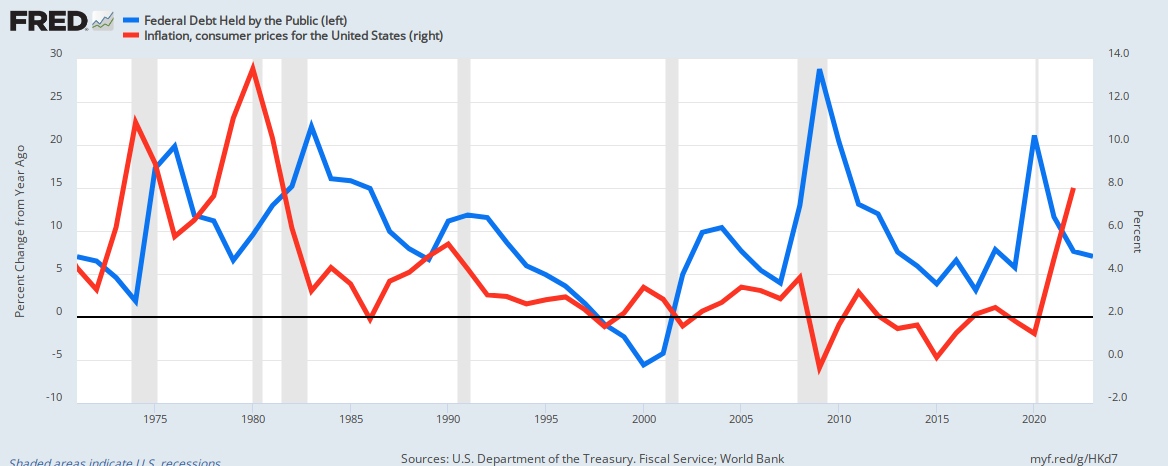
If the myth were true, an increase in federal deficit spending should correspond to an increase in prices. But does it?
There is no relationship between inflation (red line) and changes in federal deficit spending (blue line).
We see absolutely no evidence that deficit spending has led to today’s, or any day’s, inflation. Sadly, the myth is taken for granted as truth, and seldom do we see anyone daring to doubt it.
Until recently, evidence of inflation exceeding 2 percent—the Fed’s traditional goal for inflation—has been dismissed as temporary or transitory, and for good reason. Newly printed stimulus money has been passing through the system. This, accompanied by serious supply-chain disruptions, might be over in another 12 months—if we’re lucky.
Ah, “supply-chain disruptions,” (aka shortages). Here, too briefly, Mr. Yandle hints at the fact that shortages are primary cause of inflation.
Does that give Mr. Yandle a clue? Apparently not:
Then in August, the Biden administration indicated that 2021’s economy would show as much as 4.8 percent inflation—but, with an optimistic spin, would fall to 2.5 percent the next year. Meanwhile, there is some stimulus money pending in the yet-to-be determined infrastructure bill, and that complicates the issue.Avoiding the hard truth or waiting before countering inflationary forces carries a cost. In this case, delays could mean harsher action later when, for example, the Fed hits the money brakes harder to cool the economy. In such a case we might see interest rates head to the ceiling, construction activity and high-tech investment plummet, and the economy roll into a recession.
Mr. Yandle, staying with the false “spending causes inflation” trope, is not clear about what he means by “money brakes.”
If he thinks that raising interest rates would lead to recession, you would expect there to be an inverse relationship between interest levels and Gross Domestic Product growth.
Is there?
There is not the expected inverse relationship between interest rates (brown) and GDP growth (green).
The above graph does not indicate Mr. Yandle’s expected inverse relationship between interest rates and GDP growth. In fact, we see something of a positive relationship.
Contrary to the knee-jerk, temporary reaction of the stock markets, high interest rates seem to correspond with high GDP growth.
Why? Probably because higher rates force the federal government to pump more interest (i.e. growth) dollars into the economy.
If by, “hit the money brakes,” Mr. Yandle means add fewer dollars to the economy, he undoubtedly is correct. Economic growth, by formula, requires money growth.
GDP = Federal Spending+ Non-federal Spending + Net Exports
Clearly, GDP growth relies on spending growth, and one seldom will see spending growth without money growth.
In 1978, the CPI was exceeding 7.5 percent and economic growth was slowing because of deliberate Fed action to cool the economy.
“Cool the economy” surely is not anyone’s goal, if “cooling” means reduced economic growth. But Mr. Yandle, and other economists love to use ambiguous terminology, to protect themselves from error.
Increasing interest rates does not “cool” an economy, but reducing federal deficits does “cool” economic growth.
Fed chair Paul Volcker “hit the brakes” long and hard and squeezed out inflation, along with employment growth.
Although rising interest rates didn’t cut into GDP, there is a very close relationship between the money supply (approximated by total debt) and GDP growth.
Again, Yandle, intentionally or unintentionally uses imprecise terms. In what way did Volker “hit the brakes”? We assume Yandle means “raised interest rates.”
If so, that clearly does not hit any economic brakes, nor ever has. Higher interest rates do not cause recessions.
But increases in money supply do cause increased GDP growth.
No one in authority wants to admit that the dollars we hold are systematically losing their purchasing power.
“No one”? Actually, everyoneunderstands and says we are in an inflation. The only questions being, Why?”“How deep?” and “How long?”
The “why” is shortages. The “how deep” and “how long” depend on what the government does. If it spends to reduce shortages, the inflation will not be deep or long. If it does as Mr. Yandle wants — cuts spending — we probably will fall into a stagflation.
We are being quietly robbed by Washington’s dollar-printing press, with politicians calling the shots. The presses are not operating without drivers.
Wrong, wrong, wrong. As we have shown in the first graph (above), the “dollar-printing press” does not cause inflation.
Seemingly, it’s okay for the Fed chair to recognize CPI heading north, but only if he qualifies the trip by calling it temporary. And while Washington analysts argue that COVID-19 disruptions are affecting just some key items, such as used cars and lumber—
“Just some key items”? Really? How about, virtually all items and labor? How about oil, food, electronics, rare earths, etc., etc.
— and that ports clogged with container ships waiting for workers, drivers, and trucks to be unloaded are the culprit—an analysis of the price movements in the July Consumer Spending Index, which is the Fed’s preferred inflation measuring rod, shows 84 percent of included items rising.
That’s right. Clogged ports and a shortage of workers and drivers, also leads to the product shortages that are the causes of inflation. Amazing that Mr. Yandle doesn’t see it.
The price increases are widespread, which suggests they are embedded.
“Embedded” into shortages.
What Mr. Yandle doesn’t recognize is that increased federal spending can cure inflationby curing shortages.
No matter how analysts choose to slice and dice the data, the answer is the same: The U.S. inflation rate calls for taking offsetting actions, such as avoiding direct distributions of stimulus or minimum family income dollars (though not harsh, invasive measures to cool off the economy).
The perfect right-wing solution to everything: Cut family income.
Let us not forget that inflation is not about rising prices. The rising price level is the result of an inflated money supply—all those trillions of stimulus dollars now out and chasing harder after goods and services.
Exactly and diametrically wrong. Inflation IS about rising prices and IS NOT about money supply. Despite all the counter-evidence, Mr. Yandle promulgates the “deficits cause inflation” myth.
Why does he avoid fact in favor of fiction? Here’s a hint:
BRUCE YANDLE is a distinguished adjunct fellow with the Mercatus Center at George Mason University.Wikipedia: The Mercatus Center at George Mason University is a libertarian, non-profit, free-market-oriented research, education, and outreach think tank. The Koch family has been a major financial supporter of the organization since the mid-1980s. Charles Koch serves on the group’s board of directors.
And there you have it. Yandle is a Libertarian being paid by a think tank that is supported (bribed) by the infamous and wealthy Kochs. Their goal in life seems to be to widen the Gap between the rich and the rest.
Widening the Gap is how the rich become richer. (Without the Gap no one would be rich. We all would be the same.) The rich widen the Gap, i.e. become richer, by gaining more for themselves or by forcing the rest to have less.
By blaming federal deficits for inflation, Yandle, Mercatus, and the Kochs are able to demand the next “logical” step, cut deficit spending on such social programs as: Social Security, Medicare, and all poverty aids.
Along with the military, those constitute the largest federal deficit expenditures.
Libertarians and Republicans falsely claim that deficit spending should be cut to cure inflation. They are deceptive and wrong.
The rich widen the Gap by bribing thought leaders:
Economists are bribed via “think tank” salaries and payments to universities
The Media are bribed via ownership and advertising dollars
Politicians are bribed via political contributions and promises of lucrative employment later
Libertarians and Republicans wrongfully claim that deficit spending should be cut to cure inflation.
But, cuts to federal deficit spending do not cure inflation. Rather, spendingcuts cause recessions and depressions, while punishing the poor and middle classes.
Yandle’s suggested cuts simply would make the rich richer and the rest, poorer. In short, Yandle’s cuts would widen the Gap between the rich and the rest, and we believe that is what he is paid to want.
Rodger Malcolm Mitchell
Monetary SovereigntyTwitter: @rodgermitchellSearch #monetarysovereigntyFacebook: Rodger Malcolm Mitchell
……………………………………………………………………..
THE SOLE PURPOSE OF GOVERNMENT IS TO IMPROVE AND PROTECT THE LIVES OF THE PEOPLE.
Gap Psychology describes the common desire to distance oneself from those “below” in any socio-economic ranking, and to come nearer those “above.” The socio-economic distance is referred to as “The Gap.”
Wide Gaps negatively affect poverty, health and longevity, education, housing, law and crime, war, leadership, ownership, bigotry, supply and demand, taxation, GDP, international relations, scientific advancement, the environment, human motivation and well-being, and virtually every other issue in economics.Implementation of Monetary Sovereignty and The Ten Steps To Prosperity can grow the economy and narrow the Gaps:
Ten Steps To Prosperity:







 #Monetary Sovereignty - Mitchell