When you are faced with an unwanted effect, the solution is to find and then solve the cause. If you don’t understand the cause, you will be faced with the same effect again and again.
Washington Post headline:
Inflation emerges as defining economic challenge of Biden presidency, with no obvious solution at handAmerica is emerging from the pandemic facing its biggest inflationary spike in decades, as startling and persistent price hikes threaten to undermine the recovery, while posing an entirely new kind of economic challenge to the Biden presidency.Policymakers are facing the devilish and unfamiliar quandary of booming consumer demand and dramatic supply disruptions combining to push higher the cost of necessities such as food, gas and housing.
I’m not sure why this is such a mystery. All inflations are caused by the same thing: Shortages of key goods and services.
The cure for any inflation is to increase the availability of the scarce goods and services. So when the Washington Post says, “no obvious solution at hand,” they may be talking about no obvious political solution.
This inflationary burst has no single cause and no obvious solution.
The cause is a shortage of key goods and services. The cause is notfederal deficit spending.
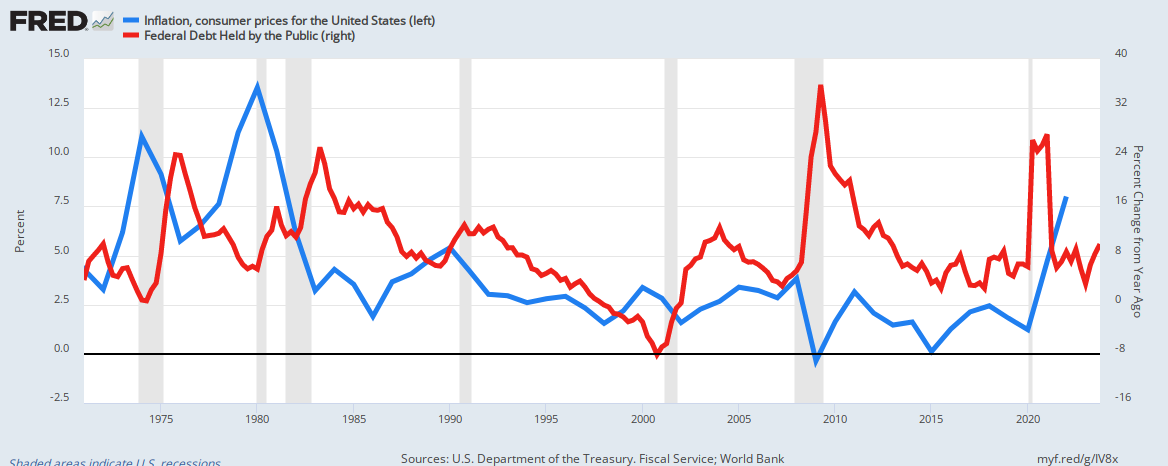
This graph shows there is no historical relationship between federal deficit spending (red) and inflation (blue). The graph also shows that reductions in deficit growth lead to recessions (vertical bars) which are cured by increases in deficit growth.
The economic solution is quite plain: Federal deficit spending to increase the supply of energy, food, computer chips, supply-chain methods, and labor.
Trillions of dollars in federal aid approved by Congress in response to the pandemic have led American consumers and companies to purchase more goods than ever before, putting new strains on global supply chains to accommodate the soaring volume. But that higher demand has collided with shortages in workers, supplies and transportation capacity — challenges caused in part by the pandemic as well as long-standing structural deficiencies in the national economy.
It is those shortages, not federal deficits, that have caused inflation. Cure the shortages and you cure the inflation.
A record 4.4 million Americans quit their jobs in September as labor market tumult continued.
The labor shortage exists partly because people quit their jobs for a variety of reasons including:
Need for child home care
Low wages
FICA cost
Bad hours.
Virus fear
There are others, but these all could be solved by federal deficit spending — a kind of “Manhattan Project” to cure the shortages that cause inflation.
Federal pay for child home care
Higher minimum wage together with the elimination of business taxes, to help fund the higher wages
Elimination of FICA and reduction of income taxes at the low pay scales
Standard 4-day week and/or shorter workday
Federal support for vaccination rewards in selected industries.
The federal government also should reduce the need for human labor by funding more development of Artificial Intelligence (AI) and mechanization along with other labor-saving initiatives.
This inflationary burst has no single cause and no obvious solution.
The single cause is shortages. The obvious solution is to cure the shortages.
Trillions of dollars in federal aid approved by Congress in response to the pandemic have led American consumers and companies to purchase more goods than ever before, putting new strains on global supply chains to accommodate the soaring volume. But that higher demand has collided with shortages in workers, supplies and transportation capacity — challenges caused in part by the pandemic as well as long-standing structural deficiencies in the national economy.
In the Eisenhower years, the federal government spent billions to improve highway traffic. Today, not only do highways need to be improved, but all other elements of the supply chain need similarly to be improved.
Our railroads are a mess. Our ports are inadequate. The quasi-privatized postal service is struggling. Shipping itself should be funded. These all are critical national needs, surely as important as weapons development.
Gas prices are at a seven-year high amid a global energy crisis, exacerbated by unusually high demand in Europe and a coal shortage in China.
Solutions: Temporarily fund increased oil drilling while funding more research and development of renewable, non-carbon fuels.
Food prices are rising at the highest level in 12 years amid severe droughts and spiking demand from families and restaurant reopenings. Meat, fish and egg prices are up nearly 12 percent from a year ago — the highest increase since 1979 (other than the early days of the pandemic) — partly fueled by processing plants’ struggle to find workers.
While other industries have mechanized, food processing remains in the electronic dark ages. Federal funding of computerization would help, significantly, as would federal financial support for raising wages.
Droughts are being caused by climate change, which has been denied by the right wing and largely ignored by the left. Federal support for non-carbon energy sources would help solve the problem.
The longer inflation lasts, the greater the political problem for the White House and congressional Democrats. Already news of the October inflation spike spurred new head winds for President Biden’s signature and key legislative initiative — the roughly $2 trillion Build Back Better package — exacerbating fears that other moderate Democrats may echo the concerns raised by Sen. Joe Manchin III (D-W.Va.) this past week about more spending. Congress won’t use their infinite supply of water to put out our economic fire.Meanwhile, Republicans have sharpened their attacks over inflation, seeing it as among their best arguments against the Biden’s presidency.
In other words, our boat is burning, but the politicians won’t put out the fire because they don’t want to use water.
Yet many economists say that the inflationary pressures hitting the U.S. economy were necessary to avoid the far worse scenario of a prolonged downturn and that focusing on rising prices risks obscuring the healthy facets of the current rebound such as the rapid rebound in jobs.Most families have more financial resources than they did before covid, especially among the bottom third. Even when accounting for inflation, disposable income has been roughly 9.5 percent higher in 2021 than it was before the coronavirus pandemic hit in 2019, according to Julia Coronado, president and founder of MacroPolicy Perspectives.“It’s safe to say the bottom 40 percent of Americans are definitely better off in the past year from a combination of rising wages and government aid, even with inflation,” said Arindrajit Dube, economics professor at the University of Massachusetts Amherst.
The Democrats are laughably (or “cryably”) bad at telling their story. Somehow, they expect the public to see “the obvious,” but history shows that the public would rather believe the words of a personality than the facts.
The U.S. economy is growing at a very fast clip, especially compared with the rest of the world, and could recover the lost economic output from the pandemic by the end of next year, according to some projections. Workers at the bottom of the income distribution are seeing meaningful wage increases, even factoring in inflation. Job openings are plentiful. The stock market has continued its meteoric rise under Biden, with the S&P 500 jumping by more than 20 percent since he took office. Inflation is up globally, not just in the United States, and the supply chain dysfunction reflects a decades-long trend of companies scattering their production sources across the globe.
All of the above is true, but who is telling the story? Certainly not Biden. And not the Vice President, whatever her name is and wherever she is hiding.
The old saw is, “If you’re defending you’re losing”, and the Dems aren’t even defending.
The approximately 50 percent rise in gasoline prices from last year — and 6 percent jump in October alone — has proved one of the most visible burdens on American families, spurred by a mixture of factors from Chinese manufacturing and an acute energy crisis in Europe.
To the average American voter, gas prices = inflation. The federal government has the financial ability to lower gas prices, although it may not have the political ability, unless someone in the government figures out how to tell the story.
Sadly, a personality like Donald Trump could do it, and he would do it, if it benefited him.
Supply chain backlogs also show little sign of easing before early 2023, said Phil Levy, chief economist at freight company Flexport. While shipping rates from Shanghai to Los Angeles came down modestly from their September peaks and auto companies report slightly easier access to semiconductors now, a record 81 container ships were sitting off the southern California coast on Tuesday, according to the Marine Exchange.
A “Manhattan Project” for America’s supply chain could fix the problem.
Rent prices also jumped 0.4 percent from September to October, continuing an upward trend, while the sales price of a single-family home jumped by 16 percent over one year, according to the National Association of Realtors.A red-hot housing market has been spurred on in part by low interest ratesand shortages in supplycaused by a freeze in construction during the pandemic.
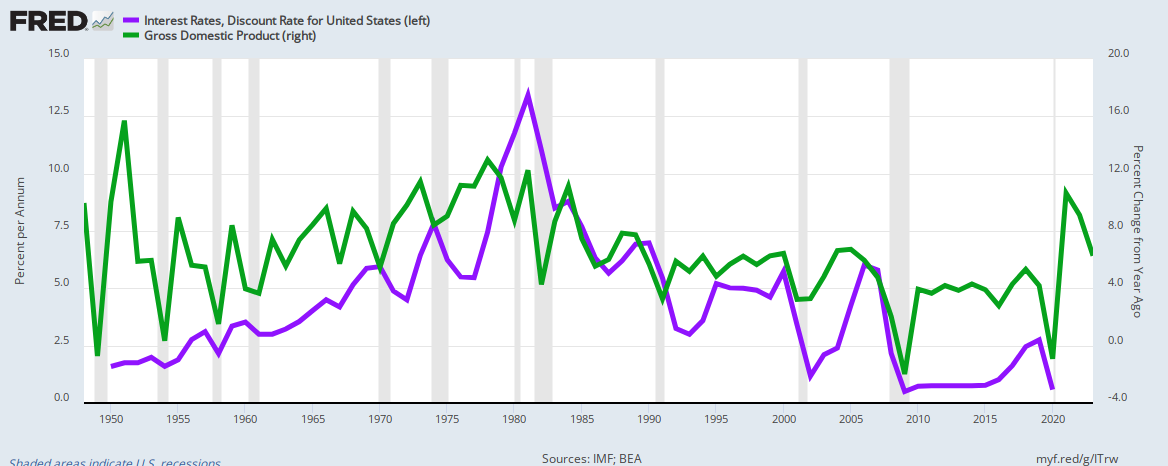
Annual interest rates (purple) vs. annual growth of Gross Domestic Product. Rate reductions do not stimulate GDP growth.
Shortages in supply always cause price increases.
However, as with so many myths in economics, the myth that low interest rates are stimulative has no basis. In fact, there is evidence, as you can see from the above graph, that high interest rates are stimulative.
The reason: High rates cause the federal government to pour more interest dollars into the economy.
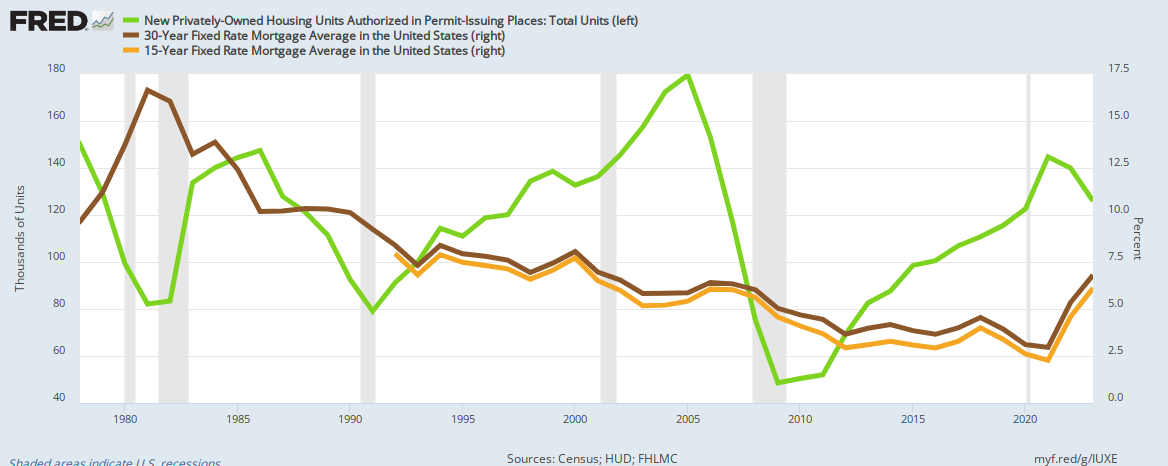
New housing construction (green) does not correlate with reductions in 30-year (brown) or 15-year (gold) mortgage rates.
New housing construction does not correlate with reduced mortgage rates. Both 30-year and 15-year mortgage rates have drifted downward since 1982, yet new housing construction (green) has changed wildly.
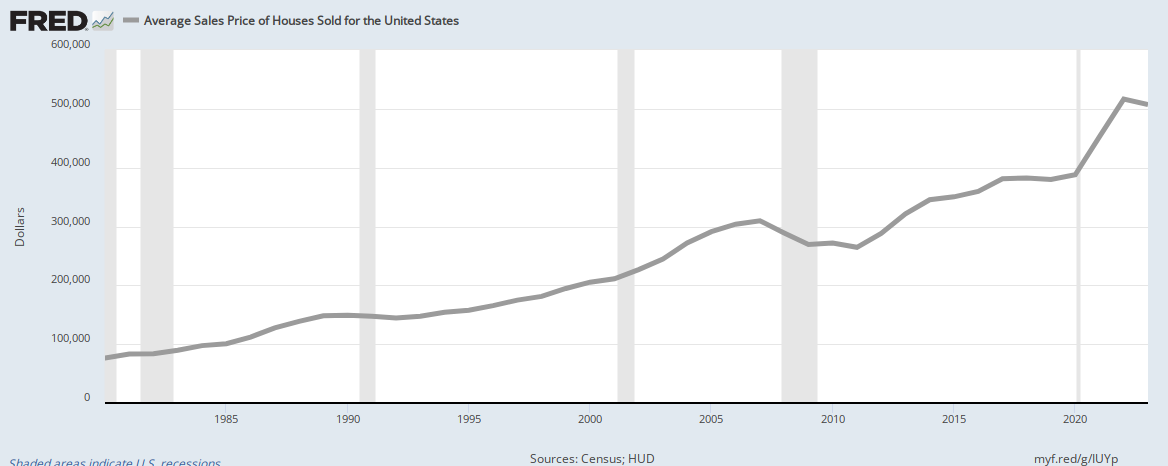
One reason for the lack of correlation may be that interest rates are not the deciding factor for home buyers.Since 1980, the average sales price of a house has increased from $80,000 to $450,000. A 1% drop in mortgage rates for a $450,000 house (less 20% down) comes to $3,600 per year or $300 per month, not nearly enough to encourage or discourage the purchase of a $450,000 house.
Thus, contrary to common knowledge and Federal Reserve dogma, reducing interest rates is not stimulative, and in fact, the argument could be made that rate reductions are recessive.
Interest rates should be raised and home construction, especially the construction of modestly priced homes, should be federally aided.
Raising interest rates also would mitigate against inflation, by increasing the value of the U.S. dollar.
If price increases continue, the Federal Reserve may raise interest rates, which would not only slow the pace of inflation, but also the pace of job and economic growth.
Yes and no. Yes, it would slow the pace of inflation, and no, it would not slow economic growth, as the above graphs indicate.
SUMMARY
The single greatest asset of the U.S. federal government is its Monetary Sovereignty. Yet myths and politics both have prevented the efficient use of this asset.
The federal government has the infinite ability to create U.S. dollars, and the addition of dollars is economically stimulative. Further, there is no evidence that federal deficit spending causes inflation, and massive evidence that it does not.
In short, there scarcely is an economic problem facing America that cannot be addressed by the wise addition of federal dollars, and there are no economic problems that can be solved by reductions in federal spending.
Rodger Malcolm Mitchell
Monetary SovereigntyTwitter: @rodgermitchellSearch #monetarysovereigntyFacebook: Rodger Malcolm Mitchell
……………………………………………………………………..
THE SOLE PURPOSE OF GOVERNMENT IS TO IMPROVE AND PROTECT THE LIVES OF THE PEOPLE.
Gap Psychology describes the common desire to distance oneself from those “below” in any socio-economic ranking, and to come nearer those “above.” The socio-economic distance is referred to as “The Gap.”
Wide Gaps negatively affect poverty, health and longevity, education, housing, law and crime, war, leadership, ownership, bigotry, supply and demand, taxation, GDP, international relations, scientific advancement, the environment, human motivation and well-being, and virtually every other issue in economics.Implementation of Monetary Sovereignty and The Ten Steps To Prosperity can grow the economy and narrow the Gaps:
Ten Steps To Prosperity:
The ruling, issued Friday by the New Orleans-based U.S. Court of Appeals for the 5th Circuit, solidifies its earlier order blocking implementation of the Occupational Safety and Health Administration’s emergency regulation. Florida hospital overcrowded with the unvaccinated., Its ruling comes ahead of a Judicial Panel on Multidistrict Litigation lottery to determine which federal appeals court will be assigned to adjudicate the many legal challenges to the measure now pending across the country. The lottery is slated for Nov. 16.In a 22-page opinion, the court had harsh words for the vaccine mandate. The mandate “threatens to substantially burden the liberty interests of reluctant individual recipients put to a choice between their schooling and their jab(s),” the court said.“Likewise, the schools and parents seeking a stay in this case will also be irreparably harmed in the absence of a stay, whether by the school and financial effects or a lost or suspended student, compliance and monitoring costs associated with the Mandate, the diversion of resources necessitated by the Mandate, or by OSHA’s plan to impose stiff financial penalties on schools that refuse to punish or test unwilling student,” the court said.The U.S. had asked the court to set aside its prior order to allow that process to play out.OSHA’s rule requires qualifying schools to ensure that all students are fully vaccinated by Jan. 4, or subjected to testing for polio at least weekly.Barring a long-lasting injunction, schools will have to comply with other parts of the rule by Dec. 5, including developing a compliance plan, offering paid time off for vaccinations, and requiring unvaccinated students to wear masks.The 5th Circuit is considering challenges filed by Texas, joined by Louisiana, Mississippi, Utah, South Carolina and schools that claim they’re adversely affected by the rule. The plaintiffs contend the emergency temporary standard exceeds OSHA’s statutory authority.
Polio endangers the lives, not just of students and not just of their families, but of Americans everywhere. Polio is a virulent and dangerous disease, and the courts should not put some theoretical, invented “freedom” ahead of actual lives.
Oh, wait!
I’m sorry. I was confused. The article actually concerned COVID vaccines, not the vaccines thatALL states require of school children.
But, those hepatitis A & B, measles, mumps, rubella, varicella, diphtheria, tetanus, pertussis, and poliovirus vaccines are different, because they help prevent the spread of fatal diseases throughout the population, and most are highly contagious, while the COVID vaccine . . . uh . . . is . . . only . . . something Trump Republicans don’t like.
This just in:
DeSantis brings back Florida lawmakers to crack down on vaccination mandatesGovernor says special session will be ‘striking a blow for freedom’ in a state fighting federal vaccine requirementsTALLAHASSEE — A special legislative session dubbed “Keep Florida Free” begins Monday at the behest of Gov. Ron DeSantis, who wants lawmakers to pass more measures to block vaccine mandates by public and private schools.The four bills being considered would ratchet up the penalties for schools, local governments and other entities that require workers to be vaccinated against the viruses and students to wear masks in school. According to DeSantis (R), the session will strengthen as well as augment rules already in place — in part through his own executive orders.“At the end of the day, we want people to be able to make informed decisions for themselves, but we’ve got to stop bossing people around,” DeSantis said last week as he officially announced his 2022 reelection bid. “We’ve got to stop the coercion. We’ve got to stop trying to browbeat people.”
Oops, sorry again. This article was about the COVID vaccination, not all the other vaccinations that Floridamandates to protect our schoolchildren.
See, it’s like this. We don’t want our kids to die from hepatitis A & B, measles, mumps, rubella, varicella, diphtheria, tetanus, pertussis, and poliovirus, or to spread those diseases to friends and family, but we don’t care if our people die from or spread COVID to friends and family.
It’s different, somehow, in the minds of the Trumpers.
We have to stop browbeating our people.
Remember, those other diseases are highly contagious, while COVID is not.
Donald Trump and the rest of the GOP told me so.
“We’ve got to stop trying to browbeat people.”FloridaGov. Ron DeSantis.
Rodger Malcolm Mitchell
Monetary SovereigntyTwitter: @rodgermitchellSearch #monetarysovereigntyFacebook: Rodger Malcolm Mitchell
……………………………………………………………………..
THE SOLE PURPOSE OF GOVERNMENT IS TO IMPROVE AND PROTECT THE LIVES OF THE PEOPLE.
Gap Psychology describes the common desire to distance oneself from those “below” in any socio-economic ranking, and to come nearer those “above.” The socio-economic distance is referred to as “The Gap.”
Wide Gaps negatively affect poverty, health and longevity, education, housing, law and crime, war, leadership, ownership, bigotry, supply and demand, taxation, GDP, international relations, scientific advancement, the environment, human motivation and well-being, and virtually every other issue in economics.Implementation of Monetary Sovereignty and The Ten Steps To Prosperity can grow the economy and narrow the Gaps:
Ten Steps To Prosperity:
Economics involves many questions, of course, but is there one question that is key? Is there one question, the answer to which opens the door to the entire study of economics?
After some thought, I believe such a question exists, and I will reveal my nomination here. You may disagree with my choice, and if so, I’d be glad to know yours, or if you feel no question is that important.
First, a bit of:
BACKGROUND
In the first eleven billion years of the universe’s existence, and the first 4 billion years of the earth’s existence, there was no such thing as the United States or the U.S. dollar.
But beginning in the 1700’s AD, men created a variety of laws. The laws were completely arbitrary and created from thin air, as all laws are. And as is true for all laws, these laws had no physical existence. They merely were concepts.
The laws could be spoken, handwritten, typed, printed, mimeographed, texted, Emailed, or delivered in any number of ways, but the laws themselves had no physical existence. They merely were an amalgam of ideas, concepts, and beliefs.
Some of those laws, which were created, from thin air, produced the political entity known as “the United States of America.” and some of those laws created, also from thin air, the U.S. dollar.
Those laws arbitrarily created millions of dollars, and arbitrarily created the value of those dollars, with regard to arbitrary amounts of silver and gold.
And now for the question that I believe to be the most important question in economics:
How Many Laws Can The U.S. Federal Government Create?
I suggest that the answer to this question is: “Infinite.”
Now “infinite” is a very big number. It is bigger than the number of glasses of water in all the oceans on earth. It is bigger than the number of stars in the sky. Infinite is bigger than the number of atoms in the known universe.
How is it possible for humans to create here on earth, something that is bigger than the oceans, stars, and the universe’s atoms? The reason is that water, stars, and atoms are physical objects, but laws have no physical existence.
Like creating numbers, the ability to create laws is limitless. You cannot see, hear, feel, taste, or smell a number or a law. You can sense representations of numbers and laws, but the numbers and laws themselves merely are concepts.
Similarly, the dollars created by laws, have no physical existence. You can see representations of dollars — dollar bills, bank statements, savings account passbooks, T-bill records, etc. — but you cannot see, hear, feel, taste, or smell a dollar. It is just a number in a balance sheet.
When you go to a store to make a purchase, you pay by presenting your credit card. Invisible dollars are taken from that card and sent to the card issuer, who in turn, sends invisible dollars to the store. Soon thereafter, invisible dollars will be taken from your checking account and sent to the credit card company, which will deposit these invisible dollars into its balance sheets.
All the while, invisible dollars will flow to and from the Federal Reserve, tidying things up. And it all will be done in thin air, with nothing but the occasional atom moving.
Because the U.S. dollar was created by U.S. laws, and because the federal government has the infinite ability to create U.S. laws, and because neither laws nor dollars have any physical existence:
I. Dollars are created by laws. The U.S. federal government has the infinite ability to create laws, so it has the infinite ability to create U.S. dollars.
We’re not even talking about an infinite ability to “print” dollars. Those printed green paper things you carry in your wallet are not dollars. They are representations of, or titles to, dollars. The real dollars are just numbers in numerous records and balance sheets all over the world.
Because the U.S. government has the infinite ability to create the laws that create dollars, and so has the infinite ability to create dollars, the government never unintentionally can run short of dollars.
And because the government has the infinite ability to create U.S. dollars:
II. The U.S. government has no need to collect U.S. dollars from anyone or anywhere.
This means the government has no need to borrow or to tax. It does not need to ask you for dollars. It does not need to ask China for dollars. It does not need to ask anyone for dollars. The federal government creates from thin air all the dollars it uses.
Even if all federal tax collections fell to zero, the federal government could continue spending forever. Not only that, but:
III. All the tax dollars you send to the federal government are destroyed upon receipt.
The amount of money that exists in the United States is divided into “M”classifications such as MZM, M0, M1, M2, and M3,according to the type and size of the account in which the instrument is kept. The money supply reflects the different types of liquidity each type of money has in the economy. It is broken up into different categories of liquidity or spendability.
The tax dollars you, and everyone else sends to the federal government generally come from checking accounts, which are part of the money supply measure called “M1.”
When you pay taxes, you take money from your M1 checking account and send them to the Treasury where they cease to be part of any money supply measure. Effectively, your tax dollars are destroyed.
The reason is clear. Because the federal government has the unlimited ability to create dollars, it would make no sense to try to measure its money supply, which is infinite. If, say, you send $1,000 to the federal government, $1,000 + infinity = infinity. No difference.
That is why no one ever can answer the question, “How much money does the federal government have?” The only accurate answer is “Infinite.”
The Monopoly Example
If you ever have played the board game Monopoly, you know that it usually is played with four players, plus a Bank. The function of the Bank is to distribute Monopoly dollars to, and to collect Monopoly dollars from, the players, according to the rules.
But, one rule of Monopoly is that the Bank never can run short of dollars. If you were to open the game box to discover all the printed dollar certificates were missing, what would you do in order to play the game?
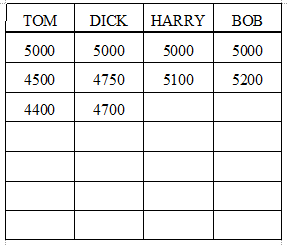
How to play Monopoly without using Monopoly paper dollars. Create a table. No column for the Bank.
One approach would be to take a sheet of paper and divide it into four columns, one column for each player.
At the top of each column you would print each player’s name, and below each name, a starting amount of money.
The illustration at the right shows that each player begins with 5,000 Monopoly dollars.
Then as each player spends and receives money, the amounts below that player’s name are changed.
Many of those dollars go to, and come from, the Bank, but the bank has no column because the Bank has infinite dollars.
In the game, when you pay dollars to the “Community Chest,” the dollars are supposed to go to the Bank, and when you receive $200 for passing “GO,” the dollars are supposed to come from the Bank.
Although the rules specify that tax dollars and other dollars go to the Bank, the above example shows that they really are destroyed upon receipt. The Bank has no column. There is no way to determine how many dollars the Bank has. It has infinite dollars.
In the real world, the federal government operates just like the Monopoly Bank: It collects dollars from the public, and it distributes dollars to the public. But once dollars are received by the Treasury, they disappear.
Though the Treasury keeps internal records, there is no way to determine how many dollars the government has. It has infinite dollars.
Since the federal government has no use for tax dollars, why does the federal government collect tax dollars?
There are three reasons: One real, one mythical, and one secret.
The real reason the government collects tax dollars is to control the economy. It taxes what it wishes to discourage and it gives tax breaks to what it wishes to reward or encourage. That is why there are so many tax breaks for the rich people who control the government.
The mythical reason the federal government collects tax dollars — a reason espoused by many economists — is to create demand for dollars with which to pay taxes. The demand for such cryptocurrencies as Bitcoin, Ethereum, and Litecoin, which are not supported by taxes, debunks this reason.
The secret reason the federal government collects taxes is to help make you believe dollars are scarce to the government. This belief keeps you from demanding more benefits like expanded Social Security, Medicare for All, poverty aids, free college for all, and an end to the FICA tax.
The rich people and rich companies are rich only because of the Gap between them and those who are not as rich. If there were no Gap, we all would be the same. No one would be rich. And the wider the Gap, the richer are the rich.
The rich always want to be richer. This is known as “Gap Psychology,” the desire to widen the income/wealth/power Gap below, and to narrow it above.
Widening the Gap below can involve either gaining more for oneself or preventing those below from gaining. Either will make one richer.
To make themselves richer, the rich bribe the key sources of your information. They bribe the politicians (via political contributions and promises of lucrative employment later). They bribe the media(via ownership and advertising dollars). They bribe the economists (via university contributions and “think tank” employment).
All these sources of information combine to tell you the Big Lie, that in order for you to receive more federal benefits, taxes must be increased.
That misinformation provides an excuse for the current battles against President Biden’s “Build Back Better” Act, which first was proposed at a $3.5 trillion level, and since has been cut in half because of the Big Lie.
The pretext was that this proposal must be “paid for” with taxes. But, as you now know, taxes do not fund federal spending.
The federal government pays for everything by merely sending instructions (checks and wires) to creditors’ banks, instructing the banks to increase the balances in creditors’ checking accounts.
When the banks do as instructed, this creates more M1 dollars, the same kind of dollars you send to the federal government as taxes.
Since the federal government has no need to ask anyone for dollars, why does it borrow dollars?
The U.S. federal government never borrows dollars. The acceptance of deposits into Treasury Security accounts (T-bills, T-notes, T-bills) is wrongly called “borrowing” and federal “debt.” It neither is borrowing nor debt.The closest parallel to a T-security account is a safe deposit box.
When you put dollars into your safe deposit box, your bank never touches those dollars, and your bank doesn’t owe you those dollars.
They neither are loans to your bank nor are they debts of your bank.
The bank “pays you back” simply by allowing you to take back whatever dollars are in your box.
Similarly, when you make a deposit into your T-security account, the federal government never touches those dollars. The government “pays you back” by allowing you to take back whatever dollars are in your account.
Since the federal government has no need to ask anyone for dollars, why does it provide for deposits into T-security accounts? There are two real reasons and one secret reason:
The first real reason is to help the Federal Reserve to control interest rates. These accounts pay interest, the rates for which begin with Federal Reserve decisions regarding the state of the economy.
The second real reason is to provide a safe, interest-paying place for people, businesses, and nations to “park” unused dollars.
The secret reason is again to help make you believe the federal government is so deeply “in debt” it cannot afford to help narrow the Gap between the rich and the rest.
The federal government has no need to ask anyone for dollars, and has the infinite power to spend. But, doesn’t too much government spending cause inflation?
Remember that way back in the 1780s, the federal government created as many dollars as it wished and gave those dollars whatever value it wished — and it did all this by passing laws.
The federal government still has the unlimited power to:
Pass laws
Create dollars, and
Control the value of dollars.
Over the years, the government has used all three of those powers. While nos. 1 and 2 already have been explained, you may be curious about how the government controls the value of dollars. It has two primary tools:
When the government raises interest rates, more people will want to obtain more dollars to invest in interest-paying bonds, and this increased demand for U.S. dollars increases their value.
Government fiat. When the U.S. was on various silver and gold standards, the government merely would pass laws saying that a dollar could be exchanged for specific amounts of gold or silver. The U.S. Constitution gives Congress the power “To coin Money, regulate the Value thereof.” The government, by fiat, can change the exchange rate between dollars and other currencies. This is known as “devaluation” and “revaluation.”
That said, the primarydriver of inflation is not interest rates, or federal fiat, or federal deficit spending, or so-called federal “debt.” The primary driver of inflation is shortages.
If the “federal deficit spending” myth were true, an increase in federal deficit spending should correspond to an increase in prices.
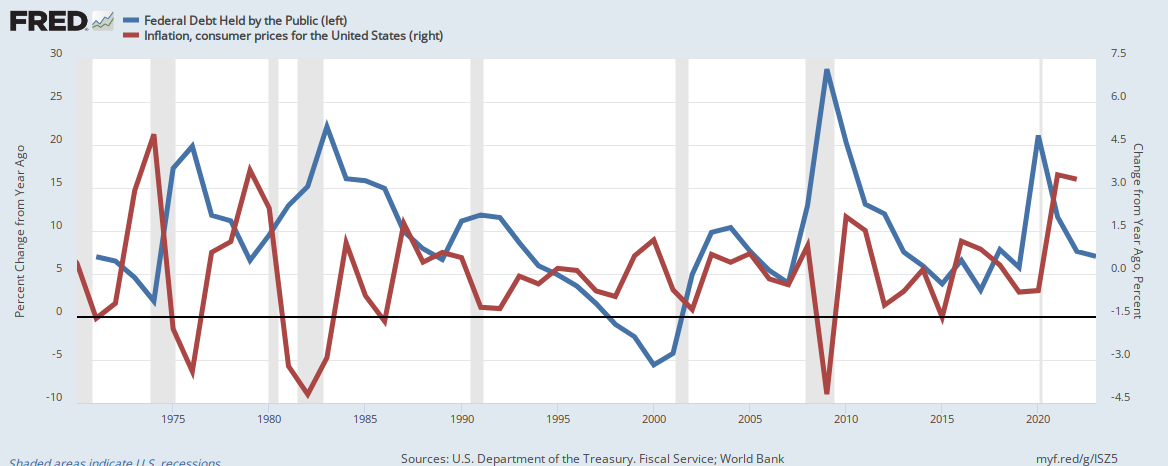
Changes in federal deficit spending (blue line) vs. inflation (red line). Vertical bars are recessions.
There is no historical relationship between changes in federal deficit spending (blue line) and changes in inflation (red line). Federal deficits do not cause inflations.
IV. The driver of inflation never is federal deficit spending, but rather the scarcity of key goods and services.
Like all inflations through history, today’s inflation is caused by shortages of energy, food, computer chips, supply chain resources, and labor.
Some of these are related to global warming and some are related to COVID. Many are related to inefficient government.
Contrary to popular wisdom, today’s inflation could be controlled via increased federal spending to eliminate the shortages. Federal spending to increase oil and gas drilling, renewable energy production, farmer aids, computer chip production, shipping, and the elimination of taxes that discourage employment (i.e. FICA), would reduce inflation.
Also notice in the above graph that:
V. Recessions begin with reductions in federal deficit growth and are cured by increases in federal deficit growth.
This should surprise no one because economic growth requires money growth. The most common measure of economic growth is Gross Domestic Product (GDP) a formula for which is:
GDP=Federal Spending + Non-federal Spending + Net Exports.
All three factors on the right-hand side of the equation are related to an increased dollar supply.
What happens when the federal “debt” (i.e., the net total of deficits) decreases?
1804-1812: U. S. Federal “Debt” reduced 48%. Depression began 1807.
1817-1821: U. S. Federal “Debt” reduced 29%. Depression began 1819.
1823-1836: U. S. Federal “Debt” reduced 99%. Depression began 1837.
1852-1857: U. S. Federal “Debt” reduced 59%. Depression began 1857.
1867-1873: U. S. Federal “Debt” reduced 27%. Depression began 1873.
1880-1893: U. S. Federal “Debt” reduced 57%. Depression began 1893.
1920-1930: U. S. Federal “Debt” reduced 36%. Depression began 1929.
1997-2001: U. S. Federal “Debt” reduced 15%. Recession began 2001.
Again, this should surprise no one. Just as a growing economy requires a growing supply of money, reducing federal “debt” (i.e. running federal surpluses) takes dollars from the economy and sends them to the Treasury, where they are destroyed..
By definition, GDP is reduced when dollars are taken from the economy.
Fortunately, the U.S. federal government has the ability to create infinite U.S. dollars and to control their value, i.e. prevent excessive inflation.
So, the federal government has the ability to fund Medicare for All, Social Security for All and college for all who want it. Further, the government has the financial ability to eliminate the grossly recessive employment taxes (FICA) and to help the states, counties, and cities to reduce their tax burdens.
Given this infinite power, the federal government is left with one final question: Is there a limit? We know the government has the power, but is there a limit as to how much of this power the government should use?
The problem has two parts: Financial and political.
Financially, is there a dollar limit, beyond which federal deficit spending actually harms the economy rather than benefitting it?
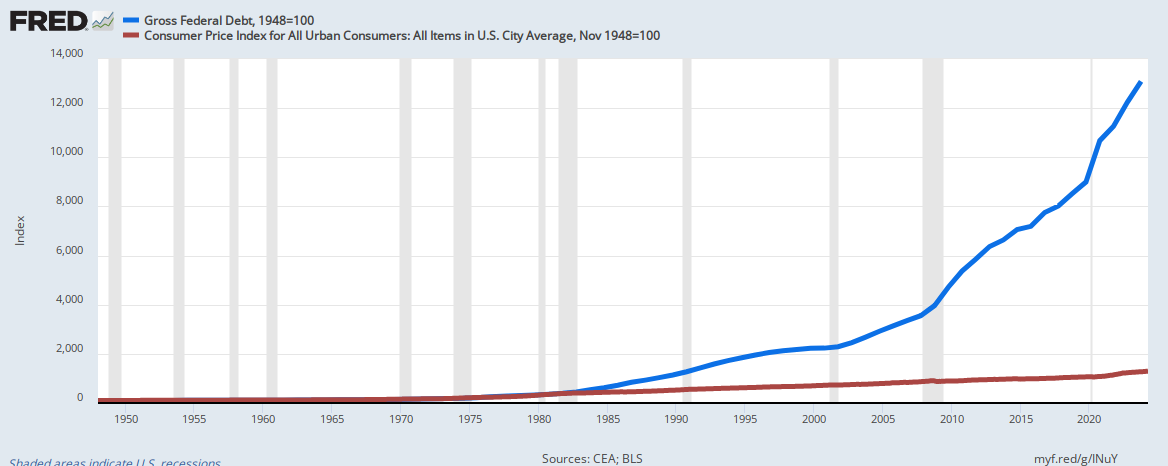
There may be, but no evidence exists for any limit. As the following graph shows, federal “debt” (blue line) has increased massively, while inflation (red line) has followed a comparatively modest, even trajectory.
If federal deficit spending caused inflations, the blue line (federal deficits) and the red line (inflation) would be parallel.
Claims that future federal deficit spending, in any given amount, will cause inflation are based on intuition and guesswork and not on historical precedent.
Politically, is there a point beyond which federal deficit spending gives the federal government “too much power”?Libertarians think so.
In fact, Libertarians can be trusted to object to any amount of federal deficit spending, or even any amount of federal spending at all. They think people should be “free” to pay for unaffordable health care, education, infrastructure, housing, schooling, sustenance, and retirement.
Others think local governments should do what the federal government does because, in their belief, local governments know what local people want, and after all, aren’t we all “local” people?
Sadly, while the federal government, being Monetarily Sovereign, has infinite funds, monetarily non-sovereign local governments do not. They must levy burdensome taxes in order to spend.
The question of “too much federal power” often is answered in a general sense, but when specifics are broached, the answers are not clear. I, for one, have no idea what “too much” federal power is, except when it impinges on what I personally view as a personal privilege.
Outlawing recreational drugs, liquor, abortions, certain marriages, and certain books fall into that category. Mandating vaccination to protect our species does not. But that’s just my view.
Power begets criminality, but on balance I suspect local government tend to be less honest than does the federal government for one reason: The media do a better job of investigating and shining light on federal government than on local governments, where media have less investigative power and less influence.
SUMMARY
The most important question in economics is: How Many Laws Can The U.S. Federal Government Create? The answer is “infinite.” Since U.S. dollars are created by laws, the U.S. government can create infinite dollars and can give these dollars any value it chooses.
Thus, the U.S. government has no need to collect U.S. dollars from anyone or anywhere. All the tax dollars you send to the federal government are destroyed upon receipt.
Economic growth requires money growth, which requires federal deficit growth. The insufficiency of federal deficit growth leads to recessions and depressions, which can be cured only by federal deficit growth.
The driver of inflation never is federal deficit spending, but rather the scarcity of key goods and services. Inflations actually can be prevented and cured by increased federal deficit spending to cure shortages. To date, despite massive federal deficits, particularly in the past decade, we never have reached the level of “too much federal spending.”
Rodger Malcolm Mitchell
Monetary SovereigntyTwitter: @rodgermitchellSearch #monetarysovereigntyFacebook: Rodger Malcolm Mitchell
……………………………………………………………………..
THE SOLE PURPOSE OF GOVERNMENT IS TO IMPROVE AND PROTECT THE LIVES OF THE PEOPLE.
Gap Psychology describes the common desire to distance oneself from those “below” in any socio-economic ranking, and to come nearer those “above.” The socio-economic distance is referred to as “The Gap.”
Wide Gaps negatively affect poverty, health and longevity, education, housing, law and crime, war, leadership, ownership, bigotry, supply and demand, taxation, GDP, international relations, scientific advancement, the environment, human motivation and well-being, and virtually every other issue in economics.Implementation of Monetary Sovereignty and The Ten Steps To Prosperity can grow the economy and narrow the Gaps:
Ten Steps To Prosperity:
Conservatives are notorious for not only arguing against COVID vaccination mandates, but for refusing vaccinations themselves.
They adopt the macho stance that they don’t want anyone to “tell them what to do,” despite the fact that when you live in a society, you can’t simply do whatever you want, and let the effects on everyone else be damned.
If your actions are liable to hurt others, our society passes laws to protect the group. Vaccine mandates, down through history, are examples of those group-protection laws.
Conservatives don’t care about groups. They are a “Me first, me last, me only” bunch.
The following articles show why selfish conservatives are America’s and the world’s greatest danger.
Covid-19 vaccines reduce the likelihood of infecting othersNEWSCIENTIST: People who are fully vaccinated against covid-19 are far less likely to infect others, despite the arrival of the delta variant, several studies show. The findings refute the idea, which has become common in some circles, that vaccines no longer do much to prevent the spread of the coronavirus.“They absolutely do reduce transmission,” says Christopher Byron Brooke at the University of Illinois at Urbana-Champaign. “Vaccinated people do transmit the virus in some cases, but the data are super crystal-clear that the risk of transmission for a vaccinated individual is much, much lower than for an unvaccinated individual.”A recent study found that vaccinated people infected with the delta variant are 63 per cent less likely to infect people who are unvaccinated.This is only slightly lower than with the alpha variant, says Brechje de Gier at the National Institute for Public Health and the Environment in the Netherlands, who led the study. Her team had previously found that vaccinated people infected with alpha were 73 per cent less likely to infect unvaccinated people.What is important to realise, de Gier says, is that the full effect of vaccines on reducing transmission is even higher than 63 per cent, because most vaccinated people don’t become infected in the first place.Even assuming vaccination only halves the risk of infection, this would still imply that vaccines reduce transmission by more than 80 per cent overall.Others have worked out the full effect. Earlier this year, Ottavia Prunas at Yale University applied two different models to data from Israel, where the Pfizer vaccine was used. Her team’s conclusion was that the overall vaccine effectiveness against transmission was 89 per cent.The idea that vaccines are no longer that effective against transmission may derive from news reports in July claiming that vaccinated people who become infected “can carry as much virus as others”. Even if this were true, however, vaccines would still greatly reduce transmission by reducing infections in the first place.In fact, the study that sparked the news reports didn’t measure the number of viruses in someone directly but relied on so-called Ct scores, a measure of viral RNA. However, this RNA can derive from viruses destroyed by the immune system. “You can measure the RNA but it’s rendered useless,” says Timothy Peto at the University of Oxford.There are now several lines of evidence that Ct scores aren’t a good measure of the amount of virus someone has. Firstly, the fact that infected vaccinated people are much less likely to infect others. Peto has done a similar study to de Gier using contact tracing data from England and gotten similar results.Secondly, Peto’s team specifically showed that there is little connection between Ct scores and infectiousness. “It appeared people who were positive after vaccination had the same viral load as the unvaccinated. We thought they were just as infectious. But it turns out you are less infectious,” says Peto. “That’s quite important. People were over-pessimistic.”Yet another line of evidence comes from a study by Brooke. His team took samples from 23 people every day after they first tested positive until the infection cleared and performed tests, including trying to infect cells in a dish with the samples.With five out of the six fully vaccinated people, none of the samples were infectious, unlike most from unvaccinated people. The study shows that vaccinated people shed fewer viruses and also stop shedding sooner than unvaccinated people, says Brooke.
That’s the science. If you are vaccinated you are much less likely to harm others. Do you care? If you are conservative, perhaps not.
Republican Governors Now Racing Each Other to Ban COVID Vaccine MandatesConservatives across the country are hopping on the federal-overreach bandwagon in opposition to Biden’s private-sector vaccine mandates, setting up what will likely be a series of fruitless legal challenges.BY VANITY FAIR, CHARLOTTE KLEIN, OCTOBER 13, 2021President Joe Biden is facing mounting opposition to his private workplace vaccine mandates in Republican-led states, where officials continue to prioritize their own grievances over the safety of their constituents.Texas Governor Greg Abbott made headlines this week with an executive order banning “any entity,” including private businesses, from mandating coronavirus vaccines—a directive at odds with the federal vaccine-or-test requirement for companies with more than 100 employees, which Biden announced last month but has yet to issue.Abbott claimed he was responding to “federal overreach” and “bullying” by the Biden administration, a position other Republican officials are seizing upon.According to the Associated Press, conservatives “in several states are moving to block or undercut” Biden’s private-sector vaccine mandates “before the regulations are even issued.”The emerging fight between Republican governors and the president is in some cases creating the potential “that businesses will be forced to choose whether to break federal or state law.”The extent to which the opposition is working not “in the interests of the people you are governing” but “in the interest of your own politics,” as White House Press Secretary Jen Psaki put it Tuesday, is underscored by the fact that many large employers have already implemented their own mandates.American Airlines and Southwest Airlines were among the Texas-based companies that came out on Tuesday against Abbott’s order. “We believe the federal vaccine mandate supersedes any conflicting state laws, and this does not change anything for American,” said a spokesperson for the airline. Southwest likewise said it would “remain compliant” with the federal rule.Henry McMaster, pledged earlier this month to fight Biden’s vaccine mandates “to the gates of hell to protect the liberty and livelihood of every South Carolinian.” Experts say that the states are likely to lose, however, with the Times noting that courts in the U.S. have historically upheld vaccine mandates and prioritized protecting public health.
Sadly, the conservatives don’t seem to care much about public health, but rather are more interested in pandering to the nut-case, anti-vaxer, anti-science, selfish individualism, Aaron Rodgers segment of the GOP.
Truly pitiful, but not surprising, considering past GOP votes against pro-people proposals like healthcare insurance and anti-poverty programs.
Rodger Malcolm Mitchell
Monetary SovereigntyTwitter: @rodgermitchellSearch #monetarysovereigntyFacebook: Rodger Malcolm Mitchell
……………………………………………………………………..
THE SOLE PURPOSE OF GOVERNMENT IS TO IMPROVE AND PROTECT THE LIVES OF THE PEOPLE.
Gap Psychology describes the common desire to distance oneself from those “below” in any socio-economic ranking, and to come nearer those “above.” The socio-economic distance is referred to as “The Gap.”
Wide Gaps negatively affect poverty, health and longevity, education, housing, law and crime, war, leadership, ownership, bigotry, supply and demand, taxation, GDP, international relations, scientific advancement, the environment, human motivation and well-being, and virtually every other issue in economics.Implementation of Monetary Sovereignty and The Ten Steps To Prosperity can grow the economy and narrow the Gaps:
Ten Steps To Prosperity:



 Some of those laws, which were created, from thin air, produced the political entity known as “the United States of America.” and some of those laws created, also from thin air, the U.S. dollar.
Those laws arbitrarily created millions of dollars, and arbitrarily created the value of those dollars, with regard to arbitrary amounts of silver and gold.
And now for the question that I believe to be the most important question in economics:
Some of those laws, which were created, from thin air, produced the political entity known as “the United States of America.” and some of those laws created, also from thin air, the U.S. dollar.
Those laws arbitrarily created millions of dollars, and arbitrarily created the value of those dollars, with regard to arbitrary amounts of silver and gold.
And now for the question that I believe to be the most important question in economics:
 The closest parallel to a T-security account is a safe deposit box.
When you put dollars into your safe deposit box, your bank never touches those dollars, and your bank doesn’t owe you those dollars.
They neither are loans to your bank nor are they debts of your bank.
The bank “pays you back” simply by allowing you to take back whatever dollars are in your box.
Similarly, when you make a deposit into your T-security account, the federal government never touches those dollars. The government “pays you back” by allowing you to take back whatever dollars are in your account.
Since the federal government has no need to ask anyone for dollars, why does it provide for deposits into T-security accounts? There are two real reasons and one secret reason:
The closest parallel to a T-security account is a safe deposit box.
When you put dollars into your safe deposit box, your bank never touches those dollars, and your bank doesn’t owe you those dollars.
They neither are loans to your bank nor are they debts of your bank.
The bank “pays you back” simply by allowing you to take back whatever dollars are in your box.
Similarly, when you make a deposit into your T-security account, the federal government never touches those dollars. The government “pays you back” by allowing you to take back whatever dollars are in your account.
Since the federal government has no need to ask anyone for dollars, why does it provide for deposits into T-security accounts? There are two real reasons and one secret reason:

 If federal deficit spending caused inflations, the blue line (federal deficits) and the red line (inflation) would be parallel.
Claims that future federal deficit spending, in any given amount, will cause inflation are based on intuition and guesswork and not on historical precedent.
Politically, is there a point beyond which federal deficit spending gives the federal government “too much power”?Libertarians think so.
In fact, Libertarians can be trusted to object to any amount of federal deficit spending, or even any amount of federal spending at all. They think people should be “free” to pay for unaffordable health care, education, infrastructure, housing, schooling, sustenance, and retirement.
Others think local governments should do what the federal government does because, in their belief, local governments know what local people want, and after all, aren’t we all “local” people?
Sadly, while the federal government, being
If federal deficit spending caused inflations, the blue line (federal deficits) and the red line (inflation) would be parallel.
Claims that future federal deficit spending, in any given amount, will cause inflation are based on intuition and guesswork and not on historical precedent.
Politically, is there a point beyond which federal deficit spending gives the federal government “too much power”?Libertarians think so.
In fact, Libertarians can be trusted to object to any amount of federal deficit spending, or even any amount of federal spending at all. They think people should be “free” to pay for unaffordable health care, education, infrastructure, housing, schooling, sustenance, and retirement.
Others think local governments should do what the federal government does because, in their belief, local governments know what local people want, and after all, aren’t we all “local” people?
Sadly, while the federal government, being 
 #Monetary Sovereignty - Mitchell