Public radio recently broadcast a show about the compensation of CEOs compared to average workers. The findings were in line with those of this article:
CEOs see pay grow 1,000% in the last 40 years, now make 278 times the average worker
FRI, AUG 16 2019
Jeff CoxTop corporate executives have seen their pay grow by more than 1,000% over the past 40 years, nearly 100 times the rate of average workers, according to a study released this week.
With wealth disparity continuing to accelerate, particularly since the financial crisis, the Economic Policy Institute reports that the gap between CEOs at the top 350 U.S. firms and the rank and file remains wide.
In terms of pay, benefits and the value of stock options when they are exercised, total CEO compensation growth was 1,007.5% from 1978 to 2018.
That compares with a wage increase of just 11.9% for what the liberal-leaning institute terms “average workers.”
Using another measure of compensation, which takes into account the realized value of the options when they were granted, the CEO comp growth still stood at 940.3%.
Institute researchers Lawrence Mishel and Julia Wolfe called for action to reduce the pay gap, even if means taxing the firms where the disparity is greatest.
“Exorbitant CEO pay is a major contributor to rising inequality that we could safely do away with,” they wrote. “The economy would suffer no harm if CEOs were paid less (or taxed more).”
Though Mishel and Wolf “called for action,” they did not explicitly explain why pay inequality is a problem we should “do away with.”
Income/wealth/power inequality clearly is a problem.
It negatively affects poverty, health and longevity, education, housing, law and crime, war, leadership, ownership, bigotry, supply and demand, taxation, GDP, international relations, scientific advancement, the environment, human motivation, well-being, and virtually every other issue in economics.
But the false tacit assumption is that income/wealth/power inequality is the same as pay inequality.
Disparity between executives and the broader workforce has been a hot-button issue as the gap has widened over the decades.
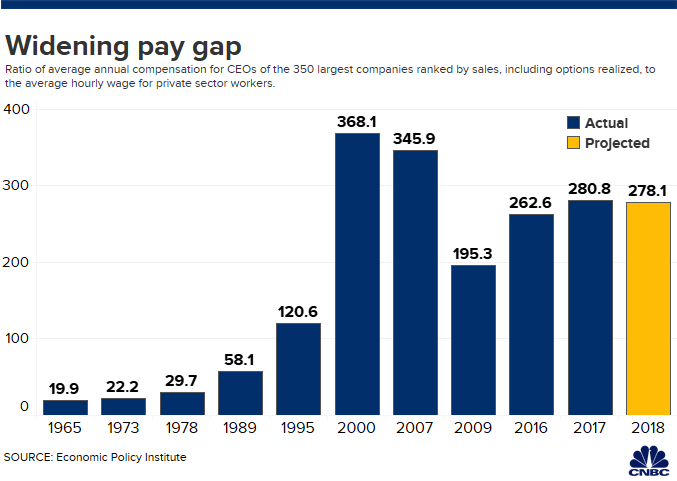
In comparative terms, CEOs now make on average 278 times the average worker’s salary, using the options-exercised formula.
That’s up from 58 times in 1989 and 20 times in 1965, according to the institute’s figures though, it is down from the 2000 peak of 368 to 1.
The total compensation growth since 1978 has outstripped that of the stock market growth of 706.7% and the wages of “very high earners,” which have grown 339.2%.
Mishel and Wolfe propose a variety of policy remedies:
- Higher taxes for top earners
- Taxing companies more that have greater compensation disparities
- A “luxury tax” that would impose a $1 levy for every dollar companies go over a certain ratio cap
- Corporate governance reforms that would give shareholders a greater say over wages.
Three of the proposed “reforms” involve higher taxes, but:
- Raising taxes takes dollars out of the private sector (aka, the economy, and therefore is recessive.
- We already have an ostensibly recessive tax system that the rich have no difficulty avoiding, as Donald Trump et al. demonstrate.
- Taxing companies makes the tacit assumption that reducing corporate pay solves the fundamental problem of the Gap between the rich and the rest.
The “corporate governance reforms falsely assume shareholders have both the knowledge and the ability to set wages properly.
“We need to enact policy solutions that would both reduce incentives for CEOs to extract economic concessions and limit their ability to do so,” the EPI team wrote.
It is questionable that reducing CEO incentives to receive higher pay would be productive, desirable, or possible.
Measures to control their pay, though, would face opposition on the grounds that they are arbitrary and don’t take into account the value that strong CEOs add to their companies compared with other workers.
Carol Roth, CEO of Intercap Merchant Partners, a business advisory firm, said, “I don’t understand why there is any comparison between what a CEO makes and a quote unquote average worker makes.”
Roth also said the numbers are skewed by a few CEOs who earn huge compensation packages, and added that taking pay from CEOs and redistributing it to thousands of workers wouldn’t make a difference to the workers anyway.
“The CEO is not getting paid at the expense of workers,” Roth said. “The workers are making what they make because that’s the market rate.
If the CEO didn’t get paid that much, it’s not that the workers would get paid more. That money would go somewhere else.”
Wrong solutions come from wrong questions. The question is not, “How do we get corporations to pay CEOs less compared to other workers?” The question is: “How do we narrow the income/wealth/power Gap between the rich and the rest?”
The Gap can be narrowed in two ways: Cut the income/wealth/power of the rich and/or raise the income/wealth/power of the rest.
Of the two, the latter is preferable because it would meet with somewhat less resistance and avoidance by the rich, and more importantly, it is pro-economic growth.
The ability of the rich to avoid progressive taxation should be ample proof of their strength in preventing income from being taken from them. But we already raise the rest’s income/wealth/power; we merely must do more of it and target it better.
Solutions to the Gap begin with the acknowledgment of just two facts:
1. The federal government has infinite dollars. It neither needs nor uses tax dollars:
Former Federal Reserve Chairman Alan Greenspan: “A government cannot become insolvent with respect to obligations in its own currency.”
Former Federal Reserve Chairman Ben Bernanke: “The U.S. government has a technology, called a printing press (or, today, its electronic equivalent), that allows it to produce as many U.S. dollars as it wishes at essentially no cost.”
Quote from former Fed Chairman Ben Bernanke when he was on 60 Minutes:
Scott Pelley: “Is that tax money that the Fed is spending?”
Ben Bernanke: “It’s not tax money… We simply use the computer to mark up the size of the account.”
Statement from the St. Louis Fed: “As the sole manufacturer of dollars, whose debt is denominated in dollars, the U.S. government can never become insolvent, i.e., unable to pay its bills. In this sense, the government is not dependent on credit markets to remain operational.”
2. Inflations are caused by shortages, not by federal spending.

Inflations can be cured by additional federal spending to eliminate shortages of crucial goods and services, most often energy and food shortages.
Today’s inflation is caused by shortages of oil, food, computer chips, construction materials, and labor. Federal spending to cure those shortages would eliminate the inflation.
A few federal solutions to the widened Gap are:
- Eliminate payroll (FICA) taxes. They are America’s most regressive (i.e., Gap-widening) taxes.
- Eliminate income taxes. The rich have found loopholes that turn progressive tax rates into regressive taxes.
- Pay each state per-capita financial support to reduce the need for regressive sales taxes.
- Provide free, no-deductible, comprehensive Medicare for every man, woman, and child in America.
- Pay Social Security to every man, woman, and child of all ages.
- Provide housing supplements to every renter and homeowner
- Provide free college tuition for all who want it
- Pay salaries to all who attend high schools and colleges
- Support federally funded public transportation
- Provide free life insurance for everyone who wants it.
The Gap should be viewed as a percentage difference, not a dollar difference. Example: Give a poor man $10,000, and it can change his life; give a rich man $10,000, and he wouldn’t even notice it.
Thus, federally funded benefits should be paid equally to all recipients regardless of current wealth or income. That would eliminate the complexity of our current tax code, which provides the rich with Gap-widening loopholes.
SUMMARY
The single biggest problem in economics is: How to narrow the Gaps between the rich and the rest.
Wide Gaps negatively affect poverty, health and longevity, education, housing, law and crime, war, leadership, ownership, bigotry, supply and demand, taxation, GDP, international relations, scientific advancement, the environment, human motivation and well-being, and virtually every other issue in economics.
The Gaps can be narrowed by taking from the richer or by giving to the poorer. The latter approach is preferable because it will suffer less resistance from the rich and grow the economy.
Some methods for narrowing the Gaps are:
- Eliminate payroll (FICA) taxes. They are America’s most regressive (i.e., Gap-widening) taxes.
- Eliminate income taxes. The rich have found loopholes that turn progressive tax rates into regressive taxes.
- Pay each state per-capita financial support to reduce the need for regressive sales taxes.
- Provide free, no-deductible, comprehensive Medicare for every man, woman, and child in America.
- Pay Social Security to every man, woman, and child of all ages.
- Provide housing supplements to every renter and homeowner
- Provide free college tuition for all who want it
- Pay salaries to all who attend high schools and colleges
- Support federally funded public transportation
- Provide free life insurance for everyone who wants it.
The federal government has infinite dollars that can be used for Gap-narrowing. Shortages of crucial goods and services, not federal spending, cause inflations. These shortages can be cured, and Gaps can be narrowed, by targeted federal expenditures.
Rodger Malcolm Mitchell
Monetary Sovereignty
Twitter: @rodgermitchell Search #monetarysovereignty
Facebook: Rodger Malcolm Mitchell


 #Monetary Sovereignty - Mitchell