Ignorance or Lies? The single worst economic scare-mongering bullshit ever encountered.

J.D. Tuccille, the Libertarians, and surprisingly, the highly respected University of Pennsylvania’s Penn Wharton School may have set a world record for utter nonsense and wrongheaded scaremongering Moving on from the “ticking debt time bomb” that never explodes, we have arrived at “20 Years to Disaster.” Don’t you love predictions of 20 years? They are so safe. You can’t be proved wrong. Twenty 20 years from now, the world will have changed many times, and anyway, no one will remember what you said. Aside from the idiocy of making a 20-year economic prediction, the entire premise of the article is wrong.

20 Years to Disaster The United States has about 20 years for corrective action after which no amount of future tax increases or spending cuts could avoid the government defaulting on its debt.” J.D. TUCCILLE | 11.6.2023 7:00 AM

For decades, budgetary experts have warned that the U.S. federal government is backing itself—and the country—into a corner with expenditures that consistently exceed revenues, driving the national debt ever higher.

What Tuccille, the Libertarians, and the Wharton School seem not to understand is that federal deficits are absolutely necessary for economic growth. You have seen this graph many times: GRAPH I
Federal “Deficits” (red) and Gross Domestic Product (blue) rise in parallel.
And this graph: GRAPH II.
Before every recession (vertical gray bars), federal deficits (blue) decline. Then, to cure the recession, the government increases federal deficit spending.

The latest red flag is raised by the University of Pennsylvania’s Penn Wharton Budget Model (PWBM), which says that the federal government has no more than 20 years to mend its ways. After this time, it will be too late to remedy the situation.

Every time the federal government “controls” (i.e. cuts) spending, we have recessions if we are lucky and depressions if we are not as fortunate:

U.S. depressions come on the heels of federal surpluses.

1804-1812: U. S. Federal Debt reduced 48%. Depression began 1807. 1817-1821: U. S. Federal Debt reduced 29%. Depression began 1819. 1823-1836: U. S. Federal Debt reduced 99%. Depression began 1837. 1852-1857: U. S. Federal Debt reduced 59%. Depression began 1857. 1867-1873: U. S. Federal Debt reduced 27%. Depression began 1873. 1880-1893: U. S. Federal Debt reduced 57%. Depression began 1893. 1920-1930: U. S. Federal Debt reduced 36%. Depression began 1929. 1997-2001: U. S. Federal Debt reduced 15%. Recession began 2001.

Having learned nothing from history, Tucille, the Libertarians, and Wharton continue the same old ignorance about federal deficit spending: They equate personal finances with our Monetarily Sovereign government’s finances, not recognizing the massive differences between the two. While monetarily, non-sovereign entities like you and me need to run balanced budgets over the long term, or we’ll face bankruptcy, the federal government must never run a balanced budget and never will face bankruptcy.

20 Years to Control Spending

“Under current policy, the United States has about 20 years for corrective action after which no amount of future tax increases or spending cuts could avoid the government defaulting on its debt whether explicitly or implicitly (i.e., debt monetization producing significant inflation)” Jagadeesh Gokhale and Kent Smetters, authors of the October 6 Penn Wharton Budget Model brief, write in summarizing their findings.

“Unlike technical defaults where payments are merely delayed, this default would be much larger and reverberate across the U.S. and world economies.”

To say that the above is 100% bullshit would be to insult bullshit. Here’s why:
    1. The federal government, being Monetarily Sovereign, has the infinite ability to create its sovereign currency, the U.S. dollar. It has infinite dollars with which to pay its bills. It never needs to default.
    2. Despite concerns about “debt monetization” (aka “money printing’) causing inflation, this never has happened to any nation in world history. All inflations have been caused by shortages of crucial goods and services, most often oil and food.
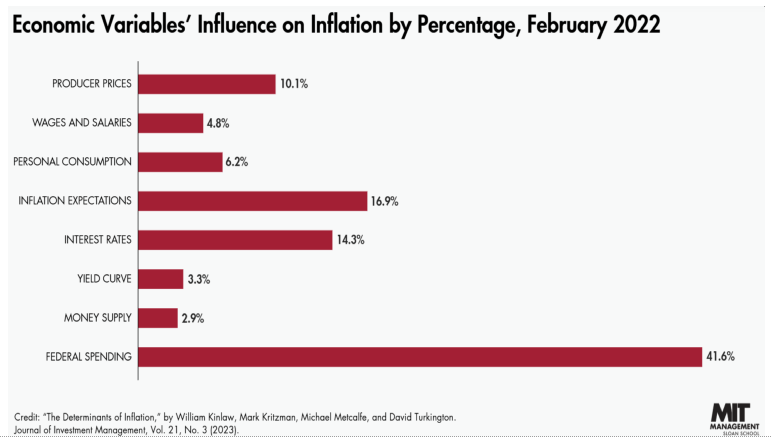
    3. Many years of massive U.S. federal deficits didn’t cause today’s inflation. Only when COVID caused shortages of oil, food, computer parts, shipping, metals, lumber, labor, etc., did inflation arise. Now, the government’s massive spending to prevent and cure recession continues while inflation ebbs. The massive federal spending has helped cure the shortages and thus cure the inflation.

The reason for worrying about accumulating deficits and the resulting growing debt, the authors explain, is that “government debt reduces economic activity by crowding out private capital formation and by requiring future tax increases or spending cuts to accommodate future interest payments.”

1. The historical fact that increasing government deficit spending increases economic activity (See Graph I, above) seems lost on the Wharton authors. Mathematically, GDP = Federal Spending + Nonfederal Spending + Net Exports 2. There is no historical example of “crowding out of capital formation.” In fact, the federal money added to the economy increases the funds available to the private sector for capital formation. 3. Future tax increases are not necessary because federal taxes do not fund federal spending:

A. All federal tax dollars are destroyed upon receipt by the U.S. Treasury. The tax dollars come from the M2 money supply measure, but when they reach the Treasury, they become part of no money supply measure. The reason: The Treasury’s money supply, being infinite, cannot be measured.

B. Even if the federal government collected zero tax dollars, it could continue spending forever. It has the infinite ability to create spending dollars.

C. The purposes of federal taxes are not to fund federal spending but rather:

a. To control the economy by taxing what the government wishes to discourage and giving tax breaks to what the government wishes to reward.

b. To assure demand for and acceptance of the U.S. dollar by requiring taxes to be paid in dollars.

c. To fool the public (and presumably Wharton economists) into believing federal benefits require federal taxes. (This last purpose is promulgated by the rich to discourage the populace from demanding benefits that would narrow the Gap between the rich and the rest.)

If debt gets too big, lenders can’t be paid back, credibility is shot, the dollar loses value, and the economy tanks.

This is the oft-claimed “ticking time bomb” that never seems to explode. There never has been and never will be a time when the federal debt “gets too big” to be paid. Again, the Wharton economists demonstrate they don’t understand the differences between a Monetarily Sovereign government and a monetarily non-sovereign government.

Alan Greenspan: “A government cannot become insolvent with respect to obligations in its own currency. There is nothing to prevent the federal government from creating as much money as it wants and paying it to somebody. The United States can pay any debt it has because we can always print the money to do that.”

Ben Bernanke: “The U.S. government has a technology, called a printing press (or, today, its electronic equivalent), that allows it to produce as many U.S. dollars as it wishes at essentially no cost. Scott Pelley: Is that tax money that the Fed is spending? Ben Bernanke: It’s not tax money… We simply use the computer to mark up the size of the account.

Statement from the St. Louis Fed: “As the sole manufacturer of dollars, whose debt is denominated in dollars, the U.S. government can never become insolvent, i.e., unable to pay its bills. In this sense, the government is not dependent on credit markets to remain operational.”

“It would be an unfettered economic catastrophe,” economists Joseph Brusuelas and Tuan Nguyen predicted earlier this year of such a scenario. “Our model indicates that unemployment would surge above 12% in the first six months, the economy would contract by more than 10%, triggering a deep and lasting recession, and inflation would soar toward 11% over the next year.”

Strange how history says exactly the opposite. Following many years of massive federal spending, unemployment was at historical lows. The reason: Federal spending stimulated GDP growth, which required more labor.

So long as investors believe federal officials will eventually balance their books, you have a grace period as debt grows—that is until the debt burden is so enormous that it crushes economic activity.

History shows that balancing the federal books creates recessions and depressions. The so-called “debt burden” is not debt, and it’s not a burden. It’s deposits into Treasury security bills, notes, and bond accounts which are owned by the depositors. It’s not debt because the government never touches the dollars in those accounts. The government creates dollars at will. It has no need to borrow dollars, and indeed, the U.S. federal government never borrows dollars. To “pay off” the debt (that isn’t debt), the government merely returns the dollars in the accounts to their owners. This is no burden at all. The purpose of T-securities is not to provide spending money to the government but rather to give the world with a safe, interest-paying place to store unused dollars. This makes the dollar an attractive international medium of exchange.

“Even with the most favorable of assumptions for the United States, PWBM estimates that a maximum debt-GDP ratio of 200 percent can be sustained,” the authors add. “This 200 percent value is computed as an outer bound using various favorable assumptions: a more plausible value is closer to 175 percent, and, even then, it assumes that financial markets believe that the government will eventually implement an efficient closure rule.” (That’s a mix of tax and spending changes to curtail deficits and debt.)

As we have demonstrated numerous times, the Debt/GDP ratio is meaningless. It tells nothing about the current or future health of an economy. It predicts nothing; it evaluates nothing. It is 100% meaningless. That is why economists who don’t understand the fundamentals of Monetary Sovereignty love to quote it.

The 20-year countdown assumes that investors remain optimistic about the willingness and ability of U.S. officials to bring spending in-line with tax revenues. “Once financial markets believe otherwise, financial markets can unravel at smaller debt-GDP ratios,” according to the PWBM analysis.

We suspect financial markets understand history better than the economists at Wharton. We suspect they know that when the federal government spends more, stock prices rise.
As federal deficit spending has increased, the value of corporate stock has risen.

As PWBM points out, “Financial markets demand a higher interest rate to purchase government debt as the supply of that debt increases… Forward-looking financial markets should demand an even higher return if they see debt increasing well into the future. Those higher borrowing rates, in turn, make debt grow even faster.”

That’s already happening.

Increasing Costs and a Looming Deadline To finance trillions of dollars in spending beyond what incoming revenue can support, the US Treasury is now issuing more debt in the form of Treasury securities than global financial markets can readily absorb,” Yahoo! Finance’s Rick Newman wrote on October 30.

“That forces the borrower—the US government—to pay higher interest rates, which in turn pushes up borrowing costs for consumers and businesses in much of the Western world.”

Again, the Wharton experts misunderstand Monetary Sovereignty and the realities of federal financing. The federal government does not finance spending by borrowing (“issuing debt.”) It finances spending by creating dollars, ad hoc. It can allow as much or as little in T-security deposits as it wishes. If the public fails to invest as much as the Federal Reserve wishes (to stabilize the dollar), the Fed merely uses its infinite money creation ability to fill the gap. Federal spending never is constrained by the public’s desire to own T-securities. As for interest rates, the Fed sets them not to attract depositors but to control inflation. If the Fed smells inflation, it raises rates. If the inflation scare passes, the Fed lowers rates. This has nothing to do with any need for deposits into T-security accounts. (Sadly, raising interest rates, far from moderating inflation, exacerbates it by raising prices. The only thing that moderates inflation is federal spending to ease shortages of critical goods and services.)

Just when the U.S. federal government hits that magic unsustainable debt-to-GDP ratio of between 175 and 200 percent depends on investor confidence and how much the markets charge to finance more borrowing. PWBM estimates it will happen between 2040 and 2045—if we’re lucky.

The notion of a “magic, unsustainable debt-to-GDP ratio” is utter nonsense. Japan already has exceeded that meaningless ratio.

The U.S. Treasury concedes that “since 2001, the federal government’s budget has run a deficit each year. Starting in 2016, increases in spending on Social Security, health care, and interest on federal debt have outpaced the growth of federal revenue.”

The 2001 Clinton surplus caused the 2001 recession.  See Graph I.

Options for Fixing the Mess In September, PWBM explored three policy options to render fiscal policy less disastrous: increasing taxes on high incomes, reforms to Social Security and Medicare that reduce payouts and increase taxes, and a mix of tax increases and spending cuts.

Increasing taxes on high incomes would help narrow the Gap between the rich and the rest, which would be a good thing. It would do nothing to improve the federal government’s already infinite ability to pay its creditors. “Reforms” to Social Security and Medicare (i.e. cuts to benefits paid to those who need them most, while increasing taxes on those who can afford them least) also would do nothing to improve the federal government’s bill-paying ability. The “mix of tax increases and spending cuts” would take spending dollars from the private sector and cause a recession or depression.  Remember this equation: GDP = Federal + Nonfederal Spending + Net Exports. Spending cuts and tax increases would decrease Federal + Nonfederal Spending, which would reduce GDP, i.e. cause a recession or depression. Simple mathematics.

The authors predict entitlement reforms and a mix of tax increases and spending cuts would both stabilize the debt-to-GDP ratio, with entitlement reform allowing the greatest economic growth.

Hmmm. Giving the economy fewer Social Security and Medicare dollars and taking dollars from the economy by increasing taxes would “allow the greatest economic growth”???? Also, pouring water out of a bucket fills it??

The St. Louis Federal Reserve Bank has tax revenues hitting 19 percent of GDP last year—the highest share in two decades. The IRS may scream about a “tax gap” between what is owed and what it collects, and lawmakers may supercharge the tax agency with funds, but fixing the federal government’s spendthrift ways by squeezing taxpayers won’t just be unpopular—it’s a scheme that defies historical trends.

Spending cuts and entitlement reforms will also elicit resistance. But at least they’re within reach of lawmakers who could spend no more than they collect—or even to run surpluses to pay down debt.

Twenty years to fix the federal budget should be plenty of time. But brace yourself. The record so far suggests it won’t be enough.

The above is so staggeringly ignorant one scarcely can believe it was written by humans. Indeed, it must have been written by an Artificial Intelligence gone rogue. Cuts to federal spending and tax increases do the same: They take dollars out of the economy and cause recessions and depressions. The Libertarian (aka anarchist) comments are not surprising. Anti-government ignorance is expected from them. But, if this is the best to come out of Wharton, heaven help its students. Rodger Malcolm Mitchell Monetary Sovereignty Twitter: @rodgermitchell Search #monetarysovereignty Facebook: Rodger Malcolm Mitchell

……………………………………………………………………..

The Sole Purpose of Government Is to Improve and Protect the Lives of the People.

MONETARY SOVEREIGNTY

An Email I received about the Gaza/Israel war. What is the plan for Hamas?

I just received an Email that reminded me of a question I wanted to ask the pro-Palestinian protestors — those people who exhibit their love of men, women, and children by chanting, “Kill the Jews.”

The question is: What is your plan for Hamas?

Somehow, I never hear a plan that doesn’t involve destroying Israel. Call it the “Hitler redux plan.”

The truth is the Gazan’s wretched existence is not caused by Israel. It’s caused by Gaza’s leaders and their Arab neighbors (who want nothing to do with Gaza.)

There is no reason why Gaza must be poor and dilapidated. Billions of dollars have flowed into Gaza, but Gaza’s leaders, being focused on Israel’s destruction and their own power, steal all the money for two things:

  1. Military construction: Weapons and attack tunnels
  2. Personal enrichment.

The money that was supposed to be used for food, fuel, housing, and schools has been coopted by Hamas and its predecessors to be used in a never-ending effort to destroy Israel.

No secret about it. That is their stated goal.

Then, when Israel fights back, the world whines that too many Gazans are being killed.

Never mind that the Palestinian leaders build attack tunnels under hospitals, schools, homes, and buildings. 

Israel is expected to ignore those hiding places until they become staging areas for attacks on Israeli citizens. Israel also is expected to filter out the Gazan military and the Gazan non-military (who intentionally are dressed identically) and to kill only the army (hiding behind the non-military).

There is no reason why Gaza could not be wealthy. It receives billions in support, not only from the US but many other nations. 

Gaza has a 24-mile oceanfront on the Mediterranean Sea. That could have been a valuable tourist resource.

This is just one of Gaza’s beaches. Why is it empty?

It has 139 square miles, which is more than Vatican City: 0.171 square miles, Monaco: 0.781, Nauru: 8.1, Tuvalu: 11.6, San Marino: 24, Liechtenstein: 62, Marshall Islands: 70, Saint Kitts and Nevis: 104, Maldives: 115, Malta: 122, and
Grenada: 133, none of which are as impoverished as the people of Gaza.

If the excuse for their poverty is population density, the population density of the Gaza Strip is approximately 6,100 people per km².

That is dense, but not as thick as, Macau SAR, China: 21,000 people per km², Monaco: 18,000 people per km². Singapore: 8,250 people per km². Hong Kong SAR, China: 6,725 people per km², all of which have figured out how not to let population density force poverty.

Again, Gaza’s problems are not due to Israel or Israel’s West Bank settlements. In fact, many Gazans have jobs in Israel and use Israel’s hospitals and other facilities. 

Who would have thought that after almost 20 years have passed since Israel left Gaza, the people would be worse off than they were then and trending down? 

Gaza’s problems are due to its leaders’ focus on Israel’s destruction and their own power rather than on improving the lives of its people. This war has absolutely nothing to do with making better lives for the people of Gaza. It strictly is to increase the power of Hamas.

Gaza has received many millions of dollars to rebuild its homes, schools, hospitals, and buildings, and all those dollars were used for tunnels and weapons. None for homes.

You can be sure that after the current war, Gaza will receive many millions more. Expect those dollars to be used for re-armament and not to help the people.

Note: I am Jewish, and I admit to a natural bias based on 2,000+ years of being blamed for the world’s ills. Yet I sympathize with the plight of the Palestinian people who are being told the same old lies:

  1. That Jews are the cause of their misery.
  2. And the only solution is what Hitler called “the final solution,” the elimination of the Jewish people.

I feel confident that if Gazans were not brainwashed with hatred and instead wanted to form a mutually beneficial alliance with Israel, their lives would improve immensely. Long haul, that really is the only “final solution.”

Here is the Email I received:

I am an assistant professor at Columbia Business School.  I am a father, a husband, an uncle, and a son.  I am a forty-year-old man, and last week I found myself crying in front of a group of complete strangers.

In a video that has since gone viral, I stood on Columbia University’s main campus and pleaded with my employer to protect me and help me protect the thousands of Jewish students whose lives and safety have been entrusted to us by worried parents all across the United States.

I pleaded with my employer to help me protect the lives of thousands of Jewish students from pro-terror student organizations who openly laud Hamas—an internationally recognized terrorist organization.

I pleaded with the presidents of colleges and universities all around the country to take a clear moral stance against rape and torture and the kidnapping of helpless civilians.

I pleaded with colleges and universities to live up to their stated mission of humanism and enlightenment.  I pleaded—and still plead—because the silence of college presidents all across the country is deafening.

I am not tenured.  I could be fired for this. But if my research into behavioral psychology has taught me anything, it’s that looking back on my life, I am more likely to regret not taking a stance.

I can’t afford not to take a stance. Not when students’ lives are on the line. Not when my children’s lives are on the line. My children may be American citizens, but, through their mother and me, they are Israelis, too. And because they are Israelis, because they are Jews, I fear for them.

I fear for my two-year-old daughter, who’s funny and brave and thinks everyone in the world is her friend. I fear for my seven-year-old son, who still asks me to sit next to his bed for a few minutes every night when I tuck him into bed. I fear, because there are student organizations on my own campus who see my beautiful children as legitimate targets.

I fear, because the president of my university—my very own employer—refuses to speak up against such senseless violence and hatred. Let’s call this what it is.

This is cowardice.

I see my son’s and daughter’s faces in the faces of the hundreds of innocent children and teenagers who were murdered, tortured, raped, brutalized, and kidnapped on October 7th. For Hamas and its supporters, those children are acceptable targets. 

And right now, in colleges and universities all across the country, there are hundreds of pro-terror student organizations that are celebrating these vile crimes against humanity.

This is what the President of Columbia is refusing to condemn.  This is what the President of Harvard is refusing to condemn.  This is what the Presidents of Yale and NYU and UC Berkeley and many other “enlightened” institutions throughout the country are refusing to condemn.

They would never allow student organizations to celebrate the senseless loss of life in the horrific attacks of 9/11. They would never allow student organizations to celebrate the horrific murder of George Floyd. They would never allow student organizations to celebrate the mass shooting of more than 100 LGBTQ+ people in an Orlando nightclub on June 12, 2016.

And yet, when it comes to Jewish lives—when it comes to my own children’s lives—they could care less.

Let me be as clear as I can: This is not about being pro-Israel or pro-Palestine.  This is about making a clear distinction between legitimate resistance and unspeakable crimes against humanity. This is about human decency.

You can support the rights of millions of innocent Palestinians and still take a moral stance against heinous violence and brutality. I know, because I do.

You can spend your adult life advocating for the establishment of a prosperous Palestinian state next to a prosperous Israeli state and still be willing to draw the line at rape. I know, because I do.

You can be a lefty and a softy who can’t fathom why we can’t just end this senseless cycle of violence yet still shout at the top of your lungs that shooting babies in their cribs and burning their corpses is just plain evil. I know, because I am and I do.

You can be pro-Israel and pro-Palestine and anti-terror. I know, because I am.

Parents from all across the country have reached out to me in the past week asking if their kids are safe. Thousands of worried parents who have been losing sleep as they see their children’s campuses rampaged by extremist organizations that openly celebrate and encourage terrorism.

Thousands of moms and dads who only want to make sure that their children are protected from harm. To all those parents, I reply: No.  Your children are not safe.

Because, as a professor, I can tell you that universities across the country would rather appease pro-terror campus coalitions than care for their Jewish students. Because, as a professor, I can tell you that the presidents of universities all across the U.S. are more concerned with getting bad press than with getting your children home safely.

What sort of education is your child getting at a place that refuses to condemn terror-sympathizing organizations and allows them to roam freely on campus? What sort of education is your child getting at a place that gives a platform and a mix to organizations that celebrate the execution of infants in their cribs? 

The raping of teenagers? The kidnapping of toddlers? The moral and intellectual bankruptcy of universities throughout the country is now undeniable. 

But I know that if we all work together we can make a real difference. This is not about me.  I’m not some leader.  I’m just a dad who is scared and who is willing to put EVERYTHING on the line to protect his children.

Many of you have reached out in the past days, and your messages have brought me immense light into a very dark time. I am so extremely inspired by the stories people have been sending me.

People are telling me about the committees they’ve formed and the PTAs they’ve joined and the politicians they’ve called and TV and radio shows to which they have called-in, demanding that their voice be heard.

People have written to me about stopping their annual donations to their alma mater until it takes a clear stance against pure evil.  Until it takes a clear stance against those who celebrate pure evil.

If you want to get in touch and let me know about all that you have, are, and will be doing at your job, school, alma mater, neighborhood, and so forth, please email me at: shaidavidai2023@gmail.com (mailto:shaidavidai2023@gmail.com)

One more thing — If you have read thus far, I imagine that it must be because you are someone who cares deeply about this. 

So I have a small request: If every person who read thus far personally sent this to at least 10 of their friends RIGHT NOW and asked those friends to send this to 10 of their friends, I know that we will be able to make a big difference in the world.  I truly do. (and if I’m wrong well, hey at least we will all know that in this time of crisis we did everything that we could).

I know it’s weird, but can I please ask you to email this to all your friends and post it on all your social media profiles? I really just want the message to get through.

Thank you! 

Whatever money can buy, the federal government can do

Whatever money can buy, the U.S. federal government can do. There is no financial problem the federal government cannot solve, and solve without collecting taxes. Read this short article from the Kaiser Family Foundation:

Annual Family Premiums for Employer Coverage Rise 7% to Nearly $24,000 in 2023

Amid rising inflation, annual family premiums for employer-sponsored health insurance climbed 7% on average this year to reach $23,968, a sharp departure from virtually no growth in premiums last year, the 2023 benchmark KFF Employer Health Benefits Survey finds. On average, workers this year contribute $6,575 annually toward the cost of family premium, up nearly $500 from 2022, with employers paying the rest.
Future increases may be on the horizon, as nearly a quarter (23%) of employers say they will increase workers’ contributions in the next two years.
The reality is that workers already pay the full $23,968. When employers hire, they figure the overall cost of each worker (including perks) into their payroll decisions. If employers didn’t have the healthcare expense, they would increase wages as a competitive move. That is how wages are determined. Think of it: Healthcare insurance costs the average worker $24,000 annually, about $2,000 monthly. And it could be free. A more complete version of the study can be found here.  Here are a few excerpts from the study:

Average annual health insurance premiums in 2023 are $8,435 for single coverage and $23,968 for family coverage. These average premiums each increased 7% in 2023. The average family premium has increased 22% since 2018 and 47% since 2013.

And it could be free. Figure 1.1: Average Annual Premiums for Covered Workers, Single and Family Coverage, by Plan Type, 2023 And it could be free. Figure 1.4: Average Monthly and Annual Premiums for Covered Workers, by Plan Type and Region, 2023 And it could be free. Not all insurance is the same. Coverages differ. Generally, better coverages cost more. The more costly coverages have fewer and lower deductibles and cover more medical needs. Figure 1.11: Distribution of Annual Premiums for Covered Workers With Family Coverage, 2023 Presumably, those $34,000 plans cover everything you can imagine and possibly some things you can’t imagine. Dental? Certainly. Health clubs and spas? Cosmetic? Travel for health? Weight loss? Hair transplants? Emotional support animals? You can buy a great deal of health for $34,000+. But it all could be free. Workers mistakenly believe that when the company pays, they don’t. But those dollars, whether down at the $14K level or more than the $34K+ level, are part of each company’s cost considerations when deciding how much to pay. But it all really could be free if the federal government paid for comprehensive, no-deductible Medicare for every man, woman, and child in America. Three reasons. Because the federal government uniquely is Monetarily Sovereign:

1. The federal government cannot run short of dollars. It creates all the dollars it uses simply by pressing computer keys.

(Alan Greenspan: “There is nothing to prevent the federal government from creating as much money as it wants and paying it to somebody.”)

2. Your federal taxes do not fund federal spending.

(Quote from former Fed Chairman Ben Bernanke when he was on 60 Minutes: Scott Pelley: Is that tax money that the Fed is spending? Ben Bernanke: It’s not tax money… We simply use the computer to mark up the size of the account.)

3. Similarly, the federal government never borrows dollars. Accepting dollars for T-bills, T-notes, and T-bonds does not constitute borrowing. The government never uses those dollars. Upon maturity of the T-securities, the government simply returns the dollars in each account to the account owner.

The purpose of T-securities is not to provide spending funds to the federal government. The purpose is to create a safe storage place for unused dollars. This stabilizes and creates demand for the U.S. dollar.

Federal bills, notes and bonds are nothing like state/local government bonds, which are borrowing. State and local governments borrow because they are not Monetarily Sovereign. That is why you, too borrow.

4. Federal spending grows the economy as do federal deficits. 

(GDP = Federal Spending + Non-federal Spending + Net Exports)

There is not a single good reason — not one — why the federal government does not pay for America’s health care. But there is a bad reason: The rich are rich, not because of how much they have, but because of how much MORE they have than what the rest of us have. “Rich” and “poor” are not absolutes. They are comparatives. You would be rich if you owned $10,000 and everyone else owned only $1,000. You would be poor if everyone else had $100,000. The two ways to become richer are to get more for yourself, and/or to make everyone else get less. The rich, who run America, have chosen both routes. They pass laws that give them more and give you less. To keep you from objecting they indoctrinate you with lies.

They tell you the federal government can’t afford to provide comprehensive, no deductible Medicare for everyone. A lie. The federal government cannot run short of dollars. It can afford anything.

They tell you your federal benefits must be paid for by your taxes. A lie. Federal spending is not funded by taxes. Tax dollars are destroyed when they reach the U.S. Treasury.

They tell you inflation is caused by federal deficit spending. A lie. All inflations are caused by shortages of goods and services (oil, food, metals, lumber, computer parts, labor, etc.). The cure for inflations is more, not less, federal spending to increase the availability of scarce goods and services.

They tell you that the federal budget should be balanced. A lie. Deficit reduction always leads to recessions and depressions.

The lies are so devious, that one political party has devoted itself almost exclusively to reducing your federal benefits. They have tried for many years to eliminate ACA (“Obamacare”), Medicare, SNAP (food stamps) school lunch programs, and all other benefits received by the poor. Both parties created fake “trust funds” for Medicare and Social Security and claim falsely these “trust funds” are running short of money (so you’ll believe benefits must be cut and taxes increased). The GOP (the party of the rich) wants to cut funding of the IRS, solely to allow the rich to cheat on their taxes. (The middle classes have taxes deducted from their salaries with scant chances to cheat.) Tax laws are designed by the rich to reduce tax rates on the types of compensation most enjoyed by the rich (long term capital gains, real estate “losses,” trusts, etc.) It’s how a billionaire like Donald Trump pays far less income tax than you do. WHAT IS THE SOLUTION? EDUCATE YOURSELF 1. Understand that the federal government, being Monetarily Sovereign never can run short of America’s sovereign currency, the U.S. dollar. It neither needs, nor even uses, tax dollars. It destroys all the tax dollars it receives and creates new dollars to pay every bill. 2. Understand that the federal government is run by the rich. The federal politicians have but two goals: Receiving campaign money and being elected. Nothing is done for “good” reasons; everything is done for political reasons. 3. You are not important to them as a person. They want your vote and your money. Period. To attain their goals, the rich bribe politicians, media, and economists to mislead you. 4. The rich and their lackeys, the politicians, do not want you to understand federal finances. They want you to believe the federal government’s finances are like yours or your state’s. They claim poverty for a government that has infinite money. The goal of the rich is to widen the income/wealth /power Gap between them and you. That is the only reason they want to cut Medicare, Social Security and other benefits. The wider the Gap, the richer they are. The so-called Social Security and Medicare “trust funds” are fakes. They do not fund anything. They aren’t even trust funds. They merely are balance sheet notations. SS and Medicare are funded by the federal government, not by FICA, the same way that Congress, the White House, the Supreme Court and all the military branches are funded: By federal money creation. 5. GDP = Federal Spending + Non-federal Spending + Net Exports. Mathematically, the more the federal government spends, the more the economy grows. The economy cannot grow when the federal government fails to run deficits. The bigger the deficits, the more the economy grows. When deficits fail to grow significantly, we have recessions. Recessions can be avoided if the federal government continually were to run increasing deficits.
See how when federal deficits (red line) decline, we have recessions (vertical gray bars), which are cured by increased deficits. This pattern has occurred 9 times since 1960.
6. Federal spending does not cause inflation. All inflations are caused by shortages. The current inflation was caused by COVID shortages of oil, food, lumber, metals, computer chips, shipping, labor, etc. Even the inflation of WWII was not caused by federal spending. It was caused by the difficulty of importing oil and other goods (those German U-boats) and labor shortages (the men were off to war.) “Too much money” never is an inflationary issue. The issue always is “too few goods.” 7. Unless you’re rich, vote for the politicians who will:

A. Provide free, comprehensive Medicare for All

B. Provide free Social Security for All

C. Provide free college for all

D. Eliminate federal taxes on all but the rich

E. Provide benefits including school lunch, food stamps, other poverty aids

F. Run significant deficits every year to fund science and research, air and water quality, housing, and everything else that improves the quality of your life in America.

Whatever money can buy, the federal government can do.  Rodger Malcolm Mitchell Monetary Sovereignty Twitter: @rodgermitchell Search #monetarysovereignty Facebook: Rodger Malcolm Mitchell

……………………………………………………………………..

The Sole Purpose of Government Is to Improve and Protect the Lives of the People.

MONETARY SOVEREIGNTY

The world’s shortest course in economics. Give it to someone who is telling you fake facts.

You probably don’t engage in extensive economic research. What you know about our economy mainly comes from what the media, politicians, economists and your peers tell you. Sadly, much of what they tell you is wrong. Some pundit, perhaps Mark Twain or Will Rogers, reportedly said, “It ain’t what you don’t know that gets you into trouble. It’s what you know for sure that just ain’t so.”Fact Or Fake? How To Fact-Check Online Articles - LearnSafe If you are in the majority, you know for sure the federal debt is too high, federal taxes fund federal spending, Social Security and Medicare are near insolvency, the federal government should run a balanced budget, Federal spending causes inflation, raising interest rates fights inflation, and the federal government is deeply in debt. And not one of them is true. They all “just ain’t so.” Not even close. Here is the reality: 1. Unlike state/local governments and the American people, the U.S. government is Monetarily Sovereign. In the 1780s, the government created the first U.S. dollars from thin air by passing laws, which it also created from thin air. The federal government’s infinite ability to create laws gives it the infinite ability to create its sovereign currency, the U.S. dollar. 2. The government continues to create U.S. dollars from thin air, by pressing computer keys. The government has the unique ability to create as many U.S.  dollars as it wishes.

(Ben Bernanke: “The U.S. government has a technology, called a printing press — or, today, its electronic equivalent — that allows it to produce as many U.S. dollars as it wishes at essentially no cost.”)

Thus, the federal government cannot run short of dollars unless it wishes to. Even if the federal government collected zero taxes, it could continue spending, forever. 3. The federal government never borrows dollars.

(Statement from the St. Louis Fed: “The U.S. government is not dependent on credit markets to remain operational.”)

The deposits into T-security accounts (T-bills, T-notes, T-bonds), mistakenly referred to as “debt,” neither are owned nor owed by the federal government. The deposits are owned by the depositors and never used by the federal government. Upon maturity, these deposits are returned to their owners, which is not a financial burden on the federal government. It is a simple money transfer like a transfer from your savings account to your checking account. 4. Federal taxes do not fund federal spending. Tax dollars are paid out of accounts that are part of the M1 money supply measure. When they reach the Treasury, they cease to be part of any money supply measure, thus federal tax dollars effectively are destroyed upon receipt by the Treasury. 5. The purposes of federal taxes are:

A. To control the economy by taxing what the government wishes to discourage and by giving tax breaks to what the government wishes to reward.

B. To assure demand for the U.S. dollar by requiring taxes to be paid in dollars.

C. To foster the myth that such benefits as Social Security, Medicare, poverty aids, etc. are limited by tax collections. This myth is funded and propagated by the rich to widen the income/wealth/power Gap between the rich and the rest. Widening the Gap makes the rich richer and the rest, poorer.

6. To propagate the myth of potential Federal insolvency, the rich bribe these sources of information:

A. The media are bribed via advertising dollars and ownership.

B. The politicians are bribed via campaign contributions and promises of lucrative employment after leaving office.

C. The university economists are bribed via donations to universities and promises of lucrative employment in think tanks and other enterprises.

5. State/local governments, euro nation governments, businesses, and people are monetarily non-sovereign. They can, and often do, run short of U.S. dollars. They do not have the infinite ability to create dollars. Thus, state/local taxes fund state/local spending. Equivalences between personal finances and federal finances are misleading. 6. Scarcity makes prices rise. Inflation is a general increase in prices. Federal deficit spending does not cause inflation. All inflations are caused by scarcities of crucial goods and services, most often energy and food. Today’s inflation resulted from COVID-caused scarcities of oil, food, shipping, computer chips, labor, metals, lumber, and other goods and services. Contrary to popular wisdom, “excessive” federal spending did not cause the scarcity of these goods and services, so is not responsible for inflation. 7. Increased federal spending cures inflations by aiding the acquisition, production, and distribution of scarce resources. 8. High interest rates have a contradictory effect on inflation. They strengthen the value of the dollar, which means fewer dollars are needed to purchase goods and services. And high rates force the federal government to pump more growth dollars into the economy. But interest is added to the costs of all goods and services, so high rates exacerbate inflation. On balance, curing scarcities, not cutting federal spending, or raising interest rates, cures inflations. Rodger Malcolm Mitchell Monetary Sovereignty Twitter: @rodgermitchell Search #monetarysovereignty Facebook: Rodger Malcolm Mitchell

……………………………………………………………………..

The Sole Purpose of Government Is to Improve and Protect the Lives of the People.

MONETARY SOVEREIGNTY