Mitigating America’s inequality problem: Progressive Voting.

The most important problems in economics involve the excessive income/wealth/power Gaps between the richer and the poorer.

Wide Gaps negatively affect poverty, health and longevity, education, housing, law and crime, war, leadership, ownership, bigotry, supply and demand, taxation, GDP, international relations, scientific advancement, the environment, human motivation and well-being, and virtually every other issue related to economics.

In attempts to solve that pervasive problem, governments and private sectors have instituted several processes, including: Socialism and communism, progressive taxation, social benefits, unions, charities, etc.Image result for rich voter, poor voter

Each is based on progressively providing money to the lower wealth/power groups.

But, the rich repeatedly evade the most restrictive elements of these plans or they reduce the progressive benefits. Either way, the Gap continues to grow.

Socialism and communism, the ultimates of progressivism, devolve to totalitarianism.

A progressive income tax inevitably becomes loaded with special exemptions for the rich.

Progressive social benefits falsely are derided as “unaffordable” and sloth-enabling. Charities help but are woefully inadequate and often too focused on narrow intent.

The reason for the failure of our most well-intentioned, Gap-narrowing efforts can be summarized in two words: “Political power.”

Because of “Gap Psychology” (the desire to widen the Gap below and to narrow the Gap above), the rich continually try to widen the Gap below them. 

Their political power stems from the money they use to bribe America’s thought-leaders — the politicians, the media, and the economists.

(The politicians are bribed via campaign contributions and promises of lucrative employment later. The media are bribed via advertising dollars and ownership. The economists are bribed via school contributions and jobs in think tanks.)

The November, 2018 edition of Scientific American Magazine contained articles about the “Inequality” (Gap) problem. Here are some excerpts.

The American Economy Is eRigged
By Joseph E. Stiglitz on November 1, 2018

Economic inequality is higher in the U.S. than in virtually all other advanced countries.
The American political system, coupled with high initial inequality, gave the moneyed enough political influence to change laws to benefit themselves, further exacerbating inequality.

Breaking this feedback loop by curbing the power of money in politics is essential to reducing inequality and restoring hope.

By most accounts, the U.S. has the highest level of economic inequality among developed countries. It has the world’s greatest per capita health expenditures yet the lowest life expectancy among comparable countries.

The notion of the American Dream—that, unlike old Europe, we are a land of opportunity—is part of our essence. Yet the numbers say otherwise. The life prospects of a young American depend more on the income and education of his or her parents than in almost any other advanced country.

Things appear to be getting worse, partly as a result of forces, such as technology and globalization, that seem beyond our control, but most disturbingly because of those within our command.

It is not the laws of nature that have led to this dire situation: it is the laws of humankind. Markets do not exist in a vacuum: they are shaped by rules and regulations, which can be designed to favor one group over another.

President Donald Trump was right in saying that the system is rigged—by those in the inherited plutocracy of which he himself is a member. And he is making it much, much worse.

The recent example is the GOP’s recent “Tax Cuts and Jobs Act (TCJA)” that is heavily skewed toward benefiting the richand widening the Gap.

Whereas the income share of the top 0.1 percent has more than quadrupled and that of the top 1 percent has almost doubled, that of the bottom 90 percent has declined.

Wages at the bottom, adjusted for inflation, are about the same as they were some 60 years ago! In fact, for those with a high school education or less, incomes have fallen over recent decades.

Even more important than income, is wealth. Income can be transitory, sometimes relevant to only a year or less. But wealth, too often, is passed from generation to generation, because our laws encourage it.

Wealth is even less equally distributed, with just three Americans having as much as the bottom 50 percent—testimony to how much money there is at the top and how little there is at the bottom.

Families in the bottom 50 percent hardly have the cash reserves to meet an emergency.

Newspapers are replete with stories of those for whom the breakdown of a car or an illness starts a downward spiral from which they never recover.

Defenders of America’s inequality refer to the workings of a competitive market, where the laws of supply and demand determine wages, prices and even interest rates—a mechanical system, much like that describing the physical universe.

Those with scarce assets or skills are amply rewarded, they argue, because of the larger contributions they make to the economy.

What they get merely represents what they have contributed. Often they take out less than they contributed, so what is left over for the rest is that much more.

This fictional narrative may at one time have assuaged the guilt of those at the top and persuaded everyone else to accept this sorry state of affairs.

Perhaps the defining moment exposing the lie was the 2008 financial crisis, when the bankers who brought the global economy to the brink of ruin with predatory lending, market manipulation and various other antisocial practices walked away with millions of dollars in bonuses just as millions of Americans lost their jobs and homes and tens of millions more worldwide suffered on their account.

Virtually none of these bankers were ever held to account for their misdeeds.

Fundamentally, the Gap problem boils down to wealth and political power. The wealthy bribe accommodating politicians to pass wealth-friendly laws.

Since the mid-1970s the rules of the economic game have been rewritten, both globally and nationally, in ways that advantage the rich and disadvantage the rest.

And they have been rewritten further in this perverse direction in the U.S. than in other developed countries—even though the rules in the U.S. were already less favorable to workers.

From this perspective, increasing inequality is a matter of choice: a consequence of our policies, laws and regulations.

Weak corporate governance laws have allowed chief executives in the U.S. to compensate themselves 361 times more than the average worker, far more than in other developed countries.

Financial liberalization—the stripping away of regulations designed to prevent the financial sector from imposing harms, such as the 2008 economic crisis, on the rest of society—has enabled the finance industry to grow in size and profitability and has increased its opportunities to exploit everyone else.

A legal provision enacted in 2003 prohibited the government from negotiating drug prices for Medicare—a gift of some $50 billion a year or more to the pharmaceutical industry. Special favors, such as extractive industries’ obtaining public resources such as oil a t below fair-market value or banks’ getting funds from the Federal Reserve at near-zero interest rates (which they relend at high interest rates), also amount to rent extraction.

Further exacerbating inequality is favorable tax treatment for the rich. In the U.S., those at the top pay a smaller fraction of their income in taxes than those who are much poorer.

Historically, the more conservative politicians of either party have favored the rich over the poor.

It’s not that conservatives are more or less honest than progressives. It’s just that the political leanings of progressives, especially at the national level, are more related to compassion for the poor. The vast majority of social programs have been promoted by progressive leaning politicians of either party.

The article concludes with suggested changes:

There is no magic bullet to remedy a problem as deep-rooted as America’s inequality.

Its origins are largely political, so it is hard to imagine meaningful change without a concerted effort to take money out of politics—through, for instance, campaign finance reform.

Blocking the revolving doors by which regulators and other government officials come from and return to the same industries they regulate and work with is also essential.

Beyond that, we need more progressive taxation and high-quality federally funded public education, including affordable access to universities for all, no ruinous loans required.

We need modern competition laws to deal with the problems posed by 21st-century market power and stronger enforcement of the laws we do have.

We need labor laws that protect workers and their rights to unionize.

We need corporate governance laws that curb exorbitant salaries bestowed on chief executives, and we need stronger financial regulations that will prevent banks from engaging in the exploitative practices that have become their hallmark.

We need better enforcement of antidiscrimination laws: it is unconscionable that women and minorities get paid a mere fraction of what their white male counterparts receive.

We also need more sensible inheritance laws that will reduce the intergenerational transmission of advantage and disadvantage.

We need to strengthen and reform retirement programs, which have put an increasing burden of risk management on workers.

Our mortgage system was our Achilles’ heel, and we have not really fixed it. With such a large fraction of Americans living in cities, we have to have urban housing policies that ensure affordable housing

We need to guarantee access to health care.

All of the above suggestions refer to laws, but the wealthy pay to elect representatives who vote to widen the Gap.

While Gap-narrowing efforts provide money and jobs to the less affluent, the rich repeatedly use their political power to pass laws that widen the Gap.

So rather than just trying to provide money and jobs progressively to the less affluent, perhaps there can be an additional approach: Provide progressive political power to the less affluent. I’m referring to Progressive Voting.

From, “Voting in Early America,” we find:

At its birth, the United States was not a democratic nation—far from it. The very word “democracy” had pejorative overtones, summoning up images of disorder, government by the unfit, even mob rule.

In practice, moreover, relatively few of the nation’s inhabitants were able to participate in elections: among the excluded were most African Americans, Native Americans, women, men who had not attained their majority, and white males who did not own land.

That was regressive voting, the belief that the rich were more capable of intelligent voting — a belief endlessly fostered by the rich. Elements of that belief remain even today in some states’ restrictive voter identification laws.Image result for voter inequality
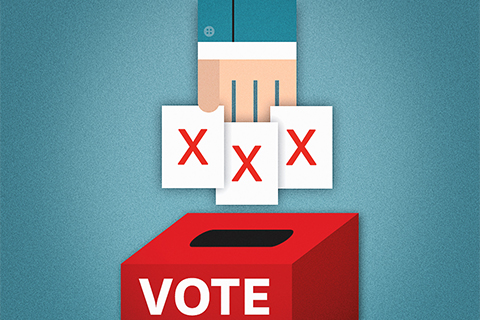
Though there are far more poor than rich, who are eligible to vote, one might think voting already is progressive.

But with gerrymandering, polling-place restrictions, threats, voter disenfranchisement, election chicanery, the fundamental belief that “my vote doesn’t count,” and wealth-funded propaganda, the poor too often, are not able to elect progressive representation.

Thus, we might consider Progressive Voting, wherein a less affluent (based on net worth) voter has more votes than does a rich voter. 

Just as an example:

  • Individual’s Net Worth below $100,000: Each vote counts as 3 votes
  • Individual’s Net worth $100,000 – $10 million: Each vote counts as 2 votes
  • Individual’s Net worth above $10 million: Each vote counts as 1 vote

No doubt, there would be complications. Measuring one’s wealth, for instance, would require definitions and appraisals. But, we already do that in our current income tax and poverty-reduction programs.

Great Britain already does it. Great Britain’s Office for National Statistics published “Measuring Wealth on an Individual Level,” describing their method for determining each person’s wealth:

The main results from the Wealth and Assets Survey (WAS) are published in the series Wealth in Great Britain. To date total wealth has only been published at a household level.

This article describes the methodology we have recently adopted to provide estimates of total wealth for individuals living in private households in Great Britain.

Wealth, as measured by WAS, can be split into four categories:

  • net financial wealth
  • net property wealth
  • private pensions wealth
  • physical wealth

Progressive Voting would give necessary political power to America’s less affluent, thus assuring the maintenance of other progressive, Gap narrowing programs.

In summary: 

The most important problems in economics involve the excessive income/wealth/power Gaps between the richer and the poorer.

Because of Gap Psychology, the Gap between the rich and the rest is wide, widening, and a direct threat to democracy and people’s lives.

Progressive programs to narrow the Gap, inevitably have been compromised by the rich, because these programs are not supported by ongoing political power.

Social Security, for instance, has been compromised by changes in age requirements and by taxation. Medicare has been compromised by deductibles and non-coverages. Medicaid has been compromised by funding cuts.

The rich use their money to fund political power. The not-rich can use votes, particularly with a wealth-based Progressive Voting program, to maintain and strengthen Gap-narrowing efforts.

Rodger Malcolm Mitchell
Monetary Sovereignty
Twitter: @rodgermitchell
Search #monetarysovereigntyFacebook: Rodger Malcolm Mitchell

…………………………………………………………………………………………………………………………………………………………………………………………………………………………………………………………………………………………..

The most important problems in economics involve the excessive income/wealth/power Gaps between the richer and the poorer.

Wide Gaps negatively affect poverty, health and longevity, education, housing, law and crime, war, leadership, ownership, bigotry, supply and demand, taxation, GDP, international relations, scientific advancement, the environment, human motivation and well-being, and virtually every other issue in economics.

Implementation of The Ten Steps To Prosperity can narrow the Gaps:

Ten Steps To Prosperity:

1. Eliminate FICA

2. Federally funded medicare — parts a, b & d, plus long-term care — for everyone

3. Provide a monthly economic bonus to every man, woman and child in America (similar to social security for all)

4. Free education (including post-grad) for everyone

5. Salary for attending school

6. Eliminate federal taxes on business

7. Increase the standard income tax deduction, annually. 

8. Tax the very rich (the “.1%) more, with higher progressive tax rates on all forms of income.

9. Federal ownership of all banks

10. Increase federal spending on the myriad initiatives that benefit America’s 99.9% 

The Ten Steps will grow the economy, and narrow the income/wealth/power Gap between the rich and you.

MONETARY SOVEREIGNTY
 

Why do they want to make you angry at the wrong thing?

I’ll tell you who “they” are and what the “wrong thing” is. But allow me to lead off with some excerpts from the anti-government site, Reason.com.

Fundamentally, Reason.com believes all governments are too large, no matter how large or small they may be.

Of course, making a government smaller does not make it more efficient, more benevolent, or wiser. 

Government is an easy target, because as you repeatedly have been told, government is terrible, except for one little thing: In a world without government, we would be starving, non-human, savage, undisciplined animals. 

Recently, Reason.com published an article titled, GOVERNMENT WASTE, Happy Tax Day! Here Are 6 Infuriating Ways the Government Spends Your Money
Surprised? Yeah, neither are we. By, JOE SETYON | 4.15.2019

The article refers to the federal government (important point). Excerpts:

Happy April 15, everyone! The federal government collects about $3.5 trillion in tax revenue each year, according to the White House Office of Budget and Management. Here, in no particular order, are six of the more infuriating ways that money has gone to waste.

1. $300,000 on 391 coffee mugs
2. $400,000 to promote asset forfeiture…in Paraguay.
3. $13.6 million to hire two border agents
4. More than $325,000 for Mike Pence’s national anthem stunt
5. $333,000 to study bars on the U.S.-Mexico border
6. Nearly $3 million to study dance clubs

If you’re curious, you can click the above link to read the details about each expenditure, but the point is that the federal government spent millions, billions and even trillions on lots of stuff that seems really dumb, and the writer wants you to be angry that these “useless” expenditures are taking dollars from your taxpayer pockets.

And it’s all a lie.

Those payments for coffee mugs, Paraguay, border agents, Pence, bars, and dance clubs didn’t cost you one cent. In fact, those payments put dollars into your pockets.

All federal “wasted” spending puts dollars into your pockets.

Now, if the article had been talking about state government or local government waste, it would have been correct. State and local taxpayers do pay for state and local government spending.

That is because state and local governments are monetarily non-sovereign. (So are you and I).Image result for government money

Those state/local governments do not have the unlimited ability to create their own sovereign currency; they have no sovereign currency; they use the U.S. dollar.

They can, and often do, run short of dollars, and they need tax dollars in order to survive.

By contrast, the federal government is Monetarily Sovereign. It has the unlimited ability to create its own sovereign currency, the U.S. dollar.

The federal government never unintentionally can run short of dollars. Even if all tax collections — income taxes, FICA taxes, luxury taxes, etc. — totaled $0, the federal government could continue spending, forever.

Every time the federal government pays a creditor, it creates new dollars, ad hoc.,

So what about all that “wasted” federal spending? Those are dollars that the federal government created from thin air, and added to the economy.

The “dance club” millions, the coffee mug thousand, the millions for two border agents — all those dollars were created from thin air and were added to the U.S. economy (except for a few that may have gone to overseas suppliers).

The vast majority of those dollars went to U.S. businesses, who used those dollars to pay for employees, who in turn used the dollars to purchase things like food, housing, clothing, cars, education, etc.

In short, the federal government’s “wasted” dollars actually are stimulus dollars, that grow the economy, and eventually wind up in your pockets, my pockets, your kids’ pockets, and even Donald Trump’s pockets.

Again, this is not true of state and local government waste. They do not create dollars from thin air. They use existing tax dollars for their spending. So when they waste money, the dollars come from their taxpayers’ pockets.

Image result for bernanke and greenspan
It’s our little secret. Don’t tell the people we don’t use their tax dollars.

Ben Bernanke: “The U.S. government has a technology, called a printing press (or, today, its electronic equivalent), that allows it to produce as many U.S. dollars as it wishes at essentially no cost.”

Alan Greenspan: “Central banks can issue currency, a non-interest-bearing claim on the government, effectively without limit. A government cannot become insolvent with respect to obligations in its own currency.”

St. Louis Federal Reserve: “As the sole manufacturer of dollars, whose debt is denominated in dollars, the U.S. government can never become insolvent, i.e.,unable to pay its bills. In this sense, the government is not dependent on credit markets to remain operational.

So, if the government neither needs nor uses tax dollars, why does it collect taxes? I’m glad you asked. There are three reasons: One mostly good, one bad, and one horrible.

The mostly good reason is: To control the economy by levying taxes on things they wish to reduce, and by giving tax breaks to things they wish to encourage. So-called “sin” taxes are examples of the former, and home real estate tax deductions are examples of the latter.

The bad reason is to reward rich political donors by giving them special tax breaks not available to the middle and lower classes.

The horrible reason is to groom you, the public, to believe that federal spending for social benefits (Social Security, Medicare, Medicaid, food stamps, other poverty aids, college tuition aids, etc.) must be limited or taxes must be increased.

Since the people do not want increased taxes, they easily are convinced that social benefits must be reduced. 

Thus, we have the fake claim that the Social Security Trust Fund is running short of dollars. (Like the federal government itself, no federal agency can run short of U.S. dollars, unless Congress and the President want it to run short). The “Trust Fund” is an accounting fiction, designed to give an imprimatur to a false assertion.

And we have the fake claim that “Medicare for All is unaffordable. And we have all the other fake claims about federal spending being unaffordable, and federal deficits costing taxpayers money. All untrue.

The bottom line is, the rich are rich because they have more money and property than you do. The key word is, “more” because “rich” is a comparative word.

That is, if you have a million dollars, and everyone else has a million dollars, you are not rich. You are just the same as everyone else. But, if you have one hundred dollars and everyone else has just one dollar, you are very rich, indeed.

In short, to be richer, you either must obtain more money for yourself, or you must arrange for the other people to have less money.

Either way widens the Gap between you and those below you, and it is the Gap that makes you rich.

That is why the rich bribe:

  • The politicians via campaign contributions and promises of lucrative employment later
  • The media via advertising dollars and ownership
  • The economics professors via university contributions and jobs with think tanks

The primary purpose of these bribes is to induce legislation to widen the Gap and to make you accept the necessity of widening.

In Summary:

The rich control American politics. Their fundamental goal in life is personal enrichment, which requires widening the Gap between the rich and the rest.

This involves not only bribing the politicians to make Gap-widening legal changes, but also bribing the media and economists to convince you, the public, that Gap-widening is necessary and beneficial.

These information sources promulgate the “Big Lie” that federal finances are similar to your finances, and federal taxes are necessary to fund federal spending.

The rich fear that if you knew federal taxes are not necessary to fund spending, you would demand more benefits, thereby narrowing the Gap, and effectively making the rich less rich.

The rich want you to be angry at “unnecessary” federal spending, so you readily will agree to cut your social benefits.

Finally, the rich want you to believe that federal deficit and debt lead to hyperinflations, similar to those in Zimbabwe and Weimar Germany, though inflations actually are caused by shortages, usually shortages of food and/or energy, not by money creation.

(Despite a 50,000% increase in federal money creation over the past 80 years, average inflation has been moderate, within the Fed’s target range.

While federal debt (blue line) has risen dramatically, inflation (red line) has risen moderately and within the Fed’s target rate

Unfortunately, the constant drip, drip, drip of anti-deficit, anti-debt propaganda continues to brainwash the public, and the Gap widens.

Rodger Malcolm Mitchell
Monetary Sovereignty
Twitter: @rodgermitchell
Search #monetarysovereigntyFacebook: Rodger Malcolm Mitchell

…………………………………………………………………………………………………………………………………………………………………………………………………………………………………………………………………………………………..

The most important problems in economics involve the excessive income/wealth/power Gaps between the richer and the poorer.

Wide Gaps negatively affect poverty, health and longevity, education, housing, law and crime, war, leadership, ownership, bigotry, supply and demand, taxation, GDP, international relations, scientific advancement, the environment, human motivation and well-being, and virtually every other issue in economics.

Implementation of The Ten Steps To Prosperity can narrow the Gaps:

Ten Steps To Prosperity:

1. Eliminate FICA

2. Federally funded medicare — parts a, b & d, plus long-term care — for everyone

3. Provide a monthly economic bonus to every man, woman and child in America (similar to social security for all)

4. Free education (including post-grad) for everyone

5. Salary for attending school

6. Eliminate federal taxes on business

7. Increase the standard income tax deduction, annually. 

8. Tax the very rich (the “.1%) more, with higher progressive tax rates on all forms of income.

9. Federal ownership of all banks

10. Increase federal spending on the myriad initiatives that benefit America’s 99.9% 

The Ten Steps will grow the economy, and narrow the income/wealth/power Gap between the rich and you.

MONETARY SOVEREIGNTY

” . . . some of the roughest people you’ve ever seen, people that look like they should be fighting for the UFC.”

Trump: (Immigrants are) “some of the roughest people you’ve ever seen . . .”
Trump: (Immigrants are): ” . . . , people that look like they should be fighting for the UFC.” “
Trump: “Good people”

The best way to defend the devil

If you lower yourself to write articles defending the devil, you won’t have legitimate and factual points to make.Related image

So, your best approach may be to fill your article with emotionally charged and biased words, to shield the non-thinkers from the truth.

This is exactly what Matthew Walther did in his article titled, “The Trump tax return mirage.”

Walther wants you to believe that trying to show American voters Trump’s repeatedly promised return is:
1. Unnecessary, because we all know rich people lie on their taxes, so who cares?
2. Illegal because the President is, or should be, so far above the law that any legitimate investigations constitute harassment.
3. Fruitless, because a politically motivated Congress and/or the Supreme Court won’t let it happen, so why even try?

In his fact-starved article, Walther uses the following, charged terminology to get you to stop thinking and to limit yourself to just feeling:

ludicrous request made recently by Rep. Richard E. Neal, the Boy Scout ”
“this is nonsense
“the obscure 1924 provision of the Internal Revenue Code seized upon by Democrats”
“harassing the sitting president”
“The whole thing is a farce.”
“Pretending that a committee of dorks in the House of Representatives has magical powers”
“pathetic fantasy that the president of the United States is some random citizen who can be subpoenaed, indicted, or otherwise mucked around at the whim of his political opponents in Congress.”
“Rep. Neal and his cronies”
“Whining about Trump’s tax returns”
“the (Democratic) party’s longstanding obsession with showboating, grandstanding, and applauding its own moral victories”
“Democrats feign some kind of horror”

You are free to pick your reason for not seeing Trump’s returns, because if you do wish to know what is in them, you would be “ludicrous, farcical, pathetic, whining, obsessed, and feigning horror.” Right?

As a Trump apologist, Walther does not want you to think about this simple, sincere question: “What is Trump hiding?”

Yes, after all his self-righteous insults about “Crooked Hillary,” what is honest Don hiding?

If all of this is nothing more than “ludicrous,” “nonsense,” “pathetic,” “showboating,” “farce,” “grandstanding,” “feigning horror,” and “whining” by a “Boy Scout,” and “his cronies,” why is Trump so crazed about the possibility that people might see what he really has been hiding?

And why did he repeatedly promise to release his returns, as previous Presidents have done, before the election and then invent the lie that an audit somehow prevents their release?

To Walther’s credit, he did mention the GOP’s Benghazi investigation, as an example of what not to do, but isn’t that the point?

If “whining” and “harassment” are to be frowned upon, how can the GOP and Walther, in good conscience (if conscience exists in the GOP) “whine” about Trump having to reveal his tax returns after they have put Hillary Clinton through that senseless inquisition – which many of them, including Trump, wish to repeat?

Bottom line: Trump is a serial liar and adulterer, a torturer of children and their parents, a bigot, a science denier, a proven criminal, a dictator wannabe, and a man whose personal greed far outweighs any concerns about Americans.

He is an unstable danger and he is harming America, as his revolving-door administration filled with incompetent felons and toadies reveals.

His idea for making America “great again” is to erect lucrative Trump Towers in Russia, Saudi Arabia, North Korea, and any other “shithole countries” that will pay him big money and supply him with beautiful hookers when his next few wives aren’t looking.

His greatest fear is that if he loses the coming election, he also will lose the protections of the Presidency, and the Republican party will turn on him like a rabid dog.

Then to paraphrase Trump and his followers’ favorite chant: “Lock him up!”

This is the man Matthew Walther chooses to defend.

We know what Trump is, but what does that say about Walther?

Rodger Malcolm Mitchell
Monetary Sovereignty
Twitter: @rodgermitchell
Search #monetarysovereigntyFacebook: Rodger Malcolm Mitchell

…………………………………………………………………………………………………………………………………………………………………………………………………………………………………………………………………………………………..

The most important problems in economics involve the excessive income/wealth/power Gaps between the richer and the poorer.

Wide Gaps negatively affect poverty, health and longevity, education, housing, law and crime, war, leadership, ownership, bigotry, supply and demand, taxation, GDP, international relations, scientific advancement, the environment, human motivation and well-being, and virtually every other issue in economics.

Implementation of The Ten Steps To Prosperity can narrow the Gaps:

Ten Steps To Prosperity:

1. Eliminate FICA

2. Federally funded medicare — parts a, b & d, plus long-term care — for everyone

3. Provide a monthly economic bonus to every man, woman and child in America (similar to social security for all)

4. Free education (including post-grad) for everyone

5. Salary for attending school

6. Eliminate federal taxes on business

7. Increase the standard income tax deduction, annually. 

8. Tax the very rich (the “.1%) more, with higher progressive tax rates on all forms of income.

9. Federal ownership of all banks

10. Increase federal spending on the myriad initiatives that benefit America’s 99.9% 

The Ten Steps will grow the economy, and narrow the income/wealth/power Gap between the rich and you.

MONETARY SOVEREIGNTY