The “unsustainable” federal debt

If you type “unsustainable federal debt” into your search bar, you will see this: (Try it)

Implications of Unsustainable Debt
1. Economic Growth Risks: Rising debt levels can lead to slower economic growth as more government resources are allocated to interest payments rather than productive investments.

2. Increased Borrowing Costs: As debt accumulates, the government’s borrowing costs may rise, crowding out investments in other critical areas such as infrastructure and education.

3. Potential Default: If corrective actions are not taken, the U.S. could face a situation where it defaults on its debt obligations, either explicitly or through inflationary measures.

Experts suggest that without significant fiscal reforms, the U.S. government may face a fiscal crisis within the next 20 years.

Recommendations for Addressing Federal Debt To mitigate the risks associated with unsustainable federal debt, policymakers are urged to develop strategies that include:
*Reforming Spending: Addressing the key drivers of federal spending, particularly in healthcare and social programs, to align expenditures with revenues. 
*Increasing Revenues: Exploring options to enhance tax revenues, such as eliminating certain tax deductions and increasing corporate and individual income taxes.
*Implementing Fiscal Policies: Establishing a comprehensive fiscal policy framework that prioritizes long-term sustainability over short-term gains. 

Not one sentence in the above is true. Together, they form what is widely known in economics as “The Big Lie.”

It’s a series of lies that may not be the result of malevolence; it may just be ignorance. Either way, it’s wrong and harmful.

Let’s begin at the top:

The Lie: “Rising debt levels can lead to slower economic growth as more government resources are allocated to interest payments rather than productive investments.”

This lie includes two false assumptions: That federal deficit spending slows growth and government resources are limited by interest payments.

The Truth: Government deficit spending adds growth dollars to the economy as this formula illustrates: Gross Domestic Product = Federal Spending + Nonfederal Spending + Net Exports. 

By formula, the more federal spending, the more economic growth.

The lie that federal deficit spending slows growth is disproven by the mathematical definition of economic growth.

The idea that Government resources are limited by interest payments is disputed by the experts from the three Fed Chairmen, the St. Louis Fed Bank, and the Treasury, all acknowledging that the federal government has unlimited resources. It cannot run short of dollars.

=======================================

The Lie:As debt accumulates, the government’s borrowing costs may rise, crowding out investments in other critical areas such as infrastructure and education.”

This Lie makes false assumptions:

False assumption: The federal government borrows U.S. dollars.

The Truth: The federal government never borrows U.S. dollars. Having the infinite ability to create dollars, the assumption makes no sense on its face. The confusion arises because of the words, “bill,” “note,” “bond,” and “debt” all of which have different meanings in federal finance vs. private finance.

In private finance, those words indicate that money is owed. In federal finance, a T-bill, T-note, and T-bond represent deposits (not borrowing) into Treasury security accounts.

The purpose of those accounts is not to acquire spending money but rather to:

*Provide dollar holders with a safe place to store unused dollars — safer than any bank in the world — which is why nations such as China store dollars there, and

*Help the Fed control interest rates by creating a base rate upon which all other rates are calculated.

The total of outstanding T-bills, T-notes, and T-bonds is misnamed “debt,” though nothing is owed. These accounts resemble bank safe-deposit boxes, in which valuables are held by a bank but not owed to the depositor. 

The so-called “debt” is nothing more than a simple exchange of money. You send dollar bills to the government, and the government sends you Treasury bills. They both are U.S. money, with exactly the same backing: the full faith and credit of the United States government.

A dollar bill and a Treasury bill are identical in terms of government liability. They both are U.S. money issued by the U.S. government.

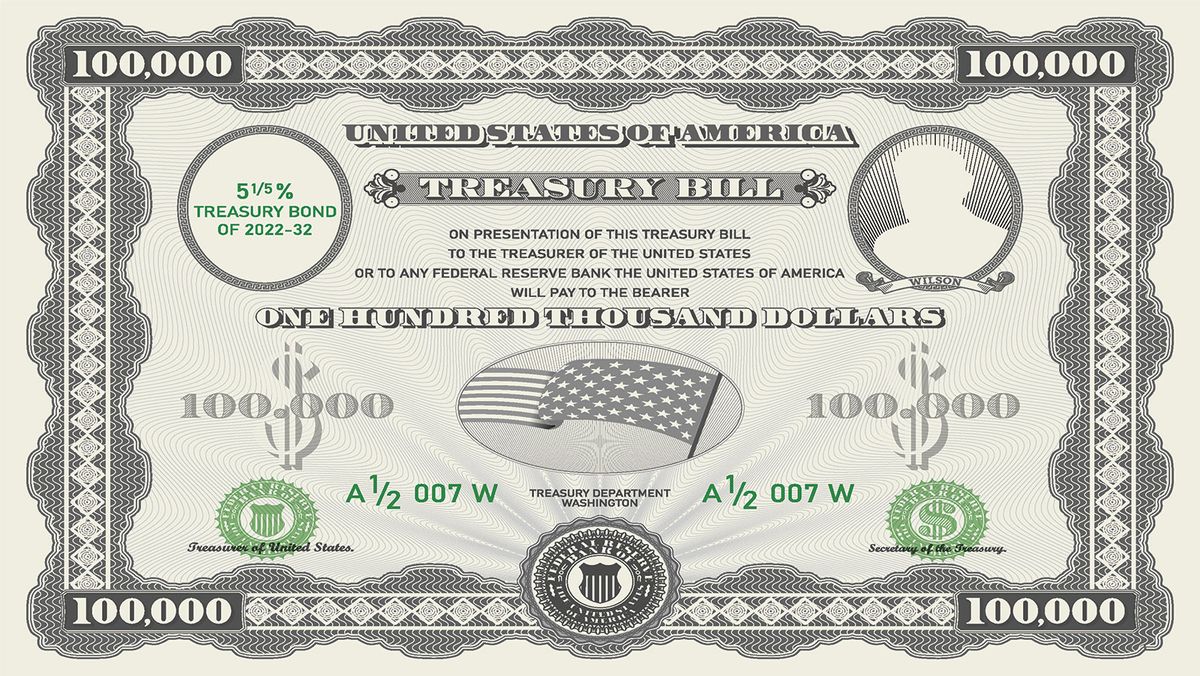
 

United States one-dollar bill - Wikipedia

How Treasury Bills Work | HowStuffWorks

As the St. Louis Fed clearly said, “the government is not dependent on credit markets (i.e., does not borrow) to remain operational.”


False assumption: “… the government’s ‘borrowing’ costs may rise, crowding out investments in other critical areas

The Truth: The government’s “borrowing costs” (meaning interest payments) will have no effect on the government’s ability to pay interest. It has infinite ability to pay for anything.

We are not sure what “crowding out” means. If it means the government will run short of dollars, that clearly is impossible.

If it means that private sector borrowers will be unable to borrow, that too is false. Interest rates are arbitrarily controlled by the Fed and are not related to the issuance of Treasury securities. The Fed sets interest rates to control inflation.

===================================

The Lie: “… the U.S. could face a situation where it defaults on its debt obligations, either explicitly or through inflationary measures. 

The Truth: Again, we see multiple false assumptions:

First false assumption: “… the U.S. could face a situation where it defaults on its debt obligations.”

As every competent economist (including those mentioned above) has said, “The federal government never can become insolvent, i.e., unable to pay its bills.” Having the infinite ability to create dollars confirms this.

Second false assumption: “… through inflationary measures.”

We are not sure if this means that federal spending causes inflation, a claim not in accord with history.” 

Inflation never has been caused by federal spending. Every inflation has been caused by shortages of critical goods and services. The most recent COVID-related inflation was caused by shortages of oil, food, shipping, metals, lumber, labor, computer chips, and other needs. Inflation was being mitigated by federal spending to obtain and distribute scarce items.

See: “At long last, let’s put this inflation question to bed.”

Or does “inflationary measures” mean that the measures to forestall inflation actually cause defaults on debt obligations?  The Fed mistakenly raises interest rates to combat inflation, but a nation with the ability to create its own money can never default.

And in any event, the government pays its misnamed “debt” by the simple act of returning the dollars that reside in T-security accounts. This is not a financial burden on the government. 

Did you know that the federal “debt” has been called “unsustainable” for the past eighty-five years? (See: “A trip down memory lane, or proof ignorance is hard to conquer if the ignorant want to remain that way.”) 

Yes, for eighty-five years, they have been crying wolf, and the people have yet to catch on. Talk about slow learners!

Why the lies?

That is the most important question. The so-called “cures” for the non-existent “problem” of federal debt involve tax increases on the poor and/or reducing social programs that primarily aid those who are not wealthy, such as Social Security, Medicare, Medicaid, and food stamps. 

Thought seldom is given to reducing benefits for the rich, like eliminating tax loopholes.

This was driven home yet again when billionaire President Trump revealed that he had paid virtually no income tax for ten years, a most enviable position — and his political party just passed a “Big, Beautiful” law that saves the rich billions, while the rest receive a pittance while losing some benefits.

This is no accident.

The lies that FICA taxes fund Social Security and Medicare, and that social programs must be cut, are told on behalf of the rich, whose money runs America.

An infinite pile of dollars rising high into space
The federal government has infinite money. It never can run short. It never can default on its obligations for lack of money.

Those of our information sources that promulgate The Big Lie either are ignorant of the facts or are bribed to lie. The rich bribe:

  1. The media, via ownership and advertising dollars
  2. The politicians, via political contributions and promises of lucrative employment later
  3. The economists, via promises of employment with “think tanks” and university endowments.

IN SUMMARY

Even if the federal government did not collect a single penny in taxes, it could fund:

  1. A generous “living-income” Social Security benefit for every man, woman, and child in America.
  2. A livable Social Security benefit for every man, woman, and child in America
  3. Comprehensive, no-deductible Medicare for every man, woman, and child in America
  4. Generous aid for grades K-12.
  5. Free college for all who want it.
  6. Housing assistance
  7. Generous support for the various scientific and medical research projects in America.
  8. Economic growth

And it could do all of that without causing inflation.

America, you have been cheated and lied to, perhaps intentionally, perhaps ignorantly. The federal government has the wherewithal to make America a paradise on Earth. But the rich don’t want that, because if we all were equal, no one would be rich.

The rich want the income/wealth/power gap between the rich and the rest o us to widen. They want the desperation that forces people to accept jobs they don’t like and receive low pay.

So they bribe your sources of information to promulgate The Big Lie, that federal finances are like personal finances, and the government can’t afford to aid the “lazy” poor (who, on average, work harder than the rich).

It doesn’t have to be this way. However, it will remain so if the people reject the facts and choose to believe the lies.

If you don’t protest — if you don’t call, write, and gather groups to demand what if rightfully yours — if you weakly accept The Big Lie and think the truth “is too good to be true– then it always will be that you work hard, receive little, and your children and their children will do the same.

Now that you have heard the facts, the choice is yours. 

Rodger Malcolm Mitchell

Monetary Sovereignty

Twitter: @rodgermitchell

Search #monetarysovereignty

Facebook: Rodger Malcolm Mitchell;

MUCK RACK: https://muckrack.com/rodger-malcolm-mitchell;

https://www.academia.edu/

……………………………………………………………………..

A Government’s Sole Purpose is to Improve and Protect The People’s Lives.

MONETARY SOVEREIGNTY

Historical claims the Federal Debt is a “ticking time bomb.” From Sept. 26, 1940, to June 21, 2024

This is an update of previous posts showing the seemingly never-ending warnings about “federal debt” (that isn’t federal and isn’t debt).

The Big Lie in economics is: “Federal taxes fund federal spending.” The truth is that federal taxes fund nothing. They are destroyed upon receipt by the Treasury.

The U.S. federal government is not like state/local governments, not like euro governments, not like businesses, and not like you and me.

It uniquely is Monetarily Sovereign. It cannot, unwillingly, run short of its own sovereign currency, the U.S. dollar. As real experts have said:

Former Federal Reserve Chairman Alan Greenspan: “A government cannot become insolvent with respect to obligations in its own currency. There is nothing to prevent the federal government from creating as much money as it wants and paying it to somebody. The United States can pay any debt it has because we can always print the money to do that.

Former Fed Chairman Ben Bernanke: “The U.S. government has a technology, called a printing press (or, today, its electronic equivalent), that allows it to produce as many U.S. dollars as it wishes at essentially no cost. It’s not tax money… We simply use the computer to mark up the size of the account.”

Statement from the St. Louis Fed: “As the sole manufacturer of dollars, whose debt is denominated in dollars, the U.S. government can never become insolvent, i.e., unable to pay its bills. In this sense, the government is not dependent on credit markets to remain operational.

Press Conference: Mario Draghi, President of the Monetarily Sovereign ECB, 9 January 2014 Question: can the ECB ever run out of money? Mario Draghi: Technically, no. We cannot run out of money.

Because the U.S. federal government has the infinite ability to create its sovereign currency, the U.S. dollar, it never borrows dollars.

Contrary to popular wisdom, T-bills, T-notes, and T-bonds do not represent borrowing. They simply are deposits, the purpose of which is to provide a safe place to store unused dollars and to help the Fed control interest rates.

The government never touches those dollars, which remain the property of the depositors. Not only can our Monetarily Sovereign government not run short of dollars, but federal deficits are necessary to grow the economy, as evidenced by the formula: GDP = Federal Spending + Nonfederal Spending + Net Exports.

When we don’t have sufficient federal deficits, we have depressions and recessions:

U.S. depressions tend to come on the heels of federal surpluses.

        1. 1804-1812: U. S. Federal Debt reduced 48%. Depression began 1807.
        2. 1817-1821: U. S. Federal Debt reduced 29%. Depression began 1819.
        3. 1823-1836: U. S. Federal Debt reduced 99%. Depression began 1837.
        4. 1852-1857: U. S. Federal Debt reduced 59%. Depression began 1857.
        5. 1867-1873: U. S. Federal Debt reduced 27%. Depression began 1873.
        6. 1880-1893: U. S. Federal Debt reduced 57%. Depression began 1893.
        7. 1920-1930: U. S. Federal Debt reduced 36%. Depression began 1929.
        8. 1997-2001: U. S. Federal Debt reduced 15%. Recession began 2001.

Periodically, we publish yet another shrieking claim that the U.S. federal debt is “unsustainable” and a “ticking time bomb.”

This lie has been told to you every year (really, almost every day) since 1940, and that bomb has never exploded, nor will it.

Rather than repeat the entire list of the thousands of lies to which you have been subject, I will list samples here as a reference and add periodically, at the end, new “federal debt is a ticking time bomb lies as I encounter them.

Read these and see that even respected economists replace facts with intuition:

 ————————//—————————

September 26, 1940, New York Times: The federal budget was a “ticking time-bomb which can eventually destroy the American system,” said Robert M. Hanes, president of the American Bankers Association.

September 26, 1940, New York Times: The federal budget was a “ticking time-bomb which can eventually destroy the American system,” said Robert M. Hanes, president of the American Bankers Association. 
By 1960, the debt was “threatening the country’s fiscal future,” said Secretary of Commerce Frederick H. Mueller. (“The enormous cost of various Federal programs is a time-bomb threatening the country’s fiscal future, Secretary of Commerce Frederick H. Mueller warned here yesterday.”)

By 1983“The debt probably will explode in the third quarter of 1984,” said Fred Napolitano, former National Association of Home Builders president.

In 1984: AFL-CIO President Lane Kirkland said. “It’s a time bomb ticking away.”

In 1985“The federal deficit is a ticking time bomb, and it’s about to blow up,” U.S. Sen. Mitch McConnell. (Remember him?)

Later in 1985: Los Angeles Times: “We labeled the deficit a ‘ticking time bomb that threatens to permanently undermine the strength and vitality of the American economy.”

In 1987: Richmond Times-Dispatch – Richmond, VA: “100TH CONGRESS FACING U.S. DEFICIT’ TIME BOMB‘”

Later in 1987: The Dallas Morning News: “A fiscal time bomb is slowly ticking that, if not defused, could explode into a financial crisis within the next few years for the federal government.”

In 1989: FORTUNE Magazine: “A TIME BOMB FOR U.S. TAXPAYERS

In 1992: The Pantagraph – Bloomington, Illinois: “I have seen where politicians in Washington have expressed little or no concern about this ticking time bomb they have helped to create, that being the enormous federal budget deficit, approaching $4 trillion.

Later in 1992, Ross Perot said, “Our great nation is sitting right on top of a ticking time bomb. We have a national debt of $4 trillion.”

In 1995: Kansas City Star: “Concerned citizens. . . regard the national debt as a ticking time bomb poised to explode with devastating consequences at some future date.”

In 2003: Porter Stansberry, for the Daily Reckoning: “Generation debt is a ticking time bomb . . . with about ten years left on the clock.”

In 2004: Bradenton Herald: “A NATION AT RISK: TWIN DEFICIT A TICKING TIME BOMB

In 2005: Providence Journal: “Some lawmakers see the Medicare drug benefit for what it is: a ticking time bomb.”

In 2006: NewsMax.com, “We have to worry about the deficit . . . when we combine it with the trade deficit, we have a real ticking time bomb in our economy,” said Mrs. Clinton.

In 2007: USA Today: “Like a ticking time bomb, the national debt is an explosion waiting to happen.

In 2010: Heritage Foundation: “Why the National Debt is a Ticking Time Bomb. Interest rates on government bonds are virtually guaranteed to jump over the next few years.

In 2010: Reason Alert: “. . . the time bomb that’s ticking under the federal budget like a Guy Fawkes’ powder keg.”

In 2011: Washington Post, Lori Montgomery:”. . . defuse the biggest budgetary time bombs that are set to explode.”

June 19, 2013Chamber of Commerce: Safety net spending is a ‘time bomb’, By Jim Tankersley: The U.S. Chamber of Commerce is worried that not enough Americans are worried about social safety net spending. The nation’s largest business lobbying group launched a renewed effort Wednesday to reduce projected federal spending on safety-net programs, labeling them a “ticking time bomb” that, left unchanged, “will bankrupt this nation.”

On June 15, 2014: CBN News: “The United States of Debt: A Ticking Time Bomb

On June 18, 2015The ticking economic time bomb that presidential candidates are ignoring: Fortune Magazine, Shawn Tully,

On February 10, 2016The Daily Bell“Obama’s $4.1 Trillion Budget Is Latest Sign of America’s Looming Collapse”

On January 23, 2017Trump’s ‘Debt Bomb‘: Deficit May Grow, Defense Budget May Not, By Sydney J. Freedberg, Jr.

On January 27, 2017: America’s “debt bomb is going to explode.” That’s according to financial strategist Peter Schiff. Schiff said that while low interest rates had helped keep a lid on U.S. debt, it couldn’t be contained for much longer. Interest rates and inflation are rising, creditors will demand higher premiums, and the country is headed “off the edge of a cliff.”

On April 28, 2017Debt in the U.S. Fuel for Growth or Ticking Time Bomb?, American Institute for Economic Research, by Max Gulker, PhD – Senior Research Fellow, Theodore Cangeros

February 16, 2018 America’s Debt Bomb By Andrew Soergel, Senior Reporter: Conservatives and deficit hawks are hurling criticism at Washington for deepening America’s debt hole.

April 18, 2018 By Alan Greenspan and John R. Kasich: “Time is running short, and America’s debt time bomb continues to tick.”

January 10, 2019Unfunded Govt. Liabilities — Our Ticking Time Bomb. By Myra Adams, Tick, tick, tick goes the time bomb of national doom.

January 18, 2019; 2019 Is Gold’s Year To Shine (And The Ticking U.S. Debt Time-Bomb) By Gavin Wendt

April 10, 2019, The National Debt: America’s Ticking Time Bomb. TIL Journal. Entire nations can go bankrupt. One prominent example was the *nation of Greece which was threatened with insolvency a decade ago. Greece survived the economic crisis because the European Union and the IMF bailed the nation out.

July 11, 2019National debt is a ‘ticking time bomb: Sen. Mike Lee

SEP 12, 2019Our national ticking time bomb, By BILL YEARGIN SPECIAL TO THE SUN SENTINEL | At some point, investors will become concerned about lending to a debt-riddled U.S., which will result in having to offer higher interest rates to attract the money. Even with rates low today, interest expense is the federal government’s third-highest expenditure following the elderly and military. The U.S. already borrows all the money it uses to pay its interest expense, sort of like a Ponzi scheme. Lack of investor confidence will only make this problem worse.

JANUARY 06, 2020, National debt is a time bomb, BY MARK MANSPERGER, Tri City Herald | The increase in the U.S. deficit last year was about $1.1 trillion, bringing our total national debt to more than $23 trillion! This fiscal year, the deficit is forecasted to be even higher, and when the economy eventually slows down, our annual deficits could be pushing $2 trillion a year! This is financial madness. there’s not going to be a drastic cut in federal expenditures — that is, until we go broke — nor are we going to “grow our way” out of this predicament. Therefore, to gain control of this looming debt, we’re going to have to raise taxes.

February 14, 2020, OMG! It’s February 14, 2020, and the national debt is still a ticking time bomb! The national debt: A ticking time bomb? America is “headed toward a crisis,” said Tiana Lowe in WashingonExaminer.com. The Treasury Department reported last week that the federal deficit swelled to more than $1 trillion in 2019 for the first time since 2012. Even more alarming was the report from the bipartisan Congressional Budget Office (CBO) predicting that $1 trillion deficits will continue for the next 10 years, eventually reaching $1.7 trillion in 2030

April 26, 2020, ‘Catastrophic’: Why government debt is a ticking time bomb, Stephen Koukoulas, Yahoo Finance  [Re. Monetarily Sovereign Australia’s debt.]

August 29, 2020LOS ANGELES, California: America’s mountain of debt is a ticking time bomb  The United States not only looks ill, but also dead broke. To offset the pandemic-induced “Great Cessation,” the U.S. Federal Reserve and Congress have marshalled staggering sums of stimulus spending out of fear that the economy would otherwise plunge to 1930s soup kitchen levels. Assuming that America eventually defeats COVID-19 and does not devolve into a Terminator-like dystopia, how will it avoid the approaching fiscal cliff and national bankruptcy?

April 16, 2021NATIONAL POLICY: ECONOMY AND TAXES / MARK ALEXANDER / The National Debt Clock: A Ticking Time Bomb: At the moment, our national debt exceeds $28 TRILLION — about 80% held as public debt and the rest as intragovernmental debt. That is $225,000 per taxpayer. Federal annual spending this year is almost $8 trillion, and more than half of that is deficit spending — piling on the national debt.

June 17, 2022 Time Bomb On National Debt Is Counting Down Faster Thanks To Fed’s Rate Hike,  Tim Brown /We are now staring down the barrel of the end of the U.S. economy based on fiat money, printed out of thin air but charged back to the people at ridiculous interest rates.

Now, the national debt is approaching $31 trillion, which is $12 trillion more than when Donald Trump took office in 2017 and more than half of that debt was tacked on in his final year. Then we’ve had the disastrous year and a half of Joe Biden.

Now, the Fed is now hiking its rates and that spells even more trouble for the national debt and the economy at large.

December 4, 2022 America’s ticking time bomb: $66 trillion in debt that could crash the economy By Stephen Moore, The national debt is $31 trillion when including Social Security’s and Medicare’s unfunded liabilities. Wake up, America.

That ticking sound you’re hearing is the American debt time bomb that with each passing day is getting precariously close to detonating and crashing the US economy.

January 13, 2023. A ticking time bomb in the U.S. economy is running perilously close to detonation. Long considered a harbinger of bad luck, Friday, Jan. 13 came with a warning for Congress that the country could default on its debt as soon as June. 

With the U.S. reaching its debt limit of $31.4 trillion on Jan. 19, Treasury Secretary Janet Yellen urged lawmakers to increase or suspend the debt ceiling.

February 5 2023 ‘The world’s largest Ponzi scheme’: Peter Schiff just blasted the US debt ceiling drama. Here are 3 assets he trusts amid major market uncertainty Story by Bethan Moorcraft, A ticking time bomb in the U.S. economy is running perilously close to detonation. With the U.S. reaching its debt limit of $31.4 trillion on Jan. 19, Treasury Secretary Janet Yellen urged lawmakers to increase or suspend the debt ceiling.

April 22, 2023 The Debt Ceiling Debate Is About More Than Debt, Jim Tankersley, WASHINGTON — Speaker Kevin McCarthy of California has repeatedly said that he and his fellow House Republicans are refusing to raise the nation’s borrowing limit, and risking economic catastrophe, to force a reckoning on America’s $31 trillion national debt. “Without exaggeration, America’s debt is a ticking time bomb that will detonate unless we take serious, responsible action,” he said this week.

November 3, 2023 The Fuse on America’s Debt Bomb Just Got Shorter, J Antoni Heritage Organization. The Treasury is now on track to borrow almost as much in just six months as it did in the previous 12 months. That’s nearly a doubling of the deficit. Because the federal debt is $33.7 trillion, just a 1 percent increase in yields adds $337 billion to the annual cost of servicing the debt over time. Absent spending reform, eventually no one will be willing to hold the bomb anymore, and the yields on U.S. debt will begin to resemble those in Argentina.

February 2, 2024 How Florida can help defuse the nation’s debt bomb By  professor emeritus of economics at the University of Colorado Boulder and  former comptroller general of the United States. Washington’s out-of-control spending, combined with fiscal and monetary policies have resulted in trillion-dollar-plus annual deficits, over $34 trillion in federal debt, over $125 trillion in total federal liabilities and unfunded obligations, and excess inflation. Excessive spending and loose monetary policy increase inflation in the short term, and mounting debt burdens serve to reduce future economic growth and shift the economic burden and consequences of mounting debt burdens to future generations.

February 8, 2024 Legendary investor Paul Tudor Jones says a ‘debt bomb’ is about to go off in the U.S.: ‘We’re fast-pouring consumption like crazy’. The U.S. economy may seem like it’s firing on all cylinders, but underneath the surface, a “debt bomb” could be on the verge of exploding, according to billionaire hedge fund manager Paul Tudor Jones. The esteemed investor said in an interview with CNBC that he couldn’t deny the economy was strong, but that it was actually “on steroids” due to massive government spending and borrowing.

Jones is not the only one to call attention to the growing deficit issue in the U.S. On Sunday, Federal Reserve Chairman Jerome Powell took a rare dive into politics, telling CBS’s 60 Minutes that the national debt was “growing faster than the economy,” and calling for lawmakers to get the federal government “back on a sustainable fiscal path.” Meanwhile, U.S. Treasury Secretary Janet Yellen has said she is not yet worried about the increasing national debt as long as the government keeps in check the net payments it makes on its debt relative to GDP.

Those payments are projected to rise from 2.5% last year to 2.9% next year, according to the Office of Management and Budget—below their level in the early 1990s. Jones told CNBC that the strong economy could postpone the effects of the government’s deficit spending, but only for a little while. “The only question is … when does that manifest itself in markets?” he added.

“It could be this year, it could be next year. Productivity may mask and it might be three or four years from now. But clearly, clearly we’re on an unsustainable path.”

June 21, 2024 My Weekly Column: Our debt crisis is a ticking time bomb by Randy Feenstra: On June 18th, the nonpartisan Congressional Budget Office (CBO) – the government agency tasked with monitoring our nation’s fiscal health – confirmed my serious concerns with President Biden’s reckless spending agenda.

His administration’s fiscal policies have not only caused cumulative inflation to skyrocket by over 20% since he took office, but they have also accelerated our accumulation of debt to levels that are beyond unsustainable. Instead of changing course, he recently released his budget for Fiscal Year 2025, which has a $ 7.3 trillion price tag and looks to raise taxes on our families, farmers, and businesses to the tune of $5.5 trillion.

The CBO estimates that his debt “cancelation” policies will cost taxpayers nearly $400 billion over the next ten years. I strongly oppose these bailouts. Iowans who never attended college entered the workforce early or helped put their kids through school should not be forced to pick up the tab for President Biden’s costly and unfair executive orders. 

———————–//———————–

The latest installment contains the same old lies (“unsustainable,” “cost taxpayers” 0they’ve been telling since 1940.

They have been wrong for all those years. If we wait long enough, something will happen to prove them right, perhaps in a thousand years?

Today, this makes “only” 84 years of the debt nuts be ignorant. 

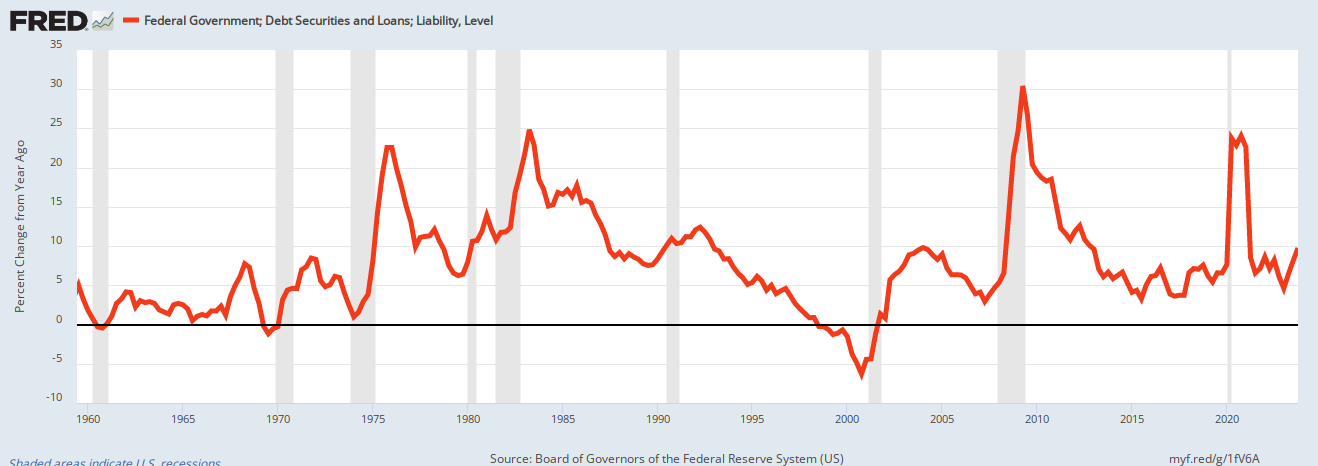
The federal deficit yields economic growth year after year. When deficits are insufficient, we have had recessions, which were cured by increased deficits.

When deficits decline, we have recessions (vertical gray bars), which are cured by increased deficits.

If respected economists keep predicting something terrible is imminent year after year, yet exactly the opposite happens, at what point do they reexamine their beliefs?

At what point does the public say, “Fool me once; shame on you. Fool me repeatedly for 84 years; shame on me”?

Rodger Malcolm Mitchell

Monetary Sovereignty Twitter: @rodgermitchell Search #monetarysovereignty Facebook: Rodger Malcolm Mitchell

……………………………………………………………………..

THE SOLE PURPOSE OF GOVERNMENT IS TO IMPROVE AND PROTECT THE LIVES OF THE PEOPLE.

The most important problems in economics involve:

  1. Monetary Sovereignty describes money creation and destruction.
  2. Gap Psychology describes the common desire to distance oneself from those “below” in any socio-economic ranking, and to come nearer those “above.” The socio-economic distance is referred to as “The Gap.”

Wide Gaps negatively affect poverty, health and longevity, education, housing, law and crime, war, leadership, ownership, bigotry, supply and demand, taxation, GDP, international relations, scientific advancement, the environment, human motivation and well-being, and virtually every other issue in economics.

The economics scare-mongers defy facts. Were you fooled?

Since 1981, the CRFB (Committee for a Responsible Federal Budget) has been scaring you about a “soon-to-come economic doomsday.”

The fiscal apocalypse always is imminent — always just around the corner.

Does the fact that it never arrives embarrass the CRFB? Apparently not,

If you made the same wrong predictions every year for the past 40 years wouldn’t you be a bit hesitant about doing it yet again? And if you were one of the CRFB’s readers, wouldn’t you have learned long ago not to trust anything these people say?

It seems that being wrong again and again and again, doesn’t cause them any embarrassment, nor does it cause their followers any second thoughts.

The CRFB keeps peddling the same nonsense every year, using exactly the same words. Only the numbers change.

Today, the Congressional Budget Office (CBO) released its March 2021 Long-Term Budget Outlook, confirming that the federal budget is on an unsustainable long-term trajectory. 

Let us pause to examine the word “unsustainable.” What does it mean? The CRFB never says.

Does “unsustainable” mean the federal government will go bankrupt? No, that cannot happen.

It can happen to monetarily non-sovereign entities like U.S. states, counties, and cities. It can happen to euro nations because they are monetarily non-sovereign. It can happen to businesses, and to you and to me.

But it cannot happen to the U.S. government. It is Monetarily Sovereign. It creates U.S. dollars by the very act of paying creditors.

[To pay a creditor, the federal government sends instructions (in the form of a check or wire) to the creditor’s bank. The instructions say, “Pay to the order of________”

When the bank receives those instructions, it does as it is told. It increases the numbers in the creditor’s checking account. At the moment that happens, a money measure known as “M1” increases.

The bank then clears the instructions through the government’s own Federal Reserve Bank, which always approves government instructions. In short, the government approves its own instructions.

That is the way the federal government creates dollars.]

Because the government never can run short of instructions, it never can run short of dollars.

Does “unsustainable”  mean the federal government will be unable to pay its debts? No. Clearly having unlimited money gives the government unlimited ability to pay its debts.

Does “unsustainable” mean countries or people will begin to reject payment in dollars? No. The U.S. has a massive economy. Long after people begin to reject euros, and the money of smaller economies like those of Japan, Canada, Australia, England, China et al, they still will accept U.S. dollars.

Does “unsustainable” mean that one day, China will demand a return of all the dollars it has lent the U.S.? No. China has not lent the U.S. any dollars. (The U.S. government, having the unlimited ability to create dollars, has no need to borrow dollars.)

What erroneously is termed “borrowing” actually is China making deposits of U.S. dollars into its own T-security accounts held at the Federal Reserve Bank. There the dollars remain until China wants them back. The U.S. government has no need for them.

Whenever China wants those dollars returned, the Bank merely transfers them to China’s own checking account, at any bank in the world. This is a simple money transfer that is no burden on the U.S. or on taxpayers. It happens every day of the week.

Does “unsustainable” mean we will have uncontrolled inflation? No, our Monetarily Sovereign government has unlimited control over the value of the U.S. dollar, a control it has exercised many times over the years.

It formerly was accomplished by arbitrarily changing the dollar’s exchange value with gold or silver. Today, it is accomplished by arbitrarily changing the interest rates paid on Treasury Securities. Raising the rates makes the dollar more valuable (i.e., decreases inflation).

So what does “unsustainable” mean? It means, “We want you to be worried, frightened even, about some unknown thing lying in the shadows.” But folks, the only thing lying is the CRFB, and they do it every day:

Analysis of CBO’s March 2021 Long-Term Budget Outlook | Committee for a Responsible Federal Budget (crfb.org)

 Under current law, CBO projects federal debt held by the public to rise from less than 80 percent of GDP at the end of FY 2019 to 202 percent of GDP by 2051.

Under a more realistic scenario, debt could reach nearly 260 percent of GDP by 2051.

Why is it bad that the total of deposits into T-bill, T-note, and T-bond accounts (wrongly called “debt”) will be more than double Gross Domestic Product?

It isn’t. One has nothing to do with the other. It’s like announcing that the number of blond-haired people will be double the number of fire-plugs in Chicago. The “debt”/GDP ratio is an irrelevant apples/oranges comparison.

So-called “federal debt” is the total of deposits into T-security accounts, similar to bank savings accounts. In today’s federal bookkeeping system, it also is the net total of federal deficits run by the federal government in the 240 years since the U.S. began.

By contrast, GDP is a one-year total of spending by the U.S. public and private sectors. Increases or decreases in deposits do not correlate with increases or decreases in spending. The U.S. government has the power to stop accepting dollars in T-security accounts, while continuing to spend, forever.

Japan, which has a ratio exceeding 250%, long ago proved the meaninglessness of that meant-to-be-scary debt/GDP fraction.

Perhaps, that is why the CRFB never specifically says what problems the ratio supposedly causes — just a vague reference to “unsustainable.”

Deficits Will Explode. Under current law, CBO projects annual budget deficits will grow to 13.3 percent of GDP by 2051.

While this is lower than the COVID-driven deficit of 14.9 percent of GDP in FY 2020, it will be nearly three times higher than the 2019 deficit of 4.6 percent of GDP, roughly four times as high as the 3.3 percent of GDP average seen over the past 50 years, and higher than any point in modern history outside of World War II and the current crisis.

Ooooh, “explode”! How frightening. The CRFB fails to mention that 2020, 2019, the past 50 years, and World War II, all were periods of large deficits and of economic growth.

And what are those terrible “deficits” the CRFB wants to scare you with? Deficits are times when the federal government pumps more stimulus dollars into the private sector than it removes via taxing.

Not only does federal deficit spending stimulate economic growth, but the economy could not grow without federal deficit spending. In fact, when federal deficit spending is reduced, we have recessions and depressions.

When the growth in federal deficit spending is reduced (red line), we eventually have recessions, which are cured by increases in deficit spending. Other than that, there is no relationship between deficit spending and federal “debt” (blue line).

Is a growing economy something that should frighten you??? The idea is laughable.

Spending Will Continuously Outpace Revenue.

CBO projects spending will grow from 21.0 percent of GDP in 2019 to 31.8 percent of GDP by 2051, while revenue will grow from 16.3 to 18.5 percent of GDP.

Over the long term, rising health care, retirement, and interest costs will cause a significant increase in spending. Revenue will also grow under current law, but only modestly.

In the above paragraphs, the CRFB confuses federal finances with personal finances.

You and I, and indeed all monetarily non-sovereign entities, use income (“revenue”) to fund spending. Without some form of income, we can’t spend.

The Monetarily Sovereign government, which creates dollars, ad hoc, from thin air, whenever it spends, needs no income. In fact, the federal government destroys all income upon receipt.

When, for instance, your tax dollars reach the U.S. Treasury, they cease to be a part of any money measure (M0, M1, M2, M3). Your tax dollars effectively no longer exist.

While comparisons between revenue and spending are important for you and me, they are meaningless for the federal government. The CRFB intentionally confuses the two.

Major Trust Funds Are Headed Toward Insolvency.

CBO projects Highway Trust Fund (HTF) insolvency in FY 2022, Medicare Hospital Insurance (HI) trust fund insolvency in FY 2026, Social Security Old Age and Survivors Insurance (OASI) trust fund insolvency in calendar year 2032 and Social Security Disability Insurance (SSDI) trust fund insolvency in calendar year 2035.

On a theoretical combined basis, the Social Security program will be insolvent in calendar year 2032.

The major “trust funds” are not really trust funds (See “The phony ‘trust fund’ controversy”), and whatever one wishes to call them, they are not “headed for insolvency.”

Given that the federal government has the unlimited ability to create dollars, no federal agency can become insolvent unless the government wishes it to be insolvent. The federal government could (and should) end collection of the FICA tax, and still pay Social Security and Medicare benefits, forever.

The Long-Term Outlook is Similar to Last Year.

Ultimately, high debt levels will slow income and wage growth, increase interest payments, place upward pressure on interest rates, reduce the fiscal space available to respond to a recession or other emergency, place an undue burden on future generations, and heighten the risk of a fiscal crisis.

Once the current crisis ends, policymakers must work to get our long-term fiscal house in order.

It’s all a lie.

Increased debt levels (red line) have not slowed personal income growth (blue line).

As for “increased interest payments,” they stimulate economic growth by adding dollars to the private sector


There has been no “upward pressure on interest rates” which instead are at historic lows.

And because the federal government has the unlimited ability to create dollars, by definition it always has infinite “fiscal space” to respond to a recession or other emergency. It has demonstrated this infinite fiscal space by repeatedly passing multi-trillion dollar stimulus packages.

There is no burden on future generations. Future taxes will not fund today’s spending. The only burden on future generations would be a poverty burden if the government had not spent trillions to stimulate the economy.

And finally, “fiscal house in order” is a word-salad meaning nothing with regard to our Monetarily Sovereign federal government.

In Summary

The CRFB article is one gigantic lie, designed to scare those who do not understand the workings of a Monetarily Sovereign entity. It makes false claims that are contradicted by easily seen facts.

These are people who insist you are standing in the midst of a thunderstorm while you plainly can see the sun shining.

Michigan mansion once owned by Eminem is back on the market
Maintaining the Gap

Why does the CRFB lie about the economy? Because they are paid by, and controlled by, the very rich, who because of Gap Psychology, want you to accept higher taxes and lower federal benefits.

[“Rich” is a relative term. If you have $1,000, and everyone else has $1, you are rich.; The wider the Gap between you and those who are poorer, the richer you are.

“Gap Psychology” is the desire to become richer by widening the income/wealth/power Gap below, while narrowing the Gap above.

Being funded by the rich, the CRFB spreads lies that will influence you to believe the federal government can’t afford social benefits.

They want you meekly to accept your lower station in life, so that the rich can maintain or increase their control over America.]

This is the same motive behind the repeated, claims that federal deficit spending is the dreaded “socialism.” It isn’t. “Socialism” is government ownership and control. Though all governments are partly socialistic, most federal spending involves neither ownership nor control.

But the rich know that the word “socialism” has pejorative implications, so they apply it to such federal benefits as Medicare, Social Security, SNAP programs, etc.

It is all a lie proxies for the rich continually repeat until the false ideas are implanted so deeply into the public consciousness, that obvious facts are doubted.

Because of liars like the CRFB, the rich own you, and only the truth can set you free.

Rodger Malcolm Mitchell

Monetary Sovereignty Twitter: @rodgermitchell Search #monetarysovereignty Facebook: Rodger Malcolm Mitchell …………………………………………………………………………………………………………………………………………………………………………………………………………………………………………………………………………………………..

THE SOLE PURPOSE OF GOVERNMENT IS TO IMPROVE AND PROTECT THE LIVES OF THE PEOPLE.

The most important problems in economics involve:

  1. Monetary Sovereignty describes money creation and destruction.
  2. Gap Psychology describes the common desire to distance oneself from those “below” in any socio-economic ranking, and to come nearer those “above.” The socio-economic distance is referred to as “The Gap.”

Wide Gaps negatively affect poverty, health and longevity, education, housing, law and crime, war, leadership, ownership, bigotry, supply and demand, taxation, GDP, international relations, scientific advancement, the environment, human motivation and well-being, and virtually every other issue in economics. Implementation of Monetary Sovereignty and The Ten Steps To Prosperity can grow the economy and narrow the Gaps:

Ten Steps To Prosperity:

  1. Eliminate FICA
  2. Federally funded Medicare — parts A, B & D, plus long-term care — for everyone
  3. Social Security for all or a reverse income tax
  4. Free education (including post-grad) for everyone
  5. Salary for attending school
  6. Eliminate federal taxes on business
  7. Increase the standard income tax deduction, annually. 
  8. Tax the very rich (the “.1%”) more, with higher progressive tax rates on all forms of income.
  9. Federal ownership of all banks
  10. Increase federal spending on the myriad initiatives that benefit America’s 99.9% 

The Ten Steps will grow the economy and narrow the income/wealth/power Gap between the rich and the rest.

MONETARY SOVEREIGNTY

How To Prevent Economic Growth, by Maya MacGuineas of CRFB

No one can do a better job of describing how to thoroughly destroy the American economy than Maya MacGuineas, head of the Committee for a Responsible Federal Budget (CRFB).  She not only writes articles for the CRFB web site, but she often is invited to spew her wisdom before Congress. She is a true celebrity in Washington.

To give you a taste of her acumen, here are excerpts from an Email I just received from her:

Wed, Oct 7 at 8:29 AM, The Cost of the Trump and Biden Campaign Plans

Whoever is inaugurated on January 20, 2021, will face many fiscal challenges over his term.

Under current law, trillion-dollar annual budget deficits will become the new normal, even after the current public health emergency subsides.

Meanwhile, the national debt is projected to exceed the post-World War II record high over the next four-year term and reach twice the size of the economy within 30 years.

For reasons never explained, MacGuineas repeatedly compares the national “debt” (i.e. the federal “debt”), with Gross Domestic Product.

The former is nothing more than the total of deposits into Treasury Security accounts; the latter is total spending in America. The two are not directly related, co-dependent or in any way comparable.

The federal government could stop accepting deposits into T-security accounts tomorrow, at which time the so-called “debt” would begin to shrink to $0 — and this would have no effect on GDP. Or the government could accept twice as much in deposits, and this too would have no effect on GDP.

So her complaint that these deposits will “reach twice the size of the economy” is meaningless, meant more to shock you than to educate you.

Four major trust funds are also headed for insolvency, including the Highway and Medicare Hospital Insurance trust funds, within the next presidential term.

What MacGuineas (and many others) misleadingly term “trust funds” are not trust funds. They are nothing more than bookkeeping accounts that are 100% controlled by the federal government. These accounts cannot become insolvent unless Congress wants them to become insolvent.

The federal government, which has the unlimited power to create U.S. dollars, along with the unlimited power to change its bookkeeping, can put any numbers it wishes into those accounts, any time it wishes.

The federal government arbitrarily could decide to double or triple the balances in these so-called “trust fund” accounts, and as if by magic, the numbers would double, and MacGuineas could stop fretting.

Whenever you see or hear the words, “federal trust funds,” know you are not being told the truth. Though even federal sites refer to “trust funds,” these are like the Bank in the game of Monopoly™: Changeable according to the players’ desires.

Fiscal irresponsibility prior to the pandemic worsened structural deficits that were already growing due to rising health and retirement costs and insufficient revenue.

It is not fiscally irresponsible for the federal government to spend more. On the contrary, not spending more would be fiscally irresponsible. Federal deficit spending grows the economy, and insufficient federal deficit spending shrinks the economy.

The country’s large and growing national debt threatens to slow economic growth, constrain the choices available to future policymakers, and is ultimately unsustainable.

The above sentence is diametrically wrong. False complaints about the national “debt” being a ticking time bomb,” have been voiced since 1940, while the economy has grown massively.

MacGuineas herself has been making the same wrong predictions continually. and for many, many years, but has learned nothing from her predictive failures.

Yet neither presidential candidate has a plan to address the growth in debt. In fact, we find both candidates’ plans are likely to increase the debt.

Under current law, the so-called “debt” results from federal deficit spending, which pumps stimulus dollars into the economy. MacGuineas opts to remove dollars from the economy by running federal surpluses. She ignores the fact that removing dollars from the economy causes recessions and depressions.

A growing economy requires a growing supply of money. Federal deficit spending increases the supply of money, which grows the economy.

The formula for GDP is: GDP = Federal Spending + Non-federal Spending + Net Exports. All these terms are related to the money supply in the United States.

Under our central estimate, we find President Donald Trump’s campaign plan would increase the debt by $4.95 trillion over ten years and former Vice President Biden’s plan would increase the debt by $5.60 trillion.

Debt would rise from 98 percent of Gross Domestic Product (GDP) today to 125 percent by 2030 under President Trump and 128 percent under Vice President Biden, compared to 109 percent under current law.

Despite MacGuenias’s hand-wringing, both plans are insufficient to grow GDP over time. An average of 1/2 trillion dollars in deficit spending in a $20 trillion economy, amounts to only 5% per year, a level that on average, has led to recessions.


Vertical gray lines are recessions. Year to year reductions in federal “debt” growth lead to recessions, while increases in federal “debt” cure recessions.

President Donald Trump has issued a 54 bullet point agenda that calls for lowering taxes, strengthening the military, increasing infrastructure spending, expanding spending on veterans and space travel, lowering drug prices, expanding school and health care choice, ending wars abroad, and reducing spending on immigrants. He also has proposed a “Platinum Plan” for black Americans, which increases spending on education and small businesses.

Meanwhile, Vice President Joe Biden has proposed a detailed agenda to increase spending on child care and education, health care, retirement, disability benefits, infrastructure, research, and climate change, while lowering the costs of prescription drugs, ending wars abroad, and increasing taxes on high-income households and corporations.

Which of the above proposals does MacGuineas suggest should be eliminated?

She never says. She decries deficit spending while not saying where the deficit spending should be reduced. Why is she so reticent? Because she probably understands the economic need for federal deficit spending, but she is paid to deny it.

That is why she has been mouthing the same tripe for so many years.

Debt has already grown from 39 percent of the economy in 2008 to 76 percent in 2016, and is estimated to reach 98 percent by the end of FY2020.
Under current law, the Congressional Budget Office (CBO) projects debt will continue to rise to 109 percent of GDP by 2030.

Our central estimate of the Trump plan finds debt would rise to 125 percent of the economy by 2030, excluding the effects of further COVID relief. Under our central estimate of the Biden plan, debt would rise to 128 percent of the economy by 2030, again excluding COVID proposals.

Then next few paragraphs of MacGuineas’s letter comprise an endless recitation of “debt” as a percentage of “the economy” (GDP), all with the tacit — and completely wrong — assumptions that a low ratio is a good ratio, and a high ratio is a bad ratio.

Here is a list showing the Debt/GDP ratio for many nations:

Based solely on the percentages, which nations would you expect to have the healthiest and/or strongest economies”?

Japan 237.54%, Venezuela 214.45%, Sudan 177.87%, Greece 174.15%,
Lebanon 157.81%, Italy 133.43%, Eritrea 127.34%, Cape Verde 125.29%,
Mozambique 124.46%, Portugal 119.46%, Barbados 117.27%, Singapore 109.37%,
United States 106.70%, Bhutan 103.85%, Cyprus 101.04%, Bahrain 100.19%,
Belgium 99.57%, France 99.20%, Spain 95.96%, Jordan 94.83%, Jamaica 94.13%,
Belize 92.64%, Angola 90.46%, Brazil 90.36%, Republic Of The Congo 90.19%,
Antigua And Barbuda 88.35%, Canada 88.01%, Egypt 86.93%, United Kingdom 85.67%,
Aruba 83.57%, Sri Lanka 82.99%, Tunisia 81.55%, Mauritania 80.61%, Zambia 80.50%,
Dominica 79.84%, Gambia 78.67%, San Marino 77.12%, Pakistan 77.00%, Argentina 75.90%,
Sao Tome And Principe 74.10%, Sierra Leone 72.37%, Suriname 72.05%,
Saint Lucia 71.62%, Saint Vincent And The Grenadines 71.38%, Uruguay 71.34%,
Austria 71.17%, Croatia 70.73%, Montenegro 70.58%, Togo 70.39%, India 69.04%,
El Salvador 68.10%, Mauritius 67.50%, Hungary 66.62%, Slovenia 65.44%, Albania 65.13%,
Morocco 65.11%, Laos 64.13%, Burundi 63.54%, Djibouti 62.99%, Ireland 62.42%,
Ukraine 62.03%, Senegal 62.00%, Ghana 61.99%, Maldives 61.43%, Oman 61.29%,
Bahamas 60.49%, Nauru 60.39%, Finland 59.88%, Saint Kitts And Nevis 59.49%,
Malawi 59.01%, Israel 58.96%, Gabon 58.48%, South Africa 57.81%, Puerto Rico 57.70%,
Ethiopia 57.43%, Vietnam 57.36%, Guyana 57.22%, Bolivia 57.11%, Germany 56.93%,
Malaysia 56.32%, Costa Rica 56.15%, Grenada 56.12%, Kyrgyzstan 56.09%, Niger 55.60%,
Kenya 55.50%, China 55.36%, Guinea Bissau 54.92%, Yemen 54.51%, Seychelles 54.49%,
Mexico 54.11%, Benin 54.00%, Qatar 52.74%, Vanuatu 52.18%, Netherlands 52.04%,
Namibia 51.60%, Belarus 51.08%, Serbia 50.95%, Ivory Coast 50.92%, Iraq 50.25%,
Fiji 50.22%, Rwanda 50.00%, Trinidad And Tobago 49.75%, Tajikistan 49.46%,
Samoa 49.44%, Ecuador 49.20%, Colombia 49.16%, Armenia 47.95%, Poland 47.48%,
Algeria 46.92%, Slovakia 46.90%, Liberia 46.66%, Guinea 45.98%, Georgia 45.05%,
Uganda 44.81%, Chad 42.91%, Burkina Faso 42.47%, Malta 42.46%,
Central African Republic 42.25%, Dominican Republic 41.92%, Thailand 41.47%,
Eswatini 41.11%, Australia 41.10%, Madagascar 41.02%, Nicaragua 40.88%,
Honduras 40.80%, South Korea 40.54%, North Macedonia 40.48%, Switzerland 39.49%,
Myanmar 39.19%, Philippines 39.10%, Cameroon 38.11%, Romania 37.99%, Lesotho 37.95%,
South Sudan 37.81%, Panama 37.81%, Papua New Guinea 37.72%, Equatorial Guinea 37.49%,
Sweden 37.23%, Mali 36.93%, Norway 36.75%, Latvia 36.66%, Tanzania 36.57%,
Bosnia And Herzegovina 36.34%, Haiti 36.23%, Comoros 35.08%, Bangladesh 34.81%,
Taiwan 33.91%, Lithuania 33.79%, Denmark 33.61%, Iceland 33.13%, Nepal 33.07%,
Czech Republic 31.57%, Turkmenistan 30.25%, Nigeria 30.05%, Iran 30.04%, Turkey 29.93%,
Cambodia 29.57%, Indonesia 29.29%, Moldova 28.82%, New Zealand 28.07%, Peru 27.18%,
Chile 27.17%, Guatemala 24.76%, Saudi Arabia 23.71%, Kiribati 23.48%,
Marshall Islands 23.37%, Uzbekistan 23.23%, Paraguay 22.37%, Tuvalu 21.81%,
Luxembourg 21.61%, Zimbabwe 20.99%, Kazakhstan 20.90%, Bulgaria 19.33%,
United Arab Emirates 19.20%, Micronesia 18.41%, Kuwait 17.78%, Azerbaijan 17.59%,
Solomon Islands 14.56%, Dr Congo 14.01%, Russia 13.79%, Botswana 12.78%, Estonia 7.61%,
Afghanistan 6.88%, Brunei 2.63%

If you say there seems to be no relationship between “debt” and GDP you would be correct, for several reasons:

  1. Some nations are Monetarily Sovereign, which means they have the unlimited ability to create their own sovereign currency. Any liability denominated in their own currency is serviced simply by creating new currency. They cannot become insolvent if they owe their own currency.
  2. Some nations are monetarily non-sovereign, which like you, me, the euro nations, and all local governments, cannot arbitrarily create money, and so can become insolvent.
  3. The word “debt” means something entirely different, depending on what is owed, and why. If the “debt” consists of optional deposits, as does America’s, Japan’s, Canada’s, Australia’s, and the UK’s, paying it off merely requires returning the money on deposit.
  4. But if the debt is necessary for the purchase of goods and services, like state and local government debt, then taxpayers must fund it, or the government will become insolvent.
  5. If the “debt” adds net money to the economy, as with Monetarily Sovereign governments, it will grow the economy.
  6. But, if the debt must be paid by taxpayers, which subtracts net money, as is the case with monetarily non-sovereign governments. it will shrink the economy.

Conclusion: Even before the onset of the COVID-19 pandemic and subsequent global economic crisis, the federal government was on an unsustainable fiscal path.

Under our central estimate, neither major candidate for President of the United States in 2020 has put forward a plan that would address our unsustainable fiscal path.

The favorite word used by debt critics is “unsustainable.” They never explain what they mean by that word.

Does it mean the U.S. government will run short of dollars? No, that is impossible. The government has the unlimited ability to create dollars at the touch of a computer key.

Does “unsustainable” mean other nations will not lend to the U.S.? No, the U.S. never borrows from other nations. What erroneously is termed “borrowing.” actually is the acceptance of deposits, which has two purposes:

  1. To provide a safe, parking place for unused dollars, which helps stabilize the dollar.
  2. To assist the Fed in controlling interest rates.

Neither purpose has anything to do with the federal government acquiring dollars. The U.S. government does not need to “acquire” dollars. It creates all the dollars it needs. Those dollars on deposit never are touched. They merely are returned when the T-certificates mature.

Does unsustainable mean people will refuse to use the U.S. dollar? No, Despite an 80-year supply increase of more than 50,000%, the U.S. dollar remains a trusted currency. No knowledgeable person fears U.S. insolvency.

So what does the oft-used term unsustainable mean? It is a term that has no specific meaning, but is used to hint at some dark, unspecified, future event, to make you believe the federal debt is too high, without your knowing why.

This high and rising debt could have significant economic, generational, fiscal and distributional consequences.

What are the consequences of a high and rising debt? Answer: Economic growth and prosperity.

Addendum: As I write this, I am watching the so-called debate between Kamala Harris and Mike Pence. It isn’t a debate so much as a performance, but one thing struck me: The both repeat the Big Lie that federal government financing is like state/local government financing.

They both claim that federal taxes fund federal spending, and the “How will you pay for it?” question needs be answered via a complex, convoluted, Byzantine explanation involving increased taxes and money transfers.

The real answer: The federal government will do what it always has done: It will create new dollars, ad hoc, every time it pays a bill. It’s called “Monetary Sovereignty.”

It is the way, the only way, the U.S. economy has grown and will continue to grow.

Rodger Malcolm Mitchell

Monetary Sovereignty Twitter: @rodgermitchell Search #monetarysovereignty Facebook: Rodger Malcolm Mitchell …………………………………………………………………………………………………………………………………………………………………………………………………………………………………………………………………………………………..

THE SOLE PURPOSE OF GOVERNMENT IS TO IMPROVE AND PROTECT THE LIVES OF THE PEOPLE.

The most important problems in economics involve:

  1. Monetary Sovereignty describes money creation and destruction.
  2. Gap Psychology describes the common desire to distance oneself from those “below” in any socio-economic ranking, and to come nearer those “above.” The socio-economic distance is referred to as “The Gap.”

Wide Gaps negatively affect poverty, health and longevity, education, housing, law and crime, war, leadership, ownership, bigotry, supply and demand, taxation, GDP, international relations, scientific advancement, the environment, human motivation and well-being, and virtually every other issue in economics. Implementation of Monetary Sovereignty and The Ten Steps To Prosperity can grow the economy and narrow the Gaps:

Ten Steps To Prosperity:

  1. Eliminate FICA
  2. Federally funded Medicare — parts A, B & D, plus long-term care — for everyone
  3. Social Security for all or a reverse income tax
  4. Free education (including post-grad) for everyone
  5. Salary for attending school
  6. Eliminate federal taxes on business
  7. Increase the standard income tax deduction, annually. 
  8. Tax the very rich (the “.1%”) more, with higher progressive tax rates on all forms of income.
  9. Federal ownership of all banks
  10. Increase federal spending on the myriad initiatives that benefit America’s 99.9% 

The Ten Steps will grow the economy and narrow the income/wealth/power Gap between the rich and the rest.

MONETARY SOVEREIGNTY