It’s 2021, and after 81 years, the “debt bomb” is about to explode. Again?

You repeatedly are told that the federal “debt” and “deficit” are too high, and danger to America. Further, you are told that the debt/GROSS DOMESTIC PRODUCT ratio is too high, and if it ever reaches 100, there will be a calamity.

All are wrong.

The federal “debt” is not a debt. It is the total of deposits into T-security accounts, which are similar to bank safe deposit accounts. The federal government never touches those dollars.

The federal deficit is the annual investment by the federal government into the private sector. The federal government has infinite money, and the private sector uses federal investments for economic growth.

The purpose of T-securities is not to supply the federal government with spending money. The purposes are:

  1. to provide a safe parking place for unused dollars. This stabilizes the dollar.
  2. to help the Fed control interest rates. This helps prevent inflation.

Because the federal government is Monetarily Sovereign, it pays its bills by creating new dollars ad hoc. It has no need to borrow or even to levy taxes. The federal government cannot unwillingly become insolvent.

Even if all tax collections fell to $0, the federal government could continue spending and paying its bills, forever.

Recessions tend to follow reductions in deficit growth:

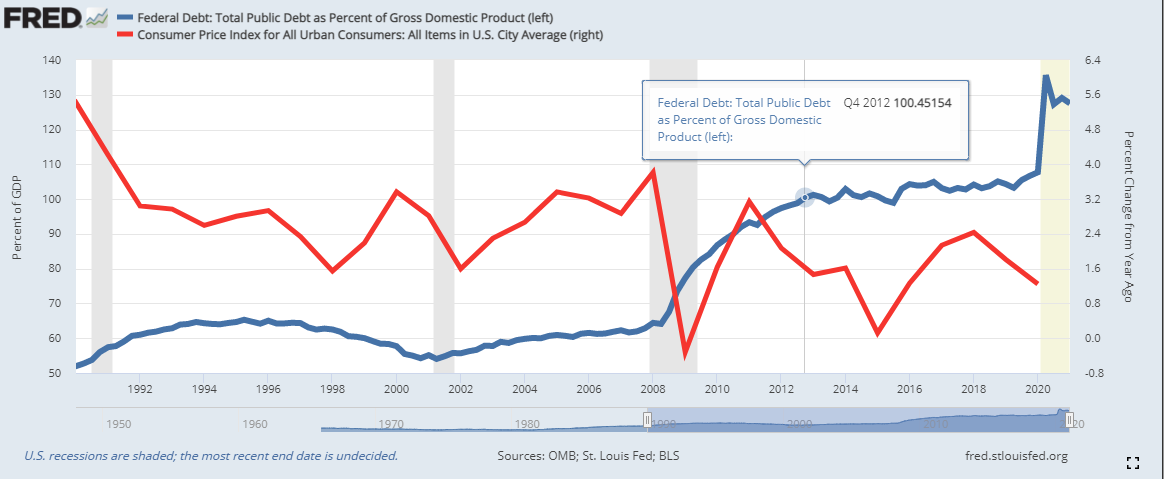
Reduced Debt growth (red line) causes recessions (vertical gray bars), and increased Debt growth cures recessions

U.S. depressions tend to come on the heels of federal surpluses.

1804-1812: U. S. Federal Debt reduced 48%. Depression began 1807.
1817-1821: U. S. Federal Debt reduced 29%. Depression began 1819.
1823-1836: U. S. Federal Debt reduced 99%. Depression began 1837.
1852-1857: U. S. Federal Debt reduced 59%. Depression began 1857.
1867-1873: U. S. Federal Debt reduced 27%. Depression began 1873.
1880-1893: U. S. Federal Debt reduced 57%. Depression began 1893.
1920-1930: U. S. Federal Debt reduced 36%. Depression began 1929.
1997-2001: U. S. Federal Debt reduced 15%. Recession began 2001.

Despite all of the above, self-proclaimed “experts” continue to claim that the federal debt is a “ticking time bomb.” Since 1940, they have made the same claim, and have been wrong.

Yet, they seem incapable of learning from failure, so they continue to disseminate the easily disproved nonsense:

……………………………………………………………………………………………………………………………………………………………………………………………………………………..

September 1940, the federal budget was a “ticking time-bomb which can eventually destroy the American system,” said Robert M. Hanes, president of the American Bankers Association.

At this time, the federal debt was $40 Billion.

September 26, 1940, New York Times, Column 8

By 1960: the debt was “threatening the country’s fiscal future,” said Secretary of Commerce, Frederick H. Mueller. (“The enormous cost of various Federal programs is a time-bomb threatening the country’s fiscal future, Secretary of Commerce Frederick H. Mueller warned here yesterday.”) At this time, the federal debt was $237 Billion.

By 1983: “The debt probably will explode in the third quarter of 1984,” said Fred Napolitano, former president of the National Association of Home Builders. At this time, the federal debt was $1,137 Billion.

In 1984: AFL-CIO President Lane Kirkland said. “It’s a time bomb ticking away.” At this time, the federal debt was $1,307 Billion.

In 1985: “The federal deficit is ‘a ticking time bomb, and it’s about to blow up,” U.S. Sen. Mitch McConnell. (Remember him?) At this time, the federal debt was $1,507 Billion.

Later in 1985: Los Angeles Times: “We labeled the deficit a ‘ticking time bomb’ that threatens to permanently undermine the strength and vitality of the American economy.” At this time, the federal debt was $1,507 Billion.

In 1987: Richmond Times–Dispatch – Richmond, VA: “100TH CONGRESS FACING U.S. DEFICIT ‘TIME BOMB’” At this time, the federal debt was $1,890 Billion.

Later in 1987: The Dallas Morning News: “A fiscal time bomb is slowly ticking that, if not defused, could explode into a financial crisis within the next few years for the federal government.”

In 1989: FORTUNE Magazine: “A TIME BOMB FOR U.S. TAXPAYERS” At this time, the federal debt was $2,191 Billion.

In 1992: The Pantagraph – Bloomington, Illinois: “I have seen where politicians in Washington have expressed little or no concern about this ticking time bomb they have helped to create, that being the enormous federal budget deficit, approaching $4 trillion.” At this time, the federal debt was $3,000 Billion.

Later in 1992: Ross Perot: “Our great nation is sitting right on top of a ticking time bomb. We have a total national debt of $4 trillion.” At this time, the federal debt held by the public was $3,000 Billion.

In 1995: Kansas City Star: “Concerned citizens. . . regard the national debt as a ticking time bomb poised to explode with devastating consequences at some future date.” At this time, the federal debt was $3,604 Billion.

In 2003: Porter Stansberry, for the Daily Reckoning: “Generation debt is a ticking time bomb . . . with about ten years left on the clock.” At this time, the federal debt was $3,913 Billion.

In 2004: Bradenton Herald: “A NATION AT RISK: TWIN DEFICIT A TICKING TIME BOMB” At this time, the federal debt was $4,926 Billion.

In 2005: Providence Journal: “Some lawmakers see the Medicare drug benefit for what it is: a ticking time bomb.” At this time, the federal debt was $4,592 Billion.

In 2006: NewsMax.com, “We have to worry about the deficit . . . when we combine it with the trade deficit we have a real ticking time bomb in our economy,” said Mrs. Clinton. At this time, the federal debt was $4,829 Billion.

In 2007: USA Today: “Like a ticking time bomb, the national debt is an explosion waiting to happen.” At this time, the federal debt was $5,035 Billion.

In 2010: Heritage Foundation: Why the National Debt is a Ticking Time Bomb. Interest rates on government bonds are virtually guaranteed to jump over the next few years.   At this time, the federal debt was $9,019 Billion.

In 2010: Reason Alert: “. . . the time bomb that’s ticking under the federal budget like a Guy Fawkes’ powder keg.” At this time, the federal debt was $9,019 Billion.

In 2011: Washington Post, Lori Montgomery: ” . . . defuse the biggest budgetary time bombs that are set to explode.” At this time, the federal debt was $10,129 Billion.

June 19, 2013: Chamber of Commerce: Safety net spending is a ‘time bomb’, By Jim Tankersley: The U.S. Chamber of Commerce is worried that not enough Americans are worried about social safety net spending. The nation’s largest business lobbying group launched a renewed effort Wednesday to reduce projected federal spending on safety-net programs, labeling them a “ticking time bomb” that, left unchanged, “will bankrupt this nation.” At this time, the federal debt was $11,983 Billion.

In 2014: CBN News: “The United States of Debt: A Ticking Time Bomb” At this time, the federal debt was $12,780 Billion.

On Jun 18, 2015: The ticking economic time bomb that presidential candidates are ignoring: Fortune Magazine, Shawn Tully. At this time, the federal debt was $13,117 Billion.

On February 10, 2016, The Daily Bell“Obama’s $4.1 Trillion Budget Is Latest Sign of America’s Looming Collapse” At this time, the federal debt was $14,168 Billion.

On January 23, 2017: Trump’s ‘Debt Bomb’: Deficit May Grow, Defense Budget May Not, By Sydney J. Freedberg, Jr. At this time, the federal debt was $14,665 Billion.

On January 27, 2017: America’s “debt bomb is going to explode.” That’s according to financial strategist Peter Schiff. Schiff said that while low interest rates had helped keep a lid on U.S. debt, it couldn’t be contained for much longer. Interest rates and inflation are rising, creditors will demand higher premiums, and the country is headed “off the edge of a cliff.” At this time, the federal debt held by the public was $14,665 Billion.

On April 28, 2017: Debt in the U.S. Fuel for Growth or Ticking Time Bomb?, American Institute for Economic Research, by Max Gulker, PhD – Senior Research Fellow, Theodore Cangeros. At this time, the federal debt held by the public was $14,665 Billion.

Feb. 16, 2018  America’s Debt Bomb By Andrew Soergel, Senior Reporter: Conservatives and deficit hawks are hurling criticism at Washington for deepening America’s debt hole. At this time, the federal debt held by the public was $15,750 Billion.

April 18, 2018 By Alan Greenspan and John R. Kasich: “Time is running short, and America’s debt time bomb continues to tick.”

January 10, 2019, Unfunded Govt. Liabilities — Our Ticking Time Bomb. By Myra Adams, Tick, tick, tick goes the time bomb of national doom. At this time, the federal debt held by the public was $14,665 Billion.

January 18, 2019; 2019 Is Gold’s Year To Shine (And The Ticking US Debt Time-Bomb) By Gavin Wendt

[The following were added after the original publishing of this article]

April 10, 2019, The National Debt: America’s Ticking Time Bomb.  TIL Journal. Entire nations can go bankrupt. One prominent example was the *nation of Greece which was threatened with insolvency, a decade ago. Greece survived the economic crisis because the European Union and the IMF bailed the nation out.

July 11, 2019National debt is a ‘ticking time bomb‘: Sen. Mike Lee

SEP 12, 2019, Our national ticking time bomb, By BILL YEARGIN SPECIAL TO THE SUN-SENTINEL | At some point, investors will become concerned about lending to a debt-riddled U.S., which will result in having to offer higher interest rates to attract the money. Even with rates low today, interest expense is the federal government’s third-highest expenditure following the elderly and military. The U.S. already borrows all the money it uses to pay its interest expense, sort of like a Ponzi scheme. Lack of investor confidence will only make this problem worse. At this time, the federal debt held by the public was $15,801 Billion.

JANUARY 06, 2020, National debt is a time bomb, BY MARK MANSPERGER, Tri City Herald | The increase in the U.S. deficit last year was about $1.1 trillion, bringing our total national debt to more than $23 trillion! This fiscal year, the deficit is forecasted to be even higher, and when the economy eventually slows down, our annual deficits could be pushing $2 trillion a year! This is financial madness. There’s not going to be a drastic cut in federal expenditures — that is, until we go broke — nor are we going to “grow our way” out of this predicament. Therefore, to gain control of this looming debt, we’re going to have to raise taxes.

February 14, 2020, OMG! It’s February 14, 2020, and the national debt is still a ticking time bomb!  The national debt: A ticking time bomb? America is “headed toward a crisis,” said Tiana Lowe in WashingonExaminer.com. The Treasury Department reported last week that the federal deficit swelled to more than $1 trillion in 2019 for the first time since 2012. Even more alarming was the report from the bipartisan Congressional Budget Office (CBO) predicting that $1 trillion deficits will continue for the next 10 years, eventually reaching $1.7 trillion in 2030

April 26, 2020, ‘Catastrophic’: Why government debt is a ticking time bomb, Stephen Koukoulas, Yahoo Finance  [Re. Monetarily Sovereign Australia’s debt.]

August 29, 2020LOS ANGELES, California: America’s mountain of debt is a ticking time bomb  The United States not only looks ill, but also dead broke. To offset the pandemic-induced “Great Cessation,” the US Federal Reserve and Congress have marshalled staggering sums of stimulus spending out of fear that the economy would otherwise plunge to 1930s soup kitchen levels. Assuming that America eventually defeats COVID-19 and does not devolve into a Terminator-like dystopia, how will it avoid the approaching fiscal cliff and national bankruptcy? At this time, the federal debt held by the public was $14,665 Billion.

March 17, 2021The Democrats’ ‘Big’ Infrastructure Plan: A Giant Debt Bomb? by Rachel Bucchino, a reporter at the National Interest. Her work has appeared in The Washington Post, U.S. News & World Report and The Hill. Congress basically has two options: borrowing money or raising taxes, whether it uses reconciliation or not,” Stan Veuger, a resident scholar in economic policy studies at the American Enterprise Institute, said.

Rodger Malcolm Mitchell

Monetary Sovereignty Twitter: @rodgermitchell Search #monetarysovereignty Facebook: Rodger Malcolm Mitchell

……………………………………………………………………..

THE SOLE PURPOSE OF GOVERNMENT IS TO IMPROVE AND PROTECT THE LIVES OF THE PEOPLE.

The most important problems in economics involve:

  1. Monetary Sovereignty describes money creation and destruction.
  2. Gap Psychology describes the common desire to distance oneself from those “below” in any socio-economic ranking, and to come nearer those “above.” The socio-economic distance is referred to as “The Gap.”

Wide Gaps negatively affect poverty, health and longevity, education, housing, law and crime, war, leadership, ownership, bigotry, supply and demand, taxation, GDP, international relations, scientific advancement, the environment, human motivation and well-being, and virtually every other issue in economics. Implementation of Monetary Sovereignty and The Ten Steps To Prosperity can grow the economy and narrow the Gaps: Ten Steps To Prosperity:

  1. Eliminate FICA
  2. Federally funded Medicare — parts A, B & D, plus long-term care — for everyone
  3. Social Security for all
  4. Free education (including post-grad) for everyone
  5. Salary for attending school
  6. Eliminate federal taxes on business
  7. Increase the standard income tax deduction, annually. 
  8. Tax the very rich (the “.1%”) more, with higher progressive tax rates on all forms of income.
  9. Federal ownership of all banks
  10. Increase federal spending on the myriad initiatives that benefit America’s 99.9% 

The Ten Steps will grow the economy and narrow the income/wealth/power Gap between the rich and the rest.

MONETARY SOVEREIGNTY
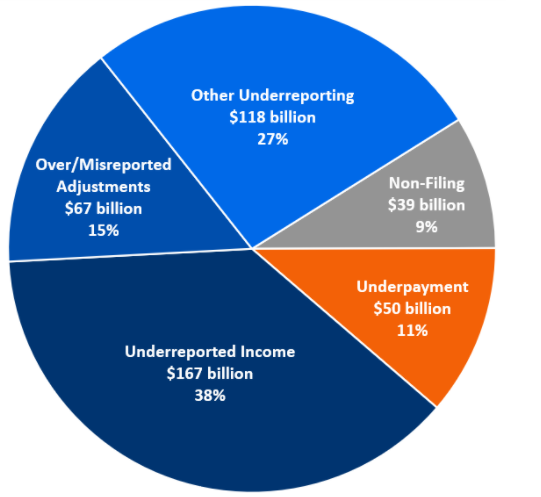


Percentages of people who failed to throw their dollars into the IRS bonfire

Those who understand Monetary Sovereignty are familiar with these basics:
  1. The federal government, being Monetarily Sovereign, has the unlimited ability to create its sovereign currency, the U.S. dollar.
  2. Thus, unlike state and local governments, which are monetarily non-sovereign, the federal government cannot unintentionally run short of U.S. dollars.
  3. The federal government pays for all its spending by creating new dollars, ad hoc.
  4. It creates dollars by sending instructions, (“Pay to the order of”) to each creditor’s bank, instructing the bank to increase the balance in the creditor’s checking account.
  5. The instant the bank obeys those instructions, new dollars are created and added to the M1 money-supply measure.
  6. So, even if all federal tax collections ceased, the federal government could continue spending, forever.
  7. In fact, no form of income, whether taxing or borrowing, provides spending dollars to the federal government.
  8. Tax dollars sent to the federal government leave the economy. They leave the M1 money-supply measure and effectively are destroyed upon receipt.
  9. The purpose of federal taxes is to control the economy, by taxing what the government wishes to discourage, and by giving tax breaks to what the government wishes to encourage. That is why the very rich, who own Congress and the President, are given such generous tax breaks that the richest pay little or no taxes at all.
In essence, you might as well throw your tax dollars into a bonfire, for all the good they do to prevent federal government insolvency. In return for your obeying the law, the Treasury does you the service of throwing your dollars into that federal bonfire, so you don’t have to bother. The Committee for a Responsible Federal Budget (CRFB), in bemoaning the lack of tax-payment compliance in America, has published the following graph. Presumably, the graph is meant to make you feel outrage about so many people having refused or neglected to throw their dollars into the IRS bonfire.

PERCENT OF PEOPLE WHO HAVE FAILED TO THROW THEIR DOLLARS INTO THE FEDERAL BONFIRE

In reality, the outrage you feel should be directed at the politicians and groups like the CRFB. They are the ones who claim that the federal government either can’t afford to, or must raise taxes to, provide free Medicare for All, Social Security for All, College for All, reduced carbon emissions, improved infrastructure, air, water, and land, narrowed Gap between the rich and the rest, etc. The U.S. Congress, having unlimited disposable dollars, could and should be doing so much more to improve your life. Instead, they argue about whether spending by the federal government has exceeded the government’s “means” (It has no “means” to exceed), or whether federal spending is “socialism” (It isn’t), or whether the poor will refuse to work if given financial aid (They won’t refuse if the aid is on top of, rather than instead of salaries). President Richard Nixon, a Republican, gave us Monetary Sovereignty by eliminating the last gold standard, so it is a special disgrace that the current Republican Party now refuses to use the most valuable asset any nation can have: Unlimited money. Rodger Malcolm Mitchell Monetary Sovereignty Twitter: @rodgermitchell Search #monetarysovereignty Facebook: Rodger Malcolm Mitchell ………………………………………………………………………………………………………………………………

THE SOLE PURPOSE OF GOVERNMENT IS TO IMPROVE AND PROTECT THE LIVES OF THE PEOPLE.

The most important problems in economics involve:
  1. Monetary Sovereignty describes money creation and destruction.
  2. Gap Psychology describes the common desire to distance oneself from those “below” in any socio-economic ranking, and to come nearer those “above.” The socio-economic distance is referred to as “The Gap.”
Wide Gaps negatively affect poverty, health and longevity, education, housing, law and crime, war, leadership, ownership, bigotry, supply and demand, taxation, GDP, international relations, scientific advancement, the environment, human motivation and well-being, and virtually every other issue in economics. Implementation of Monetary Sovereignty and The Ten Steps To Prosperity can grow the economy and narrow the Gaps: Ten Steps To Prosperity:
  1. Eliminate FICA
  2. Federally funded Medicare — parts A, B & D, plus long-term care — for everyone
  3. Social Security for all
  4. Free education (including post-grad) for everyone
  5. Salary for attending school
  6. Eliminate federal taxes on business
  7. Increase the standard income tax deduction, annually. 
  8. Tax the very rich (the “.1%”) more, with higher progressive tax rates on all forms of income.
  9. Federal ownership of all banks
  10. Increase federal spending on the myriad initiatives that benefit America’s 99.9% 
The Ten Steps will grow the economy and narrow the income/wealth/power Gap between the rich and the rest.

MONETARY SOVEREIGNTY


Rick Scott shovels the myth

Senator Rick Scott is a Floridian. He is a Republican. And he is a Trumper.
Official Portrait of Senator Rick Scott (R-FL).jpg
Would this face lie to you?
He sent me a form letter telling me how he is going to improve my life:
(Republican) Senator Rick Scott led his colleagues in introducing the Federal Debt Emergency Control Act to rein in Washington’s out-of-control spending and provide a concrete path forward to tackle the nation’s nearly $30 trillion debt.
“Out-of-control” is a synonym for “Gosh, that’s a lot of money to waste on the poor.” In fact, the “Out-of-control” spending is controlled by Congress, of which Republican Senator Rick Scott is a part. This is the same Republican Congress that gave the rich a vast, over-budget tax reduction, without a whimper from Senator Rick Scott. Suddenly, with a Democratic majority Congress and Presidency, the Republicans have re-discovered federal deficits. And they are “shocked, shocked I tell you.” “Out of control” also is a synonym for “ticking time bomb,” about which we have written several times. It’s the bomb that for 80+ years, debt haters have been telling you is ready to explode. Yet, here we are. No explosion. Economic growth. Decades of low inflation.
The Federal Debt Emergency Control Act requires the Office of Management and Budget to declare a “Federal Debt Emergency” in any fiscal year where the federal debt exceeds 100% of that year’s Gross Domestic Product (GDP).
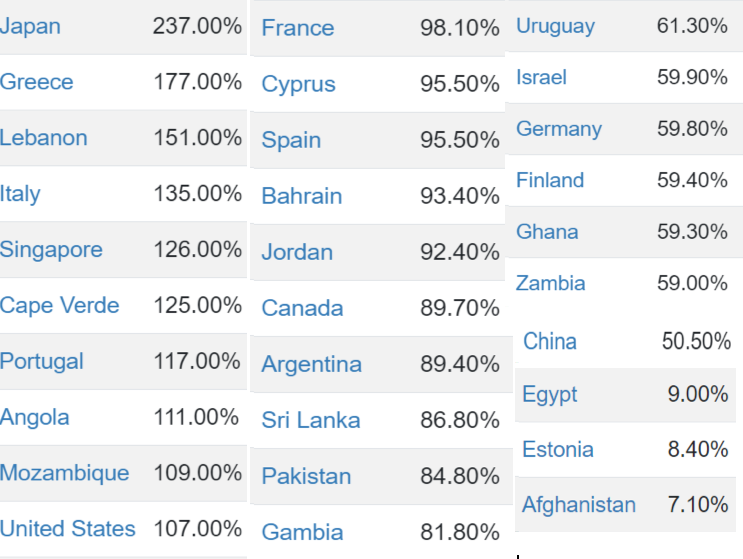
Why the 100% figure? There’s no reason for it other than ignorance. The ratio of federal debt to GDP has absolutely no significance regarding the health of the U.S. economy. It’s a useless, meaningless ratio that gets fire-breathed with alarm by those who either know nothing about economics, or worse, want you to know nothing about economics. If (Republican) Senator Rick Scott is right, you would expect the sickest, weakest economies to have the highest Debt/GDP ratios, while the healthiest, weakest economics have the lowest Debt/GDP ratios. But what do we find? Here are some examples:

Sample Nations: DEBT / GDP Ratios

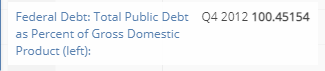
Based on the above ratios, which nations would you say have the strongest, healthiest economies, and which have the weakest, sickest economies? Right. The Debt/GDP ratio tells you exactly nothing about the health or strength of a nation’s economy. But Republican Senator Rick Scott wants to cut federal spending as soon as our ratio hits the arbitrary and meaningless number: 100% (which it already did way back in the 4th qtr of 2012 — blue line). And by the way, inflation (red line), the current Republican excuse for cutting benefits for the poor, has averaged below the Fed’s 2% target.
This emergency designation would trigger several provisions to help control and reduce the federal debt to levels below 100% of GDP, including: Terminating any unobligated funding from the American Rescue Plan Act, and any previous stimulus bills, and sending it back to the Treasury General Fund immediately for deficit reduction.
He’s not specific about what should be cut. He just wants to cut “any unobligated funds,” no matter how vital to the economy and the people they may be. Exactly what is supposed to happen in the Treasury General Fund for deficit reduction? What is the “it” he wants to send back? Which dollars are not to be spent? The whole thing is financially senseless, but it is a classic right-wing approach. The American Rescue Plan Act and the previous stimulus bills rescued America from the severe recession that was exacerbated by Donald Trump’s incompetent and deadly COVID denial along with his economically damaging trade duty war against China. Scott is silent about that. Scott never says. Why? Because, being a Republican, he would cut all the spending that benefits the poor and middle classes, while falsely claiming that the rich are “job makers” who should be rewarded even more than they already are.
Requiring all legislation that increases the federal deficit, as determined by the Congressional Budget Office, to carry its own offsets.
This means running a balanced budget, perhaps the least intelligent idea ever to come out of any Congressperson’s mouth because: A balanced federal budget is absolutely, positively guaranteed to cause a deep recession if we are lucky, or a deep depression if we are not lucky. If you can find anyone on this planet who can demonstrate how running a balanced federal budget would allow for economic growth and/or prevent a depression, I would love to see the evidence. Perhaps the same person also can prove that global warming is a Chinese myth, and that Donald Trump actually won the election — two equally nutsy claims coming from the GOP.
If it does not, the legislation shall be considered out of order and will require at least two-thirds of all Senators to vote to increase federal debt before even being able to consider the bill.
Wait! What if two-thirds of all Senators were, by some miracle, to vote to increase the federal debt, would that mean it then becomes OK? Suddenly it would be within the government’s “means”? And, don’t we already have the ridiculous federal “debt limit,” that not only does the same thing, but is raised every time it’s reached? And why is the debt limit always raised? Because, Congress is well aware that limiting federal debt would destroy the U.S. economy.
Fast-tracking any legislation that would reduce the federal deficit by at least 5 percent over ten years.
Where did that 5% number come from? It surely wasn’t derived by any scientific method. Scott apparently thinks it’s a nice number, so he uses it. It reminds one of dearly departed Herman Cain’s meaningless “9-9-9” tax plan. Just numbers with no real reason. And where is the math that says reducing the federal deficit would benefit the economy in some way? Non-existent.
Senator Rick Scott said, “America is in a debt crisis. Our nation is barreling toward $30 trillion in debt – an unimaginable $233,000 in debt for every family in America.
It’s not that families owe that debt. The government does. But Scott tries to imply, falsely, that your family will have to pay for that debt.
It’s a crisis caused by decades of wasteful and reckless spending by Washington politicians. Now, President Biden is continuing this way of governing by pushing for trillions in wasteful spending, raising the U.S. federal debt by 60% to $39 trillion and the debt-to-GDP ratio to 117% in 2030, the highest level ever recorded in American history.
And what has been the result of all this “wasteful and reckless spending? Taxes are down and GDP is up. But Scott wants to fix that, by raising taxes and/or reducing GDP.
Spending beyond our means has consequences.
The federal government, being Monetarily Sovereign, has no “means.”
We’re already seeing rising inflation, which disproportionately hurts the poorest families, like mine growing up.
The “rising inflation,” which for decades has been below Federal goals, is the result of the pandemic, not the result of federal spending. It was the pandemic, and Trump’s atrocious handling of it, that led to the shortages of goods and services, that resulted in a thoroughly predictable inflation. Someone, please ask Sen. Scott, “Where was the inflation last year and the year before, and the decades before, when deficit spending was massive?” And yes, we caught that “I grew up poor” disgusting attempt at ingratiating yourself with the people you are trying to screw. But hey, as long as you’re talking about your history, let’s get into where your calculations might have come from:
In 1987, after serving in the United States Navy and becoming a law firm partner, Scott co-founded Columbia Hospital Corporation. Columbia later merged with another corporation to form Columbia/HCA, which eventually became the nation’s largest private for-profit health care company. Scott was pressured to resign as chief executive of Columbia/HCA in 1997. During his tenure as chief executive, the company defrauded Medicare, Medicaid and other federal programs. The Department of Justice ultimately fined the company $1.7 billion in what was at the time the largest health care fraud settlement in U.S. history.
And this fraudster is the guy who suddenly has become so concerned about the federal government’s “means” and its ability to pay its bills. No wonder this criminal is a Trumper. “Birds of a feather,” as they say. He must have envied Trump University.
I look forward to every fiscally responsible Republican and Democrat working with me to quickly pass the Federal Debt Emergency Control Act.”
Yes, do vote for good old “fiscally responsible” Rick Scott, who can hardly wait to cut benefits to the poor, while driving the economy into a depression, thus allowing his rich backers to buy up property and businesses at discount prices, while paying workers depression-era wages. And, there are people who actually believe this guy! Strange. Fortunately, with a currently Democratic Congress and President, this idiotic ploy has no chance to pass, and least not in the near future. And it wasn’t meant to pass. There isn’t a new idea in the entire proposal. It’s a rehash of all the discredited nonsense that has been floated by populists for decades.  It was assembled in a half-hour as a political stunt to show how fiscally sound is the do-nothing, historically crooked Senator from Columbia/HCA. Rodger Malcolm Mitchell Monetary Sovereignty Twitter: @rodgermitchell Search #monetarysovereignty Facebook: Rodger Malcolm Mitchell ………………………………………………………………………………………………………………………………

THE SOLE PURPOSE OF GOVERNMENT IS TO IMPROVE AND PROTECT THE LIVES OF THE PEOPLE.

The most important problems in economics involve:
  1. Monetary Sovereignty describes money creation and destruction.
  2. Gap Psychology describes the common desire to distance oneself from those “below” in any socio-economic ranking, and to come nearer those “above.” The socio-economic distance is referred to as “The Gap.”
Wide Gaps negatively affect poverty, health and longevity, education, housing, law and crime, war, leadership, ownership, bigotry, supply and demand, taxation, GDP, international relations, scientific advancement, the environment, human motivation and well-being, and virtually every other issue in economics. Implementation of Monetary Sovereignty and The Ten Steps To Prosperity can grow the economy and narrow the Gaps: Ten Steps To Prosperity:
  1. Eliminate FICA
  2. Federally funded Medicare — parts A, B & D, plus long-term care — for everyone
  3. Social Security for all
  4. Free education (including post-grad) for everyone
  5. Salary for attending school
  6. Eliminate federal taxes on business
  7. Increase the standard income tax deduction, annually. 
  8. Tax the very rich (the “.1%”) more, with higher progressive tax rates on all forms of income.
  9. Federal ownership of all banks
  10. Increase federal spending on the myriad initiatives that benefit America’s 99.9% 
The Ten Steps will grow the economy and narrow the income/wealth/power Gap between the rich and the rest. MONETARY SOVEREIGNTY    
What is the purpose of government? What is the purpose of business? What are their goals and methods?

We are not born with governments and businesses. We create them. But why?

Why do people voluntarily allow themselves to be ruled by others? You might believe it is not necessarily voluntary, particularly in the case of dictatorial governments.

But there always are vastly more ruled than rulers, and if government was not what the ruled wanted — if government was a burden — they have the numerical power to rid themselves of this device.

Sometimes this happens. Sometimes the governed rise up and free themselves of dictators. And when they do, what happens?

They form another government.Brexit: Rediscovering Europe as a win-win project – EURACTIV.com

So what is the purpose of this institution that virtually all humans and even some animals have adopted.?

It has persisted for millennia, so it clearly has an evolutionary advantage.

While one can list several specific purposes, there is one general, overall purpose of government:

The purpose of government is to improve the lives of the people.

Government is a form of mandated cooperation. Having a government says two things:

  1. Cooperation is more efficient than working individually, and
  2. Cooperation works better when there is leadership

So we give up our individual freedoms and rights to reap the benefits of cooperation and leadership. In that sense, businesses are very much like governments.

We form businesses because specialization is more efficient than the “jack-of-all-trades” who most often is “master-of-none.”

To accomplish this efficiency, businesses are formed as legal mini-governments, complete with rulers and the ruled.

Governments tell people what to do and what not to do, and the people allow this because it improves their lives.

Business owners and managers tell their people what to do and what not to do, and the people allow this, because it improves their lives.

The purpose of business is to improve the lives of the people.

That said, it is crucial not to confuse purpose with goal. While improving the lives of the people is the purpose of government and business, it is not the goal of government and business.

The goal of government and business is to improve the lives of the leaders.

The leaders accomplish this goal via several methods.

In analyzing government and business, we not only must consider purpose and goal but also, method. Governments essentially balance two methods: Providing benefits and applying force.

The benefits — food, clothing, shelter, medical care, entertainment — lead to acquiescence among the populace.

Government force — laws, police, military — does the same. Either way discourages action against the leaders.

Businesses also balance two methods: Providing benefits and force. The benefits are promotion, salary, and perks, while the force is demotion and firing.

Again, business and government use similar methods — the carrot and the stick — to reach their goals.

Keep the purpose, the goals, and the methods of business and government in mind as we discuss the following articles.

Pay a Living Wage or ‘Flip Your Own Damn Burgers’: Progressives Blast Right-Wing Narrative on Jobs Posted on May 8, 2021 by Yves Smith
Yves here. Glad to see someone is calling out the Republican “You need to keep them hungry so they’ll turn up” approach to labor management.
Corporate profit share of GDP has been record highs for years, which means nearly two times the level Warren Buffett deemed to be unsustainably high in the early 2000s.
Time for corporate owners to pay a decent wage.
By Kenny Stancil, staff writer at Common Dreams. Originally published at Common Dreams
………………………………………………………………………………………………………………………………………………
The U.S. Chamber of Congress blamed last month’s weak employment growth on the existence of a $300 weekly supplemental jobless benefit and began urging lawmakers to eliminate the federally enhanced unemployment payments that were extended through early September when congressional Democrats passed President Joe Biden’s American Rescue Plan.
“No. We don’t need to end [the additional] $300 a week in emergency unemployment benefits that workers desperately need,” Sen. Bernie Sanders (I-Vt.) said in response to the grumbles of the nation’s largest business lobbying group.
“We need to end starvation wages in America.”
“If $300 a week is preventing employers from hiring low-wage workers there’s a simple solution,” Sanders added. “Raise your wages. Pay decent benefits.”
According to the Chamber’s analysis, the extra $300 unemployment insurance (UI) benefit results in roughly one in four recipients taking home more pay than they earned working.
In response to that claim, Sanders’ staff director Warren Gunnels said: “If one in four recipients are making more off unemployment than they did working, that’s not an indictment of $300 a week in UI benefits. It’s an indictment of corporations paying starvation wages.”

The problem: Government believes that the more benefits government gives to workers, the more likely the government’s goal — improving the lives of the political leaders by acquiring votes — will be reached.

Business believes that keeping salaries low will improve business’s goal of improving the lives of business leaders by increasing profits.

Today, Government benefits to the people are high enough that going to work provides little marginal benefit for many people.

The Republican proposed method is for the government to stop paying benefits, so that workers will be starved back to work, and business profits will keep increasing.

The Democratic proposed method is for businesses to pay more — enough to tempt workers to forego government benefits, but this may reduce profits.

While both goals are different, and the methods may seem incompatible, the solution is mind-numbingly simple: Do both.

Rather than the current either/or of government benefits coming instead of business benefits, as unemployment compensation does, pay government benefits in addition to business benefits.

This would come under the heading:

Medicare for All, Social Security for All, Free College for All, etc.

A wage of $300 per week is at poverty levels. It is a starvation wage. It is an “abandon all hope” wage.

How a multi-billionaire, a person whose wealth measures up to $170 billion could countenance such a wage, is beyond cruel.

Do these people lack all sense of sympathy and empathy? Are they made of compassionless stone?

Well, yes. Compassion comes from Latin, and means “co-suffering,” as in “I feel your pain.” But how many of us really do feel someone else’s pain?

Keep in mind, the goal of business is to improve the lives of the leaders, and the leaders are certain that keeping costs down, which leads to keeping salaries down, will improve profits and thereby improve their lives.

“Raise your wages and benefits or flip your own damn burgers and sweep your own damn floors,” Gunnels added.
Other progressives like former labor secretary Robert Reich and Rep. Alexandria Ocasio-Cortez (D-N.Y.) also chimed in. “We do not have a shortage of willing workers in this country,” Morris Pearl of the Patriotic Millionaires said in a Friday afternoon statement responding to the Chamber. “We have a shortage of employers who are willing to pay workers enough to live.”
“Claiming that today’s disappointing jobs report is a result of expanded unemployment insurance is nothing more than a cruel tactic to pressure the administration into helping companies that they represent to continue to underpay and exploit their workforce,” Pearl continued.
“Our leaders are supposed to be helping to increase wages for low paid workers, not helping employers to keep wages down.”
“Instead of blaming struggling workers,” Pearl continued, “large corporations that do not pay their employees a liveable wage… should take this moment to self-reflect.
Maybe—just maybe—paying their workers more than starvation wages would incentivize workers to reenter the workforce.”

Yes, this is all true, but it ignores the true goal of business: Profits that enrich the leaders.

One might argue that paying workers more will make the workers bigger consumers who in buying more will enrich companies, but that too ignores reality.

If Company “A” pays its workers more, those workers may spend more, but not necessarily with Company “A.”

If Ford raises wages, nothing says those newly enriched workers will, out of the goodness of their hearts, buy Fords.

The public has as little compassion as do the business executives. The people who formerly were myriad small-business customers, but now are Amazon customers, have proved that.

Loyalty is something honored more in the breach.

Writing for Jacobin earlier this week, Sandy Barnard noted that another overlooked factor is the increased morbidity rates among food and agricultural workers, which increased more than any other occupation during the Covid-19 pandemic.

Is big agriculture supposed to have such guilt that workers immediately are given raises? Dream on.

“Living, breathing people… have decided they do not want to risk their lives for $7.25 per hour and no health benefits,” Barnard wrote.
Rep. Ilhan Omar (D-Minn.) responded to the Chamber’s call for an end to enhanced unemployment benefits by arguing that “the interests of big business are at war with the interests of the working class.”

And that is the fundamental problem. It is a war, with one side winning and the other sides losing.

The solution is for all sides — government, business, and the populace — to win.

Government can win — win votes, that is — by providing benefits.

Business can win by paying enough to attract workers — while remaining profitable. The populace can win by receiving benefits from both sides, from government and from business.

There absolutely will be no long-term solutions that involve either business, government, or the people losing.

The only intelligent solution is for all sides to get what they want, or at least to get enough of what they want. See the Ten Steps to Prosperity, below.

…………………………………………………………………………

Rodger Malcolm Mitchell [ Monetary Sovereignty, Twitter: @rodgermitchell, Search: #monetarysovereignty Facebook: Rodger Malcolm Mitchell ]

THE SOLE PURPOSE OF GOVERNMENT IS TO IMPROVE AND PROTECT THE LIVES OF THE PEOPLE. The most important problems in economics involve:

  • Monetary Sovereignty describes money creation and destruction.
  • Gap Psychology describes the common desire to distance oneself from those “below” in any socio-economic ranking, and to come nearer those “above.” The socio-economic distance is referred to as “The Gap.”

Wide Gaps negatively affect poverty, health and longevity, education, housing, law and crime, war, leadership, ownership, bigotry, supply and demand, taxation, GDP, international relations, scientific advancement, the environment, human motivation and well-being, and virtually every other issue in economics. Implementation of Monetary Sovereignty and The Ten Steps To Prosperity can grow the economy and narrow the Gaps: Ten Steps To Prosperity:

  1. Eliminate FICA
  2. Federally funded Medicare — parts A, B & D, plus long-term care — for everyone
  3. Social Security for all
  4. Free education (including post-grad) for everyone
  5. Salary for attending school
  6. Eliminate federal taxes on business
  7. Increase the standard income tax deduction, annually.
  8. Tax the very rich (the “.1%”) more, with higher progressive tax rates on all forms of income.
  9. Federal ownership of all banks
  10. Increase federal spending on the myriad initiatives that benefit America’s 99.9% 


The Ten Steps will grow the economy and narrow the income/wealth/power Gap between the rich and the rest.

MONETARY SOVEREIGNTY