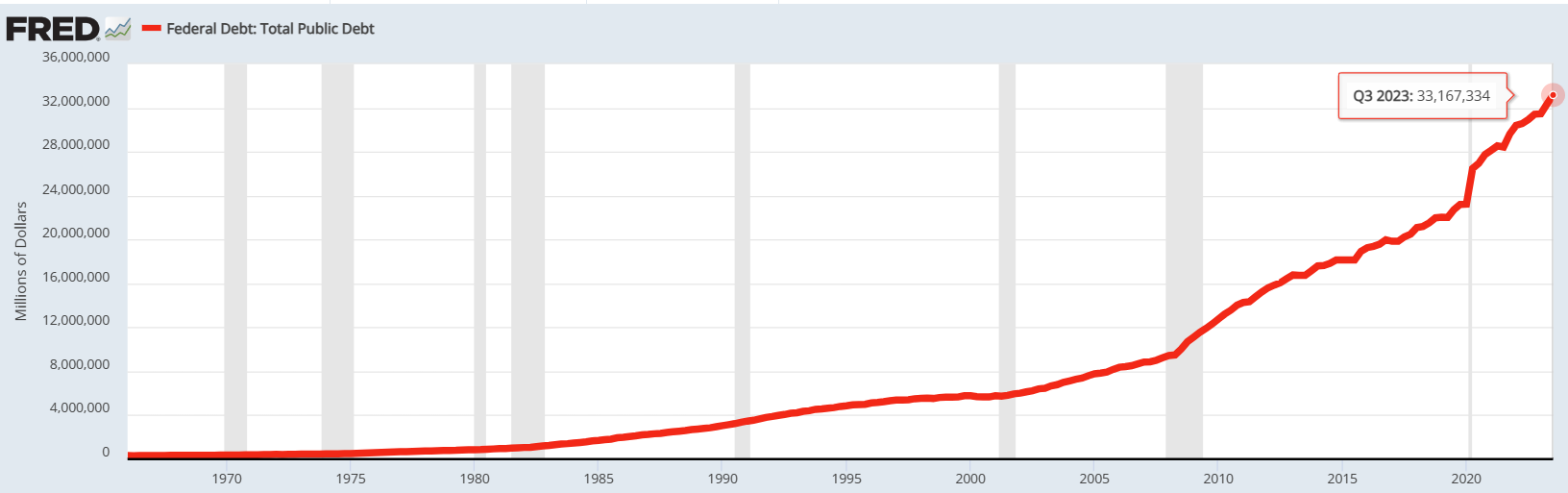
“As the U.S. faces the consequences of runaway pandemic spending and deficitsthat could add $25 trillion to our existing $36 trillion national debtover the next decade, “neither party is serious” about tackling the problem.”
“The so-called ‘debt’ is nothing more than the total of deposits in T-security accounts at the Federal Reserve—a form of savings for the private sector, not actual borrowing.”
So, calling it a “national debt” is actually misleading. It’s not something the U.S. must “repay” in any traditional sense. It’s more accurate to think of it as net financial assets that the federal government has injected into the private sector.
The so-called debt has risen, as the above graph demonstrates. It was very high during World War II, then fell to nearly nothing post-war.
But to cure the 2008 recession, it began its dramatic rise, which has Ms. de Rugy and virtually every other economist all aflutter. As she said:
“With Washinton in a state of bipartisn denial,’ the debt crisis will only get worse.’”
What exactly is the “debt crisis”? She never says. Actually, no one ever says what that “crisis” is. In fact, all the data seem to show that as the “debt” rises, the economy grows:
Gross Domestic Product grew dramatically as federal “debt” rose.
Along with fears about the federal “debt,” economists seem to shudder about the Debt/GDP ratio. We often have been told that when the ratio reaches 50%, 80%, 100%, or some other arbitrary number, then awful things will happen.
But they never happen.
The debt/GDP ratio now has exceeded 100%, and the economy continues to grow.
In our earlier posts, we demonstrated that the debt-to-GDP ratio is not a meaningful indicator. It does not predict the federal government’s ability to pay its debts (Its ability is infinite). The ratio does not show anything. See: “Enough already with the Debt/GDP ratio“)
What has been missing from all those claims is specificity. What exactly is the problem with high federal debt?
Here are some general claims, none of which is supported by data:
Higher Interest Rates
Claim: As the government “borrows more,” it competes with private borrowers, driving up interest rates (the “crowding out” argument).
No data supports this. The Fed sets interest rates. The U.S. doesn’t borrow in a market-driven way; it issues currency. So interest rates are a policy choice, not a supply-and-demand issue. There is no evidence that the vastly increased debt has forced interest rates up.
Inflation
Claim: More government spending = more money = inflation.
No data supports this: All inflations are caused by shortages, not “too much money.” Deficit spending that eases shortages (labor, housing, energy) can reduce inflation. The solution to inflation is targeted spending, not austerity. There is no relationship between federal spending and inflation. See: “At long last, let’s put this inflation question to bed.“
Debt Service Becomes Unsustainable
Claim: As debt rises, so do interest payments, “crowding out” other spending.
No data supports this: The federal government can always pay interest in its own currency. And again, it chooses interest rates. There’s no risk of involuntary default. There is no evidence that the vastly increased debt has crowded out private borrowers.
Burden on Future Generations
Claim: Today’s borrowing saddles future taxpayers with repayment.
No data supports this: Taxes don’t fund federal spending. “Paying off the debt” is just swapping Treasury securities (savings) for cash. No burden is passed on—future generations inherit the assets, not a liability.
Loss of Investor Confidence / Currency Collapse
Claim: If debt gets too high, investors may stop buying Treasuries, or the dollar could collapse.
No data supports this. Treasuries aren’t “bought” to fund the government—they’re offered as a place to park dollars that already exist. The government doesn’t need to entice buyers—it creates the dollars it spends. Plus, confidence in the dollar is based on productive capacity and stability, not some debt-to-GDP ratio.
SUMMARY
The so-called “federal debt” isn’t federal (the dollars in Treasury Securities are owned by the depositors, not by the government) or debt(the government merely holds the dollars for safekeeping, as with a bank safe deposit box).
It poses no threat to, or burden on, the government or the public.
The entire debt story is designed to convince the public to forego some of the benefits the federal government provides.
As Ms. de Rugy claims, “Republicans, for their part, try to convince voters they care about the deficit but feed the delusion that they can balance the budget through discretionary spending cuts that leave Social Security and Medicare untouched.”
That is the story the wealthy tell. They want to cut social programs to widen the income/wealth/power Gapbetween them and the rest of America. The wider the Gap, the richer are the wealthy.
I can’t say whether Ms. de Rugy is in cahoots with the rich or merely ignorant of Monetary Sovereignty. Still, articles like hers greatly damage the nation’s economy and people.
Economics is a science loaded with data, but economists don’t believe the data.
As you read this post, think about these two simple questions. What would happen if your city, county, and state stopped collecting taxes. What would happen if the U.S. government stopped collecting taxes?
Later, if you’re in school, you can ask your economics professor. See if he/she knows.
—–/////—–
“Rich” is a comparative. A person earning $100,000 is rich if everyone else earns $10,000. But that person earning $10,00 is rich if everyone else earns $1,000.
The income/wealth/power Gap below you and above you determines how rich you are. The average annual income in 1930 was about $4,800. Adjusted for inflation, that’s equivalent to $85,000 today.
Thus, the wealthy need to make you poorer to make themselves richer. Here is how they plan to do it:
Graham commented while debating Sen. Bernie Sanders during a “Senate Project” debate.
There is not one legitimate reason why seniors will “have to” take less or pay more. Not one. The U.S. federal government, being Monetarily Sovereign, cannot run short of dollars.
Alan Greenspan: “A government cannot become insolvent with respect to obligations in its own currency. There is nothing to prevent the federal government from creating as much money as it wants and paying it to somebody. The United States can pay any debt it has because we can always print the money to do that.”
And because the federal government cannot become insolvent, no federal government agency can become insolvent unless that is what Congress and the President want.
Social Security and Medicare are not funded by FICA taxes or other taxes. Like every other federal agency, these agencies, including Congress, the Supreme Court, the White House, the armed services, etc., are funded by new dollar creation.
Ben Bernanke:“The U.S. government has a technology, called a printing press (or, today, its electronic equivalent), that allows it to produce as many U.S. dollars as it wishes at essentially no cost.”
Keep these facts in mind as you read the following:
Senator Sanders: Bring your Social Security plan to the floor. All it does is raise taxes. People like me must take a little less and pay a little more to get out of this mess.
Quote from 60 Minutes: Scott Pelley: Is that tax money that the Fed is spending? Ben Bernanke: It’s not tax money… We simply use the computer to mark up the size of the account.
Even Sanders, a proponent of Medicare for All and increased Social Security parrots the Big Lie that federal taxes fund federal spending.
We must adjust the age again like Ronald Reagan and Tip — Tip O’Neil did. There is a bipartisan way forward. You describe problems, but your answer is always the government — it’s always socialism,” Graham said.
Graham deceivingly uses the epithet “socialism.” But it’s not socialism. Socialism is government ownership and control, not government funding.
Strangely, he doesn’t use that word when describing his own salary, which, in fact, is socialism, as is the Veteran’s Administration Hospitals, the military, and the U.S. court system.
The cost of supporting SCOTUS, POTUS, Congress, and many other approximately 1,000 federal agencieshas increased, but we don’t hear that spending for those agencies needs to be cut.
Instead, federal spending goes up to accommodate increased needs. In 2023, the federal government spent $1.7 trillion more than it collected in taxes.
The federal government has spent over $33 TRILLION more than it has collected in taxes.
The federal government has spent over $33 TRILLION more than it has collected in taxes. Yet, the government has no problem paying its creditors.
Federal deficits are not a burden or obligation on anyone. A federal deficit is merely the number of growth dollars the government pumps into the economy. You and I don’t owe those dollars. Even the government doesn’t owe those dollars. They have already been paid to creditors.
No one owes the federal deficit or debt. Those are just record-keeping numbers.
Why, then, do people who know better (or should know better) talk about having to raise taxes?
Sanders admitted that Social Security “has a solvency issue,” but his proposal — also backed by Sen. Elizabeth Warren — would extend solvency for 75 years while increasing benefits for recipients by $2,400 per year.
Sanders’s proposal would ostensibly fund this expansion of Social Security via a tax on high-earning households, per CNBC.
While I have no object to a tax on high-earning households, it has several problems:
It would have trouble passing Congress, whose members are bribed by the rich not to tax wealthy folk.
Even if high-income were taxed at higher rates, the rich don’t pay those rates. They slip through tax loopholes Congress has given them.
Most importantly, Social Security does not have a “solvency issue,” nor do taxes fund Social Security.
Social Security has an ignorance issue — Congress, the President, and the public wrongly claim FICA funds Social Security (and Medicare).
President Franklin D. Roosevelt, the originator of Social Security, instituted the FICA tax not to fund Social Security but to protect it. “We put those payroll contributions there to give the contributors a legal, moral, and political right to collect their pensions… With those taxes in there, no damn politician can ever scrap my Social Security program.”
Little did he expect that the “damn politicians” would find a way to kill Social Security by the death of a thousand cuts.
It resulted from a series of administrative rulings issued by the Treasury Department in the program’s early years.
In 1983, GOP President Ronald Reagan and Congress changed the law by explicitly authorizing the taxation of Social Security benefits. This was part of the 1983 Amendments, and this law overrode the earlier administrative rulings from the Treasury Department.
Aside from the fact that federal taxes don’t fund federal spending, the federal government taxing its own benefits — the right hand gives, and the left hand takes away — defies logic.
And here is the ultimate irony. People who earn more receive higher benefits. Why?
Why does a person earning $100,000 a year receive higher Social Security benefits than a person earning $30,000 a year? Shouldn’t it be the other way around?
Federal poverty benefits are based on how littleyou earn. But Social Security is based on how muchyou earn. It’s a senseless formula based on the Big Lie that federal taxes fund federal spending.
Federal taxes fund nothing. The purposes of federal taxes are:
To narrow the income/wealth/power Gapbetween the rich and the rest. (But because of tax loopholes, the rich pay a lower percentage of their income in taxes than the rest of us. Federal taxes actually widen the Gap.)
To assure demand for the U.S. dollar by requiring taxes to be paid in dollars. (But there is no shortage of demand for U.S. dollars. Even people, businesses, and nations that don’t pay taxes want dollars.)
To control the economy by taxing what the government wishes to discourage and giving tax breaks to what the government wishes to reward. (But by bribing Congress, the rich have twisted this purpose to their favor. They are the ones being rewarded with tax breaks.)
To fool the public into believing that their federal benefits are limited by taxes collected.
Does the White House have a solvency issue? The Supreme Court? Congress? The Army? The Air Force? The Central Intelligence Agency? The U.S. Treasury? The Federal Reserve?
No. These agencies never are said to be in danger of insolvency. Why do we see a special tax, ostensibly to support Social Security and Medicare, but no special taxes to support the White House, the Supreme Court, Congress, et al?
Because the function of FICA is not to fund Social Security and Medicarebut to provide political cover for limiting these programs. They are programs supposedly to benefit the powerless. But the federal government neither needs nor uses tax dollars.
Congress and the President claim that taxes fund spending so they can pretend to be “forced” to cut benefitsby blaming “insolvency.”
Graham also said that Sanders’ Medicare for All program would eliminate private-sector health care, which would be extremely costly.
“Costly” to whom? Cost means nothing to the federal government, which, being Monetarily Sovereign, has the infinite ability to pay any invoice to any creditor.
A “Medicare for All” would cost consumers nothing. That is the whole point of the program.
So, to whom would it be “costly.” Answer: The health insurance companies would lose all that lucrative income. That’s why every Senator in Congress has received bribes (aka “campaign contributions”) from health insurance companies — every single one.
Knewz reported that Sanders and 14 other senators introduced the Medicare for All plan in May to “guarantee health care in the United States as a fundamental human right to all.”
“There has to be some sense of responsibility here. You just can’t tax people into oblivion and turn every problem over to the government,” Graham said.
You can’t turn “every” problem over to the government. Still, we expect certain basics from our government — Enough food to feed our loved ones and ourselves, a safe place to live, and protection from attack by domestic criminals and foreigners. Education, and healthcare.
If you elected officials can’t provide those basics, who needs you? Get lost. We’ll elect someone who understands the purpose of government.
SUMMARY
The bottom line of this entire article is a straightforward truth. Unlike state/local governments, the U.S. federal government does not pay its bills with tax dollars. It destroys every tax dollar it receives.
State/local governments, being monetarily non-sovereign, survive on tax dollars. But, even if the federal government collected zero taxes, it could continue spending, forever. It cannot become insolvent.
Social Security and Medicare are federal agencies. They cannot become insolvent unless that is what Congress and the President want.
The government has the infinite ability to pay creditors by creating new dollars ad hoc. Having that infinite ability, the federal government does not borrow.
Treasury securities — T-bills, T-notes, and T-bonds– erroneously termed “borrowing” should be called “money storage.” The sole purposes of T-securities are:
To provide a safe place to store unused dollars and
To help the Federal Reserve control interest rates.
Every dollar deposited into T-security accounts remains the property of the depositors. They neither are touched, borrowed, nor owed by the government.
The federal government pays all its creditors on time and in full. Thus, the federal debt merely is an accounting number that shows how many growth dollars have been pumped into the economy. Increasing the misnamed “debt” increases the growth dollars added to Gross Domestic Product.
Far from being a worrisome burden, the growing federal “deficit” and “debt” are absolutely necessary for a healthy economy.
Why isn’t every economist in America broadcasting this truth? That is a mystery I’ve not been able to solve.
With a new House Speaker who is an extreme right-winger, a leader in attempts to overturn the election, and who justifies everything by his conversations with God, you could only expect idiocy.
Johnson has not disappointed.
He even receives plaudits from Libertarian Eric Boehm, further evidence of his woolyheadedness.
Here are some excerpts from Reason.com, aka “Nonsense.com.”
Just moments after picking up the gavel, newly elected Speaker of the House Mike Johnson (R–La.) endorsed an idea that manages to be both eye-roll-inducing and really important.
“The greatest threat to our national security is our nation’s debt,” Johnson said during his first speech from the speaker’s dais in the House chamber.
It isn’t the most stupid comment any politician ever has made, but it’s right up there with “Global warming is a Chinese hoax” and “COVID is like the common cold. It’ll just go away.”
Not only does the statement omit Russia and China as threats to our national security, but says the national debt is more to be feared. Johnson won’t tell you:
It isn’t “national.” It’s T-securities owned by private citizens and by governments.
It isn’t even “debt.” It’s deposits into accounts wholly owned by the above-mentioned private citizens and governments, not by the U.S. government. The federal government, which never borrows U.S. dollars, neither needs nor even touches those deposits.
It isn’t a threat to anything or anyone. It’s just deposits easily paid back by simply returning the deposits. That is how the federal government always pays back T-security deposits.
“We know this is not going to be an easy task, and tough decisions will have to be made, but the consequences—if we don’t act now—are unbearable.”
What exactly are the “unbearable consequences”? Johnson, like all the other debt nuts, never says, probably because there are zero consequences to the government accepting deposits into T-security accounts. Zero.
There are consequences to large deficits, from which the “national debt” evolves, but those are good consequences, including economic growth and more benefits to Americans (health, infrastructure, military security, etc.) Federal deficit spending grows GDP.
Then, Johnson promised to “establish a bipartisan debt commission to begin working on this crisis immediately.”
This is, in some ways, a pretty silly idea. After all, Johnson is the newly elected leader of Congress, a group of elected officials from two political parties with the constitutionally granted power to control the federal government’s fiscal policies like borrowing and spending.
Congress is, quite literally, a bipartisan commission tasked with managing the debt.
Within Congress, there’s also a Budget Committee, which is, of course, a bipartisan group of lawmakers tasked even more explicitly with determining how much the government can afford to spend, what it should spend tax revenue on, and when there’s been too much borrowing.
Anyone who understands Monetary Sovereignty knows that the federal government’s ability to “afford to spend” is infinite.
Ben Bernanke: “The U.S. government has a technology, called a printing press (or, today, its electronic equivalent), that allows it to produce as many U.S. dollars as it wishes at essentially no cost.”
So, yes, the very notion of a new and special bipartisan commission that’s going to do the thing Congress is already supposed to be doing is a little funny and more than a little redundant.
And yet, it’s obvious that something new has to be tried. “In the time it will take me to deliver this speech, we’ll go up another $20 million in debt. It’s unsustainable,” Johnson pointed out on Wednesday—and it wasn’t a very long speech.
And there’s the favorite word of the debt nuts: “Unsustainable.”
Why is it unsustainable? The debt nuts never say. The so-called, misnamed “debt” (deposits) has been growing for over 80 years, and still, we sustain it.
“Unsustainable” falls into the same category as “unbearable consequences.” It’s a frightening term that has no basis in reality.
Even if it were a debt (which it isn’t), our Monetarily Sovereign government services any obligation of any size simply by creating dollars, which it has the infinite ability to do.
And no, the “debt” doesn’t cause inflation, recession, depression, crime, poverty, or disease. About the only thing the debt-that-isn’t-debt causes is muddle-brained thinking by Libertarians and other debt nuts.
As an oft-given reminder to our readers, here is what happens when the “debt” is reduced by cutting deficits and running surpluses:
1804-1812: U. S. Federal Debt reduced 48%. Depression began 1807
1817-1821: U. S. Federal Debt reduced 29%. Depression began 1819
1823-1836: U. S. Federal Debt reduced 99%. Depression began 1837
1852-1857: U. S. Federal Debt reduced 59%. Depression began 1857
1867-1873: U. S. Federal Debt reduced 27%. Depression began 1873
1880-1893: U. S. Federal Debt reduced 57%. Depression began 1893
1920-1930: U. S. Federal Debt reduced 36%. Depression began 1929
1997-2001: U. S. Federal Debt reduced 15%. Recession began 2001.
The above happens when the federal deficit is eliminated and becomes a federal surplus. And this is what happens when the federal deficit simply is reduced, not eliminated.
The red line is the annual change in the federal deficit. Vertical gray bars are recessions. Recessions occur when federal deficits decline because economic growth requires a growing money supply. Recessions are cured by increased federal deficits.
Economic growth, by its definition, requires the economy to have more money. When the federal government isn’t adding dollars by running deficits or even adding too few dollars by adding too-small deficits, we have recessions.
What can a bipartisan commission on the debt accomplish? The Committee for a Responsible Federal Budget (CRFB), which has been advocating for such a commission, argues that special congressional task forces can focus discussions, generate greater public awareness of major issues, and create the opportunity for lawmakers to put all ideas on the table.
You can’t discuss “issues” and “ideas” when the starting point is, “All deficits and debt are bad.” It’s like discussing ideas for curing thirst when your starting point is, “Water is bad for you.”
In 1983, for example, Social Security was approaching insolvency—a problem that sounds familiar today—when a commission of congressional leaders and presidential appointees worked out a series of potential fixes. Afterward, Congress enacted many of those reforms, making Social Security solvent for another five decades.
Social Security, being an agency of the U.S. federal government, is as solvent as the government itself, i.e., infinitely solvent. The so-called insolvency comes from the lie that FICA funds Social Security.
Alan Greenspan: “A government cannot become insolvent with respect to obligations in its own currency.”
FICA funds nothing. All FICA dollars originate in the M2 money supply measure. When they reach the Treasury, they cease to be part of any money supply measure because the Treasury has infinite dollars.
Thus, FICA dollars effectively are destroyed. No federal agency can go bankrupt unless Congress and the President want it to go bankrupt.
That includes such agencies as the White House, Congress, the Supreme Court, and the military branches. The so-called reforms meant making Americans pay more and receive less.
It’s like solving the hunger problem by making poor Americans pay more for less food and calling that a “reform.”
More recently, there was the National Commission on Fiscal Responsibility and Reform, formed by President Barack Obama in the aftermath of the 2008 recession. It produced a plan that could have reduced the debt by $4 trillion over 10 years by raising taxes, cutting spending, and selling off federal property.
Translation: Obama’s plan would have taken dollars from the economy, given them to the federal government that doesn’t need them, and plunged America into a recession if we were lucky, but more likely a depression.
Even though most of those proposals were never enacted, the CRFB points hopefully to the fact that 11 of the 18 commission members supported the final recommendations, including five Republicans and five Democrats.
It is sad that 11 of the 18 commission members either were ignorant of economics or deliberately hoped for a recession or depression.
The idea for another commission on the deficit has been kicking around for a few years but has recently gained steam. The moderate lawmakers in the bipartisan Problem Solvers Caucus have endorsed the idea.
Polling by the Peter G. Peterson Foundation, which advocates for balancing the budget, shows that majorities of both Republican and Democratic voters support the formation of a commission.
As history shows, a balanced budget may be necessary for monetarily non-sovereign entities like cities, counties, states, businesses, and individuals; it unnecessarily will cause recessions and depressions in Monetarily Sovereign nations.
How would it work? Reps. Bill Huizenga (R–Mich.) and Scott Peters (D–Calif.) have introduced a bill to establish a 16-member commission that would include four experts from outside Congress (to be appointed by party leaders from both the House and Senate).
The commission’s recommendations would receive priority considerationby Congress and would be scheduled for a final vote during the lame-duck session after the 2024 election.
The problem is the commission, no doubt, will be as ignorant as Congress. Obama had his commission. Fortunately, its recommendations did not become law, so we avoided the depression.
That timing reveals something about the real reason why members of Congress like this sort of idea: because it allows them to avoid accountability for doing the thing they’re supposed to be doing in the first place.
It allows Congress to avoid economic facts and to do the bidding of the very rich, who grow when federal benefits to the poor are reduced. This widens the Gap between the rich and the rest, making the rich richer.
Recall what Johnson said on Wednesday: this will be a process that requires “tough decisions.” There’s nothing all that complicated about balancing the federal budget.
Members of Congress don’t need notable experts or a bipartisan commission to tell them that closing the deficit will require raising taxes or cutting spending (or some combination of the two). That’s literally all there is to it.
A prime measurement of the economy is the Gross Domestic Product. Raising taxes and/or cutting spending reduces the amount of money in the economy, which, by mathematical definition, reduces GDP.
A reduction in GDP is known as a “recession” or a “depression.”That’s literally all there is to it.
But those decisions become tough because politicians know that voters don’t like having their taxes raised. They also know that cutting even the most useless and wasteful government spending will spur outrage from whatever particular interest group benefits from it.
Imagine that. Voters don’t like money being taken out of their pockets. Who would have guessed that?
In the end, the right way to think about a bipartisan commission on the debt is as a sort of politicalsuicide pact.
No, a commission to lower the debt or balance the budget is an economic suicide pact.
It means that members of both parties are committed to, at the very least, proposing ideas for balancing the budget—and that, in turn, should limit some of the partisan screeching that makes it so hard for Congress to make these decisions under normal circumstances.
Why do they assume that balancing the federal budget should be a goal? There is zero evidence that a balanced federal budget benefits the nation, the government, or anyone.
How about a commission to propose ideas for improving the lives of Americans?
Both sides will have to take responsibility for ending the government’s addiction to borrowing.
The article began with a lie (“The greatest threat to our national security is our nation’s debt”), and now it ends with a lie (“The government’s addiction to borrowing”). The U.S. federal government does not borrow.
Statement from the St. Louis Fed: “As the sole manufacturer of dollars, whose debt is denominated in dollars, the U.S. government can never become insolvent, i.e., unable to pay its bills. In this sense, the government is not dependent on credit markets to remain operational.”
Will it work? Probably not, but nothing else seems more promising right now. Johnson’s got his work cut out, but this is a worthwhile effort.
If this indeed is Johnson’s goal, he will be remembered as the most ignorant, traitorous, damaging Speaker in American history — a man who tried to overturn our democracy and now hopes to cause America’s first depression since 1929.
Here is the Republican solution to student debt, as brought to you by the Libertarian Reason.com
Can Republicans Fix Student Debt?Unlike Democrats, Senate and House Republicans have released proposals that would actually tackle the root causes of increasing student loan debt.Emma Camp | 6.16.2023
As a long-awaited Supreme Court decision on President Joe Biden’s massive student loan forgiveness plan looms, Senate Republicans have unveiled a plan of their own to address the nation’s climbing student loan debt burden.
However, instead of promising blanket forgiveness, the Senate Republicans’ plan aims to reform how student loans are given out in the first place—seeking to direct students toward high-quality programs and limit access to schools that provide a poor return on students’ investment.
As you will see later in this “plan,” the Republicans believe the only purpose of attending college is to make more money. They measure “return on students’ investment” solely by the salaries students will receive after graduation.
The plan is composed of five separate bills. Three of the bills focus on ensuring that prospective borrowers are aware of the financial tradeoffs of taking out student loans and the financial outcomes for alumni of specific institutions.
The last two tackle the federal student loan system itself, cutting down the number of repayment plans and limiting the circumstances in which federal student loans can be given out.
The first bill in the package focuses on increasing transparency from colleges.
The bill seeks to require colleges and universities to provide a wide range of data on student outcomes and enrollment trends to the National Center for Education Statistics, which would create a database of this information aimed at helping prospective students make informed educational decisions.
Transparency is a good thing.
“Student outcomes” might have to do with graduation rates, dropout rates, advanced degrees, and employment after graduation. But they wouldn’t measure what students learn.
And most importantly, it doesn’t address the student loan indebtedness problem.
Can anyone tell me why a nation whose competitiveness relies on its young people to being educated wants to “limit the circumstances in which federal student loans can be given out?”
If the Republicans ran a company, would they want to limit the circumstances in which the company could profit?
It’s absolutely nuts, especially since the U.S. federal government has infinite dollars.
The proposal’s second bill would require colleges and universities to use a standardized financial aid offer form to maximize transparency around the true cost of attending a given institution.
The third bill in the proposal has similar aims, requiring that students applying for federal student loans receive information detailing sample payments for their loans, as well as how long they would expect to be paying off their student loans and what income they can expect to make after graduating from a given school.
These two “solutions” are reasonable in that they provide borrowing information. But they still fall far short of solving the student loan indebtedness problem.
They merely say, “Here’s what it will cost you, and if you can’t afford it, don’t go to college or take out a loan.”
But the purpose of the student loan program is to enable more children to attend college, not to winnow down the number that can afford it.
The fourth bill cuts down on the number of repayment plans available to borrowers.
The bill would consolidate the host of current repayment options down to two—a standard 10-year repayment plan and a Revised Pay As You Earn (REPAYE) repayment plan with minor changes.
The REPAYE plan is an income-driven repayment (IDR) plan, which currently allows borrowers to pay a monthly amount fixed to their income, achieving forgiveness after at least 20 years of payments.
Importantly, the fourth bill also cuts off access to federal student loans for students attending programs that do not result in median earnings higher than those of adults who only have a high school diploma—or a bachelor’s degree, in the case of a graduate program.
To Republican minds, the purpose of attending college is to make more money. Otherwise, it supposedly is a waste of time and money.
The right-wing mentality says that the arts — music, dance, painting, theater, writing, sculpture, etc., — should be measured by how much money you can make from them.
History and philosophy also should be measured by the money you can make, not by their contributions to human culture. Mathematics, too. And teaching. And physics.
To the right-wingers, if your education doesn’t pay you more money, the government shouldn’t help you, no matter how valuable to America it might be. WHY?
Most importantly, the Republicans assume college has no social benefits. But, the 18 through 24 age period is a maturation time, a time to go from childhood to adulthood.
College provides the non-financial benefits of learning about the world along with other young people of like age.
Again, the Republicans measure everything by dollars, while falsely claiming the government doesn’t have enough dollars.
The final bill in the package would eliminate Graduate PLUS Loans—a type of federal student loan whose borrowing cap was removed in 2006.
The removal of this cap has been directly connected to a rapid increase in graduate school tuition, as—unlike for undergraduate programs—graduate students were able to borrow an unlimited amount from the federal government, incentivizing universities to jack up prices.
The function of the student loan program is to help more students afford college. So, of course, colleges have more room to “jack up” prices with more students able to pay. That is a fundamental result of affordability.
The government must pump more growth dollars into the economy when colleges increase prices. That benefits the economy.
Capping loans merely means that fewer students will be able to afford advanced degrees.How does that benefit America? It doesn’t. It simply reduces the number of highly educated Americans and widens the income/wealth/power Gap between the rich and the rest.
Notably, House Republicans have also introduced their own legislation aiming to reform federal student loans.
Their proposal would provide “targeted” student debt relief to those who have consistently made payments but have seen their debt increase anyway.
The GOP (aka, “the party of the rich”) wants to give “targeted” relief to those who were able to afford debt payments, conveniently leaving out those who were financially weaker and unable to make payments.
The proposal would also reform existing income-driven repayment plans and mandate considerable warnings for borrowers before student loan payments resume in October.
“Colleges and universities using the availability of federal loans to increase their tuitions have left too many students drowning in debt without a path for success,” said Sen. Bill Cassidy (R–La.) in a Wednesday statement.
No, Sen. Cassidy, the government has left students drowning in debt by lending them money that should have been given.
Grades K-12 have been government supported for centuries. Grades 13+ also should be government-funded, not just at community schools, but top schools, too.
The more kids who decide to go for advanced degrees, the better off America will be.
“Unlike President Biden’s student loan schemes, this plan addresses the root causes of the student debt crisis. It puts downward pressure on tuition and empowers students to make the educational decisions that put them on track to academically and financially succeed.”
No, it cleverly disempowers poorer students and widens the education gap between the rich and the rest. It does nothing about the “root causes of the student debt crisis.”
The Republicans’ plans offer a constructive solution to the problems that plague the federal student loan system. Rather than focusing on short-term solutions—like Biden’s $400 billion student loan forgiveness boondoggle—Republicans’ plans target the sloppy government policies which directly cause rising student debt.
In particular, the Senate’s attempt to eliminate Graduate PLUS Loans and both plans’ proposals to reform income-driven repayment plans take direct aim at some of the most fiscally irresponsible federal student loan policies.
To Republicans, “fiscally irresponsible” means money going to the poor and middle classes. Notably, it does not mean the tax loopholes given to the rich.
While both bills face an unlikely path toward actually becoming law, they provide a clear template for what a sensible response to the student loan crisis looks like—and policies that are actually likely to lower the cost of college, not raise it.
Except, the bills ignore the fundamental purpose of education in America: To improve America.
The original Colonists understood that. Sadly, today’s inferior crop of politicians is so taken with what’s in it for them that they completely ignore the question, “What’s in it for America.”
THE ROOT CAUSES OF THE STUDENT DEBT CRISIS
Educating young people benefits America. That is why the American colonies mandated free education for our children.
And that came when reading, writing, and arithmetic were much less important to our agrarian society than they are today.
Yet, taxpayers willingly bore the cost of education.
Today, primary education and especially advanced education are far more critical. The world has advanced, and to remain competitive, America must rely on its educated young people.
There are three root causes of the student debt crisis:
Attending college is expensive. Many families find tuition, food and lodging, books, and materials unaffordable.
Not having a job is expensive. Many children can’t afford college because their families need them to stay home and work full-time. Even with a free ride that includes everything in point #1, some kids can’t afford not to work full time.
The federal government, which has infinite dollars, lends rather than giving money to the students.
The latter point is an extension of the false belief that our Monetarily Sovereign government’s finances are like personal finances.
The ignorant idea that the federal government spends too much contradicts the simple formula: Gross Domestic Product (GDP) = Federal Spending + Nonfederal Spending + Net Exports.
GDP is the measure of our economy, so by formula, increased Federal Spending grows our economy, and decreased Federal Spending shrinks our economy. Simple algebra.
Thus, the Federal Government never should lend to Americans; it only should give to Americans.
The student debt crisis results from requiring students to borrow from the government rather than receiving dollars with no payback requirement.
The government neither needs nor even uses the dollars that are paid back. The solution to the student debt crisis is straightforward. Just as local governments fund local schools, the federal government should fund colleges and universities.
In fact, the federal government can do it more easily than can local governments because the federal government uniquely is Monetarily Sovereign; it cannot run short of dollars.
The federal government even should pay students a salary for attending college, so the students’ college attendance does not penalize the student’s family monetarily.
It is beyond stupid for the U.S. government to take dollars from students when America’s competitive position depends on our young people being educated, and the government has infinite money to pay for their education.
Of course, a government that refuses to recognize Monetary Sovereignty and the formula GDP = Federal Spending + Nonfederal Spending + Net Exportsis already beyond stupid, so the extra stupidity is to be expected.





 If the Republicans ran a company, would they want to limit the circumstances in which the company could profit?
 #Monetary Sovereignty - Mitchell