Everyone wants price transparency in health care, except for . . . well . . . almost everyone.

Price transparency in health care is a great idea.

Let’s say your house needs a new roof. You solicit three bids, you obtain references, and you choose the cheapest, best-referenced roofer. That’s the way to make expensive purchases.

Image result for older person looking at a computer
How do I do this?

Let’s say you need a knee operation. You can do the same: Solicit three bids from doctors, anesthesiologists, hospitals and the hospitals’ pharmacies, and then you obtain references for all of the above.

Finally, you’ll choose the cheapest, best referenced of each. Right?

Not a chance.

Maybe, just maybe, you’ll find reliable and informed (from Aunt Suzie?) references for doctors, and maybe the doctors all will give you estimates of cost, and maybe the doctors won’t tell you, “Cost depends on what we find.”

Even then, will you really manage to receive cost estimates for all the ambulances, nurses, anesthesiologists, hospitals, rehabs, and pharmaceuticals, many of which you can’t anticipate?

The whole process is way too complex, uncertain, and beyond your lay understanding. And anyway, your insurance may pick up 80%, or less, so why even bother?

Overall, it’s an impossible task, but it is exactly the “solution” the rich people think you should follow, and to assist you, they contribute to articles about medical care “price transparency,” when they should be talking about free medical care.

The idea is to make you believe you actually can do something about high medical prices, and if you don’t, it’s all your fault.

How Price Transparency Can Control the Cost of Health Care
March 1, 2016 Publisher: Robert Wood Johnson Foundation Publication: Health Policy

Many people are calling for greater price transparency in health care, where patients can clearly see the price of a treatment and determine how much they will pay out-of-pocket before receiving care.

Experts have long agreed that price transparency in the health care industry has a number of positive consequences.

It is an important information-gathering tool for consumers who want to compare prices so they can make more informed decisions about their health care.

Most people in American want greater price transparency and would compare health care prices if given the option, according to Public Agenda.

Oh, sure you would.

If, by some miraculous intervention, you managed to learn what your doctor, hospital, nurses, medicines, etc. will cost, then what?

Are you going to shop around for the cheapest nurses and ambulance service? Will you search out the cheapest anesthesiologist and the bargain-priced hypodermic needle?

When was the last time you did that?

The Healthcare Financial Management Association highlights a number of tools that can be used to increase price transparency, like Member Payment Estimator by Aetna®, as well as crowdsourced platforms like ClearHealthCosts.

Check out the Member Payment Estimator and you’ll be told:

“The Member Payment Estimator lets employees — our members — estimate how much they’ll pay out of pocket for medical tests, office visits and procedures ahead of time. No more surprise bills. Or bills that are higher than expected.

“About 43 percent of households put off care because of costs. Our online tool lets employees compare costs for up to 10 doctors or facilities at once.

“This helps them avoid paying more than they have to.”

Isn’t that exactly what you want? To slog through price comparisons of medical factors you don’t understand and can’t evaluate for quality, so you can judge whether to go to Hospital A which has the cheapest aspirin prices or Hospital B, which offers a half dozen room-rate alternatives?

Even if that labor appeals to you, the deck still is stacked against you:

Many providers and insurance companies have succeeded in keeping health care prices opaque using non-disclosure agreements and restrictive gag clauses in contracts.

Because of this, a majority of states have been unsuccessful in achieving greater price transparency to help consumers make educated choices about their health care.

And, surprisingly, even the insurance companies don’t want medical price transparency.

Insurers and hospitals love secret prices
Steven Pearlstein
The Washington Post
As costs skyrocket, the Department of Health and Human Services is proposing new rules that would require hospitals to publish “their minimum and maximum rates for 300 common services.”

And, given this list, you, being an “expert” in medical procedures, will easily calculate which “common services” will apply to your next procedure, and then you will add up all those costs to make your medical decision. Sure you will.

And you’ll especially be delighted when you learn that the big bucks went to the thousands of “uncommon” services, which just happened to be the ones your procedure involved.

It would also make insurers reveal the prices they’ve negotiated for services and publish them on an interactive website that lets customers compare providers.

Thus, knowing your hospital’s gross profit on 300 common services, you’ll be able to . . . uh, what? . . . . go to the least profitable hospital??

Hospitals and insurers have teamed up to fight this. Hospitals claim that the rule would compel them to stop offering discounts and raise prices. That’s nonsense.

Look at New Hampshire. The state began “listing how much customers of different insurance plans would be charged at different hospitals and labs for medical imaging such as X-rays, CT scans, and MRIs.”

After five years, out-of-pocket costs fell 11 percent while the cost of imaging for insurers went down as well.

That’s nice. The costs your insurer pays would decline. But . . .

And the insurance companies? You might think lower costs would make them happy.

But they don’t actually want to drive down prices; in fact, “both hospitals and insurers profit more when prices and premiums are high.”

The thing the insurers “really care about is whether they are getting a better price than their competitors.” Transparency would expose this con game.

In summary:

  1. The medical community doesn’t want price transparency
  2. The insurance companies don’t want price transparency
  3. And you shouldn’t want price transparency if it is a substitute for free Medicare for all — which is exactly what it would be.

And that is the whole con. You are supposed to believe that price transparency is a good alternative to free health care, which our Monetarily Sovereign government easily could fund.

The insurance companies surely don’t want Medicare for All, because it would put them out of business.

And the rich, who control America, don’t want Medicare for All, because that would narrow the income/wealth/power Gap between the rich and you.

And strangely, even you don’t want Medicare for All because you cruelly have been lied to and told it is “socialism” (It isn’t).

As a result, you prefer to keep your incomplete, expensive health insurance policy and all its deductibles, or do without health care insurance at all.

After all, if it doesn’t cost you anything it’s too good to be true.

You want to pay, pay, pay — unlike the rich and the politicians who get their comprehensive health care free.

Rodger Malcolm Mitchell
Monetary Sovereignty
Twitter: @rodgermitchell
Search #monetarysovereignty Facebook: Rodger Malcolm Mitchell

…………………………………………………………………………………………………………………………………………………………………………………………………………………………………………………………………………………………..

The most important problems in economics involve:

  1. Monetary Sovereignty describes money creation and destruction.
  2. Gap Psychology describes the common desire to distance oneself from those “below” in any socio-economic ranking, and to come nearer those “above.” The socio-economic distance is referred to as “The Gap.”

Wide Gaps negatively affect poverty, health and longevity, education, housing, law and crime, war, leadership, ownership, bigotry, supply and demand, taxation, GDP, international relations, scientific advancement, the environment, human motivation and well-being, and virtually every other issue in economics.

Implementation of Monetary Sovereignty and The Ten Steps To Prosperity can grow the economy and narrow the Gaps:

Ten Steps To Prosperity:

1. Eliminate FICA

2. Federally funded Medicare — parts A, B & D, plus long-term care — for everyone

3. Provide a monthly economic bonus to every man, woman and child in America (similar to social security for all)

4. Free education (including post-grad) for everyone

5. Salary for attending school

6. Eliminate federal taxes on business

7. Increase the standard income tax deduction, annually. 

8. Tax the very rich (the “.1%”) more, with higher progressive tax rates on all forms of income.

9. Federal ownership of all banks

10. Increase federal spending on the myriad initiatives that benefit America’s 99.9% 

The Ten Steps will grow the economy and narrow the income/wealth/power Gap between the rich and the rest.

MONETARY SOVEREIGNTY

Paul Volker’s accidental success

A short article in the December 20th edition of THEWEEK magazine shows how Paul Volker accidentally succeeded in curing “nearly a decade of runaway inflation and weak growth.”

The central banker who whipped inflation
Appointed chairman of the Federal Reserve by President Carter in 1979 after nearly a decade of runaway inflation and weak growth, Paul Volcker set out to cure the nation’s malaise through a program of economic “shock therapy.”

Volcker slashed the supply of money flowing into the economy, sending interest rates soaring to just over 20 percent at their peak.

The U.S. tumbled into a deep recession, with unemployment peaking at 10.8 percent. Homebuilders mailed Volcker unused two-by-fours and protesting farmers circled the Federal Reserve building with tractors.

But by 1983, inflation had fallen from 12 percent to below 4 percent, allowing Volcker to take his foot off the brakes.

“I’m not sorry about it,” he said last year. “I don’t know any other course of action that would’ve been politically feasible or economically feasible.”

What Volcker did not understand is that economic growth requires money supply growth so his cut of the money supply caused the recession and did nothing to cure the inflation.

Recessions (vertical bars) are introduced by decreases in federal deficit spending growth (black line) and are cured by increases in deficit spending growth.
Raising interest rates (red line) makes money more valuable by increasing the demand for money (This is called “strengthening the dollar.”) By definition, more valuable money is anti-inflationary (blue line).
Contrary to popular wisdom, lowered interest rates (orange line) do not increase economic growth (purple line). In fact, the opposite seems to be true. Higher interest rates are economically stimulative because they require the federal government to pump more interest (growth) money into the economy.

Volcker believed the economy was caught in a vicious cycle, with Americans borrowing, spending, and demanding ever higher wages to keep ahead of inflation, which in turn caused prices to rise.

The blue line shows the Consumer Price Index for all Items. The red line shows the Consumer Price Index just for food and energy.  Shortages of food and/or energy, not excess money supply, are what cause inflations.

Contrary to popular wisdom, inflations are caused by shortages, usually shortages of food and/or energy, not by excess money creation or by the so-called “vicious cycle.”

Volcker worked under the false belief that inflation is the opposite of recession, so to stop inflation one must cause a recession. But the opposite of inflation is deflation.

Commodity prices rise not because of too much demand, but rather because of insufficient supply. Curing an inflation requires curing the shortages of food and/or energy, which generally requires more government spending, not less.

Rather than constricting the money supply, Volker and Congress financially should have helped farmers to grow more and helped oil drillers to drill more. Increasing the food and energy supply would have ended the inflation without causing a recession. Rathers, this approach would have stimulated economic growth.

His success tackling inflation “laid the foundations for governments around the world to give greater independence to their central banks.”

“For a man who understood the mysteries of money more deeply than almost anyone, Volcker had little use for the trappings of wealth,” said The Washington Post.

Unfortunately, the “foundations for governments around the world” are misleading examples, which like austerity, debt reduction, and the euro, demonstrate ignorance of Monetary Sovereignty.

Reappointed Fed chair by President Reagan, he declined a third term amid tensions with the administration over financial deregulation, which he adamantly opposed.

Serving on President Obama’s Economic Recovery Advisory Board in the wake of the 2008 financial crash, “he was highly critical of banks’ risk-taking,” said The Times (U.K.).

The former Fed boss lent his name to the Dodd-Frank financial reform bill’s “Volcker Rule,” which banned taxpayer-protected banks from engaging in speculative trading with their customers’ deposits.

But in a 2018 interview, Volcker said he doubted whether a Washington that had lost public trust and was now stuffed with lobbyists and lawyers would be up to tackling the next crisis. “We’re in a hell of a mess in every direction.”

In this, Volcker was correct. Banks and lobbyists do not operate in the best interests of America. They operate with the profit motive in the best interests of themselves.

That is why all banks should be federally owned, to remove the profit motive and to regain federal control over the money supply. (See Ten Steps to Prosperity, Step #9, below.)

Rodger Malcolm Mitchell
Monetary Sovereignty
Twitter: @rodgermitchell
Search #monetarysovereignty Facebook: Rodger Malcolm Mitchell

…………………………………………………………………………………………………………………………………………………………………………………………………………………………………………………………………………………………..

The most important problems in economics involve:

  1. Monetary Sovereignty describes money creation and destruction.
  2. Gap Psychology describes the common desire to distance oneself from those “below” in any socio-economic ranking, and to come nearer those “above.” The socio-economic distance is referred to as “The Gap.”

Wide Gaps negatively affect poverty, health and longevity, education, housing, law and crime, war, leadership, ownership, bigotry, supply and demand, taxation, GDP, international relations, scientific advancement, the environment, human motivation and well-being, and virtually every other issue in economics.

Implementation of Monetary Sovereignty and The Ten Steps To Prosperity can grow the economy and narrow the Gaps:

Ten Steps To Prosperity:

1. Eliminate FICA

2. Federally funded Medicare — parts A, B & D, plus long-term care — for everyone

3. Provide a monthly economic bonus to every man, woman and child in America (similar to social security for all)

4. Free education (including post-grad) for everyone

5. Salary for attending school

6. Eliminate federal taxes on business

7. Increase the standard income tax deduction, annually. 

8. Tax the very rich (the “.1%”) more, with higher progressive tax rates on all forms of income.

9. Federal ownership of all banks

10. Increase federal spending on the myriad initiatives that benefit America’s 99.9% 

The Ten Steps will grow the economy and narrow the income/wealth/power Gap between the rich and the rest.

MONETARY SOVEREIGNTY

A movie about Gap Psychology in everyday life

Gap Psychology is the desire to distance oneself from those considered “below” you in any socioeconomic ranking, and to come closer to those above.

You are subject to Gap Psychology, whether you realize it or not.

Think about where you live, who your friends are, where you go to school, the type of job you’ll accept, how you vote, who you marry, and as in the case of the movie, “Parasite,” your relationship with those you employ and those who employ you.

A discussion of Parasite can be found here; some excerpts from that discussion are below:

The Invisible Line
“Parasite” nails the inherent inequality of hiring household help
By Sarah Todd
The South Korean satire-thriller Parasite is emerging as a major contender this awards season.

It’s on the Oscars shortlist for best international film, while writer-director Bong Joon-ho received Golden Globe nominations for best director and best screenplay, and the movie’s cast is up for best film ensemble at the Screen Actors Guild awards.

(The movie) focuses on the complex relationships and moral ambiguity that surrounds hiring household help.

For the uninitiated (spoilers ahead!), Parasite tells the story of the Kims, a poor family who connive their way into working (for) the wealthy Parks.

To get on the rich family’s payroll, the Kims must appear more educated and accustomed to rubbing shoulders with the upper class than they actually are.

The son pretends to have a prestigious university degree; the daughter poses as a trained art therapist. The parents invent lengthy employment histories as a highly sought-after driver and housekeeper.

Yet even as the Kims disguise themselves, they must also respect what Mr. Park, the head of the family, refers to repeatedly as “the line”—the boundaries that mark them as employees in a hierarchical relationship, the terms of which are defined exclusively by the Parks.

It’s fine for Mrs. Park to expect the Kims to come to work on their day off to put together a last-minute birthday party for her son. But it’s unacceptable for Mr. Kim to talk too much about himself as he drives his boss home at the end of a long work day.

The Kims may be the wealthy family’s intimates, even confidantes, but they are never to think of themselves as equals.

This dynamic rings true to the real-life experiences of many domestic workers, according to Megan Stack, a journalist and author of the book Women’s Work: A Reckoning With Work and Home.

Power imbalances tend to manifest most frequently like this,” Stack writes. “The house becomes both an intimate family setting and a job site at the same time. But employers are the ones who have the power, and they end up getting to decide (often without being conscious of it) whether they are approaching the employee in a way that corresponds to an intimate relationship or in a way that corresponds to an employment relationship.

So the employee has to navigate both a faux family relationship and a job where basic labor rights can be granted or withdrawn on the whim of an unreliable manager.”

It’s a job arrangement that depends on a wide gap between haves and have-nots.

Women shouldn’t feel guilty about hiring household help, but that they should push for regulations that ensure domestic workers are earning fair wages and working under non-exploitative conditions.

The movie also exposes the toxicity of the Parks’ expectation that they can pay domestic workers to care for them without caring about the workers in return, or even seeing their employees as fully human.

There is a deep unfairness in the notion that employers get to decide where that line between intimacy and work is drawn—and, usually, it keeps shifting around.

Nannies are asked to be “simultaneously present and absent in children’s lives”—and to be sensitive enough to know when to negate themselves in order to preserve their boss’s feelings.

Parasite makes it impossible for audiences to ignore the uncomfortable ways in which household labor has been constructed to prioritize one group’s emotional life over another—and suggests that money is not all that’s owed to the people who power middle- and upper-class homes.

The income/wealth/power Gap, which stimulates Gap Psychology, always has existed in our lives, always will exist, and indeed must exist in any realistic socio-economic setting. The problem, however, occurs when the Gap becomes too wide, as it always tends to do.

The width of the Gap is determined by the more powerful — i.e., those “above.”  Their natural instincts are to widen the Gap, because it is the Gap that makes them superior. (Without Gaps, no one would be superior. We all would be the same.) And the wider the Gaps, the more superior they are.

Thus, over time, a Gap tends to persist or even widen, because that is what the more powerful want.

Then, moral pressure causes a revolution by the lower group and/or an awakening by the upper group.

The Gap temporarily narrows. It becomes “improper” or unlawful. Then, it again begins to widen, as the upper group resumes its resistance.

Typical scenario: A weaker group is bullied by a more powerful group’s leaders. These actions are mimicked by the more powerful group’s followers until the bigotry becomes routine and traditional.

At some tipping point, the bullied group resists and/or the more powerful group’s leaders find virtue, and they declare the bullying to be improper or unlawful.

After a time, some of the more powerful group’s leaders begin to justify and to resume the bullying, and the cycle repeats.

Slavery in America, the Civil War, and its aftermath provide one example. Today, years after blacks received the right to vote, America’s bigots attempt, and often succeed, in making voting more difficult for blacks.

Social Security, launched as a partial cure for poverty, now is under atta ck, as is healthcare and other benefits for the poor.

Another example. I play tennis, and I much prefer to play with those whose skills are at least equal to, and preferably superior to my own. On the surface, this may seem illogical, because I have a much greater chance of winning when I compete with inferior players. Still, I dislike playing with them.

I like to play with the “big boys,” and it doesn’t trouble me at all that the “big boys” may not relish playing with me.

Gap Psychology is everywhere. From your “trophy” (or not-so-trophy) wife, to the size of your house in the “right” neighborhood, to sending your children to the “right” school, to belonging to the “right” club, to your clothing, your jewelry, your car, to having the “right” job, the certificate on your wall, yours and your child’s achievements, to your friends, to being an “A-lister (or not),” even to your accent and the language you use, you live your life guided by Gap Psychology, whether you are willing to admit it or not.

If you are a fan of a team, your emotions watching that team are guided by Gap Psychology. When you see a list of nations, states, or cities,  ranked by any positive measure, you want to see your nation, state, or city near the top.

Would you like to be rich? “Rich” is a comparative, not an absolute. You can be rich only if others are poorer. The wider the Gaps below you, the richer you are.

Gap Psychology certainly is not your sole motivator, but it is the single, most powerful motivator in human society, and perhaps in other social animals’ societies, too.

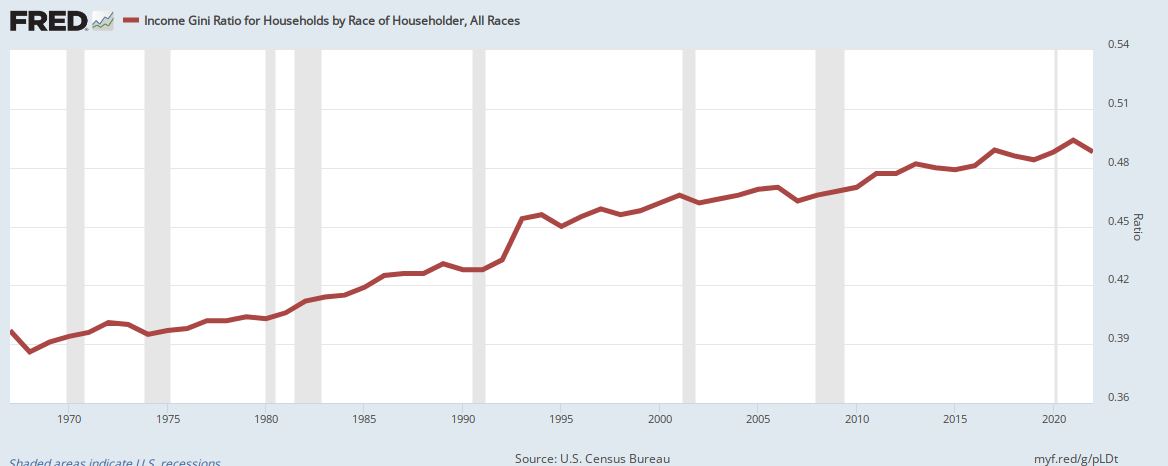
The Gap in America is too wide, and is widening.

The GINI Index. The higher the number, the wider the Gap.

But the Gap can be narrowed. Because the U.S. government is Monetarily Sovereign, and so has the unlimited ability to create its own sovereign currency, it also has the unlimited ability to narrow the Gap.

Applying the Ten Steps to Prosperity (below) would narrow the Gap.

Because of Gap Psychology, the very rich do not want the Gap narrowed. But they comprise only 1% of the voting population.

Narrowing the Gap is a job for the 99%. They can’t hope the 1% will save them.

Rodger Malcolm Mitchell
Monetary Sovereignty
Twitter: @rodgermitchell
Search #monetarysovereignty Facebook: Rodger Malcolm Mitchell

…………………………………………………………………………………………………………………………………………………………………………………………………………………………………………………………………………………………..

The most important problems in economics involve:

  1. Monetary Sovereignty describes money creation and destruction.
  2. Gap Psychology describes the common desire to distance oneself from those “below” in any socio-economic ranking, and to come nearer those “above.” The socio-economic distance is referred to as “The Gap.”

Wide Gaps negatively affect poverty, health and longevity, education, housing, law and crime, war, leadership, ownership, bigotry, supply and demand, taxation, GDP, international relations, scientific advancement, the environment, human motivation and well-being, and virtually every other issue in economics.

Implementation of Monetary Sovereignty and The Ten Steps To Prosperity can grow the economy and narrow the Gaps:

Ten Steps To Prosperity:

1. Eliminate FICA

2. Federally funded Medicare — parts A, B & D, plus long-term care — for everyone

3. Provide a monthly economic bonus to every man, woman and child in America (similar to social security for all)

4. Free education (including post-grad) for everyone

5. Salary for attending school

6. Eliminate federal taxes on business

7. Increase the standard income tax deduction, annually. 

8. Tax the very rich (the “.1%”) more, with higher progressive tax rates on all forms of income.

9. Federal ownership of all banks

10. Increase federal spending on the myriad initiatives that benefit America’s 99.9% 

The Ten Steps will grow the economy and narrow the income/wealth/power Gap between the rich and the rest.

MONETARY SOVEREIGNTY


The party of the rich is at it, again. Making life more difficult for the disabled.

Do you support the GOP? If so, you must be very rich, very mean, and/or very stupid. Sorry, but there are no other alternatives.

As if life isn’t difficult enough for the disabled, the Trump administration wants to make it even more difficult — and for no good reason. That’s known as “Making America Great, Again” compassion.

While you read the following, keep in mind three facts:

  1. Contrary to popular belief, Social Security is not funded by FICA or any other taxes. Even if all FICA collections totaled $0, the federal government could continue paying Social Security benefits, forever.
  2. It isn’t the very rich who need Social Security benefits. They can fund all their financial needs personally. Social Security, and especially its disability benefits, are most needed by the middle-income and the poor.
  3. The GOP, the party of the rich, expends all its efforts toward widening the Gap between the very rich and the rest. Cutting Social Security, Medicaid, poverty aids, and other programs that help the not-rich, all are part of the GOP’s Gap-widening plan.
Image result for bernanke and greenspan
It’s our little secret. Don’t tell the people we don’t use their tax dollars.

Ben Bernanke: “The U.S. government has a technology, called a printing press (or, today, its electronic equivalent), that allows it to produce as many U.S. dollars as it wishes at essentially no cost.”

Alan Greenspan: “Central banks can issue currency, a non-interest-bearing claim on the government, effectively without limit. A government cannot become insolvent with respect to obligations in its own currency.”

St. Louis Federal Reserve: “As the sole manufacturer of dollars, whose debt is denominated in dollars, the U.S. government can never become insolvent, i.e.,unable to pay its bills. In this sense, the government is not dependent on credit markets (borrowing) to remain operational.

Here are excerpts from two articles describing the latest GOP war on the less fortunate.

A National Disgrace’: Trump Proposes Social Security Change That Could End Disability Benefits for Hundreds of Thousands
Posted on December 17, 2019 by Yves Smith, (By Jake Johnson, staff writer at Common Dreams)

The public comments period on the proposed rule change to make it more difficult to remain eligible for Social Security disability benefitsis open till January 31, 2020.

It is so depressing to see how mean-spirited the US has become. First imposing more stringent and often impossible-to-meet work requirements for SNAP beneficiaries, and now this.

Activists are working to raise public awareness and outrage over a little-noticed Trump administration proposal that could strip life-saving disability benefits from hundreds of thousands of peopleby further complicating the way the Social Security Administration determines who is eligible for payments.

Alex Lawson, executive director of the progressive advocacy group Social Security Works, told Common Dreams that the rule change “is the Trump administration’s most brazen attack on Social Security yet.”

When Ronald Reagan implemented a similar benefit cut, it ripped away the earned benefits of 200,000 people,” Lawson said. “Ultimately, Reagan was forced to reverse his attack on Social Security after massive public outcry—but not before people suffered and died.

Patient advocate Peter Morley, who lobbies Congress on healthcare issues, called the proposal “a national disgrace.”The process for receiving Social Security Disability Insurance (SSDI) and Supplemental Security Income (SSI) is already notoriously complicated, and the Trump administration is attempting to add yet another layer of complexity that critics say is aimed at slashing people’s benefits.

As The Philadelphia Inquirer reported last week, “those already receiving disability benefits are subject to so-called continuing disability reviews, which determine whether they are still deserving of compensation for an injury, illness, or other incapacitating problem as their lives progress.”

Currently, beneficiaries are placed in three separate categories based on the severity of their disability: “Medical Improvement Not Expected,” “Medical Improvement Expected,” and “Medical Improvement Possible.” People with more severe medical conditions face less frequent disability reviews.

The Trump administration’s proposed rule would another category called “Medical Improvement Likely,” which would subject beneficiaries to disability reviews every two years.

According to the Inquirer, “an estimated 4.4 million beneficiaries would be included in that designation, many of them children and so-called Step 5 recipients, an internal Social Security classification.”

Step 5 recipients, the Inquirer noted, “are typically 50 to 65 years of age, in poor health, without much education or many job skills [and] often suffer from maladies such as debilitating back pain, depression, a herniated disc, or schizophrenia.

Jennifer Burdick, supervising attorney with Community Legal Services in Philadelphia, told the Inquirer that placing Step 5 recipients in the new “Medical Improvement Likely” category and subjecting them to reviews every two years would represent “a radical departure from past practice.”

Lawson of Social Security Works said “Donald Trump and his advisers know that this will kill people, and they do not care.

The proposal, said Democrat Sen. Bob Casey, “appears to be yet another attempt by the Trump administration to make it more difficult for people with disabilities to receive benefits.

Boyle said the “changes seem arbitrary, concocted with no evidence or data to justify such consequential modifications.”

“This seems like the next iteration of the Trump administration’s continued efforts to gut Social Security benefits,” Democrat Rep. Brendan Boyle added.

The GOP endlessly tries to “save money,” by cutting benefits to the not-rich.  “Saving money” is unnecessary for a Monetarily Sovereign nation (which creates unlimited money at the touch of a computer key), but it is a bald-faced lie for a party that supports tax breaks for the rich.

Here is another commentary:

Trump administration proposes Social Security rule changes that could cut off thousands of disabled recipients
by Alfred Lubrano, Updated: December 12, 2019

The Trump administration is proposing changes to Social Security that could terminate disability payments to hundreds of thousands of Americans, particularly older people and children.

The new rule would change aspects of disability reviews — the methods by which the Social Security Administration determines whether a person continues to qualify for benefits.

Few recipients are aware of the proposal, which is open for public comment through January.

Critics of the plan liken it to the administration’s efforts to cut food stamps, among other entitlement programs, with insufficient information offered to explain curtailing benefits.

Social Security officials declined to comment. For years, Republicans have argued that Social Security benefits need to be reined in to save money.

The new rule, advocates for low-income Americans say, is just a way to push people off the disability rolls.

To the Republicans, any benefit to the not-rich is too much., They use words like “socialism,” or “unaffordable,” or “unsustainable,” or “promoting laziness,” or many other excuses for making the poor poorer and the rich richer.

There is not a single, valid reason to cut benefits to the disabled. In fact, a “great” America would increase benefits to these unfortunate, suffering people.

But despite red baseball caps and vague promises, this nation has moved a considerable distance from greatness, unless one counts being mean-spirited, hate-mongering, and serial lying as signs of greatness.

So yes, if you support the GOP and Donald Trump. you must be very rich, very mean, and/or very stupid.

There are no other alternatives.

Rodger Malcolm Mitchell
Monetary Sovereignty
Twitter: @rodgermitchell
Search #monetarysovereignty Facebook: Rodger Malcolm Mitchell

…………………………………………………………………………………………………………………………………………………………………………………………………………………………………………………………………………………………..

The most important problems in economics involve:

  1. Monetary Sovereignty describes money creation and destruction.
  2. Gap Psychology describes the common desire to distance oneself from those “below” in any socio-economic ranking, and to come nearer those “above.” The socio-economic distance is referred to as “The Gap.”

Wide Gaps negatively affect poverty, health and longevity, education, housing, law and crime, war, leadership, ownership, bigotry, supply and demand, taxation, GDP, international relations, scientific advancement, the environment, human motivation and well-being, and virtually every other issue in economics.

Implementation of Monetary Sovereignty and The Ten Steps To Prosperity can grow the economy and narrow the Gaps:

Ten Steps To Prosperity:

1. Eliminate FICA

2. Federally funded Medicare — parts A, B & D, plus long-term care — for everyone

3. Provide a monthly economic bonus to every man, woman and child in America (similar to social security for all)

4. Free education (including post-grad) for everyone

5. Salary for attending school

6. Eliminate federal taxes on business

7. Increase the standard income tax deduction, annually. 

8. Tax the very rich (the “.1%”) more, with higher progressive tax rates on all forms of income.

9. Federal ownership of all banks

10. Increase federal spending on the myriad initiatives that benefit America’s 99.9% 

The Ten Steps will grow the economy and narrow the income/wealth/power Gap between the rich and the rest.

MONETARY SOVEREIGNTY