Is it possible to use Monetary Sovereignty (MS), succeed with MS, and still not understand it? (The U.S. and Japan.)

If you are unfamiliar with Monetary Sovereignty (MS) and Modern Monetary Theory (MMT), you should know they fundamentally are alike.

Where they differ most is:

  1. In certain applications (for example, a Jobs Guarantee) which MMT recommends and MS does not, and
  2. The primary purpose of federal taxes. MMT says they are to give value to money; MS says they are to control the economy and to deceive the public and:
  3. Inflation: MMT says curing inflation requires tax increases. MS says curing inflation requires deficit spending to eliminate shortages, usually of food or energy.

But they agree on the key fundamentals, for instance:

Image result for pouring money
Money moves between the economy and the government.
  1. The federal government invented the U.S. dollar, creates dollars at will, and so cannot run short of dollars.
  2. The federal government does not borrow to fund spending, but rather creates new dollars every time it pays a bill.
  3. So-called “federal debt” is nothing more than the total of deposits into T-security accounts, which easily are repaid by returning the dollars deposited, are not paid by taxpayers.
  4. No level of federal debt is unsustainable.
  5. Federal tax dollars are destroyed upon receipt.

In short, deficit spending by the government goes into the economy, and taxes paid by the economy go into the government. The difference: Monetarily sovereign governments have infinite access to money; economies do not.

The following are excerpts from an article that appeared in the June 5, 2019, New York Times, and written by Ben Dooley

Modern Monetary Theory’s Reluctant Poster Child: Japan
Despite its huge debt, the country remains an economic powerhouse. Some say it provides a model for the United States, but its leaders disavow the idea.

Immediately, the article is misleading. Rather than saying “Despite its huge debt . . .” it should read, “Because of its huge debt . . . ” or even more accurately, “Because of its massive deficit spending, which led to a huge amount of deposits into government bond accounts.”

TOKYO — Spend big and never mind the deficit. That’s what proponents of modern monetary theory, the unorthodox set of economic ideas that has inspired politicians like Bernie Sanders and Alexandria Ocasio-Cortez, see as the winning formula for American prosperity.

It may have “inspired” them, but even they cling to the false notion that federal taxes are necessary to fund federal spending.

For proof, its admirers point to Japan. Despite the highest debt in the developed world, Japan remains an economic powerhouse with high living standards.

Because the Japanese government, like the governments of Canada, the UK, Australia, China, and others, is Monetarily Sovereign (it creates its own sovereign currency), Japan remains an economic powerhouse with high living standards. ”

Japanese leaders wish they would point somewhere else.

Shinzo Abe, the Japanese prime minister, has dismissed the theory as “simplistic.” Finance Minister Taro Aso described it as “very dangerous.” And Haruhiko Kuroda, the head of Japan’s central bank, called it “extreme.”

Monetary Sovereignty saved Japan’s economy.

Had Japan been monetarily non-sovereign, like the euro nations or like cities, counties, and states, the Japanese economy would be shattered, and the Japanese people would be destitute.

Perhaps, Mr. Abe would respect something more complex than: “Adding yen to the economy helps prevent recessions” and “Monetarily Sovereign governments never can run short of their own sovereign currency.

Rather than embrace an idea that could explain or even justify the country’s situation, Japan is furiously debating it.

Lawmakers to Mr. Abe’s left are citing the theory — known as M.M.T. — to denounce his plan to raise taxes on the country’s consumers.

On the right, members of his own party have tried to link his policies to the theory, accusing him of running up gargantuan debts the country can never repay.

Japan could repay all of its debt tomorrow, if it chose. Like all Monetarily Sovereign nations, it has the unlimited ability to create its own sovereign currency.

Imagine you owned a legal, dollar-printing press. How many dollars of debt could you repay? The answer, of course, is: Infinite.

According to economics textbooks, when deficits grow, inflation and interest rates should grow along with them.

That is not what has happened in countries like the United States that racked up huge government debt after the global financial crisis in 2008.

Instead, prices and borrowing costs have remained low.

The textbooks are wrong, as both Japan and the United States have proved. There is no relationship between today’s deficits (high) and inflation (low).

In the United States, politicians from both parties have begun to question decades of consensus that government debt is bad. President Trump’s tax cuts have widened the deficit.

Proposals floated by Democrats for universal health care and investments in renewable energy could make it even bigger.

“Have begun.” I’ve been questioning it for 20 years. Other economists have questioned it even longer.

Trump’s tax cuts have widened the deficit, yet inflation remains low and growth continues. Those are facts, not economic hypotheses.

Sadly, those proposals have been floated by politicians who do not have the courage of their convictions. They still try to answer the question, “How will you pay for it?” by advancing a complex, convoluted “solution,” in which federal deficits do not increase.

The numbers make budget hawks nervous. But proponents of modern monetary theory say they should take a deep breath.

Deficits are a good thing, they say, as long as the government doesn’t create inflation by pushing the economy too far, too fast.

“Pushing the economy” is not the way inflations are created. Price increases are caused by shortages, usually shortages of food and energy, not by increased government spending.

In fact, increased government spending can cure inflations if the spending is devoted to curing the shortages.

If there is a food shortage, there will be inflation. If the government responds to the food shortage by using deficit spending to purchase food from abroad and distributing it to the people, the inflation will end.

The idea has provoked criticism from established economists like Paul Krugman, the Nobel laureate and columnist for The New York Times, as well as Lawrence Summers, the former Treasury secretary.

Government spending may be necessary when times are tough or to meet national priorities, they argue. But the bill will eventually come due.

In the meantime, all of that spending could crowd out the private sector and make it harder for governments to borrow money in the form of bonds. Besides, they say, M.M.T. remains largely untested.

Krugman and Summers simply do not know what they are talking about. “The bill will eventually come due” makes no sense. There is no “bill” for deficit spending.

The federal government can deficit spend forever.

And the federal government, which has the unlimited ability to create dollars, it has no need to borrow, and indeed, the U.S. government does not borrow.

What erroneously is termed “borrowing,” really is the issuance of Treasury securities (T-notes, T-bills, T-bonds) which do not provide spending money to the government.

When you buy a T-bill, you deposit dollars into your T-bill account. There you dollars remain, accumulating interest, until maturity. The U.S. government does not use the dollars in your T-bill account.

Proponents of the theory disagree (with Krugman and Summers). It has been tested, they say. In Japan.

The country is their equivalent of Charles Darwin’s Galápagos Islands: a natural experiment that reveals a fundamental truth about the way the world really works.

Since the country’s boom ended in the early 1990s, Japan has borrowed deeply. Currently, its debt level is approaching 250 percent of its annual economic output (GDP). Critics say it is an economic basket case.

Despite all that, Japanese inflation and lending rates remain low. In fact, some bond rates are negative, meaning Japan can profit when it borrows money.

Its standard of living remains competitive with those of the United States and other developed countries.

Negative bond rates result from the mistaken idea that low rates are stimulative of negative rates really are stimulative. Utter nonsense. High rates force the government to pump more interest money into the economy, and that is stimulative.

Low rates are unprofitable for lenders, and because lending creates money, negative discourage lending, so negative rates are recessionary.

And because Japan is Monetarily Sovereign, it has no need to make a profit. It can create all the yen it needs, at the touch of a computer key.

Modern monetary theory explains it all, according to Bill Mitchell, a professor of economics at the University of Newcastle in Australia and one of the theory’s founders. He has been studying Japan since the 1990s.

“It is my laboratory,” he said, calling the country “a really good demonstration of why mainstream macroeconomics is wrong.”

Briefly stated, the theory holds that a country controlling its own currency like the United States and Japan cannot go broke no matter how much it borrows.

Government spending puts money in the hands of people and businesses. In other words, a government deficit is effectively a private sector surplus.

It’s not just a belief; it’s an absolute fact. A federal deficit adds money to the economy, which grows the economy. It is simple arithmetic.

To spur growth, the theory says, governments should run up deficits to give consumers and companies more to spend. If leaders need more money, they can print it.

That is basically what Japan has done on and off for the last 20 years. Its economy boomed after World War II. Then the go-go 1980s ended with a bust. The economy stagnated. Deflation drove down prices and corporate profits.

The debt “Henny Pennys” are so spooked by non-existent inflation that they forget about the real curse: Deflation.

Japan borrowed and spent to get growth going again.

When that didn’t work, it pioneered techniques, like quantitative easing, to inject money into its financial system. The idea — basically printing lots of money and spending it on large-scale asset purchases — went on to be used by central banks around the world to deal with the effects of the global financial crisis.

The measures were necessary, but Japan’s conservative policymakers were not happy about them, according to Gene Park, an expert on the Japanese economy at Loyola Marymount University in Los Angeles, and they were soon dropped.

Translation of the above: Adding yen to the economy cured the deflation and grew the economy. It worked.

But it violated the beliefs of the mainstream economists, so they stopped doing what worked.

Similarly, deficit spending cured America’s 2008 “Great Recession” (as well as the 1929 “Great Depression), so again, the economists railed against what works, and try to install what doesn’t work: Austerity.

That has led to 80 years of complaints that the growing federal debt is a “ticking time bomb,” — while the American economy has grown — a complaint that continues to this day.

Economics may be the only science in which the mainstream denies what always works and insists on implementing what never works.

“The ideas came from outside of Japan, and they only tried them when they were backed into a corner,” he said.

Still, inflation did not budge. Interest rates stayed low.

Of course.

Inflation is not caused by deficit spending. Inflation is caused by shortages. Period.

While Mr. Abe’s policies may resemble those put forward by supporters of the theory, they differ in one major way: Since his election, he has pledged to find a way to pay down the debts run up under his administration.

Mr. Abe is following the usual mainstream economists’ dictum: If it works, stop doing it, and if it never works, keep doing it.

To fulfill that promise, Mr. Abe has said, he will raise Japan’s consumption tax to 10 percent from 8 percent by October.

The pledge is controversial with lawmakers on both the left and right.

A similar tax increase in 2014 may have pushed Japan’s already sluggish economy into recession. This time, the economy has already been weakened by China’s slowing demand for its goods.

Does it get any dumber than that? The economy is sluggish, so let’s take money away from consumers.

Many in Mr. Abe’s party also oppose the tax increase, arguing that the government should address the deficits once Japan’s economic condition has improved and the country is better able to withstand the shock.

In the meantime, they fear that if Japan continues piling up debt, it will be even harder for the country to climb back out.

“A crash is going to come at some point,” said Kohei Otsuka, an opposition member of the Upper House finance committee who has warned about the country’s debt for over two decades, “and then we’ll see that M.M.T. didn’t have any merit after all.”

Get it? We know that cutting deficits will create a shock, so let’s do it. And we have been warning about debt for over two decades, and nothing bad happened, so that is evidence we have been right.

Only in economics could that be considered logical.

Pavlina Tcherneva, an associate professor of economics at Bard College in New York and part of a core group of M.M.T. theorists, said the debate demonstrated an important point: While the Japanese case may validate the ideas, there is a difference between the theory of M.M.T. and its practice.

“Japan has been the clearest case of some of the things that M.M.T. has been saying,” she said, but “that doesn’t guarantee you good policy.”

Yes, stunningly in the weird world of economics, where intuition rules over proven fact, you even can get statements of belief in deficit spending, but then the leaders cannot believe what their eyes tell them, and they regress into the nightmare world of austerity.

In the past, economists wrote textbooks that claimed: “Excessive government spending causes inflations.” This became dogma, when Weimar Republic, Zimbabwe et al had hyperinflations that corresponded to currency printing.

So when the likes of Krugman and Summers went to college and learned that deficits cause inflation, they not only were indoctrinated, but continued the flow of false information to young people, who themselves indoctrinated even younger people.

And so it went, with successive generations of economists ignoring the facts on the ground, and disseminating the false beliefs.

The facts are:

  1. The currency printing does not cause the inflations; the inflations caused the currency printing, because the leaders did not understand that shortages caused their inflations. So out of ignorance, they printed currency to keep up with inflation.
  2. Economic growth requires money growth. Deficit spending causes money growth. Therefore, economic growth requires deficit spending. Lack of money growth causes recessions and depressions.
  3. Monetarily Sovereign governments cannot run short of money with which to pay any size obligations.Oh, and one last point that has become an issue, lately’
  4. Deficit spending is not “socialism.” Socialism is government ownership and control, not mere spending.

For example, the U.S. Veterans Administration is socialism. Medicare is not.

Economics may be the only “science” in which the lay public believes it knows everything, and the university-trained scientists rely more on intuition than on facts.

What next, economists? Do you recommend we apply leeches to cure anemia?

Federal Spending: The myths and the facts.

It takes only two things to keep people in chains: The ignorance of the oppressed and the treachery of their leaders.

……………………………………………………………………………………………………………………………………………………

An article printed in the 2/10/20 Chicago Tribune, by Andrew Taylor, of the Associated Press, demonstrates the disinformation you are being given about our economy.

In this post, we’ll parse the article and comment on each section.

Skepticism and doubts over Trump’s budget plan for ’21
By Andrew Taylor, Associated Press
WASHINGTON — Confronted with trillion-dollar-plus deficits, President Donald Trump is offering a budget plan that rehashes previously rejected spending cuts while leaving Social Security and Medicare benefits untouched.

Trump’s fiscal 2021 budget plan, expected to be released Monday, isn’t likely to generate a serious Washington dialogue about what to do, if anything this election year, about entrenched fiscal problems that have deficits surging despite a healthy economy.

Comment: The federal deficits are economic surpluses; they are dollar additions that are necessary to make the economy grow. Without deficit spending, the economy would not grow, and in fact, it would fall into recession and depression.

The so-called “entrenched fiscal problems” are a widely promulgated myth. The only fiscal problems the U.S. has are the misstatements about the federal deficits and debts.

It was being released on the eve of the New Hampshire primary, a move that minimizes attention.

A blueprint written as if Trump could enact it without congressional approval, the budget proposal relies on rosy economic projections and fanciful claims of future cuts to domestic programs to show that it is possible to bend the deficit curve in the right direction.

As is typical for the Republican party, the spending cuts (which are unnecessary and harmful) would negatively impact programs that benefit lower- and middle-income Americans.

Ironically, these are the GOP base-voters. But they have been so brainwashed by the media, the politicians, and the university economists, that they unintentionally vote against their own best interests.

Why?  They think they are voting against “them” (the poorest and the immigrants), whom they have been taught to hate.

It’s a hatred-seeded vote that boomerangs on the voters.

The reality is that no one — Trump, the Democratic-controlled House or the GOP-held Senate — has any interest in tackling a chronic budget gap that forces the government to borrow 22 cents of every dollar it spends.

Trump’s reelection campaign, meanwhile, is focused on the economy and the historically low jobless rate while ignoring the government’s budget.

The so-called “budget gap” (i.e. the federal deficit) grows the economy. The politicians know this, but pay lip service to claims that federal deficits (economic surpluses) should be avoided as harmful or “unsustainable.”

This disinformation allows the GOP to justify cutting benefits for the non-rich, while increasing benefits to the rich.

The federal government is Monetarily Sovereign, meaning it has the unlimited ability to create U.S. dollars. Therefore, the federal government does not need to borrow, and indeed, does not borrow.

What erroneously is termed “borrowing” actually is the acceptance of deposits into Treasury Security accounts (T-bills, T-notes, T-bonds). The purpose of these securities is not to obtain spending dollars for the federal government (which has unlimited access to dollars) but rather to:

  1. Provide a safe place to stash unused dollars, which helps stabilize the dollar, and
  2. To assist the Fed in controlling interest rates.

These T-securities are paid off every day simply by returning the dollars that were deposited in the accounts. This is no burden on the government or on future taxpayers.

It doesn’t occur to the author, Andrew Taylor, that the “historically low jobless rate,” is in fact related to massive federal deficit spending, which provides dollars to American business, directly and via increased consumer spending.

On Capitol Hill, House Democrats have seen their number of deficit-conscious “Blue Dogs” shrink while the roster of lawmakers favoring costly “Medicare for All” and “Green New Deal” proposals has swelled.

Tea party Republicans have abandoned the cause that defined, at least in part, their successful takeover of the House a decade ago.

Trump has succumbed to the Washington temptation to deliver spending increases and tax cuts first and then deal — or not — with their effect on the deficit.

Trump and key administration figures such as Treasury Secretary Steven Mnuchin had promised that Trump’s signature cuts to corporate and individual tax rates would pay for themselves; instead the deficit spiked by more than $300 billion over 2017 to 2019, to nearly $1 trillion.

The “Blue Dog” Democrats and the Tea Party Republicans were misguided and/or deliberately lying about the effects of federal deficits (which grow the economy) and deficit cuts (which lead to recessions and depressions).

Trump has not “succumbed” to anything. He knows that his re-election chances increase if the economy grows, and the economy can grow only if the money supply grows.

That’s the reason why Trump pushes record federal deficits.

Treasury Secretary Steven Mnuchin is a first-class fabulist. “Pay for themselves” means that tax cuts would actually increase tax collections. If that were true, the tax cuts would not be stimulative. Tax collections remove growth dollars from the economy.

Sadly, “Green New Deal” proposals, to save the world for our grandchildren, are being demeaned by the false belief the federal government can’t afford to pay for them and/or taxpayers will pay.

So the weather grows hotter, while air and water become more polluted, all because of a pernicious myth.

Trump has also signed two broader budget deals worked out by Democrats and Republicans to get rid of spending cuts left over from a failed 2011 budget accord.

The result has been eye-popping spending levels for defense — to about $750 billion this year — and comparable gains for domestic programs favored by Democrats.

The White House hasn’t done much to draw attention to this year’s budget release, though Trump has revealed initiatives of interest to key 2020 battleground states, such as an increase to $250 million to restore Florida’s Everglades and a move to finally abandon a multibillion-dollar, never used, nuclear waste dump that’s political poison in Nevada.

It’s all politics. They talk deficit reduction, to con the voters, but they enact deficit increases to grow the economy, especially in battleground states.

Then they shed crocodile tears about the size of the federal debt.

The White House also leaked word of a $25 billion proposal for “Revitalizing Rural America“ with grants for broadband internet access and other traditional infrastructure projects such as roads and bridges.

The Trump budget also promises a $3 billion increase — to $25 billion — for NASA in hopes of returning astronauts to the moon and on to Mars.

It also is likely to reprise his small-bore infrastructure initiative — proposed in prior years to provide just $200 billion in new federal contributions — while proposing a modest parental leave plan.

The voters love deficit reduction — for other people.

But they love deficit spending in their own back yard for the Internet, roads, bridges, and the always magical return trip to the moon.

Trump took to Twitter on Saturday to promise voters that his budget “will not be touching your Social Security or Medicare” in keeping with his long-standing 2016 campaign promise.

Trump had made a bit of a stir last month at a meeting of global economic elites in Davos, Switzerland, when he told a CNBC interviewer that “at some point” he would consider curbs to popular benefit programs like Medicare and Social Security.

Trump has proposed modest adjustments to eligibility for Social Security disability benefits and he’s proposed cuts to Medicare providers such as hospitals, but the real cost driver of Medicare and Social Security is the ongoing retirement surge of the baby boom-generation and health care costs that continue to outpace inflation.

This is part of the traditional “Talk big cuts, wait for the reaction, then enact small cuts” scam.

The purpose of the scam is to enure voters to a hated idea. Then when actual, smaller cuts are made, the people actually are relieved. “They were talking about stealing a billion from me. But out of compassion, they only stole a few million.”

There is no reason for any cuts. Cuts are harmful to the economy. But the rich who run America, love cuts to programs that benefit the poor.

Now that you’ve seen the myths and the commentary, here is a reminder about the truth:

I. Reduced federal debt growth leads to recessions. Increased federal debt growth cures recessions.

Reductions in federal debt growth (red line) lead to recessions (vertical gray bars). Increases in federal debt growth cure recessions.

.

II. Depressions come on the heels of federal surpluses, because federal surpluses take growth dollars out of the economy.

1804-1812: U. S. Federal Debt reduced 48%. Depression began 1807.
1817-1821: U. S. Federal Debt reduced 29%. Depression began 1819.
1823-1836: U. S. Federal Debt reduced 99%. Depression began 1837.
1852-1857: U. S. Federal Debt reduced 59%. Depression began 1857.
1867-1873: U. S. Federal Debt reduced 27%. Depression began 1873.
1880-1893: U. S. Federal Debt reduced 57%. Depression began 1893.
1920-1930: U. S. Federal Debt reduced 36%. Depression began 1929.
1997-2001: U. S. Federal Debt reduced 15%. Recession began 2001.

III. A growing economy requires a growing supply of moneyFederal deficits grow the money supply and the economy.

By definition, a large economy has a larger money supply than does a small economy.

The graph below shows the essentially parallel paths of GDP (blue line) vs. perhaps the most comprehensive measure of the money supply, Domestic Non-Financial Debt (red line):

Gross Domestic Product (GDP — blue line) essentially parallels the money supply (red line).

Rodger Malcolm Mitchell
Monetary Sovereignty
Twitter: @rodgermitchell
Search #monetarysovereignty Facebook: Rodger Malcolm Mitchell

…………………………………………………………………………………………………………………………………………………………………………………………………………………………………………………………………………………………..

The most important problems in economics involve:

  1. Monetary Sovereignty describes money creation and destruction.
  2. Gap Psychology describes the common desire to distance oneself from those “below” in any socio-economic ranking, and to come nearer those “above.” The socio-economic distance is referred to as “The Gap.”

Wide Gaps negatively affect poverty, health and longevity, education, housing, law and crime, war, leadership, ownership, bigotry, supply and demand, taxation, GDP, international relations, scientific advancement, the environment, human motivation and well-being, and virtually every other issue in economics.

Implementation of Monetary Sovereignty and The Ten Steps To Prosperity can grow the economy and narrow the Gaps:

Ten Steps To Prosperity:

1. Eliminate FICA

2. Federally funded Medicare — parts A, B & D, plus long-term care — for everyone

3. Provide a monthly economic bonus to every man, woman and child in America (similar to social security for all)

4. Free education (including post-grad) for everyone

5. Salary for attending school

6. Eliminate federal taxes on business

7. Increase the standard income tax deduction, annually. 

8. Tax the very rich (the “.1%”) more, with higher progressive tax rates on all forms of income.

9. Federal ownership of all banks

10. Increase federal spending on the myriad initiatives that benefit America’s 99.9% 

The Ten Steps will grow the economy and narrow the income/wealth/power Gap between the rich and the rest.

MONETARY SOVEREIGNTY

A Monopoly™ story, why you can’t see dollars, and why federal tax dollars are destroyed.

Last month, we published the post, “The text of a speech I never will give to my friends at our country club, because they probably won’t believe me, and who needs the aggravation?”

In the post, we said, “The U.S. dollar is not a physical entity. The dollar is a legal entity. It is a group of laws. You can’t see, smell, taste, feel, or hear a dollar any more than you can see, smell, taste, feel, or hear a law.”

The purpose of that paragraph was to help readers visualize why the federal government has absolute control over the U.S. dollar and its value, and why the federal government cannot run short of dollars.

After all, if something has no physical existence, the creator of that thing cannot run short.

Therefore, warnings that the federal government owes too many dollars, or can run short of dollars, make absolutely no sense. It is like warning that the federal government will run short of laws or lies. The government has an infinite supply.

To help readers visualize the concept, we gave the example of the board game Monopoly™.

As you probably know Monopoly™ usually is played by 3-6 players. The object of the game is to make money by buying and selling real estate, and to accomplish this purpose, the game gives players various tokens, dice, instruction cards, and play dollars.

To begin the game, a mythical “Banker” provides each player with an equal amount of play dollars.

One day, four of us wished to play, but when we opened the game box, everything was there except the play dollars.

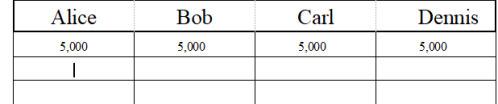
So we created this table to keep track of the Monopoly™ “economy”:

monopoly 4.png
At this stage of the game, the “economy” had 20,000 dollars

It was a simple sheet of paper, containing a four-column table. At the top of each column, we wrote the name of one player.

Then, on the first line, under each player’s name, we wrote “5,000.” That showed how many dollars each player had.

We could have written any number, but we arbitrarily decided that the Bank should give each player 5,000 dollars.

In real-world terms,  this corresponded to a total of 20,000 in deficit spending by the Bank, which added 20,000 dollars into the economy.

By rule, players take turns rolling dice, and at each roll, players may receive other moneys from the Bank, and/or pay the Bank for real estate, taxes, and other penalties.

So money flows back and forth from player to player, and to and from players to the Bank.

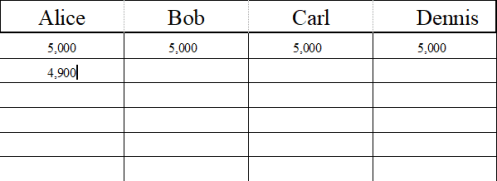
In the game’s first transaction Alice paid the Bank 100 dollars for a piece of property.

To memorialize the transaction, we deducted 100 dollars from Alice’s column, leaving her with 4,900 dollars.

Monopoly 3 - Copy.png
Now, the money supply of the “economy” is 19,900 dollars.

In total, the money supply of the “economy” fell to 19,900.

But what about the Bank? It received 100 from Alice. But the Bank had no column.

Two questions: Where did that 100 Alice paid to the Bank go? And how much money did the Bank have?

The answers to those two questions lead to the central points of this post.

Where Is The Bank’s Money and How Much Does It Have?
The game’s rules specifically state that the Bank never can run out of money. (The rules even suggest cutting up pieces of paper, if necessary, and using them as Monopoly dollars.)

So again, where did Alice’s dollars go when she paid the Bank? Answer: The Monopoly™ dollars were destroyed. They ceased to exist.

And how much money did the Bank have? Answer: It has none but can create infinite.

Payments to the Bank cannot enrich the Bank; it can create infinite money at any time. Payments to the Bank serve only to impoverish the players. That is the sole effect and the sole purpose of payments to the Bank.

Similarly, payments from the Bank, which the Bank can make endlessly, enrich the players but do not impoverish the Bank. Infinity minus any number still is infinity.

Thus, the Monopoly™ game provides an interesting, simplified corollary to the U.S. financial system.

Players can be thought of as the real people in the United States who pay dollars to, and receive dollars from, the U.S. federal government.

The Monopoly™ Bank resembles the U.S. federal government, and the players correspond to the U.S. economy.

  1. The rules of the game correspond to the laws of the U.S.
  2. Both the Bank and the U.S. government create dollars from thin air, simply by spending dollars into the economy.
  3. Both receive tax dollars that are destroyed upon receipt.
  4. Both can run deficits endlessly, and these deficits enrich the players (the “economy”), while deficits do not impoverish the Bank or the federal government.
  5. For both the Bank and the U.S. federal government, debt and borrowing are meaningless, as they do not provide spending funds to the Bank or to the government.
  6. Any amount of money owed by the Bank or the U.S. government can be paid instantly. Neither can run short of dollars. Neither needs to ask for tax dollars.

Although the Bank pays out far more dollars than it takes in (just like the U.S. federal government does), the players are not concerned that the Bank’s deficits are “unsustainable,” no matter how large they may grow.

Like the Monopoly Bank, the U.S. federal government does not borrow dollars. Why would it? It has the unlimited ability to create dollars from thin air.

What erroneously is termed “U.S. federal borrowing,” actually is the acceptance of deposits into Treasury Security Accounts. This so-called “borrowing” does not provide spending funds to the government. The government can create infinite spending funds.

The purposes of accepting deposits into federal T-security accounts are:

  1. To provide a safe place to “park” unused dollars, which helps stabilize the dollar, and
  2. To assist the Federal Reserve in its task of controlling interest rates.

And the purposes of federal taxes are not to provide the government with spending money, of which it has infinite, but rather:

  1. To control the economy by rewarding activities the federal government wishes to encourage and by punishing the activities the government wishes to discourage, and
  2. To make the populace believe the government’s ability to spend is limited by taxes, so that the people will not ask for more benefits.

The rules of Monopoly™ provides players with regular payments of 200 dollars when their tokens pass “Go.” These payments serve to enrich the players and the MonopolyImage result for monopoly game go “economy.”

The makers of the game could have decided on payments of any size — 10 dollars or 1,000 dollars, the Bank could afford anything — but arbitrarily settled on 200 dollars.

The purpose of the 200 dollar payments is to energize the “economy” by injecting dollars into it. Without the additional dollars, the economy could not grow.

Similarly, the U. S. federal government makes regular Social Security payments. These payments, which enrich the populace and the economy, could be of any size — the federal government can afford anything — but lately, benefits have been reduced.

The government arbitrarily collects taxes on benefits and delays benefits past the original age of 65.

Why would the U.S. federal government, which can afford anything, invent false claims that Social Security, an agency of the federal government, is running short of money? Why would the government reduce benefits that enrich the populace and the economy?

One might think the government would want to do the opposite. But there are reasons:

  1. The Monopoly™ “Pass Go” payment is not more than 200 dollars only because the creators felt that would lengthen the game too much. The Bank easily could afford any level of payment.
  2. The Social Security payments are not higher or extended to more people, because the very rich, who run America, do not want the Gap between them and the rest of Americans to be narrowed. The U.S. Treasury easily could afford any level of payment.

SUMMARY
The game of Monopoly™ provides an interesting corollary to the U.S. federal government and the U.S. economy. The Monopoly™ Bank mirrors the U.S. federal government, and the players represent the economy.

The U.S. federal government originally created laws that created an arbitrary number of U.S. dollars from thin air, and gave them an arbitrary value.

Today, the U.S. government retains the power to create an arbitrary number of dollars from thin air and to give them any value it wishes.

Thus, being Monetarily Sovereign, i.e. sovereign over the U.S. dollar, the government can control the U.S. money supply and the value of the dollar (U.S. inflation).

Like the Monopoly™ Bank, the federal government can sustain any level of deficit spending. It also can set any level of T-security issuance (wrongly termed “borrowing”).

Federal deficit spending is necessary to grow the U.S. economy, and claims that federal spending and federal debt are harmful or unsustainable are false.

Ben Bernanke: “The U.S. government has a technology, called a printing press (or, today, its electronic equivalent), that allows it to produce as many U.S. dollars as it wishes at essentially no cost.”

Alan Greenspan: “Central banks can issue currency, a non-interest-bearing claim on the government, effectively without limit. A government cannot become insolvent with respect to obligations in its own currency.”

St. Louis Federal Reserve: “As the sole manufacturer of dollars, whose debt is denominated in dollars, the U.S. government can never become insolvent, i.e.,unable to pay its bills. In this sense, the government is not dependent on credit markets (borrowing) to remain operational.

Rodger Malcolm Mitchell
Monetary Sovereignty
Twitter: @rodgermitchell
Search #monetarysovereignty Facebook: Rodger Malcolm Mitchell

…………………………………………………………………………………………………………………………………………………………………………………………………………………………………………………………………………………………..

The most important problems in economics involve:

  1. Monetary Sovereignty describes money creation and destruction.
  2. Gap Psychology describes the common desire to distance oneself from those “below” in any socio-economic ranking, and to come nearer those “above.” The socio-economic distance is referred to as “The Gap.”

Wide Gaps negatively affect poverty, health and longevity, education, housing, law and crime, war, leadership, ownership, bigotry, supply and demand, taxation, GDP, international relations, scientific advancement, the environment, human motivation and well-being, and virtually every other issue in economics.

Implementation of Monetary Sovereignty and The Ten Steps To Prosperity can grow the economy and narrow the Gaps:

Ten Steps To Prosperity:

1. Eliminate FICA

2. Federally funded Medicare — parts A, B & D, plus long-term care — for everyone

3. Provide a monthly economic bonus to every man, woman and child in America (similar to social security for all)

4. Free education (including post-grad) for everyone

5. Salary for attending school

6. Eliminate federal taxes on business

7. Increase the standard income tax deduction, annually. 

8. Tax the very rich (the “.1%”) more, with higher progressive tax rates on all forms of income.

9. Federal ownership of all banks

10. Increase federal spending on the myriad initiatives that benefit America’s 99.9% 

The Ten Steps will grow the economy and narrow the income/wealth/power Gap between the rich and the rest.

MONETARY SOVEREIGNTY

Only 450 words answer the question, “Does printing money cause inflation?”

Does “printing” money cause inflation? Or is so-called “printing” money the best way to cure inflation?

1. The federal government does not print money. It prints
Federal Reserve Notes (FRN), which are not dollars, but rather are bearer certificates: Titles to dollars.

Only a small percentage of dollars are represented by FRNs.

2. Dollars are balance sheet numbers. They have no physical existence. You cannot feel, see, hear, smell, or taste dollars.

3. The government, being Monetarily Sovereign, has the unlimited ability to create dollars. The government never unintentionally can run short of dollars.

4. Printing FRNs does not cause inflations. The reverse is true. The printing of FRNs results from inflations.

5. The cause of inflations — a general increase in prices — is shortages, generally scarcities of energy and/or food.

Scarcity causes prices to rise, and widespread scarcities of food and/or oil, cause widespread price increases.

6. Federal deficit spending actually can prevent or cure inflations, if the spending cures the shortages.

Case in point: Zimbabwe’s inflation came when its government seized farmland from farmers and gave it to non-farmers, who could not grow enough food.

The resultant food shortage caused hyperinflation, which the government could have cured by deficit spending to purchase food from other countries.

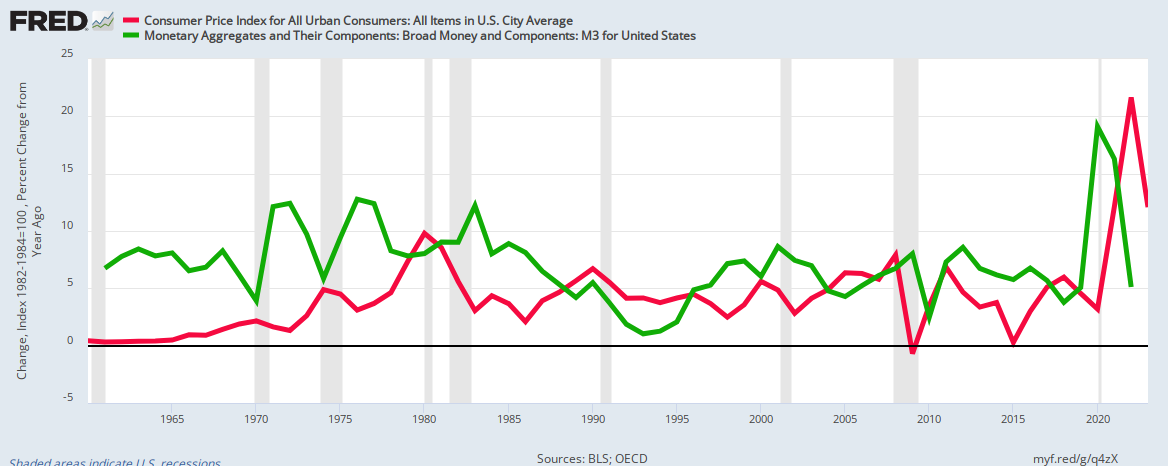
The graph below compares changes in the U.S. money supply (Green – M3) to changes in inflation (red).

Changes in M3 (green) are NOT predictive of changes in prices (red).

The graph below compares changes in the price of oil (blue) (which closely reflect shortages) to changes in inflation. (red).

Changes in the price of oil ((blue — which closely reflect supply changes) ARE predictive of inflation.

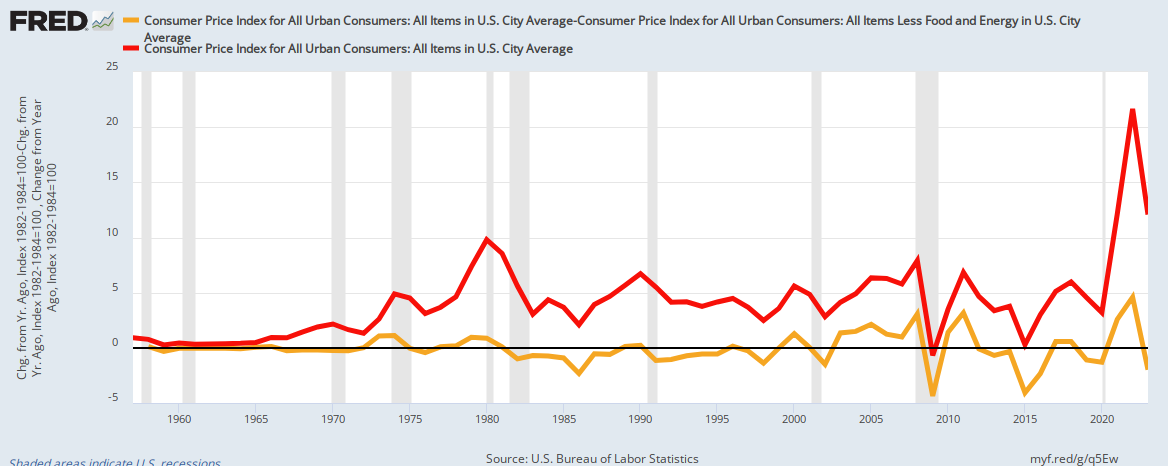
The graph below compares the overall Consumer Price Index (Red) to the price index of food and energy (gold). Food and energy prices (which reflect availability) are predictive of overall inflation.

Food and energy inflation (gold) IS predictive of overall inflation (red).

Discussion of federal projects generally lead to the question, “How will you pay for it.” The correct answer never is, “by raising taxes” or “by cutting other spending.”

The correct answer always is, via federal deficit spending.

In summary:
Prices rise (inflation) because of scarcity, usually a scarcity of food and/or energy. Curing the scarcity reduces prices.

Scarcity can be cured by federal deficit spending to purchase the scarce items and distribute them into the economy.

The amount of deficit spending is not the key to inflation or its cure. The key is how the deficit spending is used.

Deficit spending, to purchase the scarce items, cures inflations. Poorly directed deficit spending that does not cure the scarcity, will worsen inflation.

A Monetarily Sovereign government cannot run short of the sovereign currency needed to cure an inflation.

Rodger Malcolm Mitchell
Monetary Sovereignty
Twitter: @rodgermitchell
Search #monetarysovereignty Facebook: Rodger Malcolm Mitchell

…………………………………………………………………………………………………………………………………………………………………………………………………………………………………………………………………………………………..

The most important problems in economics involve:

  1. Monetary Sovereignty describes money creation and destruction.
  2. Gap Psychology describes the common desire to distance oneself from those “below” in any socio-economic ranking, and to come nearer those “above.” The socio-economic distance is referred to as “The Gap.”

Wide Gaps negatively affect poverty, health and longevity, education, housing, law and crime, war, leadership, ownership, bigotry, supply and demand, taxation, GDP, international relations, scientific advancement, the environment, human motivation and well-being, and virtually every other issue in economics.

Implementation of Monetary Sovereignty and The Ten Steps To Prosperity can grow the economy and narrow the Gaps:

Ten Steps To Prosperity:

1. Eliminate FICA

2. Federally funded Medicare — parts A, B & D, plus long-term care — for everyone

3. Provide a monthly economic bonus to every man, woman and child in America (similar to social security for all)

4. Free education (including post-grad) for everyone

5. Salary for attending school

6. Eliminate federal taxes on business

7. Increase the standard income tax deduction, annually. 

8. Tax the very rich (the “.1%”) more, with higher progressive tax rates on all forms of income.

9. Federal ownership of all banks

10. Increase federal spending on the myriad initiatives that benefit America’s 99.9% 

The Ten Steps will grow the economy and narrow the income/wealth/power Gap between the rich and the rest.

MONETARY SOVEREIGNTY