INFLATION! You can hear it now, can’t you? The sound of hands wringing in concert.
The GOP is owned by the very rich. And the rich are terrified that you ever-so-slightly will narrow the Gap between you and them.
So their GOP flunkees, having already given a huge tax deduction to their rich patrons, now will tell you that the Democrats’ stimulus packages are wrecking the economy and causing not just inflation, but hyperinflation.
It’s all a great big fat lie, a repeated myth designed to calm your requests for more stimulus dollars to flow to your benefit.
It goes like this:
Because the unemployment benefits are too generous, people won’t come back to work. So the GOP solution is to cut benefits, thereby starving people into working for low pay at unpleasant jobs.
The inflation theory is that increasing the supply of dollars when the demand for dollars remains constant, reduces the value of the dollar, and that reduction is known as “inflation.”
The GOP solution to inflation and unemployment.
Nice hypotheses, except:
There is a way to pay people good wages and also encourage work, and
The value of dollars does not decrease just because the supply increases.
Dollars are not like oranges, oil, or opera tickets. Money is a unique commodity. Increase the supply and people want still more.
Give a person a million or a billion, and he will want yet another million or billion. Ask Jeff Bezos, Elon Musk, Mark Zuckerberg, or Warren Buffet. They all still work — for money.
The one thing that affects the demand for money is the reward for owning money, i.e. interest rates, and that effect is modest. So, though interest rates today are quite low, the demand for dollars remains high.
As I have demonstrated in previous posts, inflations have not been caused by federal deficits. Nor have hyperinflations. All have been caused by shortages.
Inflations are caused by shortages, not by money supply.
If deficit spending (red line) caused inflations (blue line) you would expect to see the two lines reasonably parallel. But there seems to be no relationship between the lines. Cuts in deficit spending lead to recessions (gray bars).
The shortages that most likely to lead to inflations involve food, energy, and personnel.
Consumer prices surge again, rising 5% over the past yearBy Martin Crutsinger Associated PressWASHINGTON — American consumers absorbed another surge in prices in May — a 0.6% increase over April and 5% over the past year, the biggest 12-month inflation spike since 2008.The May rise in consumer prices that the Labor Department reported Thursday reflected a range of goods and services now in growing demand as people increasingly shop, travel, dine out and attend entertainment events in a rapidly reopening economy.The increased consumer appetite is bumping up against a shortage of components, from lumber and steel to chemicals and semiconductors, that supply such key products as autos and computer equipment, all of which has forced up prices. And as consumers increasingly venture away from home, demandhas spread from manufactured goods to services — airline fares, for example, along with restaurant meals and hotel prices — raising inflation in those areas, too.Among specific items in May, prices for used vehicles, which had surged by a record 10% in April, shot up an additional 7.3% and accounted for one-third of May’s overall price jump. The price of new cars, too, rose 1.6% — the largest one-month increase since 2009.The jump in new and used vehicle prices reflects supply chain problems that have caused a shortage of semiconductors.The lack of computer chips has limited production of new cars, which, in turn, has reduced the supply of used cars. As demand for vehicles has risen, prices have followed.But higher prices were evident in a wide variety of categories in May, including household furnishings, which rose 0.9%, driven by a record jump in the price of floor coverings. Airline fares rose 7% after having increased 10.2% in April. Food prices rose 0.4%, with beef prices jumping 2.3%. Energy costs, though unchanged in May, are still up 56.2% in the past year.
The problem isn’t excessive money. Furnishings, floor coverings, airline tickets, beef, and oil prices all reflect the lack of production or availability, which in turn reflects the lack of demand during COVID-19.
Only now, is supply beginning to grow to meet demand.
From the cereal maker General Mills to Chipotle Mexican Grill to the paint maker Sherwin-Williams, a range of companies have been raising prices or plan to do so, in some cases to make up for higher wages they’re now paying to keep or attract workers.
The GOP’s solution to the shortage of workersis to stop paying unemployment compensation.
For the benefit of the rich, the GOP wishes to starve the people until they are forced to return to low wages and poor working conditions.
That “solution” is a disgusting, medieval approach when a modern solution is available.
The solution is not for the federal government to pay the unemployed instead of salaries, but rather for the government to pay everyone in addition to salaries.
Don’t compensate people for staying home. Compensate people for being people. Institute Social Security for all.
That way, there would be no temptation to stay home (when salaries are lower than the unemployment pay), and the public would be enriched, which means the entire economy would be enriched.
This week, for example, Chipotle Mexican Grill announced it was boosting menu prices by roughly 4% to cover the cost of raising its workers’ wages. In May, Chipotle had said that it would raise wages for its restaurant workers to reach an average of $15 an hour by the end of June.Andrew Hunter, a senior U.S. economist at Capital Economics, noted that the price category that covers restaurant meals jumped 0.6% last month. He took that as evidence that labor shortages at restaurants, hotels and other service sector companies are beginning to fuel wage and price increases.
The best cure for inflation, i.e. the best cure for shortages, is for the federal government to spend more either to obtain and distribute the scarce goods or to encourage the production of the scarce goods.
Rather than paying people to be unemployed, let employment serve as the marginal reward for labor.
And finally, the purpose of federal taxes is not to supply money to the federal government, which already has the unlimited ability to create money.
The purpose of federal taxes is to discourage what the government doesn’t want by taxing it, and to encourage what the government does want by giving tax breaks.
So why does the federal government tax businesses? To discourage the profits that pay salaries? It makes no sense.
Rather than discouraging business profits by taxing, encourage business profits and salaries by eliminating business taxes.
Punishing the poor to send them back to work, is a solution only in the eyes of the rich and the GOP.
SUMMARY
Federal deficit spending does not cause inflations. Shortages of goods and services cause inflations.
Cuts in federal deficit spending lead to recessions and depressions.
A Monetarily Sovereign federal government can prevent/cure inflations by more spending to cure shortages
Paying people not to work (unemployment compensation) should be eliminated in favor of Social Security for All.
The purpose of federal taxes is not to provide the government with spending money, but rather to discourage what the federal government wishes to limit.
Gap Psychology describes the common desire to distance oneself from those “below” in any socio-economic ranking, and to come nearer those “above.” The socio-economic distance is referred to as “The Gap.”
Wide Gaps negatively affect poverty, health and longevity, education, housing, law and crime, war, leadership, ownership, bigotry, supply and demand, taxation, GDP, international relations, scientific advancement, the environment, human motivation and well-being, and virtually every other issue in economics.Implementation of Monetary Sovereignty and The Ten Steps To Prosperity can grow the economy and narrow the Gaps:
Ten Steps To Prosperity:
The 50 U.S. states each have a great many financial obligations, which they satisfy in one of several ways:
Income taxes
Sales taxes
Tolls and user fees
Borrowing
Lotteries
Cheating creditors by late or non-paying of debt
Take some. There’s plenty more where that came from.
It all is an unnecessary routine that has been foisted not only on the states but on the counties, cities, and the other political subdivisions of America.
All of the above-noted sources of money tend to be regressive, with sales taxes, tolls, user fees, and lotteries being dramatically so.
But a solution to the insufficient, inefficient, regressive money collection is available, and even has been tested successfully.
Flush states bask in fiscal sunshineBy David A. Lieb Associated PressJEFFERSON CITY, Mo. — Just a year ago, the financial future looked bleak for state governments as governors and lawmakers scrambled to cut spending amid the coronavirus recession that was projected to pummel revenue.They laid off state workers, threatened big cuts to schools and warned about canceling or scaling back building projects, among other steps.
States, counties, and cities are responsible for financing education, grades K through 12. Why is this a state responsibility?
The reason may be partly historical, with the original colonies each being entities unto themselves, and the subsequent federal government not understanding the power and availability of Monetary Sovereignty.
Unlike our current, Monetarily Sovereign, federal government, the states do not have a sovereign currency, and therefore do not share the federal government’s unlimited ability to create a sovereign currency.
The states can, and regularly do, run short of the federal government’s sovereign currency: the U.S. dollar.
This ability by the federal government to create unlimited dollars has been hidden from the general public for almost the entire 245 years of America’s life.
But no longer.
Today, many of those same states are flush with cash, and lawmakers are passing budgets with record spending. Money is pouring into schools, social programs and infrastructure.At the same time, many states are socking away billions of dollars in savings.“It’s definitely safe to say that states are in a much better fiscal situation than they anticipated,” said Erica MacKellar, a fiscal analyst with the National Conference of State Legislatures.Spending plans for the budget year that begins July 1 are up 10% or more in states spanning from Florida and Maryland to Colorado, Utah and Washington.In Oklahoma, pandemic uncertainties last year prompted lawmakers to trim $1.3 billion from their anticipated general revenue. That resulted in across-the-board cuts for public education and most state services.This year, the new budget is up nearly 18%. That includes money to reduce class sizes in kindergarten anid first grade, funding for a new children’s behavioral health center and new incentives for businesses to make movies in Oklahoma. The Republican-led Legislature even set aside money to cut individual and corporate income tax ratesand expand tax credits for a school choice program.“Last year: shaky foundation. This year: solid foundation,” said Republican state Sen. Roger Thompson, chairman of the chamber’s budget-writing committee.
Think of it. The states went from the impoverished cutting of education and building projects (roads, dams, schools, etc.) to spending for education, social programs, infrastructure, services, business incentives, along with tax cuts and savings.
How did this magic happen?
Many states experienced a similar turnaround. Fiscal analysts cite a variety of reasons.The federal government poured billions of dollars into state coffers through a series of pandemic relief packages. Federal aid also sent billions more to households and businesses that, in turn, pumped money into the economy.Consumer spending rebounded to shore up sales tax revenue, and state income taxes were bolstered by a strong stock market and high-wage earners who kept working remotely while others were laid off.The result is that states now face “a very promising fiscal and economic outlook over the next couple of years,” said Justin Theal, a state fiscal research officer at The Pew Charitable Trusts.
And there it is. The federal government is like the billionaire uncle; the states, counties, and cities are like his impoverished nieces and nephews.
In the last 12 months, the billionaire uncle finally opened his purse, and with no sacrifice on his part, took his nieces and nephews, and their children and grandchildren out of poverty.
The federal government has the unlimited ability to take the states and their residents out of unnecessary financial distress. As the former chairman of the Fed said:
The $212 billion budget enacted in New York is up almost 10% over the previous one. Federal COVID-19 relief provided the bulk of that growth. But state spending still is up by 3.8% in the new budget, according to Gov. Andrew Cuomo’s administration.New York’s bigger budget includes a $1.4 billion boost in basic aid for schoolsand a $1.3 billion plan to overhaul Penn Station.Florida’s record $101.5 billion budget is up roughly 11%, with bonuses for teachers, police and firefighters, and new construction projects at schools and colleges.Lawmakers decided they had money to spare, expanding sales tax breaks for school and hurricane supplies and creating a new tax-free week to buy museum and concert tickets and recreational gear for camping, fishing and surfing.Florida is among several states that amplified their 2021-22 budgets with at least part of their share of a $195 billion state aid package from the recent American Rescue Plan Act signed by President Joe Biden.
All those worthwhile projects to improve the lives of Americans, and there is nothing to prevent them, except Congress and the President.
Many Republicans in Congress had criticized the Biden relief plan as excessive, especially in the amount of money going to state governments.
Why is it termed”excessive”?
One excuse often given by debt-scarers is that federal spending will cause inflation. In previous papers, we have shown that scarcity, not spending, is the root cause of all inflations.
Every inflation in history has been caused by a scarcity of key elements, most often food and/or energy.
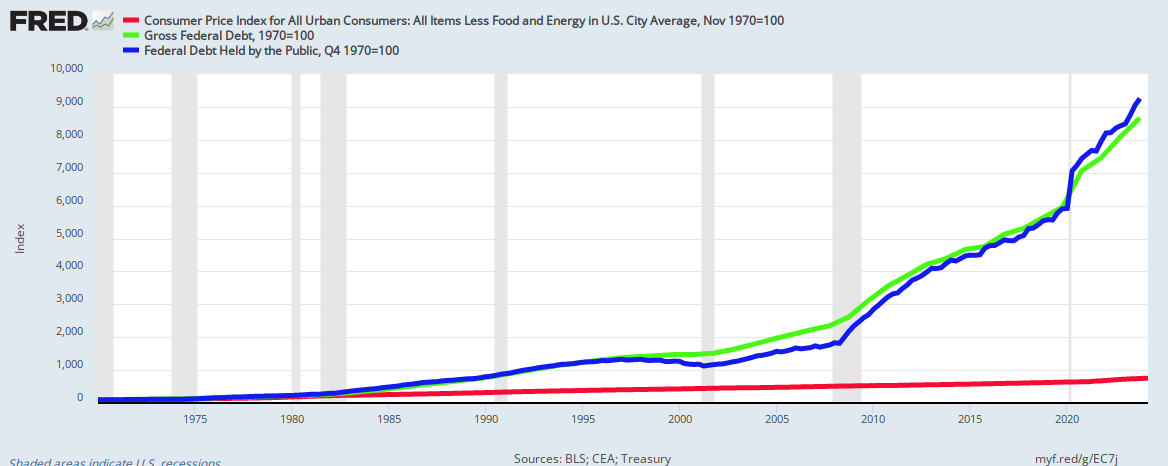
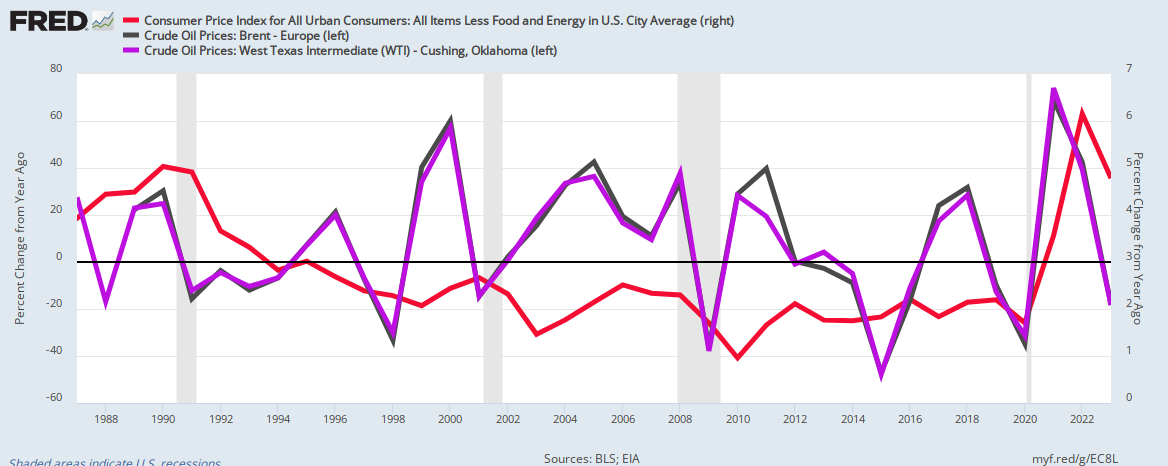
While federal debt (blue and green lines) has risen massively, inflation (red) has risen moderately.There is no relationship between annual changes in federal debt (blue and green) vs. annual changes in inflation.There is a close relationship between annual changes in the prices of oil (blackand purple) and inflation (red)
Another excuse is that federal spending is “socialism.” It isn’t.
Socialism is government (or the nation as a whole) ownership and control over production, distribution, and exchange. Merely handing money to the states, would not be socialism. Not even close.
America does have some socialism. The development of the atomic bomb was socialism. The government owned and controlled every step. Federal benefits are not socialism.
Another concern is that the state governments will spend the money unwisely. But that concern merely expresses the desire for socialism, i.e. federal control.
Sen. Bob Rankin, a Republican member of the Legislature’s Joint Budget Committee, said he is concerned about how that additional $3.8 billion of federal aid will be spent.“I’m afraid that we are spending money and making commitments that we will not be able to sustain once that one-time federal money goes away,” he said.
But rather than worry about the federal money going away, the politicians should be pushing for the federal money never to go away.
The fundamental purpose of government — the only reason why people create governments — is to protect and improve the lives of the people.
Governments are formed solely to be the servants of the people. We do not form any organization with the hope and intention that we will be ruled. Quite the opposite. We want to be served.
If ever a government stops protecting and improving the lives of the people, that government should be replaced with one that does.
The U.S. government has all the power and tools it needs in order to improve our lives. We do not want the dubious pleasure of being taxed. Rather we should want to tax the federal government.
After all, the federal government has no need for our tax dollars. It has infinite dollars at its disposal. It is we who can run short of dollars.
The people and the states, all being monetarily non-sovereign, should levy a per-capita tax on the federal government, to pay for our protection and our life improvement.
If the people do it, we might want to call it Social Security for All.
Rodger Malcolm Mitchell
Monetary SovereigntyTwitter: @rodgermitchellSearch #monetarysovereignty Facebook: Rodger Malcolm Mitchell ………………………………………………………………………………………………………………………………
THE SOLE PURPOSE OF GOVERNMENT IS TO IMPROVE AND PROTECT THE LIVES OF THE PEOPLE.
Gap Psychology describes the common desire to distance oneself from those “below” in any socio-economic ranking, and to come nearer those “above.” The socio-economic distance is referred to as “The Gap.”
Wide Gaps negatively affect poverty, health and longevity, education, housing, law and crime, war, leadership, ownership, bigotry, supply and demand, taxation, GDP, international relations, scientific advancement, the environment, human motivation and well-being, and virtually every other issue in economics.Implementation of Monetary Sovereignty and The Ten Steps To Prosperity can grow the economy and narrow the Gaps:
Ten Steps To Prosperity:
Liberals wish to protect the poor from the rich. Conservatives wish to protect the rich from the poor.
—/—
If you don’t know what you’re talking about, or if you’re outright lying, be sure to quote fake numbers or no numbers at all, as does this article from the notorious Committee for a Responsible Federal Budget (CRFB).
Partial Student Debt Cancellation is Poor Economic Stimulus, June 3, 2021 Last year, we estimated that fully canceling student debt would produce eight to 23 cents of economic activity for every dollar of cost and speculated that partial student debt cancellation might have a higher multiplier.
.
In light of the current economic recovery, and employing new techniques made available by working papers from the Congressional Budget Office (CBO), we find that partial cancellation of federal student loans would also be extremely poor stimulus, producing only 2 to 27 cents of economic activity for every dollar of cost.
Immediately, the acrid odor of bull excrement wafts over the land.
.
There is a difference between debt “cancellation” and debt “payment.” The federal government can do both, and both of which cancel the debt.
.
But federal debt “cancellation” can take dollars from the economy (depending on who the lender is and how the cancellation is handled), while federal debt payment adds dollars to the economy.
.
Let’s look at four scenarios:
I. The government is the lender and the debt is canceled.
This would add stimulus dollars to the economy, because every dollar that would have been paid to the government, now would stay in the private sector, i.e. the economy. (Federal dollars are not part of the economy until they are owned by the private sector.)
II. Government is the lender and the government pays off the debt (pays itself).
Same as I.
III. Private sector is the lender and the debt is canceled.
This neither would add nor subtract money from the economy, but it would cheat lenders while enriching borrowers.
IV. Private sector is the lender and the government pays off the debt.
This immediately adds short-term stimulus dollars to the economy, but cancels long-term dollars. There would be immediate financial benefits, while long-term interest is transformed into long-term earnings on the payment/
All four scenarios either add dollars to the economy or do not add dollars, but none subtracts dollars.
.
These scenarios can be boiled down to one simple financial question:
Would you prefer that the federal government adds growth dollars to the economy, or merely circulates existing dollars within the economy?
.
In short, would you prefer that the economy grow or remain level?
As we shall see, the immediate money supply is not the entire issue.
Specifically, we find: Canceling $10,000 of debt results in an economic multiplier of 0.13x in our central estimate, with a range of 0.03x to 0.27x depending on the parameters.
Before we shovel too much of the bull excrement, we call your attention to the little word “an” that we bolded in their article (above).
According to Investopedia: “In economics, a multiplier broadly refers to an economic factor that, when increased or changed, causes increases or changes in many other related economic variables.”
And bless their little hearts, the CRFB flips back, forth, and around and around about exactly which multiplier they are talking about.
For example, consider the multiplier: GDP/Federal Deficit Spending.
The formula for GDP is;
GDP = Federal Spending + Non-federal Spending + Net Exports.
Any of the three terms on the right side of the equation can be considered an economic multiplier with respect to GDP. Increase any of the last three terms in the equation, and GDP must rise.
.
In straight algebra, you would say that GDP must rise by the same amount as each one of the terms rises. In the above four scenarios, none indicate an increase in federal spending would cause a reduction in GDP.
.
But economics contains multipliers, that if the CRFB were honest (!), are impossible to measure. For instance, consider these questions.
How many additional dollars would be created by federal investments in Research and Development? How many additional dollars would be created by private investments in R&D?
These two simple questions are massively complex and are impossible to answer. They involve factors such as:
Which R&D specifically
The likely success rates of the R&D
How much success
The timing of successes
The collateral results
The effect on the other factors
Or, take just one tiny segment of R&D. What if the federal government and the private sector invested $1 billion in battery research. What will be the effects on GDP?
That’s just one minuscule slice of the problem.
.
Now multiply that by the hundreds of thousands of different investments the private sector could possibly make, with the extra dollars received via loan payoff or loan cancellation. Then compute the multiplier.
Can you do that? Can anyone do it?
The CRFB can, or rather, pretends it can:
Partial cancellation of student debt would increase economic output in the coming years, but only by a small fraction of the overall cost. Canceling $10,000 of student debt per borrower would completely eliminate student debt for 15 million borrowers and partially reduce debt for 28 million more at a cost of between $210 billion and $280 billion.
.
We estimate this would reduce annual loan payments by around $18 billion per year (once current automatic forbearance ends), or roughly $54 billion over three years. This means that even over a three-year period, less than a fifth of the total amount forgiven would translate into cash savings.
First, remember that every dollar the Monetarily Sovereign federal government invests is free. No tax dollars are used. The private sector pays nothing for federal spending.
So even if the government found a way to spend a trillion dollars that, by some magical mathematics, translated into only an extra $1 for the private sector, the economy would be ahead of the game.
.
And then, why the three-year comparison? What about over a ten-year period. A twenty-year period?
The CRFB “cooks the books” by comparing a long-term liability to a short-term return. Given the CRFB’s dumb business logic, no one ever would invest in R&D, because almost none of it pays off in three years.
And now the CRFB’s diarrhetic bull really unloads:
Based on existing literature, we estimate these cash savings plus the added wealth from student debt cancellation would lead to $36 billion in increased consumption, resulting in roughly $31 billion in higher output over three years. The net fiscal multiplier in this case would be roughly 0.13x. Employing a broader range of assumptions, this multiplier could be as low as 0.03x and as high as 0.27x.
.
Canceling $50,000 would wipe out all student debt for around 36 million borrowers and reduce debt for 7 million more at a cost of $950 billion based on our estimates. This would reduce annual payments by $55 billion per year and $165 billion over three years.
.
In our central estimate, we find the resulting increased cash flow and wealth would increase consumption by roughly $104 billion, resulting in roughly $91 billion in added output over three years. The net fiscal multiplier would total 0.10x.
“Based on existing literature”? Make that “based on cherry-picking something someone wrote, that supports our case.”The CRFB has no clue about how much previously indebted students will spend, and how they will spend it, when partly or fully relieved of their debt.
.
Consider the student who can’t afford to start a business because of his debt, but now relieved of that debt he is able to start the next Costco or McDonalds. How does that figure into CRFB’s phony math?
Employing a broader range of assumptions, this multiplier could be as low as 0.02x and as high as 0.25x. These multipliers are extremely low. Even during periods of extreme social distancing, CBO estimated most COVID relief measures had a multiplier of between 0.4x and 0.9x.
Wait! What? Now you use “a broader range of multipliers”? What does that say about your “narrower” range of multipliers? How did you pick those multipliers?
.
The CRFB arbitrarily picks multipliers from the infinite number available, and then estimates from those multipliers, just to get the answer it wants.
Is the CRFB now “proving” that getting us out of the COVID recession was not worth the federal investment?
And now we move from bull-scat to a herd of bull’s-scat.
Historically, multipliers on most stimulus policies have ranged from 0.5x to 2.0x.
Which multipliers? The narrow ones or the wide ones? Over what period of time? It’s all vague — intentionally vague.
The multipliers for partial student debt cancellation are low for three main reasons. First, partial cancellation boosts household cash flow very modestly relative to the cost.
Yes, if you pay off a 20-year loan, and then measure the 3-year savings, that is exactly the way it turns out. By that phony criterion, no long-term loan ever should be paid off.
Second, the benefits are poorly targeted to those who are less likely to spend any additional cash they receive.
All that says is, they’ll save it for future investment in the economy, which apparently the CRFB considers worthless.
And third, the combination of a strong economic recovery, excessive cash, and supply constraints in the current economy suggests limited room to further boost demand.
This has been the CRFB mantra for ages: “There is no more room for GDP growth.” A truly pitiful conclusion designed to keep the lower income group from asking for government benefits.
The CRFB’s ongoing mantra: “There’s no more room for economic growth.”
As we highlighted in last year’s analysis on full student debt cancellation, forgiving large amounts of this type of debt results in only modest reductions to annual repayment costs and thus frees up only a small amount of additional funds to be used for consumption in the short run.
Oops. They sneaked in that little phrase, “in the short run.” As in, “Never invest in anything that does not pay you back fully within three years. Never buy a stock. Never buy a bond. Never buy a business.”
And the above is what passes for financial sense in the world of the CRFB.
Student debt is generally repaid gradually over a 10-to-30-year period. In fact, the majority of canceled debt would result in no improvement in cash flow this year.
Say I buy a house for $1,100,000, put down $100,000, and mortgage $1 million for 30 years at 5%.
Not counting taxes and other costs, that mortgage will cost me $64,418.64 a year — or using the CRFB’s three-year criterion, $193,255.92 for three years.
Over the full 30 years of the mortgage, I will pay $932,559 in interest.
If instead, I decide to pay cash for the house, rather than mortgage, I will pay an extra $1 million, and save “only” $193,255.92 for three years.
According to CRFB math, I will “lose” $806,744 in the first three years.
My cash flow in the first year will be a negative $935,536.
So, the CRFB:
Ignores the fact that federal spending costs no one anything
Claims one never should pay off any loan unless they net profit in three years, or even in one year.
Relies on vague, optional estimates based on vague, optional, and ever-changing “multipliers.”
All of this is to “prove” that it is better for America that college students — especially those who don’t come from wealthy families — be indebted for life, thereby prevented from investing in lucrative careers.
The South kept black slaves from getting an education for the very same reason.
But it is how liars figure.
Almost 90 percent of IDR borrowers have balances above $10,000 and around 40 percent have balances over $50,000.
Now suddenly, the CRFB seems to be criticizing the small size of the payoff! Hey guys, make up your minds.
According to an analysis by Sylvain Catherine and Constantine Yannelis, which shows that the top income decile receives more benefit than the bottom 30 percent of earners.
Obviously. If you eliminate almost any tax or any cost in America, the high income people will receive more dollar benefit. But that isn’t the point.
.
A $10,000 savings means more to a low earner than to a high earner. It will have a greater effect on the low earner’s life, on his ability and willingness to spend, and on the economy.
Sadly, there is no noncontroversial way to do this correctly. One might want to give low-income people more of the school loan benefit, or pay off less of high-income people’s loans, but there are many reasons that never has seems to work.
.
The U.S. tax code tries but fails.
Given high levels of savings, massive stimulus in the pipeline, pent-up demand, supply constraints, inflation pressures, and expectations of a strong economic recovery, additional cash injected into the economy will have few places to go. To the extent that it leads to new spending – as opposed to saving – it is likely to result in additional inflation pressures (especially in the near term), which risks higher interest rates (especially once the economy has fully recovered) and thus tamped-down growth.
When it suits their purpose, CRFB becomes fixated on the nearterm.
.
We might have inflation for a couple of months, at which point the CRFB will set their hair on fire, and subsequently ignore the welfare of the people.
But inflation never is caused by federal deficits. It always is caused by shortages. And the federal government can cure any shortages by additional federal spending to obtain the scarce goods or to reward their creation.
When the economy is well below potential and the Federal Reserve is constrained, CBO estimates each dollar of demand leads to about $1.50 of ultimate output. But when the economy is near potential and the Fed is able to respond, CBO believes $1 of demand will produce only 50 cents of net output.
Not choosing to understand economics, the CBO and the CRFB won’t tell you that even if $1 in demand produced only 2 cents in net output, it still would be worth it, because the $1 in demand cost no one anything.
And so far as the economy being “near potential,” that is as bogus a figure as is the “economic multiplier.
.
Economic potential the total ability of a nation to produce goods and services. It is a corollary to GDP, which a total spending number.
The latter is history. The former is predicted. What is the total capacity of the U.S. to produce goods and services? No one knows because capacity not only includes the availability of production assets but also changes in methodology due to automation and many other factors.
While there is no doubt that student debt cancellation would be a financial and psychological benefit to many borrowers who would receive forgiveness, canceling $10,000 or $50,000 in student debt would not be an effective stimulus.
Huh? Something that not only is a financial benefit, but also a psychological benefit, is not an effective stimulus??? Was that part of the “let the poor suffer,” conservative playbook?
.
And now, for the best part, which conveniently is hidden in the Appendix:
Appendix: Uncertainty in EstimatesOur estimates come with a significant degree of uncertainty.
Translation: “Our estimates are WAGs (Wild Ass Guesses) designed to scare you.
The ranges (in our) estimates reflect uncertainty over three components: the budgetary cost of forgiving the loans, the demand multiplier associated with reduced loans payments, and the reduction in the effectiveness of a multiplier in an economy operating at or above potential.
.
There is also uncertainty about the decrease in repayment as a result of cancellation, though it does not contribute to the range of the estimates.
Translation: !t is a guess, based on a guess, multipied by a guess, swayed by our own biases, and distorted by the phases of the moon in August.
In short, we threw darts at a dartboard from 100 feet away, and moved the board so that the darts would hit exactly where we wanted.
.
And that, dear friends, is known as CRFB conservative science. Enjoy the experience.
Gap Psychology describes the common desire to distance oneself from those “below” in any socio-economic ranking, and to come nearer those “above.” The socio-economic distance is referred to as “The Gap.”
Wide Gaps negatively affect poverty, health and longevity, education, housing, law and crime, war, leadership, ownership, bigotry, supply and demand, taxation, GDP, international relations, scientific advancement, the environment, human motivation and well-being, and virtually every other issue in economics.Implementation of Monetary Sovereignty and The Ten Steps To Prosperity can grow the economy and narrow the Gaps:
Ten Steps To Prosperity:
The only people who deny America’s bigotry are America’s bigots
………………………………………………………………………………………………………..
You are alive.
That is a miracle because the entire universe works against you. Your whole life, however short or long, is a losing battle against entropy.
You, I, seven billion others, and all the fish and all the trees, every living thing struggles against the universe. As does the earth. As does the sun and all the suns and all the planets. Everything struggles against entropy.
So you might think we humans would have a bit more empathy for our fellow strugglers. But no. The fishermen do not empathize with the fish. We barely can empathize with people, and even then with only a few.
If you travel to another country, you will meet people who do not think the way you do. They are aliens, as are you to them.
Patriots attack America.
But you don’t need to go far. You can travel in America, where Southerners, Northerners, Easterners, and Westerners toil.
All but your closest neighbors seem a bit (or more than a bit) “off.”
They don’t think or act exactly like you, though they are doing exactly the same thing you are: Struggling to survive.
And we all will lose.
The world is a loser’s game, like Las Vegas. We go there to enjoy our losing. Or some do.
I for one, have been there twice in my 86 years. I don’t understand the concept of intentionally playing a game you cannot win, when just being alive already forces you to play a game you cannot win.
I do not understand the ladies, who sit in front of slots, holding paper cups of chips, and mindlessly inserting one into a slot, pulling a lever or pushing a button, and before even noticing the outcome, already are sliding in another one into the same slot.
Insert. Press. Insert. Press. Insert. Press. Lose.
To me, they are aliens, wasting the miracle given to them.
You and I are surrounded by aliens, people we simply cannot fathom. What is their game plan? What do they hope? What would they consider success when their failure is inevitable?
And though I may only marginally understand or not understand most people at all, there is one alien bunch I really, really, really don’t understand. They might as well be born out of octopuses from Mars — that kind of alien.
I wonder — I close-my-eyes-and-ponder — are they actually people, and if so. . .
What kind of people? You tell me.
Aliens among us.
I see aliens who:
Despise every religion, every nationality, every age, every belief group, every geographical existence, every color, every hairstyle, every way of speaking, every size and shape that is different from their own.
Deny human-caused, species-destroying global warming despite the nearly unanimous scientific opinion.
Claim to be “pro-life” (only for the unborn), yet are “pro-death” (for everyone else) by refusing gun control?
Support a violent, white supremacist insurrection that attempted to destroy American democracy by taking over the federal government, then falsely claim the left did it?
Who, despite 200 years of mistreatment and killing of blacks, still refuse to acknowledge bigotry in America?
Disseminate and believe the repeatedly debunked lie that their tarnished hero won the Presidential election?
Refuse mask-wearing despite nearly unanimous scientific opinion, and the fact that refusal endangers fellow Americans.
Value their own lives and their fellow Americans’ lives so little, they must be bribed with beer and Lotto tickets, before agreeing to a vaccination?
Demean the mainstream media in support of a proven liar?
Believe and claim that blacks were “happy” and “treated well” under slavery.
Are flag-waving proud of the nation’s slave history and culture?
Proudly claim to love God and the Judeo-Christian bible, yet support hate-filled, white supremacists and an irreligious sinner?
Promulgate hatred and contempt for blacks, browns, yellows, reds, Mexicans, Muslims, Jews, immigrants, most women, and liberals, but claim to love America?
At our southern border, intentionally destroyed families and tortured children, all to discourage people from seeking a better life, like our ancestors did?
Discourage attempts to save America’s natural lands and species in favor of big business?
Claim to advocate law and order, yet support a man who has cheated on his taxes and his multiple wives, and told more than 30,000 lives while in office.
Respect and adore a braggart, who has gone bankrupt multiple times while cheating thousands of his employees, lenders, and students of his fake University?
Will put one man’s ego ahead of American democracy by passing laws to make voting difficult or impossible for the poor, the black, and the brown?
Have done, and continue to do, everything they can to take healthcare away from the poor?
Get all their beliefs from FOX and a fool like Tucker Carlson, Breitbart, QAnon, Parler, and other fake-conspiracy-promoting sources?
Respect and adore a bully?
Respect and adore a sneaky draft-dodger who disparages as “suckers” the patriots. who gave their lives in service of their country.
Respect and adore a man who, given the vast power of the American Presidency, wasted his precious time playing golf, sending insulting tweets, and making enemies, worldwide?
Now pray for a proven lazy, lying, traitorous, crooked, incompetent, bigoted, mean-spirited, adulterous, psychopathic, egomaniacal loser to return as President of the United States?
What kind of people are these? Are they actual people? Were they born on planet earth? Are they aliens walking among us, pretending to be human while having no humanity?
Think about it, What kind of people are these?
Aliens. I simply do not understand them.
Rodger Malcolm Mitchell
Monetary SovereigntyTwitter: @rodgermitchellSearch #monetarysovereignty Facebook: Rodger Malcolm Mitchell ………………………………………………………………………………………………………………………………
THE SOLE PURPOSE OF GOVERNMENT IS TO IMPROVE AND PROTECT THE LIVES OF THE PEOPLE.
Gap Psychology describes the common desire to distance oneself from those “below” in any socio-economic ranking, and to come nearer those “above.” The socio-economic distance is referred to as “The Gap.”
Wide Gaps negatively affect poverty, health and longevity, education, housing, law and crime, war, leadership, ownership, bigotry, supply and demand, taxation, GDP, international relations, scientific advancement, the environment, human motivation and well-being, and virtually every other issue in economics.Implementation of Monetary Sovereignty and The Ten Steps To Prosperity can grow the economy and narrow the Gaps:
Ten Steps To Prosperity:








 #Monetary Sovereignty - Mitchell