Does the Republican Party really exist anymore?

Accredited Cockroach Pest Control & Removal in Melbourne
No more, my favorite
Imagine walking into your favorite restaurant — a restaurant you have frequented for many years — only to discover it’s under new management, and the tables are covered with flies, roaches, and filth. Will you still eat there just because you always have? I had to answer that question five years ago. Before that, I mostly had voted Republican. But then my favorite political party came under new management, and indeed it has become covered with flies, roaches, and filth. The new Republicans claim to be “conservatives,” with the word “conserve” being in opposition to the word “change.” What are conservatives? The are many opinions about this. One opinion comes from The Intercollegiate Studies Institute (ISI).
It is a nonprofit educational organization that promotes conservative thought on college campuses. It lists the following six as its core beliefs: limited government, individual liberty, personal responsibility, the rule of law, free-market economics, and traditional Judeo-Christian values. ISI was founded in 1953 by Frank Chodorov with William F. Buckley Jr. as its first president.
Yet, does that Republican Party, led by William Buckley, still exist? The following article, from Scientific American, describes one aspect of the new Republican Party:
Elected officials who campaigned against critical race theory (CRT) (the study of how social structures perpetuate racial inequality and injustice), are being sworn into office all over the U.S. These candidates captured voters’ attention by vilifying CRT, which has become a catch-all to describe any teaching about racial injustice. Lessons about the genocide of Native Americans, slavery, segregation and systemic racism would harm children, these candidates argued. Calling its inclusion divisive, some states have enacted legislation banning CRT from school curricula altogether. This regressive agenda threatens children’s education by propagating a falsified view of reality in which American history and culture are outcomes of white virtue. It is part of a larger program of avoiding any truths that make some people uncomfortable, which sometimes allows active disinformation, such as creationism. Children are especially susceptible to disinformationas Melinda Wenner Moyer writes in “Schooled in Lies.” Removing conversations around race and society removes truth and reality from education. This political interference is nothing new—political and cultural ideologues have fought for years to remove subjects such as evolution, Earth history and sex education from classrooms and textbooks.
That is today’s Republican party, preaching “limited government, individual liberty, and personal responsibility“, but voting for government book-burning with regard to racial history. “Limited government”? “Individual liberty”? Is that today’s Republican Party? Or does the following better describe today’s Republican Party?:
Many of the school districts that brought in anti-CRT board members are the same ones that refuse to mandate masks, despite the evidence that masks can prevent the spread of COVID. These school officials also rail against vaccine mandates as a violation of personal choice. It is the same prioritization of individuals over community and a discomfort with hard truths that characterize the movement against the teaching of true history.
Or, perhaps this is the real Republican Party: Newt Gingrich, a former House speaker and candidate for the Republican presidential nomination, stoked outrage on Sunday by predicting members of the House committee investigating the Capitol attack will be imprisoned if Republicans retake the chamber this year.
One of two Republicans on the committee, Liz Cheney, said, A former speaker of the House is threatening jail time for members of Congress who are investigating the violent attack on our Capitol and our constitution. This is what it looks like when the rule of law unravels.”
The rule of law” once was a cornerstone of Republican politics. But no more. That rule is gone. Now, it is “the rule of Trump.” Or perhaps more accurately, the cornerstone of the Republican party now is, the rule of Trump’s lies.” Some of his doozies, according to Updated 9:28 AM ET, Sat January 16, 2021, were:
  1. It never rained on his inauguration. (It poured)
  2. The coronavirus is under control. (Never was)
  3. Sharpiegate (Alabama never was threatened)
  4. “The head of the Boy Scouts called him “to say my address to the Scouts’ National Jamboree was “the greatest speech that was ever made to them.”  (No such call ever was made._
  5. Rep. Ilhan Omar supports al Qaeda. (Ugly, bigoted lie.)
  6. The US for years had a $500 billion annual trade deficit. (Never even reached $400.)
  7. Big, burly men repeatedly came up to him crying tears of gratitude. (No record of it ever happening).
  8. He didn’t know anything about a $130,000 payment to porn performer Stormy Daniels. (He personally reimbursed Cohen, who made the payment.)
  9. He claimed to end family separation at the border. (He ended his own policy of family separation after the public uproar.
  10. Claimed Biden would destroy protections for people with pre-existing health conditions. (This was part of Obamacare that Trump tried for years, to destroy.)
  11. Claimed got the Veterans Choice program passed after other presidents tried and failed for years. (It was a lie. When asked about it,  he left the room).
  12. “They say” the noise from windmills “causes cancer.” (This was just one of his many, many “they say” or “people tell me” lies.)
  13. Trump’s big health care plan was eternally coming in “two weeks.” (It never arrived, just as his many other plans and announcement never arrived.)
  14. Claimed he was named “Michigan Man of the Year.” (Never happened, though he claimed it more than 100 times.
  15. And the winner is: “I won the election.” (It didn’t happen. Fifty judges, many Republican, said it didn’t happen. Recounts said it didn’t happen. Republican election officials said it didn’t happen. And he lost the popular vote by 7 million, a huge difference.)
St. John's Church: Trump photo op at DC church has bishop furious - Vox
Trump being religious
And remind me, wasn’t it Trump who promised to show his tax returns and to put his holdings into a blind trust? He lied, of course, as he always does. He’s still fighting to preserve as much of that secrecy as he can. And, you may have thought bearing false witness was a violation of Republicans’ “traditional Judeo-Christian values.”  Apparently, those religious values are limited to his holding up a bible for a photo op, (after gassing protesters to make way for him.) Today’s Republican Party makes excuses when they resort to “whataboutism” to justify Trump’s firehose of lies.  Getting back to the Republican claim of “individual liberty,” it doesn’t apply to women, particularly poor women, who want an abortion. Rich women always can get abortions, but poor women must resort to coat hangers, because the new Republican Supreme Court denies them individual liberty. And then there is the conservative desire for “free-market economics,” which really means, free-market economics for the rich. That’s why during the Trump administration, the rich received monster tax cuts while the poor and middle classes received next to nothing. And finally, we come to “personal responsibility.” It’s the Republican excuse for trying to destroy Obamacare and for voting against, Medicare for All and the Build Back Better plan. This is an example of what 100% of Republican Congresspeople oppose:
  • Free preschool for 3-4-year-olds
  • Child-care financial aid
  • Financial aid to care for the elderly or disabled
  • Increased child tax credits
  • Clean energy tax credits and investment
  • Investment in coastal renovation, forest management, soil conservation
  • Cost reduction for prescription drugs
  • Reduced premiums for Obamacare
  • Close the Medicaid coverage gap
  • Medicaid hearing benefits
  • Investment in affordable housing
  • Expanded Earned Income Tax Credit for low-wage employees
  • Funds education beyond high school
  • Expands funding for low-income children’s meals
  • Funds reduced immigration backlog
Not only do 100% of Republicans oppose these programs you could have had, but 0% of Republicans offer nothing of their own. The Republicans have no plans. They even failed to come up with a platform ahead of the past election. What was once the “party of ideas” has become the “brain-dead party,” the party whose sole objective is to oppose anything that could benefit America’s working class. Republicans now firmly are the party of the rich, the party of the cruel, the party of the bigot, the party of the lie, the traitor party, the fear-mongering party, the xenophobe party, the paranoid party, the party that forged election documents in order to destroy our democracy, the traitor party of Donald Trump. Any opposed to this new Republicanism are censured, ostracized, “primaried,” and removed from committee positions. Astoundingly, virtually all Republican politicians and many Republican voters continue to support Trump’s lies. They continue to eat at their once-favorite restaurant because they always have. Trump has convinced the naive that the poor, the middle-classes, the black, the brown, the yellow, women, and the gay are a danger to America. This, from the traitor who encouraged a coup, and continues to resist America’s peaceful transfer of power. If you traditionally have voted Republican, know this. The party that now calls itself “Republican” is no more. The ideas and ideals for which you once voted have been destroyed. Your vote no longer means “Republican.” It no longer means “conservative.” It now means “Trump.”Food | Food and Wine | Food and Restaurants | Daily Telegraph Vote Republican and you are patronizing that restaurant you once loved but now is filled with vermin — the restaurant that no longer exists as you remember it. . . Rodger Malcolm Mitchell Monetary Sovereignty Twitter: @rodgermitchell Search #monetarysovereignty Facebook: Rodger Malcolm Mitchell

……………………………………………………………………..

THE SOLE PURPOSE OF GOVERNMENT IS TO IMPROVE AND PROTECT THE LIVES OF THE PEOPLE.

The most important problems in economics involve:
  1. Monetary Sovereignty describes money creation and destruction.
  2. Gap Psychology describes the common desire to distance oneself from those “below” in any socio-economic ranking, and to come nearer those “above.” The socio-economic distance is referred to as “The Gap.”
Wide Gaps negatively affect poverty, health and longevity, education, housing, law and crime, war, leadership, ownership, bigotry, supply and demand, taxation, GDP, international relations, scientific advancement, the environment, human motivation and well-being, and virtually every other issue in economics. Implementation of Monetary Sovereignty and The Ten Steps To Prosperity can grow the economy and narrow the Gaps: Ten Steps To Prosperity:
  1. Eliminate FICA
  2. Federally funded Medicare — parts A, B & D, plus long-term care — for everyone
  3. Social Security for all
  4. Free education (including post-grad) for everyone
  5. Salary for attending school
  6. Eliminate federal taxes on business
  7. Increase the standard income tax deduction, annually. 
  8. Tax the very rich (the “.1%”) more, with higher progressive tax rates on all forms of income.
  9. Federal ownership of all banks
  10. Increase federal spending on the myriad initiatives that benefit America’s 99.9% 
The Ten Steps will grow the economy and narrow the income/wealth/power Gap between the rich and the rest.

MONETARY SOVEREIGNTY

Understanding economic reality via a board game

I continually am puzzled by the misunderstanding (“disunderstanding”?) of Monetary Sovereignty. It is both simple and obvious, yet many (most?) people have trouble comprehending it. MS is based on just four simple facts:The case against the American Constitution | The Week
  1. In the 1780s, the U.S. federal government created the laws that created the U.S. dollar from thin air — as many dollars as it wished – and gave them the value it wished.
  2. The government’s own laws give it the power to continue creating dollars, infinitely
  3. The government’s own laws give it the power to continue changing the value of the dollar — a power it has used many times.
  4. The government can change its laws at will.
Really, what could be simpler, more obvious, and less controversial? Derived from these simple, obvious facts comes the following:
  1. The U.S. federal government never unintentionally can run short of U.S. dollars.
  2. No agency of the government can run short of dollars unless the government wishes it.
  3. Federal taxes are not used or needed to fund federal spending.
  4. By changing the value of the dollar, the government has absolute control over inflation
And that’s it. Monetary Sovereignty. Intuition is powerful. Many of us prefer to believe our intuition than believe facts. Interestingly, where fiction parallels facts, you might not believe the facts about the fiction, while still believing fiction about the facts. That is, you might read a historical novel of fiction, and not believe the background facts presented. Yet, you might be fooled by a conspiracy theory website presenting fiction as fact. So here is the explanation that may appeal to intuition as well as to facts. You probably have played the hugely popular board game, Monopolytm. As a game, it’s fiction, but you believe and understand the facts (i.e. “rules.’)Amazon.com: Hasbro Monopoly Money : Toys & Games Here are some of the facts.
The game is played with multiple players plus a Bank The Bank pays Monopoly dollars to the players for various benefits. The Bank collects taxes, fines, loans and interest from the players. The Bank “never goes broke.” If the Bank needs money, it may issue as many dollars as needed by printing on scraps of paper or simply by creating a bookkeeping tally.
Example of a Monopoly running tally
A sample tally is demonstrated by the illustration at the right. It reveals three things: I. Monopoly money is not physical. Those printed $500, $100, $50, $20 $10 $5, and $1 bills aren’t dollars in of themselves. They merely represent dollars, just as the numbers on a tally represent dollars. II. The Bank can create an infinite supply of Monopoly dollars. If needed, the Bank instantly could pay Tom, Dick, Harry, or Bob $1, or $100, or $1,000,000,000 in Monopoly dollars. In the tally, there is no need to create a column for the Monopoly Bank.

This lack of a column demonstrates the Bank’s ownership of infinite dollars.

It also demonstrates that all dollars sent to the Monopoly Bank are destroyed upon receipt.

If Tom, for instance, sent $100 to the Bank, his $4,400 would be reduced to $4,300. So, what happened to the $100 Tom paid? They simply disappeared. They no longer exist. Although the Bank can create infinite dollars this creation process does not create Monopoly Bank “debt.” The Monopoly Bank does not borrow dollars nor does it owe any dollars. Thus, taxes are not levied to “pay off” any Monopoly Bank debt. By rule, the Monopoly Bank simply creates all the dollars it needs. Although the Bank is not precluded from keeping track of the dollars it receives from players, that record would not indicate how many dollars the Monopoly Bank “owes” or has. There is no ongoing debt owed by the Monopoly Bank. All of the above is easily understood by you and by virtually anyone else who has played the game. Now, in the above paragraphs, substitute the words, “U.S. federal government” for the word “Bank.” And substitute “members of the public” for “players.” The facts remain essentially the same.

There are multiple members of the public plus the federal government. 

The federal government pays dollars to the public for various benefits.

The federal government collects taxes, fines, loans, and interest from the public.

The federal government “never goes broke.” If the federal government needs money, the government may issue as much as needed by printing on paper or simply by creating a bookkeeping tally.

[Former Fed Chairman, Alan Greenspan: “A government cannot become insolvent with respect to obligations in its own currency.”]

Continue reading and substituting until you come to the part that some people have difficulty understanding:

The federal government does not borrow dollars nor does it owe any dollars. Taxes are not levied to “pay off” any federal government debt.

[Quote from Ben Bernanke when, as Fed chief, he was on 60 Minutes: Scott Pelley: Is that tax money that the Fed is spending? Former Fed Chair, Ben Bernanke: It’s not tax money… We simply use the computer to mark up the size of the account.]

The Monopoly Bank and the U.S. federal government both are Monetarily Sovereign. They both are issuers of their dollars. Neither of them can run short of dollars. Both the Monopoly Bank and the U.S federal government have infinite dollars.

[Former Fed Chair, Ben Bernanke: “The U.S. government has a technology, called a printing press (or, today, its electronic equivalent), that allows it to produce as many U.S. dollars as it wishes at essentially no cost.”]

Neither the Monopoly Bank nor the federal government borrows or taxes in order to pay their financial obligations. Spending by the Monopoly Bank or the U.S. federal government does not create future taxpayer obligations. For that reason, Social Security, an agency of the federal government, cannot run short of dollars, unless that is what the government wants. Even if there were no FICA tax (which contrary to popular myth, does not fund Social Security), that agency need not run short of dollars.
State and Local Governments With the Most Debt Per Capita
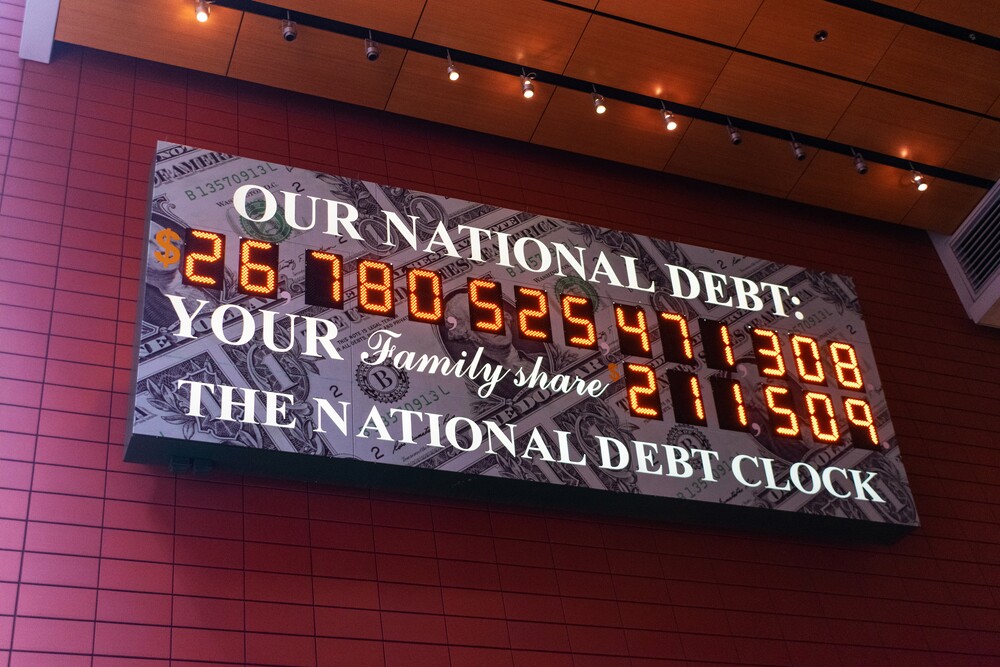
The “debt clock.” You have no share.
Medicare for All, college for all, upgraded infrastructure, good housing for all — every imaginable federal benefit — all are easily affordable. The so-called federal debt is not a burden on future taxpayers or on the government. The famous “debt clock” implies the lie that somehow the federal “debt” is a danger to you, your children, and the federal government. It is not a debt, and it is not a danger, to you or anyone. It is just simple deposits by the public into accounts. The parallels between the Monopoly game and federal financing are stunning. Yet, though people tend to understand the rules of Monopoly, too many become hopelessly confused by the same set of facts when applied to real life. Yes, one is fiction and the other is fact, but that difference is not the source of the confusion. The confusion is caused by the longtime, ongoing, relentless dissemination of false information about the federal government’s finances and by the misnaming of T-securities as “borrowing” and “debt.” They are neither. The misinformation is promulgated by agents for the rich, who want to prevent you from asking for the benefits the rich already receive: Retirement benefits, medical care, good housing, safe neighborhoods, college education, spending money for a good life. Neither the government nor you owes the deposits that sit in T-security accounts. These accounts resemble bank safe deposit boxes, which the bank “pays off” simply by returning the contents. No “debt” or tax liability there. The Monopoly board game is a good analog for the federal finance system. If you understand one, you should understand the other. Rodger Malcolm Mitchell Monetary Sovereignty Twitter: @rodgermitchell Search #monetarysovereignty Facebook: Rodger Malcolm Mitchell

……………………………………………………………………..

THE SOLE PURPOSE OF GOVERNMENT IS TO IMPROVE AND PROTECT THE LIVES OF THE PEOPLE.

The most important problems in economics involve:
  1. Monetary Sovereignty describes money creation and destruction.
  2. Gap Psychology describes the common desire to distance oneself from those “below” in any socio-economic ranking, and to come nearer those “above.” The socio-economic distance is referred to as “The Gap.”
Wide Gaps negatively affect poverty, health and longevity, education, housing, law and crime, war, leadership, ownership, bigotry, supply and demand, taxation, GDP, international relations, scientific advancement, the environment, human motivation and well-being, and virtually every other issue in economics. Implementation of Monetary Sovereignty and The Ten Steps To Prosperity can grow the economy and narrow the Gaps: Ten Steps To Prosperity:
  1. Eliminate FICA
  2. Federally funded Medicare — parts A, B & D, plus long-term care — for everyone
  3. Social Security for all
  4. Free education (including post-grad) for everyone
  5. Salary for attending school
  6. Eliminate federal taxes on business
  7. Increase the standard income tax deduction, annually. 
  8. Tax the very rich (the “.1%”) more, with higher progressive tax rates on all forms of income.
  9. Federal ownership of all banks
  10. Increase federal spending on the myriad initiatives that benefit America’s 99.9% 
The Ten Steps will grow the economy and narrow the income/wealth/power Gap between the rich and the rest.

MONETARY SOVEREIGNTY

How can federal spending increase the nation’s money supply?

The U.S. federal government created the very first U.S. laws from thin air, and some of those laws created the very first U.S. dollars, also from thin air. Ever since then, the government has continued to create laws, and some of those laws allow the government to continue creating more dollars. Thus, the U.S. government has given itself the power to create an infinite supply of U.S. laws and an infinite supply of U.S. dollars. The power is called “Monetary Sovereignty.” You do not have this power. Nor does your city, county, state, or business. You all are monetarily non-sovereign. While the federal government can’t unintentionally run short of dollars, you can, as can even the wealthiest people or businesses on earth. So would you or anyone elect to send your precious dollars to the federal government?
Water Bottle Pouring Water To Ocean Canvas Print | Canvas Prints-somchaij
Sending dollars to a Monetarily Sovereign government is even more futile than pouring a bottle of water into the ocean.
Of course, you wouldn’t, because you are too wise to throw your money away. The only reason why you would send money to the federal government is to obey laws requiring you to do so. Otherwise, you would be a fool to send dollars to an entity that has infinite dollars. Sadly, thousands, perhaps millions, of well-meaning Americans do just that. Recently, reader “Mark” mentioned this government website:
Gift Contributions to Reduce Debt Held by the Public The Bureau of the Fiscal Service may accept gifts donated to the United States Government to reduce debt held by the public. Acting for the Secretary of the Treasury, Fiscal Service may accept a gift of: Money, only on the condition that it be used to reduce debt held by the public. An outstanding government obligation, only on the condition that the obligation be cashed and the proceeds used to reduce debt held by the public. Other intangible personal property only on the condition that the property is sold and the proceeds used to reduce the public debt. Gifts to reduce debt held by the public may be inter vivos (from a living person) gifts or testamentary bequests (in a person’s will). The fiscal year to date information includes total gifts received for the months of October through September. Monthly data is not available for the years 1996 and 1997. Read about how to make a contribution to reduce the debt. Gift Contributions* 2021 $1,268,950.35   2020 $1,615,198.54    2019 $4,991,215.70    2018 $775,654.63 2017 $2,611,428.24   2016 $2,718,154.76    2015 $3,864,661.38    2014 $5,103,452.84 2013 $1,763,754.56   2012 $7,749,618.27    2011 $3,277,369.23    2010 $2,840,466.75 2009 3,063,057.05    2008 2,189,358.89     2007 2,624,862.42      2006 1,646,209.41 2005 1,455,541.65    2004 664,911.25       2003 1,277,423.40      2002 744,675.06 2001 1,645,082.28    2000 1,868,891.93     1999 1,457,510.59      1998 1,535,541.02 *Gifts to Reduce Debt Held by the Public have been reported in the footnotes of the Monthly Statement of the Public Debt since February 1988. Visit the MSPD to view historical information on the debt including fiscal year to date tables through and including 1987.
If a private citizen had written the above pack of lies to solicit money, a sheriff would be banging on his door. But who will arrest Timothy (Tim) E. Gribben, commissioner of the U.S. Department of the Treasury’s Bureau of the Fiscal Service (Fiscal Service)? If you go to his department’s website, you will see lies that would shame even Donald Trump. For instance:
. . . gifts donated to the United States Government to reduce debt held by the public.
What a con job. First, there is no reason to reduce the debt held by the public. This so-called “debt” is nothing more than deposits into T-security accounts held by the Federal Reserve Bank. There is no reason to reduce these deposits, and the federal government has the unlimited ability to increase or constrain them. Further, the government pays off the deposits every day upon maturity, simply by returning the money in the accounts. This is no burden whatsoever on the government or on taxpayers, as no tax dollars are used. Second, the dollars you send to the federal government are destroyed upon receipt. The dollars you send come from the M1 money supply measure, but when they are received they immediately become part of no money supply measure. Because the government has the infinite ability to create infinite dollars, there is no point in trying to measure or add to the government’s money supply. It is worse than hoping to raise an ocean level by pouring a bottle of water into the ocean because even an ocean isn’t infinte. Infinity plus any number, still is infinity, which is why voluntarily sending dollars to the federal government is infinitely foolish.

∞ + 1 = ∞

“We are guided by our commitment to integrity, collaboration, accountability, learning, and excellence in our dealings with each other and with those we support and serve.” Oh, puleeze. When someone brags about his integrity, collaboration, accountability, learning, and excellence, you can be sure he has none of those virtues, especially when:
“We . . . conducted 472 auctions to fund critical government operations and activities.”
His auctions do nothing to fund government operations and activities. Like federal tax dollars, auction dollars are destroyed upon receipt. The transition from being part of the M1 money supply to being part of no money supply effectively destroys dollars.
“We collected over $4.91 trillion in federal revenue of which 99.6% was settled electronically.”
Whether settled electronically or with an abacus, it was $4.91 trillion dollars removed from the U.S. private sector (aka “the economy”) or from some other nation’s private sector — and destroyed.
. . . processed nearly  202.2 million transactions valued at over $3.56 trillion in tax revenue.
He destroyed $3.56 trillion that formerly was in the economy.
“We collected $5.04 billion in delinquent debt.”
And gave that $5.04 billion to an entity that already has an unlimited supply of dollars.
Treasury Offset Program collected $271.76 million of delinquent child support collections and $294.8 million of State Unemployment Insurance. The Centralized Receivables Service processed 805,980 cases and collected over $79.1 million.
All of the above-mentioned dollars were taken from the private sector, and destroyed.
“We finance government operations by offering Treasury securities through reliable, accurate, flexible, and electronic systems.”
No, you do not “finance government operations by offering Treasury securities.” The government finances its own operations by creating dollars, ad hoc. In summary, take pity on the well-meaning but ignorant folks who voluntarily pour their precious dollars into an infinite, unmeasurable ocean. But take even more pity on those of us who are forced, by law, to do the same, unnecessary thing: Paying FICA. Rodger Malcolm Mitchell Monetary Sovereignty Twitter: @rodgermitchell Search #monetarysovereignty Facebook: Rodger Malcolm Mitchell

……………………………………………………………………..

THE SOLE PURPOSE OF GOVERNMENT IS TO IMPROVE AND PROTECT THE LIVES OF THE PEOPLE.

The most important problems in economics involve:
  1. Monetary Sovereignty describes money creation and destruction.
  2. Gap Psychology describes the common desire to distance oneself from those “below” in any socio-economic ranking, and to come nearer those “above.” The socio-economic distance is referred to as “The Gap.”
Wide Gaps negatively affect poverty, health and longevity, education, housing, law and crime, war, leadership, ownership, bigotry, supply and demand, taxation, GDP, international relations, scientific advancement, the environment, human motivation and well-being, and virtually every other issue in economics. Implementation of Monetary Sovereignty and The Ten Steps To Prosperity can grow the economy and narrow the Gaps: Ten Steps To Prosperity:
  1. Eliminate FICA
  2. Federally funded Medicare — parts A, B & D, plus long-term care — for everyone
  3. Social Security for all
  4. Free education (including post-grad) for everyone
  5. Salary for attending school
  6. Eliminate federal taxes on business
  7. Increase the standard income tax deduction, annually. 
  8. Tax the very rich (the “.1%”) more, with higher progressive tax rates on all forms of income.
  9. Federal ownership of all banks
  10. Increase federal spending on the myriad initiatives that benefit America’s 99.9% 
The Ten Steps will grow the economy and narrow the income/wealth/power Gap between the rich and the rest.

MONETARY SOVEREIGNTY

EMERGENCY! THE FEDERAL GOVERNMENT IS RUNNING OUT OF DOLLARS! (Nah)

EMERGENCY! THE FEDERAL GOVERNMENT IS RUNNING SHORT OF DOLLARS!

Who wants you to believe that nonsense? The rich, of course. They want to widen the income/wealth/power Gap between them and you — and REASON is happy to oblige.

Let’s begin with the headlines:

REASON: ECONOMICS
Inflation Means Interest Rates Could Rise. Higher Interest Rates Will Make the National Debt More Expensive.
The Fed may soon get serious about hitting the monetary brakes to slow the economy.
BRUCE YANDLE | FROM THE FEBRUARY 2022 ISSUE of REASON

They say the so-called “national debt” will be “more expensive.”

The definition of “more expensive” is: An entity having infinite dollars (the U.S. governement) will pump more stimulus dollars into the private sector (aka “the economy’), thus not only helping the private sector grow, but also accomplishing many important economic tasks.

That’s what REASON means by “more expensive.”

10-Year US Treasury Note - Guide, Examples, Importance of 10-Yr Notes
The U.S. government can’t run short of these, 

One1 REAL ONE Dollar UNCIRCULATED United States Gem Mint image 1
or these,

United States Treasury Check For Either A Federal Tax Refund Or Social Security Payment Isolated On White Stock Photo, Picture And Royalty Free Image. Image 137893207.
or these.

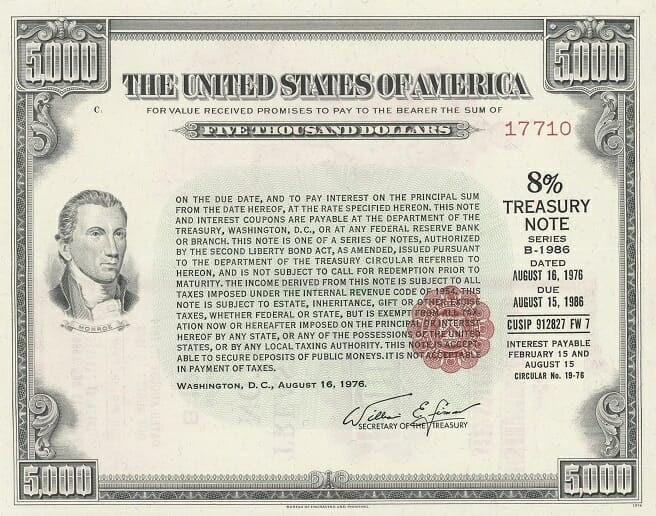
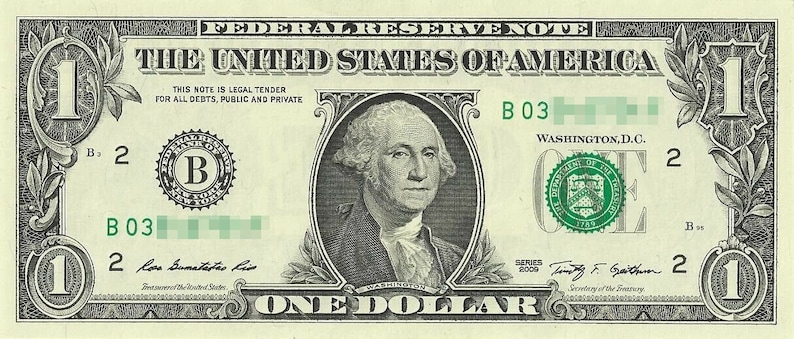
The Treasury bond, the dollar bill and the Treasury check all are titles to dollars. Just as a car title is not a car, and a house title is not a house, the above three titles are not dollars. They merely represent dollars, which have no physical existence.

The so-called “national debt” refers to the total of dollars deposited from non-federal sources into T-security (T-bills, T-notes, T-bonds) accounts.

They are not debts of the federal government, which neither needs, uses, nor even touches the dollar in those accounts, except to return them upon maturity. Unlike real debts, the “national debt” is not a financial burden on the federal government or on taxpayers.

The sole purposes of the “national debt” are to provide a safe parking place for unused dollars (thus helping to stabilize the dollar), and to help the Federal Reserve control interest rates (by setting a base rate).

Recent comments from Federal Reserve Chair Jerome Powell hinted that the Fed may soon get serious about hitting the monetary brakes to slow the economy.

Until recently, inflation was described as transitory. But at some point, that story has to change.

For REASON, economic growth is bad, so the economy must be “slowed.” Actually, for REASON, government and all government spending are bad, and there is no acceptable level of either.

Price levels likely will rise into 2022. The all-item consumer price index (CPI) was up more than 5 percent on a year-over-year basis for July, August, and September. The increase for October was 6.2 percent—the largest jump since 1990.

The Fed considers 2 percent inflation to be its goal. Obviously, there is a large gap between that and what we are seeing.

The inflation rate is reflected in interest rates that borrowers must pay, especially for longer-term debt. Lenders hope to be paid back with at least as much purchasing power.

If they believe inflation will tick away at 4 percent, interest rates will tend to rise. Higher interest rates mean higher interest costs on all forms of public and private debt.

As a result, mortgage rates will rise, all forms of construction will suffer, and businesses will postpone making large investments in plants and equipment.

REASON, which wants the economy to “hit the brakes,” suddenly becomes conserned about construction, and businesses investing in plants and equipment, thus criticizing both sides of the same stimulus question.

Now consider the public debt—especially the federal debt, which ballooned as a result of large budget deficits in recent years. (In 2020, the federal government raised $3.4 trillion in revenue and spent $6.6 trillion.)

Translation: The federal government pumped $3.2 trillion net growth dollars into the economy, and you should be shocked.

The interest cost of the national debt was $253 billion in 2008, equivalent to $325 billion in 2021 dollars; it remained around that level through 2015.

Even though the debt doubled in those years, sharply falling interest rates and low inflation helped contain costs.

But that was yesterday. With today’s higher inflation and rising interest rates (perhaps with more to come), the Congressional Budget Office (CBO) estimates that the interest cost of public debt is $413 billion in 2021, stated in current dollars.

Obviously, any dollar spent on interest cannot be spent on government benefits or services.

REASON, demonstrates its ignorance about federal financing, by implying that if the government spends dollars on interest it doesn’t have enough dollars to spend on benefits or services (which REASON hates, anyway).

Of course, if REASON had evan an ounce of knowledge about federal financing, they would admit that the federal government has infinite dollars to spend, so interest payments do not in any way preclude other spending.

Looking ahead, the CBO expects more of the same. For 2026, it projects that the interest rate on 10-year Treasury bonds, currently 1.5 percent, will be 2.6 percent, and that the interest cost of the federal debt will rise to $524 billion.

For 2030, the projections are 2.8 percent and $829 billion, respectively, all stated in current dollars for the noted years.

In other words, the federal government will pump $524 billionand $829 billion interest into the economy in 2030.

Now we are talking about real money. To put $829 billion into perspective, in 2020 the United States spent $714 billion on the military, $769 billion on Medicare, and $914 billion on all nondefense discretionary spending, all stated in 2020 dollars.

Back-of-the-envelope calculations strongly suggest that some spending categories will have to give.

The above-mentioned “back-of-the-envelope calculations neglect to mention that the federal deficit spending is not constrained by lack of dollars. It is infinite.

Finally, we come to the heart of the issue.

The United States is experiencing an inflationary surge caused fundamentally by the injection into the economy of trillions of dollars—stimulus and other spending—without an accompanying rise in production of goods and services that might be purchased with the new dollars. It’s rising demand plus troubled supply.

All inflations are scarcity-based. None are spending-based. Increased deficit spending to cure shortages would end the inflation.

The government has been spending massively for many years, without the long-feared inflat

These forces will be with us until the stimulus dollars work their way through the economy and the federal government stops printing more money.

When the federal government stops “printing” (technically the wrong term) money we will have a recession, just as we always do when money creation stops.

Reductions in federal debt growth lead to inflation
Reductions in federal “debt” growth (blue line) cause receissions (gray vertical bars) which are cured by increases in federal “debt” growth.

As the process continues, our government—the source of inflation in the first place—will face hard choices when paying for past and future deficits and rising debt. 

The federal government pays for all its spending, promptly. Yet, the so-called federal debt is composed of T-securities that are as much as 30 years old. They pay for nothing.

All federal obligations are paid for immediately. The government faces no “hard choices” when paying its debts. It has the infinite ability to create dollars.

The federal government cannot unintentionally run short of dollars.

The so-called “debt is about $25 trillion. The U.S. government does not owe anyone or any thing $25 trillion.

The government could pay off the $25 trillion of T-securities today simply by returning the $25 trillion dollars already deposited into T-security accounts. No burden on the government. No tax dollars involved. No taxpayers burdened.

BRUCE YANDLE is a distinguished adjunct fellow with the Mercatus Center at George Mason University, dean emeritus of the Clemson College of Business and Behavioral Sciences, and a former executive director of the Federal Trade Commission.

This does not speak kindly of the Mercatus Center and GME or of the FTC, who seem to be devoid of information about federal financing.