Excerpts from Maya MacGuineas completely wrong testimony to Congress

Today, Maya MacGuineas, president of the Committee for a Responsible Federal Budget and head of the Campaign to Fix the Debt, told Congress dozens of lies — O.K., “incorrect non-facts.”.

The primary purpose of these “incorrect non-facts” is to support the myth that somehow our Monetarily Sovereign federal government will run short of dollars to pay its bills, and therefore, spending (especially social benefit spending) must be cut.

This myth is exactly what the rich want you to believe, so they can reduce your Social Security, cut your Medicare, eliminate poverty prevention and cure, worsen education for your children, and destroy many of the other benefits to the middle-income and the poor.

The motive has to do with Gap Psychology, which we previously have discussed many times, including here,  here and here. It is the human desire to distance oneself from those below on any scale, and to near those above

The following represent just a few excerpts from her MacGuineas’s speech.

Testimony of Maya MacGuineas
Committee for a Responsible Federal Budget
Hearing before the House Financial Services Committee: The Peril of an Ignored National Debt

I will touch on several points today:

1.The national debt is on an unsustainable path.

2.There are many reasons to care about the debt, ranging from detrimental effects on the economy, to interest payments crowding out the rest of the budget, to the economic, political, and security vulnerabilities of such a large debt.

3.There are many approaches Congress can take to fix the debt, but we must stop denying the problem, stop making it worse, and begin to address it.

The so-called national “debt” actually is the total of everyone’s (yours, mine, China’s) deposits into all our Treasury security accounts.

As these deposit accounts mature, the federal government pays them off by returning to our checking accounts the dollars that are in the accounts.

(The dollars remain in our T-security accounts until maturity. The federal government, being Monetarily Sovereign, neither borrows nor uses these dollars. It creates new dollars every time it pays a creditor).

Thus, paying off the so-called debt is no burden on the federal government or on taxpayers. It simply is a money transfer from one (T-security) of our accounts to another (checking) of our accounts. Tax dollars are not involved.

The federal “debt” (deposits) totaled $40 Billion in 1940. Today, the “debt” is $16 Trillion, a 40,000% increase. Every year since then, pundits have claimed the debt is “unsustainable,” “a ticking time bomb,” and/or in some other way, “detrimental to our economy.” See: “From ticking time bomb to looming collapse.”

But, in that same 1940 – 2018 period, the Gross Domestic Product has grown from $102 Billion to more than $20 Trillion. Yet still, we hear the obviously wrong incessant claim that the federal “debt” (deposits) is unsustainable.

To make matters worse, debt is expected to grow drastically in the coming decades. According to the Congressional Budget Office (CBO), debt under current law will grow from 78% of GDP this year to exceed the size of the economy in just 13 years and reach an unprecedented 152% of GDP in 30 years. Our estimates suggest debt under current law will reach 358% of GDP in 75 years.

The federal “debt” / GDP ratio is meaningless. The “debt” is not paid off with GDP. The two are unrelated.  Japan, a wealthy nation, had a debt / GDP ratio of 253% in 2017, yet its debt remains “sustainable.

Putting debt on a sustainable path will require significant deficit reduction.

•Simply holding debt at today’s near-record as a share of GDP (78%) would require savings of $4.8 trillion of spending cuts and/or tax hikes over the next decade.

•Balancing the budget in 2028 would require about $7 trillion in savings over ten years.

•Reducing debt to its historical average of 41% of GDP in 30 years would require $7.6 trillion in deficit reduction over ten years.

•And waiting just ten years increases the size of the adjustments by half.

MacGuineas neglected to tell Congress that every depression in U.S. history was caused by a reduction in U.S. debt:

1804-1812: U. S. Federal Debt reduced 48%. Depression began 1807.
1817-1821: U. S. Federal Debt reduced 29%. Depression began 1819.
1823-1836: U. S. Federal Debt reduced 99%. Depression began 1837.
1852-1857: U. S. Federal Debt reduced 59%. Depression began 1857.
1867-1873: U. S. Federal Debt reduced 27%. Depression began 1873.
1880-1893: U. S. Federal Debt reduced 57%. Depression began 1893.
1920-1930: U. S. Federal Debt reduced 36%. Depression began 1929.
1997-2001: U. S. Federal Debt reduced 15%. Recession began 2001.

And recessions begin with reductions in deficit growth.
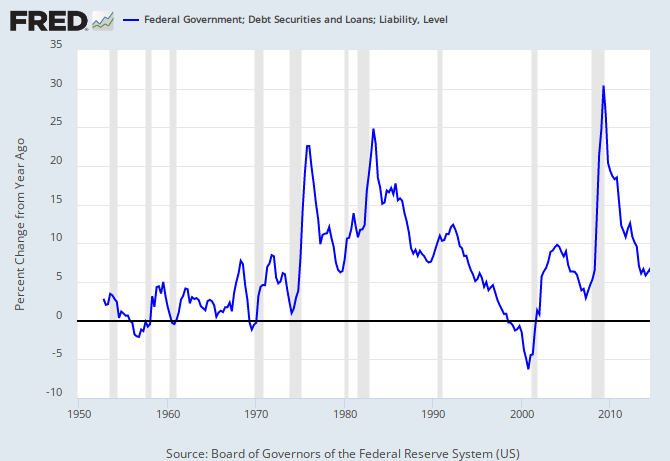
Reductions in federal debt growth lead to inflation
Blue line = deficit growth. Vertical gray bars = recessions. Recessions are cured by increases in deficit growth.

The reason for this effect is simple: Deficits add dollars to the economy, and these added dollars are necessary for economic growth.

Macguineas’s article continues:

The risks and consequences of high and rising debt include:

•Slower economic and income growth due to debt crowding out private sector investment. As the government issues more debt, investors buy these bonds in place of private investment. Over time, this results in a smaller stock of buildings, machines, and equipment; fewer new ventures and new technologies; and slower wage growth. CBO estimates average income will be $6,000 ( 6%) lower in 2048 if we allow debt to rise rather than reduce it to historical levels.

Completely false. There is no crowding out. Higher debt results from federal deficit spending which adds investment dollars to the economy.

That is why massive debt growth has paralleled massive economic growth.

MacGuineas ignores these obvious facts.

•Higher interest rates on loans for households and businesses. Rising federal debt tends to put upward pressure on interest rates throughout the economy. This increase trickles into business and consumer loans, making it more expensive for Americans to take out mortgages, car loans, and credit card debt – not to mention small business loans and other borrowing that helps grow the economy.

Interest rates have remained low in past years despite growing debt due to Federal Reserve accommodation and a slow recovery, but there is a very strong risk those conditions will and have started to change as the economy has gotten stronger, the Federal Reserve tightens monetary policy, and we come closer to full employment.

Federal “debt” does not put pressure on interest rates. The Fed sets rates to combat inflation, not to sell federal “debt.”

Further, federal debt does not cause inflation, which instead is caused by shortages. Historically, they have been shortages of food, but more recently, they have been shortages of oil. See: Federal deficit spending doesn’t cause inflation; oil does.

•Higher government interest payments that displace other government priorities. Due to rising interest rates and an increasing stock of debt, interest payments are projected to be the fastest growing part of the federal budget.

Under current law, interest costs will tripleover the next decade. As a result, interest costs will exceed Medicaid spending by 2020, defense spending by 2023, and total discretionary spending by 2045.

We estimate that before 2050, net interest will be the single largest line item in the budget.

In the above comment about “displacing other government priorities,” MacGuineas makes the tacit and false assumption that the federal government can run short of its own sovereign currency, the U.S. dollar.

Because our Monetarily Sovereign federal government has the infinite ability to create dollars, the notion of “displacing” makes no sense.

Clearly, MacGuineas either does not understand Monetary Sovereignty, or she doesn’t want you to understand Monetary Sovereignty.

Reduced fiscal space for the government to react to wars, recessions, or other emergencies. It is impossible to predict the timing of the next recession. However, the fact that one has not occurred in the last nine years suggests another may be on the horizon.

Unless there is a dramatic reduction in debt, we will enter the next recession with the highest debt in nearly 70 years (and higher than any time prior to World War II). This leads to legitimate concerns about the available “fiscal space” in the U.S., or the federal government’s financial capacity and willingness to respond to emergencies.

While it is impossible to know the precise amount available, the U.S. almost certainly has less fiscal space today than it did a decade ago, and it is projected to have even less in the coming years. The U.S. is less equipped to handle the next recession than it was in handling the Great Recession.

The “precise amount available” is infinite. That is why it’s impossible to know.

The “fiscal space” argument is identical with the “displace other priorities” argument. Again, MacGuineas wants you to believe the federal government can run short of its own sovereign currency.

While you and I, and the cities and states, and even the euro nations can run short of money, the U.S federal government cannot unintentionally run short of dollars.

•Lost opportunities to make thoughtful investments or reforms. Rising debt hinders our ability to enact good public policy. Whether you care about strengthening the military, developing clean energy, reducing burdensome taxes, or investing in education and infrastructure, rising debt will crowd it out.

Thanks to the increasing debt burden, next year the country will spend more on interest than on children, which means we will be spending more on financing our past than investing in our future.

And there are many new issues on the horizon, from the effects of technology to the future of work to new types of global threats that we are only just developing the capacity to withstand. As time goes on, we will increasingly lose the capability to address our debt situation through thoughtful, gradual, and targeted tax and spending reforms. At some point in the near future, our debt will be so high we will have to forgo new ideas and impose blunt spending cuts and tax hikes.

Hinders our ability” is another statement of “crowding out,” and “reducing fiscal space.” MacGuineas keeps repeating the same false premise, just using different words

•Risk of an eventual fiscal crisis if changes are not made. The combination of our strong economy, steady monetary policy, and longstanding commitment to pay our debts has allowed us to amass significant debt without severe consequences. This will not last forever. Unsustainable debt may eventually lead some investors to demand higher interest rates, which could set off a chain of events that begins with a small selloff of existing federal bonds and ends with a global financial crisis.

No one knows what level of debt or combination of events would set off such a crisis ; I hope we will never have to find out.

The Fed, not investors, sets interest rates. Unlike with private bonds, demand is not an issue for federal bonds. If no one wished to buy federal bonds, the Federal Reserve could buy them, which is often has. (This is known as “Quantitative Easing.”)

In any event, the Treasury does not need to sell bonds to obtain dollars. It has an infinite supply of dollars.

Instead, the two most important reasons why the Treasury issues T-securities are:

  1. To provide a safe place to “park” unused dollars. This safety helps stabilize the dollar.
  2. To assist the Fed in controlling interest rates, which helps fight inflation.

Thus, the reasons for issuing of federal debt (aka “borrowing”) are quite unlike the reasons why you and I borrow.

Our Monetarily Sovereign federal government could stop issuing debt today — even stop collecting taxes today — and still retain the unlimited ability to pay for goods and services, forever.

Those unconcerned about our rising debt have sometimes pointed to the built- up debt in recent years as evidence that the United States can borrow with little consequence. That’s a mistake.

China owns $1.1 trillion of U.S. debt. Trade and other tensions with them can certainly affect their lending decisions. Moreover, given our unstable political relationship with China, it is less than ideal to be as dependent on them as we are for funds.

Japan, which holds another $1 trillion of our debt, has also halted net purchases – possibly due to its aging population.

As the population continues to age, this nation of savers is likely to draw down its savings to finance retirement and therefore have fewer assets available to purchase U.S. debt.

Currently, foreign investors and governments own about 40% of the publicly traded debt, a percentage that has decreased in recent years as China and Japan have pulled back and forced domestic investors to finance our debt instead.

As we’ve said, the federal government does not need to sell debt to anyone — not to China, not to Japan, not to you or me, not to anyone.

Further, “domestic investors” are not forced to do anything. I know of no “forcing” device the federal government uses to sell T-bonds. It’s all nonsense.

And now we come to the real reason why MacGuineas spreads the Big Lie that the federal government is running short of dollars:

The primary drivers of long-term debt are growing mandatory spending and the lack of revenue to pay for it. Over the next ten years, 82% of spending growth will be due to Social Security, health programs, and interest payments.

Mandatory spending, specifically the costs stemming from an aging population, remains the largest long-term problem to address. Congress should have offset the increased discretionary funding with mandatory cuts and revenues that led to growing deficit reduction over time.

The fastest growing parts of the budget are Social Security, health programs like Medicare and Medicaid, and interest payments on the debt – each of which does not go through the annual appropriations process and is growing faster than the economy.

Mandatory spending and interest have already grown from 61% of the budget in 2010 to 69% today, and they are projected to be at 77% in 2028.

Get it? Her pay comes from the wealthy. So, on behalf of the wealthy, she wants the government to cut Social Security, Medicare, and Medicaid, programs that are vital for the middle classes and the poor, but mean little to the rich.

In short, the rich want to widen the Gap between the rich and the rest, and MacGuineas acts as their mouthpiece.

One of the many reasons this concerns me is the extent to which it has squeezed productive investments.

The best first step our leaders could make is to pledge to not make the debt situation worse(unless there is a smart reason to borrow such as a recession).

Squeezed productive investments” is yet another synonym for “hinders our ability,”  “crowding out,” and “reducing fiscal space.” It’s completely phony when referring to a Monetarily Sovereign government.

And notice she acknowledges that deficit spending is good during a recession (because deficit spending grows the economy), but she doesn’t want to grow the economy unless we have a recession. That’s totally illogical.

Lawmakers should focus on making changes to two of the largest drivers of our long-term debt problem: health care spending and Social Security. Reforms in these areas have the most potential for significant savings, and it would be between difficult and impossible to control our debt problem without making changes to these programs.

The largest driver of future costs is health care. The other major area needing attention is Social Security. The program’s trust fund is on track to exhaust its reserves by 2034, at which point benefits will be cut by 20% to 25% without legislative action to stop it.

Starting this year, the Social Security trust fund is being drawn down to pay benefits, meaning that the government must borrow from elsewhere so that Social Security can redeem its trust fund reserves.

In other words, Social Security is increasing the current deficit and will continue to do so dramatically in the future if the program is not reformed.

We can fix this program by adjusting benefits, raising revenues, or both.

First, there is no Social Security Trust Fund. It’s an accounting fiction. See: “The End of Social Security.” Being Monetarily Sovereign, the federal government has no need for Trust Funds. See: “Fake federal trust funds and fake concerns.”

In fact, get this:

The Supplemental Medical Insurance fund, which pays for Medicare Part B and Part D benefits, is funded by Congress. It doesn’t rely on a “trust fund.” Congress directly authorizes what funds are needed.

So, while Medicare and Social Security supposedly are paid through trust funds, in reality, half of Medicare doesn’t even pretend to go through a “trust fund.”

Second, “raising revenues: means increasing FICA, which is deducted from salaries. The rich, who do not receive most of their income via salaries, don’t care about FICA, and in any event, the salary from which FICA is deducted is a comparatively piddling $100K.

This all demonstrates that the federal government has the unlimited ability to fund Social Security and Medicare forever, with no trust funds and not even a FICA tax.

In Summary:

The rich, who run America, want to widen the Gap between them and the rest of the populace.

It is the Gap that makes them rich. Without the Gap, we all would be the same, and the wider the Gap, the richer they are.

The rich don’t want you to understand that:
1. A growing economy requires a growing supply of money
2. Deficits increase the supply of money
3. Therefore, deficits grow the economy
4. The federal government, being Monetarily Sovereign, never can run short of dollars with which to pay its creditors

They just don’t want you to know it.
They want you to believe the government can’t afford to pay for benefits like Medicare for All, free college for all, and anti-poverty initiatives.

They certainly don’t want you to ask for the Ten Steps to Prosperity (below).

Rodger Malcolm Mitchell
Monetary Sovereignty
Twitter: @rodgermitchell; Search #monetarysovereignty
Facebook: Rodger Malcolm Mitchell

…………………………………………………………………………………………………………………………………………………………………………………………………………………………………………………………………………………………..

The single most important problems in economics involve the excessive income/wealth/power Gaps between the have-mores and the have-less.

Wide Gaps negatively affect poverty, health and longevity, education, housing, law and crime, war, leadership, ownership, bigotry, supply and demand, taxation, GDP, international relations, scientific advancement, the environment, human motivation and well-being, and virtually every other issue in economics.

Implementation of The Ten Steps To Prosperity can narrow the Gaps:

Ten Steps To Prosperity:
1. Eliminate FICA

2. Federally funded medicare — parts a, b & d, plus long-term care — for everyone

3. Provide a monthly economic bonus to every man, woman and child in America (similar to social security for all)

4. Free education (including post-grad) for everyone

5. Salary for attending school

6. Eliminate federal taxes on business

7. Increase the standard income tax deduction, annually. 

8. Tax the very rich (the “.1%) more, with higher progressive tax rates on all forms of income.

9. Federal ownership of all banks

10. Increase federal spending on the myriad initiatives that benefit America’s 99.9% 

The Ten Steps will grow the economy, and narrow the income/wealth/power Gap between the rich and you.

MONETARY SOVEREIGNTY

Tariffs vs. spending

Through time, some industries rise and some fall. Some industries fall due to the natural progression of progress. The products they produce and/or the services they provide, have become less needed.

Or, foreign competition has taken its toll.

Whatever the reason, industries that are stressed often ask for government aid, and the government then is tempted to step in, “to protect jobs.”

There are three primary tactics our Monetarily Sovereign government can use to protect domestic industries from foreign competition:

    1. Import tariffs
    2. Direct financial support.
    3. Grow the economy

1. Import tariffs: This is the most common, and also the least effective approach. Taxing your own people in order to make it harder for them to buy foreign products, is foolish on the face of it.

Image result for ten steps to prosperity
Tariffs destroy dollars

First, tariffs take dollars out of the private sector.

A growing economy requires an increasing supply of money in the private sector, but tariffs destroy dollars.

The more tariffs the federal government collects, the more dollars are removed from the economy, and thus tariffs restrict economic growth.

Second, these tariffs are designed to raise domestic prices, and therefore are inflationary.

Third, import tariffs beget retaliation by the nations whose exports were taxed, and this retaliation also is inflationary.

In summary, import tariffs may temporarily aid specific industries, but they harm the overall economy.

They are like trying to improve your hearing by gouging out your eyes.

2. Direct Financial Support: Because import tariffs beget retaliation that punishes domestic industries, a nation may be forced to assist those industries directly:

Trump’s farmer bailout begins. USDA spends $1.2 billion to buy surplus food 

By Katie Lobosco, Updated 12:45 PM ET, Tue August 28, 2018

The initial $4.7 billion of direct payments will go to corn, cotton, dairy, hog, sorghum, soybean, and wheat producers.Image result for give farmers money

Farmers can begin requesting the aid on September 4, the US Department of Agriculture said.

Most of that aid has been set aside for farmers who grow soybeans. Their prices reached historic lows after China imposed a tariff on the legume.

China is buying soybeans again, but Trump is still paying farmers hurt by tariffsKatie Lobosco, CNN, Updated 7:33 PM ET, Mon December 17, 2018

Many countries have slapped tariffs on American commodities in retaliation to the Trump administration’s move to impose tariffs on imported steel and aluminum from much of the world, as well as on many goods from China.

When the Trump administration imposed tariffs on certain imports from China, the Chinese retaliated by taxing purchases of soybeans. So, to protect soybean farmers, the administration was forced to bail them out with subsidies.

The better approach would have been to avoid harmful trade wars and simply support those industries the government believed needed protection.

For instance, rather than applying import tariffs on steel and aluminum to protect the steel and aluminum industries, the federal government could have supported those industries the way it now is being forced to support the victims of Chinese retaliation, the farmers.

That approach would have added growth dollars to the economy while avoiding inflationary price increases.

3. Grow the economy: Not every industry needs protection. The United States does not need to be self-sufficient in all things.

In this current world economy, it is perfectly fine for some industries to decline while others grow.

Even where industries such as steel and aluminum may have some wartime security implications, it is not necessary that they be so robust as to support all our needs.

Since WWII, there never has been a time when the importation of steel and aluminum has been difficult.

The better approach to industry and employment protection is to grow the economy, i.e. to put more dollars into the pockets of consumers.

How?

One approach would be to institute the Ten Steps to Prosperity (below).

With certain very specific exceptions, industries that are not competitive should be allowed to fail, while successful industries grow the overall economy.

Industries that are deemed vital for America’s security can be protected, not with import duties, but with direct financial support and overall economic growth.

Import tariffs never, never, ever are a good solution to anything. They always are harmful to the people of the nations that impose import tariffs.

Rodger Malcolm Mitchell
Monetary Sovereignty
Twitter: @rodgermitchell; Search #monetarysovereigntyFacebook: Rodger Malcolm Mitchell

…………………………………………………………………………………………………………………………………………………………………………………………………………………………………………………………………………………………..

The single most important problems in economics involve the excessive income/wealth/power Gaps between the have-mores and the have-less.

Wide Gaps negatively affect poverty, health and longevity, education, housing, law and crime, war, leadership, ownership, bigotry, supply and demand, taxation, GDP, international relations, scientific advancement, the environment, human motivation and well-being, and virtually every other issue in economics.

Implementation of The Ten Steps To Prosperity can narrow the Gaps:

Ten Steps To Prosperity:

1. Eliminate FICA

2. Federally funded medicare — parts a, b & d, plus long-term care — for everyone

3. Provide a monthly economic bonus to every man, woman and child in America (similar to social security for all)

4. Free education (including post-grad) for everyone

5. Salary for attending school

6. Eliminate federal taxes on business

7. Increase the standard income tax deduction, annually. 

8. Tax the very rich (the “.1%) more, with higher progressive tax rates on all forms of income.

9. Federal ownership of all banks

10.Increase federal spending on the myriad initiatives that benefit America’s 99.9%  

The Ten Steps will grow the economy, and narrow the income/wealth/power Gap between the rich and you.

MONETARY SOVEREIGNTY

America lost

We are born, we live, we die. The few hours we have been given are precious, though what we do in those few hours lives after us.

Our voyage is short, and we are buffeted by the winds of circumstance, but we have our hands on the tiller. We can at least try be what we wish to be.

The question now: What do we wish to be?

Once we Americans were a welcoming people with open arms, joyful and generous. We were admired for our caring and compassion. Our parents and grandparents came across oceans to build their lives, and in so doing, built America.

We were courageous. We were the greatest generation. We were America the beautiful.

That America is lost.

It is the right-wing, especially, that has changed. The change is is tragic. Eisenhower was not this way.  Ford, Reagan, and the two Bushes were not this way. Even Nixon was not this way.

It may have begun with Newt Gingrich, and his “make ’em work” approach to poverty. Or, it may have begun with the Tea Party, a group espousing a philosophy of closed-fisted stinginess and covetousness.

Whatever and however, it has become the “I’ve got mine, to hell with you” Party of the Rich.  And it has morphed downward from there.

Today, we no longer are joyful and generous, no longer are admired for our caring and compassion. We no longer are courageous.

We fear. We fear the unfortunate weak, begging for entry. We fear them as invading hoards, trying to steal our culture. We fear the black, brown, and yellow. We fear the gay. We fear the Muslim.

America the brave has become a land of selfish cowards, cringing behind a Wall, afraid to welcome or to share.

But no Wall is high enough or long enough to remedy our terror. Another $5 billion to make it taller and billions more to guard it, and still that will not be enough.  More guards, more guns, more Walls — cowardice knows no limits

And, no cruelty to the poor is sufficient. Take away their food; take away their health; take away their homes and their education; take away their children. They deserve whatever misery we can foist on them.

In this vein, Breitbart, a publication of the right, wrote a story about an undocumented father and his young daughter, trying to enter America. They made the perilous journey because he is a father wanting the best for his daughter.

Like most parents, like you and me, the father was desperate to give his daughter a better, longer life than she would have had. But after all the adversity, and before they could reach their goal, the young girl dies.

I’m sure you can visualize the horror. I know you can imagine the grief. You are human.

But Breitbart’s tale is devoid of sympathy or humanity. It focuses on blaming the father for his daughter’s death.

The purpose of the article was to demonstrate that immigrants are not real people, not to be pitied or aided, but rather to be despised and blamed for their own despair.

Deceased Migrant Girl’s Father Did Not Report Illness for 7 Hours, Says CBP

Officials said the agents asked the father the questions in Spanish and translated his answers to English for documentation on the form. The father reportedly checked the box on the I-779 immigration form that said his daughter had no current illnesses.

Travel time by bus on these highly primitive roads in mountainous desert terrain takes about two to three hours. Officials stressed that bus transportation is the fastest means available in this area — keeping in mind that the father had not yet reported the girl to be ill.

At about 4:30 a.m., the bus began loading family unit migrants, including the little girl and her father. At about 5 a.m., the father reported the little girl was ill and vomiting. Border Patrol agents on the bus reportedly called ahead to the station to advise the girl’s condition and request EMT trained agents to meet them on arrival.

At about 6 a.m., the bus arrived at the Lordsburg Station and the girl had reportedly stopped breathing. Agents revived the girl and arranged transportation for her to a children’s hospital in El Paso by helicopter.

The helicopter arrived at 7:45 a.m and took the girl to El Paso. The agents provided ground transportation for the father. During the flight, the girl reportedly suffered cardiac arrest and was revived by the aircrew.

Doctors said the girl suffered brain swelling and liver failure. She died later that day.

She was an innocent little girl, with her full life ahead. She wished for what little girls wish. Her crime and her father’s was to strive for a happy life. Her punishment for that dream was early death.

At the end of the article, dozens of readers commented. Nearly all were of the same ilk: Cruelty and hatred.

Read these comments,  representative and word-for-word. They are typical of what you will find at the end of all Breitbart articles:

Son of Snake Plissken Michaelg8 • 6 hours ago
The father is guilty of child abuse and negligent homicide that is for sure.
The lies put out by the Left wing government and the propaganda bureaus disguised as media are an outrage. This homicide lies with them as well.

LuckyStrike Son of Snake Plissken • 6 hours ago
The father – if indeed he is the real father – as well as MURDERED that little girl.
That man should be tried for child abuse and murder and sent to prison for LIFE.
Repatriate ALL illegal aliens!

MaximusBraveheart LuckyStrike • 6 hours ago
Repatriate ALL illegal aliens; immediately! They are in a race… a mad, dangerous and illegal race to get more Democrat voters!

Homeschool Momma MaximusBraveheart • 5 hours ago
Instead of focusing on the extraordinary efforts to save the girl, all the open borders fascists will do is focus on the fact that the girl died…as if that was somehow the fault of border patrol.

Budda Homeschool Momma • 5 hours ago
The father needs to be charged with child abuse, endangering a minor and manslaughter.

SkipMayfield Budda • 5 hours ago
I believe ALL of the adults arrested in this group need to be charged with the same crime.

sgb1 SkipMayfield • 5 hours ago
They must have all known the child was terribly ill. It makes me wonder if it wasn’t deliberate in order set up a body to carry on about.

gman sgb1 • 4 hours ago
Of course the media will blow this up as being Trump’s fault for not having the Welcome Wagon at the border.
Will the mainstream media report that this child was already sick in Mexico?
Nope.
The parent or Guardian should be charged with child neglect.
What would happen to you or I if we brought our child along during an illegal act?
The mainstream media should be so outraged over American children killed by illegal aliens.

Trump Train aka Honey Badger gman • 4 hours ago
The Mob Dems are the real Murderers for enticing the illegal invaders to come here and break our laws in the first place.
0bama in coordination with the propaganda media and deep state globalists orchestrated this to destroy US.

uvm73 Trump Train aka Honey Badger • 4 hours ago
For me, the sickest part of this story is that we still do not know what illness killed this girl. The invaders are bringing 3rd world diseases with them. Unlike Ellis Island, where there was a natural quarantine period, along with a significant body of water to protect Americans, these invaders carry all kinds of diseases to infect American citizens, including these Border Patrol agents & their families.

Son of Snake Plissken uvm73 • 3 hours ago
A POX on all the children and grand children of the media and Government officials who support this madness. Hate to wish for such but they have caused it so bring it only to the ones who earned it.

Stormwaves uvm73 • an hour ago
Apparently a new form of polio is affecting children in the United States. The media has gone suddenly silent, as has the CDC, on the numbers of children who are now suffering paralysis and what is causing it.

gman Trump Train aka Honey Badger • 4 hours ago
While nobody wants to see a child sick or perish,
I believe they do say not to drink the water in Mexico.
Dumb parents making dumb decisions putting their children in danger.
Everyone of these selfish people could have applied for asylum in their home countries.
Child endangerment at its finest.
They have nobody to blame but themselves

Andrew Scott Carlisle gman • 4 hours ago
The “Father” is just upset he lost his get out of detention free card, probably should have shared some of his water with her instead of keeping it all to himself. The child died BECAUSE of the catch and release policy for illegals traveling with children, get rid of that and he would have left her at home.

Tom Alstadt John Penhale • 2 hours ago
“Blessed are the merciful, for they shall receive mercy.” Mat 5:7 This verse is referring to forgiveness against others and showing compassion. It is not a requirement to overlook civil law and allow others to destroy your community, family, and nation.

JessZ John Penhale • 2 hours ago
Jesus said give to Ceasar what is Ceasars and give to God what is God….I take that to mean obey the laws of the Country and obey Gods laws..legal immigrants are all welcome but for those bypassing our laws they are disobeying not only the Countries laws but Gods law…

Daniel Hertlein Trump Train aka Honey Badger • an hour ago
You are dumb as literal dirt. I don’t know how you are able to breath.

Don Wadd Gail Brooks • 2 hours ago
Ever seen a WHITE landscaper in the last 10 years?

Tom Alstadt Don Wadd • an hour ago
Yes. Quite a few. We want LEGAL IMMIGRANTS and cannot tolerate illegal aliens.

JessZ Don Wadd • an hour ago
Actually a lot of the landscapers in our area are white….

Ribert Koonce Don Wadd • 2 hours ago
Nope, like construction workers, they were trashed for cheaper laborers from south of the border more than 30 years ago.

Angela Moore Don Wadd • an hour ago
Go to any majority-white state and you’ll find white people working construction, landscaping, pumping gas, waiting tables, cleaning hotel rooms, etc etc etc. Go to Bernie Sanders state and sit on a park bench for an afternoon, and see all the jobs white folks want to do, you total SFB.

SuperPrivileged Trumpisaliarhiswifeisawhore • 2 hours ago
They won’t hire you because libtards are worthless and incapable of hard work.

Kawboy Trumpisaliarhiswifeisawhore • 2 hours ago
Whatever,the frigging prisoners should be picking the crops instead of sitting on their azzes watching tv or working out? And if migrants are needed then when picking season is over they go home. The illegals and the cheap azzes who hire them ruined the construction industry

This is how far the Republican party has sunk, dark, cold and hate-filled. And with Donald Trump, it has reached its nadir.

There is no warmth, no love. Compassion is derided as weakness. Hatred is strength. Nazis are “good people.” Murderous dictators are admired. Power and realpolitik are all we have.

We are hatred and hated.

Ronald Reagan: America is a shining city upon a hill whose beacon light guides freedom-loving people everywhere. I’ve spoken of the Shining City all my political life. …In my mind it was a tall, proud city built on rocks stronger than oceans, windswept, God-blessed, and teeming with people of all kinds living in harmony and peace; a city with free ports that hummed with commerce and creativity. And if there had to be city walls, the walls had doors and the doors were open to anyone with the will and the heart to get here. That’s how I saw it, and see it still.”

That Shining City upon a hill is gone, replaced by the faux gold of a Trump Tower and a hideous Wall.

The America we once knew and loved is lost.

Rodger Malcolm Mitchell
Monetary Sovereignty
Twitter: @rodgermitchell; Search #monetarysovereignty
Facebook: Rodger Malcolm Mitchell

…………………………………………………………………………………………………………………………………………………………………………………………………………………………………………………………………………………………..

The single most important problems in economics involve the excessive income/wealth/power Gaps between the have-mores and the have-less.

Wide Gaps negatively affect poverty, health and longevity, education, housing, law and crime, war, leadership, ownership, bigotry, supply and demand, taxation, GDP, international relations, scientific advancement, the environment, human motivation and well-being, and virtually every other issue in economics.

Implementation of The Ten Steps To Prosperity can narrow the Gaps:

Ten Steps To Prosperity:
1. Eliminate FICA

2. Federally funded medicare — parts a, b & d, plus long-term care — for everyone

3. Provide a monthly economic bonus to every man, woman and child in America (similar to social security for all)

4. Free education (including post-grad) for everyone

5. Salary for attending school

6. Eliminate federal taxes on business

7. Increase the standard income tax deduction, annually. 

8. Tax the very rich (the “.1%) more, with higher progressive tax rates on all forms of income.

9. Federal ownership of all banks

10. Increase federal spending on the myriad initiatives that benefit America’s 99.9% 

The Ten Steps will grow the economy, and narrow the income/wealth/power Gap between the rich and you.

MONETARY SOVEREIGNTY
 

More on tariffs. Moron tariffs

We often have written about the giant misunderstandings regarding tariffs.

Many (most?) people believe import tariffs benefit America by:

  1. Protecting Americans’ jobs
  2. Providing the federal government with dollars

This is not even laughably wrong. It is tragically wrong.

To paraphrase the comedian, Henny Youngman, “Take this article, please”:

US reaps more than $1.4 billion from steel and aluminum tariffs, report finds
By Stephanie Dhue, Kayla Tausche, Published Mon, 13 Aug 2018

*Between March 23 and July 16, the U.S. collected $1.4 billion from levies on foreign imports of steel and aluminum.
*That figure could reach $7.5 billion this year, based on last year’s import levels.
*Tariff revenue is impacted by Commerce Department exclusions and President Trump’s change of heart.

In less than five months, the Trump administration has collected more than $1.4 billion in new revenue from steel and aluminum tariffs, according to a recent report prepared for members of Congress.

The Congressional Research Service estimated that, between March 23 and July 16, the U.S. reaped $1.1 billion and $344.2 million from levies on foreign steel and aluminum, respectively.

Those earnings are on the rise as trade negotiations with allies linger on and President Donald Trump moves to hike tariff rates on countries like Turkey.

CRS says the new tariffs could reap the U.S. some $7.5 billion$5.8 billion on steel and $1.7 billion on aluminum– based on last year’s import levels.

Whom do you think will pay that $7.5 billion? Not Turkey. Not Canada. Not China. Not any foreign nation.

The answer: You, the American consumer, will see $7.5 billion taken out of your pockets, and transferred to the U.S. government, where all $7.5 billion will be destroyed.

That’s right, destroyed. As soon as those dollars hit the Treasury, they no longer will exist as part of any money-measure. The government doesn’t need or use those dollars.

To pay creditors, the government creates brand new dollars, ad hoc. Paying creditors is the only method by which the government creates U.S. dollars. 

Those federal tariffs constitute a $7.5 billion tax on the American economy, a net loss for the private sector and a net gain for no one.

Just as a tax cut is stimulative, a tariff not only is recessive, but it also is inflationary, as it increases prices.

Trump has suggested the tariffs – originally unveiled as a national security provision – could have the added benefit of reducing the federal deficit, which rose to $77 billion in July, wider than the July 2017 budget deficit of $43 billion.

And the Treasury’s borrowing to fund government operations is set to top $1 trillion this year for the first time ever.

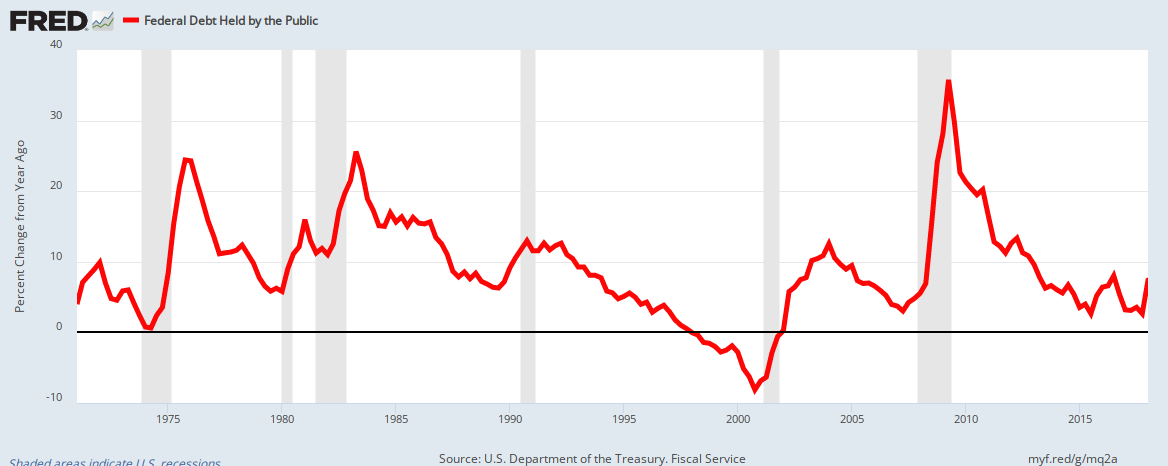
There are only two ways to reduce the deficit: Increase federal taxes and/or cut federal spending. Both are recessionary. They reduce the number of growth dollars coming into the economy.

A growing economy requires a growing supply of money. Reducing the deficit is the worst possible act if one wishes the economy to grow. 

Red line shows changes in federal debt. Reductions in debt growth lead to recessions (vertical gray bars) by taking dollars from the economy. Increases in federal debt growth cure recessions by adding dollars to the economy.

Because of Tariffs we will be able to start paying down large amounts of the $21 Trillion in debt that has been accumulated,” Trump tweeted on Aug. 5. “At minimum, we will make much better Trade Deals for our country!”

As usual with Trump pronouncements, this is false. Tariffs do not in any way help pay down the federal debt.

The debt is paid down by returning the dollars that already exist in Treasury security accounts. No taxes are used for this.

And in any event, paying down debt causes depressions.

1804-1812: U. S. Federal Debt reduced 48%. Depression began 1807.
1817-1821: U. S. Federal Debt reduced 29%. Depression began 1819.
1823-1836: U. S. Federal Debt reduced 99%. Depression began 1837.
1852-1857: U. S. Federal Debt reduced 59%. Depression began 1857.
1867-1873: U. S. Federal Debt reduced 27%. Depression began 1873.
1880-1893: U. S. Federal Debt reduced 57%. Depression began 1893.
1920-1930: U. S. Federal Debt reduced 36%. Depression began 1929.
1997-2001: U. S. Federal Debt reduced 15%. Recession began 2001.

In short, while tariffs may protect a relatively few jobs in a chosen industry, they cost jobs overall by being recessive and inflationary. 

Taking $7.5 billion from the economy in an attempt to save jobs is moronic.

Rather than destroying $7.5 billion, the government could, if it wished, support those chosen industries by:

  1. Reducing their taxes
  2. And/or buying from them
  3. And/or giving them money

Though we have come to expect moronic ideas from Trump, we also receive the same moronic ideas from “respected” sources. For instance:

What to learn from Trump’s accidental tariff success 
THE WEEK, Ryan Cooper

President Trump’s economic choices over the last two years have been terrible. When he wasn’t busy shoveling vast piles of cash into the suppurating maw of the top 1 percent, he busied himself starting a flailing trade war with China and Europe.

So far, so good, but why is that trade war failing? Because all trade wars fail.

However, there have been some accidental side benefits. The tax cuts provided a bit of badly needed fiscal stimulus that jolted the economy half-awake (despite being otherwise monstrous policy).

Right. The tax cuts are stimulative, because they add dollars to the economy. Unfortunately, the primary benefits of Trump’s tax cuts went to Trump and his rich pals.

And, as an Economic Policy Institute report details, his tariffs on aluminum have restored some employment and production in that sector.

Whereas nearly the entire American aluminum industry had vanished between 2010 and 2017, after tariffs went up in March of this year, production is up 67 percent, three smelters have been reopened, and one has been expanded, resulting in 1,000 new jobs and $100 million in new investment.

Taking billions from the economy does not create “new” jobs. It shuffles jobs from one industry to another, while costing the economy money and inflating the price of all things made with aluminum.

Not that tariffs are always and everywhere good, but they can be an important tool for managing trade and the economy.

Tariffs are taxes. Taxes are not a tool for managing the economy; they are a tool for shrinking the economy.

Sure, some tariffs have been pretty lousy or misguided. For instance, the Smoot-Hawley tariffs of 1930 at a minimum utterly failed to cure the Great Depression — and quite possibly enabled a protectionist race to the bottom that ultimately worsened the situation.

Tariffs, being taxes, cannot cure anything. As you have seen from the above data, recessions are caused by reduced money growth, and are cured by increased money growth. Taxes (tariffs) take dollars from the economy.

But, free trade (especially of capital) under a fiat currency regime can fuel devastating financial crises just as it did in the 1920s.

The depression of 1929 was caused by ten years of federal surpluses (taxes exceeding spending).

What the world and America need is a global trade regime that allows poorer nations to get started on the development ladder, but without creating (politically disastrous) severe trade imbalances, or requiring the United States to run a gigantic trade deficit until the end of time so nations can settle their international accounts.

Utter nonsense. “Trade imbalances” (i.e. more money leaving a country than entering it) are no problem for a Monetarily Sovereign government. Such a government creates its own sovereign currency at will, and at no cost.

The U.S. consistently runs trade deficits, which actually are beneficial. Trade deficits allow the federal government to obtain valuable goods and services in exchange for dollars they produce at the touch of a computer key.

Past Federal Reserve Chairman Ben Bernanke: “The U.S. government has a technology that allows it to produce as many U.S. dollars as it wishes at essentially no cost.”

This is discussed further at: Questions about the trade deficit illusion. Do we even have a trade deficit?  Monday, Dec 10 2018

A world trade system like Bretton Woods (but better) would be best — but tariffs can absolutely be part of such an effort in the meantime.

Bretton Woods was the last of a series of gold standards which inevitably fail because they tie money creation to the availability of a physical chemical. Nations that are short of gold cannot grow, just as nations that are short of money cannot grow.

For the author, Mr. Cooper, to mention Bretton Woods favorably, demonstrates an abject ignorance of economics.

Trump’s tariffs show they do pretty much exactly what they say on the tin: change the price structure to make domestic production more feasible.

No, tariffs cost both people and nations money, and have zero positive value.

It’s long since time China (and Germany, for that matter) rebalanced its economy to be less export dependent.

Cooper does not even understand that Germany is monetarily non-sovereign. It cannot create its own sovereign currency at will, as it does not have a sovereign currency. So Germany, and all euro nations, must be net exporters (i.e import money) to survive.

The U.S., by contrast, does not need exports in order to import money. It can create its money at will.

As John Maynard Keynes suggested, a trade system favoring neither surpluses nor deficits is a much more sensible way to structure the global economy.

“A trade system favoring neither surpluses nor deficits” would be a zero growth trade system.

Bottom line: A Monetarily Sovereign nation should not levy tariffs, ever. It can encourage any of its industries and their jobs, if it wishes, simply by supporting those industries financially.

A tariff is a tax. Just as a tax cut is stimulative, a tariff not only is recessive because it takes dollars from the private sector, but it also is inflationary because it increases prices.

Rodger Malcolm Mitchell
Monetary Sovereignty
Twitter: @rodgermitchell; Search #monetarysovereignty
Facebook: Rodger Malcolm Mitchell

…………………………………………………………………………………………………………………………………………………………………………………………………………………………………………………………………………………………..

The single most important problems in economics involve the excessive income/wealth/power Gaps between the have-mores and the have-less.

Wide Gaps negatively affect poverty, health and longevity, education, housing, law and crime, war, leadership, ownership, bigotry, supply and demand, taxation, GDP, international relations, scientific advancement, the environment, human motivation and well-being, and virtually every other issue in economics.

Implementation of The Ten Steps To Prosperity can narrow the Gaps:

Ten Steps To Prosperity:
1. Eliminate FICA

2. Federally funded medicare — parts a, b & d, plus long-term care — for everyone

3. Provide a monthly economic bonus to every man, woman and child in America (similar to social security for all)

4. Free education (including post-grad) for everyone

5. Salary for attending school

6. Eliminate federal taxes on business

7. Increase the standard income tax deduction, annually. 

8. Tax the very rich (the “.1%) more, with higher progressive tax rates on all forms of income.

9. Federal ownership of all banks

10. Increase federal spending on the myriad initiatives that benefit America’s 99.9% 

The Ten Steps will grow the economy, and narrow the income/wealth/power Gap between the rich and you.

MONETARY SOVEREIGNTY