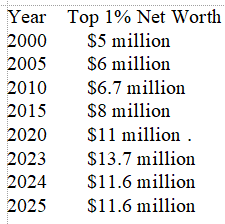
Bad ideas lead to bad results

A decision based on a false belief, will probably be a bad decision.

Rep. Jay Obernolte (R., Calif.), a Budget Committee member, said the Republican plan would unquestionably put the country on a stronger fiscal footing. “If you have to pick between a higher-tax, higher-spending regime and a lower-tax, lower-spending regime, the latter is always better for economic growth,” he said.

That belief may be common, but it is not supported by fact. Using it as a basis for Trump’s “big, beautiful” tax cut for the rich adds greater falsity.

1. Obernolte’s statement conveniently omits the questions, “Lower tax for whom?” and “Lower spending for whom?” 

In the case of Trump’s tax cut, the answers are: “Lower tax for the rich” and “lower spending for the rest of America.” As is usual for the right wing, the tax cut makes the rich richer and the rest poorer.

2. Because the U.S. government is Monetarily Sovereign, we never “have to pick between a higher-tax, higher-spending regime and a lower-tax, lower-spending regime.” We can and should have a lower tax (especially for the poorer), higher spending regime.

3. Federal debt and deficits are not a burden on the federal government or on taxpayers. Being Monetarily Sovereign, the federal government has infinite dollars to fund any debt

4. The so-called “federal debt”  is neither “federal” nor “debt.” It is the total of dollars deposited into Treasury Security accounts, wholly owned by depositors and held for safekeeping by the government (Think: Safe deposit boxes).

5, The “debt” is not a burden on taxpayers. Tax rates have nothing to do with the “debt.” Federal tax rates are arbitrarily chosen by Congress for political reasons, not to fund spending. (By contrast, state and local taxes do fund monetarily non-sovereign state and local spending.)

6. The purposes of federal taxes are:

A. To control the economy by taxing what the government wishes to discourage and by giving tax breaks to what the government wishes to reward 

B. To assure demand for the U.S. dollar by requiring taxes to be paid in dollars.

7. Federal deficit spending does not cause inflation. See: “At long last, let’s put this inflation question to bed.”  Inflations, i.e, general increases in prices, are based on shortages of crucial goods and services. Federal deficit spending does not create those shortages.

Even during wars, it’s not the federal spending that causes shortages; it’s the war needs. If during a war, federal spending was lower, inflation would be worse, as there would be even fewer consumer goods.

In fact, federal deficit spending can cure inflation when the spending supports the availability of scarce goods and services.

Example: The notorious Zimbabwe inflation was caused by a food shortage. It could have been cured by government spending to aid farming and imports of food. Instead, the government simply printed currency, which created the illusion that the currency creation caused the inflation.

The most recent inflation was caused by COVID-related shortages of oil, food, metals, paper, lumber, shipping, labor and other needs.  Government spending has helped reduce those shortages and inflation.

8. Just as federal deficit spending does not cause inflation, it also does not force interest rates up. 

A. Interest rate increases add to business costs, which result in higher, not lower prices

B. Interest rate increases are an arbitrary option of the Federal Reserve because of the mistaken belief that they cure inflation. The Fed also raises rates to encourage the purchase of Treasury Securities. This takes spending dollars from the economy, and therefore is recessive.

The federal government does not need to sell Treasury securities to pay its bills. It pays all its bills with newly created dollars, not by so-called borrowing.

Because inflation is supply-based, not demand-based, recessions do not cure inflation. In fact, we can have both simultaneously. It is called “stagflation.”

There are those of a Libertarian bent who simply do not like government (except when they receive such benefits as Medicare, Medicaid, Social Security, highways, military defense, police defense, schools, parks, disaster relief, food and drug inspection, new drug R&D, FBI, CIA, etc.)

They invent false reasons why government spending should be cut (except for programs that benefit them).

Federal deficit spending is necessary for economic growth. It is part of the formula for Gross Domestic Product:

GDP = Federal Spending + Non-federal Spending + Net Exports

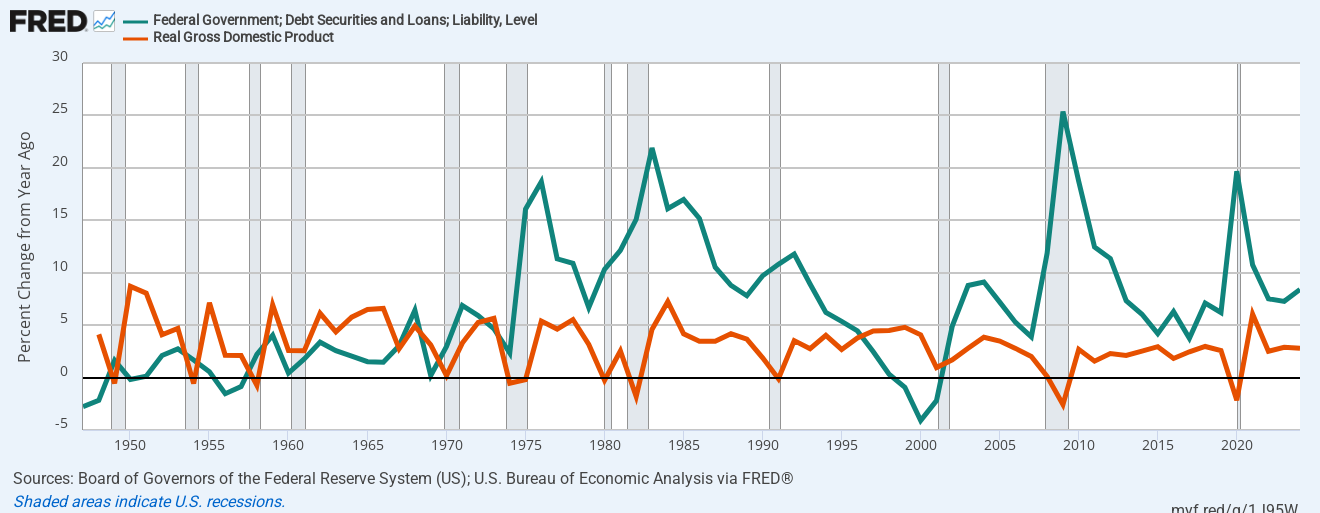
As you can see from the following graph, relative declines in federal spending (green) precede recessions (vertical gray bars). Increases and decreases in federal deficit spending are generally associated with increases and decreases in GDP.

        Is anyone fooled by the pols who pretend outrage at the federal deficit and debt, and then pass legislation that widens the income/wealth/power Gap between the rich and the rest? 

        Those folks simply are the greedy rich. I don’t know what to say about the media and economists who go along with that charade.

        Bottom line: The economy always does better when the federal government spends more and taxes less. That’s simple algebra. Given the power, my first act would be to eliminate FICA, and give everyone Medicare.

        Rodger Malcolm Mitchell

        Monetary Sovereignty

        Twitter: @rodgermitchell

        Search #monetarysovereignty

        Facebook: Rodger Malcolm Mitchell;

        MUCK RACK: https://muckrack.com/rodger-malcolm-mitchell;

        https://www.academia.edu/

        ……………………………………………………………………..

        A Government’s Sole Purpose is to Improve and Protect The People’s Lives.

        MONETARY SOVEREIGNTY
         

        Retirees face potential 33% benefit CUT if they receive MORE benefits. What??

        The following story appeared today online. It purports to tell you why you’ll have a benefit cut if Social Security benefits are not taxed.

        That’s right. The article claims that either you allow the government to take away part of your benefits via taxes, or it will take away part of your benefits via benefit cuts.

        This Hobson’s choice is brought to you by the rich, who want to widen the income/wealth/power Gap between them and you.

        Spoiler alert: Here’s the “why” mentioned in the headline of this post: The lies of the rich and the ignorance of the populace.

        Uncle Sam talks to poor people
        “If you dare to ask for more, I’ll give you lesss. So shut up and be grateful for what you get. I have rich people to take care of. “

        Retirees face potential 33% benefit cut under new tax plan; Here’s why

        Story by Andrea Arlett Nabor Herrera

        Trump-backed tax plan may slash Social Security benefits by 33%, raising solvency concerns /

        Retirees across the United States may soon face a daunting financial challenge. A proposed tax plan, supported by President Trump and several legislators, aims to eliminate federal income taxes on Social Security benefits, tips, and overtime.

        While this might initially seem beneficial, experts warn it could lead to a significant reduction in Social Security benefits, potentially cutting them by 33% by 2035.

        Proposed tax plan details

        The tax proposal suggests removing federal income taxes on Social Security benefits, a move that could eliminate a crucial revenue stream for the program.

        Currently, Social Security is funded primarily through payroll taxes (91%), with a smaller portion coming from taxes on benefits (4%) and interest from trust fund assets (5%). The elimination of these taxes could severely impact the program’s financial health.

        Not one word of the above paragraph is true. All federal spending, including spending for the Supreme Court, for Congress, for the Senate, for the House, for the military — ALL federal spending — is funded the same way: By federal new money creation.

        Congress and the President vote for spending, and the money is automatically created. No fake “trust funds” are involved.

        The federal government, being Monetarily Sovereign, cannot run short of dollars, nor can any agency of the federal government run short unless Congress and the President want it to.

        The financial helplessness implied in the article is a lie. The federal government has ownership and control over the Social Security agency, and so can add as many dollars as it wishes at any time it wishes.

        Social Security faces financial challenges due to a growing retiree population and a slower-growing workforce.

        The Congressional Budget Office (CBO) estimates that under current law, the Social Security Trust Fund will be depleted by 2034. If this occurs, benefits would need to be reduced to about 77% of scheduled payments, equating to a 23% cut.

        The Social Security “trust fund” is not a trust fund. It is merely a record of payments.

        As a record, and only a record, it “has” no money. It’s just a balance sheet for informational purposes. The purpose of FICA taxes (according to the SS founder, President Franklin D. Roosevelt) is to give you the illusion of ownership, so you will protest against cuts.

        FICA does not fund SS benefits. It actually limits benefits as practiced by Congress.
        Impact of eliminating benefit taxes Removing taxes on Social Security benefits would eliminate a revenue source expected to contribute $1.1 trillion over the next decade.
        False. The “revenue” source is not FICA taxes. The revenue source is the federal government, which has the unlimited power to credit those taxes to Social Security — or not — or to credit some other figure.

        The amount of FICA does not control how much Social Security is allowed to spend. Congress and the President do.

        If Congress and the President wished, they could pass a law saying, for instance, that every person living in America receives double the current level of SS benefits. That law would be funded by Congressional fiat just as taxing benefits now is reverse funded by fiat.

        This would exacerbate the program’s deficit, potentially depleting the trust fund sooner. The Committee for a Responsible Federal Budget (CRFB) estimates that eliminating these taxes could advance the fund’s depletion by one year, while Penn Wharton suggests it could be two years.

        The CRFB is a libertarian-leaning mouthpiece that likes to express shock at how many growth dollars the federal government pumps into the economy. Their solution to the non-problem invariably tends toward cutting benefits to the middle- and lower-income groups, but seldom suggests cutting tax loopholes enjoyed by the rich.

        How much you need to save in order to retire

        If taxes on Social Security, tips, and overtime are all eliminated, as proposed by President Trump, the CRFB estimates the trust fund could be depleted three years earlier.

        This scenario could lead to benefit cuts as early as 2032, rather than 2035, putting additional financial strain on retirees.

        Again, the above is a lie or ignorance, hoping that you will believe the lie or share the ignorance. The bottom line: The author claims that any increase in your benefits will result in a decrease in your benefits, so shut up and accept your losses.

        Magnitude of potential benefit cuts The proposed tax eliminations could reduce Social Security revenues by up to $2 trillion over the next decade.
        Translation: The proposed tax eliminations could increase Social Security benefits by up to $2 trillion over the next decade, while also increasing the number of growth dollars added to the economy by those same $2 trillion.
        This would necessitate deeper benefit cuts than currently projected. The CRFB estimates that benefits could be reduced by 33% by 2035, compared to the 23% cut projected by the CBO under existing law.
        The same old lie: “Don’t you dare ask for more or we’ll give you even less than you currently receive. And by the way, we’re giving the rich another tax break, but that doesn’t count.”
        Experts like Nancy Altman, President of Social Security Works, caution against the proposed tax eliminations. Altman argues that while eliminating taxes might increase benefits for some, the overall impact would be detrimental, leading to drastic benefit reductions. She describes the proposal as “not honest,” highlighting the potential long-term harm to retirees.
        Ms. Altman, with all your experience, you should know better. Eliminating taxes would not “lead to benefit reductions” if you told America that the federal government can easily fund SS forever.
        The proposed tax plan, while seemingly beneficial in the short term, poses significant risks to the financial stability of Social Security. Retirees could face earlier and more severe benefit cuts, underscoring the need for careful consideration of the plan’s long-term implications.

        As the debate continues, stakeholders must weigh the immediate benefits against the potential for substantial future losses.

        If ever the stakeholders, i.e. SS current and future recipients, ever begin to understand the truth, there will be an uprising and (gasp!) the income/wealth/power Gap between the rich and the rest will narrow.

        OMG!

        Rodger Malcolm Mitchell

        Monetary Sovereignty

        Twitter: @rodgermitchell

        Search #monetarysovereignty

        Facebook: Rodger Malcolm Mitchell;

        MUCK RACK: https://muckrack.com/rodger-malcolm-mitchell;

        https://www.academia.edu/

        ……………………………………………………………………..

        A Government’s Sole Purpose is to Improve and Protect The People’s Lives.

        MONETARY SOVEREIGNTY

        AARP continues to promulgate the Big Lie in economics: Social Security version

        While it’s difficult to verify the exact words or the precise historical record of the exchange, the essence of the story is historically consistent with Franklin D. Roosevelt’s thinking about Social Security.

        Here’s the most widely cited version of the exchange:

        During the creation of the Social Security program in the 1930s, FDR was advised by his economic team — particularly economist John Kenneth Galbraith and others in the Treasury — that the federal government, as a monetary sovereign, did not need to collect payroll taxes to fund Social Security benefits.

        They explained that the government could simply create the money and pay the benefits directly.

        Roosevelt is reported to have responded with something along these lines:

        “I guess you’re right on the economics — but the politics are what matter here. Those taxes aren’t really needed for revenue. They’re needed to give the workers a sense of personal stake in the system — to give them a legal, moral, and political claim to their benefits.”

        “With those taxes in there, no damn politician can ever scrap my Social Security program.

        Now compare that to what AARP wrote in its  May/June 2025 issue of the AARP Bulletin, Social Security and Medicare, by T.R. Reid:

        “These two programs (Social Security and Medicare) have protected the quality of life for older Americans,” (AARP’s Nancy) LeaMond observes. “So we need to save them.

        “Job 1 is ensuring the solvency of the programs for current beneficiaries, but also for future generations. To do that, we have to ensure that the trust funds are  stable.”

        And there it is, the Big Lie, that Social Security and Medicare are paid for by taxes via federal trust funds. It is a lie believed by most Americans, and possibly most federal politicians, most media writers, and even most economists.

        But despite common belief, it is a pernicious, harmful, cruel lie.

        Even Franklin D. Roosevelt, the creator of Social Security, knew it was a lie, but he allowed it, not for financial reasons, but for political reasons — so that “no damn politician can ever scrap my Social Security program.

        How little did even he realize the depths of ignorance the damn politicians would plumb in order to limit benefits to the common people vs. the rich.

        The rich have bribed the media (via ownership and advertising dollars), the economists (via university grants and promises of future think tank employment for professors), and the politicians (via many routes), to feed you false information. This guarantees ignorance through false information from trusted sources.

        It is a multi-layered campaign of receipt:

        1. Ignorance About Monetary Sovereignty: Unlike state and local governments, businesses, and individuals, the federal government is Monetarily Sovereign. It is the original creator of the U.S. dollar and continues to create dollars at will.

        The federal government can never unintentionally run short of its sovereign currency, the U.S. dollar. Even if the federal government did not collect a single dollar in taxes, it could continue creating and spending dollars forever.

        2. Ignorance about federal deficits, debt, and borrowing. Federal deficits are the net amount of money that an infinitely rich federal government sends to the private sector to grow Gross Domestic Product. Without federal deficits, the economy cannot grow and instead would fall into a depression.

        The federal “debt” is not federal, and it is not “debt.” It is the total of outstanding Treasury security accounts (T-bills, T-notes, T-bonds) the dollars in which are owned by depositors and only held by the federal government for safety.

        Those dollars are never used by the federal government for anything. The accounts are similar to bank safe deposit boxes in which the contents are held for safety and not part of the bank’s debt.

        The federal government does not borrow dollars; it has the infinite ability to create them from thin air. As the St. Louis Federal Reserve wrote in their October 2011 publication titled “Why Health Care Matters and the Current Debt Does Not”:

        “As the sole manufacturer of dollars, whose debt is denominated in dollars, the U.S. government can never become insolvent, i.e., unable to pay its bills. In this sense, the government is not dependent on credit markets to remain operational.

        3. Ignorance About Federal Taxes: Federal taxes fund nothing. The purposes of federal taxes are different from the purposes of state/local gov. taxes. The sole purposes of federal taxes are:
        • To assure demand for the U.S. dollars by requiring taxes to be paid in dollars
        • To control the economy by taxing what the government wishes to discourage and by giving tax breaks to what the government wishes to reward
        • To deceive the public into believing that benefits must be limited by taxes. This is a belief fostered by the rich to limit benefits to the rest of us.

        Contrary to popular wisdom, the rich pay a much lower tax rate than you do. Pay no attention to the tax rate table that say otherwise. The rich have managed to engineer special tax deductions that make the tax tables invalid.

        For example: Billionaire Donald Trump paid no federal income taxes at all in 10 of 15 years prior to 2016, In 2016 and 2017, he paid just $750 each year in federal income taxes.

        In 2020, he paid $0 in federal income tax. He reported large losses across many years, some in the tens or hundreds of millions, which allowed him to offset future income.

        These losses were often carried forward using legal provisions in the tax code. He claimed major business expenses — including for residences, aircraft, and other personal luxuries — as deductions.

        (Have you been able to deduct the costs of your home, transportation, meals, clothing, cars, furniture, entertainment, etc.? Trump and other billionaires could.) But Social  Security and Medicare are headed toward insolvency?? Really?

        4. Ignorance about Inflation: No sooner does anyone realize that the federal government’s finances are nothing like state and local governments’ finances, than we hear the false claim of last resort about federal spending, “but that would cause inflation.”

        Let me be very clear about this: Inflation is not a spending problem, and inflation is not a demand problem. Inflation is, always has been, and always will be a supply problem.

        Federal spending does not cause inflation. In fact, federal spending cures inflation when directed at curing the shortages that cause inflation. We discuss this in more detail here.

        The inflation myth has been promulgated solely to prevent the populace from demanding the kinds of federal spending and tax relief afforded to the rich — the kind of relief that has allowed billionaires like Donald Trump to pay less federal taxes than you have.

        5. Ignorance about Federal Trust Funds: The USA.gov A–Z Index lists over 400 federal departments, agencies, and related entities. This includes executive departments, independent agencies, government corporations, commissions, and government-sponsored enterprises.

        Very few federal agencies are (supposedly) funded through trust funds. The largest and most well-known trust funds include:

        • Social Security Trust Funds: Managed by the Social Security Administration, supposedly funded by payroll taxes.

        • Medicare Trust Funds: Managed by the Centers for Medicare & Medicaid Services, supposedly funded by payroll taxes, premiums, and general revenues.

        • Highway Trust Fund: Managed by the Department of Transportation, supposedly funded by fuel and excise taxes.

        • Unemployment Trust Fund: Managed by the Department of Labor, supposedly funded by federal and state unemployment taxes.

        • Civil Service Retirement and Disability Fund: Managed by the Office of Personnel Management, supposedly funded by employee and agency contributions.

        In total, there are approximately a dozen major federal trust funds. So, only a small number of agencies are supposedly funded through these mechanisms.

        The Supreme Court is not supposedly funded via a trust fund. Nor is the Executive Branch (The White House). Nor is Congress itself. Nor are the military services. Why, out of 400 federal departments, agencies, etc., are there only about a dozen trust funds?

        Trust funds are not used because the government needs the money. They’re used because Congress wants to: Create political protection for specific programs (e.g., Social Security, Medicare), give the illusion of self-funding (“you paid in, so you earned it”), and limit or earmark spending, to avoid general budget fights — not for any financial reasons.

        As the Peter G. Peterson Foundation wrote:

        A federal trust fund is an accounting mechanism used by the federal government to track earmarked receipts (money designated for a specific purpose or program) and corresponding expenditures.

        The largest and best-known trust funds finance Social Security, portions of Medicarehighways and mass transit, and pensions for government employees.

        Federal trust funds bear little resemblance to their private-sector counterparts, and therefore the name can be misleading.

        A “trust fund” implies a secure source of funding. However, a federal trust fund is simply an accounting mechanism used to track inflows and outflows for specific programs.

        In private-sector trust funds, receipts are deposited and assets are held and invested by trustees on behalf of the stated beneficiaries.

        In federal trust funds, the federal government does not set aside the receipts or invest them in private assets.

        Rather, the receipts are recorded as accounting credits in the trust funds, and then combined with other receipts that the Treasury collects and spends.

        Further, the federal government owns the accounts and can, by changing the law, unilaterally alter the purposes of the accounts and raise or lower collections and expenditures.

        Note the last line, which is worth repeating: “The federal government unilaterally can alter the purposes of the accounts and raise or lower collections and expenditures.

        While Congress, the media (including AARP), and the economists pretend to fret over the coming “insolvency” of the Social Security and Medicare “trust funds,” the simple and honest fact is this:

        Congress and the President could prevent or cure any “insolvency” simply by voting to do so.

        They could vote to add a few trillion dollars to the fake trust funds, or they could vote to do away with the trust funds altogether and pay for Social Security and Medicare the same way they pay for the POTUS, the SCOTUS, or Congress.

        At one time, there even was the suggestion to create a multi-trillion dollar platinum coin (which the Treasury specifically is allowed to do) and to deposit that coin in the Social Security trust fund account, to prevent insolvency. This solution was rejected because. . . because it would have demonstrated the Big Lie about federal financing.

        When did you ever hear that the President was running short of money? Or that SCOTUS couldn’t pay for the justices’ salaries? Or that Senators couldn’t be paid?

        Answer: Never, and you never will.

        There has never been a time when the Supreme Court, the Presidency, the military, or Congress was said to be “facing insolvency.”

        Why? Because those agencies are funded directly by Congressional appropriations from the General Fund of the U.S. Treasury, which is not constrained by tax revenue or borrowing.

        The Social Security and Medicare programs were deliberately designed to resemble savings accounts. This has enabled politicians and media to manufacture a crisis narrative: “We’re running out of money!” But that’s accounting fiction.

        The difference is purely political, not financial:

        Agency/Program Funding Mechanism Ever faced “insolvency”? Why or Why Not
        Department of Defense General Fund (appropriated) ❌ Never Congress always appropriates what it wants
        Congress itself General Fund (appropriated) ❌ Never Congress won’t default on itself
        Supreme Court General Fund (appropriated) ❌ Never Treated as an essential government function
        Social Security Trust Fund + FICA tax ✅ “Facing insolvency” Artificial limit imposed by political design
        Medicare (HI) Trust Fund + payroll tax ✅ “Facing insolvency” Same as above — not a real constraint
         

        .

        .

        .

        For years, you have been told about the Social Security and Medicare crisis, which is exacerbated by Congress’s and the President’s ridiculous decision to tax your benefits.

        Why would a federal government, that neither uses nor needs tax dollars, tax the benefits it gives to the populace? For only one reason: To widen the Gap between the rich and the rest. “Rich” is a relative term. The wider the Gap, the wealthier the rich.

        So to make themselves wealthier, the rich bribe Congress to pass laws that widen the Gap, bribe the media to promulgate those laws, and bribe economists to justify those laws. And that is why you see persistence in the Big Lie.

        SUMMARY

        The Big Lie in economics is that federal taxes and borrowing fund federal spending.

        The Big Truth in economics is that even if the federal government didn’t collect a penny in taxes, and continues not to borrow dollars, it could keep spending forever, without causing inflation.

        The so-called “crisis” in Social Security and Medicare solvency is a lie invented by the very rich, to widen the income/wealth/power Gap between them and you. There is no crisis other than a crisis of truth.

        Your information sources and leaders are lying to you, and they will continue lying until you demonstrate that you will reject their lies. Vote the liars out of office. Stop using the lying media until they expose the truth. Stop funding universities that teach the lies.

        Then one day, you will pay the same taxes as Donald Trump.

        Rodger Malcolm Mitchell

        Monetary Sovereignty

        Twitter: @rodgermitchell

        Search #monetarysovereignty

        Facebook: Rodger Malcolm Mitchell; MUCK RACK: https://muckrack.com/rodger-malcolm-mitchell;

        https://www.academia.edu/

        ……………………………………………………………………..

        A Government’s Sole Purpose is to Improve and Protect The People’s Lives.

        MONETARY SOVEREIGNTY

        At long last, let’s put this inflation question to bed

        You may have heard that inflation is too much money chasing too few goods and services. You’re about to learn that it simply is not true. Question: Does massive federal spending cause inflation? First, let us answer the intermediate question: Can our Monetarily Sovereign federal government massively spend without raising taxes?

        Alan Greenspan, former Federal Reserve Chairman: “A government cannot become insolvent with respect to obligations in its own currency. There is nothing to prevent the federal government from creating as much money as it wants and paying it to somebody. The United States can pay any debt it has because we can always print the money to do that.”

        Ben Bernanke, former Federal Reserve Chairman: “The U.S. government has a technology, called a printing press (or, today, its electronic equivalent), that allows it to produce as many U.S. dollars as it wishes at essentially no cost. It’s not tax money… We simply use the computer to mark up the size of the account.”

        Jerome Powell, Federal Reserve Chairman: “As a central bank, we have the ability to create money digitally.

        St. Louis Fed, in their publication titled “Why Health Care Matters and the Current Debt Does Not”: “As the sole manufacturer of dollars, whose debt is denominated in dollars, the U.S. government can never become insolvent, i.e., unable to pay its bills. In this sense, the government is not dependent on credit markets to remain operational.”

        Paul O’Neill, former Secretary of the Treasury:  “I come to you as a managing trustee of Social Security. Today, we have no assets in the trust fund. We have promises of the good faith and credit of the United States government that benefits will flow.”

        Mario Draghi, former president of the (Monetarily Sovereign) European Central Bank, asked, “Can the ECB ever run out of money?” Mario Draghi: Technically, no. We cannot run out of money.

        Paul Krugman, Nobel Prize–winning economist: “The U.S. government is not like a household. It literally prints money, and it can’t run out.”

        Hyman Minsky, Economist: “The government can always finance its spending by creating money.”

        Eric Tymoigne, Economist: “A sovereign government does not need to collect taxes or issue bonds to finance spending. It finances directly through money creation.”

        Three Federal Reserve Chairmen, the Secretary of the Treasury, the President of the European Central Bank, and three economists agree that the Monetarily Sovereign U.S. can never run short of dollars. This means it can always pay all its debt without borrowing or taxing.

        Warren Mosler (MMT Founder): “Federal taxes don’t pay for anything. They function to remove money from the economy. The government doesn’t need taxes to spend—it taxes after spending to manage demand.

        Frank Newman (Former Deputy Secretary of the U.S. Treasury): “The government creates money when it spends. Taxes are just a way to remove money.”

        Stephanie Kelton (Economist, former Senate Budget Committee Chief Economist): “The U.S. government is not like a household. It is the issuer of the currency. It doesn’t need to ‘get’ money from anyone else—not from taxpayers, not from China.”

         James Galbraith (Economist, advisor to Congress): “The U.S. government spends money into existence. It does not need to collect taxes to spend.”

        Federal deficits and debt (i.e., the total of deficits) are not burdens on the federal government.

        Concerns about the size of a federal deficit or the federal debt are misplaced. The federal debt, no matter how large, never is a burden on the government or on taxpayers.

        Even if federal tax collections fell to $0, the government could continue spending forever. Think about this the next time someone says Medicare and Social Security are running short of money. This cannot happen unless Congress and the President want it to.

        Why then does the government collect taxes, if not to pay for spending:

        • To control the economy by taxing what it wishes to discourage and by giving tax breaks to what it wishes to reward.
        • To assure demand for the U.S. dollar by requiring taxes be paid in dollars.

        All those articles you read and speeches you hear expressing horror at the size of a federal deficit or the U.S. debt result from ignorance or an attempt to mislead you.

        Federal deficits and debt are necessary to grow the economy. When the federal government runs a deficit, it pumps growth dollars into the economy.

        Recessions occur when deficits are too small for economic growth.

        Recessions (vertical gray lines) immediately follow declines in federal deficit spending growth. Recessions are cured by increases in federal deficit spending growth.

        Federal deficit spending adds growth dollars to the economy. Rather than calling it a “federal deficit,” it should be called an economy’s surplus.

        This brings us to the central question: Does massive federal spending cause inflation?

        Here are the inflations that have occurred since 1940, the start of  World War II

        U.S. Inflations Since 1940 — Causes Explained

        1941–1947, Inflation Peak: ~20% in 1947 Cause: World War production and rationing replaced production for the economy, causing shortages of oil, food, rubber, steel, and other war goods. Consumer goods were scarce. The inflation was not caused by “too much money” but by total war mobilization stretching supply chains.

        1950–1951 – Korean War Inflation Inflation Peak: ~9% in 1951 Cause: Sudden demand surge for military goods. Civilian supply shortages as factories shifted to war production. Another classic case of resource reallocation causing shortages.

        1966–1969 – Vietnam War + Great Society Buildup Inflation Peak: ~6% by 1969 Cause: High military spending. Shortages of labor created wage/price pressures. Fed kept rates too low, allowing demand to overrun capacity.

        1973–1975 – First Oil Shock Inflation Peak: ~12% in 1974 Cause: OPEC oil embargo caused energy shortages. Gasoline, transportation, and heating costs soared. Knock-on effects on food prices and shipping. Classic inflation from a shortage of a critical resource—oil.

        1979–1981 – Second Oil Shock + Supply Constraints Inflation Peak: ~14.8% in 1980 Cause: Iranian Revolution disrupted oil supply. Ongoing energy bottlenecks from the 1970s. Rising wage expectations and commodity prices. Again, a supply-side crisis, not monetary excess.

        1990 – Gulf War / Oil Price Spike Inflation Peak: ~6% in 1990 Cause: Oil price spike due to Iraq’s invasion of Kuwait. Temporary, short-lived inflation driven by energy costs. Again, a supply-side external shock—oil.

        1992–2019 – Low and Stable Inflation Cause: Globalization, technology, slack labor markets, and stable commodity supply kept inflation low. Despite massive federal deficit spending, the Fed met its 2% inflation target (or missed below it) for most of this era. No notable inflation episodes for ~30 years because there were no serious shortages.

        2021–2022 – Pandemic Inflation Inflation Peak: ~9.1% in June 2022 Cause: COVID-19 supply chain disruptions. Labor shortages and shipping bottlenecks. Oil/gas price surge from Russia–Ukraine war. Housing and car shortages (semiconductors, construction delays). Not simply “too much stimulus”—inflation started after supply chains snapped, not when money was spent.

        2023–2025 – Disinflation (Monetary Sovereign view fits here: shortage-driven, not money-driven.Inflation Falling) Inflation has been falling steadily, despite continued government spending. Supply chains have recovered, and energy prices normalized.  A strong example of how inflation eases when shortages ease—even with ongoing deficits.

        There is no relationship between federal deficit spending (green) and inflation (red). Deficit spending does not cause inflation.

        However, there is a strong relationship between an oil shortage and inflation.

        Oil prices respond quickly to oil shortages, and because oil prices affect all other pricing, oil shortages cause inflation.

        While oil shortages are important, shortages of other products can also affect inflation: Other energy sources, food, transportation, steel, lumber, labor, housing, and computer chips all contribute to inflationary pressure.

        And it’s not only in America. Here are a few foreign hyperinflations and their causes:

        Weimar Germany (1921–1923) Cause: War reparations from the Treaty of Versailles had to be paid in foreign currency. The shortage of foreign currency plus shortages caused by the loss of industrial capacity in the Ruhr region after French and Belgian occupation.

        Zimbabwe (2007–2008) Cause: The land reform program disrupted agricultural production, especially of tobacco and maize, key exports. There was a massive drop in food and export production. Severe shortages of food and essential goods caused inflation to spiral.

        Hungary (1945–1946) Cause: After World War II, Hungary’s infrastructure and economy were destroyed, leading to shortages of goods, services, and production capacity.

        Yugoslavia (1992–1994) Cause: War and sanctions after the breakup of Yugoslavia led to the loss of industrial output and massive shortages.

        Venezuela (2016–present) Cause: The collapse of oil production and exports, which were the main source of foreign exchange. The import-dependent economy faced extreme shortages of food, medicine, and goods.

        In every case, shortages caused prices to rise. However, rather than address the scarcities, the governments printed currency, which gave the illusion that the currency caused inflation.

        SUMMARY 

        While “excessive federal spending” is often blamed for inflation, the data do not support that common belief.

        The data show that inflation is caused by shortages and is cured by addressing them. Printing currency merely pours gasoline on the fire that would be quenched by removing the fuel—the shortages.

        So the next time you read or hear that the federal debt or deficit is too big, write or ask the authors to show you proof. If they say that Germans pushed wheelbarrows filled with money or merely claim that Zimbabwe is an example, show them this article and see if they can pick it apart.

        Inflation is most definitely not “too much money” chasing anything. Inflation is too few goods and services. Cure the shortages, and you cure the inflation.

        Rodger Malcolm Mitchell

        Monetary Sovereignty

        Twitter: @rodgermitchell

        Search #monetarysovereignty

        Facebook: Rodger Malcolm Mitchell;

        MUCK RACK: https://muckrack.com/rodger-malcolm-mitchell;

        https://www.academia.edu/

        ……………………………………………………………………..

        A Government’s Sole Purpose is to Improve and Protect The People’s Lives.

        MONETARY SOVEREIGNTY