Animation of a double-rod pendulum showing chaotic behavior. Starting the pendulum from a slightly different initial condition results in a vastly different trajectory.
Here is why the economy is devilishly hard to predict. Think first of the weather. We all agree it’s hard to predict, though it’s based on just a few simple facts:
The sun is essentially a point source of our heat that heats the ground and water and, to a lesser degree, the air.
Hot air rises; cool air falls; the earth’s uneven surface turns, and all that motion creates wind.
Warm water evaporates, forms clouds, and comes down as windblown rain or snow when it cools.
Add in a few other things like cloud covers, volcanos, and the human creation of CO2, and that’s about it. The whole thing, though complex and chaotic, can be described mathematically.
You could predict the weather with sufficient data, the proper formulas, and the fastest supercomputers. It’s just numbers.
Now consider economics, the science of money. It’s a bifurcated science, part Monetary Sovereignty and part Gap Psychology. The Monetary Sovereignty part is similar to the weather in that it can be described mathematically.
A monetarily sovereign entity creates laws from thin air, and these laws create money from thin air.
Money is scarce to users but never scarce to issuers. Being able to create infinite laws, the monetarily sovereign entity can issue unlimited money. It never can run short, even without collecting taxes.
All money is a form of debt; it’s the issuer’s debt in that the demand for any one form of money is based on the issuer’s full faith and credit. If the issuer has good credit: People want that money. Bad credit: No one wants that money.
Because money is an infinitely available exchange medium, money’s value is generally based on the scarcity of the goods and servicesfor which it is exchanged. Scarcity makes goods more valuable, thus requiring more money in exchange.
Like the weather, Monetary Sovereignty, though complex and chaotic, can be described mathematically. Given sufficient data, one could predict the flow and value of money.
Except . . .
Except for Gap Psychology, the human desire to widen the income/wealth/power Gap below and to narrow the Gap above. We want to distance ourselves from those below us and come closer to those above us.
Gap Psychology is based on human emotions about comparisons. Consider a middle-income, middle-wealth person today. He (she) has much more and much better “stuff” than even a wealthy person of yesteryear.
Today’s “middle” people have air-conditioned, heated homes and cars, televisions, cell phones, computers, and indoor flush toilets. They drink purified water, eat purified foods, and receive painless (relatively) dentistry. They have modern medical care paid for by insurance. Vaccination protects them from dozens of diseases, many fatal.
They fly or drive hundreds of miles in a few hours on paved roads. They ride escalators and elevators up tall buildings.
They are middle-income, middle-wealth, but by the standards of yesteryear, they are fabulously wealthy. Even John D. Rockefeller, possibly the richest person in history, didn’t have what the average Joe in America has now.
You would feel poor if you had smelly plumbing, mud streets, no air conditioning, and a horse-drawn buggy to get around.
Gap Psychology creates the appeal of lotteries and Las Vegas, expensive cars, natural diamonds rather than fake ones, and celebrities. Gap Psychology is the genuine desire to earn more money, own more wealth, and have more power, in short, to be more prosperous.
“Rich” is not absolute. It is a comparative.
There are two ways for you to become more prosperous, i.e., to widen the Gap below or narrow the Gap above. You either must acquire more income, wealth, and/or power for yourself, or others must lose income, wealth, and power.
And this is where economics becomes hard to predict. It is based on human psychology, which devolves into individual psychology and often into one person’s psychology.
Gap Psychology causes people to vote against poverty aid lest it narrows the Gap below. That narrowing would make you feel poorer. Gap Psychology encourages people to vote against their freedoms if that vote would restrict the poor even more, thus widening the Gap.
There is no mathematics to predict that an incompetent psychopathic President would receive enough votes to be elected. And there is no mathematics to measure what that incapable psychopath would do to the economy.
One such President added duties on Chinese goods (for which you paid and which raised prices). COVID came along, and its denial caused hundreds of thousands of Americans to die and raised prices further. Shortages and inflation were direct results.
There is no mathematics to reveal that millions would ignore their eyes, ears, and brains to continue believing the most recent election was stolen. A mob is chaotic.
It took losing a war, but the German people finally understood what Hitler had done to them, and belatedly they rejected white supremacy and fascist hatred. The Italians hung Mussolini by his heels.
Recently, Italy elected a pro-Russia, anti-gay conservative to be Speaker of their lower house of Parliament.
One day earlier, an ultra-conservative lawmaker, who collects fascist memorabilia, became their Senate Speaker; a month earlier, a neo-fascist conservative became Prime Minister.
Mussolini must be laughing (upside down) in his grave. Who could have predicted post World War II Italy’s (and America’s) failure to learn where extreme conservatism leads?
IN SUMMARYChaos theory describes the difficulty of predicting some events because of the “butterfly effect.” Some small events can multiply upon themselves until a butterfly flapping its wings in Brazil eventually results in a hurricane over Florida — or an extreme conservative being re-elected.
Edward Lorenz described chaos this way: “When the present determines the future, but the approximate present does not approximately determine the future.”
American economics is a blend of Monetary Sovereignty and Gap Psychology.
The former is a factual and mathematical description of money. It could allow us to predict our economic future if we were logical machines having sufficient data.
The latter results from human psychology, individual and herd, which is chaotic. Here, logic disappears, as witness the likes of Donald Trump, Herschel Walker, Lauren Boebert, Marjorie Greene, Ted Cruz, Matt Gaetz, Jim Jordan, et all, intentionally being chosen by many voters.
Think about it. These politicians, and others of their ilk with economic and political power, actually received votes from sentient human beings. It boggles.
For the same reasons why Psychology is not a science, Economics, which relies on psychology, is not a science. They are beauty contests with results in the eyes of the beholders.
And as with beauty contests, where no strict criteria are possible, everyone is absolutely, positively, unequivocally sure about the correctness of their opinions.
Now, try to predict who the next U.S. President will be and what effects she will have on the economy.
Rodger Malcolm Mitchell
Monetary SovereigntyTwitter: @rodgermitchellSearch #monetarysovereigntyFacebook: Rodger Malcolm Mitchell
……………………………………………………………………..
The Sole Purpose of Government Is to Improve and Protect the Lives of the People.
One might think the Democrats would win every election, and not just win but win big.
One might think the Dems would gather nearly every vote from the poor and middle-income, the gays, blacks, browns, yellows, reds, Jews, Muslims, immigrants, the elderly, the sick, the educated, and those who care about the environment, women’s right to an abortion, and America’s democracy.
After all, the Dems are the party that invented and tries to protect and expand Medicare, Social Security, and ACA (Obamacare). They want to raise the minimum wage, give unions a greater voice, and support equal housing legislation.
They also passed the Civil Rights Act of 1964 and the Economic Opportunity Act of 1964. They support free preschool programs for disadvantaged children (Head Start) and volunteer teachers in schools in poor areas (the AmeriCorps VISTA program).
They support more accessible voting for the poor.
Additionally, the Democrats passed and support:
The Wilderness Act, protecting 9 million acres of forestland;
The Voting Rights Act banned practices intended to deny African-Americans the right to vote;
The Elementary and Secondary Education Act provides federal funding for public schools;
The Older Americans Actcreated home and community-based services for older Americans;
The Immigration and Nationality Act ending immigration quotas based on ethnicity;
The Freedom of Information Act making government records more easily available to the people; and
The Housing and Urban Development Act for construction of low-income housing.
And they enacted laws strengthening the anti-pollution Air and Water Quality Acts; raised standards ensuring the safety of consumer products; and created the National Endowment for the Arts and Humanities.
The GOP either has opposed all of the above or supported some of it reluctantly. They promise to cut Social Security benefits and/or raise FICA taxes. They repeatedly try to deport the “Dreamers,” children who were brought to the US before the age of 16 and don’t have lawful immigration status. They try to eliminate abortion, even under the most extenuating circumstances.
They also promise to cut Medicare and Medicaid and have tried, for six years, to eliminate Obamacare.The current Democratic administration added to the list of Democrats’ accomplishments;
1) $1.2 trillion to rebuild America’s infrastructure
2) $1.9 trillion COVID relief deal
3) Halt on federal executions
4) Rejoined the international Paris Climate Accord
5) Mandated converting the federal fleet to zero-emission vehicles.
6) Support for transgender service members
7) Reduced unemployment
8) Strengthened QUAD, the alliance of the U.S., India, Australia, and Japan.
9) Student loan debt relief
10) Strengthened NATO.
11) Sanctioned Russia for its invasion of Ukraine
12) Fought Saudi’s oil prices by releasing180 million barrels
of oil from the country’s Strategic Oil Reserves.
13) Pardoned anyone convicted of a federal marijuana charge
The above should help the middle- and lower-income classes and/or aid America’s security. The GOP opposed all of it.
On the other side, the GOP’s main accomplishment is a tax cut for the rich and belated support for the creation of the COVID vaccine (while simultaneously denying the need for a vaccine).
The GOP is led lockstep by a convicted tax cheat, the head of the scam operation known as “Trump University,” an unceasing liar, a conspiracy theorist, and a sympathizer with white supremacists, Nazis, QAnon, and traitors who tried to overthrow the U.S government.
His false and damaging claims about a “stolen” election repeatedly have been rebutted by facts from all sides, though unfortunately parroted by many in the GOP..
He has expressed bigotry against blacks, browns, yellows, reds, Jews, Muslims, gays, Mexicans, and women who are not “beautiful” enough to suit him.
He has cheated on three wives, groped many women, paid hush money to hookers, and disseminated anti-vaccine, anti-virus lies that cost hundreds of thousands of Americans their lives.
No matter what measure one uses, Donald Trump is a bad human being, a psychopath, and a danger to America. That is reality.
Based on the above, one might expect the Democrats to trounce the Republicans in every election. After all, there are far more poor and middle-income people, brown, black, yellow, and red people, far more Jewish, Muslim, and gay people, and far more people who favor abortion than wealthy, white supremacist, right-wing, Christian, male bigots.
Yet, the Republicans are projected to do well in the mid-term elections and beyond.
Why?
There are several reasons having to do with individual issues and with the strange way our founders created the American “minority-vote-wins” voting system. But the one overriding reason is Gap Psychology.
Gap Psychology describes your human desire to widen the income/wealth/power Gap below you and to narrow the Gap above you.
Because of Gap Psychology, the middle classes despise the poor even more than the rich do.
While the rich see the poor as a minimal threat — the Gap is too wide to worry much about — the middle sees the poor as an existential danger.
Sometimes, the Gap between the poor and the middle is so narrow as to be almost invisible. For example, some in the middle are outraged about poor children receiving a college scholarship to a school unaffordable for a middle-income family.
The issue of “fairness” — fairness in education, hiring, and all types of government aid — hangs heavily over the middle-income mind. While the middle may be mildly concerned about the massive tax breaks the rich receive, they are outraged by the small preferences the poor may receive.
A narrowing of the Gap below you is far more frightening than a widening of the Gap above you.
Many in the middle live in neighborhoods that abut poor, crime-ridden areas. They see the poor as dangerous criminals living right next door. That Gap is perceived as narrow.
The poor, of course, live among the poor and despise them. It’s a form of self-loathing related to denial of the truth. Most poor don’t think of themselves as poor but rather “unlucky.” It is those around them who are deservedly “poor” and so should not receive aid.
These people seek a leader who will not lift the poor but rather will punish them and push them down. Lifting the poor would narrow the Gap vs. the “unlucky,” which is the last thing the “unlucky” want.
The poor and middle do not hate the rich. They admire the rich and aspire to be rich. If they cannot be rich, they want to be like the rich, and in that way, narrow the psychological Gap between them and the rich.
Far from being a negative, Donald Trump’s wealth is an election advantage in that it attracts his MAGA followers. They live his extravagant life through him. They resent those who would bring their hero down.
Never mind his many failings, he is their rich guy, their protector.
The cliched example is the poor man who wins a lottery and goes broke while trying to emulate the rich. No one tries to emulate the poor.
Common sense might dictate that the massive population advantage of the poor and middle-income/wealth/power groups vs. the rich would mean the GOP — the party of the rich — never would win an election.
And that would be true if people voted logically and in their own self-interest.
But people do not act logically; they act emotionally, with fear and hatred being our strongest emotions.
The Republican leadership has nurtured the idea that only the GOP can be trusted to keep “them” (the poor, the blacks, browns, gays, etc.) down, so the various Gaps between the middle and poor will be maintained or widened.
The GOP message is: “You don’t need to worry that the blacks will climb up over you. We’ll protect you.
“Don’t worry that the gays will absorb your children. We’ll protect you.
“Don’t worry that the browns will take your job and rape your women. We’ll build a wall.
“Don’t worry that the Jews will take over and rule you. Our white supremacists will fight them for you.”
So when Marjorie Taylor Greene says Nancy Pelosi should be killed, otherwise decent middle-class and poor people overlook the obvious evil. They feel comforted that someone will protect them against those they fear.
Fear and hatred. You can’t have one without the other. They are our twin, primary survival emotions. It was the duo Hitler and Mussolini used to influence the mob.
Think of the Democrats as the strict mother, who tells you not to drink, smoke, or take drugs but instead to eat healthful foods, exercise, and avoid bad company.
The GOP is the affable corner gang leader, who tells you to join up, and he’ll get you all the alcohol, tobacco, and drugs you want, and all you need do is help him rob someone.
I suspect that most Americans understand intellectually that a coup is wrong, Trump is wrong, the GOP is wrong, and the election was not stolen. I suspect that most Americans know intellectually that the white supremacists and the Nazis, and Marjorie Taylor Greene are wrong.
I suspect that most Southerners always knew slavery was wrong.
But fear, hatred, and Gap Psychology are powerful drugs. It looks like America needs first to succumb to the temptation of addiction before reason takes over, if it ever does.
Meanwhile, the Dems underachieve because the poor and middle-income people succumb to Gap Psychology in their desire to be protected from pain. Ironically, they will feel the pain of right-wing rule.
We may not get what we need; we may not get what we deserve; we may not get what we want, but we get what we vote for.
Rodger Malcolm Mitchell
Monetary SovereigntyTwitter: @rodgermitchellSearch #monetarysovereigntyFacebook: Rodger Malcolm Mitchell
……………………………………………………………………..
The Sole Purpose of Government Is to Improve and Protect the Lives of the People.
It’s not the hammer. My problem is that I have a headache. Get me an aspirin.
What is America’s most dangerous and harmful conspiracy theory?
No, it’s not the idiocy from QAnon. There is no group of Satanists, cannibals, and child sex abusers plotting against Donald Trump.
Only the mentally challenged believe that tripe.
No, it’s not the ages-old, anti-Semitic B.S. that Jews drink children’s blood on holidays. Jews famously love children. Mogen David wine is the preferred imbibement.
And no, it isn’t that Trump was cheated out of the election (though he and the entire GOP already plan to make the same claim if they lose again).
Fifty lawsuits, dozens of judges — some Republican — and numerous recounts have demonstrated the ongoing perfidy of that assertion.
The guy lost by over 7 MILLION individual votes and 74 electoral votes! And still, he whines. What does it take to convince the MAGAs?
Only the bottom segment of America’s intelligence range still believes those ideas.
The single most dangerous and harmful conspiracy theory is believed by the majority of America because it is repeated by the majority of America. Repetition is convincing.
The United States faces numerous economic and fiscal challenges, including surging inflation, rising interest rates, trust funds heading toward insolvency, a broken budget process, and an unsustainably increasing national debt.
The CRFB (Committee for a Responsible Federal Budget) is part of a conspiracy to spread the false theory that these are problems caused by too much federal deficit spending.
The very rich, who support the CRFB, want you to believe that if you would accept less help from Medicare and Social Security while paying more of your salary to FICA, America could survive financially.
You working stiffs who struggle to pay for food, clothing, a car, a few days of vacation, and education for your kids are simply being selfish by asking the government to help you with your medical bills and retirement.
Shame on you, especially when the rich have to scrimp along on the few millions they get from tax loopholes. After all, rich Donald Trump paid minimal taxes in three of the past ten years. What more do you expect?
In order to help the Federal Reserve fight inflation, reduce interest costs, and support economic growth, policymakers should put forward a plan to put the national debt on a sustainable long-term path.
Though there is no one single “correct” fiscal metric, the higher the debt-to-Gross-Domestic-Product (GDP) ratio and its growth trajectory, the more vulnerable the U.S. economy is.
If you believe those two sentences, you have been royally conned. They are lies.
You have been fed the same baloney since at least 1940 when the “debt” first was called a “ticking time bomb.” The so-called “national debt” was only $40 billion back then.
Today, it’s somewhere in the neighborhood of $25 TRILLION, an astounding 62,400% increase. Yet here we are. Still sustaining. How is that possible?
First, the so-called national debt isn’t really a debt; second, it is infinitely sustainable. The federal “debt” is two different things united by an unnecessary law.
I. The so-called “debt” is the net total of federal deficits, i.e., the difference between federal income (mainly tax collections) and federal spending.
But, while state/local government taxes fund state/local government spending, federal taxes do not fund federal spending. The Monetarily Sovereign federal government destroys every tax dollar it receives, and it funds all its spending by creating new dollars, ad hoc, every time it pays a bill. It works like this:
When you pay taxes, you take dollars from your checking account. Those dollars are part of the “M2” money supply measure.
When those dollars reach the U.S. Treasury, they suddenly are not part of any money supply measure. Because the federal government has infinite dollars, there is no measure of the government’s money.
Your tax dollars disappear from existence. They effectively are destroyed.
State/local governments, being monetarily non-sovereign, put tax dollars into banks, where they continue to be part of the M2 money supply measure. While state/local government debt really is debt, the federal government has infinite money, so it has no measurable debt.
II. The so-called “debt” is the total of deposits into Treasury security accounts resembling bank safe deposit boxes. You put money into your T-security account, the government adds some money, and later, when the account matures, the government returns the dollars already in your account — just like your safe deposit box.
The contents of the boxes are yours, from beginning to end. The government doesn’t “owe” them to you because you never lose ownership of them. The government isn’t indebted to you for those dollars any more than the banks are indebted to you for the box’s contents.
In both cases, the bank and the government do not touch the contents of the “account box.” The government and banks simply store them for you.
Another reason why that misnamed “debt-that-isn’t-a-debt” is infinitely sustainable: The federal government, being Monetarily Sovereign, has the infinite ability to create its sovereign currency, the U.S. dollar.
It never, never, never can unintentionally run short of dollars.
Quote from former Fed Chairman Ben Bernanke when he was on 60 Minutes:Scott Pelley: Is that tax money the Fed is spending?Ben Bernanke: It’s not tax money… We simply use the computer to mark up the size of the account.
Statement from the St. Louis Fed:“As the sole manufacturer of dollars, whose debt is denominated in dollars, the U.S. government can never become insolvent, i.e., unable to pay its bills. In this sense, the government is not dependent on credit markets to remain operational.”
In plain English, the federal government does not borrow dollars. Nor does it rely on taxes. It creates dollars, at will, by pressing computer keys.
Implant this in your mind: THE U.S. GOVERNMENT CANNOT UNINTENTIONALLY RUN SHORT OF DOLLARS. NOT TODAY. NOT TOMORROW. NOT EVER.
Even if the misnamed “debt” doubled or tripled tomorrow, that would have zero effect on the federal government’s ability to pay its bills.
And what goes for the government as a whole also goes for federal agencies. Medicare cannot run short of dollars unless that is what the President and Congress want.
Similarly, Social Security cannot run short of dollars unless that is what our leaders want.
The next time you hear some Congressperson expressing anguish about the “debt” or the “debt ceiling,” you can be sure he/she is lying or ignorant about federal finances.
And when you hear that the Medicare or Social Security fake “trust funds” are running short of money, you will know you are hearing the most dangerous and harmful conspiracy theory in America.
The conspiracy theory continues:
Ideally, debt should be gradually reduced to its half-century historical average of about 50 percent of GDP.
The “debt”/GDP ratio is 100% meaningless. It has no predictive value. It tells you nothing about the federal government’s ability to pay its bills. “Debt” is a measure that accounts for the full lifetime of America. GDP is a one-yearmeasure.
“Debt” is the difference between federal income and federal spending. GDP is total spending (federal + non-federal) + net exports. They are as comparable as apples vs. Apple computers.
Here are the nations having the lowestDebt/GDP ratios: Suriname, United Kingdom, Mauritania, Costa Rica, Tunisia, Brazil, El Salvador, Croatia, Sao Tome/Prin, Austria, Belize, India, Bahamas, Hungary, Morocco, Slovenia, Albania, Qatar, Mauritius, Yemen, Trinidad/Tobago, Sierra Leone, Montenegro, South Africa, Sudan
Here are the nations having the highest Debt/GDP ratios: Japan, Greece, Lebanon, Italy, Singapore, Cape Verde, Portugal, Angola, Bhutan, Mozambique, United States, Djibouti, Jamaica, Belgium, France, Spain, Cyprus, Bahrain, Jordan, Egypt, Canada, Argentina.
What generalizations can you make about these nations? What does the Debt/GDP ratio tell you about their financial health? Absolutely nothing.
Yet it is quoted frequently by those who either want to fool you or are ignorant about national finances.
Every time you see or hear someone quoting that ratio as having some importance, know this: That person should not be listened to.
Given political constraints, we suggest at least stabilizing the debt at its current level within a decade, requiring roughly $7 trillion in savings.
The CRFB wants to reduce the “debt” by $7 trillion — about 25% — guaranteeing a depression that would make 1929 look like Christmas. What the CRFB doesn’t want you to know is every time we reduce the “debt,” we have a recession or a depression:
1804-1812: U. S. Federal Debt reduced 48%. Depression began 1807. 1817-1821: U. S. Federal Debt reduced 29%. Depression began 1819. 1823-1836: U. S. Federal Debt reduced 99%. Depression began 1837. 1852-1857: U. S. Federal Debt reduced 59%. Depression began 1857. 1867-1873: U. S. Federal Debt reduced 27%. Depression began 1873. 1880-1893: U. S. Federal Debt reduced 57%. Depression began 1893. 1920-1930: U. S. Federal Debt reduced 36%. Depression began 1929. 1997-2001: U. S. Federal Debt reduced 15%. Recession began 2001.
The Great Depression, which some “experts” claim was caused by “excessive speculation” or some other myth, actually was caused by federal surpluses.
The federal surplus President Clinton loves to boast about led to a recession that President Bush had to deal with.
Mathematically, a growing economy requires a growing supply of money, but federal surpluses take dollars out of the economy and destroy them, which leads to reduced economic growth or negative economic growth.
America’s money supply growth parallels America’s GDP growth.
(The CRFB) blueprint puts forward a framework to achieve these goals through a combination of revenue and spending changes – with savings from health care, tax reform, discretionary spending caps, energy reforms, Social Security solvency, and other changes to the budget.
About 40 percent of the deficit reduction comes from revenue and 60 percent from changes in spending.
And virtually all of the deficit reduction comes from the middle classes and the poor.
Translation: The CRFB wants to cut Medicare (“health care”), increase the FICA tax (“tax reform”), reduce aids to the poor (“discretionary spending caps”), ignore global warming (“energy reforms”), and cut Social Security (“Social Security solvency”).
The very rich are laughing all the way to the bank.
Are you in one of these positions? You want to ask for a raise, but you fear you could get fired. Or, you would like to change jobs or quit working altogether.
But you are held captive by your health care insurance. Your company pays some of the premiums, and you can’t afford to pay the total amount yourself.
Or you have a pre-existing condition and will not be able to find another policy. It’s about to get even worse for you and for your company:
It cost an average of $22,463 to cover a family through employer-sponsored health insurance in 2022, according to an annual benefits survey from the Kaiser Family Foundation.
Though your employer may seem to pay the $22,463, you actually pay it. Your employer figures those dollars as part of your employment cost and your salary, sick days, vacation days, lunchroom, and any other perks you receive.
If there were no healthcare costs, your employer could raise your salary by that average of $22,463. Instead of paying it to you, he pays it to the health care insurance company.
Why it matters: Nearly 159 million Americans get health coverage through work, and coverage costs and benefits have become a critical factor in a tight labor market.
While families and individuals paid similar amounts for coverage in 2022 and 2021, premiums have increased by 20% over the past five years, KFF said.
And because many premiums for 2022 were finalized in the fall of 2021, before the effects of inflation were clear, KFF expects a higher increase in average premiums for 2023 than what’s been observed in recent years.
A single person paid $7,911 on premiums in a year for their employer health plan in 2022.
Again, while it may seem that you only paid “only” $7,911, you actually paid the full premium in lost wages — wages you should have received, but didn’t.
Between the lines: Employers are making tough choices in a competitive labor market and in some instances, absorbing rising costs of coverage instead of passing them on to workers.
An October survey of 1,200 small businesses found that nearly half of them have increased the cost of their goods or services to offset the rising costs of health care. Four in 10 businesses surveyed stopped offering health insurance altogether.
Angry about inflation? Much of the blame goes to the ballooning cost of health care. You pay inflated costs directly via premiums and insurance deductibles, and indirectly via the lost wages your employer would have paid you.
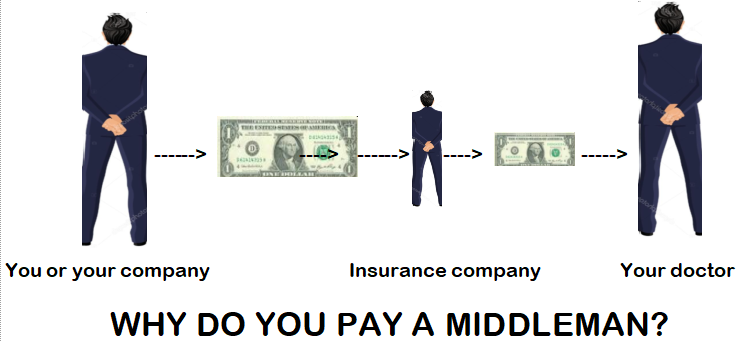
In fact, why do you or your company pay anyone, when the federal government is perfectly capable of paying your doctor, hospital, nurses, pharmaceutical company, and medical equipment manufacturer with no help from you?
You also pay the inflated costs of the goods and services you purchase from companies that have had to raise their prices to cover increased insurance costs.
In short, employer-supplied health care insurance is a net loser for everyone except for the insurance companies.
It cuts your salary while increasing what you pay for goods and services.
When the federal government pays, you get more and it costs you nothing.
The cost of care is expected to continue to increase in the coming years, putting added pressure on employers to offer competitive benefits packages.
Employer-sponsored plans have seen increased demand for mental health services, and 44% of companies surveyed with 200 or more employees offered mental health or self-care apps as benefits, accompanying research in Health Affairs says.
Covered workers are picking up a portion of the cost when they visit in-network physicians: Average copayments were $27 for primary care and $44 for specialty care, and there was even more cost-sharing for hospital admissions or outpatient procedures.
A large majority of firms with 50 or more employees cover some telemedicine in their largest health plan.What’s next: Premiums are likely to surge next year as inflation persists.
“Premium increases may be even higher than the 3–4 percentage points that we have seen in recent years,” the Health Affairs study authors write.
It’s the classic vicious circle. The cost of health care goes up which directly increases inflation, Then, inflation pushes the cost of insurance up, which impacts your net salary. And ’round and ’round we go.
Your net take-home pay is numerically reduced by the insurance premiums, while it is functionallyreduced by inflation.
Employer-provided health care insurance costs you both ways.
THE SOLUTION The U.S. federal government has infinite dollars. It neither needs nor uses tax dollars to pay its bills. Even if all federal tax collections totaled $0, the government could continue spending any amount, forever.
Without collecting a penny in taxes, the federal government could provide you and your family with free, comprehensive, no-limit health care insurance,that includes everything you can imagine — eyes, dental, psychiatric, every form of health-related equipment, etc.
Your healthcare could cost you nothing, either for services or for premiums. It could be Medicare for All only much, much better. And it wouldn’t increase the cost of goods and services, because, unlike employer-provided insurance, it wouldn’t increase employers’ costs.
Unlike employer-funded medical insurance, which does nothing for the economy, federally funded Medicare for All would grow the economy by adding stimulus dollars.
SO WHY NOT? Why don’t you have this plan, already?
Because you have been led to believe three lies.
Lie #1. You shouldn’t trust the government to provide health care.
But, a comprehensive Medicare for All plan would not involve the government providinghealth care. The plan would involve the government only paying for health care.
The actual care still would be provided by your same doctors, nurses, hospitals, therapists, and equipment manufacturers. It merely would cut out the wholly unnecessary and costly middlemen, the insurance companies.
The insurance companies provide no medical function. They merely collect your dollars, take some for themselves, and pass the rest on to the real medical practitioners.
The government would function as your insurance company. The big differences would be no dollars would be taken from you, and the government never can run short of dollars.
Lie #2. Your taxes would go up.
The U.S. federal government, unlike state and local governments, is Monetarily Sovereign. It cannot unintentionally run short of U.S. dollars.
It can spend forever without collecting any tax dollars.
Compare the federal government to state and local governments. They are monetarily non-sovereign. While state and local taxes fund state and local spending, federal taxes do not fund federal spending.
The purpose of federal taxes is not to help the government spend, but rather:
a. To control the economy by taxing what the government wishes to reduce and giving tax breaks to what the government wishes to reward.
b. To create demand for the U.S. dollar by requiring taxes to be paid in dollars.
c. To reduce your demand for services (like free health care insurance), by making you believe taxes are necessary to pay for benefits.
Lie #3. Federal spending causes inflation.
No inflation ever has been caused by spending. All inflations, including the current one, are caused by shortages of key goods and services, most often oil and food.
During and after the Great Recession of 2008, we had massive government spending without inflation. We only experienced inflation when COVID caused shortages of oil, food, lumber, computer chips, shipping, labor and other products and services.
Inflation (red line) doesn’t parallel federal deficit spending (blue line).
If you understood that the federal government has infinite money and does not need or use taxes, you would demand Medicare for All, Social Security for All, College for All, Food Assistance for All, Housing Assistance for All, etc.
Why don’t we have it?
The very rich, who run America, don’t want it. They are rich because of the income/wealth/power Gap between them and you. The wider the Gap, the richer they are. But the more free benefits you receive, the narrower the Gap becomes.
Your free benefits actually make the rich less rich.
So the rich bribe the politicians (via campaign contributions and promises of employment), the media (via advertising dollars and media ownership), and the economists (via donations to schools and employment in think tanks).
The rich bribe these people to tell you “the Big Lie” that federal taxes fund federal spending, and if you want more benefits you’ll have to pay for them.
It’s all a con to keep you ignorant. An ignorant public is a docile public, which is exactly what the rich want. It keeps them rich.
Sen. Bernie Sanders recommended a Medicare for All plan, but his plan had three serious faults:
Fault #1. It claimed to rely on tax collections, the same fault current Medicare has. So Sanders struggled to show how it was tax-neutral.
That was unnecessary. He should have explained that federal taxes do not fund federal spending and that the federal government would do what it always does: Create dollars, ad hoc, to pay every bill.
Fault #2. It was not comprehensive. It still required co-pays and didn’t cover many medical problems. This was done to save money and balance against tax collections — an unnecessary step.
The federal government does not need to save dollars. It has infinite dollars. It never can run short of dollars, even if it collects zero taxes.
Former Federal Reserve Chairman Alan Greenspan: “A government cannot become insolvent with respect to obligations in its own currency.”
Former Federal Reserve Chairman Ben Bernanke: “The U.S. government has a technology, called a printing press (or, today, its electronic equivalent), that allows it to produce as many U.S. dollars as it wishes at essentially no cost.”
The scare stories about federal “debt” and deficits are just that: Scare stories. False scare stories.
So called federal “debt” and deficits are no burden on a government with the infinite ability to pay its bills. If the federal government and your political representatives were doing their job, you would have free, comprehensive Medicare for All right now.
Why do you pay a middleman when the government can provide better service, free?

 Additionally, the Democrats



 #Monetary Sovereignty - Mitchell