II. Federal Spending is all the spending the federal government does. It includes every dollar the government spends.
III. Nonfederal spending includes all the dollars spent in the economy by every individual, every business, and every state/local government.
IV. Net Imports is the difference between dollars spent on imports vs. dollars received for exports. Usually, we spend more on imports than we receive for exports, so just to break even, either Federal Spending or Non-federal spending must take up the slack.
However, if we break even, the economy will shrink because of inflation. So — and this is very important– for the economy to grow, government spending must grow.
There is no way for the economy to grow when government spending does not grow. That is basic algebra.
Now someone might say, what if federal spending doesn’t grow but nonfederal spending grows enough to overcome both Net Imports and Inflation.
The problem with that hypothetical scenario is that when Federal Spending doesn’t grow, there is no way for the Non-federal sector to obtain the spending dollars that would grow the economy.
In fact, not only do we have recessions and depressions when Federal Spending doesn’t grow, we even have recessions and depressions when Federal Spending grows, but too little to overcome inflation and Net Imports.
U.S. depressions come on the heels of federal surpluses.
1804-1812: U. S. Federal Debt reduced 48%. Depression began 1807.
1817-1821: U. S. Federal Debt reduced 29%. Depression began 1819.
1823-1836: U. S. Federal Debt reduced 99%. Depression began 1837.
1852-1857: U. S. Federal Debt reduced 59%. Depression began 1857.
1867-1873: U. S. Federal Debt reduced 27%. Depression began 1873.
1880-1893: U. S. Federal Debt reduced 57%. Depression began 1893.
1920-1930: U. S. Federal Debt reduced 36%. Depression began 1929.
1997-2001: U. S. Federal Debt reduced 15%. Recession began 2001.
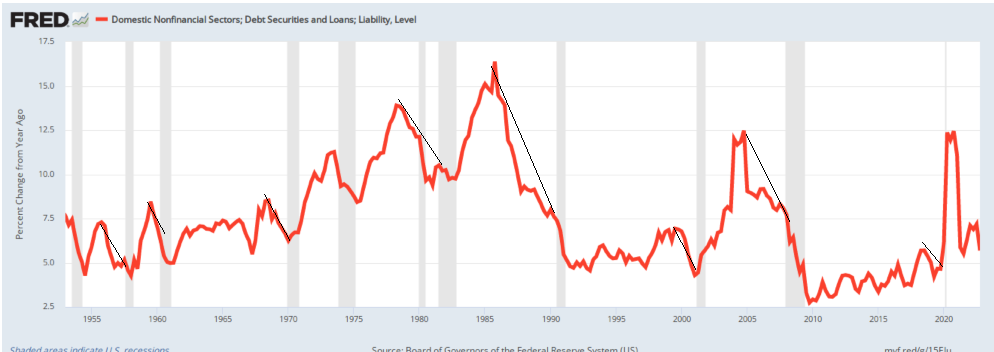
When the money supply decreases, or even increases, but not enough, we have recessions.Federal Spending increases the money supply. When the money supply increases, GDP increases. When the money supply decreases, we have recessions and depressions. The above graph shows the parallel paths taken by the money supply and GDP.
Again, GDP is the measure of two things. It is the measure of the economy, and it is the measure of spending. This is just simple algebra. You don’t need a degree in economics to understand it.
And yet, Congress, the President, the Republican, Democratic, and especially the Libertarian Parties pretend it’s all a mystery to them because they say they don’t want Federal Spending to grow.
In essence, they don’t want the economy to grow; more accurately, they want us to have recessions and depressions that affect the rich much less than they affect the rest of us.
Congress, the media, and the economists all parrot the same line. They claim federal spending is “unsustainable” and should be reduced. But what makes federal spending “unsustainable”?
The federal government is Monetarily Sovereign, meaning it cannot run short of U.S. dollars. The Federal government can pay any bill of any size if it’s denominated in dollars. Send the government an invoice for a trillion dollars; it could pay it tomorrow by pressing computer keys.
This is not just my opinion. It is a well-known fact:
Former Federal Reserve Chairman, Alan Greenspan: “A government cannot become insolvent with respect to obligations in its own currency.”
Alan Greenspan: “There is nothing to prevent the federal government from creating as much money as it wants and paying it to somebody.”
Alan Greenspan: “The United States can pay any debt it has because we can always print the money to do that.”
Former Fed Chairman, Ben Bernanke: “The U.S. government has a technology, called a printing press (or, today, its electronic equivalent), that allows it to produce as many U.S. dollars as it wishesat essentially no cost.”
Quote from Ben Bernanke when he was on 60 Minutes:Scott Pelley: Is that tax money that the Fed is spending?Ben Bernanke: It’s not tax money… We simply use the computer to mark up the size of the account.
Despite what you’ve read and heard, not only can the government create all the dollars it needs by pressing computer keys, but it never needs to borrow dollars.
Statement from the St. Louis Fed:“As the sole manufacturer of dollars, whose debt is denominated in dollars, the U.S. government can never become insolvent, i.e., unable to pay its bills. In this sense, the government is not dependent on credit markets to remain operational.”
The words “not dependent on credit markets” means the federal government does not borrow. Those T-bills, T-notes, and T-bonds that wrongly are called “borrowing” are nothing of the sort.
A borrower borrows because it needs money. The federal government doesn’t. The government merely accepts deposits into T-security accounts. It never touches those dollars. Why would it, given its infinite ability to create dollars?
The purposes of T-securities are not to provide the government with spending dollars, but rather to:
To provide a safe storage place for unused dollars. This helps stabilize the dollar
To help the Fed control interest rates.
And then there is the false “inflation” claim. The mantra is that we will have inflation if the federal government prints money.
Historically, that simply is not true:
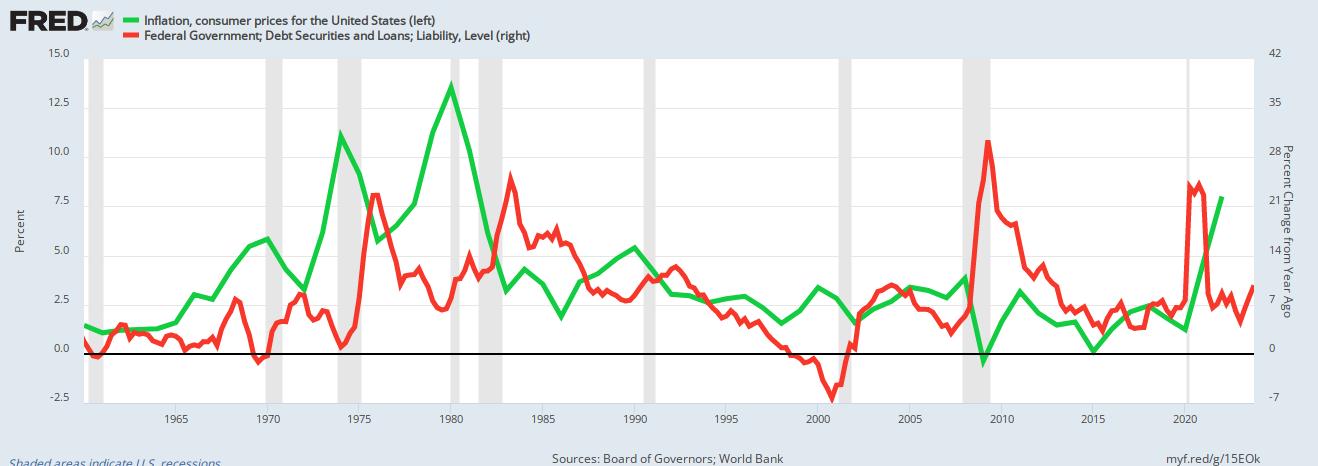
If federal spending caused inflation the red spending line and the green inflation line would essentially be parallel. They are not. They move randomly with respect to one another.The thing that always causes prices to rise is scarcity. You know this from experience.
When weather causes a shortage of oranges or apples, the price of oranges and apples goes up.
When COVID creates shortages of oil, steel, lumber, computer chips, labor, etc., the price of everything goes up. We have inflation.
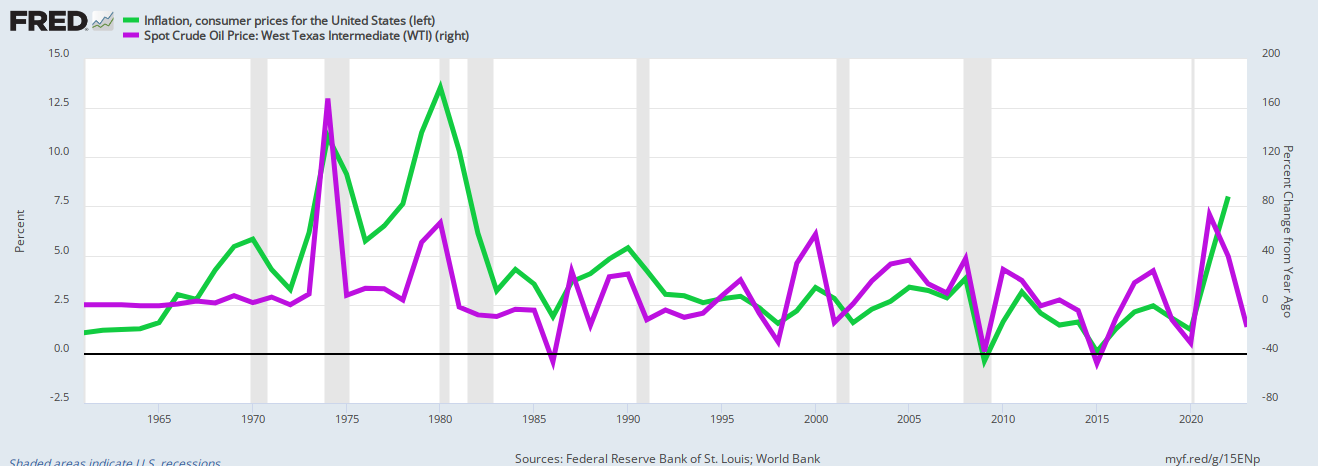
The single most common scarcity that has caused inflation for the past few decades is the scarcity of oil:Oil scarcity causes oil prices to rise, and because the price of oil affects the prices of almost every other product, oil scarcity causes inflation.
While federal spending does not parallel inflation, the scarcity of oil does parallel inflation.
Again, none of this is rocket science, and none of it is secret. Politicians, the media, and economists all have these data.
So why do they conduct these mock battles about a useless, meaningless, misleading debt ceiling? Why all the lies?
Because the politicians, media, and economists have been bribed by the rich, who run America.
The politicians are bribed by campaign contributions and promises of lucrative employment at think tanks.
The media are bribed by advertising dollars and by straight-out ownership of the media.
The economists are bribed by contributions to their universities and promises of employment in think tanks and controlled corporations.
And why do the rich want the politicians, media, and economists to pretend that federal spending should be reduced? It’s because of something called “Gap Psychology.”
The word “rich” is comparative, not absolute. Someone with a million dollars is poor if everyone else has ten million. Someone who has a hundred dollars is rich if everyone has one dollar. Getting richer requires acquiring more compared to everyone else.
You can do this in either or both of two ways:
Acquiring more for yourself and/or
Making sure everyone else has less.
Gap Psychology is the human desire to distance oneself from those below you and/or to come closer to those above you on any scale of income, wealth, or power.
Most people wish to become richer. This is especially true of the rich, who are driven by their insatiable desire to become even richer, i.e., distancing themselves from those below and coming closer to those above.
They hate your receiving government-funded healthcare insurance. They hate food stamps, unemployment benefits, government-funded college — anything that even slightly narrows the Gap between them and those below.
To distance themselves from the middle and lower quadrants, the rich do all they can to make you believe the federal government cannot afford to give you benefits. They draw false comparisons between your personal financing and federal government financing.
They talk about federal “borrowing”though the government, unlike you, does not borrow dollars.
They talk about the federal “credit card,” though the government uses nothing that resembles a credit card.
They talk about “out-of-control” spending, though unlike you, the federal government has the infinite ability to spend.
They claim federal deficit spending is “unsustainable” though the government has “sustained” deficit spending for more than 80 years — deficit spending that grew the economy from several billion dollars to thirty trillion.
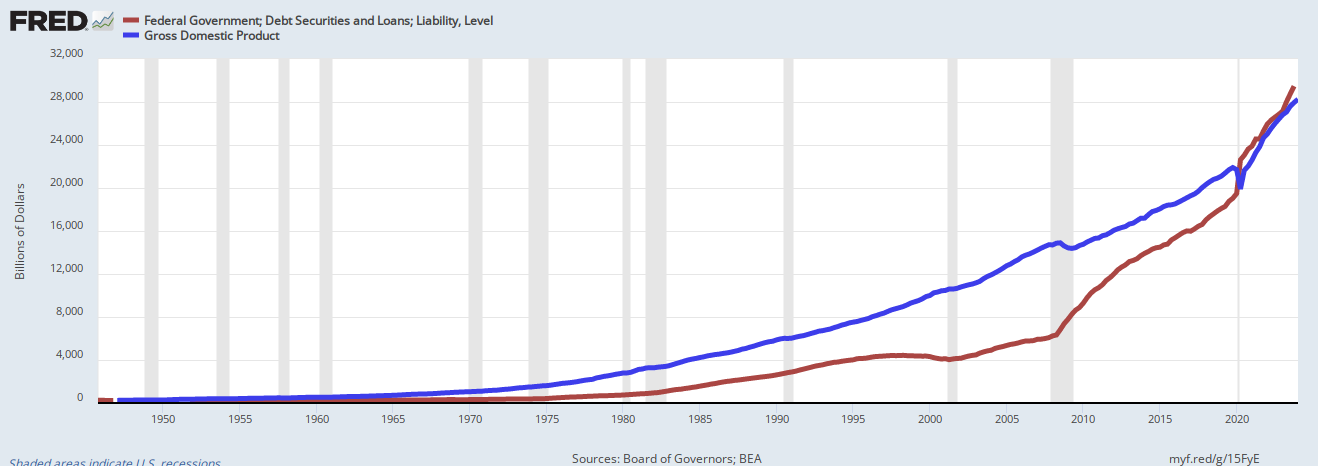
Here is another graph that shows the essentially parallel paths of federal spending and GDP.
Naturally, the lines essentially are parallel. Federal Spending is an integral part of GDP. It would be like a graph comparing total touchdowns with total points. The lines essentially would be parallel.
To say that federal spending is too high, unsustainable, or out-of-control — i.e., to say that federal spending should be reduced — is to say that economic growth is too high, unsustainable, out of control, and should be cut.
No one believes that, not even the rich. They just want to cut the benefits you receive, not the benefits they receive.
They bribe Congress to give them tax loopholes so that they, like Donald Trump, pay at a far lower rate than the average salaried person.
And they spread the myth that giving the Internal Revenue Service more money will send investigators after you when the money was meant to investigate the rich.
Everywhere you turn, the rich have bribed your sources of information to indoctrinate you with the belief that federal spending should be cut and taxes increased, especially the spending and taxes related to benefits for you who are not rich.The purpose of federal taxes is different from the purpose of state/local government taxes. Federal taxes do not provide spending money to the federal government, which already has infinite spending money. Federal taxes have two financial purposes plus a third purpose that should anger you:
To control the economy by taxing what the government wishes to discourage and by giving tax breaks to what the government wishes to encourage
To assure demand for the U.S. dollar by requiring taxes to be paid in dollars. And here is the one you’ll really hate:
To help widen the income/wealth/power Gap by giving tax loopholes to the rich.
And now we have the phony “debt-limit” struggle. The Republicans (the party of the rich) demand cuts to Medicare, Medicaid, food stamps, etc., and the Democrats (pretending to be the party of the poor) fight weakly against too many cuts (just a few).
And neither of them tells you the truth. The entire charade is a professional wrestling exhibition held in the halls of Congress.
The bottom line is: You have been brainwashed into ignorance. Federal deficit spending is not unsustainable, nor does it cause inflation.
The federal government easily could fund no-deductible, comprehensive, generous Medicare and Social Security benefits for every man, woman, and child in America, a college education for everyone who wanted it, food so that no child in America ever would need to go hungry, and decent housing for even the poorest among us.
The federal government could do all that while funding the military, medical research and development, the physical sciences, renewable energy, and all the other things that would improve your life and the lives of those you love.
It can be done, and it will be done, but first, you must understand the lies you are being fed and then demand, en masse, that the government does what it was formed to do.
Rodger Malcolm Mitchell
Monetary SovereigntyTwitter: @rodgermitchellSearch #monetarysovereigntyFacebook: Rodger Malcolm Mitchell
……………………………………………………………………..
The Sole Purpose of Government Is to Improve and Protect the Lives of the People.
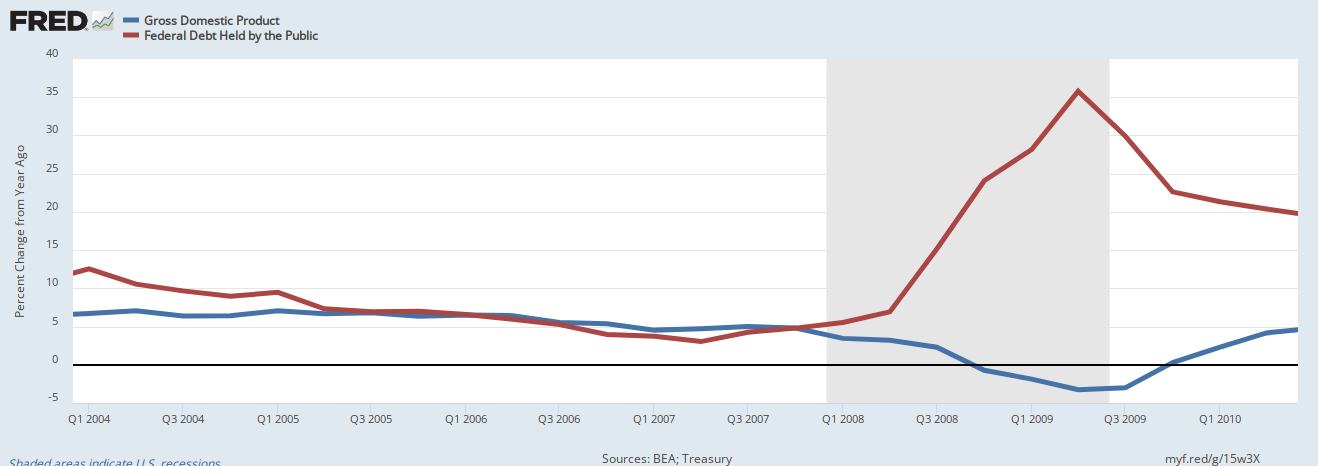
We did it with the “Economic Stimulus Act 2008. The federal government simply sent people money.
Generally, low and middle-income taxpayers received up to $300 per person or $600 per couple.
The purpose was to stimulate economic growth and to cure the recession.
It worked:
As federal deficits (blue) declined, we fell into a deep recession, cured only by a robust increase in federal deficit spending (red).
Gross Domestic Product (GDP) is a common measure of the economy. The above graph should come as no surprise. The formula for economic growth is:
GDP = Federal Spending+ Nonfederal Spending + Net Exports
Mathematically, as federal deficit spending decreases, economic growth falls, and as federal deficit spending increases, economic growth increases.
If you want economic growth, you want federal deficit spending to increase.
I’ve written about this many times.It’s simple algebra. I’m not sure why this is a mystery to the politicians who think a debt limit is prudent finance. It’s exceedingly ignorant finance.
I mention this again because of an article I just read on MEDPAGETODAY:
Uninsured Rate Hits Record Low of 8.3% — But that number will slowly rise as pandemic health insurance protections unwind, experts say by Joyce Frieden, Washington Editor, MedPage Today May 24, 2023
WASHINGTON — The uninsured rate in the U.S. has fallen to a record-low 8.3%, but that percentage is expected to gradually increase as insurance protections from the COVID-19 pandemic wind down, according to officials from the Congressional Budget Office (CBO).
Why will insurance protections “wind down.” For the same reason we currently have a debt=limit battle in Congress. Sheer ignorance.
The federal government has repeatedly proved that it has the infinite ability to pay for anything. Why is it “winding down” payments for healthcare insurance?
The temporary policies enacted in the wake of the COVID-19 pandemic “have contributed to a record low uninsurance rate in 2023 of 8.3% and record-high enrollment in both Medicaid and ACA [Affordable Care Act] marketplace coverage,”said Caroline Hanson, Ph.D., principal analyst at the CBO, during a briefing sponsored by Health Affairs.
“As those temporary policies expire under current law, the distribution of coverage will change and the share of people who lack insurance is expected to increase by 2033.”
CBO is projecting an uninsured rate of 10.1% by 2033, and “while that’s obviously higher than the 8.3% that we’re estimating for 2023, it is nevertheless lower than the uninsured rate in the last year prior to the COVID-19 pandemic,” which was about 12%, she said.
Think about it. America has about 330 million people. A ten percent uninsured rate means 33 MILLION (!) people in America will have to do without health care insurance. I hope you’re not among them.
Whether or not you have insurance, here are some data that should concern you:
“A widely cited study published in the American Journal of Public Health in 2009 analyzed data from the National Health Interview Survey and found that uninsured individuals had a 40% higher risk of death compared to their insured counterparts. This study estimated that lack of health insurance contributed to approximately 45,000 deaths annually in the United States.
“Another study published in the Annals of Internal Medicine in 2017 conducted a systematic review and meta-analysis of previous research. The analysis concluded that uninsured individuals faced a 25% higher risk of mortality compared to those with insurance.”
When you don’t have healthcare insurance, you die younger.
“Throughout the 2023-33 period, employment-based coverage will remain the largest source of health insurance, with average monthly enrollment between 155 million and 159 million,” Hanson and co-authors wrote in an article published in Health Affairs.
Employer-based health care insurance has two features seldom discussed.
It ties employees to their employer, making job negotiation and movement much more difficult
It is paid for by the employee because the employer figures the cost as part of the employment. Salaries could be higher without this “perk.”
If the federal government funded a comprehensive Medicare for All plan, employees would earn more without costing employers more.
However, they added, “in addition to policy changes over the course of the next decade, demographic and macroeconomic changes affect trends in coverage in the CBO’s projections.”
The Families First Coronavirus Response Act of 2020 gave states a 6.2-percentage-point boost in their Medicaid matching rates as long as the states didn’t disenroll anyone in Medicaid or CHIP for the duration of the COVID public health emergency.
Hanson noted that this law “allowed people to remain enrolled regardless of their changes in eligibility. So, for example, even if they had an income increase that would have made them ineligible but for the policy,” they were still able to stay on Medicaid.
The COVID public health emergency has been canceled now. Disenrollments can begin.
As a result of the law, Medicaid enrollment has grown substantially since 2019 — by 16.1 million enrollees, she said. But that has been superseded by another act of Congress, which allowed states to begin “unwinding” the continuous eligibility rules and start disenrolling people from Medicaid and CHIP beginning on April 1.
In total, “15.5 million people will be transitioning out of Medicaid after eligibility redetermination,” said Hanson. “Among that 15.5 million people, CBO is estimating that 6.2 million of them will go uninsured and the remainder will be enrolled in another source of coverage,” such as individual coverage or employment-based coverage.
Of those who are leaving Medicaid, how many are leaving voluntarily and how many are “falling through the cracks” because they didn’t receive their disenrollment notification or failed to fill out the required paperwork to reapply?
“We recognize that before these continuous eligibility requirements were put into place, people were losing Medicaid coverage, both because they were becoming no longer eligible for Medicaid, and … because they did not complete the application process despite remaining eligible,” said CBO analyst Claire Hou, PhD. However, she added, “we’re currently not aware of any data that would allow us to quantify the size of those two different groups.”
All of the above would be unnecessary if our Monetarily Sovereign federal government (which has unlimited funds) simply would fund a comprehensive, no-deductibles Medicare for All program.
Hanson delivered some bad news for those footing the bill for private health insurance. “We are projecting relatively high short-term premium growth rates in private health insurance, and this is for a few reasons,” she said.
“One is the economy-wide inflation that we’re experiencing in 2023 and that we have been experiencing, and that has not fully reflected itself in premiums yet.
And another contributor is the continued bouncing back of medical spending after the suppressed utilization that we saw earlier in the pandemic.”
The study authors project average premium increases of 6.5% in 2023, 5.9% during 2024-2025, and 5.7% in 2026-2027.
The current and projected-to-increase hardship on the American people is totally unnecessary. The federal government efficiently could ameliorate this hardship by:
Funding comprehensive, no-deductible Medicare for every man, woman, and child in America
Funding Social Security benefits for every man, woman, and child in America.
Both would add dollars to Gross Domestic Product, thus growing the economy.
Instead, Congress battles over the unbelievably stupid debt ceiling. How do those people manage to dress themselves in the morning, much less be elected to America’s Congress? It boggles the mind.
Here is what true experts say about Monetarily Sovereign entities like the United States government and the European Union:
Alan Greenspan: “A government cannot become insolvent with respect to obligations in its own currency.”
Alan Greenspan: “There is nothing to prevent the federal government from creating as much money as it wantsand paying it to somebody.”
Alan Greenspan: “The United States can pay any debtit has because we can always print the money to do that.”
Ben Bernanke: “The U.S. government has a technology, called a printing press (or, today, its electronic equivalent), that allows it to produce as many U.S. dollars as it wishes at essentially no cost.”
Quote from former Fed Chairman Ben Bernanke when he was on 60 Minutes: Scott Pelley: Is that tax money that the Fed is spending? Ben Bernanke: It’s not tax money… We simply use the computer to mark up the size of the account.
Statement from the St. Louis Fed: “As the sole manufacturer of dollars, whose debt is denominated in dollars, the U.S. government can never become insolvent, i.e., unable to pay its bills. In this sense, the government is not dependent on credit marketsto remain operational.”
Press Conference: Mario Draghi, President of the ECB, 9 January 2014 Question: I am wondering: can the ECB ever run out of money? Mario Draghi: Technically, no. We cannot run out of money.
Here is what people who are ignorant of Monetary Sovereignty say:
Although it’s volatile (like personal bank balances often are), the treasury’s cash pile of $57.3bn, recorded last Thursday, is by far the lowest figure for more than a year — and it’s well below the $150bn minimum that the treasury reportedly likes to keep as a buffer.
The X-date Treasury Secretary Janet Yellen has said to lawmakers that the “X-date” — the date when the US can no longer guarantee its ability to pay bills— is June 1st.
If the US government does run out of money, the biggest problem is a default on its debt.
Most analysts agree that a default would lead to complete financial chaos but the reality is that it’s anyone’s guess, because it’s never happened before.
“Will someone please get me a longer rope, so I don’t have to kill myself.”
The current debt ceiling stands at a whopping $31.4 trillion, legally limiting how much the treasury can borrow.
Because the government has the infinite ability to create dollars, it never borrows dollars. Sadly, the public doesn’t comprehend that simple fact.
Talks between President Biden and Speaker Kevin McCarthy are set to resume today, as each side negotiates the latest fiscal package that would raise the limit, though both parties remain ideologically opposed on whether the new debt ceiling should come with deep cuts to, or caps on, federal spending.
The U.S. federal government has the infinite ability to pay its bills simply by pressing a computer key. It also has the infinite ability to raise the phony debt ceiling, which it already has done 94 times.
The spending that resulted in the current debt had been authorized by previous Congresses and previous Presidents. The current Republican House essentially is saying, “Even though the money already is spent, by both Democratic and Republican Congresses and Presidents — and even though we have infinite money to pay our bills — we aren’t going to pay what we owe.”
Sounds like something six-times-bankrupt Donald Trump would do. Despite being a billionaire, he has cheated many creditors, and now his party threatens to do what he has called “smart business.”
This is exactly what the 14th Amendment was written to stop.
(“The validity of the public debt of the United States, authorized by law, including debts incurred for payment of pensions and bounties for services in suppressing insurrection or rebellion, shall not be questioned.”)
Now, the party of the biggest crook in Presidential history threatens to cheat our creditors unless the current President yields to their demands to raise your taxes (though not the taxes of the very rich) or to cut your benenfits (though not the benefits of the very rich).
Ironically, if President Biden invokes the 14th Amendment, the party that wants to cheat our creditors will claim that this is cheating the Constitution.
The question is, will the Democrats follow the Constitution and end the ridiculous “debt ceiling,” once and for all.
Then, we can leave it up to the right-wing SCOTUS, beholden to the “party-of-law-and-order,” to wriggle a way to claim that the Constitution really doesn’t say what it says.
Hey, they did it for the 2nd Amendment with regard to well-regulated militias; why not the 14th?
Want to have a discussion about anything — ANYTHING —with an intelligent person? How about a discussion with a seemingly intelligent, seeming person?
Here’s a discussion I had with a pretty good facsimile, an exercise you can enjoy yourself by clicking the link.
We discussed the cause of inflation. Warning, it’s addictive. Unlike the humans I try to reason with, the computer never gets angry or even impolite. It always acknowledges points made. And its opinions are not its own.
Sadly, it doesn’t learn from arguments. It just keeps repeating what it already has been told by its references.
Rodger Mitchell: It widely is believed that “excessive federal spending causes inflation,” yet when I try to find an example of excessive federal spending causing inflation, I receive the explanation that, “It’s really a combination of factors of which excessive federal spending is one factor and not even an immediate factor.
“It could be a delayed part.”
Sadly, that could be said of anything. I could make the same statement about phases of the moon or children born with red hair — as being only one factor and not even an immediate factor in inflation.
A computer-generated illustration of: A computer on a stage, talking into a microphone.”
In short, federal spending is no more a demonstrable factor than is a sign of the zodiac.
Chat GPF:The relationship between federal spending and inflation is a complex and debated topic among economists.
While some people hold the belief that excessive federal spending directly causes inflation, the reality is more nuanced and not as straightforward as a simple cause-and-effect relationship.
Inflation is a general increase in prices over time, and it can be influenced by a variety of factors, including monetary policy, fiscal policy, supply and demand dynamics, international trade, productivity levels, and more.
Excessive federal spending can potentially contribute to inflation, but it is not the sole or immediate factor responsible for it.
When economists explain that excessive federal spending is only one factor and not an immediate one in inflation, they are acknowledging the multifaceted nature of inflation.
They are suggesting that while federal spending can have an impact on inflation, it needs to be considered alongside other variables that influence price levels.
Simply blaming federal spending without considering other factors would oversimplify the issue.
It is important to note that economic phenomena, such as inflation, are typically the result of multiple interacting factors. This complexity makes it challenging to isolate and definitively prove the direct causal relationship between any single factor and inflation.
Therefore, it is not accurate to compare federal spending’s role in inflation to unrelated factors like phases of the moon or hair color, as the former is subject to economic analysis and empirical research.
Computer-generated image of: “A computer pondering a question in economics.”
Economists continue to study the relationship between federal spending and inflation, and there are differing views within the field.
Some argue that excessive government spending, particularly when not matched by increased productivity or accompanied by monetary expansion, can contribute to inflationary pressures.
Others argue that other factors, such as changes in private sector spending, global economic conditions, or shifts in supply and demand, have a more significant influence on inflation.
In summary, while excessive federal spending can potentially contribute to inflation, it is just one factor among many.
The complexity of economic systems and the multitude of factors influencing inflation make it difficult to attribute it solely to federal spending. Economic analysis and research are ongoing to better understand these dynamics and their interrelationships.
Rodger Mitchell: It’s not terribly “challenging to isolate and definitively prove the direct causal relationship between any single factor and inflation.” Inflations historically are caused by shortages, usually shortages of oil or food. I see many parallels through history between oil or food shortages and inflation.
I do not see the same parallels between federal spending and inflation. Can you provide an example of an inflation that did not result from an oil or food shortage, but instead resulted from excessive federal spending?
ChatGPT:While it is true that supply shocks, such as oil or food shortages, have historically played a role in triggering inflationary episodes, it would be incorrect to assert that inflation is exclusively caused by these factors. Inflation can also arise due to other factors, including excessive government spending.
One example often cited as an instance where excessive federal spending contributed to inflation is the case of Zimbabwe in the late 2000s. The Zimbabwean government embarked on a policy of significant fiscal expansion, primarily through extensive money creation, to finance its expenditures.
This resulted in a substantial increase in the money supply, leading to hyperinflation.
During this period, Zimbabwe experienced a severe economic crisis, with skyrocketing prices, rapid depreciation of the currency, and a loss of confidence in the monetary system.
Four computer generated images of: “A computer laughing at a joke”
While there were other factors at play, such as economic mismanagement and a decline in agricultural productivity, excessive government spending and the consequent increase in the money supply were key drivers of inflation in Zimbabwe.
It’s important to note that this example is just one case among many, and the relationship between federal spending and inflation is not always straightforward.
The impact of government spending on inflation can vary depending on several factors, including the overall state of the economy, fiscal and monetary policies, and the credibility of the government in managing its finances.
In many instances, inflation may result from a combination of factors rather than being solely attributable to a single cause.
It is also worth noting that the effects of excessive government spending on inflation may not be immediate but can manifest over time as the economy adjusts to the increased money supply and the potential distortionary effects of government interventions.
In summary, while oil or food shortages have historically been associated with inflation, excessive federal spending can also contribute to inflationary pressures under certain circumstances.
The example of Zimbabwe illustrates how a combination of factors, including excessive government spending and monetary mismanagement, can lead to inflation.
However, it is important to recognize that the relationship between federal spending and inflation is complex, and various factors can interact to influence price levels in an economy.
Rodger Mitchell: The Zimbabwe inflation was caused by a food shortage. Farmland was taken from farmers and given to non-farmers. The result: Food shortage and inflation.
The money “printing” was a response to, not a cause of, inflation.
ChatGPT:While it is true that Zimbabwe’s land redistribution policies and subsequent disruptions in agricultural productivity were significant contributors to the country’s hyperinflation, it is essential to note that excessive money creation by the central bank played a crucial role as well.
The Zimbabwean government resorted to financing its budget deficit by effectively printing money, leading to a significant expansion of the money supply.
This, combined with the loss of agricultural output, created a situation of excess money chasing limited goods, fueling hyperinflation.
The land redistribution policy disrupted agricultural production by displacing experienced farmers and replacing them with individuals who lacked the necessary skills, resources, and incentives to maintain productive farms. This resulted in a decline in food production, contributing to shortages and price increases.
However, it is important to understand the sequence of events. The initial cause of the inflationary spiral in Zimbabwe was the disruption in agricultural productivity due to the land redistribution policy.
As the economy faced shortages of food and other goods, the government responded by printing money to finance its spending obligations, exacerbating the inflationary pressures.
Inflation is a complex phenomenon, and it rarely has a single cause. In the case of Zimbabwe, both the land redistribution policy and the subsequent monetary expansion played significant roles in the hyperinflationary episode. It is crucial to recognize the interplay between these factors rather than attributing the entire inflationary outcome to a single cause.
This example underscores the importance of considering multiple factors and their interactions when analyzing the relationship between excessive federal spending and inflation. While it is true that supply shocks like food shortages can trigger inflation, the subsequent monetary and fiscal responses to those shocks can amplify and prolong the inflationary effects.
Rodger Mitchell:
(At this point I decided not to get into the fact that Zimbabwe was not Monetarily Sovereign, so though it could print currency, it’s money was tied to the dollar, and important inflationary consideration.)
It would be helpful if you could point to a single inflation in history that was precipitated by government spending rather than being precipitated by a shortage of oil, food or some other critical factor.
I suspect all inflations really are caused by shortages.
ChatGPT:There have been cases in history where excessive government spending has contributed to inflation, even in the absence of shortages in critical factors like oil or food. One notable example is the hyperinflation experienced by Germany in the early 1920s.
After World War I, Germany faced significant war reparations and a massive budget deficit. The German government resorted to financing its spending by issuing large amounts of debt and, eventually, by printing money.
The excessive money creation, combined with a lack of corresponding increase in production and output, led to a rapid devaluation of the German mark and hyperinflation.
During this period, there were no significant shortages of oil or food in Germany. Instead, the excessive government spending and the resulting increase in the money supply caused a loss of confidence in the currency, leading to skyrocketing prices.
People’s wages and savings quickly became worthless as the value of the mark rapidly declined.
This example illustrates how excessive government spending and the subsequent expansion of the money supply, without corresponding increases in productivity or output, can lead to inflation.
It demonstrates that inflation can occur even in the absence of shortages in critical factors.
While supply shortages can certainly contribute to inflation, it is not accurate to claim that all inflations are solely caused by shortages. Economic phenomena such as inflation are influenced by a multitude of factors, including both demand and supply-side dynamics, monetary policy, fiscal policy, and other macroeconomic conditions.
It is crucial to recognize that inflation is a complex phenomenon with multiple potential causes, and it can arise from different combinations of factors in different historical contexts.
Rodger Mitchell: So, prices of food and oil went up even though there was no shortage of these products? And it was all due to government spending? Then the inflation was cured by even more government spending to create the greatest military force the world had ever known? Does any of this make sense to you?
ChatGPT:I apologize if my previous responses were not clear. Allow me to clarify.
In the case of Germany’s hyperinflation in the early 1920s, it is important to note that the excessive government spending and subsequent increase in the money supply were contributing factors to inflation.
However, it would be inaccurate to say that the inflation was solely caused by government spending without considering other factors at play.
During that period, Germany faced a complex set of circumstances, including war reparations, economic disruptions from World War I, and political instability.
The excessive government spending and the resulting expansion of the money supply added to these challenges, leading to hyperinflation.
Inflation is a multifaceted phenomenon influenced by various factors, including monetary policy, fiscal policy, supply and demand dynamics, productivity, external factors, and more. It is rarely driven by a single cause.
Regarding your statement about inflation being “cured by even more government spending to create the greatest military force the world had ever known,” it is important to differentiate between the context of post-World War I Germany and the broader discussion about the relationship between government spending and inflation.
Government spending, particularly in the context of wartime mobilization or rebuilding efforts, can have stimulative effects on the economy.
However, the impact on inflation depends on various factors, including the state of the economy, fiscal management, and monetary policies implemented.
It is crucial to approach the analysis of inflation and government spending with nuance, considering the specific historical context and the multitude of factors involved. There is no one-size-fits-all explanation, and each situation requires careful examination of the unique circumstances at hand.
Rodger Mitchell: There is a widespread fear that government spending causes inflation. It is the foundation of the “debt-limit” laws. Because the federal government cannot run short of dollars, the only ostensible purpose of the debt limit is to prevent inflation.
But, government spending alone doesn’t cause inflation. There needs to be, as you said, “war reparations, economic disruptions, and political instability.”
Absent these factors, which cause shortages of key goods and services, government spending does not cause inflation. Thus, the excuse for a debt limit disappears.
ChatGPT:You raise an important point about the relationship between government spending and inflation. While it is a common belief that government spending alone leads to inflation, the reality is more nuanced.
As you mentioned, inflation typically occurs when there are shortages in key goods and servicesor when there is excessive money creation that outpaces the productive capacity of an economy.
Government spending can potentially contribute to inflation if it is not matched by increased productivity or accompanied by appropriate fiscal and monetary policies.
The purpose of debt limits, including the ones imposed on governments, can indeed be aimed at controlling inflationary pressures. By limiting the amount of debt the government can accumulate, policymakers aim to prevent excessive money creation and potential inflation.
However, it is important to note that debt limits are just one of many tools governments use to manage their fiscal policies, and their effectiveness in curbing inflation can vary.
In practice, the relationship between government spending, debt limits, and inflation is complex and dependent on various factors. These factors include the overall state of the economy, fiscal management, monetary policies, external economic conditions, and more. Each situation requires careful analysis of the specific context to understand the potential impacts on inflation.
While shortages of goods and services can exacerbate inflationary pressures, it is not accurate to dismiss government spending as irrelevant to inflation in the absence of such shortages. The impact of government spending on inflation is influenced by a range of economic factors, and it is subject to ongoing debate and analysis among economists.
In summary, the relationship between government spending and inflation is multifaceted. While shortages of key goods and services can contribute to inflation, government spending can also have inflationary effects if not appropriately managed. The role of debt limits in preventing inflation depends on various factors and can differ from one economic context to another.
Note the repeated use of the “This, but on the other hand, that” argument.
Also, while the public believes excessive” “federal spending causes inflation, ChatGPT says other factors must be present. (It is these “other factors” that are the cause of inflation. Increased money creation is a response to inflation, not a cause.)
While the complaint often is made that https://chat.openai.com/ is not a reliable source of information, that same complaint can be made about every other source of information— books, newspapers, encyclopedias, and certainly the government, the Internet and television (perhaps except for FOX and Breitbart, which are reliably wrong).
For example, you’ll notice that https://chat.openai.com/ never does provide any data to demonstrate that federal spending causes inflation. It dances around that central point by making the “various factors” claim.
Unfortunately, it cannot yet receive pictures or graphs, else I would have provided it with graphs demonstrating the lack of a historical relationship between inflation and federal spending along with the profound historical relationship between oil shortages and inflation.
I suspect that by the time this year ends, we will be able to show the AI pictures, graphs, videos, and music.
It might even admit that debt limits are a lie foisted on the innocent public by the rich, the purpose being to widen the Gap between the rich and the rest.