WIRED is one of the best magazines these days — interesting, comprehensive articles about technical subjects. There is nothing like it. But they sure blew it this time.
An article in the May edition makes two main points: A gas tax holiday won’t lower gas prices much (true), and the gas tax supports road maintenance (false).
Reducing the fee will have only a marginal impact on prices while depriving the government of revenue to maintain roads.
Immediately, the misunderstanding rears its head.
The finances of the U.S. federal government are not like state and local government finances, or business finances, or your personal finances.
The federal government uniquely is Monetarily Sovereign. It has the infinite ability to create dollars at the touch of a computer key.
It is impossible to “deprive the government of revenue.”
As gas prices stay stubbornly high across the country, President Donald Trump mused this week about suspending the fuel tax US consumers pay.
The idea is also picking up steam in Congress, with Democratic and Republican lawmakers pushing for a gas tax holiday.
But experts tell WIRED that it’s unlikely that any rollback—even temporary—of the fee will save consumers much as the unofficial start to summer travel season nears.
“It’s unlikely that oil prices, gasoline prices, diesel prices are going to fall back to where they were in February any time in the next couple months,” says Clark Williams-Derry, an analyst at the Institute for Energy Economics and Financial Analysis.
The average price of gasoline across the country was $4.53 per gallon as of Thursday, up from $4.12 a month ago, and $3.18 last year, according to AAA. That includes the federal gas tax, which is a little over 18 cents a gallon.
Trump can’t suspend the gas tax on his own—it would take an act of Congress. (Taylor Rogers, a White House spokesperson, noted the 18-cent savings in WIRED’s request for comment, and added that this move “would be a temporary measure.”)
The tax, which was created in 1932, has never been suspended. But politicians from both sides of the aisle have put forward a variety of bills this year that would temporarily lift the federal tax.
The date is important. Back in 1932, the federal government was less Monetarily Sovereign because it was hampered by a gold standard. It restricted its own money-creation ability by requiring itselfto store gold, the value of which supposedly supported the value of the dollar.
President Nixon demonstrated the folly of gold and silver standards by simply ending them in 1971. At the stroke of a pen, the fictional “backing” for the dollar disappeared, and only the real backing remained.
Even if the tax is suspended for the summer, drivers wouldn’t necessarily see much in the way of savings. Prices at the pump are decided by a number of different factors, from refining costs to the costs to operate gas stations.
And inflation driven by high fuel prices and a shortage in commodities that rely on oil as a key input, like fertilizer, around the world is also making life more expensive for Americans. In April, the consumer price index—used to measure inflation—was up 3.8 percent year over year.
With the costs of everything from food and rent to airfare ticking up, an 18-cent savings doesn’t add up to much over the long run.
“When you take away the retail gas tax, it’s not going to have a dramatic effect [for consumers],” says Tyson Slocum, the director of the energy program at the progressive think tank Public Citizen. “But what would be dramatic is the loss in federal revenues.”
Wrong. Congress could supply all the needed revenues just by voting. That is the same way Congress provides revenues to the military branches, the White House, the Supreme Court and to Congress itself, as well as all other federal projects.
The federal gas tax funds the Highway Trust Fund, which was formed to support highway maintenance and mass transit projects.
Wrong. The tax funds nothing. It’s not even a trust fund (See: The Phony Trust Fund Controversy) It’s just a line item in a federal balance sheet — which Congress can add to or reduce at whim.
That fund was already facing severe insolvency issues even before proposals to lift the federal gas tax.
No federal program can become insolvent unless Congress and the President want it to.
Williams-Derry points out that many of the roads in the US are “literally crumbling:” Nearly 40 percent of the country’s highways and roadways are in need of repair, a 2025 survey found. The already low taxes are a big driver of poor infrastructure, he says.
No, Congress’s and the President’s unwillingness to allocate sufficient funds is the problem.
Cutting off revenue, even temporarily, would only exacerbate the problem.
Congress and the President created the problem, and they also can fix it. The tax is just an excuse to do nothing, much like how the FICA tax is used as an excuse to cut Social Security and Medicare.
There’s also a possibility that a temporary break could be extended indefinitely, given the political risks of reinstating it, particularly as midterms near.
“The loss of federal revenues available to ensure that our transportation infrastructure remains sound, it’s just not a good deal for consumers,” Slocum says.
The loss of federal revenues is entirely in the hands of Congress and the President. No tax is necessary or even helpful.
Seemingly, Mr. Josh Boak or the Trump White House believes that pharmaceutical companies are not part of the economy. How else can you explain the following headline?
WASHINGTON (AP) — White House economists estimate that President Donald Trump’s deals with pharmaceutical companies to drop some of their U.S. prescription drug pricesto what they charge in other countries could save $529 billion over the next 10 years.
If a U.S. pharmaceutical company drops its prices, how does that save “the economy” anything? Less money will come from American buyers and less will go to American businesses. Both are part of the economy.
It’s a net wash for the economy. It’s good news for drug users, but bad news for drug companies, their employees, and their suppliers.
The analysis obtained by The Associated Press includes the first economy-wide projections behind a policy at the core of Trump’s pitch to voters going into November’s midterm elections for control of the House and Senate. Democratic lawmakers have been doubtful about the savings claimed by Trump and these new numbers are likely to trigger additional questions about the data.
Now why would anyone question claims provided by Donald (“The war will end in a week”) (“It actually isn’t a war” “I hardly knew Epstein”) Trump?
Cost-of-living issues are at the forefront of voters’ concerns and higher energy prices tied to the Iran war have deepened the public’s anxiety. Trump has tried in part to address affordability concerns by focusing on his efforts to cut deals with companies so that the cost of prescription drugs in the U.S. would no longer be dramatically higher than in other affluent nations.
That’s good news for some sick people — or it would be good news if the Republicans were not doing everything possible to cut Medicare, Medicaid, Social Security, and almost every other federal benefit for the lower 99% income/wealth/power group.
(You’ll be pleased to know that tax benefits for the ultra-wealthy, like those that allowed billionaire Trump to pay less than $1,000 in taxes in some years, will remain in place.
“Now you have the lowest drug prices anywhere in the world,” Trump said at a Friday rally before a crowd of seniors in Florida. “And that alone should win us the midterms.”
Really? The lowest in the world? Uh, wait . . .
The analysis was done by administration officials for the White House Council of Economic Advisers. They also estimated that federal and state governmentscould save a combined $64.3 billion on Medicaid during the next decade because of what Trump calls his “most favored nation” policy on drug prices.
The words, “The analysis was done by administration officials,” are enough to make one doubtful. But combine them with the following, and you would have to be a MAGA to believe them.
Few of the details of the deals struck by the Trump administration and 17 leading pharmaceutical companies have been made public, making it hard to independently verify the projected savings.
The White House analysis sought to estimate the prospective savings as more medications come onto the market and fall under Trump’s framework — with one model in the report tallying the possible savings at $733 billion over a decade.
If the details were that impressive, Trump likely would have shared them by now.
I toss dollars from one hand to the other. The left hand loses money; the right hand saves money. It’s just another con.
Let’s look at what we do know. The phrase “federal and state governments could save” stands out. State savings would just circulate back into the economy, essentially breaking even—money shifting from one pocket to another.
Federal savings, however, could actually harm the economy. That’s money taken from pharmaceutical companies, their workers, suppliers, and shareholders, and handed to the federal government. Federal savings pull from the economy, while federal spending injects money back in.
Essentially, it’s like taxing pharmaceutical companies, and like all federal taxes, it’s regressive. (That’s why tariffs, which consumers pay to the federal government, also are recessive.)
Trump and his Department of Health and Human Services have touted his drug-pricing deals as transformative and urged Congress to codify their principles into law.
Democratic lawmakers have challenged the administration’s claims of savings. Senate Finance Committee Ranking Member Ron Wyden, D-Ore., and 17 Senate Democrats in April proposed a measure requiring the administration to disclose the terms of the agreements signed by pharmaceutical companies.
Wow! We actually need a law requiringTrump to disclose what he is bragging about!?
“If these deals are so great, why is the Trump administration afraid of showing them to the public?” Wyden said when announcing the measure. Health Secretary Robert F. Kennedy Jr. said his team would share details that didn’t include proprietary information or trade secrets.
The White House said it has not shared the text of the agreements because they include highly sensitive data that could move financial markets.
Since when has Trump been afraid to move markets, especially if the information would make markets go up? And Trump spews “sensitive data” like a public fountain.
The potential savings estimated by the Trump administration would be substantial as Americans spent $467 billion on prescription drugs in 2024, according to the most recent government data available. The analysis is premised on the idea that foreign countries would also pay more for their prescription drugs, which would diversify drugmakers’ sources of revenue and preserve their ability to innovate with new treatments.
So, in essence, Trump wants his incompetent appointees to fix overseas prices as well as domestic prices. And of course, the pharmaceutical companies won’t respond by manufacturing overseas, right?
Outside economists have caveated that any savings might not flow directly to patients, many of whom already pay discounted prices for their drugs through their insurance coverage.
Would you really expect the political party that’s attempting to destroy Medicare and Obamacare, to provide savings to consumers? Hmmm . . .
The Congressional Budget Office in October 2024 estimated that a plan similar to what Trump ended up adopting could reduce prescription drug prices by more than 5%, though the decrease “would probably diminish over time as manufacturers adjusted to the new policy by altering prices or distribution of drugs in other countries.”
So, some (not all) prescription drugs that now cost say, $100, temporarily would cost $95, and that is the big news? That is what Trump is crowing about?
The scope of the savings claimed by the Trump administration are likely to intensify the scrutiny by Democrats, who counter that any price reductions would be offset by higher costs for prescription drugs not covered by the “most favored nation” framework.
One of their main critiques is that pharmaceutical companies have increased their profit margins while working with the administration.
In April, staff working for Sen. Bernie Sanders, I-Vt., released an analysis that looked at 15 of the companies that have agreed to this drug-pricing plan and found that their combined profits jumped 66% over the past year to $177 billion. The report noted that the tax cuts Trump signed into law last year “exempted or delayed many of the most expensive drugs” from price negotiations with Medicare.
Because Trump won’t release the details (those “highly sensitive data”) we only can surmise that the bill exempts the most expensive drugs, just like the last one did.
The Trump administration has countered that they consider Sanders’ critique to be flawed, saying that it’s based on the list prices for pharmaceutical drugs instead of the actual price that patients pay.
But that means the so-called “savings” would be lessthan expected.
And what are the “actual prices patients pay”? It’s a secret. And what are the drugs covered? It’s a secret. And how will that benefit the economy. It’s a secret. And which consumers will benefit? It’s a secret.
And who is trying to make healthcare insurance more expensive for everyone except the very rich, by increasing FICA taxes and decreasing benefits? That is no secret. Trump and his rich buddies.
There is a solution, however — a solution that would add growth dollars to the economy, save consumers billions of dollars, fund research and development of new drugs, and provide more doctors, nurses, hospitals and medical equipment, all while costing taxpayers $0.
That solution is a comprehensive, no deductible Medicare for every man, woman, and child in America regardless of age, combined with tax breaks for medical education, medical R&D, and medical equipment development and sales. Our Monetarily Sovereign federal government has the ability to fund it all without collecting a penny in taxes.
But that would narrow the income/wealth/power Gapbetween the very rich and the rest of us — and who wants that? Apparently, not the 99% lower income sheep, because you don’t hear them demanding it.
This November’s elections will demonstrate the intelligence (or lack thereof) of the American voter. So far, they’ve demonstrated a greater desire to deport innocent, hard-working, tax-paying immigrants, than assuring themselves and their children of good health care.
If you have been reading about federal finances lately, you rightly might assume that the federal government either is, or is about to be bankrupt. The message depends on three facts:
The speaker or writer does not want to spend money on a particular project and/or
The speaker or writer is ignorant about federal finances and/or
The speaker or writer assumes you are ignorant or don’t care.
In many case, all of the above.
My dirty little secret is, I don’t need your tax dollars. I always have been able to create all the dollars I need.
Being Monetarily Sovereign, the government has the unlimited ability to create U.S. dollars simply by:
Voting, then
Touching computer keys, then
Spending.
Those three easy steps require no income from any source — not from taxes, fines, tariffs or even the laughably sad “Gifts to Reduce the Public Debt” program (Yes, that’s a real thing.)
Why does the federal government collect taxes?
–To control the economy by taxing what it wants to discourage and by giving tax breaks to what it wants to reward and –To assure demandfor the U.S. dollar by requiring that taxes be paid in dollars.
State and local taxes fund state and local spending, but federal taxes do not fund federal spending.
Here is what the government thinks about funding the military:
The Trump administration is hoping to spend $1.5 trillionon defense next year. That’s roughly 42% more than the United States, by far the world’s most expensive military, spends now.
That’s also getting close to 5% of U.S. gross domestic product. The last time the defense budget was significantly higher as a percentage of gross domestic product was during the Reagan administration’s Cold War military buildup in the mid-1980s, when it reached nearly 7%, or during the Vietnam War, when it was more than 9%.
While the huge budget increase plan aims to make good on President Donald Trump’s campaign pledge to rebuild America’s military, it also represents a big shift in national spending priorities.
It’s a pace that potentially diverts billions of dollars from education, healthcare, and other initiatives while adding roughly $5.8 trillion to the national debt over the next decade.
If the government wished, it could spend an additional trillion or ten trillion on the military, while not “diverting” any money from education, healthcare, etc. and not collecting any taxes at all.
It simply could, as we mentioned, vote, touch computer keys, and spend. That is how Monetarily Sovereign nations always function.
The wealthiest 2% already get all the healthcare they want and have no need for social benefits.
It’s the remaining 98% who depend on Medicare, Medicaid, Social Security, and other types of financial assistance. Not receiving these benefits makes them relatively poorer, which makes the rich richer.
In the proposed U.S. military budget for the fiscal year 2027, the Army and Navy would each see their budgets grow by a quarter, while the Air Force would get a 34% boost. The Defense Department’s newest branch of service, the Space Force, stands to see its budget more than doubled to about $71 billion.
Even think tanks that describe themselves as hawkish, such as the Foundation for Defense of Democracies, called the administration’s proposed U.S. military budget for the fiscal year 2027 “extraordinary.”
With a bigger budget than the next nine countries combined, the U.S. already has the most expensive armed forces in the world. In terms of sheer active personnel numbers, America ranks third behind China and India, according to the Peterson Foundation.
Worth noting: The cost of the conflict with Iran is not factored into the current defense request. That will take more money – an additional $1 trillion, by some estimates.
But America’s current war is clearly influencing both public and private investments, in everything from more drones (and defenses against them) to more missiles and Navy ships.
Private investment in the military and defense sectors has surged recently, namely in defense tech and startups. In the first quarter of this year, defense startups backed by venture capital raised $468 million, a 180% increase from the same period in 2025.
There is no shortage of funds for the military, which is important to America’s security, while health, food, housing, education, etc. are not important — at least from the right-wing perspective.
This brings us to the needless and endless efforts to prevent the non-existent threat of federal insolvency:
Markets and policy headlines have offered up a familiar pattern lately: long-term risks get discussed loudly, then quietly kicked a few years down the road. Social Security is the clearest example of that dynamic. The system still pays full benefits today, but the math underneath it is shifting in a way that investors — and retirees — can’t ignore forever.
So here’s the real question behind today’s headline: benefit cuts are coming, and could be as soon as six years away, yet it’s just as much political shorthand for a much slower-moving problem.
But let’s unpack what the data actually says.
Social Security trust funds face depletion in the early 2030s (around 2033), after which payroll taxes would only cover approximately 77% of scheduled benefits, requiring Congress to choose between raising the payroll tax to ~15%, reducing benefits by 20-25%, raising the wage cap, or increasing retirement age.
The author promulgates the disinformation that the federal government must raise taxes and/or cut benefits. Neither is necessary.
But that would shrink the income, wealth, and power gap between the rich and everyone else—the last thing any Republican administration wants to see happen.
The delayed policy response to Social Security’s structural funding gap—where fewer workers per retiree (2.7 in 2025 dropping to 2.3 by 2035) cannot sustain current benefit levels—creates market risk through reduced consumer spending, as retirees account for roughly 19% of total U.S. consumption.
The mistaken belief is that the FICA payroll tax directly funds Social Security. It doesn’t. This idea was introduced by President Roosevelt as a way to discourage Congress from cutting Social Security, using a psychological “I-paid-for-it, so-I-deserve-it” approach.
He even threw in a so-called “trust fund” that was nothing more than an accounting entry, not a genuine trust fund. The idea was to make Social Security look like a private sector insurance annuity.
Unfortunately, it hasn’t worked out, as benefits are being reduced under the “You didn’t pay enough” excuse. It’s like an insurance company saying, “We have to cut your benefits because we didn’t get enough new customers to cover you.” Instead of bolstering Social Security, FICA restricts benefitsthat the federal government could otherwise provide.
Social Security is not a traditional investment fund. It’s a pay-as-you-go system where today’s workers fund today’s retirees through payroll taxes.
Not exactly. The government still pays for SS benefits, but it limits those payments to what FICA collects, and to compound the lie, it unnecessarily collects taxes on the payments.
Payroll tax rate: 12.4% of wages (split employer/employee); Workers per retiree: ~2.7 in 2025; Projected workers per retiree by 2035: ~2.3. That shrinking ratio is the core pressure point. Fewer workers are supporting more retirees, and that imbalance compounds every year.
You also are supposed to believe that you only pay half of FICA and your employer pays the other half. The truth is that you pay the whole thing, because your employer includes the cost of FICA when figuring what salaries the company can afford.
Finally, notice that the highest salaried employees pay the lowest percentage of their salaries in FICA, and that the very wealthiest earners’ income is not FICA-taxed at all. The money they receive from capital gains and interest is not subject to FICA.
Surprisingly, the system still runs a surplus on paper for parts of the cycle — but that surplus is shrinking fast. The 2025 Trustees Report estimates the combined trust funds will be depletedin the early 2030s, most commonly cited around 2033 for the Old-Age and Survivors Insurance fund.
As we said earlier, they are fake trust funds, created to deceive. Keep in mind that there is no Military Trust Fund to be “depleted.” That would be unthinkable. But cutting Social Security and Medicare is just fine.
That’s the first misconception to clear up: there is no “benefit cut date.” There is a trust fund exhaustion estimate, after which automatic reductions apply under current law.
Trust fund depletion timeline (early 2030s); Political delay window (mid-to-late 2020s); Here’s what happens mechanically, based on SSA rules:
After depletion, payroll taxes continue. But they only cover about 77% of scheduled benefits. The gap becomes an automatic reduction unless Congress acts. That’s another way of saying benefits don’t disappear, but they are statutorily reduced if no new funding is added.
Congress easily could act. For instance, it simply could vote to add a few trillion dollars to the “trust fund.” No new taxes would be needed. Congress continually votes to add dollars to various programs, without changing tax laws.
The Congressional Budget Office (2026 Long-Term Outlook) estimates that closing the financial gap would require one of the following:
Policy Option Estimated Impact: Raise payroll tax rate to ~15% Fully closes gap Raise wage cap (currently $184,500) :Covers ~60% of shortfall Reduce benefits across the board: 20%–25% reduction Gradual retirement age increase: Partial long-term fix
The CBO “forgot” one possibility: Add several trillion dollars to the trust fund: The financial gap disappears.
In short, the “six-year warning” is really about when lawmakers must act to avoid automatic reductions later in the 2030s.
The Trump Factor — and the Tax Policy Wildcard Now to the politically sensitive part of the headline.
During President Donald Trump’s administration and subsequent policy proposals tied to his fiscal agenda, several tax relief measures aimed at seniors and middle-income workers have been discussed in legislative drafts often referred to by supporters as part of a broader “big, beautiful bill” framework.
One frequently cited feature the temporary tax relief for seniors from 2025–2028, structured as deductions or credits designed to reduce taxable income, contained in Trump’s “One Big, Beautiful Bill.”
Here’s where the Social Security linkage comes in:
Social Security is funded primarily through payroll taxes. Certain tax cuts and exemptions reduce taxable wage or income bases. That can indirectly reduce inflows to the trust fund. According to analysis from the Congressional Budget Office, broad-based senior tax relief measures would reduce federal revenue by tens of billions of dollars over a multi-year window.
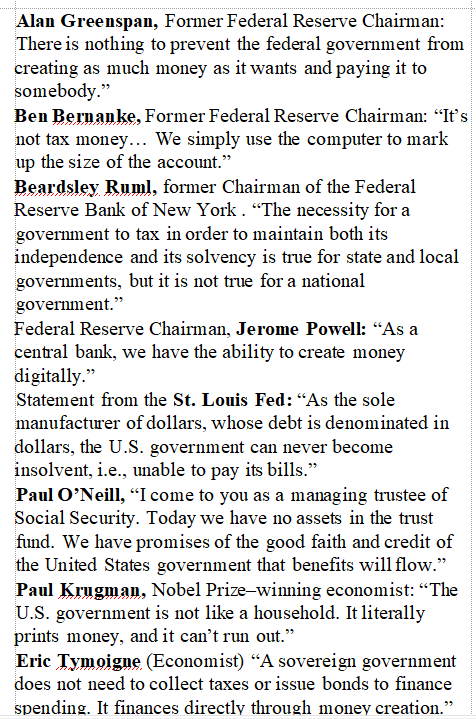
The Monetarily Sovereign federal government neither needs nor uses tax income for anything. It creates all the dollars it needs and uses. Who says so? These experts say so.
That doesn’t “raid” Social Security in a direct sense. But it does affect the broader fiscal environment the program depends on.
In plain English: If you reduce revenue elsewhere while Social Security already runs a structural gap, you make the fix slightly harder — not impossible, but tighter.
Of course, there is no need for a Monetarily Sovereign government to suffer from reduced revenue. It creates its own revenue.
Granted, supporters of the policy argue the offset comes from broader growth effects and targeted relief for retirees facing higher living costs. That said, the SSA’s own projections do not assume offsetting growth large enough to materially change the depletion timeline.
Again, this all relies on the false claim that FICA funds Social Security.
So the debate isn’t about intent. It’s about arithmetic.
The Real Market-Relevant Risk: Policy Compression Investors often miss this point because Social Security isn’t a traded asset — but it still affects macro conditions. Why? Because if lawmakers delay action too long, the eventual fix becomes more abrupt. That usually means:
Faster payroll tax increases; More sudden benefit formula changes; Or larger one-time fiscal adjustments And those ripple into consumer spending.
According to the Bureau of Economic Analysis, households 65+ account for roughly account for roughly 20% of total consumption, meaning any benefit reduction would hit demand directly.
But if the government funds increased benefits, demand would be increased, thereby increasing Gross Domestic Product. The entire economy would benefit.
That’s not theoretical — it feeds into retail, healthcare, and consumer staples earnings.
Key Takeaway When all is said and done, Social Security is not “collapsing” in six years. It is moving toward a point where lawmakers must choose between higher taxes, lower benefits, or both.
Or, they could choose federal funding, which would grow the economy at no cost to anyone.
Regardless of how headlines frame it, the math doesn’t negotiate.
As my old math instructor used to say, “Figures don’t lie, but liars figure. And there are 535 members of Congress, plus the President, who are lying to you about Social Security and Medicare finances.
The sole purpose of government is to improve and protect the lives of the people.
We give the government our money, our time, and some of our freedom, expecting in return safety, stability, opportunity, and a better life. But when a government focuses more on protecting itself than its people, it has failed.
Government is not an end. It is a tool. Tools must serve the maker. A tool that primarily serves itself is broken.
When I owned several businesses, I went to bed each night asking myself four questions:
What can go wrong?
How do we prevent it?
How do we fix it if it happens?
What can we do better?
That is exactly how our political leaders should run our nation. Unfortunately, the current leadership asks these questions:
What’s in it for me?
How can I stay in power?
How can I get away with it?
How can I do harm to my political enemies?
What Can Go Wrong? Every economic problem falls into one of three categories:
DemandFailure–People don’t have enough income, so spending collapses, and the economy falls into recession
Supply Failure–Not enough goods, i.e. shortages, which lead to inflation and recession
Structural Failure–The system itself breaks down, leading to inequality, stagnation, social instability
Monetary Sovereignty: There are two repeated, false objections to the federal spending that benefits the people.
I. The “who will pay?” objection. The federal government, uniquely being Monetarily Sovereign, has the unlimited ability to create U.S. dollars at the touch of a computer key. (See: Monetary Sovereignty: Who says so?)
Our Monetarily Sovereign federal government does not need or use taxes to pay its obligations. The government pays all its bills the same way:
Congress votes
The President approves
The Treasury creates the money at the touch of a computer key
Thus, with just those three steps, the federal government can fund any program of any size, without collecting a penny in taxes.
In fact, inflations are prevented and cured by government spending that addresses shortages. Reduced spending in the face of inflation does nothing to solve the primary problem — shortages — and can exacerbate the problem by causing more shortages.
That is why austerity, aka “belt tightening,” fails as a solution to any economic problem. It is popular among the elite, however, because it tends to widen the income/wealth gap between the rich and the rest.
State and local taxes pay for state and local government expenses, but federal taxes do not fund federal spending. That is the difference between monetary non-sovereignty and Monetary Sovereignty. The states (and business and individuals) primarily are money users, while the federal government primarily is a money creator.
So, why does the federal government collect taxes?Two reasons:
To control the economy by taxing what the government wishes to discourage and by giving tax breaks to what the government wishes to reward.
To assure demand for the U.S. dollar by requiring that taxes be paid in dollars
Federal spending is not funded by federal taxing.
Here are some steps to Prevent and Cure Common Economic Problems While Improving and Protecting the Lives of the People
I. Eliminate the FICA tax. FICA pays for nothing. Neither FICA nor trust funds (See: “The Phony Trust Fund Controversy“) support federal spending. Ending the FICA tax would:
Increase take-home pay for workers in the lower 95% income bracket
II. Fund Medicare for All. Provide free, comprehensive, no deductible health care insurance for every man, woman, and child in America. Employer-based healthcare traps workers, and creates job lock, fear-based employment inefficiency.
Universal healthcare would:
Improve health and health care in America
Allow for labor movement based on economic need rather than medical need
Increase American longevity
Increase productivity by reducing the number of sick workers and sick days off
Add growth dollars to the economy (Gross Domestic Product =Federal Spending + Non-federal Spending + Net Exports
Related programs would:
Pay schools to educate more medical professionals and workers — doctors, nurses, ancillary workers
Fund the construction and profitability of more hospitals and rehabilitation centers, especially in rural areas
Fund the research and development of pharmaceuticals and medical devices.
III. Fund Social Security for All, regardless of age or income. Income security is not charity. SS for all would:
Help prevent poverty and reduce the need for other welfare services
Narrow the gap between the rich and the rest
Benefit business by increasing the demand for products and services
Add growth dollars to the economy
IV Fund Grades K-16 + Advanced Education for All Who Want It. This would:
Help increase worker productivity
Increase scientific advances
Help make America more competitive vs. other nations
Some intelligent students can’t even afford free college because their families need them as workers, so we suggest:
Funding salaries for college students to assure America makes use of its best minds.
V Fund All Forms of Science Education, Research, & Development. R&D is future supply. Without it there would have been no innovation, no growth, no leadership, and America would have fallen behind, becoming more dependent on others.
VI Fund Infrastructure:Roads, bridges, rail, ports, airports, power grids, water systems, local mobility systems.
VII Fund Renewable Energy: This includes R&D and infrastructure for:
Electric vehicles and charging stations of all kinds — Trains, cars, trucks, boats, planes, people movers, busses,
Batteries
Solar panels
Nuclear
Geothermal
Wind
Hydro
Wave
VIII Fund Advanced Food Production
Farming Methods Education, R&D
Develop more productive, weather and insect resistant, nourishing crops that require less water and fertilizer
Advanced planting, harvesting, storage, shipping, and delivery methods
IX Fund Affordable Housing
R&D to reduce the costs of housing (building materials, methods, and locations)
Tax breaks for home ownership and renting
Fund trade schools for carpenters, electricians, roofers, etc.
Fund R&D for alternative building materials.
X Financially support State and Local Governments. Every state, county, city, and local government faces its own unique challenges they know best, along with issues similar to those of others. However, they all share the common struggle of having limited funds to tackle these problems.
Fund inter-government educational schools and meetings so government representatives can compare notes on problem solving
Fund the execution of solutions to those problems
Pay each state a per capita annual award to be used for any specified public purpose.
IN SUMMARY
The federal government, having unlimited access to funds., is best at paying for things, which it can do infinitely. The federal government also is good at addressing inter-state problems that might be intractable for individual states.
By contrast, state and local governments may understand local problems best, but often finds solutions unaffordable.
The recommendation is to combine the strengths of the federal government (paying, mediating interstate problems) with what state and local governments do best (understand local needs and solutions).
The proper combination of federal and state/local strengths and understanding will grow and enrich America while improving and protecting the lives of the people.