Examples of CNBC, Reuters, et al shoveling BS on your head. It’s Hollywood.

Searching for an honest man

.

It takes only two things to keep people in chains:
The ignorance of the oppressed and the
treachery of their leaders.


——————————————————————————————————————————————————————————————————————————————————————————–

Being Monetarily Sovereign, the U.S. government has the same money-creation powers as does the “Bank” in a game of Monopoly®. Neither can run short of their own sovereign currency.

Image result for Monopoly® money
If the Bank doesn’t have these . . .

If you open a Monopoly® box and discover there are no printed dollars inside, you still can play the game. The Bank simply could create an account ledger — on paper or electronic — and add new money to each player’s account whenever necessary.

Image result for four column chart
. . . it can create money from thin air with this.

The ledger could be something as simple as the piece of paper pictured at left, on which the Banker would tally a balance for each player.

Every time the Bank owed one of the players’ money  — for instance the $200 for passing “Go” — the Bank would add that amount to the player’s column.

In short, the Monopoly® Bank has the unlimited power to create new dollars from thin air — as does the U.S. government.

Both are Monetarily Sovereign.

The Bank never can be unable to pay its debts, unless the players wanted that to happen. To the Bank, no debt can be unsustainable.

You can play a full game of Monopoly® without having even one printed Monopoly® dollar in the box.

Similarly, the U.S. federal government never can run out of dollars. When it owes dollars to anyone, it simply marks up the creditor’s checking account. It has the same power to create dollars from thin air as does the Monopoly® Bank.

What then is the credit rating of the Monopoly® Bank and of the U.S. Treasury? Obviously, perfect — AAA+ or whatever the rating agency calls its highest level — a fact that makes the following CNBC/Reuters article so ridiculous.

YAHOO! Finance:
US to keep Aaa-rating after debt ceiling: Moody’s, Published 13 March 2017

Moody’s Investors Services said on Monday the United States will retain the rating agency’s top-notch debt rating as long as it meets its interest payments even if the government’s borrowing cap is reinstated on Thursday.

“While the periodic impasse over raising the debt ceiling is a credit negative feature of the country’s debt management, it has not affected the sovereign’s credit rating to date,” Moody’s analysts wrote in a research report published on Monday.

Like Moody’s, Fitch has kept its top AAA-rating on U.S. government debt.

However, Standard & Poor’s downgraded the U.S.’ rating by one notch to AA+ in August 2011.

It cited its high level of debt and uncertainty about the federal government’s ability to manage that debt load following a debt ceiling showdown.

S&P ranked the U.S. government lower than the highest rated corporation, conveniently neglecting the fact that if ever the U.S. government decided to default, the dollar would crash, and U.S. corporations would find themselves in serious financial difficulty.

The “borrowing cap” is a limit that Congress, in all its brilliance, has placed on the federal government’s ability to pay for what it already is obliged to pay.

The U.S. government does not borrow, in the usual sense. Like a bank, it accepts deposits. The so-called “debt” is the total of these deposits in T-security accounts.

The idea that the U.S. government arbitrarily, and for no reason, will decide not to pay its creditors is stupid or mendacious, even by normal Congressional standards of stupid mendacity.

If your Congressperson has voted for the “borrowing cap” (aka “debt ceiling”) you have ample proof that he or she either has a single digit IQ or is a liar. No other alternatives are possible.

As for S&P’s stated concern about “high level of debt” and “ability to manage that debt load,” one only can attribute this to duplicity approaching criminality.

While S&P may imagine a politically insane Congress spitefully refusing to pay its bills, a “high level of debt” is absolutely meaningless for an entity having the unlimited ability to add numbers to bank accounts.

The Treasury Department said last week it will embark “extraordinary measures” to meet its debt obligation if the debt ceiling goes into effect.

Year after year, the charade plays out like this:

  1. One party of Congress (Congress is a U.S. federal agency) pretends it is being frugal and prudent by enacting a debt limit, in a game of “chicken,” to prove the other party is composed of wastrels.
  2. The Treasury Department (another U.S. federal agency) goes along with the game by heroically embarking on “extraordinary measures” to keep America afloat. The “extraordinary measures” consist of rearranging payments and furloughing poor employees, while making sure that rich people and foreign nations are paid on time.
  3. The President (also a U.S. federal employee) will thunder outrage at those in the opposing party, for endangering America.
  4. Finally, when all other alternatives have been explored and rejected, the agencies of the U.S. federal government will halt the charade temporarily, by establishing a larger “debt limit,” as a prelude to a repeat of the charade the following year.

In short, the U.S. government agencies waste time and energy staging useless games among themselves. It’s all theater, to mystify an audience (you and me).

And that, folks, is why you pay Congress, the President, and the Secretary of the Treasury those high salaries and delicious perks — just like Hollywood actors.

U.S. Treasury Secretary Steven Mnuchin on Thursday called on Congress to raise the federal debt ceiling “at the first opportunity.” and announced the first of several likely cash management measures aimed at staving off a U.S. default.

Given his exalted position, Mnuchin should have said, “The ‘debt limit’ is a farce and should be ended forever.” He didn’t, nor did his predecessors. In politics, one keeps a job by going along with his bosses’ lies. Mnuchin is paid to read from the script.

Meanwhile, U.S. Senate majority leader Mitch McConnell told Politico on Thursday the United States will not default on its debt and will raise its debt limit in some fashion.

He too, should have admitted that the “debt limit,” which will require many hours of useless and senseless debate, must be eliminated. He didn’t, nor did his predecessors. He keeps his job by giving the electorate the lies they have been trained to demand.

The lies come at you from everywhere.  For instance, here is Mark Zandi, chief economist at Moody’s Analytics:

Moody’s Analytics chief economist: Why the Republican tax plan is set up to fail
Yahoo Finance, October 23, 2017
By: Mark Zandi

The Trump administration and Republican Congressional leadership want to go big on tax reform. They have proposed a broad set of changes to the corporate and personal income tax codes, including tax cuts and revenue raisers.

Remember, as you read the rest of these excerpts, that Zandi is the chief economist for Moody’s. (If he is the CHIEF ECONOMIST, one wonders what the subordinate economists are like.)

While the proposal is light on many important details, taken in total, it would not add significantly to economic growth, but it would add significantly to future budget deficits and the nation’s debt load.

The use of the words “debt load” tells you what Zandi wants you to believe: “Debt is bad.”

Never mind that the so-called “debt” merely is the total of deposits in T-security accounts, quite similar to bank savings accounts. 

Zandi wants you to believe these deposits are some sort of threat or burden. They are neither. They are deposits. Nothing more. You probably own some bank accounts. Banks love deposits. In days of yore, banks gave toasters to people who open accounts.

Businesses would be big beneficiaries of the Republican plan, enjoying an estimated net tax cut of $2.5 trillion over 10 years on a static basis—ignoring the impact of the tax cuts on the economy and thus tax revenues.

See that little phrase, “tax revenues.” Calling them “revenues” is part of the pretense that the federal government uses taxes to fund federal spending.

In business accounting, income is necessary to pay for outgo. In federal accounting, income pays for nothing. The federal government uniquely doesn’t use income.

Unlike state and local taxes, federal taxes cease to be part of any money supply measure. In short, federal tax dollars are destroyed upon receipt. The federal government creates brand new dollars, every time it pays a bill, just as the Monopoly® Bank can create brand new dollars to pay bills.

Neither the federal government nor the Monopoly® Bank needs tax dollars. Both can “play the game” with zero income.

The biggest corporate tax expense is the proposed reduction in the top marginal rate from 35% to 20% and repeal of the corporate alternative minimum tax.

Lowering the top tax rate on pass-through income and allowing businesses to reduce their tax bill by completely expensing their investment for at least five years are also costly.

To help pay for this largess, the plan eliminates business-related tax loopholes, although they are not spelled out, and even closing them all would not raise much revenue.

We’ve bolded the words “costly,” “pay for this largess,” “loopholes” and “revenue,” to demonstrate Zandi’s sly attempt to equate federal finances with state and local government, and personal, finances.

  1. Cutting federal taxes does not “cost” anyone anything — not you, not me, not the federal government. On the contrary, tax cuts put money into your pocket and mine. The federal government has no use of tax dollars. It destroys them.
  2. No one “pays for” tax cuts. Rather, we all “pay for” taxes. Reducing taxes reduces what taxpayers “pay for.”
  3. The word “largess” implies that you receive a generous gift from the government when they don’t pay taxes. The opposite is true. Tax dollars belong to you, the public, until they forcibly are taken by the federal government. If a thief fails to steal your money, you don’t consider that you have received “largess.”
  4. “Revenue” implies that the federal government has received something of value. But, in fact, while it is of value to you, it is of no value to the government. If you flush your dollars down the toilet, that is not considered “revenue” for your city sanitation department.

The big winners are the top 5% of taxpayers, with current incomes well over $300,000 per year. Taxpayers that make between $150,000 and $300,000 per year benefit the least, and would actually eventually pay more in taxes. Taxpayers making less than $150,000 will take home a modestly higher sum after-tax.

To help pay for these cuts, the plan eliminates personal exemptions except for mortgage interest and charitable giving along with most itemized deductions.

The big revenue raiser is the elimination of deductions for state and local income, sales tax and property taxes.

There are those misleading words, again: “Pay for” and “revenue.” Apparently, Zandi understands that repeating a lie makes it more believable.

Boosters of the Republican tax proposal argue that it will significantly increase economic growth,  this additional growth will generate roughly enough additional tax revenue for the plan to pay for itself.

That is, there would be large so-called supply-side effects from the tax cuts. So large that on a dynamic basis—after accounting for the bigger economy—the plan will not add to the nation’s deficits and debt.

The nation’s deficits are income for the nation’s people. Every dollar of deficit is a dollar that goes into the public’s pockets. Zandi, and others of his ilk, want you to believe that more dollars in your pocket is a bad thing.

They also want you to believe that your investments in your T-security account (aka “debt”), which the federal government easily could return to you today via money transfer,  (i.e. “pay off” the debt) are bad for you. Utter nonsense.

The plan will not meaningfully improve economic growth, at least not on a sustained basis.

Given that the economy is currently operating at full employment, however, stronger inflation and higher interest rates will result.

The higher rates wash out the economic benefit of the lower tax rates on investment, and the economy ends up no bigger than it would have been without the tax cuts.

These are widely promulgated misunderstandings.

  1. “Economic growth” most often is measured by Gross Domestic Product (GDP), the formula for which is: GDP=Federal Spending+Non-federal Spending+Net Exports. Tax cuts, which add to the gross money supply, increase GDP.  
  2. Inflation is not increased money supply. Inflation is the value of money (Money Demand/Supply) vs. the cost of goods and services (Goods & Services Demand/Supply). Many factors other than money supply and employment affect inflation, not the least of which are efficiency and productivity. With each passing day, labor has become a smaller inflationary factor. Thus, despite low unemployment and massive deficits, we currently have low inflation.  (See “Debt Henny Pennys.”)

We’ll conclude with a short article that appeared in The Week:

Trump rejects limiting before-tax 401(k) deductions to pay for tax cuts

President Trump on Monday rejected the possibility of raising money to pay for Republican tax cuts by reducing the pre-tax contributions Americans can make to their 401(k)s.

Trump’s position on the matter removes one option as Republicans rush to push through the legislation by the end of the year.

Republicans are looking for ways to help pay for more than $1 trillion in corporate and individual tax cuts, including eliminating the federal deduction for state and local taxes.

The notion that a federal tax increase can “pay for” a federal tax decrease is wrong, wrong, horribly wrong. While that can be true of state and local taxes, it simply is not true of our Monetarily Sovereign government’s federal taxes.

In the next few weeks, you will read and hear about Congress struggling mightily to cut taxes without increasing the debt or deficit.  It’s all performance art for your befuddlement — a comedy of errors that has run since at least 1940.

Deficits, i.e. cutting your taxes and giving you benefits, enrich you by putting dollars into your pocket. Federal deficits are the economy’s surpluses. Deficits grow the economy.

The so-called “debt” is just safe, interest-bearing deposits in T-securities accounts, similar to bank savings account deposits. The entire debt could be paid off tomorrow, without creating one new dollar, simply by transferring existing dollars from the T-security accounts back to the checking accounts of the T-security owners.Image result for ocsar

Neither federal deficit nor federal debt is a threat, or a burden, or anything to be minimized.

Your politicians lie at the behest of the rich because they are bribed by the rich. The rich want you to believe the federal government can’t afford to give you such benefits as Medicare for All, Education for All,  poverty aids, lower taxes, and other help that would narrow the Gap between you and the rich.

It is a gigantic, ongoing con job. It’s all Hollywood.

Tell your Congressperson you aren’t fooled or amused.

Rodger Malcolm Mitchell
Monetary Sovereignty
Twitter: @rodgermitchell; Search #monetarysovereignty
Facebook: Rodger Malcolm Mitchell

………………………………………………………………………………………………………………………………………………………………………………………………………………………………………………………………………………………………………………………………………..

The most important problems in economics involve the excessive income/wealth/power Gaps between the have-mores and the have-less.

Wide Gaps negatively affect poverty, health and longevity, education, housing, law and crime, war, leadership, ownership, bigotry, supply and demand, taxation, GDP, international relations, scientific advancement, the environment, human motivation and well-being, and virtually every other issue in economics.

Implementation of The Ten Steps To Prosperity can narrow the Gaps:

Ten Steps To Prosperity:
1. ELIMINATE FICA (Ten Reasons to Eliminate FICA )
Although the article lists 10 reasons to eliminate FICA, there are two fundamental reasons:
*FICA is the most regressive tax in American history, widening the Gap by punishing the low and middle-income groups, while leaving the rich untouched, and
*The federal government, being Monetarily Sovereign, neither needs nor uses FICA to support Social Security and Medicare.
2. FEDERALLY FUNDED MEDICARE — PARTS A, B & D, PLUS LONG TERM CARE — FOR EVERYONE (H.R. 676, Medicare for All )
This article addresses the questions:
*Does the economy benefit when the rich can afford better health care than can the rest of Americans?
*Aside from improved health care, what are the other economic effects of “Medicare for everyone?”
*How much would it cost taxpayers?
*Who opposes it?”
3. PROVIDE A MONTHLY ECONOMIC BONUS TO EVERY MAN, WOMAN AND CHILD IN AMERICA (similar to Social Security for All) (The JG (Jobs Guarantee) vs the GI (Guaranteed Income) vs the EB (Economic Bonus)) Or institute a reverse income tax.
This article is the fifth in a series about direct financial assistance to Americans:

Why Modern Monetary Theory’s Employer of Last Resort is a bad idea. Sunday, Jan 1 2012
MMT’s Job Guarantee (JG) — “Another crazy, rightwing, Austrian nutjob?” Thursday, Jan 12 2012
Why Modern Monetary Theory’s Jobs Guarantee is like the EU’s euro: A beloved solution to the wrong problem. Tuesday, May 29 2012
“You can’t fire me. I’m on JG” Saturday, Jun 2 2012

Economic growth should include the “bottom” 99.9%, not just the .1%, the only question being, how best to accomplish that. Modern Monetary Theory (MMT) favors giving everyone a job. Monetary Sovereignty (MS) favors giving everyone money. The five articles describe the pros and cons of each approach.
4. FREE EDUCATION (INCLUDING POST-GRAD) FOR EVERYONE Five reasons why we should eliminate school loans
Monetarily non-sovereign State and local governments, despite their limited finances, support grades K-12. That level of education may have been sufficient for a largely agrarian economy, but not for our currently more technical economy that demands greater numbers of highly educated workers.
Because state and local funding is so limited, grades K-12 receive short shrift, especially those schools whose populations come from the lowest economic groups. And college is too costly for most families.
An educated populace benefits a nation, and benefitting the nation is the purpose of the federal government, which has the unlimited ability to pay for K-16 and beyond.
5. SALARY FOR ATTENDING SCHOOL
Even were schooling to be completely free, many young people cannot attend, because they and their families cannot afford to support non-workers. In a foundering boat, everyone needs to bail, and no one can take time off for study.
If a young person’s “job” is to learn and be productive, he/she should be paid to do that job, especially since that job is one of America’s most important.
6. ELIMINATE FEDERAL TAXES ON BUSINESS
Businesses are dollar-transferring machines. They transfer dollars from customers to employees, suppliers, shareholders and the federal government (the later having no use for those dollars). Any tax on businesses reduces the amount going to employees, suppliers and shareholders, which diminishes the economy. Ultimately, all business taxes reduce your personal income.
7. INCREASE THE STANDARD INCOME TAX DEDUCTION, ANNUALLY. (Refer to this.) Federal taxes punish taxpayers and harm the economy. The federal government has no need for those punishing and harmful tax dollars. There are several ways to reduce taxes, and we should evaluate and choose the most progressive approaches.
Cutting FICA and business taxes would be a good early step, as both dramatically affect the 99%. Annual increases in the standard income tax deduction, and a reverse income tax also would provide benefits from the bottom up. Both would narrow the Gap.
8. TAX THE VERY RICH (THE “.1%) MORE, WITH HIGHER PROGRESSIVE TAX RATES ON ALL FORMS OF INCOME. (TROPHIC CASCADE)
There was a time when I argued against increasing anyone’s federal taxes. After all, the federal government has no need for tax dollars, and all taxes reduce Gross Domestic Product, thereby negatively affecting the entire economy, including the 99.9%.
But I have come to realize that narrowing the Gap requires trimming the top. It simply would not be possible to provide the 99.9% with enough benefits to narrow the Gap in any meaningful way. Bill Gates reportedly owns $70 billion. To get to that level, he must have been earning $10 billion a year. Pick any acceptable Gap (1000 to 1?), and the lowest paid American would have to receive $10 million a year. Unreasonable.
9. FEDERAL OWNERSHIP OF ALL BANKS (Click The end of private banking and How should America decide “who-gets-money”?)
Banks have created all the dollars that exist. Even dollars created at the direction of the federal government, actually come into being when banks increase the numbers in checking accounts. This gives the banks enormous financial power, and as we all know, power corrupts — especially when multiplied by a profit motive.
Although the federal government also is powerful and corrupted, it does not suffer from a profit motive, the world’s most corrupting influence.
10. INCREASE FEDERAL SPENDING ON THE MYRIAD INITIATIVES THAT BENEFIT AMERICA’S 99.9% (Federal agencies)Browse the agencies. See how many agencies benefit the lower- and middle-income/wealth/ power groups, by adding dollars to the economy and/or by actions more beneficial to the 99.9% than to the .1%.
Save this reference as your primer to current economics. Sadly, much of the material is not being taught in American schools, which is all the more reason for you to use it.

The Ten Steps will grow the economy, and narrow the income/wealth/power Gap between the rich and you.

MONETARY SOVEREIGNTY


O.K., debt Henny Pennys, where’s the inflation? An irony disclosed.


It takes only two things to keep people in chains:
The ignorance of the oppressed
and the treachery of their leaders.

——————————————————————————————————————————————————————————————————————————————————————————–

Henny Penny ran madly about screaming, “The sky is falling; the sky is falling.” For those of you whose early literacy was limited to “Goodnight Moon,” we provide this excerpt from Wikipedia:

Henny Penny is a folk tale about a chicken who, upon being hit on the head by an acorn, believes the world is coming to an end.

The phrase “The sky is falling!” features prominently in the story, and has passed into the English language as a common idiom indicating a hysterical or mistaken belief that disaster is imminent.

Today’s Henny Pennys are everywhere — in Congress, in the media, on blogs, among economists — most of whom have been bribed by our richest 1% (or even .1%) to tell you that the U.S. federal debt is “unsustainable,” and will cause a Weimar-style hyperinflation.

One Henny Penny is the Committee for a Responsible Federal Budget (CRFB),  whose leaders’ heads must have been hit by tons of acorns, because these esteemed dignitaries have preached the same “world-is-coming-to-an-end” garbage for more than 35 years.

But the CRFB is not the worst. We have documented Henny Pennys since 1940, all running in circles, screaming the same dire warning.

Yet, here we are.

The world has not ended. The debt has grown massively without hyperinflation. And the Henny Pennys seemingly have learned nothing.

Facts do not deter them, because they simply know, deep within their souls, that debt and deficit must be bad. After all, if you run a debt, that is a bad thing, so the same must be true for the U.S. government. Right?

Of course, wrong. The Federal government — unlike you, your state, your county, your city, and your business — is Monetarily Sovereign. It uniquely never can run short of its sovereign currency, the dollar.

The federal government can pay any bills of any size, without collecting even 1 cent in taxes, because it can create endless dollars. Send the government an invoice for $1 Million, or $1 Billion, or $1 Trillion, and the government could create the dollars to pay you tomorrow, with no difficulty and no tax collections.

Paying creditors is the federal government’s method for creating dollars.

“Aha,” scream the Henny Pennys, “but that will cause inflation, and not just inflation, but hyperinflation, like Weimar Germany and Zimbabwe, because as everyone knows, printing money causes inflation.”

That is the Henny Penny, “yes, but” end-of-world scenario (“Yes, the government can pay for anything — Medicare for All, Free Education for All, anti-poverty programs, etc., but that will cause hyperinflation.” )

Weimar Germany usually is given as the prime example of money “printing” causing hyperinflation. Except it is a false example.

Though money “printing” always is present during hyperinflations, the beginnings of a hyperinflation are some form of shortage.

Germany’s was a shortage of gold. Zimbabwe’s was a shortage of food. Shortages lead to higher prices, which governments are tempted to match with increased money supply.

The process is: Shortage of goods and services —> Inflation —> Government currency printing —> More Inflation —> More shortages —> More currency printing . . . and on and on to hyperinflation.

In summary, hyperinflations cause money “printing” rather than the other way around.

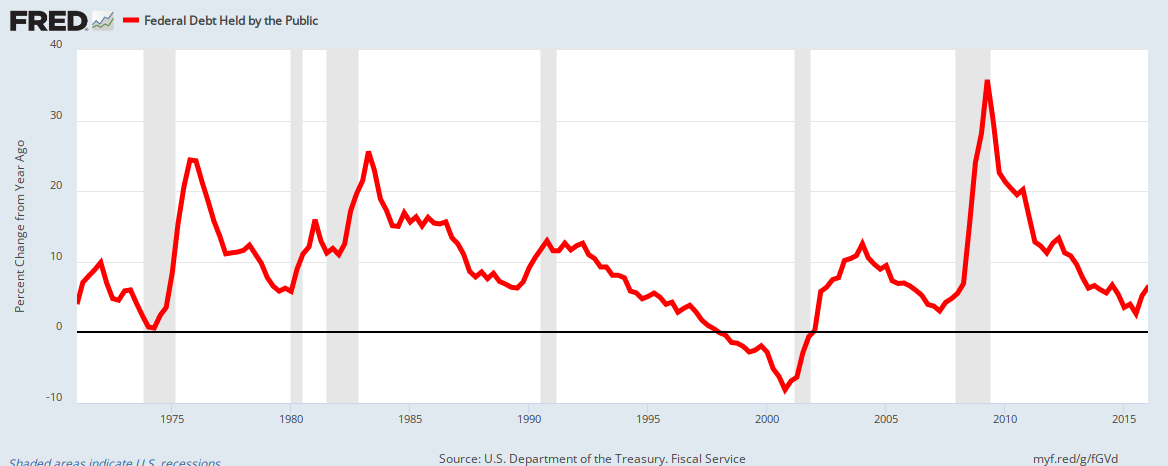
Here is a graph showing Debt growth (red line) and inflation growth. Despite the massive increase in Debt, average inflation has been modest because the U.S. did not experience serious shortages of goods and services.

Wired Magazine, 09.30.17
NO INFLATION? TECHNOLOGY MAY HAVE LEFT IT BACK IN THE 20TH CENTURY
By Zachary Karabell

During her speech to the National Association of Business Economics on Tuesday, Federal Reserve Chair Janet Yellen said inflation and wages are not rising as expected.

Nonetheless, she believes the Fed should continue on its path of raising interest rates, because diverging would risk inflation getting out of control once it starts to rise, as she believes it inevitably must.

To which the question should be: Really, must it?

What if the combined and continuing effects of technology and a globalized market of goods and labor are so altering commerce and prices that the 20th century script is as outmoded as an IBM Selectric typewriter?

Here, Mr. Karabell clarifies what should be basic and obvious, but amazingly seems to be opaque to mainstream economists: Excessive inflation begins with shortages.  PRICE = DEMAND/SUPPLY

Yellen is speaking to the fact that over the past eight years, economic output has picked up and employment has grown, but neither wages nor prices have risen much. Inflation has barely nudged 2% in the past decade.

The question is why. Yellen admirably admits that structural changes are invalidating past assumptions and patterns.

How long before we consider the possibility that (we’re in) a new normal? Unemployment has plunged from a high of 10% to the mid-4% range that is about as low as ever. But many of the newly created jobs pay less than their pre-2008 predecessors. Crucially, there’s still little growth in wages.

The absence of inflation doesn’t mean that everyone can afford basic necessities such as health care. But that reflects massive inefficiencies in how we deliver care as much as underlying cost trends.

Instead, the cost of most of life’s necessities, from food to clothing to shelter, has stabilized or dropped over the past two decades due to the deflationary effects of technology.

It isn’t just that you can get a large flat-screen TV for next to nada. You can get a car that uses less fuel and is far safer for less money (inflation adjusted) than a gas guzzler of yesteryear.

Thank, in part, composite materials, which also require less energy to produce than 20th century steel. You can get a smorgasbord of caloric abundance for a fraction of the cost of a much less varied diet in 1950; you can access new medicines to extend lives by years; and you can access for free on the Internet incalculable reams of data, costing you nothing but your time.

For some aspects of our lives, there is no apples-to-apples comparison with the past.

With Moore’s Law and the compression of data and power, today’s smartphones are the equivalent of yesterday’s supercomputer that cost 1,000 times as much, guzzled electricity and demanded expensive cooling systems.

Electrifying a grid that needed to fuel that and billions of incandescent bulbs was costly compared with the dollop of energy needed to power LEDs. That washing machine, with its smart chips monitoring the size of your load? That smart thermostat in your home dynamically adjusting heat and air-conditioning? They also reduce costs, and overall electric demand, even in their limited numbers so far.

And this doesn’t even begin to adjust for the possible efficiencies and benefits of the app economy that can connect buyers of goods and services with sellers with fewer frictional costs of middlemen scheduling and booking and coordinating.

Karabell continues with his examples, all of which demonstrate one basic truth: If the supply of goods and services grows as fast or faster than the supply of money (i.e Supply grows faster than Demand) prices will not rise.

Given that our computerized economy continues to produce more/better goods and services, and further reduces the need for labor, there is no scarcity factor to raise prices (or wages).

Similar changes are under way in the developing world, as labor gives way to robotics and basic goods become affordable and accessible to the planet’s billions.

Given those changes, why would 20th century models of prices and rates and money supply work as they used to work?

Kudos to Yellen and the Fed for at least having the humility to consider that the economic truths of the past may not be so true anymore.

They now need to make the next step, and consider what policy might look like if past patterns are indeed of the past. Otherwise we risk making policy geared toward a world that no longer exists, and it is hard to see that ending well.

Science has changed the world. We can grow more, create more, and ship more, all at less cost than ever. In our global economy, a shortage in country “A” quickly and cheaply can be filled by producers in country “B.”

In the past, businesses paid people, who labored for money to buy goods and services.  Today, businesses pay fewer people less, and these people can acquire better goods and services for less money.

Contrary to the belief of Modern Monetary Theory (MMT), that full employment is a prime goal, we are headed toward a world where full employment is an abomination — a world in which humans labor less and enjoy life more.

There is no magic to the 40-hour week. Why not a 20-hour week? Or less? Federal deficit spending can accomplish this.

And that is the irony promised to you in the title:

Federal deficit spending actually may help prevent excessive inflations, particularly if the deficit spending supports efficiency and productivity.

Consider the efficiency and productivity effect of federal deficit spending to fund scientific advances in cheaper, renewable energy — solar, wind, geothermal and others we’ve not yet thought of.

Consider the efficiency and productivity of federal deficit spending to support education, particularly STEM (Science, Technology, Engineering, Mathematics).

Consider the deficit spending that would result from reduced business taxes, thereby cutting the cost of producing virtually everything.

Federal support for the development of better seeds and better farming methods could eliminate food shortages, a key cause of inflation.

Sickness is inefficient; health is efficient. Deficit spending that supports health care would increase efficiency and productivity.

A wide Gap between the rich and the rest encourages poverty and discourages productivity. Deficit spending to reduce poverty and increase productivity would help reduce shortages.

Implementation of deficit spending for the Ten Steps to Prosperity (below) would help prevent excessive inflation.

That is something the debt Henny Pennys don’t want you to know.

Rodger Malcolm Mitchell
Monetary Sovereignty
Twitter: @rodgermitchell; Search #monetarysovereignty
Facebook: Rodger Malcolm Mitchell

………………………………………………………………………………………………………………………………………………………………………………………………………………………………………………………………………………………………………………………………………..

The most important problems in economics involve the excessive income/wealth/power Gaps between the have-mores and the have-less.

Wide Gaps negatively affect poverty, health and longevity, education, housing, law and crime, war, leadership, ownership, bigotry, supply and demand, taxation, GDP, international relations, scientific advancement, the environment, human motivation and well-being, and virtually every other issue in economics.

Implementation of The Ten Steps To Prosperity can narrow the Gaps:

Ten Steps To Prosperity:
1. ELIMINATE FICA (Ten Reasons to Eliminate FICA )
Although the article lists 10 reasons to eliminate FICA, there are two fundamental reasons:
*FICA is the most regressive tax in American history, widening the Gap by punishing the low and middle-income groups, while leaving the rich untouched, and
*The federal government, being Monetarily Sovereign, neither needs nor uses FICA to support Social Security and Medicare.
2. FEDERALLY FUNDED MEDICARE — PARTS A, B & D, PLUS LONG TERM CARE — FOR EVERYONE (H.R. 676, Medicare for All )
This article addresses the questions:
*Does the economy benefit when the rich can afford better health care than can the rest of Americans?
*Aside from improved health care, what are the other economic effects of “Medicare for everyone?”
*How much would it cost taxpayers?
*Who opposes it?”
3. PROVIDE A MONTHLY ECONOMIC BONUS TO EVERY MAN, WOMAN AND CHILD IN AMERICA (similar to Social Security for All) (The JG (Jobs Guarantee) vs the GI (Guaranteed Income) vs the EB (Economic Bonus)) Or institute a reverse income tax.
This article is the fifth in a series about direct financial assistance to Americans:

Why Modern Monetary Theory’s Employer of Last Resort is a bad idea. Sunday, Jan 1 2012
MMT’s Job Guarantee (JG) — “Another crazy, rightwing, Austrian nutjob?” Thursday, Jan 12 2012
Why Modern Monetary Theory’s Jobs Guarantee is like the EU’s euro: A beloved solution to the wrong problem. Tuesday, May 29 2012
“You can’t fire me. I’m on JG” Saturday, Jun 2 2012

Economic growth should include the “bottom” 99.9%, not just the .1%, the only question being, how best to accomplish that. Modern Monetary Theory (MMT) favors giving everyone a job. Monetary Sovereignty (MS) favors giving everyone money. The five articles describe the pros and cons of each approach.
4. FREE EDUCATION (INCLUDING POST-GRAD) FOR EVERYONE Five reasons why we should eliminate school loans
Monetarily non-sovereign State and local governments, despite their limited finances, support grades K-12. That level of education may have been sufficient for a largely agrarian economy, but not for our currently more technical economy that demands greater numbers of highly educated workers.
Because state and local funding is so limited, grades K-12 receive short shrift, especially those schools whose populations come from the lowest economic groups. And college is too costly for most families.
An educated populace benefits a nation, and benefitting the nation is the purpose of the federal government, which has the unlimited ability to pay for K-16 and beyond.
5. SALARY FOR ATTENDING SCHOOL
Even were schooling to be completely free, many young people cannot attend, because they and their families cannot afford to support non-workers. In a foundering boat, everyone needs to bail, and no one can take time off for study.
If a young person’s “job” is to learn and be productive, he/she should be paid to do that job, especially since that job is one of America’s most important.
6. ELIMINATE FEDERAL TAXES ON BUSINESS
Businesses are dollar-transferring machines. They transfer dollars from customers to employees, suppliers, shareholders and the federal government (the later having no use for those dollars). Any tax on businesses reduces the amount going to employees, suppliers and shareholders, which diminishes the economy. Ultimately, all business taxes reduce your personal income.
7. INCREASE THE STANDARD INCOME TAX DEDUCTION, ANNUALLY. (Refer to this.) Federal taxes punish taxpayers and harm the economy. The federal government has no need for those punishing and harmful tax dollars. There are several ways to reduce taxes, and we should evaluate and choose the most progressive approaches.
Cutting FICA and business taxes would be a good early step, as both dramatically affect the 99%. Annual increases in the standard income tax deduction, and a reverse income tax also would provide benefits from the bottom up. Both would narrow the Gap.
8. TAX THE VERY RICH (THE “.1%) MORE, WITH HIGHER PROGRESSIVE TAX RATES ON ALL FORMS OF INCOME. (TROPHIC CASCADE)
There was a time when I argued against increasing anyone’s federal taxes. After all, the federal government has no need for tax dollars, and all taxes reduce Gross Domestic Product, thereby negatively affecting the entire economy, including the 99.9%.
But I have come to realize that narrowing the Gap requires trimming the top. It simply would not be possible to provide the 99.9% with enough benefits to narrow the Gap in any meaningful way. Bill Gates reportedly owns $70 billion. To get to that level, he must have been earning $10 billion a year. Pick any acceptable Gap (1000 to 1?), and the lowest paid American would have to receive $10 million a year. Unreasonable.
9. FEDERAL OWNERSHIP OF ALL BANKS (Click The end of private banking and How should America decide “who-gets-money”?)
Banks have created all the dollars that exist. Even dollars created at the direction of the federal government, actually come into being when banks increase the numbers in checking accounts. This gives the banks enormous financial power, and as we all know, power corrupts — especially when multiplied by a profit motive.
Although the federal government also is powerful and corrupted, it does not suffer from a profit motive, the world’s most corrupting influence.
10. INCREASE FEDERAL SPENDING ON THE MYRIAD INITIATIVES THAT BENEFIT AMERICA’S 99.9% (Federal agencies)Browse the agencies. See how many agencies benefit the lower- and middle-income/wealth/ power groups, by adding dollars to the economy and/or by actions more beneficial to the 99.9% than to the .1%.
Save this reference as your primer to current economics. Sadly, much of the material is not being taught in American schools, which is all the more reason for you to use it.

The Ten Steps will grow the economy, and narrow the income/wealth/power Gap between the rich and you.

MONETARY SOVEREIGNTY

 

Tax & healthcare plans designed to bilk you. (Thank you suckers, for your generosity)


It takes only two things to keep people in chains:
The ignorance of the oppressed
and the treachery of their leaders.

——————————————————————————————————————————————————————————————————————————————————————————–

Let us introduce this diatribe with a statement from Maya MacGuineas, president of the Committee for a Responsible Federal Budget (CRFB):

Image result for oz man behind the curtain
Pay no attention to that man behind the curtain


“Tax cuts do not pay for themselves.

They do grow the economy, but that will only cover a portion of the costs, and we should be focusing on how to broaden the tax base to make up the difference.

Think about what she really is telling you:

  1. Tax cuts are good, because they grow the economy (by adding dollars to the economy).
  2. So we must offset those economy-growing tax cuts (for the rich 1%), by broadening the tax base (taxing the 99% more).

(In short, adding dollars to the economy is good, so subtract dollars from the economy by taxing the poor more.)

It’s all flimflam, mumbo jumbo, BS, designed for solely one purpose: To transfer money from you to the very rich.

And now, while your brain has been thoroughly washed with flimflam, mumbo jumbo, and BS, here comes Congress’s next health care plan, as excerpted from an article in the Washington Post:

Senators push ahead with ACA fix
Bipartisan group of 24 signs on, but Trump noncommittal
By Juliet Eilperin and Sean Sullivan The Washington Post

WASHINGTON — Democrats pressed Thursday to advance a bipartisan bill that would preserve subsidies for low-income Americans under the Affordable Care Act amid a new show of cooperation, even as GOP leaders suggested that they would need greater concessions before bringing it up for a vote.

Translation: “Bipartisan” is a word that is meant to lull you into believing all is well, and the Senators have formed a circle, are holding hands, and singing Kumbaya.

So don’t worry. In fact, don’t even think about it, because your reasoning has been numbed.

President Donald Trump, meanwhile, suggested that he was “open” to authorizing payments to insurers that help offset out-of-pocket health costs in the short term — but had not given up his goal of repealing the ACA.

Translation: When Trump says he is “open,” that means he has not thought about it, doesn’t intend to think about it, but somehow has formed a strong opinion about it — a strong opinion that will change five times, depending on what he has for lunch, today.

Whatever plan he eventually signs, will be the greatest plan in all of human history, for which he gives himself a “10,” though he doesn’t know what’s in it.

Health, Education, Labor and Pensions Committee Chairman Lamar Alexander, R-Tenn., and the ranking Democratic member, Sen. Patty Murray of Washington, who authored the new health care package, said it would continue the cost-sharing reduction payments, known as CSRs, in exchange for giving states greater latitude to regulate health coverage.

Translation: “Greater latitude” means the federal government won’t pay enough, so the Republican states immediately will cut benefits, and the Democratic states will try to continue the benefits, but will run out of money.

Either way, the poor and middle classes will be screwed, but that’s O.K., because it will be a bipartisan screwing.

Many conservative Republicans have expressed skepticism about legislation that would not roll back the ACA in a meaningful way.

While the bill does make it easier for states to obtain federal waivers to change the way their markets operate and allows ACA consumers age 30 and older to buy catastrophic health plans, it preserves the law’s core mandates.

Translation: Many “conservative” Republicans don’t care what is in the plan, so long as it repeals Obamacare. In GOP circles, that’s known as “protecting the people.”

And if you buy and of those so-called “catastrophic health plans,” you will find they surely are catastrophic.  They offer minimal coverage and ultra-high deductibles, in exchange for lower premiums. Crap plans for crap dollars.

If you’re too poor to pay for a real health care plan, you surely will be too poor to afford those massive deductibles.

The GOP wants you to have a “choice” of plans, because you surely must know what accidents and sicknesses you will have next month or next year. After all, anyone can predict when they will be hit by a car, break a leg, or develop cancer. Right?

The president told reporters Thursday that while he prefers providing federal health funding in a block grant to states, he is open to a different approach for a finite period.

“We will probably like a very short-term solution until we hit the block grants, until that all kicks in,” he said. “And if they can do something like that, I’m open to it, but I don’t want it to be at the expense of the people. I want to take care of our people; I don’t want to take care of our insurance companies.”

Translation: Yes, the federal government never can run short of dollars; the states can and do run short of dollars. So it’s smart to save the federal government money by giving the states small block grants, which will be insufficient.

Then, as costs increase, eliminate the block grants, so the states either are driven into insolvency or are forced to eliminate health care benefits.

The richest 1% of the public will do just fine, however, because they simply will buy the best insurance or pay out-of-pocket. You are screwed, but you seem to like it.

The president has repeatedly decried the idea of paying money to insurers, which is the way cost-sharing payments are distributed.

Translation: We know the real alternative is not to pay insurance companies, but rather to pay doctors, hospitals and other health-care providers directly (“single payer”), but that would be good for the 99%. So it is unthinkable.

Sen. Patty Murray, D-Wash.Murray said she was confident that Congress would ultimately pass the measure because Americans are beginning to grasp that the impasse in Washington has translated into higher insurance rates for 2018.

Unfortunately, Americans do not know that the federal government, being Monetarily Sovereign, can and should pay for a Medicare plan that covers every man, woman, and child in America.

Americans have been conned into a phony “Deficit spending is unsustainable and causes inflation” belief. They have been told federal taxes must be increased and the federal government is broke.

It’s all a damnable lie, but when a lie is told repeatedly over many, many years, few people have the mental acuity to see through it.

Sen. Lamar Alexander, R-Tenn, took Trump to task on Thursday, saying: “It’s always best for the president to be completely consistent in terms of what he’s supporting or not supporting. And let’s face it, he’s not been particularly consistent here.”

Trump consistent? Is that a joke? The only thing he is consistent about is self-congratulations.

“Since every Democrat, I believe, will support it, it has 60 votes,” Schumer told reporters.

A broad coalition of health groups have endorsed the bill, along with a bipartisan coalition of 10 governors.
Associated Press contributed.

Translation: It’s BIPARTISAN, so it must be good. Pay no attention to that man behind the curtain.

And now that your brain has been scrubbed clean of all logic, facts, and any ability to discern gibberish, let us move from health care to tax “reform.” Here are a few excerpts from an article in today’s Chicago Tribune:

Republicans push $4 trillion budget plan through Senate
By Andrew Taylor Associated Press

WASHINGTON — Republicans on Thursday night muscled a $4 trillion budget through the Senate in a major step forward for President Donald Trump’s promise of “massive tax cuts and reform.”

As always, the President has no idea what is in the bill — there is no bill, yet — but he is all for it, and you can be sure it will be the greatest tax bill ever to be created by human hand.

The 51-49 vote sets the stage for debate later this year to overhaul the U.S. tax code for the first time in three decades, cutting rates for individuals and corporations while eliminating trillions of dollars of deductions and special interest tax breaks.

The tax cuts would add up to $1.5 trillion to the deficit over the coming decade, however, as Republicans have shelved fears about the growing budget deficit in favor of a once-in-a-generation opportunity to rewrite tax laws.

Translation: The sole purpose of the vote was to prevent a Democratic filibuster that might prevent a GOP giveaway to the rich.

The Republican bill, when it is written, absolutely, positively will transfer dollars from you to the richest 1%. This is my guarantee to you.

(And I, being in the favored 1% group, wish to thank you suckers for your generosity.)

The upcoming tax measure has taken on even greater urgency with the failure of the party to carry out its long-standing promise to dismantle former President Barack Obama’s signature health care law.

Republicans have said failure on taxes would be politically devastating in next year’s midterm elections, when control of the House and Senate are at stake.

Translation: “We don’t care what is in the bill, so long as we can pass something, anything, that we can sell to the gullible American public. Elections are far more important than actually doing something worthwhile.”

The House measure calls for a tax plan that wouldn’t add to the deficit, as well as $200 billion worth of cuts to benefit programs that the Senate has rejected.

Translation: As Maya MacGuineas said, tax cuts grow the economy. She is right. Tax cuts do grow the economy by leaving more dollars in the economy.

So why would any “honest politician” (O.K., laugh now) propose a tax program that doesn’t add to the deficit, when it is the deficit that adds dollars to the economy?

In reality, it’s not the tax cuts that grow the economy; it’s the deficit spending that grows the economy.

“. . . it’s a right-wing fantasy document that paves the way for trillions of dollars in handouts to big corporations and the wealthy,” said Oregon Sen. Ron Wyden, the top Democrat on the tax-writing Finance Committee.

Translation: The GOP gives to the rich; the rich give to the GOP. Too bad you’re not rich, sucker.

Only one Republican, Rand Paul of Kentucky, voted against the budget. He said the measure permits too much spending and abandons the GOP drive to repeal the Obama health law.

Translation: Rand Paul says the budget doesn’t cut Medicare, Social Security, Medicaid and other poverty aids enough.  You suckers get too much from the government. A little starvation will cleanse your soul.

“The American people are sick and tired of Congress spending recklessly with no end in sight,” Paul said.

This year’s measure calls for $473 billion in cuts from Medicare over 10 years and more than $1 trillion from Medicaid.

All told, Senate Republicans would cut spending by more than $5 trillion over a decade, though they don’t attempt to spell out where the cuts would come from.

Translation: The government says you suckers are sick and tired of receiving so much from Social Security, Medicare et al. You want to receive fewer benefits, and you want the rich to receive more. It’s only fair, isn’t it?

Republicans vow that the tax plan would result in a burst of economic growth that will add enough tax revenue to make up for the ambitious rate cuts.

Most experts dismiss such promises, however, and Congress’ official scorekeepers agree with them.

The Republicans never change.  Remember “Reaganomics” and the “Laffer curve.” Like zombies, they have risen from the dead.

They too, promised that tax cuts would cause enough economic growth to increase tax collections and to balance the budget. Thankfully, that never happened, for if it did, the increased taxes would have tanked the economy.

The Bottom Line
The pols believe you are a sucker, but because suckers never realize they are suckers, the pols rely on you denying it.

Further, the pols believe you are so stupid, that if someone tells you the truth, you will angrily and sarcastically fight to retain your ignorance. By repeating lies, again and again, the pols think they have sold you on at least 41 myths about our economy, probably more.

So to any of you who are suckers, don’t know you’re suckers, deny you’re suckers, and who angrily defend your “suckerness,” I only can say, “Thank you.”

Sometime in the next few months, Congress will pass, and the President will sign, laws that screw you and benefit me. And while I am raking in the benefits that really belong to you, some of you suckers will tell me I’m wrong.

Hey, I can take it. Thanks to Congress, Trump and I will take it “bigly.”

Rodger Malcolm Mitchell
Monetary Sovereignty
Twitter: @rodgermitchell; Search #monetarysovereignty
Facebook: Rodger Malcolm Mitchell

………………………………………………………………………………………………………………………………………………………………………………………………………………………………………………………………………………………………………………………………………..

The most important problems in economics involve the excessive income/wealth/power Gaps between the have-mores and the have-less.

Wide Gaps negatively affect poverty, health and longevity, education, housing, law and crime, war, leadership, ownership, bigotry, supply and demand, taxation, GDP, international relations, scientific advancement, the environment, human motivation and well-being, and virtually every other issue in economics.

Implementation of The Ten Steps To Prosperity can narrow the Gaps:

Ten Steps To Prosperity:
1. ELIMINATE FICA (Ten Reasons to Eliminate FICA )
Although the article lists 10 reasons to eliminate FICA, there are two fundamental reasons:
*FICA is the most regressive tax in American history, widening the Gap by punishing the low and middle-income groups, while leaving the rich untouched, and
*The federal government, being Monetarily Sovereign, neither needs nor uses FICA to support Social Security and Medicare.
2. FEDERALLY FUNDED MEDICARE — PARTS A, B & D, PLUS LONG TERM CARE — FOR EVERYONE (H.R. 676, Medicare for All )
This article addresses the questions:
*Does the economy benefit when the rich can afford better health care than can the rest of Americans?
*Aside from improved health care, what are the other economic effects of “Medicare for everyone?”
*How much would it cost taxpayers?
*Who opposes it?”
3. PROVIDE A MONTHLY ECONOMIC BONUS TO EVERY MAN, WOMAN AND CHILD IN AMERICA (similar to Social Security for All) (The JG (Jobs Guarantee) vs the GI (Guaranteed Income) vs the EB (Economic Bonus)) Or institute a reverse income tax.
This article is the fifth in a series about direct financial assistance to Americans:

Why Modern Monetary Theory’s Employer of Last Resort is a bad idea. Sunday, Jan 1 2012
MMT’s Job Guarantee (JG) — “Another crazy, rightwing, Austrian nutjob?” Thursday, Jan 12 2012
Why Modern Monetary Theory’s Jobs Guarantee is like the EU’s euro: A beloved solution to the wrong problem. Tuesday, May 29 2012
“You can’t fire me. I’m on JG” Saturday, Jun 2 2012

Economic growth should include the “bottom” 99.9%, not just the .1%, the only question being, how best to accomplish that. Modern Monetary Theory (MMT) favors giving everyone a job. Monetary Sovereignty (MS) favors giving everyone money. The five articles describe the pros and cons of each approach.
4. FREE EDUCATION (INCLUDING POST-GRAD) FOR EVERYONE Five reasons why we should eliminate school loans
Monetarily non-sovereign State and local governments, despite their limited finances, support grades K-12. That level of education may have been sufficient for a largely agrarian economy, but not for our currently more technical economy that demands greater numbers of highly educated workers.
Because state and local funding is so limited, grades K-12 receive short shrift, especially those schools whose populations come from the lowest economic groups. And college is too costly for most families.
An educated populace benefits a nation, and benefitting the nation is the purpose of the federal government, which has the unlimited ability to pay for K-16 and beyond.
5. SALARY FOR ATTENDING SCHOOL
Even were schooling to be completely free, many young people cannot attend, because they and their families cannot afford to support non-workers. In a foundering boat, everyone needs to bail, and no one can take time off for study.
If a young person’s “job” is to learn and be productive, he/she should be paid to do that job, especially since that job is one of America’s most important.
6. ELIMINATE FEDERAL TAXES ON BUSINESS
Businesses are dollar-transferring machines. They transfer dollars from customers to employees, suppliers, shareholders and the federal government (the later having no use for those dollars). Any tax on businesses reduces the amount going to employees, suppliers and shareholders, which diminishes the economy. Ultimately, all business taxes reduce your personal income.
7. INCREASE THE STANDARD INCOME TAX DEDUCTION, ANNUALLY. (Refer to this.) Federal taxes punish taxpayers and harm the economy. The federal government has no need for those punishing and harmful tax dollars. There are several ways to reduce taxes, and we should evaluate and choose the most progressive approaches.
Cutting FICA and business taxes would be a good early step, as both dramatically affect the 99%. Annual increases in the standard income tax deduction, and a reverse income tax also would provide benefits from the bottom up. Both would narrow the Gap.
8. TAX THE VERY RICH (THE “.1%) MORE, WITH HIGHER PROGRESSIVE TAX RATES ON ALL FORMS OF INCOME. (TROPHIC CASCADE)
There was a time when I argued against increasing anyone’s federal taxes. After all, the federal government has no need for tax dollars, and all taxes reduce Gross Domestic Product, thereby negatively affecting the entire economy, including the 99.9%.
But I have come to realize that narrowing the Gap requires trimming the top. It simply would not be possible to provide the 99.9% with enough benefits to narrow the Gap in any meaningful way. Bill Gates reportedly owns $70 billion. To get to that level, he must have been earning $10 billion a year. Pick any acceptable Gap (1000 to 1?), and the lowest paid American would have to receive $10 million a year. Unreasonable.
9. FEDERAL OWNERSHIP OF ALL BANKS (Click The end of private banking and How should America decide “who-gets-money”?)
Banks have created all the dollars that exist. Even dollars created at the direction of the federal government, actually come into being when banks increase the numbers in checking accounts. This gives the banks enormous financial power, and as we all know, power corrupts — especially when multiplied by a profit motive.
Although the federal government also is powerful and corrupted, it does not suffer from a profit motive, the world’s most corrupting influence.
10. INCREASE FEDERAL SPENDING ON THE MYRIAD INITIATIVES THAT BENEFIT AMERICA’S 99.9% (Federal agencies)Browse the agencies. See how many agencies benefit the lower- and middle-income/wealth/ power groups, by adding dollars to the economy and/or by actions more beneficial to the 99.9% than to the .1%.
Save this reference as your primer to current economics. Sadly, much of the material is not being taught in American schools, which is all the more reason for you to use it.

The Ten Steps will grow the economy, and narrow the income/wealth/power Gap between the rich and you.

MONETARY SOVEREIGNTY


The exact date the world will end


It takes only two things to keep people in chains:
The ignorance of the oppressed
and the treachery of their leaders.

——————————————————————————————————————————————————————————————————————————————————————————–

Here is when the world will end. I read it in the October 4th, 2017 issue of NewScientist Magazine, and if it’s printed, you know it’s right.

The end is nigh.

What a surprise – the end of the world has been delayed, again
The planet Nibiru was meant to wipe us out on Saturday. Undeterred by a no-show, doomsday theorists are already peddling more nonsense
By Geraint Lewis

CONGRATULATIONS, you have survived the latest prophesied doomsday. For weeks, the darker corners of the media have been abuzz with predictions that the end of the world was coming.

Some suggested it would coincide with the 21 August US total solar eclipse. Others plumped for 23 September, for no other reason than 33 days would have passed since the eclipse.

Always keen to move on from a no-show, conspiracy theorists have revised the big day to 21 October.

Prophecies of doom aren’t new. At the turning points of centuries or millennia, someone always comes out of the woodwork to claim that the end is nigh.

Others predict the end of days based on how immoral and violent society has become, although recent decades have been relatively peaceful compared with most other historical periods.

In 2012, we were told that the ancient Mayans had predicted the demise of the world on 21 December, 2012, when some cosmic event, such as a rogue planet called Nibiru.

But in 2017, the doomsayers said Nibiru was back and headed our way again. Predictably, some corners of the media lapped it up.

With a heavy sigh, science brushed off and recycled the same messages as in 2012, pointing out that if Nibiru was wandering the solar system, we would know.

Prophesies of doom do frighten people, so we must continue to call out nonsense and pseudoscience when we see it.

The media also has a part to play inaccurate and balanced portrayal of science. There is enough scary stuff without imagined threats.

O.K., so there have been a few world ending “no-shows” –a actually quite a lot of “no-shows — but that won’t stop the claims.

Image result for end of the world prophet
The end is till nigh.

Fortunately, you are too smart to fall for that “nonsense, pseudoscience, and imagined threats.” You have seen the multitude of “Henny, Penny, the sky is falling” predictions, and none of them have come true.

Repeated no-shows are a pretty good indication of no-sense. So, you’re not going to be taken in again.   You know, “Fool me once; shame on you. Fool me twice; shame on me.”

Ah, but would you like to know when the world really will end? I’ll give you a hint. It will be shortly after September 26th, 1940.

You read right: 1940. How do I know? Click the link to see the first of my sources:

Federal Debt, A “Ticking Time Bomb”.

Sept 26, 1940, New York Times: “Deficit Financing is Hit by Hanes: ” . . . unless an end is put to deficit financing, to profligate spending and to indifference as to the nature and extent of governmental borrowing, the nation will surely take the road to dictatorship, Robert M. Hanes, president of the American Bankers Association asserted today.

He said, “insolvency is the time-bomb which can eventually destroy the American system . . . the Federal debt . . . threatens the solvency of the entire economy.”

Oops. Apparently, “the insolvency of the entire economy” wasn’t a “time bomb,” and it didn’t destroy the American system.  We still are here.

The same claim has been made repeatedly — almost daily — since 1940, and it has been a repeated no-show, since 1940.

Perhaps the prediction was a tad premature for, at the time, the federal debt was only $40 BILLION. But now, the federal debt is $14 TRILLION, 35,000% larger, so here, in the next link, is an update:

From “ticking time bomb to “looming collapse.
(Excerpts from an April 27, 2017 article in the American Institute for Economic Research, by by Max Gulker, PhD – Senior Research FellowTheodore Cangero)

The Federal Reserve will create problems if it prints money to purchase Treasury securities. First, by stepping in and buying Treasury securities, it might disincentivize Congress from putting the budget on a sustainable path.

Second, monetizing the government debt will likely cause inflation. The government receives the new money first, spending it and pushing up prices.

International investors will see the Fed buying Treasury securities. This will likely cause them to demand higher interest rates. Since many consumer interest rates are linked to Treasury rates, interest rates would rise across the economy.

See, the budget is not on a “sustainable path,” and “monetizing the debt will cause inflation” and that will cause “interest rates to rise.”

Uh, but isn’t that what Robert M. Hanes, president of the American Bankers Association, said back in 1940, when the federal debt was 1/350th of what it is today? Isn’t that what the debt scarers have been saying for the past 77 years?

Surely, 77 years of exactly the same failure — the same no-show — would convince any intelligent person, that these debt scarers don’t know what they are talking about.

Nobody would be stupid enough to keep falling for the same “Henny Penny, sky is falling, nonsense, pseudoscience, and imagined threats.” You know, ” . . . fool me twice, shame on me.”

No-shows for 77 years. At least, you won’t fall for it. Right?

Marc Goldwein: National Debt: Yes, Rising Annual Deficits Threaten the U.S. Economy
Committee for a Responsible Federal Budget (CRFB) September 5, 2017

The U.S. debt load will reduce private investment, slow wage growth, raise interest rates, shrink the economy and increase the likelihood of an eventual fiscal crisis.

(But the debt load is up 35,000% and interest rates are low, the economy has grown, and we are not in “fiscal crisis).

High debt levels also force the government to spend more on debt service leaving fewer dollars available to finance new investments, national defense, anti-poverty programs or tax relief.

“But the debt level is up 35,000% and the government has unlimited dollars available to “finance new investments, national defense, anti-poverty or tax relief.”)

Perhaps most significantly, debt cannot forever rise faster than the economy; and with debt growing unsustainably, the country is making promises we simply cannot keep.

(But for 77 years — actually for more than 200 years — the debt has risen faster than GDP, and we still are keeping whatever promises Marc Goldwein is referring to.)

A combination of thoughtful entitlement reform, tax reform, immigration reform, regulatory reform and deficit reduction will put the country on a more sustainable path and at the same time grow the economy and increase wages and income.

(Ah, and then there is that inevitable word, “sustainable.” What does it mean? No one knows.)

The United States can’t forever spend far more than it brings in, and we can’t indefinitely borrow our way to prosperity.

(How far in the future is “forever”? When is “indefinitely”? Next month? Next century? We never are told. Marc Goldwein and the CRFB have no idea. But they keep saying it, anyway.)

And there it is, folks. The CRFB, an organization that has been spewing exactly the same end-of-the-world nuttiness since it was founded in June 10, 1981.

That’s for THIRTY-SIX YEARS — the CRFB has given you exactly the same “debt cannot forever rise faster than the economy,” exactly the same, “debt growing unsustainably,” exactly the same threats about higher, “ interest rates, shrinking economy, and “fiscal crisis.”

And it all never happens, not in the past 77 years and not in the past 367 years.

Image result for aliens on an alien world
The end of the world is really, really nigh. We mean it this time.

Just more no-shows, day after day, year after year after year.

Amazingly, there still are those who believe planet Nibiru is about to wipe out the earth.

They are the types who also believe the nonsense and imagined threats” coming to them from the CRFB, and from the bribed-by-the-rich politicians, and from the owned-by-the-rich media, and from the the employed-by-the-rich economists for THIRTY-SIX years (or for the SEVENTY-SEVEN years since 1940).

And, they do not allow historical fact to influence them. They are not dissuaded by no-shows.

Hey, maybe these guys also come from planet Nibiru, and they know something we lowly humans don’t.

Or not.

Rodger Malcolm Mitchell
Monetary Sovereignty
Twitter: @rodgermitchell; Search #monetarysovereignty
Facebook: Rodger Malcolm Mitchell

………………………………………………………………………………………………………………………………………………………………………………………………………………………………………………………………………………………………………………………………………..

THOUGHTS

•All we have are partial solutions; the best we can do is try.

•Those, who do not understand the differences between Monetary Sovereignty and monetary non-sovereignty, do not understand economics.

•Any monetarily NON-sovereign government — be it city, county, state or nation — that runs an ongoing trade deficit, eventually will run out of money no matter how much it taxes its citizens.

•The more federal budgets are cut and taxes increased, the weaker an economy becomes..

•No nation can tax itself into prosperity, nor grow without money growth.

•Cutting federal deficits to grow the economy is like applying leeches to cure anemia.

•A growing economy requires a growing supply of money (GDP = Federal Spending + Non-federal Spending + Net Exports)

•Deficit spending grows the supply of money

•The limit to federal deficit spending is an inflation that cannot be cured with interest rate control. The limit to non-federal deficit spending is the ability to borrow.

•Until the 99% understand the need for federal deficits, the upper 1% will rule.

•Progressives think the purpose of government is to protect the poor and powerless from the rich and powerful. Conservatives think the purpose of government is to protect the rich and powerful from the poor and powerless.

•The single most important problem in economics is the Gap between the rich and the rest.

•Austerity is the government’s method for widening the Gap between the rich and the rest.

•Everything in economics devolves to motive, and the motive is the Gap between the rich and the rest..

MONETARY SOVEREIGNTY