The persistence of myths: The federal “debt” myth

It takes only two things to keep people in chains:

The ignorance of the oppressed Image result for in chainsand the treachery of their leaders.
——————————————————————————————————————————————————————————————————————————————————————————-

Some myths will not die. You can throw facts at them, stomp on them, refute them, and still they persist, like weeds in an untended lawn.

Here are excerpts from an article that ran in the Bozeman Daily Chronicle, describing one such myth: The federal “debt” myth.

Budget office projects growing deficits and massive debt during Trump administration
By Cathleen Decker Los Angeles Times (TNS) Apr 9, 2018

WASHINGTON — Propelled by the GOP tax-cut plan and increased government spending favored by both parties, the nation’s deficit will top $1 trillion by 2020 and its debt burden within a decade will approach rates not seen since the aftermath of World War II, the Congressional Budget Office said Monday.

Fact: There is no “debt burden” —  no burden on the government and no burden on future taxpayers —  simply because what is described as federal “debt” actually is the total of deposits in Treasury security accounts — very similar to savings accounts.

The dollars used to make those deposits remain in those accounts until the T-securities (T-bills, T-notes, T-bonds) mature, at which time the dollars are returned to the depositors, the owners of those T-securities.

(If ever you ask the Treasury, “How much is in my T-bond account?” you will be told the number of dollars that remain in your account. These are the minimum dollars you will receive when your account matures.)

The dollars are not removed from the accounts, because the U.S. federal government is Monetarily Sovereign. It has the unlimited ability to create its own sovereign currency, the dollar, at the touch of a computer key.

Thus, it has no need to borrow your dollars. Instead, the government simply is providing a safe place for people, companies and businesses to store dollars and earn interest. This safe storage facilitates demand for the dollar.

(By contrast, when cities, counties, and states issue bonds, the money is used. These governments are monetarily non-sovereign. They do not issue dollars as their sovereign currency, so do not have the unlimited ability to create dollars.)

The national debt will rise from nearly $16 trillion at the end of 2018 to almost $29 trillion by 2028, the nonpartisan office said.

“The bigger the debt, the bigger the chances of a fiscal crisis,” CBO Director Keith Hall warned Monday, noting that debt as a percentage of the gross domestic product in 2028 will be the highest since 1946.

Here, Hall expresses two myths in one short paragraph:

  1. No matter how large the debt, it never causes a fiscal crisis. Quite the opposite. When the Monetarily Sovereign U.S. encounters a fiscal crisis — a war, a recession, a depression — the federal government combats that crisis with increased deficit spending, which increases the so-called “debt.”

  Thus, curing a fiscal crisis demands a debt increase, rather than a debt increase causing a crisis.

2. There is no relationship between Gross Domestic Product and federal “debt.” GDP is all domestic spending in any one year; the “debt” is the net total of outstanding T-security deposits made within the past 30 years.

Further, the “debt” is not paid off with GDP; it is paid off by the deposits that exist in T-security accounts. The Debt/GDP ratio is the classic apples-and-oranges comparison.

3. In truth, we aren’t sure what sort of “fiscal crisis” Mr. Hall means, but the U.S. government never can run short of dollars, so if Hall’s “fiscal crisis” refers to the government’s ability to pay off any obligations denominated in dollars, the U.S. can’t inadvertently have such a crisis.

To demonstrate the lack of relationship between the debt/GDP ratio and the health of an economy, here are some recent national ratios. See if you can answer a simple question about them:

Russia 14%
Libya 17%
Iran 35%
Canada 99%
United States 105%
Singapore 112%
Japan 253%

The question: Based on Debt/GDP ratios, can you tell which economies are healthiest and which are in a “fiscal crisis”?

Of course you cannot. The Debt/GDP ratio is the least meaningful number in all of economics though it is quoted frequently.

He said that the expansion of debt was particularly troublesome during a time of economic growth, rather than in response to a recession, such as after the 2008 financial collapse.

“We’re quite a few years off a recession and we have very high deficits,” Hall said.

Right. When we have a recession, the federal government deficit spends to grow the economy.

Why? Deficit spending grows the economy by adding dollars to the economy, and deficit reduction shrinks the economy by reducing the number of dollars added to the economy.

Hall understands this, yet he still promulgates the “fiscal crisis” myth.

The new CBO report said the shortfall will now hit $12.4 trillion over the span ending in 2028, after breaking the $1 trillion mark in 2020. That’s three years earlier than expected, because of the tax cut and spending plans.

Why is the increase in T-security deposits referred to as a “shortfall” when there is no shortfall? The federal government, being Monetarily Sovereign, cannot run “short” of dollars.

Neither Republican congressional leaders — who railed against President Barack Obama’s deficit spending — nor Trump, who once vowed to balance the budget, had any immediate comment on the report.

Balancing the budget would cause a recession or a depression:

U.S. depressions tend to come on the heels of federal surpluses.
1804-1812: U. S. Federal Debt reduced 48%. Depression began 1807.
1817-1821: U. S. Federal Debt reduced 29%. Depression began 1819.
1823-1836: U. S. Federal Debt reduced 99%. Depression began 1837.
1852-1857: U. S. Federal Debt reduced 59%. Depression began 1857.
1867-1873: U. S. Federal Debt reduced 27%. Depression began 1873.
1880-1893: U. S. Federal Debt reduced 57%. Depression began 1893.
1920-1930: U. S. Federal Debt reduced 36%. Depression began 1929.

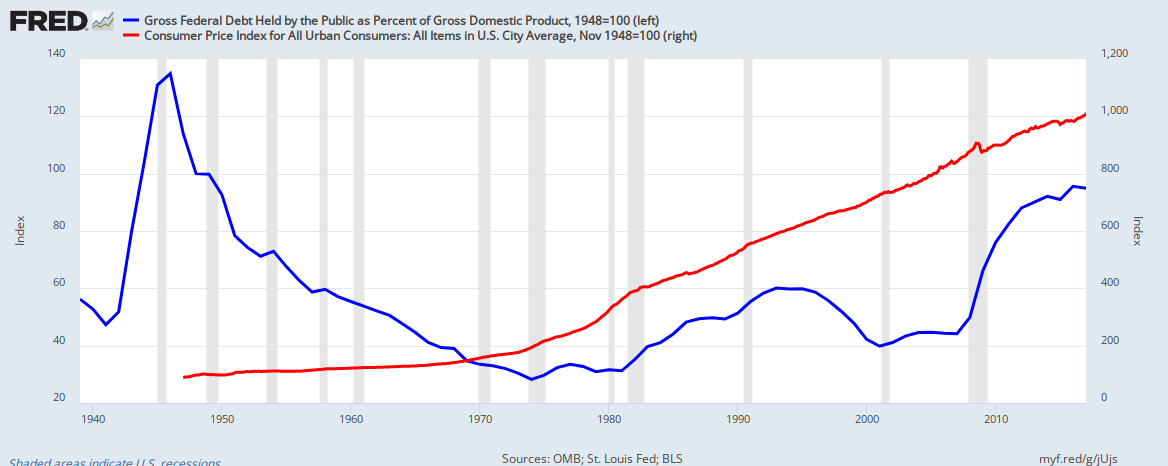
While deficit growth cures recessions, reductions in deficit growth lead to recessions.


Reductions in federal debt growth lead to inflation
Vertical gray bars are official recessions. Declines in deficit growth (blue line) lead to recessions, which are cure by increases in deficit growth.


The CBO also confirmed earlier estimates that despite Republican promises that the tax cuts would pay for themselves through economic growth, the plan would actually increase the deficit about $1.9 trillion over 11 years.

That’s 1.9 trillion stimulus dollars (less foreign spending) that will be pumped into the U.S. economy. This will grow the economy.

Ironic, isn’t it, that the one good thing the GOP Congress and President Trump have accomplished — increasing federal deficit spending — is the only thing Trump doesn’t boast about.

Democrats said the report rebuked Republicans’ claims to be fiscal conservatives.

“In their craven haste to give corporations and the wealthiest 1 percent massive tax breaks, Republicans saddled our children and grandchildren with trillions of dollars of debt,” House Minority Leader Nancy Pelosi of California said in a statement.

Here, Pelosi joins in the lie. Our children and grandchildren will not pay one penny of the “debt.”

Federal taxes do not pay for the federal deposits; in fact, federal taxes pay for nothing. They cease to be a part of any measure of the nation’s money supply, as soon as they are received. Functionally, taxes are destroyed upon receipt.

(Think about it. There is no way to measure the number of dollars the federal government has. If you own a dollar-creating machine, how many dollars do you have? Either zero or infinite, depending on how you wish to count.)

Democrats warned that Republicans may next try to slash Social Security and Medicare in an effort to pare back the deficit they’ve made worse.

Some House Republicans have floated the idea of a balanced budget amendment, which would require huge cuts to discretionary programs and those that support older and sick Americans.

It is unlikely to pass the Senate.

Yes, that is the usual GOP plan: Cut social spending for the poor and middle-income groups, and give more to the rich.

“From Day One, the Republican agenda has always been to balloon the deficit in order to dole out massive tax breaks to the largest corporations and wealthiest Americans, and then use the deficit as an excuse to cut Social Security and Medicare,” said Senate Democratic leader Charles E. Schumer of New York.

Right. The fact that many poor and middle-income people vote Republican is proof that H.L. Mencken was correct when he wrote:

“No one in this world, so far as I know — and I have searched the records for years, and employed agents to help me — has ever lost money by underestimating the intelligence of the great masses of the plain people. Nor has anyone ever lost public office thereby.”

Democrats, however, contributed to the deficit’s additional rise by supporting the March spending measure, which gave Republicans higher military spending and Democrats a boost in domestic funding.

Increased deficit spending is economically stimulative.

The CBO estimated that by 2027 the national debt would comprise 88.9 percent of the gross domestic product, just below the level at which economists say its load would harm the economy.

Any economists who say that are damn fools.

The CBO is the nonpartisan agency charged with delivering independent analysis of the economy, budget bills and other legislation.

Being supposedly “nonpartisan” does not mean they know what they are talking about.

Last year, congressional Republicans and the Trump administration criticized the CBO as lacking credibility after it delivered negative assessments of GOP health care bills.

Historically it has been considered a dependable source of fiscal predictions, even as legislators have ignored its increasingly heated warnings about the national debt.

The CBO has been reasonably accurate in predicting the amount of deficits, but is completely incompetent regarding the effect of those deficits.

Trump has routinely ignored the debt and deficit when it has come to advancing programs that are popular among his voters.

During the campaign he advocated protecting numerous expensive programs — including Social Security and Medicare — and never explained how he would finance them.

Contrary to popular myth, Social Security and Medicare are not paid for by FICA taxes. They are paid for by federal spending. Even if FICA were eliminated (which it should be) the government could continue paying benefits, forever.

While the report offered Democrats substantial ammunition in a campaign year, it offered the president some limited good news.

The average economic growth will rise 0.7 percentage points as a result of the tax plan, and about 1.1 million jobs will be added, the report said. That, in turn, will also boost the gross domestic product.

Huh?  All those warnings about the supposed negative effect of increased “debt,” and now we are told economic growth will increase, jobs will be added, and GDP will grow.

Strikingly, the CBO report underscored how the options ahead for legislators and the president are narrowing.

Over the next 10 years, for example, Social Security spending will rise to 6 percent of GDP and health care costs to 6.6 percent — both the outgrowth of the retirements of baby boomers and factors whose curtailment would be politically difficult.

The options have not changed.

Since it is functionally impossible for the U.S. federal government ever to run short of its own sovereign currency, the government always has the same payment options.

Social Security and Medicare payments benefit the economic growth. The federal government simply funds these programs without any tax increases.

But they do not represent the fastest-growing segment of federal spending. That would be interest on the debt, which will double to 3.1 percent of GDP over the next 10 years.

“Interest on the ‘debt’ (deposits) are dollars that stimulate economic growth.

Bottom line:

  1. The federal deficit is necessary for economic growth.
  2. The federal debt is the total of deposits, similar to saving account deposits.
  3. The Debt/GDP ratio is meaningless.
  4. The GOP wants to cut benefits to the poor and middle, while increasing benefits to the rich. 
  5. Most politicians, most of the media, and most economists are lying to you because they have been bribed by the rich. The politicians are bribed with campaign contributions and promises of lucrative employment. The media are bribed with advertising dollars and owners’ money. The economists are bribed with university contributions and employment in “think tanks.”

Rodger Malcolm Mitchell
Monetary Sovereignty
Twitter: @rodgermitchell; Search #monetarysovereignty
Facebook: Rodger Malcolm Mitchell

………………………………………………………………………………………………………………………………………………………………………………………………………………………………………………………………………………………………………………………………………..

The most important problems in economics involve the excessive income/wealth/power Gaps between the have-mores and the have-less.

Wide Gaps negatively affect poverty, health and longevity, education, housing, law and crime, war, leadership, ownership, bigotry, supply and demand, taxation, GDP, international relations, scientific advancement, the environment, human motivation and well-being, and virtually every other issue in economics.

Implementation of The Ten Steps To Prosperity can narrow the Gaps:

Ten Steps To Prosperity:
1. ELIMINATE FICA (Ten Reasons to Eliminate FICA )
Although the article lists 10 reasons to eliminate FICA, there are two fundamental reasons:
*FICA is the most regressive tax in American history, widening the Gap by punishing the low and middle-income groups, while leaving the rich untouched, and
*The federal government, being Monetarily Sovereign, neither needs nor uses FICA to support Social Security and Medicare.
2. FEDERALLY FUNDED MEDICARE — PARTS A, B & D, PLUS LONG TERM CARE — FOR EVERYONE (H.R. 676, Medicare for All )
This article addresses the questions:
*Does the economy benefit when the rich can afford better health care than can the rest of Americans?
*Aside from improved health care, what are the other economic effects of “Medicare for everyone?”
*How much would it cost taxpayers?
*Who opposes it?”
3. PROVIDE A MONTHLY ECONOMIC BONUS TO EVERY MAN, WOMAN AND CHILD IN AMERICA (similar to Social Security for All) (The JG (Jobs Guarantee) vs the GI (Guaranteed Income) vs the EB (Economic Bonus)) Or institute a reverse income tax.
This article is the fifth in a series about direct financial assistance to Americans:

Why Modern Monetary Theory’s Employer of Last Resort is a bad idea. Sunday, Jan 1 2012
MMT’s Job Guarantee (JG) — “Another crazy, rightwing, Austrian nutjob?” Thursday, Jan 12 2012
Why Modern Monetary Theory’s Jobs Guarantee is like the EU’s euro: A beloved solution to the wrong problem. Tuesday, May 29 2012
“You can’t fire me. I’m on JG” Saturday, Jun 2 2012

Economic growth should include the “bottom” 99.9%, not just the .1%, the only question being, how best to accomplish that. Modern Monetary Theory (MMT) favors giving everyone a job. Monetary Sovereignty (MS) favors giving everyone money. The five articles describe the pros and cons of each approach.
4. FREE EDUCATION (INCLUDING POST-GRAD) FOR EVERYONE Five reasons why we should eliminate school loans
Monetarily non-sovereign State and local governments, despite their limited finances, support grades K-12. That level of education may have been sufficient for a largely agrarian economy, but not for our currently more technical economy that demands greater numbers of highly educated workers.
Because state and local funding is so limited, grades K-12 receive short shrift, especially those schools whose populations come from the lowest economic groups. And college is too costly for most families.
An educated populace benefits a nation, and benefitting the nation is the purpose of the federal government, which has the unlimited ability to pay for K-16 and beyond.
5. SALARY FOR ATTENDING SCHOOL
Even were schooling to be completely free, many young people cannot attend, because they and their families cannot afford to support non-workers. In a foundering boat, everyone needs to bail, and no one can take time off for study.
If a young person’s “job” is to learn and be productive, he/she should be paid to do that job, especially since that job is one of America’s most important.
6. ELIMINATE FEDERAL TAXES ON BUSINESS
Businesses are dollar-transferring machines. They transfer dollars from customers to employees, suppliers, shareholders and the federal government (the later having no use for those dollars). Any tax on businesses reduces the amount going to employees, suppliers and shareholders, which diminishes the economy. Ultimately, all business taxes reduce your personal income.
7. INCREASE THE STANDARD INCOME TAX DEDUCTION, ANNUALLY. (Refer to this.) Federal taxes punish taxpayers and harm the economy. The federal government has no need for those punishing and harmful tax dollars. There are several ways to reduce taxes, and we should evaluate and choose the most progressive approaches.
Cutting FICA and business taxes would be a good early step, as both dramatically affect the 99%. Annual increases in the standard income tax deduction, and a reverse income tax also would provide benefits from the bottom up. Both would narrow the Gap.
8. TAX THE VERY RICH (THE “.1%) MORE, WITH HIGHER PROGRESSIVE TAX RATES ON ALL FORMS OF INCOME. (TROPHIC CASCADE)
There was a time when I argued against increasing anyone’s federal taxes. After all, the federal government has no need for tax dollars, and all taxes reduce Gross Domestic Product, thereby negatively affecting the entire economy, including the 99.9%.
But I have come to realize that narrowing the Gap requires trimming the top. It simply would not be possible to provide the 99.9% with enough benefits to narrow the Gap in any meaningful way. Bill Gates reportedly owns $70 billion. To get to that level, he must have been earning $10 billion a year. Pick any acceptable Gap (1000 to 1?), and the lowest paid American would have to receive $10 million a year. Unreasonable.
9. FEDERAL OWNERSHIP OF ALL BANKS (Click The end of private banking and How should America decide “who-gets-money”?)
Banks have created all the dollars that exist. Even dollars created at the direction of the federal government, actually come into being when banks increase the numbers in checking accounts. This gives the banks enormous financial power, and as we all know, power corrupts — especially when multiplied by a profit motive.
Although the federal government also is powerful and corrupted, it does not suffer from a profit motive, the world’s most corrupting influence.
10. INCREASE FEDERAL SPENDING ON THE MYRIAD INITIATIVES THAT BENEFIT AMERICA’S 99.9% (Federal agencies)Browse the agencies. See how many agencies benefit the lower- and middle-income/wealth/ power groups, by adding dollars to the economy and/or by actions more beneficial to the 99.9% than to the .1%.
Save this reference as your primer to current economics. Sadly, much of the material is not being taught in American schools, which is all the more reason for you to use it.

The Ten Steps will grow the economy, and narrow the income/wealth/power Gap between the rich and you.

———————————————————————————————————————


MONETARY SOVEREIGNTY

The great trade-deficit hoax

It takes only two things to keep people in chains:
The ignorance of the oppressed and the treachery of their leaders.Image result for in chains——————————————————————————————————————————————————————————————————————————————————————————–

Here is a direct quote from one of President Trump’s recent tweets:

“From Bush 1 to present, our Country has lost more than 55,000 factories, 6,000,000 manufacturing jobs and accumulated Trade Deficits of more than 12 Trillion Dollars. Last year we had a Trade Deficit of almost 800 Billion Dollars. Bad Policies & Leadership. Must WIN again!”

It is a classic example of how selective facts can produce a wrong conclusion.

Here is the other side of that coin:

Fact check: Is Trump right about the size of trade deficit?

Trump persistently miscasts the trade balance, citing the U.S. deficit in goods and ignoring the U.S. surplus in services. The actual trade deficit last year was $566 billion.

As for manufacturing, Trump leaves out what is widely regarded as the main reason for the decline in factory jobs — automation and other efficiencies.

What he doesn’t say is that despite the loss of those 5.5 million factory jobs, the U.S. economy overall has added a net total of about 40.6 million jobs in that time. 

Bottom line: The U.S. has been moving from “brawn” factory jobs toward “brain” office jobs. Is that a bad thing?

O.K., so Trump is ignorant and a compulsive liar.  You already knew that. But what about that trade deficit. Would you say it is harmful or beneficial?

Think of where you’ve spent your money, this year. You’ve shopped at grocery stores, drug stores, clothing stores. You’ve gone to movie theaters, restaurants, ballparks, retail malls. Perhaps you bought a car. You might have shopped online.

In each case, you gave them money and in return, they gave you goods and services.

In short, you ran a “trade deficit” with every grocery, drug, and clothing store — with every movie theater, restaurant, mall, car dealer, ballpark, and online provider.

That is exactly what a “trade deficit” means. One party gives another party money in exchange for goods and services. After the exchange, which party “WINs” (to borrow Trump’s term), and which party loses?Image result for trade

Clearly, both parties win. It’s an even exchange, which both parties desire.

When you bought that loaf of bread, did you feel that you “lost”? If you had, you wouldn’t have bought the bread.

You wanted bread; the retailer wanted dollars; you both got what you each wanted.

That exchange just as easily could be termed a trade “surplus” as a trade “deficit,” since you came out with a surplus of bread.

When the U.S. runs a trade “deficit” with the rest of the world, which we do almost every year, it doesn’t mean we have “lost.” It means we have received valuable goods and services in exchange for dollars, which our Monetarily Sovereign government can create endlessly, at the touch of a computer key and at no cost.

When you personally engage in overly large trade deficits, i.e. buy too much stuff, you can run short of dollars to pay your bills. You even can go bankrupt, as Trump’s companies often have. The reason: You are monetarily non-sovereign.

Similarly, cities, counties, states, and businesses cannot run trade deficits endlessly, because being monetarily non-sovereign, they can run short of dollars.

But the U.S. is Monetarily Sovereign. It never can run short of its own sovereign currency the dollar. America never can run short of dollars.

The early settlers of our nation built and maintained their own houses; they grew and prepared their own food; they sewed their own clothing; they even taught their own children, in the home. They mostly were self-sufficient.

Now, in our modern society, you purchase your houses from home builders; you purchase your food from farmers and processors; you purchase your clothing; you pay people to do your plumbing, carpentry, landscaping, sewage removal, and road paving. You pay schools to teach your children.

When Americans were self-sufficient, they didn’t run trade deficits.  They didn’t buy things. Today, you run trade deficits; you buy most of what you want from people who more efficiently can supply these things.

You buy from China, the things it can produce better or more cheaply, than comparable things, made here in America. Would it benefit you to purchase “Made in America” goods and services, if these goods and services were more costly or less useful than those made in China?

Trump claims that the U.S. should be a net importer of dollars.

If instead of having a trade deficit, we had a trade surplus, we would become a net importer of dollars — the very last thing this Monetarily Sovereign nation needs.

We would be sending our precious assets overseas in exchange for the one thing of which we have an infinite amount: U.S. dollars.

Finally, tariffs — both import and export — are not paid by China or the rest of the world. They are paid by you.  The tariffs on imported goods are dollars added to the price. Those dollars leave the U.S. private sector and are sent to the federal government.

The same President who boasted about how much his tax cuts would benefit the economy now proposes tariff tax increases to  — you guessed it — benefit the economy. 

How increased taxes, which take dollars from the private sector and give them to the federal government, which has no need for them, can benefit our economy has yet to be explained.

And when China, and the rest of the world, institute their retaliatory tariffs against our goods,  our factories and farmers either will have to cut profits to remain competitive or lose sales. Either way, the U.S. workers will be hurt.

I can understand why Trump wants this trade war. He is a stupid, vindictive, semi-literate man, who obtains his ideas from the stupid, vindictive people of Fox and Friends.

I even can understand why Trump’s followers buy into this economic catastrophe. They don’t understand the realities of international trade; they believe whatever their failed hero tells them.

What I cannot understand is the GOP members of the Senate and the House. These people know America will be hurt, but are too spineless to fight. They would rather see the people of America suffer than to displease this egomaniacal President.

In that sense, they choose their party over country, which makes them traitors to America.

May they be damned to eternal fires, especially the religious right, who while claiming morality, have sold their souls to the devil.

Rodger Malcolm Mitchell
Monetary Sovereignty
Twitter: @rodgermitchell; Search #monetarysovereignty
Facebook: Rodger Malcolm Mitchell

………………………………………………………………………………………………………………………………………………………………………………………………………………………………………………………………………………………………………………………………………..

The most important problems in economics involve the excessive income/wealth/power Gaps between the have-mores and the have-less.

Wide Gaps negatively affect poverty, health and longevity, education, housing, law and crime, war, leadership, ownership, bigotry, supply and demand, taxation, GDP, international relations, scientific advancement, the environment, human motivation and well-being, and virtually every other issue in economics.

Implementation of The Ten Steps To Prosperity can narrow the Gaps:

Ten Steps To Prosperity:
1. ELIMINATE FICA (Ten Reasons to Eliminate FICA )
Although the article lists 10 reasons to eliminate FICA, there are two fundamental reasons:
*FICA is the most regressive tax in American history, widening the Gap by punishing the low and middle-income groups, while leaving the rich untouched, and
*The federal government, being Monetarily Sovereign, neither needs nor uses FICA to support Social Security and Medicare.
2. FEDERALLY FUNDED MEDICARE — PARTS A, B & D, PLUS LONG TERM CARE — FOR EVERYONE (H.R. 676, Medicare for All )
This article addresses the questions:
*Does the economy benefit when the rich can afford better health care than can the rest of Americans?
*Aside from improved health care, what are the other economic effects of “Medicare for everyone?”
*How much would it cost taxpayers?
*Who opposes it?”
3. PROVIDE A MONTHLY ECONOMIC BONUS TO EVERY MAN, WOMAN AND CHILD IN AMERICA (similar to Social Security for All) (The JG (Jobs Guarantee) vs the GI (Guaranteed Income) vs the EB (Economic Bonus)) Or institute a reverse income tax.
This article is the fifth in a series about direct financial assistance to Americans:

Why Modern Monetary Theory’s Employer of Last Resort is a bad idea. Sunday, Jan 1 2012
MMT’s Job Guarantee (JG) — “Another crazy, rightwing, Austrian nutjob?” Thursday, Jan 12 2012
Why Modern Monetary Theory’s Jobs Guarantee is like the EU’s euro: A beloved solution to the wrong problem. Tuesday, May 29 2012
“You can’t fire me. I’m on JG” Saturday, Jun 2 2012

Economic growth should include the “bottom” 99.9%, not just the .1%, the only question being, how best to accomplish that. Modern Monetary Theory (MMT) favors giving everyone a job. Monetary Sovereignty (MS) favors giving everyone money. The five articles describe the pros and cons of each approach.
4. FREE EDUCATION (INCLUDING POST-GRAD) FOR EVERYONE Five reasons why we should eliminate school loans
Monetarily non-sovereign State and local governments, despite their limited finances, support grades K-12. That level of education may have been sufficient for a largely agrarian economy, but not for our currently more technical economy that demands greater numbers of highly educated workers.
Because state and local funding is so limited, grades K-12 receive short shrift, especially those schools whose populations come from the lowest economic groups. And college is too costly for most families.
An educated populace benefits a nation, and benefitting the nation is the purpose of the federal government, which has the unlimited ability to pay for K-16 and beyond.
5. SALARY FOR ATTENDING SCHOOL
Even were schooling to be completely free, many young people cannot attend, because they and their families cannot afford to support non-workers. In a foundering boat, everyone needs to bail, and no one can take time off for study.
If a young person’s “job” is to learn and be productive, he/she should be paid to do that job, especially since that job is one of America’s most important.
6. ELIMINATE FEDERAL TAXES ON BUSINESS
Businesses are dollar-transferring machines. They transfer dollars from customers to employees, suppliers, shareholders and the federal government (the later having no use for those dollars). Any tax on businesses reduces the amount going to employees, suppliers and shareholders, which diminishes the economy. Ultimately, all business taxes reduce your personal income.
7. INCREASE THE STANDARD INCOME TAX DEDUCTION, ANNUALLY. (Refer to this.) Federal taxes punish taxpayers and harm the economy. The federal government has no need for those punishing and harmful tax dollars. There are several ways to reduce taxes, and we should evaluate and choose the most progressive approaches.
Cutting FICA and business taxes would be a good early step, as both dramatically affect the 99%. Annual increases in the standard income tax deduction, and a reverse income tax also would provide benefits from the bottom up. Both would narrow the Gap.
8. TAX THE VERY RICH (THE “.1%) MORE, WITH HIGHER PROGRESSIVE TAX RATES ON ALL FORMS OF INCOME. (TROPHIC CASCADE)
There was a time when I argued against increasing anyone’s federal taxes. After all, the federal government has no need for tax dollars, and all taxes reduce Gross Domestic Product, thereby negatively affecting the entire economy, including the 99.9%.
But I have come to realize that narrowing the Gap requires trimming the top. It simply would not be possible to provide the 99.9% with enough benefits to narrow the Gap in any meaningful way. Bill Gates reportedly owns $70 billion. To get to that level, he must have been earning $10 billion a year. Pick any acceptable Gap (1000 to 1?), and the lowest paid American would have to receive $10 million a year. Unreasonable.
9. FEDERAL OWNERSHIP OF ALL BANKS (Click The end of private banking and How should America decide “who-gets-money”?)
Banks have created all the dollars that exist. Even dollars created at the direction of the federal government, actually come into being when banks increase the numbers in checking accounts. This gives the banks enormous financial power, and as we all know, power corrupts — especially when multiplied by a profit motive.
Although the federal government also is powerful and corrupted, it does not suffer from a profit motive, the world’s most corrupting influence.
10. INCREASE FEDERAL SPENDING ON THE MYRIAD INITIATIVES THAT BENEFIT AMERICA’S 99.9% (Federal agencies)Browse the agencies. See how many agencies benefit the lower- and middle-income/wealth/ power groups, by adding dollars to the economy and/or by actions more beneficial to the 99.9% than to the .1%.
Save this reference as your primer to current economics. Sadly, much of the material is not being taught in American schools, which is all the more reason for you to use it.

The Ten Steps will grow the economy, and narrow the income/wealth/power Gap between the rich and you.


MONETARY SOVEREIGNTY

How does Gap Psychology affect you?


It takes only two things to keep people in chains:
The ignorance of the oppressed and the treachery of their leaders.

——————————————————————————————————————————————————————————————————————————————————————————–

In Economics, everything devolves to Monetary Sovereignty and Gap Psychology.

  1. Economics studies the relationships among wealth, money, and human psychology.
  2. Monetary Sovereignty studies a money issuer’s power over the money it issues.
  3. Gap Psychology describes the human desire to widen the Gap below you on any economic or social measure, and to narrow the Gap above you.

The purpose of this post is to discuss Gap Psychology.

As a social animal, you are protected by your group, or rather, “groups,” for you live in many.  There are evolutionary advantages to being protected by a comparatively strong group, so you tend to cherish whichever groups you find yourself in. A group honor is seen as a personal honor.

Just a tiny sampling of our groups includes: Our nation, village, religion, age, sex, school, interest, income, company, and team.

You cheer for your country in the Olympics. You back your village or school in any kind of competition or measure. You take pride in the accomplishments of those whose religion you share.Related image

For similar emotional reasons, you wish to distance yourself from those below you — the “losers,” the poor, the socially unpopular —  while you wish to be closer to those above you.

Not only do you wish to be part of a “higher” group, but you wish to be seen as part of a higher group. You take pride in having attended a “good” school, though the quality of a school you may have attended does not, in any way, change who you really are, today.

If you yourself cannot be famously respected, you enjoy having a famously respected friend, or being seen with someone who is famously respected. You might even treasure a “selfie” with someone famous.

So deep are your social ties, the merely being thought of in a certain way — even by total strangers — can be a sufficient proxy for actually being that way.

If members of your group endure embarrassment, you feel that embarrassment. Innocent Chicagoans feel embarrassed by Chicago’s murder rate. Innocent Catholics feel burdened by the clergy’s sexual crimes. Innocent immigrants are weighted by pejorative claims against all immigrants. Your memberships in groups define you.

So, you may buy a too expensive car, or live in an unaffordable house, or wear a costly jewel, so that friends and strangers alike, will view you as being at a certain social level.

Merely being seen, even falsely, as part of a certain group, is sufficient to provide you with actual social strength or weakness.

Words that never left my memory:

“If they think you got the goods, they give you room, even if you know you don’t really got the goods.” (Neighborhood boy from my youth.)

In your social world, perception is truth.

Given all of the above, why do you give to charity? On its surface, charity would seem to be a violation of Gap Psychology.

Giving money or goods to the poor not only narrows the financial Gap (however slightly) between you and the poor, but it widens the financial Gap (also however slightly) between you and those who are richer.

Why would anyone want to do that? There are many reasons why you give to charity, and none of them are totally selfless, and all are Gap-based.

Every college contains buildings named in honor of a generous philanthropist, who stipulated the name. The price of having one’s name adorn a building might be in the millions, but to the giver, the reward was greater than the cost.  It was a gift to himself in terms of self-seen prestige.

At some point, the donor made this mental calculation: “Is the cost worth the benefit?”

Was there a time when you volunteered your time to a charity? Your benefit came from the support of your fellow volunteers, and from outsiders who know what a good thing you do. The benefit came from your enhanced view of yourself (“I am a good person.”)

The admiration for “doing a good thing,” or for merely being allowed entrance to a “good” group, can be reward enough. Even in this instance, the ever-present question is asked, “Is the cost (in time) worth the benefit (the membership in the group).

Even if you donated anonymously, you made a cost/benefit decision.  The benefit came from your view in your mirror: “I am a good person.”

In essence, everything you do, involves the tacit question, “Is the cost worth the benefit?”

Think about your day, from the time you wake up, until your bedtime, and you will be astounded at how much you do that is based on Gap Psychology — widening the Gap below you and narrowing the Gap above you.

Image result for wearing a rolex
A Rolex keeps no better time than a Timex.

You brush your teeth for a brighter smile, you dress for the approval (or at least to avoid the disapproval) of friends and strangers. You comb your hair; you may apply makeup; you drive a certain car; you live in a certain kind of dwelling in a certain kind of neighborhood, and work at a certain kind of job — and even in the most menial of jobs, if you have co-workers, you act in a certain way, so they will believe certain good things about you.

Solitary animals do not have these concerns.

Your entire life, the lives you bestow upon your children, and the pride you feel in their accomplishments, and the shame you feel in their transgressions — all are a testament to Gap Psychology.

And that also can have negative consequences because you can widen the Gap below you, not only by lifting yourself up, but by pushing others down.

If you are a Chicago Cubs fan, you not only want the Cubs to win, but you want the other teams to lose.

Go to a right-wing site like breitbart.com, and look at the readers’ comments. You will see the most hateful and vile statements about immigrants — how they should be jailed, deported, separated from their children and punished in every way.

Why? Not for factual reasons, but rather because this hatred is born of the terror that the Gap below might be narrowing.

The most extreme bigots are those who feel most insecure or resentful about their position in society.

Bigotry against certain ethnic backgrounds is Gap Psychology at its worst. We see it in the unreasoned excuses to deny jobs to those of a certain sexual orientation or of a certain religion or nationality.

Despite thin rationales to the contrary, those merely are efforts to widen the Gap below.

Similarly, the delight we take in seeing the mighty fall — a rich woman sent to jail, a powerful man humiliated  — these events narrow the Gap above us (“They are no better than me.”)

Without the Gaps no person or group would be rich, smart, talented, beautiful, or strong. We all would be the same. It is the Gaps that make you and your groups special, protected, and safe in a harsh world.

Everything in economics devolves to Monetary Sovereignty and to Gap Psychology.

Rodger Malcolm Mitchell
Monetary Sovereignty
Twitter: @rodgermitchell; Search #monetarysovereignty
Facebook: Rodger Malcolm Mitchell

………………………………………………………………………………………………………………………………………………………………………………………………………………………………………………………………………………………………………………………………………..

The most important problems in economics involve the excessive income/wealth/power Gaps between the have-mores and the have-less.

Wide Gaps negatively affect poverty, health and longevity, education, housing, law and crime, war, leadership, ownership, bigotry, supply and demand, taxation, GDP, international relations, scientific advancement, the environment, human motivation and well-being, and virtually every other issue in economics.

Implementation of The Ten Steps To Prosperity can narrow the Gaps:

Ten Steps To Prosperity:
1. ELIMINATE FICA (Ten Reasons to Eliminate FICA )
Although the article lists 10 reasons to eliminate FICA, there are two fundamental reasons:
*FICA is the most regressive tax in American history, widening the Gap by punishing the low and middle-income groups, while leaving the rich untouched, and
*The federal government, being Monetarily Sovereign, neither needs nor uses FICA to support Social Security and Medicare.
2. FEDERALLY FUNDED MEDICARE — PARTS A, B & D, PLUS LONG TERM CARE — FOR EVERYONE (H.R. 676, Medicare for All )
This article addresses the questions:
*Does the economy benefit when the rich can afford better health care than can the rest of Americans?
*Aside from improved health care, what are the other economic effects of “Medicare for everyone?”
*How much would it cost taxpayers?
*Who opposes it?”
3. PROVIDE A MONTHLY ECONOMIC BONUS TO EVERY MAN, WOMAN AND CHILD IN AMERICA (similar to Social Security for All) (The JG (Jobs Guarantee) vs the GI (Guaranteed Income) vs the EB (Economic Bonus)) Or institute a reverse income tax.
This article is the fifth in a series about direct financial assistance to Americans:

Why Modern Monetary Theory’s Employer of Last Resort is a bad idea. Sunday, Jan 1 2012
MMT’s Job Guarantee (JG) — “Another crazy, rightwing, Austrian nutjob?” Thursday, Jan 12 2012
Why Modern Monetary Theory’s Jobs Guarantee is like the EU’s euro: A beloved solution to the wrong problem. Tuesday, May 29 2012
“You can’t fire me. I’m on JG” Saturday, Jun 2 2012

Economic growth should include the “bottom” 99.9%, not just the .1%, the only question being, how best to accomplish that. Modern Monetary Theory (MMT) favors giving everyone a job. Monetary Sovereignty (MS) favors giving everyone money. The five articles describe the pros and cons of each approach.
4. FREE EDUCATION (INCLUDING POST-GRAD) FOR EVERYONE Five reasons why we should eliminate school loans
Monetarily non-sovereign State and local governments, despite their limited finances, support grades K-12. That level of education may have been sufficient for a largely agrarian economy, but not for our currently more technical economy that demands greater numbers of highly educated workers.
Because state and local funding is so limited, grades K-12 receive short shrift, especially those schools whose populations come from the lowest economic groups. And college is too costly for most families.
An educated populace benefits a nation, and benefitting the nation is the purpose of the federal government, which has the unlimited ability to pay for K-16 and beyond.
5. SALARY FOR ATTENDING SCHOOL
Even were schooling to be completely free, many young people cannot attend, because they and their families cannot afford to support non-workers. In a foundering boat, everyone needs to bail, and no one can take time off for study.
If a young person’s “job” is to learn and be productive, he/she should be paid to do that job, especially since that job is one of America’s most important.
6. ELIMINATE FEDERAL TAXES ON BUSINESS
Businesses are dollar-transferring machines. They transfer dollars from customers to employees, suppliers, shareholders and the federal government (the later having no use for those dollars). Any tax on businesses reduces the amount going to employees, suppliers and shareholders, which diminishes the economy. Ultimately, all business taxes reduce your personal income.
7. INCREASE THE STANDARD INCOME TAX DEDUCTION, ANNUALLY. (Refer to this.) Federal taxes punish taxpayers and harm the economy. The federal government has no need for those punishing and harmful tax dollars. There are several ways to reduce taxes, and we should evaluate and choose the most progressive approaches.
Cutting FICA and business taxes would be a good early step, as both dramatically affect the 99%. Annual increases in the standard income tax deduction, and a reverse income tax also would provide benefits from the bottom up. Both would narrow the Gap.
8. TAX THE VERY RICH (THE “.1%) MORE, WITH HIGHER PROGRESSIVE TAX RATES ON ALL FORMS OF INCOME. (TROPHIC CASCADE)
There was a time when I argued against increasing anyone’s federal taxes. After all, the federal government has no need for tax dollars, and all taxes reduce Gross Domestic Product, thereby negatively affecting the entire economy, including the 99.9%.
But I have come to realize that narrowing the Gap requires trimming the top. It simply would not be possible to provide the 99.9% with enough benefits to narrow the Gap in any meaningful way. Bill Gates reportedly owns $70 billion. To get to that level, he must have been earning $10 billion a year. Pick any acceptable Gap (1000 to 1?), and the lowest paid American would have to receive $10 million a year. Unreasonable.
9. FEDERAL OWNERSHIP OF ALL BANKS (Click The end of private banking and How should America decide “who-gets-money”?)
Banks have created all the dollars that exist. Even dollars created at the direction of the federal government, actually come into being when banks increase the numbers in checking accounts. This gives the banks enormous financial power, and as we all know, power corrupts — especially when multiplied by a profit motive.
Although the federal government also is powerful and corrupted, it does not suffer from a profit motive, the world’s most corrupting influence.
10. INCREASE FEDERAL SPENDING ON THE MYRIAD INITIATIVES THAT BENEFIT AMERICA’S 99.9% (Federal agencies)Browse the agencies. See how many agencies benefit the lower- and middle-income/wealth/ power groups, by adding dollars to the economy and/or by actions more beneficial to the 99.9% than to the .1%.
Save this reference as your primer to current economics. Sadly, much of the material is not being taught in American schools, which is all the more reason for you to use it.

The Ten Steps will grow the economy, and narrow the income/wealth/power Gap between the rich and you.

MONETARY SOVEREIGNTY

Interest rates going up: Should you be concerned?

It takes only two things to keep people in chains:

.

The ignorance of the oppressed

and the treachery of their leaders.

——————————————————————————————————————————————————————————————————————————————————————————–

Interest rates going up: Should you be concerned?

The answer: Well . . .  maybe and maybe not. Here are excerpts from an article by the anti-debt Committee for a Responsible Federal Budget (CRFB):

Rising Rates Could Further Balloon Interest Spending

Mar 21, 2018

The Federal Open Market Committee (decided) to raise the federal funds rate by 0.25 percentage points to 1.5-1.75 percent.

The federal government (is projected) to spend $6.8 trillion on interest costs over the next decade. If interest rates end up just 1 percentage point higher than projected, interest costs would increase by a further $2 trillion. If interest rates return to their pre-recession levels, costs could rise by $3.4 trillion.

Let us rephrase as follows:

The federal government (is projected) to pump $6.8 trillion interest dollars into the economy over the next decade.

Should a $6.8 trillion stimulus — which is similar in effect to a $6.8 trillion tax cut — be a cause for concern?

GDP growth parallels money supply growth

A large economy contains more money than does a smaller economy. The U.S. has a larger money supply than does California, which in turn, has a larger money supply than does Los Angeles.

This overly-simple example shows that to grow from smaller to larger, an economy usually needs an increased money supply. The projected $6.8 trillion in federal interest payments will produce an increased money supply and economic growth.

Federal deficit spending, which increases the money supply, is the method by which the federal government cures recessions:

Two views of deficit spending. The blue line is a direct fiscal year measure of deficit spending. The red line is the calendar year issuance of T-securities, the legal requirement for matching deficit spending. The vertical bars are recessions.

The above graph shows that federal deficit spending stimulates the economy to cure recessions. In the late 1990s, the federal government ran a surplus, which caused a recession. 

That being the proven case, one wonders why anyone would be anti-deficit.

Projected interest rates are notably below historic levels.

Most experts believe we will remain below these levels due to slower productivity growth, greater income inequality, higher demand for safe assets, higher foreign capital inflows, and generally observed reductions in global interest rates, but low interest rates are by no means a given.

If “reductions in global interest rates” are paired with “slower productivity growth” and “greater income inequality,” why would anyone favor low interest rates?

Under CBO’s interest rate assumptions, we recently estimated interest costs will quadruple in a decade or so. We projected interest will rise from $263 billion in 2017 to $965 billion in 2028 under current law and to $1.05 trillion in 2028 assuming various expiring policies are extended. In either of these scenarios interest costs (in percent of GDP) would represent a historic record.

To paraphrase, the CBO estimates that by 2028, our Monetarily Sovereign government will pump $965 billion – $1.08 trillion stimulus dollars annually into our economy.

The CBO implies that this must, in some unstated way, be bad for you. The CBO never says why, instead implying that large federal debt is similar to large personal debt.

It isn’t.

(We) project the debt-to-GDP ratio will rise from 77 percent of GDP today 101 percent of GDP by 2028. The historical record level of debt held by the public as a percent of GDP for the United States is 106 percent, set just after World War II.

We assume the warning about the debt-to-GDP ratio is supposed to frighten you, for some reason. But aside from the reason never being stated, there are two problems with the implied warning:

  1. The so-called federal “debt” isn’t a real debt. It is deposits onto into T-security accounts, that really are something like interest-paying safe deposit boxes.  The dollars go in, interest money is added, and at maturity, the dollars go back. Our federal government, being Monetarily Sovereign, uses those dollars.
  2. Even if the so-called “debt” were real debt that the government actually used (as with state and local government debt), the federal government, being Monetarily Sovereign, could pay it all off, simply by creating new dollars.

Here is a graph comparing GDP growth with the Debt/GDP ratio. It shows that changes in the ratio — up or down — do not affect our economic growth.

The rising Federal Debt/GDP ratio (red) you repeatedly are warned about, has no effect on GDP growth (blue). 

This is one of the reasons we say that the Debt/GDP ratio is meaningless. The ratio compares the historical total of deposits into T-security accounts that still exist, with the value of all goods and services produced in one year. It would be difficult to find two more dissimilar, unrelated measures in all of economics.

The ratio has nothing to do with the federal government’s solvency or ability to spend. The ratio has nothing to do with any need for future tax collections. The ratio has nothing to do with our economic growth or lack thereof.

In astrology, the motions of the planets are compared with future personal events.

 Debt/GDP ratio is economic astrology. It measures nothing.

Lawmakers need to reverse course to reduce the interest burden and the exposure to eventual higher interest rates.

“Interest burden”? Paying interest is no burden on our Monetarily Sovereign federal government. Even without collecting a penny in taxes, our federal government is capable of paying infinite amounts of interest.

Taxpayers do not fund the federal government’s interest payments or any other federal spending. The U.S. government created the very first dollars from thin air. It still creates dollars from thin air, merely by pressing computer keys. It cannot run short of its own sovereign currency.

So do not fret. Despite all the “Henny Penny” warnings, a high deficit, high debt, or high Debt/GDP ratio will not doom your children and grandchildren to higher taxes.

There is some debate about how interest rate increases affect the private sector. Most interest neither adds nor subtracts dollars from the total world economy. Interest just circulates, with some individuals and businesses paying more and some receiving more.

With higher interest rates, the public will pay more for loans and for products/services provided by borrowers. Meanwhile, the public will receive more from bonds, CDs, and interest-paying bank accounts.

So depending on your position in the economy, higher interest rates can help you or hurt you.

But remember, there is that one net benefit from higher interest: The federal government adds more stimulus dollars to the economy when it pays more interest.

When interest rates (red) grew from 1955-1980, GDP growth rates (blue) trended upward. When interest rates declined from the 1980s to 2018, GDP growth rates trended downward.

In Summary:

    1. Rising interest rates benefit the nation as a whole, because they force the federal government to add more stimulus dollars to the economy. Higher rates are associated with economic growth.Short term, the stock market reacts negatively to interest rate increases, because traders anticipate it will, and act accordingly. Within a few days, the market recovers, which proves the point.
    2. That said, borrowers are punished and lenders benefit from rising interest rates. If you plan to take out a new mortgage or to buy a car in the future, you will pay more interest. If you plan to put dollars into a bank savings account, a money market, a Treasury Security or a bank CD, you will benefit from an interest rate increase.
    3. To pay a creditor, the federal government sends instructions to the creditor’s bank, instructing the bank to increase the balance in the creditor’s checking account. When the bank does as instructed, dollars are added to the money supply.From a bookkeeping standpoint, an account at the Federal Reserve Bank called Treasury’s General Account simultaneously is debited. Though this account is not part of the nation’s money supply, an obsolete rule disallows it from having an overdraft.

      So, the federal government, which is sovereign over the dollar, is forced to issue T-securities.These securities do not add to the federal government’s money supply (the government has no money supply) or provide the federal government with spending money, but rather they obey the rule by providing a bookkeeping credit to the Treasury’s General Account.

      If the government merely eliminated the rule, the Treasury could continue paying its bills, but there would be no requirement to issue T-securities, and there would be no worries about the so-called federal “debt.”

    4. The federal debt/GDP ratio does not reflect the federal government’s ability to pay its bills. It does not reflect the health of the economy. It does not reflect future tax increases or decreases. It is a meaningless ratio comprised of a multi-year measure (total T-securities) divided by a 1-year measure (GDP).
    5. The unfounded concerns about the federal deficit and debt are promulgated by the very rich, who based on Gap Psychology, wish to convince the rest of America that federal social benefits (Social Security, Medicare, Medicaid, aids to the poor, aids to education, etc.) are unaffordable.

    Rodger Malcolm Mitchell

    Monetary Sovereignty

    Twitter: @rodgermitchell; Search #monetarysovereignty

    Facebook: Rodger Malcolm Mitchell

    MONETARY SOVEREIGNTY

    ………………………………………………………………………………………………………………………………………………………………………………………………………………………………………………………………………………………………………………………………………..

    The most important problems in economics involve the excessive income/wealth/power Gaps between the have-mores and the have-less.

    Wide Gaps negatively affect poverty, health and longevity, education, housing, law and crime, war, leadership, ownership, bigotry, supply and demand, taxation, GDP, international relations, scientific advancement, the environment, human motivation and well-being, and virtually every other issue in economics.

    Implementation of The Ten Steps To Prosperity can narrow the Gaps:

    Ten Steps To Prosperity:

    1. ELIMINATE FICA (Ten Reasons to Eliminate FICA )

    Although the article lists 10 reasons to eliminate FICA, there are two fundamental reasons:

    *FICA is the most regressive tax in American history, widening the Gap by punishing the low and middle-income groups, while leaving the rich untouched, and

    *The federal government, being Monetarily Sovereign, neither needs nor uses FICA to support Social Security and Medicare.

    2. FEDERALLY FUNDED MEDICARE — PARTS A, B & D, PLUS LONG TERM CARE — FOR EVERYONE (H.R. 676, Medicare for All )

    This article addresses the questions:

    *Does the economy benefit when the rich can afford better health care than can the rest of Americans?

    *Aside from improved health care, what are the other economic effects of “Medicare for everyone?”

    *How much would it cost taxpayers?

    *Who opposes it?”

    3. PROVIDE A MONTHLY ECONOMIC BONUS TO EVERY MAN, WOMAN AND CHILD IN AMERICA (similar to Social Security for All) (The JG (Jobs Guarantee) vs the GI (Guaranteed Income) vs the EB (Economic Bonus)) Or institute a reverse income tax.

    This article is the fifth in a series about direct financial assistance to Americans:

    Why Modern Monetary Theory’s Employer of Last Resort is a bad idea. Sunday, Jan 1 2012

    MMT’s Job Guarantee (JG) — “Another crazy, rightwing, Austrian nutjob?” Thursday, Jan 12 2012

    Why Modern Monetary Theory’s Jobs Guarantee is like the EU’s euro: A beloved solution to the wrong problem. Tuesday, May 29 2012

    “You can’t fire me. I’m on JG” Saturday, Jun 2 2012

    Economic growth should include the “bottom” 99.9%, not just the .1%, the only question being, how best to accomplish that. Modern Monetary Theory (MMT) favors giving everyone a job. Monetary Sovereignty (MS) favors giving everyone money. The five articles describe the pros and cons of each approach.

    4. FREE EDUCATION (INCLUDING POST-GRAD) FOR EVERYONE Five reasons why we should eliminate school loans

    Monetarily non-sovereign State and local governments, despite their limited finances, support grades K-12. That level of education may have been sufficient for a largely agrarian economy, but not for our currently more technical economy that demands greater numbers of highly educated workers.

    Because state and local funding is so limited, grades K-12 receive short shrift, especially those schools whose populations come from the lowest economic groups. And college is too costly for most families.

    An educated populace benefits a nation, and benefitting the nation is the purpose of the federal government, which has the unlimited ability to pay for K-16 and beyond.

    5. SALARY FOR ATTENDING SCHOOL

    Even were schooling to be completely free, many young people cannot attend, because they and their families cannot afford to support non-workers. In a foundering boat, everyone needs to bail, and no one can take time off for study.

    If a young person’s “job” is to learn and be productive, he/she should be paid to do that job, especially since that job is one of America’s most important.

    6. ELIMINATE FEDERAL TAXES ON BUSINESS

    Businesses are dollar-transferring machines. They transfer dollars from customers to employees, suppliers, shareholders and the federal government (the later having no use for those dollars). Any tax on businesses reduces the amount going to employees, suppliers and shareholders, which diminishes the economy. Ultimately, all business taxes reduce your personal income.

    7. INCREASE THE STANDARD INCOME TAX DEDUCTION, ANNUALLY. (Refer to this.) Federal taxes punish taxpayers and harm the economy. The federal government has no need for those punishing and harmful tax dollars. There are several ways to reduce taxes, and we should evaluate and choose the most progressive approaches.

    Cutting FICA and business taxes would be a good early step, as both dramatically affect the 99%. Annual increases in the standard income tax deduction, and a reverse income tax also would provide benefits from the bottom up. Both would narrow the Gap.

    8. TAX THE VERY RICH (THE “.1%) MORE, WITH HIGHER PROGRESSIVE TAX RATES ON ALL FORMS OF INCOME. (TROPHIC CASCADE)

    There was a time when I argued against increasing anyone’s federal taxes. After all, the federal government has no need for tax dollars, and all taxes reduce Gross Domestic Product, thereby negatively affecting the entire economy, including the 99.9%.

    But I have come to realize that narrowing the Gap requires trimming the top. It simply would not be possible to provide the 99.9% with enough benefits to narrow the Gap in any meaningful way. Bill Gates reportedly owns $70 billion. To get to that level, he must have been earning $10 billion a year. Pick any acceptable Gap (1000 to 1?), and the lowest paid American would have to receive $10 million a year. Unreasonable.

    9. FEDERAL OWNERSHIP OF ALL BANKS (Click The end of private banking and How should America decide “who-gets-money”?)

    Banks have created all the dollars that exist. Even dollars created at the direction of the federal government, actually come into being when banks increase the numbers in checking accounts. This gives the banks enormous financial power, and as we all know, power corrupts — especially when multiplied by a profit motive.

    Although the federal government also is powerful and corrupted, it does not suffer from a profit motive, the world’s most corrupting influence.

    10. INCREASE FEDERAL SPENDING ON THE MYRIAD INITIATIVES THAT BENEFIT AMERICA’S 99.9% (Federal agencies)Browse the agencies. See how many agencies benefit the lower- and middle-income/wealth/ power groups, by adding dollars to the economy and/or by actions more beneficial to the 99.9% than to the .1%.

    Save this reference as your primer to current economics. Sadly, much of the material is not being taught in American schools, which is all the more reason for you to use it.

    The Ten Steps will grow the economy, and narrow the income/wealth/power Gap between the rich and you.

    MONETARY SOVEREIGNTY