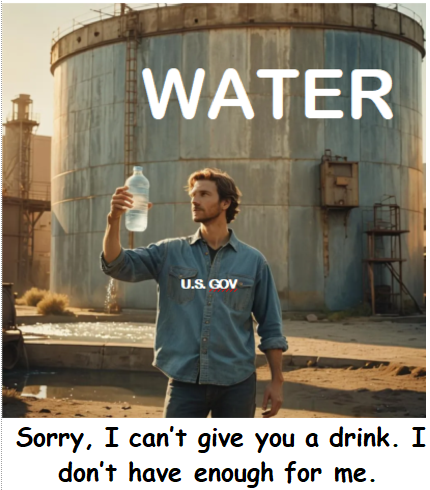
The Wall Street Journal is owned by Rupert Murdoch, who supports 32 times convicted felon Donald Trump. Murdoch also owns extreme right-wing Fox News, which paid an $800 million fine for lying.
Need I say more?
Here are excerpts from an article that appeared in the WSJ. Comments are noted.
Federal Debt Is Soaring. Here’s Why Trump and Harris Aren’t Talking About It.
Story by Richard Rubin, richard.rubin@wsj.comThe U.S. isn’t fighting a war, a crisis or a recession. Yet the federal government is borrowing as if it were.
The U.S. federal government is Monetarily Sovereign. It has the unlimited ability to create U.S. dollars:
Alan Greenspan: “There is nothing to prevent the federal government from creating as much money as it wants and paying it to somebody.”
If you owned a money-printing machine and had the unlimited, legal ability to create as many $100 bills as you wanted — at no cost to you — would you ever borrow dollars? Think about it.
The government has that “money-printing machine” and the legal right to create dollars. Why on earth would the government ever borrow dollars? Answer: The U.S. government never borrows dollars. Not ever.
Ben Bernanke: “The U.S. government has a technology, called a printing press (or, today, its electronic equivalent), that allows it to produce as many U.S. dollars as it wishes at essentially no cost.”
The confusion is semantic. In the private sector, the words “bills,” “notes,” and “bonds” denote debt. “Bills” are what you owe in your daily life. Corporate “notes” and “bonds” are evidence of corporate debt.
By contrast, Treasury bills, notes, and bonds have nothing to do with government borrowing. They are deposits into Treasury Security accounts. Depositors, like China, the UK, and private citizens like you, own the money in these accounts; the federal government doesn’t.
The federal government never accesses those dollars for federal spending. It creates new dollars to pay all its bills.
To pay a creditor, the federal government creates instructions in the form of checks or wires. The instructions tell the creditor’s bank to increase the balance in the creditor’s checking account by a certain amount.
At the moment the bank obeys those instructions, new dollars are created and added to the M2 money supply measure.
To pay off the so-called “debt,” the federal government merely returns the depositors’ dollars that already reside in their T-security accounts. (Think of a safe deposit box in which depositors place valuables. The bank doesn’t use those valuables and returns them upon request by the depositors.)
Returning existing dollars is not a financial burden on the government or on federal taxpayers.
The confusion is not only semantic but also arises from the fact that the total of deposits equals the total of federal deficits. This is an anachronism from when the federal government was not wholly sovereign over the dollar and tied itself to silver and gold.
That tie ended in 1971, when President Richard Nixon ended the last semblance of a U.S.gold standard.
In short, federal “debt” is nothing like personal debt. The federal government is not “in debt.” It pays all its bills timely and in full, and can continue doing so.
Since dollars are a creation of laws, so long as the federal government has the ability to pass laws, it has the ability create dollars.
This year’s budget deficit is on track to top $1.9 trillion, or more than 6% of economic output, a threshold reached only around World War II, the 2008 financial crisis and the Covid-19 pandemic.
Publicly held federal debt—the sum of all deficits—just passed $28 trillion or almost 100% of GDP.
The “debt”/GDP ratio is meaningless. It says nothing about the federal government’s ability to pay. Debt nuts often quote this number to scare you, but it has absolutely no relevance to the federal government’s ability to pay its bills.
If Congress does nothing, the total debt will climb by another $22 trillion through 2034. Interest costs alone are poised to exceed annual defense spending.
These are big numbers but completely meaningless concerning the federal government’s solvency. The misnamed “debt” could be ten times or a hundred times as large, and the federal government easily could continue to pay all its bills.
Even if the government didn’t collect a single penny in taxes and the “debt” was a hundred times larger, it still could continue to pay its bills in full and in a timely manner.
Federal taxes are different from state and local taxes. State and local governments are monetarily non-sovereign. They do not have the unlimited ability to create dollars. They use tax receipts and borrowing to pay their financial obligations.
By contrast, the U.S. federal government does not use tax dollars or borrowing to pay its bills. The purposes of federal taxes are:
- To control the economy by taxing what the government wishes to discourage and by giving tax breaks to what the government wishes to reward.
- To assure demand for the U.S. dollar by required taxes to be paid in dollars.
Economists and policymakers already worry that the growing debt pile could put upward pressure on interest rates, restraining economic growth, crowding out other priorities and potentially impairing Washington’s ability to borrow in case of a war or another crisis.
In one sentence, the author, Mr. Rubin, has articulated the four common lies about the so-called federal debt (that neither is federal nor debt).
- The U.S. Federal Reserve sets interest rates at its whim in an effort to control inflation. This has nothing to do with the size of the federal “debt” as shown by the following graph:

There have been scattered warning signs already, including downgrades to the U.S. credit rating and lackluster demand for Treasury debt at some auctions.
Interest rates also are set to attract depositors, an exercise that became obsolete in 1971, when the government no longer required itself to match income with outflow.
2. Credit agencies set ratings based on the debtor’s ability and likelihood of paying promptly and in full. The federal government always pays timely and in full, so why would the rating ever go down?
Answer: This is not because of the size of the “debt” but because of Congress’s political gamesmanship. The party out of power limits the party in power’s ability to pay. It uses one of the more ridiculous laws, the so-called “debt limit” (which doesn’t limit the non-existent “debt.” It limits the government’s ability to pay its daily bills).
While the federal “debt” has grown from $400 billion to $33 trillion in just 80 years, “debt” downgrades have been few and sporadic, and related only to the fear that the debt nuts will prevent the government from paying, not to the size of the “debt.”
3. Federal deficits are necessary to grow the economy. It is mathematically impossible for the U.S. economy to grow unless the federal government pumps more money into the private sector (aka, the economy) than it takes out.
4. Federal deficit spending does not “crowd out” anything. It adds lending dollars to the economy.
With more dollars on deposit, the banks can lend more easily, and when the economy has more money, it is more likely to expand by borrowing. Nothing impairs Washington’s ability to borrow; the federal government never borrows.
5. “Lackluster demand” for T-securities is not a problem for the federal government. Selling T-securities doesn’t benefit the federal government. T-securities benefit buyers looking for a safe place to store unused dollars. That is why China buys them. T-securities are more secure than any bank China could find.
T-securities have two purposes, neither of which is to provide spending funds to the U.S. government:
— To help stabilize the dollar by providing safe storage for unused dollars
— To help the Fed control interest rates.
Both Harris and Trump have promised to protect the biggest drivers of rising spending—Social Security and Medicare. And both want to extend trillions of dollars in tax cuts set to lapse at the end of 2025, amid bipartisan agreement that federal income taxes shouldn’t rise for at least 97% of households.
Those are good political promises that would benefit the economy. Of course, the reality is that debt nuts will prevail because of voter ignorance. Thus, you can expect the same strong support for cutting benefits to the middle- and lower-income groups as we have seen in the past. The eligibility age for Social Security will continue to go up, and benefits will be taxed further.
Trump has promised to exempt tips from taxation, end income taxes on Social Security benefits, eliminate taxes on overtime pay, lower tax rates for companies that manufacture in the U.S., and create a new deduction for new parents’ expenses, offering more than $2 trillion in tax cuts atop $4 trillion to extend his first-term tax cuts.
These are good ideas, but as has been typical of Trump’s promises, they’re all verbal tooth-fairy stuff. It’ll happen only in your dreams.
Harris matched Trump’s tips idea and called for an expanded child care tax credit, including $6,000 for parents of newborns.
If the Republican House allows an expanded child care tax credit and $6,000 for newborns — which it won’t.
How did the U.S. fiscal path simultaneously become economically more alarming yet politically less relevant? Federal debt and deficits have blown past various imagined red lines and feared consequences have not materialized.
Keep that phrase in mind: “Feared consequences have not materialized.” The reason: The feared consequences were based on lies. There are no adverse consequences for federal deficits. The consequences are for not running deficits or even for deficits that are too low.
Interest rates, at least until 2022, stayed low. The dollar remains the world’s reserve currency, giving the U.S. far more running room than other major countries. The U.S. of 2024 is not Greece of 2007. There is risk, but there is no fiscal crisis.
There has been no financial crisis simply because federal “debt” is not a financial crisis. The whole thing is a giant lie spun by the rich to prevent the rest of us from receiving benefits.
The tax on Social Security benefits is ludicrous. Why would any sane government tax the benefits it provides?
The fact that the U.S. dollar is the world’s most common reserve currency does not give the U.S. “more running room” (whatever that is). It merely means that the world’s banks carry more U.S. dollars in reserve to facilitate international trade.
It does not protect us from financial difficulties; Monetary Sovereignty protects us from financial difficulties.
And yes, the U.S. is not Greece (or France, Germany, or Spain), none of which is Monetarily Sovereign. Those nations are more like Illinois, New York, and Wisconsin. They cannot create the money they use. The European Union (EU) is like the U.S. federal government in that it is Monetarily Sovereign and has the unlimited ability to create euros.
“We’ve learned we borrowed more than we realized we could,” said Jason Furman, a Harvard economist who was a top aide to President Barack Obama. “And we’ve actually borrowed more than we expected.”
Actually, Mr. Harvard economist, we haven’t borrowed at all. You’re surprised because the economy has grown due to increased federal deficit spending.
You simply can’t figure out why deficit spending seems to grow the economy while insufficient deficit spending leads to recessions (which are cured by more deficit spending).
Why it’s a mystery to you is the real mystery.

Sadly, this simple graph shows that declines in deficit growth repeatedly lead to recessions, which are cured by increases in deficit growth.
Yet economically ignorant pundits continue to rail against deficit growth.
If anything, borrowing kept the economy afloat during the 2007-09 financial crisisand pandemic, and lawmakers were rewarded for it. Polls show the public is concerned about the deficit, but they also prefer politicians who dangle tax cuts, stimulus checks and money for the military.
If you believe borrowing “kept the economy afloat,” why do you oppose it?
At any rate, there was no borrowing. There was money creation, which the federal government can do in any amount, at will. The financial crisis was caused by excessive private-sector borrowing, not by non-existent federal borrowing.
The author demonstrates a failure to understand the difference between private sector and federal finances.
“No president in history, Republican or Democrat, gets a gold star or a Nobel Prize for reining in spending, the deficits and our debt,” said Rep. Jodey Arrington (R., Texas), chairman of the House Budget Committee. “Nobody gets the golden meat cleaver award.”
Thank heaven for that, because the “golden meat cleaver” cuts the legs off economic growth. (See: Ignorance is hard to conquer if the ignorant want to remain that way.)
Whoever wins in November will soon face two big fiscal tests. One is the need to raise the federal debt limit, likely in mid-2025.
No, the test will be to eliminate, not raise, the ridiculous “debt limit,” a law based on the rich’s desire to widen the income/wealth/power Gap between them and the rest. It is the Gap that makes them rich. Without the Gap, no one would be rich; we all would be the same. And the wider the Gap, the richer they are.
The two ways for the rich to become richer are: Gain more for themselves and/or make sure those below them have less. That is why cutting your benefits makes the rich richer.
In both 2011 and 2023, the threat of default without a debt-limit increase led to compromises that reduced red ink.
Any default would be caused by the idiotic, unnecessary “debt ceiling.” Compromises are political theatre based on lies.
The other trigger is the looming expiration of much of the 2017 tax law.
That is the tax law Trump passed to help the rich widen the income/wealth/power Gap between the rich and the rest.
It was a tax law that If Congress doesn’t act by the end of 2025, taxes would rise on most households, a path to deficit reduction that both parties say they don’t want.
Imagine that. Congress wants to keep taxes low, but not increase the deficit. Anyone have a magic wand to make that happen?
In the early 1990s, when deficits were much smaller, deficit hawks were powerful enough in both parties to produce bipartisan deals that raised taxes and lowered spending. Those agreements helped drive the budget into balance in the late 1990s. Federal debt fell to about one-third of GDP.
And that budget balancing is what led to the recession of 2001, which was cured by federal deficits.

When he first ran for president in 2016, Donald Trump said he would pay off the national debt within eight years. He went in the opposite direction: Debt rose from less than $15 trillion to more than $21 trillion by the time he left office.
What?? Donald Trump lied? Hard to believe. But good thing he did. The rise in “debt” fueled economic growth.
Trump made two major decisions that broke with Republicans in Congress and drove up federal borrowing.
Republicans had long advocated making Social Security and Medicare less generous and more fiscally sustainable. To appeal to middle-class voters, Trump embraced what had long been a Democratic position and shut down discussion of broad benefit cuts.
As always, Republicans wanted to cut benefits for those who are not rich. Trump saw that the voters would not buy into the lie, so he wisely increased the “debt.”
And to call Social Security and Medicare “generous” is laughable. No one can live on Social Security benefits, and Medicare covers, at best, only 80% of costs. Still, the right-wing can hardly wait to cut, cut, cut.
Then in 2017, when House Republicans sought to cut tax rates, Trump resisted their attempts to offset the full cost. The Tax Cuts and Jobs Act Trump eventually signed into law was projected then to increase deficits by $1.5 trillion over a decade.
And it helped make the rich richer.
Once the pandemic started, Trump joined the broad economic consensus that the U.S. needed to pour money into the economy, eventually adding more than $3 trillion to the debt to provide stimulus checks, enhanced jobless benefits and other relief.
O.K., debt nuts, why does pouring money into the economy grow the economy, but only is a good thing when the economy is in trouble? It makes no sense.
President Biden and Harris expanded on Trump’s pandemic spending with the $1.9 trillion American Rescue Plan, which included another round of stimulus checks and aid to state and local governments.
The stimulus checks were a toe-in-the-water introduction of Social Security for All, which America should have. It worked as desired, which is why Congress didn’t repeat them.
Biden, with Harris’s strong backing, canceled student debt in a series of executive orders that could cost the government more than $1 trillion, according to the Committee for a Responsible Federal Budget. The plan is now stuck in litigation as (right-wing) courts have curtailed Biden’s authority to cancel debt.
“I don’t think we’ve seen a president spend nearly as much without Congress as Biden,” said Marc Goldwein, the CRFB’s senior vice president.
Biden took over where the Republican Congress played politics with the economy. Putting students into debt is as stupid as it gets for a nation that claims it needs an educated population to compete on the world stage.
What happens if Trump wins depends on Congress. If Republicans also control the House and Senate, his next term could look a lot like his first—occasional talk about debt and deficits paired with tax cuts that expand both.
“Paired with tax cuts” for the rich along with deportations of much of our workforce (which would destroy the economy), the promised firing of millions of government workers (which would destroy our government), and the hiring of Trump’s incompetent friends and relatives (which would make Trump a dictator).
In his acceptance speech at the Republican National Convention, Trump said, “We’ll start paying off debt and start lowering taxes even further.”
Nonpartisan experts say there’s virtually no chance of that. Paying off debt would require the U.S. to shift from massive deficits to surpluses.
Tax cuts would work in the opposite direction. Low tax rates can encourage growth and generate some revenue, but not enough to offset the loss of revenue, economists in both parties acknowledge.
Federal surpluses take dollars out of the economy. How this is supposed to cause economic growth is a mystery never explained by the debt nuts.
Every federal surplus in history has caused a depression, but one, the 1997 recession “only” caused a recession.
1804-1812: U. S. Federal Debt reduced 48%. Depression began 1807.
1817-1821: U. S. Federal Debt reduced 29%. Depression began 1819.
1823-1836: U. S. Federal Debt reduced 99%. Depression began 1837.
1852-1857: U. S. Federal Debt reduced 59%. Depression began 1857.
1867-1873: U. S. Federal Debt reduced 27%. Depression began 1873.
1880-1893: U. S. Federal Debt reduced 57%. Depression began 1893.
1920-1930: U. S. Federal Debt reduced 36%. Depression began 1929.
1997-2001: U. S. Federal Debt reduced 15%. Recession began 2001.
The reason for the above is no mystery. GDP = Federal Spending + Nonfederal Spending + Net Exports. Reduce federal deficits, and you will reduce both federal spending and nonfederal spending. Simple algebra.
Trump has indicated that he wants to extend the pieces of his 2017 tax law that expire after 2025 and lower the 21% corporate tax rate to 20%, and 15% for some companies. His recent proposals—eliminating taxes on workers’ tips, overtime pay and retirees’ Social Security benefits—dig a deeper hole.
He’s also made other proposals that would entail significant new spending, including a mass deportation program and a domestic missile-defense system.
These are good proposals except for his deportation crime. This would destroy lives, destroy the economy of America and the world, and destroy America ‘s reputation. We would forever be stamped as a vicious, mean-spirited banana-republic dictatorship.
Trump has touted several ideas that could reduce deficits. One is impoundment, in which the president refuses to spend money Congress has appropriated. That’s legally and constitutionally dubious.
And economically suicidal.
The other is tariffs. Trump wants to impose a tariff of 10% to 20% on all imported goods and even higher on Chinese products. That could raise about $2.8 trillion over a decade, according to the Tax Policy Center.
That $2,8 trillion would come from the pockets of American consumers and the economy. It’s incredibly ignorant, which is why debt nuts will love it.
House Republicans have proposed capping federal spending growth at a level lower than inflation, though the party is split and some want significant increases in the defense budget.
Capping spending will cause a recession or depression, as it always has. Sadly, the American voter is ignorant about federal finances, so will vote for a damaging and unnecessary cap.
Arrington, who is helping cobble together Republicans’ agenda if they have full control of Congress, said they need to tackle spending and entitlement programs and hopes Trump, despite his statements to the contrary, could be open to that.
“We have an opportunity to live up to what we claim we believe when we campaign and why almost every Republican member was sent here to Congress by their constituents,” he said.
Arrington claims Republican constituents want Congress to cut Social Security and Medicare. That’s what his voters want? Really?
First, while the budget would raise taxes on the rich and corporations, the revenue isn’t enough to deliver the claimed deficit reduction, pay for Harris’ child tax credit and home-buyer subsidy proposals, and cover the Biden-Harris proposals to extend expiring cuts to prevent tax increases on households earning less than $400,000.
Second, the chances Congress would agree to such a plan are slim, even in the unlikely event Democrats control both the House and Senate. Biden couldn’t get centrist Democratic senators to pass his tax increases in 2022. Harris could face similar opposition and already dialed back Biden’s proposed capital-gains tax increase.
All of the above nonsense is due to one thing: The Big Lie that federal taxes fund federal spending. Let’s clarify this as simply as possible.
- Federal taxes do not fund anything.
- Even if the government collected $0, it could continue spending forever.
- The government pays for everything by creating new dollars ad hoc.
- Federal tax dollars are destroyed upon receipt by the Treasury.
Biden officials see next year’s tax debate as a crucial pivot point, and the White House has said any extension of expiring tax cuts should be paired with tax increases.
Ridiculous. Federal taxes pay for nothing. They are a useless drain on the economy.
Biden has proposed some Medicare savings through prescription drug pricing and has called for shoring up Social Security, which is paying out more in benefits than it collects in taxes.
Federal payment of more benefits than it collects in taxes grows the economy (aka the private sector).
But the parties are at odds over whether Social Security taxes and benefits should increase, and that gridlock means the program likely won’t be addressed for about a decade, when its trust fund is projected to be exhausted, triggering benefit cuts.
The federal government should simply pay for Social Security and Medicare to “shore up” them.
Not including interest, the U.S. government will spend $1.21 for every $1.00 it collects in revenue this year. Add interest and that climbs to $1.39.
Mathematically, that $.21 (or $.39) difference will grow the economy. Growing the economy is impossible if the federal government runs a surplus.
Voters often support balanced budgets in theory, but they also like the low taxes and higher spending of the past few decades.
Wanting federal balance budgets merely indicates that the public, having been fed the Big Lie so often, has become ignorant about federal finances.
“It’s really the combination of high deficits, high debt level, high interest burden,” said Richard Francis, the lead U.S. analyst for Fitch Ratings, one of those companies. “And we didn’t see any willingness to tackle the big issues.”
Total BS. Since 1940, the U.S. government has had high deficits, a high “debt level,” and often high interest rates, but it has never been downgraded. Why? Because Congressional infighting has become so fierce that the rating agencies were afraid the government would refuse to pay its bills out of spite toward the other side.
At some point, maybe, the U.S. will find it difficult to borrow.
The U.S. government never borrows.
At some point, interest costs may constrain policymakers.
The U.S. government has the infinite ability to pay interest.
At some point, bond investors may look at the U.S. political system and decide there’s a real risk they won’t get paid back—then begin demanding higher interest rates.
That only could happen if we continue with the astoundingly stupid, totally unnecessary, absolutely harmful “debt ceiling.”
“It’s going to be a 2029, 2030 exercise,” said Schneider of Piper Sandler.
Write to Richard Rubin at richard.rubin@wsj.com
It will be worse if publications like the Wall Street Journal continue printing lies, politicians continue speaking lies, and economists continue teaching lies to fool the public.