What is the value of a human life? The Libertarians have calculated it.

Lest you believe (or hope) the world is coming to understand the foundation of Monetary Sovereignty (a Monetarily Sovereign government cannot run short of its own sovereign currency), we bring you sad news: The Libertarians.

They call themselves “Libertarians,” but in fact they are anarchists. To them, there is no amount of government that is not “too big,” and there is no level of government spending that is not “too much.”

Here are some excerpts from a Libertarian article you may find discouraging:

Trump Is Right To Worry About the Cost of Aggressive COVID-19 Control Measures
So far politicians have been acting as if only one side of the ledger matters.
JACOB SULLUM | 3.25.2020 12:01 AM

President Donald Trump is rightly worried that the “cure” for COVID-19—sweeping restrictions on travel, local movement, business activity, and work—could prove to be “worse” than the disease.

How is that possible? The disease causes human misery and death. How can anything be worse than human misery and death?

The Libertarians have the answer. It’s “the ledger.”

That may already be true, because politicians have been acting as if only one side of this ledger matters.

Economists are predicting that the official response to the pandemic could lead to a downturn as bad as or worse than the Great Recession of 2008–09, which cost Americans an estimated $22 trillion.

It is hard to see how a loss of that magnitude can be rationally justified.

When government agencies evaluate health or safety regulations, they routinely consider not only the number of deaths they might prevent but also the cost of doing so.

That makes sense, because finite resources spent to reduce one kind of risk, depending on the payoff, might better be spent or invested elsewhere, possibly in ways that would save more lives.

Here, the Libertarian argument begins to become a bit murky.

It is true that when resources are finite and scarce, they must be allocated to a “best use” situation. An example would be coronavirus test kits, hospital beds, even doctors and nurses.

But as you will see, those are not what the author, Jacob Sullum, is talking about. He is talking about the supply of dollars (which are infinitely available to our Monetarily Sovereign U.S. government) vs. the value of human lives.

A rough calculation based on the “value of a statistical life” (VSL) that the Environmental Protection Agency uses to assess proposed regulations suggests that the cost of COVID-19 deaths in the worst-case scenario, which assumes that containment and suppression efforts are largely ineffective, would be huge: on the order of $13.6 trillion.

But if the economic projections are right, the cost of aggressive COVID-19 control measures will be substantially higher.

A definition to keep in mind:

From STRATA: THE VALUE OF A STATISTICAL LIFE: ECONOMICS AND POLITICS
Government agencies design regulations that are meant to benefit Americans. However, each regulation also comes with costs. Ideally, agencies use benefit-cost analysis to decide whether a proposed regulation is worth the cost.

When policies are designed to reduce health risks, agencies use a metric called the Value of a Statistical Life, or VSL to estimate benefits. In the simplest terms, a VSL is an estimate for how much people are willing to pay to reduce their risk of death.

Think about it. The VSL estimates how much people are willing to pay to reduce their risk of death.

How much are you willing to pay to reduce your risk of death? The question becomes meaningful if expressed in more concrete terms:

–How much extra would you pay for a car that has side-window airbags?
–How much extra would you pay to have a full-time lifeguard for your swimming pool?
–How much extra would you pay to employ a full-time, on-site doctor at your company?
–How much would you pay for a bodyguard?
–How much extra would you pay for a medicine that has a 75% chance of saving your life vs. a different medicine that has a 50% chance of saving your life.

We could go on and on with examples, but buried in the questions are more fundamental questions, such as:

–What is the likelihood you (or someone I care about) will sicken or die if you don’t pay for the preventative?
–How soon would your death happen if you don’t pay?
–How long will you live, even if you do pay?
–Are we talking about your life, your loved one’s life, your friend’s life, a stranger’s life?

STRATA goes on to list the problems with VSL. These are just a few examples:

PEOPLE DO NOT ACCURATELY PERCEIVE RISKS. Individuals have cognitive biases that do not allow them to accurately assess the risks they face.
THE VSL MAY BE OVERESTIMATED DUE TO PUBLICATION BIAS. Publication bias occurs when journals are more likely to publish studies that find large or statistically significant VSL estimates, while studies with small VSL estimates are less likely to be published.
MANY STATED PREFERENCE STUDIES ARE UNRELIABLE. Stated preference studies ask people how much they would be willing to pay to reduce risk in a hypothetical situation.
AGENCIES HAVE INCENTIVES TO MAXIMIZE BUDGETS. Public Choice Theory suggests that government agencies are incentivized to use policies and procedures designed to maximize budgets.
POLITICAL OR BUREAUCRATIC CONSIDERATIONS MAY TRUMP BENEFIT–COST ANALYSIS. VSL estimates are subject to political pressure.

Ideally, using accurate estimates of the VSL would enable agencies to conduct cost-benefit analyses that correctly identify efficient policies designed to protect people from risk and improve health.

Mr. Sullum’s article goes on to describe why he is “skeptical of policies proposed by government agencies” (his words).

That comparison assumes government intervention will be completely successful at preventing those deaths, which is certainly not true, and it uses a VSL that is arguably excessive in this case, since COVID-19 fatalities are concentrated among the elderly, meaning fewer years of life lost on average.

The true case fatality rate (CFR) for COVID-19 is likely to be much lower than the rates suggested by the official numbers, which include only confirmed cases.

Based on data from the cruise ship Diamond Princess, John Ioannidis, an epidemiologist and biostatistician at Stanford University, calculates that “reasonable estimates for the case fatality ratio in the general U.S. population vary from 0.05% to 1%.”

There is a great deal of uncertainty about these projections, and public officials may think they are erring on the side of caution. But that is true only if you ignore the potentially devastating impact of disrupting economic transactions, shutting down businesses, and depriving millions of people of their livelihoods.

If the CFR for COVID-19 is much lower than many people fear, “locking down the world with potentially tremendous social and financial consequences may be totally irrational.”

In settling on an appropriate response to COVID-19, there are no easy answers. But wise policy starts by recognizing the tradeoffs that politicians so far have been inclined to ignore.

There is one key point Mr. Sullum ignores. There is no cost for federal money.

There is no cost for federal money.

Zero. Zilch. Zip. And no, not even inflation.*

If you were to ask someone, how much extra would they pay for side-window airbags or for a medicine that has a 75% chance of saving their life (vs. a 50% chance), they would receive varying answers, depending on among other things, their personal wealth.

But if you asked a person the same kinds of questions, but said, “The federal government would pay — it would be free to you; do you want it?” — the vast majority would say, “Yes.”

In short, if we are talking about money cost, the VSL is meaningless when the Monetarily Sovereign federal government is the payer.

Unlike state and local governments, and unlike businesses and individual people, the federal government is Monetarily Sovereign. That means it has the unlimited ability to create dollars. It simply cannot unintentionally run short of dollars.

No matter how many dollars the federal government spends, it has no need to raise taxes. Federal money is absolutely free to all taxpayers. Federal spending could double, triple or increase by a factor of ten, and not one additional penny of federal taxes would be needed.

(Federal taxes serve two purposes: To help the government control economic activity and to fool the public into not asking for benefits. See: A Monopoly™ story, why you can’t see dollars, and why federal tax dollars are destroyed.)

When Mr. Sullum writes about, ” . . . the potentially devastating impact of disrupting economic transactions, shutting down businesses, and depriving millions of people of their livelihoods” he is referencing money, which the federal government has the unlimited ability to create.

*Though the public has falsely been told that federal spending causes inflation, the fact is that it would be the shutting down businesses that creates the unavailability of goods and services, and the resultant shortages are the real cause of inflation.

The best cure for inflation actually is increased federal spending for, and dissemination of, the goods and services whose scarcity caused the inflation.

In summary:

The coronavirus crisis can be addressed by massive federal investment directed in three fundamental directions.

  1. Increasing the supply of medical resources: research/development, equipment, drugs, facilities, and personnel.
  2. Increasing the supply of human resources — food, clothing, housing, education, transportation, infrastructure, etc.
  3. Increasing the buying power of the public.

The Value of Statistical Life (VSL) is meaningless in discussions of federal Monetarily Sovereign spending, which is limitless and comes at no cost.

Please give all of the above information to your favorite Libertarian.

Rodger Malcolm Mitchell
Monetary Sovereignty
Twitter: @rodgermitchell
Search #monetarysovereignty Facebook: Rodger Malcolm Mitchell

…………………………………………………………………………………………………………………………………………………………………………………………………………………………………………………………………………………………..

THE SOLE PURPOSE OF GOVERNMENT IS TO IMPROVE AND PROTECT THE LIVES OF THE PEOPLE.

The most important problems in economics involve:

  1. Monetary Sovereignty describes money creation and destruction.
  2. Gap Psychology describes the common desire to distance oneself from those “below” in any socio-economic ranking, and to come nearer those “above.” The socio-economic distance is referred to as “The Gap.”

Wide Gaps negatively affect poverty, health and longevity, education, housing, law and crime, war, leadership, ownership, bigotry, supply and demand, taxation, GDP, international relations, scientific advancement, the environment, human motivation and well-being, and virtually every other issue in economics.

Implementation of Monetary Sovereignty and The Ten Steps To Prosperity can grow the economy and narrow the Gaps:

Ten Steps To Prosperity:

1. Eliminate FICA

2. Federally funded Medicare — parts A, B & D, plus long-term care — for everyone

3. Provide a monthly economic bonus to every man, woman and child in America (similar to social security for all)

4. Free education (including post-grad) for everyone

5. Salary for attending school

6. Eliminate federal taxes on business

7. Increase the standard income tax deduction, annually. 

8. Tax the very rich (the “.1%”) more, with higher progressive tax rates on all forms of income.

9. Federal ownership of all banks

10. Increase federal spending on the myriad initiatives that benefit America’s 99.9% 

The Ten Steps will grow the economy and narrow the income/wealth/power Gap between the rich and the rest.

MONETARY SOVEREIGNTY

Who or what is John Kass and why is he promulgating the Big Lie?

John (Jack) Kass is a far-distant, way-out, right-wing columnist.

Jack Kass

As such, he is a follower of Trump (who himself is neither right-wing nor left-wing, but rather wing-ding).

Kass really should write for Brietbart or sit glassy-eyed on the Fox News couch defending Trump’s latest lies.

Instead, he conducts his mischief by writing for the formerly right-wing, but now having adopted a bit of morality, middle-wing, Chicago Tribune.

Here are some excerpts from Kass’s March 25th Tribune article:

From the animal farm in D.C.: A $2 trillion sausage
When governments frantically throw more money than they can afford at a crisis — and we’re throwing trillions (yes, trillions) at the desperate war against the coronavirus with that federal relief package out of Washington — two truths are self-evident.

One was famously expressed by Rahm Emanuel. And the other was proclaimed by Comrade Napoleon, the talking pig from George Orwell’s “Animal Farm.”

Before we go further with Jack’s opus, we should get to the very heart of his claim, which is: The U.S. government is “frantically throwing more money than it can afford” at the virus crisis.

Being Monetarily Sovereign, the federal government can afford to spend any amount of dollars. ANY amount. In fact, the federal government’s primary method for creating money is to pay bills.

Thus, the U.S. federal government never can run short of dollars. Even if all tax collections fell to $0, the federal government could continue spending forever. There is zero relationship between tax collections and federal spending.

The notion that the U.S. federal government “can’t afford” two trillion, or even fifty times that much, is what is known in economics circles as “The Big Lie.”

The Big Lie is the false claim that federal taxpayers fund federal government spending.

If you don’t believe it’s a Big Lie, read what Chairman Alan Greenspan, Chairman Ben Bernanke, and  Billionaire Warren Buffet said at: Economic rescue bill — far too little and way too late.

Continuing with excerpts from the Kass article:

“You never let a serious crisis go to waste,” said Emanuel. “And what I mean by that it’s an opportunity to do things you could not do before.”

He perfectly described House Speaker Nancy Pelosi’s cynical leveraging of human misery and fear as she used the coronavirus in a push for more political power.

And Napoleon the pig offered that other self-evident truth, proclaiming that “All animals are equal, but some animals are more equal than others.”

Pelosi, true to Emanuel’s Rule of power politics, didn’t waste the coronavirus crisis. She stalled a Senate bipartisan coronavirus relief package.

Pelosi caused the delay, dumping the Democratic Party platform that she never could have passed on her own into the relief package.

It contained leftist Green New Deal ridiculousness on climate change provisions for airlines, race- and gender-based regulations on business, even federal cash for more wind and solar energy.

To Kass, “cynical leveraging of human misery and fear, means helping the poor by providing them with some food, clothing, housing, and medical care.

Oh, how cynical. In Kass-world, it would be less cynical to deny them food, clothing, housing, and medical care, as the GOP repeatedly tries to do.

Image result for wind and solar energy
To Kass: Ridiculous

Like a true conservative, Kass hates anything that might save the world for our children.

He thinks climate change provisions are “ridiculous.” He thinks gender-equality regulations are “ridiculous.”

He even thinks investing in wind and solar energy is “ridiculous.”

But what he really, really hates is Pelosi’s stalling of the Trump money-grab that would have given Mnuchin $500 billion to distribute secretly, as he saw fit, with no one the wiser. (How do you say, “Have a bucketful of cash, Mr. Trump, for your failing hotels” in Congressese?)

For reasons unknown, Trump’s personal assurance that he would oversee the money distribution just didn’t cut it for that old meanie, Pelosi.

Here, Jack explains his objection:

One feature of the compromise Democrats wanted was congressional oversight of a $500 billion fund managed by the U.S. Treasury Department to help struggling businesses with loans and loan guarantees.

Such oversight sounds reasonable. What wasn’t reasonable was the hideous partisan rhetoric from the hard left about corporate bailouts and slush funds.

That was irresponsible.

Oh, poor little Jack Kass had his tender feelings hurt by the insinuation that Honest Don Trump (of the Trump University and Trump Foundations scams, plus at least four bankruptcy scams plus his many criminal associates) might fill his grubby little hands with secret federal money to save his on-life-support hotels.

Who could imagine such a thing, other than everyone with a brain?

So Jack decried the “hideous partisan rhetoric that said, in essence, “Don’t put that proven crooked Fox in charge of the henhouse.”

How hideous! How partisan! How irresponsible!

The American economy wasn’t hamstrung by bad management. The economy was booming.

The mass unemployment and business losses are a direct result of government shutting down commerce to stop the spread of infection.

No, they are a direct result of the infection and the government’s tardy acceptance that the infection is real.

In essence, Kass’s objection is like complaining, “The jails are filled with criminals because the cops are catching them.”

With trillions being thrown around, and human nature being what it is, it is inevitable that some who’ll pass out the government cash, those at the receiving end or perhaps those in the middle will act like greedy piggies and oink their way into deals.   jskass@chicagotribune.com, Twitter @John_Kass

Kass’s hypothesis goes like this, folks: “Our government is not only dead broke, but cursed with human nature, which is to lie, steal, and insult like you know whom.

“So that being the case, why not just let an experienced liar, stealer, and insulter take charge of the money rather than those Democrat amateurs?”

I can only summarize this article in one way.

You don’t know Jack.

Rodger Malcolm Mitchell
Monetary Sovereignty
Twitter: @rodgermitchell
Search #monetarysovereignty Facebook: Rodger Malcolm Mitchell

…………………………………………………………………………………………………………………………………………………………………………………………………………………………………………………………………………………………..

THE SOLE PURPOSE OF GOVERNMENT IS TO IMPROVE AND PROTECT THE LIVES OF THE PEOPLE.

The most important problems in economics involve:

  1. Monetary Sovereignty describes money creation and destruction.
  2. Gap Psychology describes the common desire to distance oneself from those “below” in any socio-economic ranking, and to come nearer those “above.” The socio-economic distance is referred to as “The Gap.”

Wide Gaps negatively affect poverty, health and longevity, education, housing, law and crime, war, leadership, ownership, bigotry, supply and demand, taxation, GDP, international relations, scientific advancement, the environment, human motivation and well-being, and virtually every other issue in economics.

Implementation of Monetary Sovereignty and The Ten Steps To Prosperity can grow the economy and narrow the Gaps:

Ten Steps To Prosperity:

1. Eliminate FICA

2. Federally funded Medicare — parts A, B & D, plus long-term care — for everyone

3. Provide a monthly economic bonus to every man, woman and child in America (similar to social security for all)

4. Free education (including post-grad) for everyone

5. Salary for attending school

6. Eliminate federal taxes on business

7. Increase the standard income tax deduction, annually. 

8. Tax the very rich (the “.1%”) more, with higher progressive tax rates on all forms of income.

9. Federal ownership of all banks

10. Increase federal spending on the myriad initiatives that benefit America’s 99.9% 

The Ten Steps will grow the economy and narrow the income/wealth/power Gap between the rich and the rest.

MONETARY SOVEREIGNTY

 

Economic rescue bill — far too little and way too late. A disgrace.

Mountain labor.pngThe nation is in worse trouble now than before.

This deal is a disgrace.

Congress, White House reach agreement on $2 trillion coronavirus economic rescue bill
THE WEEK, Peter Weber

“Ladies and gentlemen, we are done,” White House legislative affairs director Eric Ueland said early Wednesday, after five days of intense talks with congressional leaders about a coronavirus economic rescue bill. “We have a deal.”

No need to puff up your chest, Mr. Ueland. After “five days of intense talks” a $2 trillion deal was produced, when at least $7 trillion is needed right now, and much more later.

Think about it: If you gave every single adult in America (all 200 million of them) a check for $3,000 every month for the next six months, that would come to just $3.6 trillion.

Can the Monetarily Sovereign, U.S. federal government — a government with the infinite ability to create its own sovereign currency, a government that never can run short of dollars — can that U.S. government afford it?

Chairman Alan Greenspan: “A government cannot become insolvent with respect to obligations in its own currency.”
Chairman Ben Bernanke: “The U.S. government has a technology, called a printing press (or, today, its electronic equivalent), that allows it to produce as many U.S. dollars as it wishes at essentially no cost.”
St. Louis Federal Reserve: “As the sole manufacturer of dollars, whose debt is denominated in dollars, the U.S. government can never become insolvent, i.e.,unable to pay its bills. In this sense, the government is not dependent on credit markets to remain operational.”
Warren Buffett: Those who regularly preach doom because of government budget deficits (as I regularly did myself for many years) might note that our country’s national debt has increased roughly 400 fold during the last of my 77-year periods. That’s 40,000%!

The $2 trillion deal includes money for most Americans, $367 billion for small businesses who continue to pay employees forced to stay home, $130 billion for hospitals, and a $500 billion loan program for corporations, states, and local governments.

Beggar.png
Too little, too late.

Do the 30 million small businesses in America need more than $367 billion to stay alive?

What is the Definition of Small Business?
Depending on your industry, a small business could be defined as business with a maximum of 250 employees or a maximum of 1,500 employees.

That comes to about $12,000 per small business. More importantly:

Small businesses employ over 56 million people in the United States, and, according to the Small Business Administration, that is equal to 57 percent of the private sector employees in the nation.

So the $130 billion comes to only $2,321 per small business employee.  Considering FICA (an additional cost that is money coming right back to the government) plus the costs for health insurance, rent, maintenance, and the cost of lost business, many small businesses will not survive on that $2,321 per person.

As for the 6,000 hospitals in America, the $130 billion comes to $21,000 per hospital, less than the average cost of a 1-day, 1-patient stay, and clearly not enough to do whatever the federal government has in mind.

And finally, we come to the “$500 billion loan program for corporations, states, and local governments.” Is this supposed to be a joke?

First, what is $500 billion supposed to accomplish for corporations, states, and local governments? Gross domestic product is about $20 trillion. Do the politicians believe that an additional 2% will make up for the losses due to the virus?

More importantly, it’s a loan. It has to be paid back to the government. Why? What is the purpose of paying it back?

The federal government neither needs nor uses any dollars it receives. The payback dollars will be destroyed upon receipt. (A Monetarily Sovereign government destroys all income upon receipt, and creates new money when it spends.)

The U.S. federal government never should lend. Never. It only should give. There is no reason for the government to want money coming in.

The deal was negotiated by Ueland, Treasury Secretary Steven Mnuchin, Senate Majority Leader Mitch McConnell (R-Ky.), and Senate Minority Leader Chuck Schumer (D-N.Y.), who was in frequent contact with House Speaker Nancy Pelosi (D-Calif.).

At the insistence of Democrats, the legislation includes an independent inspector general and an oversight board for the $500 billion loan program, as well as other protections.

The Republicans tried to slip in a provision that essentially allowed the oft-bankrupt Donald Trump, the owner of the crooked Trump University, the crooked Trump Foundation, and the hard-hit Trump hotels, to determine secretly who gets the loans and the terms.

Now, what could possibly go wrong with that?

The nation is suffering financially. Additionally, more dollars are needed for research and health care related to the virus.

The government has unlimited dollars. What is the purpose of rationing them?

Visualize a billionaire dropping a single dime into a beggar’s cup. “Here, buy yourself some food.”

Far too little, and way too late. A disgrace.

Rodger Malcolm Mitchell
Monetary Sovereignty
Twitter: @rodgermitchell
Search #monetarysovereignty Facebook: Rodger Malcolm Mitchell

…………………………………………………………………………………………………………………………………………………………………………………………………………………………………………………………………………………………..

THE SOLE PURPOSE OF GOVERNMENT IS TO IMPROVE AND PROTECT THE LIVES OF THE PEOPLE.

The most important problems in economics involve:

  1. Monetary Sovereignty describes money creation and destruction.
  2. Gap Psychology describes the common desire to distance oneself from those “below” in any socio-economic ranking, and to come nearer those “above.” The socio-economic distance is referred to as “The Gap.”

Wide Gaps negatively affect poverty, health and longevity, education, housing, law and crime, war, leadership, ownership, bigotry, supply and demand, taxation, GDP, international relations, scientific advancement, the environment, human motivation and well-being, and virtually every other issue in economics.

Implementation of Monetary Sovereignty and The Ten Steps To Prosperity can grow the economy and narrow the Gaps:

Ten Steps To Prosperity:

1. Eliminate FICA

2. Federally funded Medicare — parts A, B & D, plus long-term care — for everyone

3. Provide a monthly economic bonus to every man, woman and child in America (similar to social security for all)

4. Free education (including post-grad) for everyone

5. Salary for attending school

6. Eliminate federal taxes on business

7. Increase the standard income tax deduction, annually. 

8. Tax the very rich (the “.1%”) more, with higher progressive tax rates on all forms of income.

9. Federal ownership of all banks

10. Increase federal spending on the myriad initiatives that benefit America’s 99.9% 

The Ten Steps will grow the economy and narrow the income/wealth/power Gap between the rich and the rest.

MONETARY SOVEREIGNTY

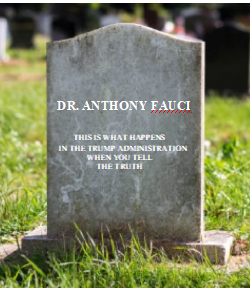
This is what happens in the Trump administration when you tell the truth.


fauci.png

TRUMP DORAL CLOSURES & UPDATES

In light of recent developments with COVID-19 and in collaboration with Miami-Dade County’s mandate, the resort has temporarily ceased all operations.

The safety and well-being of our guests, residents and team members is paramount at Trump National Doral.

The suspension may last for up to 30 days and at this time we will not be confirming any reservations.

Hmmm . . . now tell me again why Trump wants to send people back to work, even while the virus is claiming more and more lives every day.

It couldn’t have anything to do with his failing hotels, could it?

Meanwhile, if he’s so concerned about the “well-being” of Americans, why has he done so little to help fight the disease, and why is he so opposed to giving money and health care to ordinary Americans?

………………………………………………………………………………………………………………………………………….


Trump aides say he’s starting to lose his patience with Dr. Anthony Fauci

President Trump and senior White House advisers are starting to lose patience with Dr. Anthony Fauci, the director of the National Institute of Allergy and Infectious Diseases, as he continues to publicly correct Trump when he makes false statements about the coronavirus, The New York Times reports.

We certainly don’t want Fauci to correct Trump’s endless false statements. He wouldn’t have time for anything else.

………………………………………………………………………………………………………………………………………………………………………………………………………………………………………………………………………..

Trump suggests he might soon prioritize the economy over public health

The White House is apparently regretting letting medical experts handle a medical emergency.

As President Trump’s top coronavirus doctor Anthony Fauci let on in weekend interviews, he’s pleased Trump has actually listened to and taken his advice in fighting the ongoing COVID-19 outbreak.

But starting with a Sunday night tweet, Trump indicated he’s taking back the helm from Fauci as soon as the CDC’s recommended 15-day isolation period is over.

“We cannot let the cure be worse than the problem,” Trump tweeted, (copying what FOX News told him to say) alluding to the economic fallout that coronavirus containment measures have caused.

Trump is especially concerned with the economic fallout to his failing hotels. That is why he wants to send everyone back to work, and that is why he wanted Mnuchin to secretly dole out $425 Billion, to Trump’s failing hotels.

Thank heavens, the Dems are fighting it.

Trump’s followers believe it is a dandy idea.

Vice President Mike Pence echoed that sentiment in saying the CDC would update its guidance Monday to allow people exposed to the virus to return to work sooner if they wear a mask.

Wearing a mask has only marginal value, if that. More people will sicken and die if Trump has his way (but more importantly, his failing hotels will be saved).

It comes amid a “growing sentiment” in the White House that “medical experts were allowed to set policy that has hurt the economy,” and after some Republican lawmakers “pleaded with the White House to find ways to restart the economy.

Yes, masks don’t offer much protection, but who cares?

And as for those medical experts, what do they know about disease?

Let people die from the coronavirus. Saving Trump’s failing hotels is more important than saving people’s lives. Right?

………………………………………………………………………………………………………………………………………………………………………………………………………………………………………………………………….

Trump, whose hotel business is losing millions, says ‘I’ll be the oversight’ of $500 billion coronavirus ‘slush fund’

One of the big sticking points in a $1.8 trillion coronavirus bailout package Senate Republicans are trying to pass is a $500 billion fund for hard-hit businesses and state and local governments.

Treasury Secretary Steven Mnuchin would decide the recipients of $425 billion of that money, and the legislation contains no new oversight provisions for how it’s doled out, leading Democrats to warn that Mnuchin could use this “slush fund” to bail out politically connected corporations, GOP donors, and even President Trump’s private business.

When asked about those concerns during a press conference Monday evening, Trump said: “I’ll be the oversight, I’ll be the oversight. We’re gonna make good deals.”

Are these the same Republicans who keep trying to get rid of health care for the middle- and lower-income people? Yes, they are.

And don’t worry. Trump will be the oversight.

What was that story about the fox guarding the henhouse? This is the story of FOX News guarding the Presidency.

………………………………………………………………………………………………………………………………………………………………………………………………………………….

And here’s another great GOP idea:

Texas Lt. Gov. Dan Patrick thinks grandparents should be willing to sacrifice their lives to save the economy

Texas Lt. Gov. Dan Patrick (R) seems to think that if given the choice, Americans 70 and over would be willing to risk getting coronavirus and possibly dying if it means stores re-open and the economy rebounds.

On Fox News Monday night, Patrick lamented not being asked how he would balance protecting some of the people most at-risk for contracting coronavirus — adults 65 and over — while keeping businesses up and running.

“No one reached out to me and said, as a senior citizen, are you willing to take a chance on your survival in exchange for keeping the America that all America loves for your children and grandchildren?” he said. “If that’s the exchange, I’m all in.”

Well, I certainly would be willing to sacrifice my life if that would save Trump’s failing hotels. I’m sure Trump would do the same for me.

Rodger Malcolm Mitchell
Monetary Sovereignty
Twitter: @rodgermitchell
Search #monetarysovereignty Facebook: Rodger Malcolm Mitchell

…………………………………………………………………………………………………………………………………………………………………………………………………………………………………………………………………………………………..

THE SOLE PURPOSE OF GOVERNMENT IS TO IMPROVE AND PROTECT THE LIVES OF THE PEOPLE.

The most important problems in economics involve:

  1. Monetary Sovereignty describes money creation and destruction.
  2. Gap Psychology describes the common desire to distance oneself from those “below” in any socio-economic ranking, and to come nearer those “above.” The socio-economic distance is referred to as “The Gap.”

Wide Gaps negatively affect poverty, health and longevity, education, housing, law and crime, war, leadership, ownership, bigotry, supply and demand, taxation, GDP, international relations, scientific advancement, the environment, human motivation and well-being, and virtually every other issue in economics.

Implementation of Monetary Sovereignty and The Ten Steps To Prosperity can grow the economy and narrow the Gaps:

Ten Steps To Prosperity:

1. Eliminate FICA

2. Federally funded Medicare — parts A, B & D, plus long-term care — for everyone

3. Provide a monthly economic bonus to every man, woman and child in America (similar to social security for all)

4. Free education (including post-grad) for everyone

5. Salary for attending school

6. Eliminate federal taxes on business

7. Increase the standard income tax deduction, annually. 

8. Tax the very rich (the “.1%”) more, with higher progressive tax rates on all forms of income.

9. Federal ownership of all banks

10. Increase federal spending on the myriad initiatives that benefit America’s 99.9% 

The Ten Steps will grow the economy and narrow the income/wealth/power Gap between the rich and the rest.

MONETARY SOVEREIGNTY