Are you planning to vote for the end of Medicare and Social Security? These people are.

The Libertarians (also known as the Republican Party) want to cancel Medicare and Social Security under the guise of fiscal prudence and courage. The right wing has created a fake “debt crisis” and then invented a non-solution that requires exactly what they deny they want: The end of Medicare and Social Security. (See: Congressional Republicans Want Big Cuts to Social Security) Although Congress is accustomed to misleading statements and outright lies, nowhere are the lies piled deeper than the discussions of Medicare’s and Social Security’s impending “insolvency.” Let’s get something straight. The US government, being Monetarily Sovereign, cannot become insolvent. It has the infinite ability to create U.S. dollars. This means no agency of the U.S. government can become insolvent unless Congress and the President vote for insolvency. Look at this list of federal departments and agencies that cannot run short of money unless Congress and the President vote for insolvency. The list runs alphabetically from the U.S. AbilityOne Commission to the Woodrow Wilson International Center for Scholars. There are 15 executive departments in the United States federal government, each of which is headed by a Cabinet member appointed by the President. The following is a list of the 15 executive departments:

Department of Agriculture Department of Commerce Department of Defense Department of Education Department of Energy Department of Health and Human Services Department of Homeland Security Department of Housing and Urban Development Department of the Interior Department of Justice Department of Labor Department of State Department of Transportation Department of the Treasury Department of Veterans Affairs

In addition to these departments, there are over 430 federal agencies in the United States, including 9 executive offices, 259 executive department sub-agencies and bureaus, 66 independent agencies, 42 boards, commissions, and committees, and 11 quasi-official agencies. Not one of the departments, agencies, executive offices, sub-agencies, bureaus, boards, commissions, committees, and quasi-official agencies can or will run short of dollars unless that is what Congress and the President want. Who says so? How about:

Former Federal Reserve Chairman Alan Greenspan said: “A government cannot become insolvent with respect to obligations in its own currency. There is nothing to prevent the federal government from creating as much money as it wants and paying it to somebody. The United States can pay any debt it has because we can always print the money to do that.”

Ben Bernanke: “The U.S. government has a technology, called a printing press (or, today, its electronic equivalent), that allows it to produce as many U.S. dollars as it wishes at essentially no cost.” Scott Pelley: Is that tax money that the Fed is spending? Ben Bernanke: It’s not tax money… We simply use the computer to mark up the size of the account.

Not many people realize that while state/local taxes pay for state/local spending, federal taxes pay for nothing. Rather than funding federal spending, the sole purposes of federal taxes are:
  1. To control the economy by taxing what the federal government wishes to discourage and by giving tax breaks to what the federal government wishes to reward,
  2. To assure demand for the U.S. dollar by requiring dollars to be used in paying taxes and
  3. To fool the public into believing some benefits are unsustainable unless taxes are raised, which reduces benefits.

Statement from the St. Louis Fed: “As the sole manufacturer of dollars, whose debt is denominated in dollars, the U.S. government can never become insolvent, i.e., unable to pay its bills. In this sense, the government is not dependent on credit markets to remain operational.”

Anyone who claims a federal “debt crisis” is ignorant about, or lying about, federal finances. There is no federal debt crisis. The Libertarians and their alter egos, the Republicans, are doing their best to provide you with false information. Here is a Libertarian article that could have been written by the Republicans:

Congress Is Trying To Avoid Taking Responsibility for the Debt Crisis It Created A fiscal commission might be a good idea, but it’s also the ultimate expression of Congress’ irresponsibility. ERIC BOEHM | 11.29.2023 2:30 PM

It’s inaccurate to say that no one in Congress wants to talk about the national debt and the federal government’s deteriorating fiscal condition.

How can the federal government, which as you’ve just read, has the infinite ability to create dollars, have a deteriorating fiscal condition”? It can’t. It’s like claiming the world’s oceans have a deteriorating liquid condition, or the universe has a deteriorating atomic condition. The lie about “deteriorating fiscal condition” forms the basis for the rest of the lies.

Indeed, during Wednesday morning’s meeting of the House Budget Committee, there was a lot of talk about exactly that.

“Runaway deficit-spending and our unsustainable national debt threatens not only our economy, but our national security, our way of life, our leadership in the world, and everything good about America’s influence,” said Rep. Jodey Arrington (R–Texas), the committee’s chairman.

Rep. Jodey Arrington either is stupendously ignorant or stupendously lying. The phrase “unsustainable national debt” consists of three words, all three of which are lies.
  1. “Unsustainable”: Interestingly, this word never is explained by those who use it incessantly. I suspect it means something like this: Federal finances are like personal finances. If your expenses are larger than your income, eventually, you won’t be able to pay your bills, so your debt will be “unsustainable.”The problem is that the federal government is Monetarily Sovereign while you are monetarily non-sovereign, which is totally different. You can run short of money. The federal government cannot.
  2. “National” This has to do with Treasury Securities, which indeed are national or federal. The federal government is the sole authority to issue T-bills, T-notes, and T-bonds. However, the owner of those T-bills, T-notes, and T-bonds is not the federal government. When someone or some nation buys a T-security, their dollars go into their T-security account. Those dollars remain the property of the buyer.They never are owned by the federal government. When the T-security reaches maturity, the dollars are returned to their owner. Think of a bank safe-deposit box. The bank never owns the contents. It holds them for safekeeping and returns the contents to the owner. The government’s storage of unused dollars for safekeeping, stabilizes the dollar.
  3. “Debt” relates to the mistaken claim that T-securities represent borrowing. But our Monetarily Sovereign government, with its infinite ability to create dollars, never borrows dollars. The only dollars the federal government ever owes are the dollars it uses to pay for things. Those dollars are paid in a timely fashion by a government that has the infinite ability to create dollars. There is no long-term buildup of federal “debt.”

He pointed to the Congressional Budget Office (CBO) projections showing that America’s debt, as a share of the size of the nation’s economy, is now as large as it was at the end of the Second World War—and that interest payments on the debt will soon cost more than the entire military budget.

The above paragraph refers to the infamous and much-misunderstood Debt/GDP ratio. It is a meaningless ratio that tells nothing and predicts nothing about a Monetarily Sovereign nation’s finances. A high or low ratio does not indicate solvency, growth, or any other financial factor. It is entirely useless. The so-called “Debt” (that isn’t a real debt) is the net total of all T-securities purchased and still outstanding for the past 10 years. They are not a burden on the federal government, which merely returns the dollars it holds for the owners when the security matures. By contrast, GDP is a one-year (or less) total of America’s (not just the federal government’s) spending. The formula for GDP is:

GDP = Federal Spending + Non-federal Spending + Net Exports

Comparing federal “Debt” to GDP is worse than comparing your 10-year income to the federal government’s spending this week: It is meaningless. The sole purpose of this comparison is to fool you into believing the federal government is running short of the dollars it has the infinite ability to create.

What’s missing, however, is any sense that Congress is willing to turn those words into action. Just look at the premise of Wednesday’s hearing: “Examining the need for a fiscal commission.”

Yes, it was a meeting about possibly forming a committee to discuss perhaps doing something to address the problem. In fact, it was the second such committee hearing in front of the House Budget Committee within the past few weeks.

It seems like there ought to be a more direct way to address this. , say, if a committee already existed within Congress was charged with handling budgetary issues. A House Budget Committee, perhaps.

But instead of using Wednesday’s meeting to seek consensus on how to solve the federal government’s budgetary problems, lawmakers debated a series of bills that aim to let Congress offload that responsibility to a special commission.

Unlike you, me, local governments, and businesses, the federal government’s only true “budgetary problem” is to decide where it wishes to spend its infinite hoard of dollars. While you et al. must worry about the availability of dollars, the federal government has no such constraints. It creates dollars by spending dollars. This is the process:
  1. When the federal government buys something and receives an invoice, it sends to the seller’s bank instructions (not dollars), instructing the bank to increase the balance in the seller’s checking account.
  2. When the bank does as instructed, new dollars are created and added to the M2 money supply measure.
  3. The instructions then are approved by the Federal Reserve, an agency of the federal government.
In short, the federal government creates dollars by spending dollars, and this creation is approved by the Federal Reserve, an agency of the federal government. The federal government creates the laws that approve its money-creation process. Being Monetarily Sovereign, the federal government can create any money-related laws it wishes, which is why no federal agency can run short of dollars unless the federal government wants it to run short. Federal agencies are not supported by federal taxes; they are supported by federal money creation. Medicare and Social Security can run short of dollars only if that is what Congress and the President want.

What that commission would look like and how its recommendations would be handled will depend on which proposal (if any of them) eventually becomes law—and even that seems somewhat unlikely, with Democrats voicing their opposition to the idea throughout Wednesday’s hearing.

To be fair, there are plenty of good arguments for why a fiscal commission might be the best way for Congress to fix the mess that it has made. It is an idea that’s certainly worthy of being considered, even if the whole exercise seems a little bit over-engineered.

All this blah, blah, blah is meant to disguise one simple fact: The rich, who run the U.S.  government, want to cut benefits for the middle and lower-income groups. Here is why:
  1. “Rich” is a comparative. A man owning a million dollars is rich if everyone else has a thousand dollars. But a man owning a million dollars is poor if everyone else has a hundred million dollars. During the Great Depression, anyone earning $20,000 a year was rich. Today, that salary would mark him as poor.
  2. To become richer requires widening the income/wealth/power Gap below you and narrowing the Gap above you.
  3. The rich always want to be richer, i.e.,  to widen the Gap below them.
  4. Because Social Security, Medicare, Obamacare, and all aid to the poor help narrow the Gap between the rich and the rest, the rich repeatedly try to eliminate all such benefits (while giving tax loopholes to the rich).
  5. Under the guise of fiscal responsibility, the right-wing makes unending efforts to cut the federal deficit spending that benefits those who are not rich (while continuing to run deficits that benefit the rich).

Romina Boccia, director of budget and entitlement policy at the Cato Institute, argues persuasively in her Substack that a fiscal commission is the best way to overcome the political hurdles that prevent Congress from taking meaningful action on borrowing and entitlement costs (which are driving a sizable portion of future deficits).

And there it is, the true purpose of a “fiscal commission” is to cut spending on so-called “entitlements” (i.e. Medicare and Social Security.) All the lies about Social Security and Medicare “trust funds” running short of dollars are to make you compliant with the Republican effort to make you poorer and the rich, richer. What you may not realize, these so called “trust funds” aren’t even trust funds.  To quote from the Peter G. Peterson Foundation web site:
A federal trust fund is an accounting mechanism used by the federal government to track earmarked receipts (money designated for a specific purpose or program) and corresponding expenditures. The largest and best-known trust funds finance Social Security, portions of Medicarehighways and mass transit, and pensions for government employees. Federal trust funds bear little resemblance to their private-sector counterparts, and therefore the name can be misleading. A “trust fund” implies a secure source of funding. However, a federal trust fund is simply an accounting mechanism used to track inflows and outflows for specific programs. In private-sector trust funds, receipts are deposited and assets are held and invested by trustees on behalf of the stated beneficiaries. In federal trust funds, the federal government does not set aside the receipts or invest them in private assets. Rather, the receipts are recorded as accounting credits in the trust funds, and then combined with other receipts that the Treasury collects and spends. Further, the federal government owns the accounts and can, by changing the law, unilaterally alter the purposes of the accounts and raise or lower collections and expenditures.
Thus, the federal government can do whatever it wishes with the “trust funds.” It can add to them, subtract from them, or change them from the wrongly presumed mission of supporting federal expenditures. At the click of a computer key or the passage of a law, the balance in the federal “trust funds” could be changed to $100 trillion or $0, and neither would affect taxpayers. Thus, the notion that any federal “trust funds” are, as the right wing claims, “in trouble,” is a lie, unless “trouble” comes from those who don’t wish you to understand the differences between the private sector’s real trust funds vs. the federal government’s phony “trust funds.”

Boccia’s preferred solution would allow the commission’s proposals to be “self-executing unless Congress objects,” meaning that legislators would have the “political cover to vocally object to reforms that will create inevitable winners and losers, without re-election concerns undermining an outcome that’s in the best interest of the nation.”

This would be the Republican’s way of saying, “Don’t blame us for cutting your Social Security. It was the commission that did it.”

It’s probably true that Congress itself is the biggest hurdle to managing the federal government’s fiscal situation. Unfortunately, that’s also the biggest reason to be skeptical: any decisions made by a fiscal commission will only be as good as Congress’ willingness to abide by them.

President Obama, of all people, tried this with the notorious Simpson/Bowles Commission, which made exactly the recommendations expected of it. Fortunately, America learned the plot, and the commission’s recommendations never were implemented. The commission’s recommendations included increasing the Social Security retirement age, cuts to military, benefit, and domestic spending, restricting or eliminating certain tax credits and deductions, and increasing the federal gasoline tax. The Simpson-Bowles proposal would have cut entitlement and social safety net programs, including Social Security and Medicare, which was opposed by critics on the left, such as Democratic Representative Jan Schakowsky (a Commission member) and economist Paul Krugman.

There’s no secret knowledge about reducing deficits that will only be unlocked by bringing together a collection of legislators and private sector experts, which is what most of the bills to create a commission propose doing.

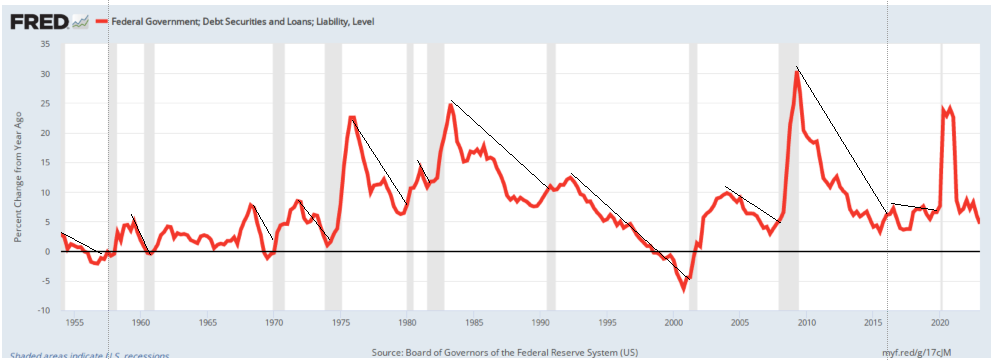
Federal deficit spending is necessary for economic growth. Deficit reduction leads to recessions, which then are cured by deficit increases.
When federal deficits decline (red line). We have recessions (vertical gray bars), which are cured by increases in federal deficits.
One would think that repeatedly seeing the same effect — nine consecutive recessions caused by deficit reduction, 9 successive recessions cured by deficit increases — our leaders eventually would realize that far from being a bad thing, federal deficits are necessary. The ignorant have been claiming for more than 80 years that the federal budget is “unsustainable” and a “ticking time bomb.” Read a list of some such claims here. In all those years, much to the consternation of the ignorant, the ticking time bomb never has exploded.

Congress should hold hearings, invite experts to share their views, draft proposals, vet those ideas through the committee process, and then put the resulting bills on the House floor for a full vote.

Shielding Congress from the electoral consequences of making poor fiscal decisions doesn’t seem to improve budget-making quality. We need Congress to be held more accountable for this mess.

No, we need our leaders to be held accountable for disseminating the lie that federal deficits are harmful. Here is what happens when we ignore the fundamental truth that federal deficits are a blessing, not a curse: Every depression in U.S. history began with a reversal of federal deficit creation:

1804-1812: U. S. Federal Debt reduced 48%. Depression began 1807. 1817-1821: U. S. Federal Debt reduced 29%. Depression began 1819. 1823-1836: U. S. Federal Debt reduced 99%. Depression began 1837. 1852-1857: U. S. Federal Debt reduced 59%. Depression began 1857. 1867-1873: U. S. Federal Debt reduced 27%. Depression began 1873. 1880-1893: U. S. Federal Debt reduced 57%. Depression began 1893. 1920-1930: U. S. Federal Debt reduced 36%. Depression began 1929. 1997-2001: U. S. Federal Debt reduced 15%. Recession began 2001.

Here is what should be done: Step 1. Call it what it really is. Rather than talking about a federal “debt,” we should talk about the economy’s income. The misnamed “debt” is income for the economy. It’s money flowing from the infinitely wealthy federal government into the economy that needs and uses the money for growth. Step 2. Rather than instituting a commission to cut private sector income, thus causing recessions and depressions, America should create a plan to improve the lives of our people. Use the infinite money-creation power of the federal government to:
  • Fund public education about the benefits of Monetary Sovereignty
  • Fund a comprehensive, no-deductible Medicare for every man, woman, and child in America.
  •  for the homeless
  • Fund college for everyone in America who wants an advanced degree.
  • Fund Social Security benefits for every man, woman, and child in America.
  • Eliminate FICA, which funds nothing but is America’s most regressive tax.
  • Fund various research projects, including medical, physical, psychological, and environmental.
  • Fund long-term care
  • Fund housing
  • Fund childcare for working families.
And fund all the other projects that would benefit the public and narrow the Gap between the rich and the rest.

A $33 trillion national debt didn’t come crashing out of the sky like an asteroid that couldn’t be avoided.

“No responsible leader can look at the rapid deterioration of our balance sheet, the CBO projection of these unsustainable deficits, and the long-term unfunded liabilities of our nation and not feel compelled to intervene and change course,” Arrington said Wednesday.

He’s right, but that only draws a line under the contradiction. A responsible Congress would be working on a serious plan to get the deficit under control. Instead, the Budget Committee is working on proposals to avoid doing that.

The article ends with ignorance and lies. Contrary to the above statements, the facts are:
  1. The federal government’s balance sheet is not “deteriorating.”
  2. Deficits are necessary, not “unsustainable.”
  3. All federal liabilities are funded by the federal government’s infinite ability to create sovereign currency.
Finally, if you vote for the right-wing here is a letter you may wish to send to your children and grandchildren:

Dear Loved Ones

I sincerely apologize for electing people who fouled your water, your earth, and your air, cut Social Security, cut Medicare, cut Obamacare, increased your taxes, lied about COVID and vaccinations, and did nothing to improve the lives of all (except the rich, who were well rewarded).

I also apologize for electing a Hitler clone who admitted he would arrest everyone disagreeing with him and give all the nation’s wealth to those who already are wealthy.

I could claim ignorance, but to be honest, I was warned about what would happen. I guess I yielded to my hatred of blacks, browns, yellows, reds, Jews, Muslims, women, the poor, immigrants, and gays. 

I should have learned about Monetary Sovereignty, but I was so busy denying the danger of guns and the attempted coup I had neither the time nor the inclination to learn anything.

Perhaps you will be wiser.

I hope you will forgive me for the miserable, ignorant, hate-filled world I have left for you.

But at least the very rich are very happy.

  Rodger Malcolm Mitchell Monetary Sovereignty Twitter: @rodgermitchell Search #monetarysovereignty Facebook: Rodger Malcolm Mitchell

……………………………………………………………………..

The Sole Purpose of Government Is to Improve and Protect the Lives of the People.

MONETARY SOVEREIGNTY
The Libertarians and the missing data


Here is a Libertarian article, as usual, complaining about the federal deficit. 

Why Did Joe Biden Stop Talking About the Deficit?

You can read the entire article by clicking the above link, but here are excerpts to give you the essence. Can you guess what crucial data is missing from the report?

The federal budget deficit has exploded under Biden’s watch, and he can no longer pretend otherwise. ERIC BOEHM | 7.19.2023

At times last summer, it seemed like the only thing President Joe Biden wanted to talk about was the federal budget deficit.

We’re on track to cut the federal deficit by another $1.5 trillion by the end of this fiscal year. The biggest decline ever in a single year, ever, in American history,” Biden claimed during a May 2022 press conference.

Later that same month, in a Wall Street Journal op-ed touting his economic program, Biden wrote that the deficit would fall by $1.7 trillion and repeated the “largest reduction in history”claim. That talking point was still getting heavy rotation in September when the president bragged on 60 Minutes about his deficit-cutting powers.

Of course, as Reason (and other outlets) clarified, the falling deficit was not the result of anything the president had done. There had been an unprecedented amount of federal spending in 2020 and 2021 due to the COVID-19 pandemic, and that spending drove the budget deficit to record highs: over $3.1 trillion in 2020 and more than $2.7 trillion in 2021.

As the pandemic passed and federal spending returned to more normal levels, so did the annual budget deficit. (In fact, the deficit would have fallen further last year if not for Biden’s policies, thanks to things like the infrastructure bill and last year’s federal budget.)

 The CBO projects that the deficit will ring in around $1.5 trillion when the current fiscal year wraps up on September 30.

Funny that Biden doesn’t want to talk about that.

It’s less funny that he’s also ignoring the trajectory of the federal deficit in future years. Rather than shrinking, the gap between federal revenue and federal spending is on course to widen dramatically in the coming decades.

Wow, the federal budget deficit must awful for the economy. Here is what Eric Boehm, the Libertarians, and the Congressional Budget Office claim:

That means the federal government will have to take on more debt. The rising cost of that debt will “slow economic growth, drive up interest payments to foreign holders of U.S. debt, elevate the risk of a fiscal crisis, increase the likelihood of other adverse effects that could occur more gradually, and make the nation’s fiscal position more vulnerable to an increase in interest rates,” the CBO warned last month.

That’s quite a claim. Have you figured out what’s missing?

Data. There is no data. Just assumptions.

Let’s examine those assumptions: Will federal deficit spending “slow economic growth”?

The term “economic growth” means Gross Domestic Product (GDP) growth. The formula for GDP is GDP = Federal Spending + Nonfederal Spending +Net Exports.

Look at that formula and explain to me the mechanism by which federal deficit spending will “slow economic growth.”

Unless you believe there is some magic way in which increased taxes can increase economic growth, there is no mechanism by which increased federal deficit spending can “slow economic growth.”

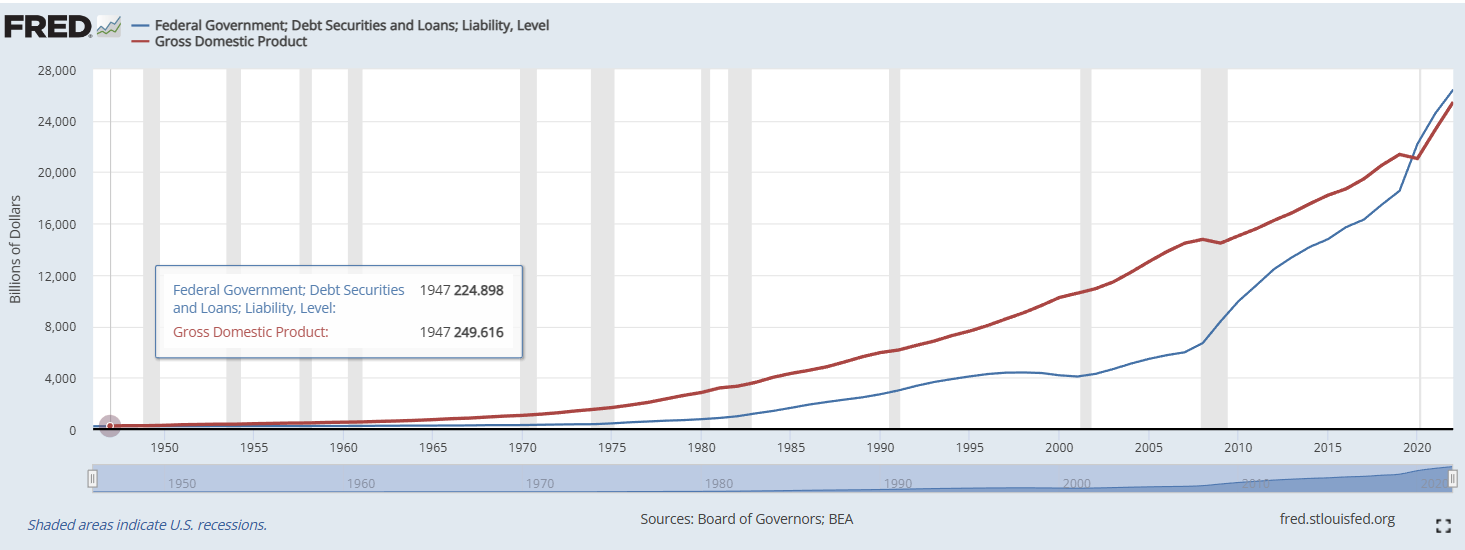
Federal deficit spending and GDP have risen since 1945

Will increased federal deficit spending “drive up interest payments to foreign holders of U.S. debt.” Yes, of course, it will. But is that supposed to be a problem?

Being uniquely Monetarily Sovereign, the federal government has infinite dollars. It pays all its dollar-denominated debts simply by pressing computer keys. No tax dollars are involved.

And despite the massive increase in deficits, the government never has and never will run short of dollars to pay interest.

Further, the federal government has absolute control over interest rates. The Fed sets rates arbitrarily to combat inflation, not to sell T-bonds.

The federal government has no need to sell any debt. It could stop offering T-securities tomorrow, and that would not affect the government’s ability to spend.

The sole purpose of T-securities is to provide a safe place to store unused dollars, which helps stabilize the dollar, not to provide spending money to the federal government/

(This is different from state/local government taxes, which do provide spending money to state/local governments.)

Will increased federal deficit spending “elevate the risk of a fiscal crisis”? What fiscal crisis? Unlike you and me. The government can’t run short of dollars. 

Liars love to use general language without data backup.

Will increased federal deficit spending “increase the likelihood of other adverse effects that could occur more gradually, and make the nation’s fiscal position more vulnerable to an increase in interest rates”?  What adverse effects?

The CBO Libertarians never say because there are none.

And what do they mean by the nation’s “fiscal position being vulnerable”? Again, they never say.

The warning is one big fat load of generalized poppycock, a vast word salad with zero meaning.

Why do they embarrass themselves by spewing such nonsense? Here’s one reason, probably the main reason:

Biden successfully blocked a House Republican attempt to impose stricter spending caps as part of that deal and refused to include entitlement spending—the real driver of long-term deficit growthin the negotiations.

Ah, yes. The “real driver” of deficit growth is entitlement spending, aka Social Security, Medicare, Medicaid, unemployment, and other “welfare” programs — all benefits to the middle- and lower-income groups.

Why do the Libertarians and the Republicans want to cut those programs? Why do they spread the nonsense that, somehow, the federal government can’t afford them, when the federal government can afford any payment denominated in U.S. dollars?

Statement from the St. Louis Fed: “As the sole manufacturer of dollars, whose debt is denominated in dollars, the U.S. government can never become insolvent, i.e., unable to pay its bills. In this sense, the government is not dependent on credit markets to remain operational.”

Get it? “Not dependent on credit markets. That’s Fed-speak meaning the government does not need to borrow, and in fact, does not borrow. It creates all the dollars it needs by pressing computer keys.

The reason has to do with Gap Psychology. The logic goes like this:

  1. “Rich” is a comparison, not an absolute. If you had $1,000, you would be rich if everyone else had $10, but you would be poor if everyone else had $10,000.
  2. To become more affluent, you must widen the Gap between you and those who have less while narrowing the Gap between you and those who have more.
  3. You can widen the Gap in two ways: Get more for yourself or make sure those below you have less.
  4. The rich, who run America, get richer by widening the Gap below them. This includes spreading the false tale that Social Security, Medicare, etc., must be cut. They spread the tale by bribing three influencers:
    • The media, bribed by advertising dollars and media ownership
    • The politicians, bribed by campaign contributions and promises of future employment
    • The economists, bribed by university contributions and lucrative jobs in “think tanks.”

Thus, the Big Lie (federal finances resemble personal and state/local government finances) is disseminated.

The public is led to believe their federal tax dollars fund federal spending. They don’t. The purpose of federal (as opposed to state/local) taxes is to control the economy by taxing what the federal government wishes to discourage and giving tax breaks to what the government wishes to help.

Additionally, federal taxes can help increase demand for the U.S. dollar by requiring taxes to be paid in dollars.

So, the entire article is based on lies. That is why it contains no historical data.

These general claims seem logical to the public because the claims apply to monetarily non-sovereign entities, not the Monetarily Sovereign U.S. government.

You never will see this graph presented by any Libertarian or Republican:

Before recessions (vertical gray bars), federal deficit growth declines, then increases to cure the recessions.

Note to politicians, media writers, and right-wing economists, you’ve done a great job lying to the public on behalf of the rich. You have helped make the rich richer. Congratulations.

One day, soon (I hope), the public will catch on to your lies.

At that time, the people will demand, vote for, and receive such benefits as Free Medicare, expanded Social Security, affordable food and housing, and free college education.

The rich already receive those benefits, courtesy of “friendly” tax laws.

The rest of the population soon will catch on to the fact that the federal government can supply all the benefits the rich receive, while collecting zero taxes.

The public just needs to see that they have been lied to.

Rodger Malcolm Mitchell
Monetary Sovereignty

Twitter: @rodgermitchell Search #monetarysovereignty
Facebook: Rodger Malcolm Mitchell

……………………………………………………………………..

The Sole Purpose of Government Is to Improve and Protect the Lives of the People.

MONETARY SOVEREIGNTY
A Challege: Show me where I’m wrong.

Do you love learning? Even though I passed right through 88, and am roaring toward 89, I still do, which means I love being shown where I’m wrong. How else can anyone learn but to be given new beliefs that replace former beliefs?
UX Design Thinking From A Senior Citizen's Perspective - Usability Geek
Never be too old or too sure to learn.
So here is a challenge to you, my readers, plus the MMT gang (Stephanie, Warren, Randy et al.), CRFB, Fox viewers, mainstream economists, journalists, politicians of all stripes, and all others who may believe some or all of what I believe is wrong. You may agree with me on many things but disagree on certain details (Hello MMTers). I’d love to hear from you. Some of you may disagree with everything I write. I’d love to hear from you (except from those whose main argument consists of comparing me to excrement. No learning there; I’ve heard it all). Some of you merely may have questions, not necessarily disagreements, about what I believe. Send me your questions and I will try to answer those I feel may be educational. Some of you agree with everything I write. Gotta love you. Here’s the challenge: I will list certain things I believe. You tell me where I’m wrong, and this is the important part: Show me your data. I’ll print worthwhile comments along with whether I feel you’ve made a valid point(s). Where appropriate, I’ll provide data or other evidence to substantiate my point. Or, I’ll simply agree with  you. This way, we all can learn, and it will be fun. I believe:

I. Our Monetarily Sovereign government never can run short of its sovereign currency, the U.S. dollar. It can pay for anything costing dollars, instantly, simply by pressing computer keys. This compares to city, county, and state governments, which are monetarily non-sovereign, and do not have a sovereign currency, so can and often do run short of dollars.

In the same vein, euro nations like Germany, France, Italy, Greece et al, do not have sovereign currencies, so they can and do run short of euros. The European Union is Monetarily Sovereign so it  cannot run short of euros.

II. Federal taxes do not fund federal spending. The primary purpose of federal taxes is to control the economy by taxing what the government wishes to limit and by giving tax breaks to what the government wishes to encourage.

Even if the federal government collected $0 taxes, it could continue spending, forever. In fact, the Treasury destroys all the tax ollars it receives, and orders new dollars to pay for goods and services.

A secondary (though not necessary) purpose of federal taxes is support demand for the U.S. dollar by requiring dollars to be used for tax payments.

III. The Federal government does not borrow dollars, nor does it use the dollars that are deposited into T-security accounts. After being deposited, those dollars remain the property of the T-security account holders and are not touched (including the interest dollars deposited by the government.)

The federal government easily could operate without accepting any T-security dollars. The purposes of T-securities are to provide a safe storage place for unused dollars (which stabilizes the dollar), and to aid the Federal Reserve in controlling interest rates.

IV. The federal deficits and debt are not, nor will they ever be, “unsustainable.” That word, “unsustainable,” is used by Libertarians and other debt hawks, yet never have I seen what it supposedly means. Does “unsustainable” mean the government will be unable to pay its bills? If not, what exactly does it mean?

The “debt ceiling” is an artifact of economic ignorance and should be eliminated. It’s sole purpose is to provide an excuse for outrage by the political party not in power. As such, it is a danger to America if used by traitors in Congress.

V. Federal deficit spending never causes inflation. Every inflation in history has been caused by shortages of key goods and services — most often oil and food — not federal deficits.

 Today’s inflation was caused by OPEC and Russia related shortages of oil, and by COVID-related of a litany of products and services.

The old saw, “Inflation is too much money chasing too few goods” is half wrong and half right. It should read, “Inflation is too few goods and services.” Period.

VI. Federal spending does not cause the above-mentioned shortages. Inflations tend to come suddenly. Federal spending does not cause a sudden increase in oil shortages (producers like OPEC, Russia and even America can and do suddenly contract production.)

Similarly, federal spending does not cause people suddenly to eat more food, thereby causeing a food shortage.

Thus, federal deficit spending does not cause inflation.

VII. All hyperinflations — pre-WW2 Germany, Zimbabwe, Argentina, et al. have been caused by shortages, not by government spending. The illusion of “excessive” spending (the infamous currency in a wheelbarrow) is created by an unknowledgable government’s poor response to inflation — printing higher denominations of currency rather than acquiring and distributing the scarce products and services.

VIII. Recessions are caused by reduced federal deficit spending and are cured by increased deficit spending to acquire and distribute the scarce products and services.

IX. Depressions are caused by federal surpluses and “balanced budgets,” and are cured by deficit spending.

X. The federal government can and should fund no-deductible, comprehensive Medicare coverage to every man, woman and child in America.

IX. The federal government can and should fund Social Security benefits for every man, woman, and child in America.

X. The federal government should fund all education from pre-K through post-college-grad, while paying people to attend school. The pre-K through 12 financial burden should be taken from the monetarily non-sovereign cities, counties, and states and paid by the infinitely solvent federal government.

XI. Benefits from the federal government do not dissuade people from working. The vast majority of Americans wish to increase their incomes and/or move up the income/wealth/power scale, so they will work to augment whatever they receive from the federal government.

XII. All benefits should go equally, to everyone, rich or poor. This eliminates the onerous task of monitoring.  incomes.

XIII. Gap Psychology (The desire of those near the top of any social scale to distance themselves from those below, and the desire of those below to approach those above) is the prime driver of bigotry, poverty and street crime in America. Curing those social problems will require dealing with Gap Psychology.

XIV. Gold, silver, or any other physical substance never were money, nor have they ever “backed” money nor provided safety for money. They merely are products the federal government periodically decides to purchase or sell at prices stipulated by the whim of the federal government.

If I were writing a book, every paragraph, I – XIV, would warrent a separate chapter and supporting data. Instead, I’ll address your comments and questions, and most importantly, I’ll provide supporting data, as I hope you will. Hoping to receive many objections, so we all can learn. Sincerely, Rodger Malcolm Mitchell Monetary Sovereignty Twitter: @rodgermitchell Search #monetarysovereignty Facebook: Rodger Malcolm Mitchell

……………………………………………………………………..

The Sole Purpose of Government Is to Improve and Protect the Lives of the People.

MONETARY SOVEREIGNTY

The useless, no harmful, battles over the Big Lie

Imagine witnessing an argument between two people. Person #1 says, “A stork delivers babies.” Person #2 says, “FedEx delivers babies.” What would you say about that argument? That it’s so ignorant as to be beyond words? It’s pretty much what I say about arguments concerning the U.S. federal “debt.”

Dems, Republicans Far Apart On Soaring U.S. Debt: I&I/TIPP Poll, Terry Jones, April 17, 2023

The perennial dance between the president and Congress over the budget and raising America’s debt ceiling is a widely reported but much-ignored, event. This time around, it shouldn’t be.

Even as our national debt soars, Americans are split over how serious the problem is, the latest I&I/TIPP Poll shows. Meanwhile, a government shutdown, or even possibly default, looms.

At the last official count, federal debt totaled about $31.5 trillion. Looked at from a different perspective, $31.5 trillion means each American household is now responsible for roughly $237,500 in U.S. debt.

There is the Big Lie in all its glory. As an American, you are responsible for exactly $0 of the so-called “debt” (that isn’t even a real debt).

And it’s getting bigger fast, posing a threat to both the economy and the financial system. If Congress and President Joe Biden can’t make a deal soon, a government shutdown, or worse, possible default, loom.

What exactly is the “threat”? Is it that our Monetarily Sovereign government, which has the infinite ability to create its sovereign currency, the dollar, will be unable to service the “debt”? No, as previous Federal Reserve Chairs have said:

Alan Greenspan: “A government cannot become insolvent with respect to obligations in its own currency.”

Ben Bernanke: “The U.S. government has a technology, called a printing press (or, today, its electronic equivalent), that allows it to produce as many U.S. dollars as it wishes at essentially no cost.”

Will the interest on the “debt” bankrupt the government? No:

Alan Greenspan: “There is nothing to prevent the federal government from creating as much money as it wants and paying it to somebody.”

The federal “debt” isn’t even federal debt. It is the net total of deposits into T-security accounts held at the Federal Reserve. Each account resembles a safe deposit box. The depositor owns the contents. When each account matures, the contents are returned to the owner by transference to the owner’s checking account. It’s a simple asset transfer that does not involve you — not as a debtor, taxpayer, or American citizen — not in any way. So you can forget about the $237,500 Terry Jones, the author, claims you owe. You don’t.

How does the public feel about this? The online I&I/TIPP Poll for April, taken from March 29-31 from 1,365 Americans across the country, asked the following question: “Some say that the debt is not sustainable.

Others say that the debt is manageable relative to the size of the American economy. Which is closer to your viewpoint?”

The respondents were given the false choice of two wrong answers. The “debt” is neither sustainable nor “manageable.” It is meaningless. The size of the economy is not the point. So long as America’s obligation to creditors is in U.S. dollars, it is totally under the control of the U.S. government. Governments get into financial trouble when:
  1. They are monetarily non-sovereign, so they cannot create whatever currency they use (Examples are cities, counties, states, and euro nations) or
  2. They are Monetarily Sovereign but still trade and borrow in U.S. dollars or some other currency, not their own (Examples are Argentina, Russia, Venezuela).

Overall, voters saying the debt is “not sustainable” totaled 48%, a plurality, compared to those who called the debt “manageable relative to the size of the economy” at 35%. (The poll’s margin of error is +/-2.8 percentage points.)

It was a meaningless poll. The public believes what they are told, and they are wrongly told that federal (Monetarily Sovereign) financing is like personal (monetarily non-sovereign) financing.

The political breakdown, however, is telling and perhaps explains why the debt debate each year gets increasingly divisive and angry: Republicans (74%) and independents (50%) overwhelmingly call the debt unsustainable, compared to Democrats at just 32%.

Only 14% of Republicans and 28% of independents call the debt “manageable,” versus 51% of Democrats who do.

This huge split between Democrats on one side, and Republicans and independents on the other, will make it hard to forge a deal satisfactory to both sides. Failure to do so risks a financial cataclysm.

It isn’t the split that makes it hard to forge a satisfactory deal. It’s just that the two alternatives are of the “stork vs. angel” variety. The third alternative — that the so-called “debt” (i.e., deposits) is meaningless — was not offered.

What can be done? On Jan. 19, the debt ceiling was hit, meaning the government has had to play a kind of fiscal shell game to pay its bills.

As though the use of the term “debt” to mean “deposits” and the wrongheaded worries about “sustainability” (whatever that means) weren’t enough, the not-a-debt also repeatedly has been called a “ticking time bomb” every year since 1940. In 1940 the Gross Federal Debt was $51 Billion. By 2022, it was $31 Trillion, an astounding 60,000% increase. Annual predictions have been made that the “debt” is not sustainable, and every year America sustains it. Although it is the slowest time bomb in history, you can rely on this year’s repeat of the annual predictions that the “debt” is “unsustainable.” And as for that  “shell game,” it’s the result of a strange law that essentially says, “We will punish our creditors unless they immediately return the dollars that T-security account owners have deposited.”

House Republicans, negotiating with the Biden administration, have put forward a plan to temporarily raise the debt ceiling until May of next year. In exchange for avoiding a possible federal default, they seek caps on federal spending,

The argument is this. The debt is unsustainable, but we’ll raise this unsustainable ceiling if you take dollars from the middle classes and the poor. Yes, really.

“The GOP proposal would call for a cap on either non-defense discretionary spending or overall discretionary spending after paring the federal budget back to 2022 levels,” the Washington Times reported last week.

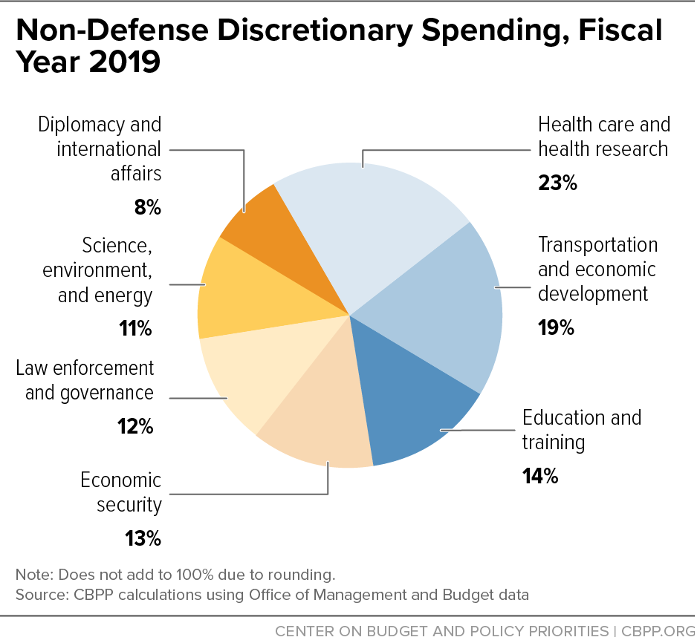
What exactly is “non-defense discretionary spending“? Non-Defense Discretionary Spending, Fiscal Year 2019 In 2019, non-defense discretionary (NDD) spending totaled $661 billion, or 14 percent of federal spending. That same year, the federal “debt” was $23 Trillion. The entire NND was less than 3% of the so-called “debt.” Would you be willing to see every dollar cut from health care and health research, diplomacy, science, environment, energy, transportation, economic development, law enforcement and governance, education and training, and economic security? Oh, but that’s not all.

“The proposal would also claw back unspent COVID-19 funds, block President Biden’s student loan forgiveness plan that is currently tied up in a Supreme Court battle, institute work requirements for social welfare programs and implement the Republican plan to lower energy costs, which passed the House but is expected to languish in the Senate,” the report said.

Essentially, the GOP’s idea is to punish the poor and middle classes and reward the military-industrial complex, all for the dubious accomplishment of immediately returning the deposits in T-security accounts. Of course, the GOP doesn’t have a real plan. Those were some general suggestions. They have refused to devise an actual plan because their only thought is to negate anything Biden suggests and exact Trumpian revenge by investigating Democrats. It’s the failed Benghazi investigation all over again.

And the White House’s position has always been: No preconditions. Just raise the debt ceiling.

The real position should be “No preconditions. Just eliminate the debt ceiling. But, the public has been imbued with the notion that having a debt ceiling makes for prudent finance. So flat-out elimination only can be accomplished when the public is educated that the “debt” is meaningless for a Monetarily Sovereign government. Strangely, the public doesn’t complain when the ceiling arbitrarily is raised — 90 times — but probably would object to it being eliminated. That’s human thought.

Fresh from his April 11-14 trip to Ireland, Biden had this to say when asked if he would talk to McCarthy:

“Of course, I’ll speak to him. Show me his budget,” Biden told reporters. “That old expression — ‘show me your budget.’ You know, he — we agreed early on, I’d lay down a budget, which I did on March 9th, and he’d lay down a budget.”

“I don’t know what we’re negotiating if I don’t know what they want,” Biden added.

Sunday was the deadline for Congress to agree on a new budget. For the 20th year in a row, it failed in that responsibility. No surprise there since the Senate is controlled by the Democrats and the House by Republicans, who remain far apart in their priorities.

What should be done?

It’s not a difficult question. The debt ceiling should be eliminated. Period.

The Biden Administration believes the solution to America’s economic woes is more federal spending and higher taxes.

Having increased federal spending by nearly $5 trillion in its first two years, the Biden administration now proposes additional tax and spending increases totaling $4.7 trillion and $1.9 trillion, respectively.

Those who understand Monetary Sovereignty know that our Monetarily Sovereign government has no need or use for taxes. It has the infinite ability to create dollars at the touch of a computer key. Monetary Sovereignty became a reality in 1971 — the “Nixon Shock” — when President Nixon made the most significant move of his administration: He divorced the U.S. dollar from gold. We no longer needed to match the value of gold (which changed daily) to any fixed number of dollars. We could create dollars at will as we needed them. The debt ceiling was created in 1917 to allay fears about dollar acceptance. It tried to make lenders and users confident that the dollar would not suddenly lose value. Today, the debt ceiling is laughably useless.

Depending on who is doing the research, it is said that the US raised its debt ceiling (in some form or other) at least 90 times in the 20th century.

Anyone with at least half a brain would understand that if any limit is increased 90 times, it has served no useful purpose. The sole purpose is to give the party that is not in power some leverage over the party in power. It’s a foolish idea, which is why Congress loves it.

The debt ceiling was raised 74 times from March 1962 to May 2011,[14] including 18 times under Ronald Reagan, eight times under Bill Clinton, seven times under George W. Bush, and five times under Barack Obama. The debt ceiling has never been reduced, even though the public debt itself may have been reduced.

Congress has raised the debt ceiling 14 times from 2001 to 2016. The debt ceiling was raised a total of 7 times during Pres. Bush’s eight-year term, and it was raised 11 times during Pres. Obama’s eight years in office.

Meanwhile, White House assertions that it will actually cut deficits over the next decade by $3 trillion have been roundly criticized by budget hawks. In fact, projections from the nonpartisan Congressional Budget Office show annual deficits growing from $1.4 trillion this year to $2.7 trillion in 2033, while as a result total federal debt will soar from $32.4 trillion at the end of this year to $52 trillion in 2033.

The White House, the entire Democratic Party, and the entire Republican Party (with the possible exception of Marjorie Taylor Greene) understands the debt ceiling is a fraud. But the public doesn’t understand it, so all politicians suck up the “fiscal responsibility” of the debt ceiling. In a way, it’s something like the GOP denying that Donald Trump is a criminal or the Democrats saying that a tax increase on the rich would “pay for” something.

The IMF’s Fiscal Affairs Director Vitor Gaspar recently told Yahoo Finance that it is clear “that from the viewpoint of medium- and long-term prospects, there is a very strong case for fiscal adjustment in the U.S.”

Actually, “there is a very strong case for” Gaspar lying or ignorant of Monetary Sovereignty.

Of greater concern is what would happen if foreign holders of U.S. government debt suddenly get spooked and start to sell their holdings of U.S. securities.

Officially, foreign treasuries and investors own about $7.6 trillion of U.S. government debt. Bad news here, such as a default on U.S. debt this summer, could spark a run on the dollar and cause interest rates to surge, sending a recessionary shock wave through the U.S. and global economies.bad news

If Congress would forget about the phony debt ceiling, it could, if it wished, pay off the federal “debt” tomorrow simply by returning the dollars sitting in T-security accounts. The purpose of those accounts is not to provide the U.S. government with spending dollars. It has infinite amounts of those. T-bills, T-notes, and T-bonds, the purpose  of which is to provide a safe, interest-paying place to store unused dollars. This stabilizes the dollar. All this nonsense about debt ceilings is about to do exactly what the debt Henny Pennys fear: Cause a run on the dollar.

Recent deals among the Russians, Chinese, and Saudis to create alternatives to the world’s dollar-based trade are already threatening the dollar’s preeminent position as the No. 1 global currency.

A debt panic might push the dollar to the brink, bringing inflation and perhaps eventually forcing the U.S. to do something it hasn’t had to since before World War II — pay some, if not most, of its bills in someone else’s currency, a huge disadvantage.

No, the Russians, Chinese, and Saudis won’t cause a run on the dollar, but this year the Republican Party might do just that.

Americans’ complacency about our growing fiscal problems has so far not hurt us too badly. That might not always be the case, however.

Complacency won’t hurt us. The nutty debt ceiling eventually might, however. We should get rid of the damn thing before it causes real damage.

I&I/TIPP publishes timely, unique, and informative data each month on topics of public interest. TIPP’s reputation for polling excellence comes from being the most accurate pollster for the past five presidential elections.

Terry Jones is an editor of Issues & Insights. His four decades of journalism experience include serving as national issues editor, economics editor, and editorial page editor for Investor’s Business Daily.

And by the way, when the federal debt doesn’t rise enough, we have recessions.  
When federal debt growth falls, we have recessions (vertical gray bars.) Recessions are cured by increased federal debt growth. 
It’s pretty simple. A growing economy requires a growing supply of money. Federal deficit spending adds money to the economy. Not enough federal money = recessions. Add federal money = recessions cured. Does it get simpler than that? Rodger Malcolm Mitchell Monetary Sovereignty Twitter: @rodgermitchell Search #monetarysovereignty Facebook: Rodger Malcolm Mitchell

……………………………………………………………………..

The Sole Purpose of Government Is to Improve and Protect the Lives of the People.

MONETARY SOVEREIGNTY