Jonah Goldberg is editor-in-chief of The Dispatch and the host of The Remnant podcast. His Twitter handle is @JonahDispatch. Goldberg’s column is provided by Tribune Content Agency.
Mr. Goldberg proves, once again, that having a platform doesn’t assure you know where you stand.
Immediately, we see a problem. Anyone who claims to be a “lifelong” anything, really is telling you: “I’ve made up my mind, so don’t bother me with facts, and especially don’t bother me with facts the might disprove what I have believed since birth.”
One of the most important lessons of the last two decades is that black swan events — game-changing surprises — aren’t nearly so rare as we’d like.In 2001, a terrorist attack resulted in two decades of military conflict. Adding up defense, health care for vets and other related costs, the price tag amounts to an estimated $5.8 trillion to $8 trillion.In 2007-08, a financial crisis almost wrecked the economy. The combined loss of tax revenue and increased expenditures put the cost around $2 trillion. A 2018 Federal Reserve Board study estimated the cost to each American at $70,000.
Really? $70,000 cost to each American? Somehow I don’t recall paying $70,000 for anything other than a down payment on a house. Even my car cost a bit less than $70,000.
I’ll bet you didn’t pay that mythical $70,000 for the government’s debt, either.
It’s the typical “play-with-numbers” lie that debt-naggers like to spread, the sole purpose of which is to scare you. You didn’t pay for the terrorist attack, and you never will. You didn’t pay the government’s share in curing the financial crisis, and you never will.
You, very simply, never will pay for federal spending. The purpose of federal taxation is not to provide spending money for the government, but rather to control the economy. Taxes help the government discourage what it doesn’t like and encourage what it does like.
The federal government creates all the dollars it needs by sending instructions to banks, telling the banks to increase the balances in checking accounts. When the banks obey those instructions, instant dollars are created. The federal government never can run short of instructions.
The social and political costs are still unfolding. Historically, financial crises spark intense, and long-lasting, populist revolts. Normal recessions do not have the same effect. (This is something to keep in mind as a debt crisis becomes more likely.)
The only “debt crisis” would come if Congress fails to raise (or better yet, eliminate) that ridiculous “debt ceiling,” aka the deadbeat law. You know, it’s the one where Congress decides whether or not to pay the bills it already owes.
Then there’s the pandemic. In November, economists David Cutler and Lawrence Summers estimated the costs in lost growth, income, life expectancy, etc. to be more than $16 trillion, roughly 90% of U.S. annual gross domestic product. The federal government has spent nearly $6 trillion combating the pandemic.
Because the U.S. federal government has the infinite ability to create its own sovereign currency, that $6 trillion amounts to less than one molecule of water from all of earth’s oceans.
It won’t cost you a single cent, nor will your children and grandchildren owe it.
To pay all its bills, the federal government creates new dollars, ad hoc. It never runs short of dollars.
And please don’t get me started on Larry Summers. You can read about him here.
Much of that spending was necessary or defensible. Government is supposed to respond to extraordinary circumstances with extraordinary measures.Which brings me to the case for raising taxes.What happens when the next black swan touches down? Do we have the financial bandwidth to handle a new pandemic or financial crisis? How about a Chinese invasion of Taiwan? A nuclear terror attack? And, remember, the current pandemic isn’t over yet.
I assume “financial bandwidth” is supposed to be a clever way of asking, “Does the U.S. federal government have enough dollars to [name of emergency goes here].” The answer is: Our Monetarily Sovereign government has enough “bandwidth” to pay any debt of any size, any time.
Even if the U.S. government collected $0 taxes, it could keep spending, forever.
World War II was a noble and necessary expenditure of national resources. But it was expensive, driving national debt to 110% of GDP. Afterward, there was a broad consensus that we had to pay it down.
“Broad consensus to pay it down?” I think not.
In 1940, the Gross Federal Debt was $50 billion. In 1945 it was $260 billion. By 1960 it was $291 billion. Today, it’s about $25 trillion. The
The federal government never has had any difficulty paying its bills, and never will.
And by the way, the 110% debt/GDP ratio is 110% irrelevant. Classic apples/oranges comparison.
The “debt” is the total of deposits into Treasury Securities (T-bills, T-notes, T-bonds). GDP is total spending in the economy.
The Debt/GDP ratio demonstrates nothing, predicts nothing, and means nothing with regard to the federal government’s ability to pay. Anytime you see a reference to that ratio, know this: The user doesn’t know what he is talking about.
It is impossible to look at the Debt/GDP ratio for any nation and learn the financial health of that nation.
Today, our debt level is even worse, but to say there is no similar consensus is an understatement on par with saying “America isn’t in a bipartisan mood.”
This is true. The Republicans are pro-rich. The Democrats are pro everyone else. And ne’er the twain shall meet. The Trump administration ended all bipartisanship. Under his leadership, politics now is all spite and vindictiveness.
Although Debt/GDP is not a good predictor of the economy, “Federal Debt Held By The Public” is a good predictor. When federal debt growth declines, we have recessions. How does that square with Goldberg’s comment that our growing debt level is even worse?When debt growth declines we have recessions (vertical gray bars) which are cured when debt growth increases
Sen. Bernie Sanders, I-Vt., insists that progressives have already compromised by coming down from a desired $6 trillion in additional spending on a raft of new entitlements and social welfare programs. Sen. Joe Manchin III, D-W.Va., is universally hailed — or demonized — as a “moderate” because he will “only” agree to a reconciliation package of $1.5 trillion to $2 trillion on top of $1 trillion in traditional infrastructure spending. Even 10 years ago, favoring that much spending would have marked Manchin as a Bernie Sanders liberal.
Joe Manchin is a Democrat trying to survive in a Republican state. In straddling that fence, he pleases no one, least of all himself, I suspect. He seems to have only one priority: Cutting — he doesn’t care what — so that he can pretend the moderate role.
Some of this spending may be for desirable or worthy things. But none of it makes sense given the fact we’re broke, never mind facing the possible return of inflation.
Good job, Jonah. Two lies in one sentence.
First, the U.S. government never can be “broke.” Never. Not ever. No way. The federal government could spend $100 trillion, without taxing, borrowing, begging, or stealing.
Second, inflation is not caused by government spending (as has been proved by the any, many years of high spending and low inflation).
Inflation always is caused by shortagesof key goods and services, most often food, energy, and sometimes, labor. Scarcity causes prices to rise.
In fact, inflation can be cured by increased federal spending, if the spending is directed toward curing the shortages.
And the White House’s risible claims that it won’t cost anything only makes sense if you think raising taxes to pay for new entitlements is costless.
The White House’s claims are true. The spendingcosts nothing. It’s the useless, needless taxes that costs unnecessarily.
Yes, Keynesians favor increased spending and lower taxes to get out of a recession by stimulating consumer demand (and yes, we are all Keynesians now). The thing is, we’re not in a recession and demand is not our problem.
No, supply is a problem, and the reason for the supply problems is excessive taxation and insufficient federal spending to increase supply.
Today’s inflation is caused by oil and food shortages, labor shortages, and computer chip shortages. All could be solved via more federal spending, not less.
So, in theory, raising (some) taxes in order to pay for previous spending on previous black swans and thus prepare for the next one makes sense.
Here, Goldberg continues to demonstrate abject ignorance of federal finances. While state/local taxes do fund state/local spending, federal taxes fund nothing.Nothing at all. Federal taxes are destroyed upon receipt.
Raising federal taxes is recessionary because they remove dollars from the economy. By simple mathematics, GDP growth demands money growth.
The problem is we live in nonsensical times. There is zero appetite in Washington to deal with the debt. That’s in part because voters don’t care about it either — and that’s because they’ve figured out the politicians never really cared to begin with. Republicans squandered their remaining credibility on the issue under President Trump, and Democrats have simply rejected the premise that debt matters at all. Democrats want what they imagine to be a European-style welfare state but blanch at taxing the middle class at European levels to pay for it — which you’d have to do.
Ooh, the dreaded “welfare” state, which the Republicans hate, only if the welfare goes to the poor and middle classes. Welfare for the rich, in the form of tax loopholes that allowed Donald Trump to earn billions and pay virtually no taxes — that welfare is just fine, thank you.
Goldberg doesn’t discuss welfare that would (should) cost taxpayers nothing. As a shill for the rich, he does not want the rabble to receive benefits, lest they might narrow the Gap between them and the rich. That’s part of the Gap Psychology that drives us.
Even for those of us who don’t want to live in a European welfare state, raising taxes to pay for the government Americans may want has an upside: It should teach us to keep politicians on a short leash. If Americans thought they would pay for the $6 trillion they’ve already borrowed and spent on the pandemic, they’d be less likely to support spending trillions more. They might say, “Let’s save that for a rainy day — or a black swan.”
Goldberg summarizes with absolute nonsense.
He doesn’t bother to mention (doesn’t know??) that the euro nations are monetarily non-sovereign (like the U.S. states, counties, and cities), so they can’t create their own sovereign currency. They don’t have a sovereign currency. They gave up their sovereign currencies when they adopted the euro.
So they must tax and tax.
By contrast, federal taxes don’t pay for the federal government. State/local taxes do pay for state/local governments. When you don’t even understand the differences between Monetary Sovereignty (federal) and monetary non-sovereignty (state/local) you should not be allowed to write about either one. Goldberg should be spanked and sent to bed.
The government has not “already borrowed.” The federal government never borrows. Why would it? It has the unlimited ability to create dollars.
–Alan Greenspan: “A government cannot become insolvent with respect to obligations in its own currency.”
–Ben Bernanke: “The U.S. government has a technology, called a printing press (or, today, its electronic equivalent), that allows it to produce as many U.S. dollars as it wishes at essentially no cost.”
–Quote from Ben Bernanke when, as Fed chief, he was on 60 Minutes:
Scott Pelley: Is that tax money that the Fed is spending?
Ben Bernanke: It’s not tax money… We simply use the computer to mark up the size of the account.
Statement from the St. Louis Fed:
“As the sole manufacturer of dollars, whose debt is denominated in dollars, the U.S. government can never become insolvent, i.e., unable to pay its bills. In this sense, the government is not dependent on credit markets to remain operational.”
–Press Conference: Mario Draghi, President of the ECB, 9 January 2014
Question: I am wondering: can the ECB ever run out of money?
Mario Draghi: Technically, no. We cannot run out of money.
I may even begin to sympathize with Trump’s claim about the “Fake News Press.”
Nah, I can’t go that far, especially with him and his media pals occupied with the fake, unnecessary, harmful, based-on-ignorance “debt ceiling.”
Maybe I should send him a Monopoly game, where he can read in the rules:
“The Bank never “goes bankrupt” but can issue as much money as is necessary in the form of IOUs.”
The Monopoly Bank is a good corollary to the U.S. federal government. It too never can go bankrupt andcan issue as much money as is necessary in the form of IOUs (aka “U.S. dollars).
Simple enough even for a columnist??
Rodger Malcolm Mitchell
Monetary SovereigntyTwitter: @rodgermitchellSearch #monetarysovereigntyFacebook: Rodger Malcolm Mitchell
……………………………………………………………………..
THE SOLE PURPOSE OF GOVERNMENT IS TO IMPROVE AND PROTECT THE LIVES OF THE PEOPLE.
Gap Psychology describes the common desire to distance oneself from those “below” in any socio-economic ranking, and to come nearer those “above.” The socio-economic distance is referred to as “The Gap.”
Wide Gaps negatively affect poverty, health and longevity, education, housing, law and crime, war, leadership, ownership, bigotry, supply and demand, taxation, GDP, international relations, scientific advancement, the environment, human motivation and well-being, and virtually every other issue in economics.Implementation of Monetary Sovereignty and The Ten Steps To Prosperity can grow the economy and narrow the Gaps:
Ten Steps To Prosperity:
Recent events have made me think about Courage and cowardice.
American history is filled with examples of both.
Courage
I think of our brave military men and women who have given their limbs and their lives so that we may enjoy the American dream.
I think of our police and firefighters who run toward danger so that we can run from it.
I think of our medical guardians who risk disease so that we may recover.
I think of those undermanned, ill-prepared, and poorly-led protectors of Congress who threw their vulnerable bodies in the way of the howling mob that had been unleashed by a madman.
I heard their screams of pain on television. I still hear them, even now.
Some did not survive. Their families mourn.
Some did survive, but with injuries that may never fully heal.
They are fathers and mothers and children; they all faced fear for us. For Congress. For America.
They are the real American Heroes.
cowardice
And last, much, much last, I think of the cowards.
I think of the traitors who attacked Congress while assuming false bravery by being sheltered in the mass, the mindless horde.
Not one of them worth the spit from a patriot’s mouth.
Safe in the mob, they called out the Vice President’s name, threatening to lynch him.
Like all lynch mobs through history, they came as a group for bravery.
One, called out “Nancy, Nancy.”
Had she appeared in front of him, she would have slapped his craven face, and if he were alone, he would have run crying like an infant.
Little did they realize that the man who urged them on, soon would disavow them, and claim they were Antifa.
How does it feel, you right-wing, cowardly bigots, for your President to be so ashamed of you, he claimed you are Antifa?
I think of the Republican party, who with but a few exceptions, continues to display treasonous cowardice, so afraid of the words of an ousted buffoon, they invent excuses for their gutlessness.
One wonders what these, our “leaders,” would do in the face of an enemy.
Heaven help us if we had to rely on the Republican Party cowards to protect us from a Putin or a Kim or a Xi, when they don’t even own courage or principles.
I pity their spouses knowing they are married to ninnies who would abandon them when the going gets tough (as Cruz did after Trump’s insult of his wife).
And last, we come to America’s leading coward, President Bonespurs, the coward so afraid of America’s enemies, he had to pay doctors to invent a disease to keep him from serving.
President Bonespurs. President Draft Dodger.
This is the coward who claimed that those courageous soldiers, who gave their lives to protect us, were “suckers.”
He asked, “What was in it for them,” not understanding the meaning of honor and patriotism.
Those terms are alien to him.
Like all frightened bullies, he talks loudly, calls names, and then, without his daddy to protect him, he whines when he loses.
With false bravado, this coward urged his followers to “fight.”
He told them to march up Pennsylvania Avenue.
He promised them he would lead the march with them.
Then, when the march began, he suddenly disappeared. Slinking quietly into the back of his black limousine, he had his driver flee the other way, so he could watch the riot from a safe television couch.
It was the same slinking he did when cheating on his wives, and when attacking women, and when slyly cheating innocent believers with his phony “University.”
Our national song claims we are the “home of the brave.”
That song most definitely does not refer to the Republican Party or to Donald J. Trump, traitors and cowards all.
Gap Psychology describes the common desire to distance oneself from those “below” in any socio-economic ranking, and to come nearer those “above.” The socio-economic distance is referred to as “The Gap.”
Wide Gaps negatively affect poverty, health and longevity, education, housing, law and crime, war, leadership, ownership, bigotry, supply and demand, taxation, GDP, international relations, scientific advancement, the environment, human motivation and well-being, and virtually every other issue in economics.Implementation of Monetary Sovereignty and The Ten Steps To Prosperity can grow the economy and narrow the Gaps:
President Trump reportedly said he wouldn’t sign the CARES Act — the $2.2 trillion stimulus package — if it contained bailout funding for USPS, according to The Washington Post.
Lawmakers have warned the postal service could run out of money by June.
USPS is asking Congress for a $50 billion bailout and $25 billion in loans from the Treasury Department to make up for losses.
Only a fool doesn’t understand the vital importance of the USPS to America. The real question: Why is the postal service required to make a profit?
The White House, Congress, and the Supreme Court don’t make a profit. The military, FEMA, FDA, NASA, FBI don’t make a profit. They are federal agencies, and as such, can receive infinite financial support from the federal government.
What about Air Force One, the planes that fly Trump, his family, and his entourage hither and yon, and charge them no fares. Should Air Force One be required to be profitable?
Any profits the postal service might send to the U.S. Treasury would be destroyed upon receipt. So what is going on, here?
President Donald Trump said he would refuse to sign the $2.2 trillion COVID-19 stimulus package if it contained funding for the United States Postal Service, according to a report Saturday from The Washington Post.
“We told them very clearly that the president was not going to sign the bill if [money for the Postal Service] was in it,” a Trump administration official told the Post.
“I don’t know if we used the v-bomb, but the president was not going to sign it, and we told them that.”
Only a fool doesn’t understand the vital importance of the USPS to America. What’s the problem with funding the postal service?
In addition to the senior White House official, The Washington Post reported a congressional official also confirmed the president threatened to refuse to sign the $2.2 trillion stimulus package known as the Coronavirus Aid, Relief, and Economic Security Act if it contained any relief money for the postal service.
“You can have a loan or you can have nothing at all,” Mnuchin said.
Why a loan? The federal government, having the unlimited ability to create dollars, doesn’t need to receive dollars back. If something is worthwhile, the government should give, not lend.
Why demand payback from this federal agency?
Only a fool doesn’t understand the vital importance of the USPS to America.
As Business Insider previously reported, lawmakers last month warned that the postal service could shut down in less than three months.
“Based on a number of briefings and warnings this week about a critical fall-off in mail across the country, it has become clear that the Postal Service will not survive the summer without immediate help from Congress and the White House,” Reps. Carolyn Maloney, a Democrat from New York, and Gerry Connolly, a Democrat from Virginia, said in a statement.
Is it only the Democrats who understand the vital importance of the postal service? No Republicans?
Only a fool doesn’t understand the vital importance of the USPS to America.
A halt in USPS operations could have varying consequences from preventing access to medication to impacting voters who cast ballots by mail as state lawmakers consider expanding main-in-voting due to the pandemic.
In a statement Friday, Megan Brennan, postmaster general & CEO of USPS said it estimated a net operating loss of over $22 billion dollars over the next eighteen months, and by over $54 billion dollars in “the longer term.”
Almost every federal agency runs at a loss, and that is as it should be. A Monetarily Sovereign government should not be in the profit-making business.
The advantage of Monetary Sovereignty is that there is no profit-motive to compete with the real motive: Providing service to the people.
So why does the often-bankrupt Donald Trump insist that the postal service be profitable?
Only a fool doesn’t understand the vital importance of the USPS to America.
“As Congress and the Administration take steps to support businesses and industries around the country, it is imperative that they also take action to shore up the finances of the Postal Service, and enable us to continue to fulfill our indispensable role during the pandemic, and to play an effective role in the nation’s economic recovery,” Brennan said.
The postal service and its board of governors is asking Congress for a $50 billion bailout as well as $25 billion in loans from the Treasury Department. The president on Tuesday blamed online retailers — like Amazon — for killing the postal service, which has for years reported losses unrelated to its COVID-19 struggles.
And there is the answer to the title question: Trump vindictiveness.
Because Trump personally hates Jeff Bezos, should the postal service be put out of business? Is eliminating the postal service part of Trump’s method for making America great, again? Is Trump’s satisfying of his vengeance the key issue for America?
Only a fool doesn’t understand the vital importance of the USPS to America.
“This is the new one. I’m the demise of the Postal Service,” Trump said. “I’ll tell you who’s the demise of the Postal Service, are these internet companies that give their stuff to the Postal Service.”
Tell me this. How will it help the economy if the postal service charges private companies more to deliver their packages?
Personally, I’d love to see Trump veto the bill, and then try to come up with a replacement for the postal service — similar to his replacement for Obamacare.
Only a fool doesn’t understand the vital importance of the USPS to America.
Gap Psychology describes the common desire to distance oneself from those “below” in any socio-economic ranking, and to come nearer those “above.” The socio-economic distance is referred to as “The Gap.”
Wide Gaps negatively affect poverty, health and longevity, education, housing, law and crime, war, leadership, ownership, bigotry, supply and demand, taxation, GDP, international relations, scientific advancement, the environment, human motivation and well-being, and virtually every other issue in economics.
Implementation of Monetary Sovereignty and The Ten Steps To Prosperity can grow the economy and narrow the Gaps:
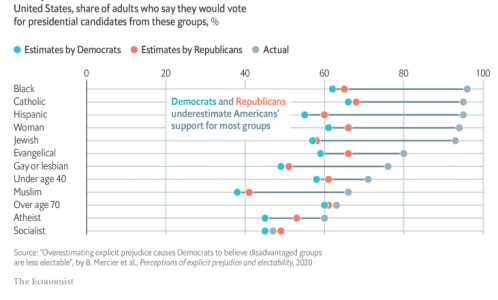
Here, from The Economist, is the one picturethat shows why Bernie Sanders is foolish to call himself a socialist:
Socialists are the least likely of the above groups to be political winners in America. (Well, at least they probably beat child molesters and telemarketers.)
The fact is that despite his strange claims, Bernie is not a socialist.
Merriam-Webster Definition of Socialism
1: any of various economic and political theories advocating collective or governmentalownership and administration of the means of production and distribution of goods
2a: a system of society or group living in which there is no private property
b: a system or condition of society in which the means of production are owned and controlled by the state
3: a stage of society in Marxist theory transitional between capitalism and communism and distinguished by unequal distribution of goods and pay according to work done
Medicare-for-All, Sanders’s signature proposal, is not a socialist program.
1. It does not propose governmental ownership and administration of anything.
2. It does not propose the elimination of private property.
3. It does not propose that the means of production be owned and controlled by the state.
4. And it does not propose the unequal distribution of goods and pay according to work done.
What it does propose is federal funding of programs vital to the health and welfare of the people. Mere funding is not socialism. It’s what every government in history has done.
Contrast Medicare for All, which proposes paying the private sector (hospitals, doctors, nurses and other hospital employees, medical equipment manufacturers, pharmaceutical companies, etc.) with the socialist Veterans Administration, which owns its own hospitals and other medical facilities, and employs their personnel.
So why does Sanders continue to call himself a “democratic socialist”? Perhaps Bernie merely is stating the obvious. The entire government of the democratic United States is a combination of functions, having some socialist and some capitalist characteristics.
By not explaining to the voters what socialism really is, and also not explaining how Monetary Sovereignty could pay for his Medicare for All, Sanders has made serious mistakes, perhaps electorally fatal.
Gap Psychology describes the common desire to distance oneself from those “below” in any socio-economic ranking, and to come nearer those “above.” The socio-economic distance is referred to as “The Gap.”
Wide Gaps negatively affect poverty, health and longevity, education, housing, law and crime, war, leadership, ownership, bigotry, supply and demand, taxation, GDP, international relations, scientific advancement, the environment, human motivation and well-being, and virtually every other issue in economics.
Implementation of Monetary Sovereignty and The Ten Steps To Prosperity can grow the economy and narrow the Gaps:
 The Debt/GDP ratio demonstrates nothing, predicts nothing, and means nothing with regard to the federal government’s ability to pay. Anytime you see a reference to that ratio, know this: The user doesn’t know what he is talking about.
It is impossible to look at the Debt/GDP ratio for any nation and learn the financial health of that nation.
The Debt/GDP ratio demonstrates nothing, predicts nothing, and means nothing with regard to the federal government’s ability to pay. Anytime you see a reference to that ratio, know this: The user doesn’t know what he is talking about.
It is impossible to look at the Debt/GDP ratio for any nation and learn the financial health of that nation.



 #Monetary Sovereignty - Mitchell