–Why Europe is the future of America. Creating failure from success.

Twitter: @rodgermitchell; Search #monetarysovereignty
Facebook: Rodger Malcolm Mitchell

Mitchell’s laws:
●The more federal budgets are cut and taxes increased, the weaker an economy becomes.
●Austerity is the government’s method for widening the gap between rich and poor,
which ultimately leads to civil disorder.
●Until the 99% understand the need for federal deficits, the upper 1% will rule.
To survive long term, a monetarily non-sovereign government must have a positive balance of payments.
●Those, who do not understand the differences between Monetary Sovereignty and monetary non-sovereignty, do not understand economics.
●The penalty for ignorance is slavery.
●Everything in economics devolves to motive.

======================================================================================================================================================================================

As “austerity,” also known as “deficit reduction,” eats America from the inside, we can look to the euro nations to see our future.

Once Europe was wealthy. Then came the euro, which required each nation to surrender its single, most valuable asset: Their Monetary Sovereignty.

SPAIN faces staggering losses as it accepts the reality of the housing bust
By Matt Phillips

The size of Spain’s banking crisis required a bigger, politically unpalatable bailout from the European policy makers writing the checks.

It’s a recipe for decades of terrible economic conditions. But that seems to be what Europe is cooking up.

The “unpalatable bailout” includes more loans to a nation unable to pay even its current debts, plus austerity: The American Tea/Republican Party’s guaranteed formula for economic disaster.

FRANCE’s ‘AA’ Hollande pays price for kowtowing to EMU deflation madness
By Ambrose Evans-Pritchard

France’s heroic fiscal squeeze of 1.8pc of GDP last year – in order to comply with EMU demands – was at best self-defeating, and arguably destructive. All France got was a double-dip recession. Some 370,000 people have lost their jobs.

There is a near religious belief in Berlin – evangelised by Brussels, and the EMU gang of five – that any let up in austerity, any recourse to stimulus, let alone a new deal, is a gift to shirkers who want to dodge reform.

The EMU gang of five claims that applying leeches is the way to cure anemia — the same believe the U.S. Congress and the President foist on America.

GREECE‘s debt inspectors back amid austerity anger

Inspectors from Greece’s bailout creditors have restarted talks on spending reforms that the government is resisting, with Greek officials ruling out any further blanket wage and pension cuts.

The sides are at odds over the size of a 2014 budget gap and whether a plan to cover it will require more austerity measures.

Greek officials insist no additional austerity measures can be implemented, arguing they would be unproductive in an economy that is contracting for a sixth year and with unemployment near 28 percent.

Conservative Prime Minister Antonis Samaras late Monday said Greece was fulfilling its bailout commitments and would cover budget gaps without new blanket pay cuts for wage earners and pensioners.

Austerity = pay cuts for the populace. It’s inevitable, because deficit reduction reduces the economy’s money supply. Less money = less business = fewer jobs = less pay = more poverty.

ITALY signals end of eurozone recession
By Mark Thompson

Italy provided further evidence Tuesday that the eurozone’s prolonged recession may already be over, after data showed its economy shrank by (only) 0.2% quarter-over-quarter, confirming the eurozone’s third-biggest economy has now been stuck in recession for two full years — a post-war record.

An easing of the austerity agenda by Italy’s coalition government, including the cancellation of a planned VAT hike and removal of a property tax on first homes, may already be contributing to a recovery in household spending.

For the Eurozone, success is when the economy shrinks less than expected. And while reducing austerity “may contribute to a recovery,” austerity has been implemented as the cure for recession.

While recognizing that reducing austerity “contributes to a recovery,” the leaders maintain that deficit reduction is beneficial.

But, of course, the euro nations, being monetarily non-sovereign,
cannot create money at will, and so are stuck with austerity. By contrast, the U.S. is Monetarily Sovereign, can create dollars at will, and never needs to cut deficits.

Yet we cut deficits, inflicting grievous harm on ourselves, for no good reason.

IRELAND’s economy forecast to grow 1.7 per cent in 2014
Olli Rehn says the European economy has reach a “turning point”, but it is too early to declare victory.

Gross public debt as a percentage of GDP is expected to decrease from 124.4 per cent in 2013, to 120.8 per cent in 2014 and to 119.1 per cent in 2015.

Olli Rehn, Commission Vice-President for Economic and Monetary Affairs and the Euro said “There are increasing signs that the European economy has reached a turning point.

(Unemployment is expected to decrease to 12.3 per cent in 2014 and to 11.7 per cent in 2015.)

That 12.3% unemployment is well above the level the U.S. economy reached during the darkest days of the Great Recession. For the euro nations, 12.3% unemployment is a happy “turning point.”

This “turning point” will be short lived, as a money shortage will make economic growth impossible.

CYPRUS reeling 6 months after EU rescue
By Alanna Petroff, September 26, 2013

25% pay cuts. 40% increase in unemployment.

Six months after Cyprus became the fourth eurozone country to need a bailout, the Mediterranean island’s economy is shrinking rapidly as austerity measures bite, sending unemployment through the roof.

Austerity measures have also been introduced to satisfy bailout conditions, with lawmakers implementing tax hikes and steep salary cuts in the public sector.

“There’s no bright future. Day by day, things get worse.”

The beat goes on. While “austerity,” which is just a synonym for deficit reduction, has ravaged Europe, we in America are subject to — that’s right — austerity.

The question has not been whether to inflict austerity on ourselves, but how much. The Democrats want a little deficit cutting, the Tea/Repulicans want a lot.

Both parties administer repeated doses of the proven-to-be-deadly, deficit-cut poison, while assuring us this will cure our ills.

By definition, a large economy has more money than does a small economy. Therefore, a growing economy requires a growing money supply. QED

The euro nations, being monetarily non-sovereign, do not have a sovereign currency. They cannot create euros at will, so debts are a heavy burden. To survive, long term, they need to acquire euros from beyond their borders.

The only successful euro nations are those with a positive balance of payments. But mathematically, all nations cannot have a positive balance of payments.

The haves take euros from the have-nots. Half of Europe is destined to starve now; the other half destined to starve later.

By contrast, the U.S. is Monetarily Sovereign, so has the unlimited ability to create its sovereign currency, the dollar. Debt never can be a burden.

Because the U.S. cannot run short of dollars, it never needs to ask anyone else for dollars — not you, not me, not China. But, U.S. politicians, media and mainstream professors pretend the U.S. is like the euro nations.

They brainwash the public into believing the U.S. can run short of its sovereign currency. The Tea/Republicans speak of small government, as though the government that provides thousands of benefits to America, actually is a burden on us.

But it is not the government that is a burden. Rather, it is unnecessary taxes — unnecessary because the government can create unlimited dollars — that are the burden.

The Tea/Republicans opt for lower benefits and higher taxes on the middle classes and the poor, so to reduce the deficit (i.e reduce money creation).

It would be easy to ascribe effort to ignorance, and for the American public, that would be true. The public is economically ignorant, relying on its leaders for guidance.

But for the political, media and academic leaders, ignorance is not the problem. They know exactly what they are doing.

The politicians have been bribed by the rich, via political contributions and promises of lucrative employment, later.

The media are owned by the rich.

The universities, and their employees, respond to what their rich donors want.

Because most federal spending benefits the poor more than the rich, it narrows the gap between the rich and the rest. But the rich want the gap widened. It is what makes them rich.

So the rich push America toward the euro disaster, and claim this is prudent.

While the European people drown because of deficit reduction, the American people willingly adopt the same destructive, deficit reduction.

And get angry when you warn them they are marching over a cliff.

Rodger Malcolm Mitchell
Monetary Sovereignty

====================================================================================================================================================
Nine Steps to Prosperity:
1. Eliminate FICA (Click here)
2. Medicare — parts A, B & D plus long term nursing care — for everyone (Click here)
3. Send every American citizen an annual check for $5,000 or give every state $5,000 per capita (Click here)
4. Free education (including post-grad) for everyone. Click here
5. Salary for attending school (Click here)
6. Eliminate corporate taxes (Click here)
7. Increase the standard income tax deduction annually
8. Increase federal spending on the myriad initiatives that benefit America’s 99% (Click here)
9. Federal ownership of all banks (Click here)

—–

10 Steps to Economic Misery: (Click here:)
1. Maintain or increase the FICA tax..
2. Spread the myth Social Security, Medicare and the U.S. government are insolvent.
3. Cut federal employment in the military, post office, other federal agencies.
4. Broaden the income tax base so more lower income people will pay.
5. Cut financial assistance to the states.
6. Spread the myth federal taxes pay for federal spending.
7. Allow banks to trade for their own accounts; save them when their investments go sour.
8. Never prosecute any banker for criminal activity.
9. Nominate arch conservatives to the Supreme Court.
10. Reduce the federal deficit and debt

No nation can tax itself into prosperity, nor grow without money growth. Monetary Sovereignty: Cutting federal deficits to grow the economy is like applying leeches to cure anemia.
Two key equations in economics:
1. Federal Deficits – Net Imports = Net Private Savings
2. Gross Domestic Product = Federal Spending + Private Investment and Consumption – Net Imports

THE RECESSION CLOCK
Monetary Sovereignty Monetary Sovereignty

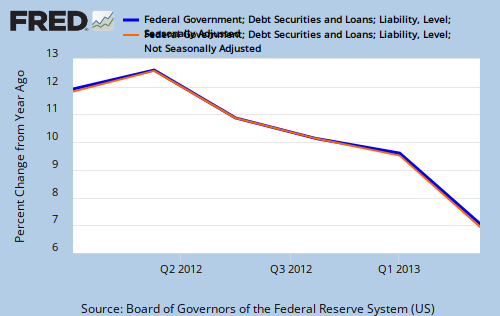
As the federal deficit growth lines drop, we approach recession, which will be cured only when the lines rise.

#MONETARY SOVEREIGNTY

–Cash cows and bull manure. A perfect doublespeak example of Fannie and Freddie

Twitter: @rodgermitchell; Search #monetarysovereignty
Facebook: Rodger Malcolm Mitchell

Mitchell’s laws:
●The more federal budgets are cut and taxes increased, the weaker an economy becomes.
●Austerity is the government’s method for widening the gap between rich and poor,
which ultimately leads to civil disorder.
●Until the 99% understand the need for federal deficits, the upper 1% will rule.
To survive long term, a monetarily non-sovereign government must have a positive balance of payments.
●Those, who do not understand the differences between Monetary Sovereignty and monetary non-sovereignty, do not understand economics.
●The penalty for ignorance is slavery.
●Everything in economics devolves to motive.

======================================================================================================================================================================================

A message to Mr. & Mrs. Average American:

Folks, admit it. The government and the media and the compliant economists have sold you on the false notion that you, as a taxpayer, pay for federal spending.

(Sure you pay for your city’s spending, and your county’s spending and your state’s spending. But you don’t pay for federal spending.)

And when the federal government receives dollars from the private sector (that’s you), you buy into the silly idea that private sector taxpayers are being paid, rather than understanding that private sector taxpayers actually are paying.

And because you believe in such nonsense, the following article, based totally on bull manure, was designed to make you feel good, although it should make you feel angry, cheated, deceived and conned.

Washington Times
Fannie, Freddie close to paying off taxpayer bailout bill
Treasury reaps revenue from 2 mortgage giants

Ooooh, wonderful. The Treasury, which has the unlimited power to create dollars, is reaping revenue it doesn’t need. Great!

Hmmm, I wonder where those dollars are coming from.

Fannie Mae and Freddie Mac announced Thursday that they will return another $39 billion in dividends to the U.S. Treasury next month, bringing them close to fully repaying the taxpayers who rescued them.

Fannie Mae said it plans an $8.6 billion dividend that will bring its total payments to the Treasury in the past two years to $114 billion — $3 billion shy of its total $117 billion bailout — while Freddie Mac said a payment of $30.4 billion in dividends will more than complete the repayment of its $71 billion bailout.

Do you, as a taxpayer, feel richer now? Have you received your share of that nearly $200 billion?

It would come to about $600 for every man, woman and child in America. Check your mailbox and see if your share has arrived.

Not there? Of course not. Here’s why:

First, consider where Fannie’s and Freddie’s dividends come from. They come from you, the private sector. They are part of your mortgage payment to your bank (which sold your Mortgage to Fannie or Freddie).

Those $200 billion dollars, which were part of America’s money supply, are now being sent to the Treasury, where they no longer will be part of America’s money supply.

So, exactly how does taking dollars from the private sector, and sending them to the Treasury, put dollars in taxpayers’ pockets. Well it doesn’t, of course.

In fact it does the opposite. Those payments from Fannie and Freddie represent dollars taken from taxpayers.

The bought-and-paid-for politicians and the rich-owned media, and the rich-supported university economists all want you to believe government spending costs you money, and taxes (and other dollars going to the Treasury) save you money. That is to convince you the government should spend less and tax you more.

Further dividends from both mortgage giants at the beginning of next year almost certainly will make taxpayers whole and turn their rescue operations into once-unimaginable cash cows for the government.

The bull manure is spread extra thick here. In Washington Post doublespeak, a “cash cow for the government” somehow benefits you, the taxpayer, while in fact it is nothing less than dollars taken from your pocket.

I have some really terrible news for you: You are not the federal government. You are not Monetarily Sovereign. The federal government is, and being Monetarily Sovereign, it creates unlimited dollars at will. The federal government has an infinite supply of dollars.

By contrast, you do not create dollars at will, and when you send your dollars to the Treasury, you get poorer. Are you shocked?

The large dividend payments to be reaped by the Treasury also highlight the important role the two mortgage giants have played in helping to sharply reduce the federal budget deficit in the past year to less than half of its $1.4 trillion peak during the crisis.

We have seen that payments from Fannie and Freddie take dollars from the economy, which hurts the economy. And now we are told (correctly) that those payments reduce the federal deficit.

So, think about it: If the payments hurt the economy and they reduce the deficit, then reducing the deficit must hurt the economy. Bingo!

Yes, that is exactly what reducing the deficit (also known as adding fewer dollars to the economy) does. It causes recessions. It causes depressions. It makes you, the taxpayer, poorer.

And all this time, you’ve been told that reducing the deficit is a good thing, when in fact it’s a bad thing. Now doesn’t that make you feel like a chump?

Only the bailout of General Motors Co. remains as a significant loss for taxpayers, although the Treasury is expected to recoup another big chunk of the $50 billion in funds it paid two of Detroit’s Big Three automakers.

You have just been treated to perfect doublespeak bull manure. Here’s a translation of the above Washington Post sentence:

“Only the bailout of General Motors Co. remains as a significant PROFIT for taxpayers, although the TAXPAYERS are expected to LOSE another big chunk of the $50 billion in funds THE TREASURY paid two of Detroit’s Big Three automakers.”

The mortgage giants owe their profitability to the robust recovery in the housing market and refinancing boom in the past two years, which dramatically lifted sales and prices and sharply increased the fees they earn for packaging individual mortgages into mortgage-backed securities.

Right. Fannie and Freddie earn fees from the private sector (aka “taxpayers”) and give those fees to the Treasury, which has no use for them. The dollars disappear from the economy.

And now, for the cherry on the sundae:

President Obama and congressional leaders all say they want to phase out Fannie and Freddie, and turn over most of their functions to the private sector. But the sizable dividend payments pose a temptation for lawmakers who are still groping for ways to reduce huge budget deficits.

The very rich have bribed Congress (via campaign contributions and promises of lucrative employment later) to widen the gap between the rich and the rest.

The best way to widen the gap is to reduce federal spending (most of which benefits the “rest”) and to increase taxes on the rest (FICA, sales taxes, “broadening the tax base.”)

Those dividends from Fannie and Freddie steal dollars from mortgage holders, which on balance, widens the gap.

That’s why Congress has been reluctant to allow the private sector to earn the dividends Fannie and Freddie now earn.

What will change Congress’s minds? When the rich-owned banks are given the lucrative Fannie and Freddie franchise. When that happens, there will be bad news and good news:

The bad news: The rich will get richer, compared with the rest, i.e. the gap will continue to widen.

The good news: At least the dollars will remain in the economy rather than wastefully going to the Treasury, which destroys them because it has no need for them.

Either way, you have been, and will continue to be, screwed, and all because you believe your tax dollars pay for federal spending.

Oh, and please send me your address. I have some costume jewelry I’d like to sell you.

(Maybe I should put an ad in the Washington Times. You think?)

Rodger Malcolm Mitchell
Monetary Sovereignty

====================================================================================================================================================
Nine Steps to Prosperity:
1. Eliminate FICA (Click here)
2. Medicare — parts A, B & D plus long term nursing care — for everyone (Click here)
3. Send every American citizen an annual check for $5,000 or give every state $5,000 per capita (Click here)
4. Free education (including post-grad) for everyone. Click here
5. Salary for attending school (Click here)
6. Eliminate corporate taxes (Click here)
7. Increase the standard income tax deduction annually
8. Increase federal spending on the myriad initiatives that benefit America’s 99% (Click here)
9. Federal ownership of all banks (Click here)

—–

10 Steps to Economic Misery: (Click here:)
1. Maintain or increase the FICA tax..
2. Spread the myth Social Security, Medicare and the U.S. government are insolvent.
3. Cut federal employment in the military, post office, other federal agencies.
4. Broaden the income tax base so more lower income people will pay.
5. Cut financial assistance to the states.
6. Spread the myth federal taxes pay for federal spending.
7. Allow banks to trade for their own accounts; save them when their investments go sour.
8. Never prosecute any banker for criminal activity.
9. Nominate arch conservatives to the Supreme Court.
10. Reduce the federal deficit and debt

No nation can tax itself into prosperity, nor grow without money growth. Monetary Sovereignty: Cutting federal deficits to grow the economy is like applying leeches to cure anemia.
Two key equations in economics:
1. Federal Deficits – Net Imports = Net Private Savings
2. Gross Domestic Product = Federal Spending + Private Investment and Consumption – Net Imports

THE RECESSION CLOCK
Monetary Sovereignty Monetary Sovereignty

As the federal deficit growth lines drop, we approach recession, which will be cured only when the lines rise.

#MONETARY SOVEREIGNTY

Can we save Social Security from those who claim they want to save it?

Twitter: @rodgermitchell; Search #monetarysovereignty
Facebook: Rodger Malcolm Mitchell

Mitchell’s laws:
●The more federal budgets are cut and taxes increased, the weaker an economy becomes.
●Austerity is the government’s method for widening the gap between rich and poor,
which ultimately leads to civil disorder.
●Until the 99% understand the need for federal deficits, the upper 1% will rule.
To survive long term, a monetarily non-sovereign government must have a positive balance of payments.
●Those, who do not understand the differences between Monetary Sovereignty and monetary non-sovereignty, do not understand economics.
●The penalty for ignorance is slavery.
●Everything in economics devolves to motive.

======================================================================================================================================================================================

Here is yet another “Save Social Security” interview of a mainstream economics professor — this time, a Nobel winner, no less: Peter Diamond, 73, who co-wrote “Social Security: A Balanced Approach,” proposing “fixes” for the program.

This interview appeared in the October 28, 2013 issue of Money Magazine.

Nobel winner Peter Diamond’s book title speaks of a “balanced” approach, and “fixes,” and the article title uses the word “save.” What could possibly be wrong with “balanced,” “fixes” and “save”?

Here are a few excerpts. You be the judge.

Can we save Social Security?
By Penelope Wang

[Peter Diamond, professor of economics, emeritus, Massachusetts Institute of Technology and recipient of the 2010 Nobel Prize in economics, answers the big question of how to fix Social Security.]

Wang: Can we save Social Security?

Diamond: Yes, Social Security can be fixed. There’s a long-term deficit problem, but it’s far from a crisis yet. Projections show the trust fund will run out of money by 2033. At that point everyone’s benefits would have to be cut by 25% if nothing is done.

According to Nobel winner Peter Diamond, there is no alternative but to increase trust fund taxes (FICA) or cut benefits. Nothing else is possible. He actually wants us to believe the federal government can run short of dollars.

Wang: So what fixes need to be made?

Diamond: We need to make Social Security financially sustainable. There’s a straightforward, nonradical way to do it.

In 2004 I proposed balancing modest and gradual reductions in benefits with a modest and gradual increase in the Social Security payroll tax.

Ah, “modest and gradual” and “nonradical.”

Who could complain about “modest and gradual” benefit reductions combined with “modest and gradual” tax increases, especially if they are “nonreadical? — except of course the middle- and lower classes, who have to pay the outrageously regressive FICA tax, and who rely most on the outrageously minuscule (and declining) Social Security benefits — which outrageously, are taxed!

(As an aside, has anyone ever wondered why Social Security benefits, which pretend to be annuity payments funded by taxes, are taxed again when received?)

The Nobel winning professor apparently feels the 99% pay too little in taxes and receive too much in benefits, so he wants to “fix” that problem, “modestly and gradually.”

And then there’s “financially sustainable,” another euphemism for: “The government is running short of dollars, and since you have plenty, please send us more or we’ll send you fewer.”

Wang: Your plan is nearly 10 years old. Would it still work?

Diamond: Yes, but the deficits have grown about 40% over the last decade, so fixes would have to be larger and kick in more quickly. [The Social Security Administration said this year that immediately raising the payroll tax 2.66 percentage points could repair the program.]

Note to Nobel winning professor: The U.S. government is Monetarily Sovereign, which means it has the unlimited ability to create its sovereign currency, the dollar.

That is why even during the Great Depression of 1929, and the Great Recession of 2008, the government never had any trouble paying its bills.

So professor, tell me again, why does Social Security need me to pay FICA in advance, and later, pay income tax on the benefits I supposedly paid for.

Diamond: We have a long-standing tradition that Social Security financing is not part of the regular budget process. Rather, as it is funded by dedicated tax revenue, changes to financing are made separately.

That way we have a secure system people can rely on for the long term.

Rely on? But professor, you just said that Social Security would not be financially sustainable unless FICA is increased and benefits are decreased. What kind of “secure system” changes the rules because it’s running short of money?

A secure system would be to have our Monetarily Sovereign government guarantee payments into perpetuity.

Wang: You’re very familiar with today’s political gridlock, which kept you off the Federal Reserve Board after your 2010 nomination. How might Washington reach a deal fixing Social Security?

Diamond: Right now it’s pretty hopeless. Obama faces difficult gridlock, so it wouldn’t be easy, but undertaking Social Security reform would be a great legacy — one that’s less controversial than health care.

Ah, now it’s “reform,” yet another euphemism for “stick it to the 99%.”

Wang: The President has proposed a cap on the total amount held in tax-advantaged retirement accounts. What’s your view?

Diamond: It’s clear that there can be gaming of the system; we’ve seen some of it in reports of hedge fund accumulations that are just enormous. A tax break that extends to too much savings is just a weakening of the taxation of capital income. So, yes, we want to limit the tax breaks.

Yes, Congress has been bribed to reduce taxes on the rich. But really, why does a Monetarily Sovereign government have to beg anyone for its sovereign currency?

Wang: What else can the government do to improve the retirement system?

Diamond: I look to the Thrift Savings Plan for federal civil servants as a model. The TSP doesn’t have many choices, but they’re great, and the costs are low. You can also easily turn your savings into income with an annuity.

The government could make the TSP available to everybody, or it could set up a parallel plan as an IRA or 401(k) option.

Or, the government simply could provide, fully paid, tax-free Social Security to everyone above an agreed-upon retirement age. If the government weren’t so busy collecting unnecessary taxes, there would be no need for IRAs or 401(k)s.

Nobel Professor, let’s get down the the bottom line. The government’s General Fund supports about 1000 federal agencies. Only Social Security and Medicare benefits are limited by tax collections. No other federal agencies are limited this way.

The military isn’t limited by tax collections. Payments for the Supreme Court aren’t limited by tax collections. Nor are payments for Congress, the White House, NASA, the FBI, the CIA, the NSA and the rest of the government.

Give me one good reason why Social Security and Medicare benefits are under constant pressure from those who quack about “sustainability,” “balanced approaches,” “fixes” and “reforms.”

Social Security, as it currently is handled, is a giant fraud. If you’re salaried — and only if your modestly salaried — you pay a high and unnecessary tax, and you receive low and declining benefits, upon which you pay yet another tax.

If you’re rich, don’t worry. None of this applies to you. The gap between you and the rest is intact.

Hey, you don’t bribe Congress to be “saved” by Nobel professors.

Rodger Malcolm Mitchell
Monetary Sovereignty

====================================================================================================================================================
Nine Steps to Prosperity:
1. Eliminate FICA (Click here)
2. Medicare — parts A, B & D plus long term nursing care — for everyone (Click here)
3. Send every American citizen an annual check for $5,000 or give every state $5,000 per capita (Click here)
4. Free education (including post-grad) for everyone. Click here
5. Salary for attending school (Click here)
6. Eliminate corporate taxes (Click here)
7. Increase the standard income tax deduction annually
8. Increase federal spending on the myriad initiatives that benefit America’s 99% (Click here)
9. Federal ownership of all banks (Click here)

—–

10 Steps to Economic Misery: (Click here:)
1. Maintain or increase the FICA tax..
2. Spread the myth Social Security, Medicare and the U.S. government are insolvent.
3. Cut federal employment in the military, post office, other federal agencies.
4. Broaden the income tax base so more lower income people will pay.
5. Cut financial assistance to the states.
6. Spread the myth federal taxes pay for federal spending.
7. Allow banks to trade for their own accounts; save them when their investments go sour.
8. Never prosecute any banker for criminal activity.
9. Nominate arch conservatives to the Supreme Court.
10. Reduce the federal deficit and debt

No nation can tax itself into prosperity, nor grow without money growth. Monetary Sovereignty: Cutting federal deficits to grow the economy is like applying leeches to cure anemia.
Two key equations in economics:
1. Federal Deficits – Net Imports = Net Private Savings
2. Gross Domestic Product = Federal Spending + Private Investment and Consumption – Net Imports

THE RECESSION CLOCK
Monetary Sovereignty Monetary Sovereignty

As the federal deficit growth lines drop, we approach recession, which will be cured only when the lines rise.

#MONETARY SOVEREIGNTY

–The Gap, the whole Gap and nothing but the Gap . . . so help me . . ..

Twitter: @rodgermitchell; Search #monetarysovereignty
Facebook: Rodger Malcolm Mitchell

Laws:
●The more federal budgets are cut and taxes increased, the weaker an economy becomes.
●Austerity is the government’s method for widening the gap between rich and poor,
which ultimately leads to civil disorder.
●Until the 99.9% understand the need for federal deficits, the upper .1% will rule.
To survive long term, a monetarily non-sovereign government must have a positive balance of payments.
●Those, who do not understand the differences between Monetary Sovereignty and monetary non-sovereignty, do not understand economics.
●A penalty for ignorance is slavery.
●Everything in economics devolves to motive, and the motive is the Gap.
======================================================================================================================================================================================

The Gap, the whole Gap and nothing but the Gap . . . so help me . . ..

“We hold these truths to be self-evident, that all men are created equal . . . ” reads the Declaration of Independence, and that same concept has permeated human thought and morality, long before and long after that great document was written.

And, it is all a lie..

We humans are not equal, not in physical nor in mental characteristics, nor even in our opportunities, nor our legal rights, nor our human rights, nor in any other facet of our existence. In fact, our inequality is what makes economics possible, so one even may question whether we should be equal..

There is no measure by which one could say that we all are created equal – not one – except perhaps that we all were born and we all die.

Economics is far more a social science than a physical science. Everything in the social sciences boils down to motivation, which in turn boils down to survival.

We evolve by surviving. We evolve to survive — not only in competition with the world, but in competition with our fellow human beings. And that brings us to the Gap.

The ability to survive is power, and in all aspects of human society, there are the few who have the most power and the many who have less power. What separates them is the Gap.

With greater sophistication, the survival urge becomes sublimated into symbols, and so for us humans there are many kinds and levels and symbols of power.

Money is power. Privilege is power. The Law is power. Control, Possessions, Strength, Influence, Glory, Weaponry, Knowledge, Talent – all are power. And despite their vast diversity, they all have one measure: The one measure of power is the Gap between the “haves” and the rest.

Power is not an absolute; it is a comparative. If each person on earth owned one million dollars, no one would be rich. But if one person had just a hundred dollars and everyone else had but one dollar, that one person with the hundred dollars would be rich.

It’s not the absolute amount of money that makes him rich; it’s the Gap.

If everyone had the same privileges, no one would be privileged. But if one person has special privileges, that one person is privileged. And the greater his privileges, compared to the privileges of all others, the greater his power. It is the privilege Gap that gives him power.

From the perspective of the more powerful, there is little benefit to accumulating more money or possessions or influence if the less powerful accumulate at a faster pace.

Because it is the Gap that provides real power and the feeling of power, the powerful understand, either intellectually or by intuition, that to maintain or increase their power, the Gap must be maintained or increased.

Owning a gun provides power, unless everyone else owns a bigger gun.

For every level of power, those below wish to narrow the Gap above them, and those above wish to widen the Gap below them. Thus, those below can be persuaded that Gap-widening strategies are beneficial, so long as the perception is that these strategies will be applied below them.

On average, fear is stronger than desire. The fear of narrowing the Gap below is stronger than the desire to narrow the Gap above. The fear of losing relative power is stronger than the desire to gain relative power.

In evolutionary terms, losing power can result in death, while gaining power may have only marginal benefits.

Being forced financially to move down to a “worse” neighborhood is far more traumatic than is the pleasure of moving to a “better” neighborhood. Being demoted carries deeper, longer-lasting emotions than does being promoted.

That is why the middle-class easily is persuaded by the rich, that social payments (food stamps, unemployment insurance, welfare, etc.) cause sloth, and so should be eliminated. We want to believe those below us are inferior and should be treated as inferiors.

Social payments also benefit the middle, but to the middle, that is less important than widening the Gap vs. the poor.

People emulate those with more power, emotionally trying to narrow the Gap. We approach the rich and famous; we hope to engage in brief small talk; we ask for autographs, we name-drop, we glow in their recognition, we flaunt diamonds and overly expensive cars. These are Gap narrowing (to those above – widening from those below) acts.

(Some Lamborghini cars cost in the neighborhood of $400 thousand. It is difficult and uncomfortable to drive, with an unlawful top speed of 200+ mph. Why would anyone want to own such a car? The Gap.)

We distance ourselves from those with less power. We don’t want to attend their dinners. We don’t want them to live near us. We want them tucked safely away from us, perhaps into jail. We try to widen that Gap.

The Gap can be widened in two ways: By reducing the power of those below, or by increasing the power of those above. “Broadening the tax base” and “reforming Social Security” are euphemistic examples of how the Gap can be widened by punishing those below.

The populace wants both ways to widen the Gap – narrow it above and widen it below..

A few examples of Gap widening:
*Racial, religious and sexual adverse discrimination
*Voting restrictions
*Deficit reduction
*All taxes on salaries and Social Security benefits
*Strict immigration laws
*Forced segregation
*Minimum wage jobs
*Lax or non-existent political contribution limits
*Exclusivity: Country clubs; gated communities
*Laws/judges/politicians favoring higher-power groups or disfavoring lower-power groups.
*Harsh jail terms for crimes typical of the poor; light or no jail terms for crimes typical of the rich.

The universal desire (conscious or subconscious) is to distance oneself from those below and to approach those above. Evolution has taught us this intuition, as the best path to survival.

Sadly, our intuitions inherited from our tribal ancestors, may not serve us well in modern society. The discrimination that built cohesion and strengthened a tribe vs. other tribes, can weaken a nation.

“Fixing” a traffic ticket encourages dangerous driving. Strict immigration laws, while ostensibly to protect jobs, actually reduce the demand for goods and services that creates jobs.

Voting restrictions and lax political contribution limits create dictatorships that diminish the entire nation. Gated communities inevitably yield poorer services to those outside the gates, in turn, creating lawlessness and greater dependency.

Economics is ruled by the psychology of the Gap. Morality tells us to narrow the Gap. Fear tells us to widen the Gap.

Fear is more basic. It overrules logic, which is why people are able to accept the illogical notion that our government of unlimited wealth should take money from the poor.

It’s the Gap, the whole Gap and nothing but the Gap . . . so help me . . . .

Economics is all about the Gap.

Tell the people.

Rodger Malcolm Mitchell
Monetary Sovereignty

====================================================================================================================================================
The Ten Steps to Prosperity:

1. Eliminate FICA (Click here)
2. Federally funded Medicare — parts A, B & D plus long term nursing care — for everyone (Click here)
3. Provide an Economic Bonus to every man, woman and child in America, and/or every state a per capita Economic Bonus. (Click here) Or institute a reverse income tax.
4. Federally funded, free education (including post-grad) for everyone. Click here
5. Salary for attending school (Click here)
6. Eliminate corporate taxes (Click here)
7. Increase the standard income tax deduction annually. (Refer to this.)
8. Tax the very rich (.1%) more, with higher, progressive tax rates on all forms of income. (Click here)
9. Federal ownership of all banks (Click here and here)
10. Increase federal spending on the myriad initiatives that benefit America’s 99% (Click here)

Initiating The Ten Steps sequentially will add dollars to the economy, stimulate the economy, and narrow the income/wealth/power Gap between the rich and the rest.
——————————————————————————————————————————————

10 Steps to Economic Misery: (Click here:)
1. Maintain or increase the FICA tax..
2. Spread the myth Social Security, Medicare and the U.S. government are insolvent.
3. Cut federal employment in the military, post office, other federal agencies.
4. Broaden the income tax base so more lower income people will pay.
5. Cut financial assistance to the states.
6. Spread the myth federal taxes pay for federal spending.
7. Allow banks to trade for their own accounts; save them when their investments go sour.
8. Never prosecute any banker for criminal activity.
9. Nominate arch conservatives to the Supreme Court.
10. Reduce the federal deficit and debt

No nation can tax itself into prosperity, nor grow without money growth. Monetary Sovereignty: Cutting federal deficits to grow the economy is like applying leeches to cure anemia.
Two key equations in economics:
1. Federal Deficits – Net Imports = Net Private Savings
2. Gross Domestic Product = Federal Spending + Private Investment and Consumption – Net Imports

THE RECESSION CLOCK
Monetary Sovereignty Monetary Sovereignty

As the federal deficit growth lines drop, we approach recession, which will be cured only when the lines rise.

#MONETARY SOVEREIGNTY