–Japan: Debt/GDP = 218%. So?

An alternative to popular faith

In a previous post, I told you the Federal Debt/GDP ratio was an apples/oranges statistic, often quoted, but completely meaningless. (See: Debt/GDP). According to debt hawks and old-line economists, a high ratio portends inflation, recession and any number of other terrible economic outcomes. Of course, there is no evidence for this; it’s just popular faith unsupported by facts.

Read this article:

Associated Press; 6/22/10: TOKYO – “Japan’s economy, the world’s second largest, will expand at a faster pace in the current fiscal year than previously forecast as robust exports to Asia and improving corporate earnings are underpinning a broadening recovery.

“The Cabinet Office said Tuesday that Japan’s gross domestic product will rise 2.6 percent in the year to March 2011. “The upward projection was due to brisk growth in exports, especially to Asia. The forecast was also upbeat thanks to a recovery in capital spending and improving corporate earnings,” said Takashi Hanagaki, an official from the Cabinet Office.

“Earlier in the month, Japan upgraded its economic growth in the January-March quarter to an annualized pace of 5 percent from 4.9 percent in a preliminary report. But the encouraging figures, including Tuesday’s upward GDP revision, are tempered by persistent deflation and other negatives, including a lackluster labor market.

Japan is also one of the most indebted countries in the world. Its public debt reached 218.6 percent of GDP last year, according to the International Monetary Fund.

So here is Japan, with its 218% Debt/GDP ratio. It’s growth is anywhere between 2.6% and 5%. It’s large national debt has not caused the inflation debt hawks predict. On the contrary, Japan is fighting deflation. Further, the large national debt has not taken the place of capital spending as debt hawks also predict, but actually has facilitated capital spending as well as earnings.

Those are the facts, all of which will be disregarded by the debt hawks, the traditional economists and the media, who just know in their hearts that debt is bad, facts be damned. In fact, the AP article ended with this amazing sentence:

Tackling the ballooning national debt is among most pressing tasks for Japan’s new Prime Minster Naoto Kan.

Wrong. And that is why economics is a religion, not a science.

Rodger Malcolm Mitchell
http://www.rodgermitchell.com

–I’m angry with the Chicago Tribune

An alternative to popular faith

I live in Chicago, and I’m angry with the Chicago Tribune. It continues to be clueless about economics. In a June 15th editorial, the Tribune said, “With 79 percent of Americans rating (the federal debt) ‘extremely serious’ or ‘very serious,” it tied with terrorism for the top (‘scariest threat’). So what does the Obama administration plan to do about it? It proposes to pile on more debt. . . . Americans have good reason to be so worried about the . . . that someone will have to repay.”

Does the term “exploding national debt” sound familiar. If you go back and read TICKING TIME BOMB , MORE BOMB NONSENSE and DEBT BOMB REDUX you will see that the Tribune and its media friends have been referring to the federal debt in explosive terms for the past seventy years! Think about it. For seventy years the media has told you a debt bomb is been ready to explode, and today we are no closer to any of those dire forecasts than we were in 1940.

Does daily failure of prediction stop the Tribune? Nope. Tribune readers keep following their prophet up the mountain to await the end of the world. When the world fails to end, do they ever begin to question their leader? No, they march back down, and sit mesmerized as their prophet repeats the same old predictions – for more than seventy, long years.

Here is what outrages the Chicago Tribune today: “$50 billion in emergency spending to help state and local governments . . . avert massive layoffs of teachers, police and firefighters . . . Block a 21 percent scheduled cut in reimbursements to doctors who treat Medicare patients.

Yes, helping avert layoffs of teachers, police, firefighters and doctors truly is awful, especially when compared with the unsupported, unproven, patently wrong “risk” of a federal debt that in the Tribune’s misguided words, “someone will have to repay.”

If you read some of the posts on this blog, starting with SUMMARY you will see there is no “someone” who has to pay. Taxpayers neither owe nor service the federal debt. There is no relationship between federal income and federal spending. The so-called “debt” merely is a balance sheet calculation of net money created by the federal government, a calculation that neither inhibits, nor is inhibited by, federal spending.

A curse be upon the person who first labeled this balance sheet column “debt” rather than the correct, “net money created.” Incorrectly calling it “debt” has misled millions of otherwise intelligent people, and worse, has prevented important programs (See: CHILDREN & GRANDCHILDREN) of benefit to us all.

I’m angry with the Tribune, not because they are clueless. Each of us is clueless about many things. I’m angry with them because they have such power to make a positive difference in our economy, but instead they are too intellectually lazy to learn, preferring to parrot the popular myths of the day. What a waste.

Rodger Malcolm Mitchell
http://www.rodgermitchell.com
No nation can tax itself into prosperity

–Is Federal money better than other money??

Mitchell’s laws:
●The more budgets are cut and taxes increased, the weaker an economy becomes.

●Until the 99% understand the need for federal deficits, the upper 1% will rule.
●To survive long term, a monetarily non-sovereign government must have a positive balance of payments.
●Austerity = poverty and leads to civil disorder.
●Those, who do not understand the differences between Monetary Sovereignty and monetary non-sovereignty, do not understand economics.

==========================================================================================================================================

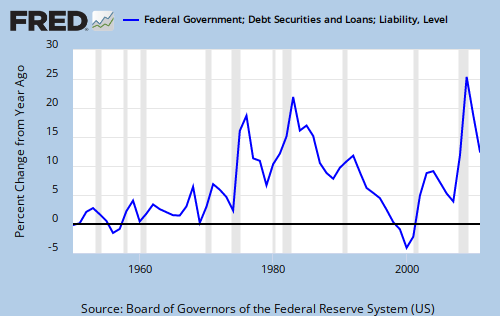
In other posts on this blog, we have discussed how reductions in federal debt growth, as shown by the following graph, “Federal Government Debt-Domestic Nonfinancial Sectors,” immediately precede recessions. This comes as no surprise, since a growing economy requires a growing supply of money, and deficit spending is the federal government’s method for adding money to the economy.

Federal debt
FEDERAL GOVERNMENT DEBT- PERCENTAGE CHANGE FROM YEAR AGO

Clearly, federal debt/money growth is essential to keep us out of recessions. Yet, when we look at “Debt Outstanding Domestic Nonfinancial Sectors” which includes not only Federal debt, but also outstanding credit market debt of state and local governments, and private nonfinancial sectors we do not see the same pattern.

Total Nonfinancial Debt
TOTAL DOMESTIC NONFINANCIAL DEBT — PERCENTAGE CHANGE FROM YEAR AGO

In fact, when we subtract federal debt from total debt, leaving only state, local and private debt, we see the opposite pattern. Recessions more often seem to follow increases in state, local and private debt.


STATE, LOCAL AND PRIVATE DEBT, PERCENT CHANGE FROM YEAR AGO

Now in one sense, money is money. Your buying on your credit card creates debt/money, just as federal deficit spending creates debt/money. Presumably, both should have the same stimulative effect on the economy. They do, but not long term. Why?

Because, unlike the federal government, you, your business and local governments cannot create new money endlessly to service your debts. Your debts can pile up to the point where you must liquidate them by paying them off or by going bankrupt. When non-federal debts become too large, a growing number of people, states, cities and businesses must pull back and stop further borrowing, i.e. stop creating money, or even destroy money by paying off loans. When that happens, we have a recession.

(As an aside, this is one reason the early stimulus efforts had so little effect. People used the stimulus money to pay off loans, so while the federal deficit spending created money, the loan pay-downs destroyed it. Debt reduction destroys debt/money.)

During the recession, and for a short time after, we tend to cut back on our personal borrowing and liquidate debt/money. Then we begin to resume borrowing, more and more, until again, we hit our personal limits and cut back, causing yet another recession. The sole prevention of this cycle, which averages about 5 years in length, is to make sure that federal deficit spending grows sufficiently to offset periodic money destruction by the private sector.

In summary, federal deficit spending is good for the economy, always good, endlessly good (up to the point of inflation). Private and local government spending/borrowing also is good, but not endlessly. Unlike the federal government, the private and local-government sectors eventually reach a point where debt is unaffordable and unsustainable.

To prevent recessions, the government continuously must provide stimulus spending, then provide added stimulus spending to offset the periodic reduction of money creation by the private sector.

Rodger Malcolm Mitchell
Monetary Sovereignty


==========================================================================================================================================
No nation can tax itself into prosperity, nor grow without money growth. Monetary Sovereignty: Cutting federal deficits to grow the economy is like applying leeches to cure anemia. Two key equations in economics:
Federal Deficits – Net Imports = Net Private Savings
Gross Domestic Product = Federal Spending + Private Investment and Consumption + Net exports

#MONETARY SOVEREIGNTY

–Punish BP or . . . ?

An alternative to popular faith

Those rotten scoundrels have ruined our oceans and our shores. They should pay not only for the cleanup, not only for the jobs lost because of the pollution, not only for the damage, but they even should pay for jobs lost because of President Obama’s decision to stop deep-water drilling. BP should pay, pay, pay until they bleed, then pay some more. These people must be held accountable.

Phew! Now I feel better.

But, wait. What is BP? It’s a legal description, nothing more than words on a piece of paper. It has no physical existence. You can’t punish BP any more than you can punish a law or a page of sheet music. BP, as a legal entity, neither caused, nor can cure, the oil spill. That disaster was caused by people, and it is people, not a piece of paper, who must be held accountable.

So the question becomes, which people should be punished? BP has a huge number of employees, the vast majority of whom had nothing to do with the oil spill. It has a huge number of innocent shareholders, a huge number of innocent suppliers, a huge number of innocent oil users. In some ways, you and I are part of BP, because as users of oil and oil-related products (i.e. all products) we are affected by what its employees do.

Which of those people should be “held accountable”? What if holding all of BP “accountable” means thousands of innocent people will be fired, or innocent suppliers will be put out of business, or all of us will have to pay more for our oil and gas, or all of us who hold BP stock, either directly or as part of a fund, will lose? What if punishing BP has an adverse effect on the whole economy. Is that wise?

Somewhere between vengeance and economic reality lies the answer. Punishing BP, as a company, punishes all of us who already are suffering from the gusher. And though widespread vengeance may feel good, there is a “cut-nose-spite-face” aspect to be considered. So, what can be done to help prevent a repeat?

First, let’s identify the people specifically responsible. Certain BP employees. Certain employees of BP suppliers. The guys who mixed and poured the rotten cement that didn’t hold.

And, with all the focus on BP, let’s not forget those government employees who failed equally. I’m talking about the people who, after having been bribed with nice gifts, so readily approved all of BP’s actions.

Yes, we should fine, fire, even jail all the responsible individuals. That would help prevent future problems. Of course, that doesn’t pay for all the efforts to cure the situation nor for all the losses. Who should pay the billions for that?

If you really care about the economy, and are not just flailing out in retribution, you would agree the economically wise approach would be for the federal government to pay. That way, the guilty would be punished, the innocent spared and the economy stimulated.

Government pays = people benefit. BP pays = people pay.

So what’s your choice: Vengeance or money in your pocket?

Rodger Malcolm Mitchell
http://www.rodgermitchell.com

No nation can tax itself into prosperity