–The UK wall of shame. How the poor will suffer, the rich will thrive, the Gap will widen and the economy will stagnate

Twitter: @rodgermitchell; Search #monetarysovereignty
Facebook: Rodger Malcolm Mitchell

Mitchell’s laws:
●Those, who do not understand the differences between Monetary Sovereignty and monetary non-sovereignty, do not understand economics.
●The more federal budgets are cut and taxes increased, the weaker an economy becomes. .
Liberals think the purpose of government is to protect the poor and powerless from the rich and powerful. Conservatives think the purpose of government is to protect the rich and powerful from the poor and powerless.
●Austerity is the government’s method for widening
the gap between rich and poor.
●Until the 99% understand the need for federal deficits, the upper 1% will rule.
To survive long term, a monetarily non-sovereign government must have a positive balance of payments.
●Everything in economics devolves to motive,
and the motive is the Gap.
==================================================================================================================================================================

At its foundation, economics is simple and obvious. All you really need to remember is:

1. A Monetarily Sovereign nation, by definition, has the unlimited ability to create the money — its sovereign currency — to pay its bills. It never can run short of its sovereign currency.
2. For that reason, a Monetarily Sovereign nation neither needs nor uses tax money or borrowing to fund its spending. Deficits are no burden on its ability to pay its bills.
3. A growing economy requires a growing supply of money.
4. Deficit reduction reduces the supply of money.
5. Interest strengthens a currency by increasing the demand for that currency. Strengthening a currency reduces inflation, which is why central banks increase interest rates to fight inflation.

That’s the basis for all economics. Everything else is amplification.

Yet it seems beyond the understanding, not only of the general public, but of the world’s financial and political leaders. Consider the sad case of the United Kingdom:

January 1, 2015 3:58 pm
Annual FT economists’ survey: Spending cuts plans ‘not plausible’
Chris Giles and Emily Cadman

The UK government’s goal of cutting public spending so public finances are back in the black by 2018-19 with a large annual surplus by the end of the next parliament will not be delivered, most economists believe.

The UK government servants wish to be “in the black,” i.e. run a surplus. They want taxes (money coming out of the economy) to exceed spending (money going into the economy). They want the UK economy to be drained of money. That is the plan.

What will draining money out of the economy accomplish? What does applying leeches to the body of an anemic accomplish?

However, a majority do think deficit reduction will continue more or less as planned until the middle of the next parliament and events may make more action unnecessary.

(Of the 87 economists who answered a question on deficit reduction,) there is a consensus that Britain has to endure more cuts or tax increases to reduce the deficit, although the pace of cuts could be slowed from current plans.

As the British have been taught, the deficit is bad. No one knows why it is bad, but it surely is bad. Seemingly, the British people have too much money (i.e. blood), and this money must be removed from the economy to make the economy healthier.

Plans for £50bn of extra spending cuts a year were widely seen as not credible and unlikely to be achieved.

Ray Barrell of Brunel University said alternatives would include more borrowing and higher taxes for pensioners and property owners.

Or, the UK government, being Monetarily Sovereign, simply could create the pounds to pay its bills, thereby adding blood to the anemic patient.

Ian Plenderleith, a former MPC member, said it was “very important” to keep reducing borrowing.

This position was supported by Kathrin Muehlbronner, vice-president of sovereign risk at credit rating agency Moody’s. “Downward pressure on the UK’s sovereign bond rating could arise if fiscal consolidation stalled,” she said.

Ah yes, Moody’s. We know all about Moody’s. They are the ones who gave top ratings to worthless, mortgage-related investments, thereby helping to cause the Great Recession. By all means, let’s take seriously what Moody’s has to say.

Ryan Bourne of the Institute of Economics Affairs added that there was little likelihood of a “catastrophic event” if the deficit was not reduced “but failure to start getting public debt back on a downward path even now, when the economy is growing robustly, would put the UK in a very vulnerable position to shocks and longer-term fiscal headwinds due to an ageing population”.

The Monetarily Sovereign UK government never can run short of its sovereign currency, the pound. It can pay any bill denominated in pounds. It doesn’t need to borrow the pounds it already has created.

So why the need to reduce the “deficit,” (i.e., why reduce the money supply?) The debt Henny-Pennys scream “the sky is falling,” and that creating money causes inflation.

Their screams are punctuated by their favorite words: “Weimar,” “Zimbabwe” and “Argentina” to demonstrate that hyperinflation lurks right around the corner. (Never mind that Weimar, Zimbabwe and Argentina are not in any way related to the UK situation.)

14 October 2014
UK inflation rate of 1.2% is lowest in five years

The CPI is the rate the Bank of England targets and it is charged with keeping inflation at about 2%.

While some economists had speculated that the Bank of England might raise interest rates from the current record low of 0.5% before the end of the year, most had expected a rise early next year.

However, the latest inflation figures means a rate rise could be pushed back further.

“There is little sign of any inflationary pressures on the horizon,” said Martin Beck, senior economic advisor to the EY Item Club.

Governments control inflation by raising and lowering interest rates. Raising interest rates strengthens a currency by increasing the demand for that currency.

So, despite interest rates at a record low — below the target rate — and inflation the lowest in five years, the British government still wishes to starve the nation of money by cutting the deficit.

Why?

Very simply, it’s what the rich want.

Deficit spending benefits the 99% poor- and middle-income people far more than the 1% rich. So deficit spending narrows the Gap between the rich and the rest — exactly what the rich do not want.

It is the Gap that makes the rich rich, and the wider the gap, the richer they are. So the rich bribe the politicians and the economists to pretend that government financing is like personal financing, and that the government could run short of pounds.

The following were asked, “Do you think the next government will deviate from the current deficit reduction plans? Does it matter?”

Not one of the following had the courage or the honesty to stand up and object, “Austerity, for a Monetarily Sovereign nation, is nuts. It rewards the rich, punishes the rest and slows economic growth. It is the very last thing the UK should do. Those who favor austerity are ignorant or criminals.”

Many of them suggested cutting benefits to the poor as a method for reducing the deficit. The poor will suffer, the UK will stagnate and the Gap will widen — all at the behest of the rich.

Here are those whose names should be inscribed on a Wall of Shame. If you know any of these people, contact them and see if you can humiliate them into telling the truth:

Adam Posen, director Peterson Institute
Sir Alan Budd, former MPC member
Andrew Hilton, Centre for the Study of Financial Innovation
Azad Zangana, Schroders
Bart van Ark, The Conference Board
Bridget Rosewell, director, Volterra
Bronwyn Curtis, OMFIF
Charles Davis, Centre for Economics and Business Research
Charles Goodhart, former MPC member
Costas Milas, Liverpool University
Danny Blanchflower, Dartmouth University and former MPC member
David Cobham, Heriot-Watt University
David Kern, British Chamber of Commerce
Diane Coyle, Enlightenment Economics
Dieter Helm, Oxford university
George Magnus, Adviser to UBS
Howard Archer, IHS Global Insight
Sir Howard Davies, former MPC member
Ian Plenderleith, former MPC member
James Knightley, ING
James Meadway, New Economics Foundation
Sir John Gieve, former MPC member
John Hawksworth, PwC
John Llewellyn, consultant
John Muellbauer, Oxford university
John Philpott, consultant
Dame Kate Barker, former MPC member
Keith Wade, Schroders
Kitty Ussher, Tooley Street Research
Mark Miller, Economist Intelligence Unit
Matthew Whittaker, Resolution Foundation
Neil Blake, CBRE
Neil Williams, Hermes
Nicholas Barr, London School of Economics
Patrick Minford, Cardiff University
Peter Dixon, Commerzbank
Peter Warburton, Economic Perspectives
Peter Westaway, Vanguard
Phil Thornton, Clarity Economics
Ray Barrell, Brunell University
Richard Batley, Lombard Street Research
Richard Jeffrey, Cazenove
Robert Wood, Berenberg Bank
Ryan Bourne, Institute of Economics Affairs
Tony Dolphin, IPPR
Tony Yates, Bristol University
Melanie Baker, Jacob Nell, Morgan Stanley
Nick Bosanquet, Imperial
George Buckley, Deutsche Bank
Frances Cairncross, Heriot-Watt University
Jagjit Chadha, University of Kent
Kevin Daly, Goldman Sachs
Danny Gabay, Fathom Consulting
Sarah Hewin, head of macro research Europe, Standard Chartered Bank
Neville Hill, Credit Suisse
Brian Hilliard, Société Générale
Stephen King, HSBC
Ruth Lea, Arbuthnot Securities
Gerard Lyons, Chief Economic Adviser to The Mayor of London Boris Johnson
Allan Monks, JPMorgan
Kathrin Muehlbronner, vice-president sovereign risk group, Moody’s
Andrew Oswald, Warwick University
David Owen, Jefferies
Vicky Pryce, CEBR
Michael Saunders, Citi
Andrew Smithers, Smithers and Co
Phillip Shaw, Investec
David Tinsley, UBS
Daniel Vernazza, UniCredit
Simon Wells, chief UK economist, HSBC
Mike Wickens, York University
Chris Williamson, Markit
David Riley, head of credit strategy at BlueBay Asset Management
John van Reenen, director of the Centre for Economic Performance at the London School of Economics
Andrew Simms, fellow at the New Economics Foundation
Dhaval Joshi, chief strategist at BCA Research
Gary Styles, director — GPS Economics
Sir Christopher Pissarides, Regius Professor of Economics, LSE
Simon Kirby, economist NIESR
Samuel Tombs, senior UK economist, Capital Economics
Jonathan Portes, director, National Institute of Economic and social Research
Andrew Smith, economist
Andrew Sentance, PwC and former MPC member

Rodger Malcolm Mitchell
Monetary Sovereignty

===================================================================================
Ten Steps to Prosperity:
1. Eliminate FICA (Click here)
2. Federally funded Medicare — parts A, B & D plus long term nursing care — for everyone (Click here)
3. Provide an Economic Bonus to every man, woman and child in America, and/or every state a per capita Economic Bonus. (Click here) Or institute a reverse income tax.
4. Free education (including post-grad) for everyone. Click here
5. Salary for attending school (Click here)
6. Eliminate corporate taxes (Click here)
7. Increase the standard income tax deduction annually. (Refer to this.)
8. Tax the very rich (.1%) more, with higher, progressive tax rates on all forms of income. (Click here)
9. Federal ownership of all banks (Click here and here)

10. Increase federal spending on the myriad initiatives that benefit America’s 99% (Click here)

The Ten Steps will add dollars to the economy, stimulate the economy, and narrow the income/wealth/power Gap between the rich and the rest.
——————————————————————————————————————————————

10 Steps to Economic Misery: (Click here:)
1. Maintain or increase the FICA tax..
2. Spread the myth Social Security, Medicare and the U.S. government are insolvent.
3. Cut federal employment in the military, post office, other federal agencies.
4. Broaden the income tax base so more lower income people will pay.
5. Cut financial assistance to the states.
6. Spread the myth federal taxes pay for federal spending.
7. Allow banks to trade for their own accounts; save them when their investments go sour.
8. Never prosecute any banker for criminal activity.
9. Nominate arch conservatives to the Supreme Court.
10. Reduce the federal deficit and debt

No nation can tax itself into prosperity, nor grow without money growth. Monetary Sovereignty: Cutting federal deficits to grow the economy is like applying leeches to cure anemia.
1. A growing economy requires a growing supply of dollars (GDP=Federal Spending + Non-federal Spending + Net Exports)
2. All deficit spending grows the supply of dollars
3. The limit to federal deficit spending is an inflation that cannot be cured with interest rate control.
4. The limit to non-federal deficit spending is the ability to borrow.

THE RECESSION CLOCK
Monetary Sovereignty

Monetary Sovereignty

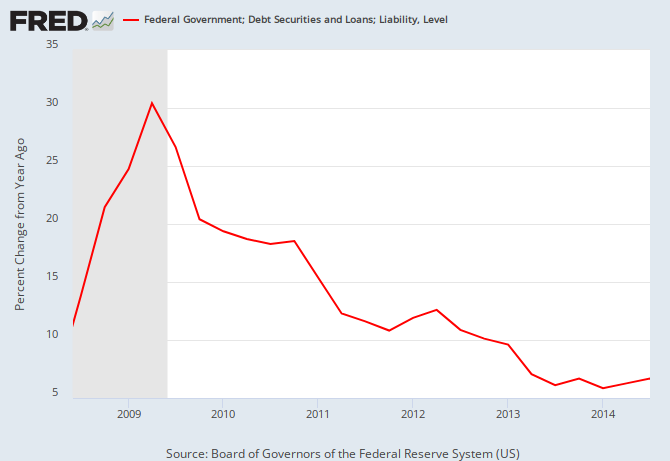
Vertical gray bars mark recessions.

As the federal deficit growth lines drop, we approach recession, which will be cured only when the growth lines rise. Increasing federal deficit growth (aka “stimulus”) is necessary for long-term economic growth.

#MONETARYSOVEREIGNTY

–How scientific truth is determined in the right wing world

Twitter: @rodgermitchell; Search #monetarysovereignty
Facebook: Rodger Malcolm Mitchell

Mitchell’s laws:
●Those, who do not understand the differences between Monetary Sovereignty and monetary non-sovereignty, do not understand economics.
●The more federal budgets are cut and taxes increased, the weaker an economy becomes. .
Liberals think the purpose of government is to protect the poor and powerless from the rich and powerful. Conservatives think the purpose of government is to protect the rich and powerful from the poor and powerless.
●Austerity is the government’s method for widening
the gap between rich and poor.
●Until the 99% understand the need for federal deficits, the upper 1% will rule.
To survive long term, a monetarily non-sovereign government must have a positive balance of payments.
●Everything in economics devolves to motive,
and the motive is the Gap.
==================================================================================================================================================================

A bit more than a week ago, we published “20 reasons why I vote Republican.”

Reason #2 was:

2. Climate change is a fake. People are not causing the earth to warm. And anyway, a warmer earth would be a good thing.

How timely, for today I read:

December 28, 2014
Pope Francis’s edict on climate change will anger deniers and US churches

Following a visit in March to Tacloban, the Philippine city devastated in 2012 by typhoon Haiyan, the pope will publish a rare encyclical on climate change and human ecology.

Urging all Catholics to take action on moral and scientific grounds, the document will be sent to the world’s 5,000 Catholic bishops and 400,000 priests, who will distribute it to parishioners.

“The monopolising of lands, deforestation, the appropriation of water, inadequate agro-toxics are some of the evils that tear man from the land of his birth. Climate change, the loss of biodiversity and deforestation are already showing their devastating effects in the great cataclysms we witness,” he said.

Bishop Marcelo Sorondo, chancellor of the Vatican’s Pontifical Academy of Sciences, a fellow Argentinian who is known to be close to Pope Francis, said: “Just as humanity confronted revolutionary change in the 19th century at the time of industrialisation, today we have changed the natural environment so much. If current trends continue, the century will witness unprecedented climate change and destruction of the ecosystem with tragic consequences.”

What?? The new Pope, leader of the world’s 1.2 Roman Catholics, now believes that humans are causing “unprecedented climate change and destruction of the ecosystem with tragic consequences”?

Well, as the saying goes, “Better late than never.”

Does this mean I’m left with only 19 reasons to vote Republican (like “The poor are naturally lazy” [10] and “Businesses are people and should have the same religious rights as people.” [9])?

Well uh, perhaps not:

Francis’s environmental radicalism is likely to attract resistance from Vatican conservatives and in rightwing church circles, particularly in the US – where Catholic climate sceptics also include John Boehner, Republican leader of the House of Representatives and Rick Santorum, the former Republican presidential candidate.

See, scientists like John Boehner and Rick Santorum don’t believe in man-made global warming, and they have solid proof:

Said Calvin Beisner, spokesman for the conservative Cornwall Alliance for the Stewardship of Creation, which has declared the US environmental movement to be “un-biblical” and a false religion.

“The pope should back off,” he said. “The Catholic church is correct on the ethical principles but has been misled on the science. It follows that the policies the Vatican is promoting are incorrect. Our position reflects the views of millions of evangelical Christians in the US.

There it is: The solid proof upon which the leader of the U.S. House of Representatives and a Republican Presidential candidate rely: Millions of evangelical Christians in the U.S. deny man-made global warming.

If that isn’t scientific proof, what is?

Ah the ignorant bliss of being a right winger.

Now for more austerity, too.

Rodger Malcolm Mitchell
Monetary Sovereignty

===================================================================================
Ten Steps to Prosperity:
1. Eliminate FICA (Click here)
2. Federally funded Medicare — parts A, B & D plus long term nursing care — for everyone (Click here)
3. Provide an Economic Bonus to every man, woman and child in America, and/or every state a per capita Economic Bonus. (Click here) Or institute a reverse income tax.
4. Free education (including post-grad) for everyone. Click here
5. Salary for attending school (Click here)
6. Eliminate corporate taxes (Click here)
7. Increase the standard income tax deduction annually. (Refer to this.)
8. Tax the very rich (.1%) more, with higher, progressive tax rates on all forms of income. (Click here)
9. Federal ownership of all banks (Click here and here)

10. Increase federal spending on the myriad initiatives that benefit America’s 99% (Click here)

The Ten Steps will add dollars to the economy, stimulate the economy, and narrow the income/wealth/power Gap between the rich and the rest.
——————————————————————————————————————————————

10 Steps to Economic Misery: (Click here:)
1. Maintain or increase the FICA tax..
2. Spread the myth Social Security, Medicare and the U.S. government are insolvent.
3. Cut federal employment in the military, post office, other federal agencies.
4. Broaden the income tax base so more lower income people will pay.
5. Cut financial assistance to the states.
6. Spread the myth federal taxes pay for federal spending.
7. Allow banks to trade for their own accounts; save them when their investments go sour.
8. Never prosecute any banker for criminal activity.
9. Nominate arch conservatives to the Supreme Court.
10. Reduce the federal deficit and debt

No nation can tax itself into prosperity, nor grow without money growth. Monetary Sovereignty: Cutting federal deficits to grow the economy is like applying leeches to cure anemia.
1. A growing economy requires a growing supply of dollars (GDP=Federal Spending + Non-federal Spending + Net Exports)
2. All deficit spending grows the supply of dollars
3. The limit to federal deficit spending is an inflation that cannot be cured with interest rate control.
4. The limit to non-federal deficit spending is the ability to borrow.

THE RECESSION CLOCK
Monetary Sovereignty

Monetary Sovereignty

Vertical gray bars mark recessions.

As the federal deficit growth lines drop, we approach recession, which will be cured only when the growth lines rise. Increasing federal deficit growth (aka “stimulus”) is necessary for long-term economic growth.

#MONETARYSOVEREIGNTY

–Stephanie Kelton: Bon Voyage and Godspeed

Twitter: @rodgermitchell; Search #monetarysovereignty
Facebook: Rodger Malcolm Mitchell

Mitchell’s laws:
●Those, who do not understand the differences between Monetary Sovereignty and monetary non-sovereignty, do not understand economics.
●The more federal budgets are cut and taxes increased, the weaker an economy becomes. .
Liberals think the purpose of government is to protect the poor and powerless from the rich and powerful. Conservatives think the purpose of government is to protect the rich and powerful from the poor and powerless.
●Austerity is the government’s method for widening
the gap between rich and poor.
●Until the 99% understand the need for federal deficits, the upper 1% will rule.
To survive long term, a monetarily non-sovereign government must have a positive balance of payments.
●Everything in economics devolves to motive,
and the motive is the Gap.
==================================================================================================================================================================

Reader Ian Winograd alerted me to the fact that Stephanie Kelton has been chosen to be Chief Economist for Senate Budget Committee. This is great news.

As many of you know, Stephanie is Chair of the Economics Department at the University of Missouri, Kansas City. UMKC is the primary hub for Modern Monetary Theory, the sister of Monetary Sovereignty.

Presumably, Stephanie will have the opportunity to insert some reality into the government’s budgeting process, although she will be constrained by politics. To give you some idea, here are the people with whom she will deal.

This morning, I dropped Stephanie a note:

Hi Stephanie,

Wow! I don’t know how you made it happen, but I’m sure glad you did. Now, you’ll have a bigger, better chance to spread the truth.

Believe this 80-year-old man: It won’t be easy.

Many people go to Washington, filled with knowledge and faith, but then the political birds whisper in their ears — things like “To get along, go along,” and “The people can’t handle the truth,” and “It’s not politically possible,” and the not-so-subtle threat, “You can accomplish more on the inside than on the outside.”

And soon those well-meaning people sip the political drug, and gradually lose their principles, and themselves become part of the Big Lie.

I’m sure every Fed Chairman knows the truth. Some even have hinted at it. But the political birds convinced them to go along politically, and they gave credibility to the Big Lie.

I’m sure Eric Holder knew he should prosecute the banksters, but the political birds convinced him to go along. I’m sure George Bush knew torture is wrong, but the birds swayed him by political expediency. I’m sure at least some Senators know the facts of MMT and Monetary Sovereignty. But, the political birds convince them to stay silent.

There’s a funny thing about surrendering beliefs: It becomes easier every time you do it, and after a while, you barely can remember what your real beliefs are.

Anyway, you’ve fought long and hard to spread the truth. And now the opportunity has arisen and you’ll have a bigger megaphone.

I know you’ll do great things.

Much good luck to you. Let me know if I can be of assistance.

Rodger

Her response:

All good words. Thx, Rodger.

I suspect her job will resemble trying to reverse course on the world’s largest oil tanker, currently in full speed.

But . . . we can hope.

Rodger Malcolm Mitchell
Monetary Sovereignty

===================================================================================
Ten Steps to Prosperity:
1. Eliminate FICA (Click here)
2. Federally funded Medicare — parts A, B & D plus long term nursing care — for everyone (Click here)
3. Provide an Economic Bonus to every man, woman and child in America, and/or every state a per capita Economic Bonus. (Click here) Or institute a reverse income tax.
4. Free education (including post-grad) for everyone. Click here
5. Salary for attending school (Click here)
6. Eliminate corporate taxes (Click here)
7. Increase the standard income tax deduction annually. (Refer to this.)
8. Tax the very rich (.1%) more, with higher, progressive tax rates on all forms of income. (Click here)
9. Federal ownership of all banks (Click here and here)

10. Increase federal spending on the myriad initiatives that benefit America’s 99% (Click here)

The Ten Steps will add dollars to the economy, stimulate the economy, and narrow the income/wealth/power Gap between the rich and the rest.
——————————————————————————————————————————————

10 Steps to Economic Misery: (Click here:)
1. Maintain or increase the FICA tax..
2. Spread the myth Social Security, Medicare and the U.S. government are insolvent.
3. Cut federal employment in the military, post office, other federal agencies.
4. Broaden the income tax base so more lower income people will pay.
5. Cut financial assistance to the states.
6. Spread the myth federal taxes pay for federal spending.
7. Allow banks to trade for their own accounts; save them when their investments go sour.
8. Never prosecute any banker for criminal activity.
9. Nominate arch conservatives to the Supreme Court.
10. Reduce the federal deficit and debt

No nation can tax itself into prosperity, nor grow without money growth. Monetary Sovereignty: Cutting federal deficits to grow the economy is like applying leeches to cure anemia.
1. A growing economy requires a growing supply of dollars (GDP=Federal Spending + Non-federal Spending + Net Exports)
2. All deficit spending grows the supply of dollars
3. The limit to federal deficit spending is an inflation that cannot be cured with interest rate control.
4. The limit to non-federal deficit spending is the ability to borrow.

THE RECESSION CLOCK
Monetary Sovereignty

Monetary Sovereignty

Vertical gray bars mark recessions.

As the federal deficit growth lines drop, we approach recession, which will be cured only when the growth lines rise. Increasing federal deficit growth (aka “stimulus”) is necessary for long-term economic growth.

#MONETARYSOVEREIGNTY

This is the single biggest problem facing America

Twitter: @rodgermitchell; Search #monetarysovereignty
Facebook: Rodger Malcolm Mitchell

Mitchell’s laws:
●Those, who do not understand the differences between Monetary Sovereignty and monetary non-sovereignty, do not understand economics.
●The more federal budgets are cut and taxes increased, the weaker an economy becomes. .
Liberals think the purpose of government is to protect the poor and powerless from the rich and powerful. Conservatives think the purpose of government is to protect the rich and powerful from the poor and powerless.
●Austerity is the government’s method for widening
the gap between rich and poor.
●Until the 99% understand the need for federal deficits, the upper 1% will rule.
To survive long term, a monetarily non-sovereign government must have a positive balance of payments.
●Everything in economics devolves to motive, and the motive is the Gap.
==================================================================================================================================================================

In November, 2013, we published “The real reason for Quantitative Easing,” which featured these paragraphs:

What is the single biggest problem facing the American economy? No, it’s not the federal deficit or the debt, not inflation, deflation, recession or depression, not reduced employment or unemployment, not health care or Social Security.

No, the single biggest problem facing the American economy is the growing Gap between the few very rich and the rest of us.

Now, more than a year later, with the economy growing, unemployment down, the stock market exploding and President Obama finally showing some spine, has this single biggest problem eased?

PEW RESEARCH
DECEMBER 17, 2014
America’s wealth gap between middle-income and upper-income families is widest on record
BY RICHARD FRY AND RAKESH KOCHHAR

The wealth gap between America’s high income group and everyone else has reached record high levels since the economic recovery from the Great Recession of 2007-09, with a clear trajectory of increasing wealth for the upper-income families and no wealth growth for the middle- and lower-income families.

In 2013, the median wealth of the nation’s upper-income families ($639,400) was nearly seven times the median wealth of middle-income families ($96,500), the widest wealth gap seen in 30 years when the Federal Reserve began collecting these data.

monetary sovereignty

In addition, America’s upper-income families have a median net worth that is nearly 70 times that of the country’s lower-income families, also the widest wealth gap between these families in 30 years.

The Gap, between the rich and the rest, grew following the “Great Recession,” but it also grew during the “Great Recession”:

The wealth gap between upper-income and middle-income families also widened during the Great Recession.

The median wealth of all three income groups declined from 2007 to 2010. But upper-income families were not hit nearly as hard as lower- and middle-income families.

Median wealth declined by 17% from 2007 ($718,000) to 2010 ($595,300) among upper-income families. In contrast, middle-income (-39%) and lower-income (-41%) families had larger declines in wealth.

Keep in mind that the rich don’t care about absolute dollars; they are interested in comparative dollars, i.e. the Gap.

It is the Gap that makes them rich. (Without the Gap, no one would be rich, and the larger the Gap, the richer they are.)

monetary sovereignty

The rich, with help primarily from conservatives in Congress and the conservative Supreme Court, bribe politicians to adopt policies that widen the Gap. A sampling of these policies:

1. Increase FICA and reduce Social Security benefits.
2. Charge for Medicare and include deductibles and “holes” and limits in payments. Attempt to make Medicare and Social Security privately funded.
3. No support for medical insurance below age 65.
4. Very little assistance for college education, and make student loans the only loans not dischargeable in bankruptcy.
5. Cut corporate tax rates and increase the many tax “loopholes” for the rich, not available to lower income taxpayers.
6. Allow wealthy bankers to trade risky futures accounts, then be reimbursed for losses by the government.
7. Opt for “smaller federal government,” especially cutting programs that benefit the 99%.

Since conservatives opt for policies that benefit the rich and widen the Gap, and the vast majority of the people are not rich, one wonders why conservatives seem to be winning the battle for approval by the 99%.

I can think of 4 reasons for this departure from self interest. (Perhaps you can think of more).
–Hatred for a black President
–Obama is a conservative disguised as a liberal, so he preaches the conservative “cut deficits” agenda, thus reducing liberal votes.
–The people don’t understand Monetary Sovereignty, so they believe that federal deficit spending causes inflation and is unsustainable.
–The voters despise those poorer than themselves, especially the black and brown –people who are considered to be lazy “takers.”

monetary sovereignty

The current gap between blacks and whites has reached its highest point since 1989, when whites had 17 times the wealth of black households. The current white-to-Hispanic wealth ratio has reached a level not seen since 2001.

The Gap not only is a Gap in wealth, income and power, but also a Gap in fairness of opportunity. Attending college is a key step toward economic success, but attending college has two, often unaffordable costs: Tuition and the time that otherwise could be spent earning money.

The Impact of Inequality on Growth
By Jared Bernstein | December 4, 2013

The interaction between high levels of wealth concentration and a political system heavily influenced by money threatens to give rise to politics that are more responsive to special interests than, for example, the need for investments in public goods that would boost productivity and growth.

In short, rather than bribing politicians to pass laws that benefit the whole nation, the rich bribe politicians to pass laws that funnel money from the poor to the rich.

The fact that conservative politics benefits the few rich, yet the majority of Americans voted conservative in the past election, gives testimony to the truth of: “Nobody ever went broke underestimating the intelligence of the American public.”

Apparently, visceral hatred of blacks, browns, the poor, immigrants, gays and non-Christians trumps logical self interest, patriotism or compassion.

Rodger Malcolm Mitchell
Monetary Sovereignty

===================================================================================
Ten Steps to Prosperity:
1. Eliminate FICA (Click here)
2. Federally funded Medicare — parts A, B & D plus long term nursing care — for everyone (Click here)
3. Provide an Economic Bonus to every man, woman and child in America, and/or every state a per capita Economic Bonus. (Click here) Or institute a reverse income tax.
4. Free education (including post-grad) for everyone. Click here
5. Salary for attending school (Click here)
6. Eliminate corporate taxes (Click here)
7. Increase the standard income tax deduction annually. (Refer to this.)
8. Tax the very rich (.1%) more, with higher, progressive tax rates on all forms of income. (Click here)
9. Federal ownership of all banks (Click here and here)

10. Increase federal spending on the myriad initiatives that benefit America’s 99% (Click here)

The Ten Steps will add dollars to the economy, stimulate the economy, and narrow the income/wealth/power Gap between the rich and the rest.
——————————————————————————————————————————————

10 Steps to Economic Misery: (Click here:)
1. Maintain or increase the FICA tax..
2. Spread the myth Social Security, Medicare and the U.S. government are insolvent.
3. Cut federal employment in the military, post office, other federal agencies.
4. Broaden the income tax base so more lower income people will pay.
5. Cut financial assistance to the states.
6. Spread the myth federal taxes pay for federal spending.
7. Allow banks to trade for their own accounts; save them when their investments go sour.
8. Never prosecute any banker for criminal activity.
9. Nominate arch conservatives to the Supreme Court.
10. Reduce the federal deficit and debt

No nation can tax itself into prosperity, nor grow without money growth. Monetary Sovereignty: Cutting federal deficits to grow the economy is like applying leeches to cure anemia.
1. A growing economy requires a growing supply of dollars (GDP=Federal Spending + Non-federal Spending + Net Exports)
2. All deficit spending grows the supply of dollars
3. The limit to federal deficit spending is an inflation that cannot be cured with interest rate control.
4. The limit to non-federal deficit spending is the ability to borrow.

THE RECESSION CLOCK
Monetary Sovereignty

Monetary Sovereignty

Vertical gray bars mark recessions.

As the federal deficit growth lines drop, we approach recession, which will be cured only when the growth lines rise. Increasing federal deficit growth (aka “stimulus”) is necessary for long-term economic growth.

#MONETARYSOVEREIGNTY