Why YOU don’t have free medical care (but the rich do).

Imagine you being the richest person in the world—the first trillionaire—when your adult daughter comes to you and says, “I have cancer, and my insurance won’t cover the treatments I need to survive. I can’t afford to pay the medical bills.”

” What would you do?

Would you say, “I’m trillionaire; I’ll pay for the cost of your treatment”?

Or would You say, “I don’t care whether you go broke or die. You’ll have to pay because, even though I’m a trillionaire, I don’t want to help you.”

The federal government, being Monetarily Sovereign. Has more money than even a trillionaire. It effectively has infinite money.

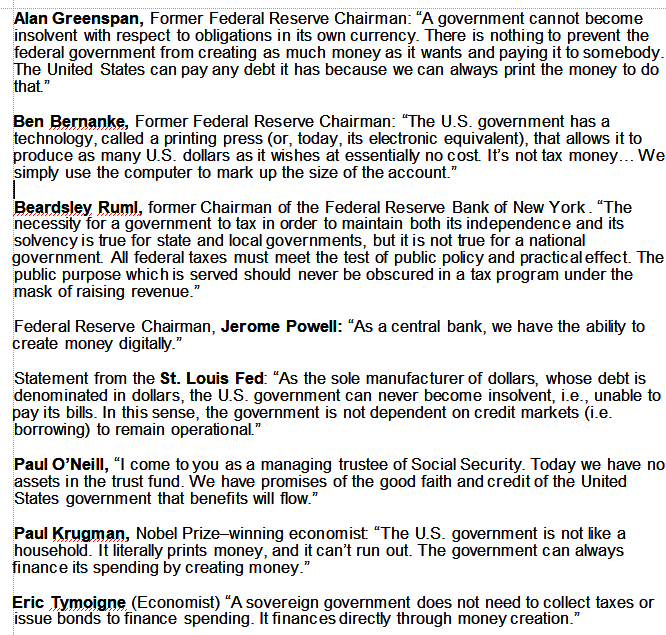
Who says so? These experts, listed at the right, and many others.

If four Federal Reserve Chairmen, and many others of similar note, say the government has the infinite ability to pay for anything, without collecting taxes or borrowing, why won’t the government simply pay for a comprehensive, no deductible Medicare for everyone, regardless of age or illness?

This recent article tells the story.

Republicans see high-risk plans as the future of health insurance Story by Kelly Hooper • 20h • 8 min read

The High Deductible Plan

Hundreds of thousands of Americans have switched to health insurance that covers a lot less of their care this year. Republicans hope a lot more will follow them.

The shift since January was driven by GOP lawmakers’ decision at the end of December to reduce the help the government provides to people who don’t get insurance through work, but instead buy it in the Obamacare marketplace. The reduction in those subsidies sent Obamacare customers searching for plans that cost less.

There’s a catch: The cheaper plans don’t cover the first several thousand dollars in sick visits, drugs and surgeries a patient needs. Nearly 4 in 10 Obamacare enrollees are in these “high-deductible” plans now, compared to 3 in 10 a year ago.

In short, Republicans want to move the financial burden from the government, which can afford it, to lower-income people, who can’t.

The reason is that it widens the income, wealth, and power gap between the rich and everyone else. This gap is what makes the rich wealthy—the wider it gets, the richer they become.

Since Republicans are seen as the “party of the rich,” their goal often seems to be helping the rich get richer while the poor get poorer.

President Donald Trump and GOP senators want to encourage more to go that route by shifting remaining Obamacare subsidies, which are now used to reduce monthly premiums, into tax-advantaged savings accounts that come with the high-deductible plans.

That would be very good for some — affluent people in good health who use the savings accounts to accrue wealth — but not so much for others: sicker and poorer people who incur medical bills they can’t afford.

The “Overuse” False Excuse

For many Republicans, that’s a worthwhile trade-off, considering the plans also reduce overuse of the health care system and put downward pressure on prices.

“The president clearly has said we need to send money to patients rather than insurers in the system, and building out policies that are consistent with that is important,” said Brian Blase, president of the right-leaning Paragon Health Institute and an adviser to Trump in his first term.

Republicans believe that poor Americans tend to “overuse” the healthcare system, whether by visiting the doctor too frequently or undergoing unnecessary surgeries.

It’s likely that very few people see a doctor too often or undergo unnecessary surgeries. Regular checkups are encouraged as a cost-seaving and preventive measure, and while some cosmetic procedures might be unnecessary, most of us would rather eat spiders than have surgery we don’t need.

Many high-deductible customers are “chasing after that lower premium, but they actually do need to use care on an ongoing basis, and then they end up with a lot of debt or being terrified to use their insurance or seek care and ignoring symptoms,” said Katherine Hempstead, senior policy adviser at the Robert Wood Johnson Foundation, a progressive health care-focused philanthropy.

The president touted his “Great Health Care Plan” at a Turning Point USA event two weeks ago, promising “to get it done one way or the other.”

The “Save Money” False Excuse

Among Republicans on Capitol Hill, both Trump allies, like Sen. Rick Scott of Florida, and adversaries, such as Sen. Bill Cassidy of Louisiana, are trying to help.

Cassidy told POLITICO he thought most people would come out ahead given the lower premiums and tax savings. “Your total cost of being insured is less,” he said.

The phrase “being insured” feels like mealy-mouthed double talk. Sure, the overall cost might be lower, but having no insurance at all would be even cheaper. Is that the idea?

Cassidy ignores the fact that deductibles shift costs from the infinitely rich government onto poor sick individuals.

The “Greater Control” False Excuse

For Scott, it’s about giving patients greater control. The change would “radically re-empower the American people and let them dictate more of where their money goes,” he said.

It’s hard to see how deductibles give more “control,” especially when a relatively small federal payment is unlikely to cover the costs of serious illnesses.

One easily could ask, If the Republican proposal offers, better, cheaper insurance, would Senators be willing to use their  own proposed plan?

A mass shift to high-deductible plans could leave millions of Americans who recently lost access to Obamacare subsidies vulnerable to unexpectedly high costs, health policy experts said. 

“You’re going to have parallel-marketed plans — next to comprehensive ACA plans — that are loosely regulated, that may look attractive at first because they they appear to have lower premiums, but then you come to find out when you actually need to use the plan you’re stuck with much higher out-of-pocket costs and fewer consumer protections,” said Michelle Long, a senior policy manager for the Program on Patient and Consumer Protections at KFF, a health policy research organization.

The “Most People” Doubletalk

Sen. Bill Cassidy (R-La.) thinks most people would come out ahead under his plan to direct Obamacare subsidies into individuals’ HSA accounts when they enroll in low-premium, high-deductible plans.

In fact, most people would be better off financially if they didn’t buy any insurance at all. That’s what makes insurance companies profitable. If most people came out ahead by purchasing insurance, there wouldn’t be any private insurers.

You can be certain that Cassidy knows this.

Cassidy, the Health Committee chair, is leading a bill with the Finance chair, Mike Crapo (R-Idaho), that would direct federal funds used for Obamacare subsidies instead to individuals’ HSA accounts when they enroll in low-premium, high-deductible plans.

If the government were to put $2,000 into enrollees’ health savings accounts, Cassidy said, that would cover the annual medical expenses of the average American.

Scott said his proposal would do more to lower costs by allowing people to save in new Trump Health Freedom Accounts in any type of insurance plan. Currently, only people in high-deductible plans can open HSAs.

Scott’s plan would also let states waive certain ACA requirements, including coverage of essential health benefits, to lower premiums. That could leave enrollees who get sick on the hook for unexpected bills.

The plan is consistent with Trump’s efforts to offer more choices for Obamacare enrollees outside traditional ACA plans, including expanding short-term health plans, which Democrats have derided as “junk insurance.”

No matter how many twists, turns, and fake options the Republicans add to  confuse the public, the goal remains the same: Have the government spend less and the people spend more.

The Trump administration has also proposed a marketplace rule that would crack down on fraudulent ACA enrollments and expand several alternative plan options, including catastrophic plans — lower-premium plans that cover Obamacare’s essential health benefits but come with a more than $10,000 deductible for an individual in 2026. Trump also proposes allowing the sale of so-called non-network plans on the ACA marketplace, which typically come with high deductibles but have no networks of doctors or providers, an option some employers currently offer.

If all these options leave you feeling confused, that’s exactly the point: toss in dozens of variations to make you believe you’re paying less, when the real goal is to have you pay more while thinking you’re getting a deal.

If insurers take a financial hit as a result of the policies, they might hike premiums across the market, raising costs for large swaths of Obamacare enrollees regardless of what plans they’re in. And the plans might not provide much protection for an unexpected medical event.

What politicians don’t mention is that while federal spending doesn’t cost taxpayers directly, it actually helps grow the economy. They complain about hospitals, doctors, and pharmaceutical companies charging “too much,” but overlook the fact that this money circulates through the economy and ends up in everyone’s pockets.

Insurers and providers argue the plans would leave consumers vulnerable to high out-of-pocket costs. vers just because they’re armed with pricing data.

“What you might see instead is somebody who gets duped into thinking it’d be better to have a lower-tier plan and $2,000. That could be a really terrible trade-off for them, because that $2,000 won’t last long if something really happens, and they’re just going to have a way more exposure to debt.” 

THE REAL SOLUTION

The government exists to protect and enhance the well-being of its people, and in return, we provide it with money and grant it authority over certain aspects of our lives.

Since the U.S. federal government has unlimited funds, it can cover services that would be expensive for individuals, such as military defense, legal protections, and healthcare.

The federal government can afford to fund — without collecting a penny in taxes — a comprehensive, no-deductible Medicare plan for everyone in America, regardless of age or health.

This would not only include all services from doctors, nurses, and hospitals, but also educational programs to train more doctors and nurses, along with funding for pharmaceutical R&D and equipment manufacturers.

A holistic approach to funding America’s health could not only cost taxpayers nothing and boost healthy longevity but also generate billions in economic growth. Cost no longer would be an issue, because the dollars would circulate through the economy and benefit everyone, both economically and physically.

If we ever can educate America on the huge possible benefits of Monetary Sovereignty, we’ll finally become the great nation we’ve always aspired to be.

Rodger Malcolm Mitchell

Monetary Sovereignty

Twitter: @rodgermitchell

Search #monetarysovereignty

Facebook: Rodger Malcolm Mitchell;

MUCK RACK: https://muckrack.com/rodger-malcolm-mitchell;

https://www.academia.edu/

……………………………………………………………………..

A Government’s Sole Purpose is to Improve and Protect The People’s Lives.

MONETARY SOVEREIGNTY

Does education benefit America? You might think the answer is obvious.

In 1647, the Massachusetts “Old Deluder Satan Act” required towns in colonial New England to hire teachers. The schools were funded by local taxes to promote literacy, so people could read the Bible.

This is widely regarded as the first law that mandated publicly funded education in what would later become the United States. By the early 1800s, this idea had spread, with other New England states adopting similar town-funded schools, although southern states did not follow suit.

In the 1830s to 1850s, modern free public schooling took shape. In Massachusetts in 1837, Horace Mann championed free, universal education funded by taxes and implemented by professional teachers.

By around 1850, most Northern states had established free public elementary schools funded by property taxes. These schools were accessible to most white children, as racial equality was achieved much later.

High schools came in 1821. The Boston English High School became the first free public high school in the U.S.

Wealthy men throw books into a bonfire, while impoverished children watch.
If we give them a college education, they won’t work in our factories.

By the late 1800s to early 1900s, free public high schools became widespread. Compulsory attendance laws began in 1880–1918, and segregation ended (legally): 1954, Brown v. Board of Education. Truly universal access began in the mid-20th century.

Why was free schooling mandated in the past, while free advanced education is often discouraged today? The answer, as usual, involves Monetary Sovereignty and Gap Psychology

Our Monetarily Sovereign federal government has an unlimited ability to create dollars with just a keystroke. It never can go bankrupt or run out of money. However, it often chooses to fund tax breaks for the wealthy rather than allocate resources to education for those who are less fortunate.

Gap Psychology describes a common, almost universal desire to distance oneself from those lower on the income, wealth, and power scale while trying to associate more with those above. This mindset is the primary way the wealthy maintain and increase their wealth. It also ensures that people continue to work even after they receive higher pay.

NEWS BRIEFING Borrowers in default on student loans may see wages garnished

WASHINGTON — The Trump administration said Tuesday that it will begin garnishing the wages of student loan borrowers who are in default early next year.

The department said it will send notices to about 1,000 borrowers the week of Jan. 7, with more notices to come at an increasing scale each month.

Millions of borrowers are considered in default, meaning they are 270 days past due on their payments. The department must give borrowers 30 days’ notice before garnishing their wages.

The department said it will begin collection activities, “only after student and parent borrowers have been provided sufficient notice and opportunity to repay their loans.”

In May, the Trump administration ended the pandemic-era pause on student loan payments and began collecting on defaulted debt by withholding tax refunds and other federal payments from borrowers.

The move ended a period of leniency for student loan borrowers. Payments resumed in October 2023, but the Biden administration extended a one-year grace period. Since March 2020, no federal student loans had been referred for collection, including those in default, until the Trump administration’s changes earlier this year.

The Biden administration tried multiple times to offer broad student loan forgiveness, but those efforts were eventually halted by courts.

Persis Yu, deputy executive director of the Student Borrower Protection Center, criticized the decision to begin wage garnishment and said the department had failed to sufficiently help borrowers find affordable payment options.

Given that:
  1. Educated young people are vital for America’s advancement and security.
  2. The federal government does not need or even use any form of income.
  3. The federal government has the infinite ability to create dollars and fund anything it wishes.

Why does the government fund free elementary and high school — in fact, make attendance compulsory — but garnish the wages of our single most valuable future resource, college students?

Free basic schooling still reinforces the social hierarchy. It still supports the Gap. Early public education has been sold as moral and obedience training, workforce preparation, and national cohesion.

It teaches punctuality, deference to authority, and literacy sufficient for labor, not power.

Even in our early days, basic schooling did not threaten the Gap. Elites benefit because it make for more productive workers, fewer unruly poor, and cultural conformity

But college education for the poor is exactly what the rich do not want.

  1. It reduces the fear of losing one’s job, thus:
  2. It increases labor’s bargaining power (which is why the rich hate unions), and
  3. It puts “the rabble” on a par with the rich and weakens employers’ control.

Free college would narrow the Gap.

In this context, a federally sponsored, comprehensive, no-deductible Medicare program that covers every man, woman, and child in America would help close the healthcare Gap.

In contrast, business-sponsored healthcare insurance for workers tends to reinforce this Gap. Millions of workers fear leaving their jobs or making demands of their employers because they worry about losing their healthcare coverage.

The federal government easily could afford to provide healthcare insurance to everyone. However, instead of doing this, it offers businesses tax incentives to provide less comprehensive coverage—just enough to keep employees dependent on their jobs for healthcare.

Finally, the same would hold for federally sponsored, living-wage Social Security for everyone, of all ages. The rich make three false excuses:

  1. It would require tax increases (aka “Who would pay for it”?)
  2. It would cause inflation by adding growth dollars to the economy (Federal spending isn’t inflationary.)
  3. If given a bare minimum stipend, no one would work because the poor have no ambition. (aka, “Keep ’em poor so they have to accept low-pay jobs and bad working conditions.:”)

And things will have to get much worse before the populace begins to understand how Monetary Sovereignty and Gap Psychology are used against them.


Only a nation of fools would give a tax break to religion but not to science and education.

Rodger Malcolm Mitchell

Monetary Sovereignty

Twitter: @rodgermitchell

Search #monetarysovereignty

Facebook: Rodger Malcolm Mitchell;

MUCK RACK: https://muckrack.com/rodger-malcolm-mitchell;

https://www.academia.edu/

……………………………………………………………………..

A Government’s Sole Purpose is to Improve and Protect The People’s Lives.

MONETARY SOVEREIGNTY

Medicare and Medicaid easily could (should) be better

There are penalties for ignorance, and America pays them every day:
Almost Half of Medicare Patients Can’t Afford a Single Hospital Stay New University of Pennsylvania research highlights growing health care affordability crisis. By Huey Freeman
Read that headline again. Digest it’s meaning. You have original Medicare. You are sick. But you can’t afford to go to the hospital. And you are not rare. Almost half of Medicare patients are just like you. What the hell??
Americans who rely on Medicare to pay for hospital stays are often unable to pay the cost of the standard deduction,sometimes producing a financial shock.
Uncle Sam pockets inside out to show he's poor.
I’m Uncle Sam. I have the infinite ability to create dollars. Even if you don’t pay me one penny in taxes, I could keep spending forever. But don’t ask me for money to pay for your healthcare. I tell everyone I’m broke.
Think about it, more. The federal government is Monetarily Sovereign. That means:
  1. It never can run short of dollars.
  2. It neither needs nor uses tax dollars to pay its bills. It just creates new dollars, every time it pays someone.
  3. Those FICA dollars that are deducted from your pay, supposedly to fund Medicare, don’t fund anything. The govenment destroys them upon receipt, and creates new dollars to pay doctors, nurses, hospitals, etc.
But for some reason, which I’ll explain later, the government insists that you pay 20% of the bill. Three years ago, my wife died in the hospital after a 2-week stay. The bill was somewhere over $400,000 in total. Medicare paid $320,000. Fortunately, I paid for supplementary insurance, which covered nearly all the rest. But for most people, that $80,000 would have landed them in bankruptcy court. Why? Why does Medicare not pay the entire cost? And so long as we’re asking questions, why do we have an alternative called Medicare Advantage that covers some things Medicare doesn’t, but with restriction original Medicare doesn’t have. Why doesn’t original Medicare simply cover everything? Remember, the federal governmennt, being Monetarily Sovereign, cannot run short of dollars.
Researchers at the University of Pennsylvania Perelman School of Medicine found that almost half of such patients have insufficient funds to pay the $1,600 payment, the standard out-of-pocket cost.
Why, the out-of-pocket cost? Here are reasons given: Medicare doesn’t cover 100% of costs for several reasons:
  1. Cost Control: Having beneficiaries share in the cost helps control overall healthcare spending and prevents overuse of services. (The false beliefs are that the government can run short of dollars and people will visit the doctor too much.)
  2. Sustainability: Given the rising healthcare costs, partial coverage helps ensure the program’s financial sustainability. (Same false beliefs as #1)
  3. Incentive for Supplemental Insurance: Encourages beneficiaries to purchase supplemental insurance (Medigap) to cover the remaining costs, providing additional financial protection. (Apparently, the profits of private insurance companies are more important than the people’s finances.)
  4. Budget Constraints: Full coverage would require significantly higher government spending, which might not be feasible given budget constraints. (Unnecessary budget constraints).
And now for the real reason:

5. The politicians are bribed by the rich (via campaign contributions and lucrative jobs) to widen the income/wealth Gap between the rich and the rest. The Gap is what makes the rich wealthy, and the wider the Gap, the wealthier they are.

Federal funding for health care narrows the Gap, so politicians invent excuses to claim it can’t be done.

Even beneficiaries with incomes above the federal poverty level sometimes cannot meet this expense after depleting their savings, according to the study results published in the Annals of Internal Medicine. However, the financial burden extends far beyond just the poorest Americans. “Many Medicare beneficiaries with modest incomes are at risk for financial hardship from costs of a single hospital stay,” the researchers wrote.
Think of yourself as a billionaire, and one of your kids can’t afford medical treatment. Would you allow him to go bankrupt? The federal govenment would.
“Nationally, 36 percent of beneficiaries report difficulty paying medical bills or delaying care due to cost concerns, and those with multiple chronic conditions and serious illnesses are at particular risk for high out-of-pocket costs and economic hardship,” they noted. While Medicaid (not Medicare) and private supplemental insurance can help cover these costs, qualifying for such assistance often requires proving extreme financial hardship.
First,  you must be destitute and prove it.
Patients must prove that their income is at or below the federal poverty level—currently set at $15,060 for individuals and $20,440 for couples in 2024. There are also asset limits of $2,000 for individuals, and $3,000 for couples.
However, some (red) states have set higher thresholds, extending Medicaid limits to 138 percent of the federal poverty level.
Why is there a need for Medicaid. Why not Medicare for All?
Additionally, access to full Medicaid benefits, including long-term care, depends on income criteria that varies by state—typically ranging from 75 to 100 percent of the federal poverty level.
Why should there be income criteria? Why must people go broke to be healthy?
Compounding the problem, fewer Medicare beneficiaries now carry supplemental insurance compared to previous years.
It’s too costly because it’s private, for-profit insurance
Among the 4,881 beneficiaries included in the Medicare study, 45 percent lacked sufficient funds in their checking and savings accounts to pay the Medicare hospital deductible.
Intolerable for the United States of America, a Monetarily Sovereign nation that acts like a 3rd world nation.
Seniors face many hardships resulting from health challenges that extend beyond just medical bills, according to Helen Levy, associate professor at the University of Michigan’s Institute for Social Research. Levy’s research identifies three main channels that lead to lower quality of life for seniors: decreased income, increased medical expenses, and the direct effects of health symptoms themselves. “The first two of these—lower income and higher medical spending—are much less quantitatively important than the third; in a nutshell, poor health makes it harder to get by with less,” Levy wrote in her article on the effects of poverty on older Americans.
Elon Musk making money
“How dare you people ask for free health care like I get. Do you think the government is made of money?” Uh, well . . . 
And then, what follows, is a clear expression of the ignorance that punishes us:
The key question that arises from this new study is how to respond to this insight, Dr. Chad Savage, an internal medicine physician, told The Epoch Times. “A common reaction is to expand insurance policies or government programs to cover an ever-growing range of medical costs,” said Savage, a member of Samaritan Ministries Inc., a group whose members share medical expenses. “However, this approach would increase the cost of coverage, thus, diverting more of the patients’ limited resources toward taxes and insurance premiums, and ultimately, depriving them of the funds they could have used for direct medical expenses.”
Dr. Savage’s comments are based on the wrong claim that the Monetarily Sovereign federal government cannot afford to fund a comprehensive Medicare for every man, woman, and child.
“The real issue, however, is why Americans remain so unprepared for medical expenses when they inevitably arise,” Savage added. “A legislative solution to address this could involve incentivizing proactive savings for medical costs that will inevitably occur as part of life.” “By creating incentives for Americans to contribute to Health Savings Accounts (HSAs) or Medical Savings Accounts (MSAs), they could gradually build up funds to cover out-of-pocket expenses for their own medical care when needed,” he said.
Dr. Savage is totally divorced from reality.
  1. Many people are unable to meet all financial obligations of food, rent, and clothing, much less contributing to HSAs
  2. For most Americans, saving enough in an HSA to cover major or recurring health issues would be impossible.
With infinite funds, the federal government can and should pay all medical expenses. The whole purpose of a government is to protect and improve the lives of the people. What is the purpose of a government that can’t or won’t do it? Here is what we need:

Free comprehensive Medicare for All.

Cover everything that Medicare Advantage covers, but do it in original Medicare. One program for all health needs.

No FICA payroll tax deductions. No fake “trust funds” (that aren’t trust funds). More generous payments to providers to attract more people into the field and more hospitals and clinics.

The federal government not only can afford it without collecting one additional penny in taxes, but the money spent by the government would grow Gross Domestic Product. And no, it wouldn’t cause inflation. See why. The Dr. Savages of the world seem to reverse reality. They think people’s purpose is to improve and protect the government, while the government’s desires come first. It’s nuts. But as I repeatedly have said, there is a penalty for ignorance, and the people of America are paying it. Rodger Malcolm Mitchell Monetary Sovereignty Twitter: @rodgermitchell Search #monetarysovereignty Facebook: Rodger Malcolm Mitchell; MUCK RACK: https://muckrack.com/rodger-malcolm-mitchell; https://www.academia.edu/

……………………………………………………………………..

The Sole Purpose of Government Is to Improve and Protect the Lives of the People.

MONETARY SOVEREIGNTY

The day Joe Biden lost the November 2024 election

Admirably, President Bident wishes to narrow the income/wealth/power Gap between the rich and the rest of us. I agree with this sentiment because the current Gap, very simply, is bad economics and bad for humanity. Wide Gaps negatively affect health and longevity, education, housing, law and crime, war, leadership, ownership, bigotry, supply and demand, GDP, international relations, scientific advancement, the environment, human motivation and well-being, freedom, and virtually every other issue in economics and the human condition. To narrow the Gaps, Biden proposes changes to federal law.  In broad strokes, he has just three options:
  1. Increase taxes on the rich (“rich” by any arbitrary measure).
  2. Reduce taxes on those who are not rich.
  3. Provide supplementary income and benefits to those who are not rich.
All three would narrow the Gap, though in different ways. From the standpoint of the U.S. economy, as measured by Gross Domestic Product, #1 would have a dramatically different effect than #2 and #3. Increasing taxes on the rich (if the rich actually paid those increased tax levels) would take dollars out of the economy. #2 and #3 would add dollars to the economy). In short, #1 is recessive, and #s 2 and 3, would grow the economy. This is demonstrated by the formula:

GDP = Federal Spending + Nonfederal Spending – Net Imports.

If the rich paid more taxes (#1), Nonfederal Spending would decline. The amount of the decline would be determined by various factors, most having to do with how much the rich actually pay. History indicates that payment would be less than anticipated because of existing loopholes and/or new loopholes the rich would bribe Congress to enact. Average Effective Tax Rate on the Top 1 Percent of U.S. Households Considering that the top tax rate in the 1950s was 90%, the rich did not pay much more in that period than they do now. And some of the richest among us pay little if anything. For example, Donald Trump paid no income taxes at all, during ten of the fifteen years, 2000-2015, despite being a billionaire. Tax laws, favorable to the rich, gave him the ability to claim losses on investments that an ordinary taxpayer may not look at as “losing” money. In summary, using federal taxation of the rich to narrow the Gap is bad economics. History shows the rich would find ways to avoid paying higher rates. But, even if the rich were forced to pay more, the higher rates would take dollars out of the economy and recess the economy. Option #1 is a “heads-you-lose (the rich don’t pay more), tails-you-lose” (GDP falls) plan. Sadly, that is the plan Biden seems to have chosen, and it will cost him the November election. The electorate may be ignorant about economics, but the rich would make sure the voters understood that raising taxes — anyone’s taxes — would hurt the economy. It’s simple math. The more the federal government takes out of the economy, the less the economy (GDP) has. Reducing federal taxes and/or providing supplementary benefits to those who are not rich, (#2 and #3) are the sole economically sensible ways to narrow the income/wealth/power Gap. Sadly this sensible approach is blocked by the non-sensible belief that federal deficit spending is “unsustainable.” That’s associated with the equally wrong belief that “excessive” federal spending or an “overheated” economy cause inflation. The fact: Inflation is not caused by “heat” (whatever that is) or by federal spending. All inflations are caused by shortages of critical goods and services, most often oil and food. Inflation can be cured by additional federal spending to acquire and distribute the scarce goods and services. Here is what the right-leaning Tax Foundation thinks:Details and Analysis of President Biden’s Fiscal Year 2025 Budget Proposal

March 22, 2024, By: Garrett Watson, Erica York, William McBride, Alex Muresianu, Huaquin Li, Alex Durante

11-Year Revenue (Trillions) Long-run GDP Long-Run Wages Long-Run FTE Jobs

+$2.2T

-2.2%

-1.6%

-788k

In plain English, the government would remove from the economy, an additional $2,2 Trillion. This would cause GDP to fall by 2.2%, wages to fall by 1.6%, and Full-Time Equivalent Jobs to shrink by 788 thousand.

Because the Tax Foundation has a right-wing agenda, one may doubt the specifics of their calculations, but I believe they are on the right track. When the federal government collects more taxes, the economy loses money. When the economy loses money, the GDP, wages, and jobs all shrink. It’s straightforward math.

The tax changes Biden proposes fall under three main categories: additional taxes on high earners, higher taxes on U.S. businesses—including increasing taxes that Biden enacted with the Inflation Reduction Act (IRA)—and more tax credits for a variety of taxpayers and activities.

The combination of policies would move the tax code further away from simplicity, transparency, and neutrality while making the U.S. economy less competitive.

The increase in the corporate tax rate and the additional taxes on top earners would result in U.S. top marginal tax rates on income that are among the highest in the developed world.

I urge you to read the entire Details and Analysis of President Biden’s Fiscal Year 2025 Budget Proposal as this post offers you the barest outline. Everything Biden may propose is based on two false assumptions:
  1. The federal government is running short of money while the private sector has too much money.
  2. The middle- and lower-income taxpayers will not understand that taking dollars from the economy is recessive, and instead will happily vote for a “soak-the-rich” administration.
The ignorance and cynicism of these beliefs cannot be overstated. Biden seems to believe that taking the populist approach will gain him votes. But, it is such government deceit that keeps you from:
  1. The end of the FICA tax deduction from your salary
  2. Comprehensive, no deductible Medicare for every adult and child.
  3. Social Security benefits for everyone of all ages
  4. Food cost aid
  5. Free college for those who want it
  6. Free public transportation
  7. Housing aid
  8. And a myriad of other benefits our Monetarily Sovereign government easily could afford, while preventing recessions and inflations.
Biden could beat Trump in a “truth vs. lies” competition, but he will not be able to out-lie Trump. If he tries, he will lose. Narrowing the Gap is good economics, but doing it by taxing businesses and the rich is a lie. It may be a good time to repeat a few facts:

•Those, who do not understand the differences between Monetary Sovereignty and monetary non-sovereignty, do not understand economics. •Any monetarily NON-sovereign government — be it city, county, state or nation — that runs an ongoing trade deficit, eventually will run out of money. •The more federal budgets are cut and taxes increased, the weaker an economy becomes. •Liberals think the purpose of government is to protect the poor and powerless from the rich and powerful. Conservatives think the purpose of government is to protect the rich and powerful from the poor and powerless. •The single most important problem in economics is the Gap between rich and poor. •Austerity is the government’s method for widening the Gap between rich and poor. •Until the lower 99% understand the need for federal deficits, the upper 1% will continue to rule. •Everything in economics devolves into motive, and the motive is the Gap between the rich and the rest.

Rodger Malcolm Mitchell Monetary Sovereignty Twitter: @rodgermitchell Search #monetarysovereignty Facebook: Rodger Malcolm Mitchell; MUCK RACK: https://muckrack.com/rodger-malcolm-mitchell

……………………………………………………………………..

The Sole Purpose of Government Is to Improve and Protect the Lives of the People.

MONETARY SOVEREIGNTY