How not to protect American industry. Be bipolar.

Here is the situation: Chinese manufacturers, possibly with the financial aid of the Chinese government, are taking business from key American industries. Quality and other marketing factors are not the real issues. The Chinese companies are doing this with low prices.
Man Pointing Gun At Camera On A Brick Wa... | Stock Video | Pond5
I’m taking your money so you will buy American-made goods. I know this makes no sense, but I’m the government. Trust me.
How should the American government protect these important industries? The American government essentially has two alternatives:
  1. It can force American consumers and businesses to pay higher prices for Chinese goods while taking growth dollars out of the U.S. economy, or
  2. It can help American consumers and businesses to pay lower prices for American goods while adding growth dollars to the U.S. economy.
Which alternative is better for American consumers and businesses? The Biden administration, and the Trump administration before it, have chosen alternative #1: Higher prices for Chinese goods and reducing Gross Domestic Product by taking dollars out of the economy. For reasons beyond logic and common sense, both administrations believe American consumers and businesses should pay higher prices for important commodities, and somehow this not only is beneficial but won’t be inflationary. So they add high taxes, which Americans pay, to the prices of Chinese goods. The alternative, of course, is to give American manufacturers tax breaks or other financial support, so they can compete on prices. That, in fact, is the primary purpose of federal taxes: To control the economy by giving tax breaks to what the government wishes to encourage. Increasing federal taxes should only be a last resort, a punishment when a reward doesn’t work. Federal taxes do not fund federal spending. They are a tool for federal economic control. But rather than use that tool, the federal government has chosen to punish American consumers with higher prices.

Biden announces new tariffs on imports of Chinese goods, including electric vehicles MAY 14, 20245:01 AM ET Asma Khalid

President Biden will slap tariffs on $18 billion of imports of goods from China including electric vehicles, semiconductors, and medical products to protect the strategic sectors and punish China for unfair trade practices.
Joe Biden: The President | The White House
To reduce inflation, my Inflation Reduction Act will give American businesses money so they can produce more, and charge consumers less. Then I’m going to charge those same consumers more with my new tariffs. Makes sense to me.
He could have given tax breaks and other financial support to America’s manufacturers of electric vehicles, semiconductors, and medical practices, thereby saving American consumers money and fighting inflation.

He will also keep in place the tariffs that former President Donald Trump had placed on more than $300 billion of imports from China.

He correctly criticized Trump for the tariffs that are paid for by American consumers.

Treasury Secretary Janet Yellen said in a statement that she raised concerns last month during a trip to Beijing about “artificially cheap Chinese imports,” concerns that she said many other countries share.

She said the new tariffs are necessary to protect American workers and companies from what could become a flood of unfairly traded products.

This “protects American workers and companies” by making them pay more for the products. Some protection that is.

The move comes as Biden pushes forward to implement three pieces of legislation that contain hundreds of billions of subsidies to boost the domestic manufacturing and clean energy sectors— and ahead of a presidential election where trade and jobs will again be an issue.

The Biden administration suffers from bipolar disease. On the one hand, they subsidize industries, and on the other hand, they charge them more in taxes.

“We know China’s unfair practices have harmed communities in Michigan and Pennsylvania and around the country that are now having the opportunity to come back due to President Biden’s investment agenda,” Lael Brainard, Biden’s top economic adviser, told reporters.

His investment agenda is good, but it’s being undone by his import duty agenda. Additionally, duties take dollars out of the economy, which by formula, reduces Gross Domestic Product. This is a recessionary act. If instead, the Biden administration stuck with subsidies, this would add dollars to the economy, a growth act. Between growth and recession, Biden chose recession.

Here’s a list of the new tariffs. Most of the new tariffs cover items that the Biden administration has sought to have made in America through investments in the Inflation Reduction Act, the CHIPS and Science Act and the Bipartisan Infrastructure Law.

Some increases will take place this year. They include tariffs of:

100% on electric vehicles, up from 25% 50% on solar cells, up from 25% 50% on syringes and needles, up from zero 25% on lithium-ion batteries for electric vehicles, and battery parts, up from 7.5% 25% on certain critical minerals, up from zero 25% on steel and aluminum products, up from a range of zero to 7.5% 25% on respirators and face masks, up from zero to 7.5% 25% on cranes used to unload container ships, up from 0% China makes cheap electric vehicles. Why can’t American shoppers buy them?

Other hikes will be phased in, including:

50% on semiconductors, up from 25%, by 2025 25% on other lithium-ion batteries, by 2026 25% on natural graphite and permanent magnets, up from zero, by 2026 25% on rubber medical and surgical gloves, up from 7.5%, by 2026

The White House says this is different from Trump’s approach.

No, it isn’t different. Give it any name you can invent and it still is a tax on purchases. It still takes dollars out of the economy. It still punishes consumers. It still is inflationary and recessionary.

Trump had made tariffs on China one of his signature policy moves when he was in the White House. At first, some Democrats warned this could really hurt the economy — and that American consumers would pay the price.

Biden’s team began reviewing those tariffs when he took office, and now has decided to keep them in place.

“One of the challenges is once tariffs have been imposed, it is quite difficult politically to reduce them — because the affected industry tends to get used to them, like them, operate with them as baked into their plans,” said Michael Froman, who was U.S. Trade Representative during the Obama administration.

It would be far more beneficial to the economy and consumers for industries to “get used to” subsidies, which grow the economy than to get used to taxes, which are inflationary and recessionary.

The White House has tried to distinguish its strategy from Trump’s approach.

It points to comments made by Trump in rallies and interviews that he would broaden tariffs on all imported goods, including targeting Chinese cars, if he wins the election — something that they said would hike consumer prices.

Huh? Taxes on Chinese cars would hike consumer prices, but taxes on the above-listed items will not hike consumer prices???

The White House has downplayed the risk that the new tariffs could spark retaliation from China, saying that the issues have been discussed during meetings of top U.S. and Chinese officials, and were unlikely to come as a surprise.

One could only hope that the Chinese government is as foolish as the American government, and increase tariffs on imports of American goods. That would be a blow to the Chinese economy. SUMMARY Raising federal taxes on the American consumer takes dollars out of the American economy, raises prices, and costs consumers money. It is the worst possible step the government could take. To protect American businesses, the government should rely on tax breaks and other forms of financial support, which would add growth dollars to the economy and lower inflationary prices. Rodger Malcolm Mitchell Monetary Sovereignty Twitter: @rodgermitchell Search #monetarysovereignty Facebook: Rodger Malcolm Mitchell

……………………………………………………………………..

The Sole Purpose of Government Is to Improve and Protect the Lives of the People.

MONETARY SOVEREIGNTY

The good bad news about the Inflation Reduction Act

Now that Senator Sinema has signed on, the Inflation Reduction Act will pass by the scant majority of 51 to 50, including the Vice President’s vote.

Sinema had opposed closing the so-called carried interest tax loophole. Carried interest is treated as a long-term capital gain. Because it’s taxed at a lower rate than ordinary income, private equity, venture capital, and hedge fund operators benefit.

Presumably, she is in bed with those people.

Giving these over-paid number pushers an extra benefit is an anathema to anyone who wants the Gap between the rich and the rest narrowed. So, on that basis, the loophole should be closed.

But it is a federal tax, and federal tax dollars do not fund anything — they are destroyed upon receipt. So whatever reduces federal taxes (i.e., leaves more money in the private sector) benefits the economy.

The dollars you use to pay federal taxes are part of the M2 money supply measure. When those dollars reach the U.S. Treasury, they cease to be part of any money supply measure. Those dollars are destroyed.

When the government spends, it creates new dollars, ad hoc.

Because the Monetarily Sovereign Treasury has the infinite ability to create dollars, there is no answer to the question, “How much money does the Treasury have?” Thus, no measure includes Treasury dollars.

So, there is good and bad in that loophole, but on balance, including the loophole is good because it benefits the entire private sector.

If the Committee for a Responsible Federal Budget’s numbers are correct, and federal deficits are reduced by $305 billion, that would be recessionary.


Reducing deficit growth causes recessions (vertical gray bars) which are cured by increased deficit growth.

Even worse than deficit growth reduction is debt reduction. That leads to depressions:

1804-1812: U. S. Federal Debt reduced 48%. Depression began 1807.
1817-1821: U. S. Federal Debt reduced 29%. Depression began 1819.
1823-1836: U. S. Federal Debt reduced 99%. Depression began 1837.
1852-1857: U. S. Federal Debt reduced 59%. Depression began 1857.
1867-1873: U. S. Federal Debt reduced 27%. Depression began 1873.
1880-1893: U. S. Federal Debt reduced 57%. Depression began 1893.
1920-1930: U. S. Federal Debt reduced 36%. Depression began 1929.
1997-2001: U. S. Federal Debt reduced 15%. A recession began 2001.

The CRFB predicts the federal debt would be reduced by nearly $2 trillion. 

This means the federal government will take $2 trillion from the private sector (aka “the economy”) and destroy those dollars.

The most popular measure of an economy is Gross Domestic Product (GDP). It measures the total spending by the federal government  everyone else in America, plus the net dollars flowing in from across our borders.

Mathematically, for GDP to grow, the private sector must have more dollars. A growing economy requires a growing supply of dollars; when the dollar supply shrinks, GDP shrinks. Simple arithmetic.

When GDP shrinks for two or more months, we call that a “recession,” and if the recession is exceptionally severe, we call it a “depression.”

[Depressions are often defined as recessions lasting longer than three years or resulting in a drop in annual GDP of at least 10 percent.]

The CRFB predicts a depression, though you wouldn’t know it from the tone of their article.

The Congressional Budget Office (CBO) just released its score of the Inflation Reduction Act (IRA) of 2022, legislation which would use Fiscal Year (FY) 2022 reconciliation instructions to raise revenue; lower prescription drug costs; fund new energy, climate, and health care provisions; and reduce the budget deficits.

Mixed bag:

  1. Raising revenue is bad. That means “take more dollars from the private sector.” The federal government neither needs nor uses the dollars, while the private sector does both, need and use.
  2. Lowering prescription drug costs would be good if it meant the government was going to pay. Unfortunately, it means the pharmaceutical companies will pay. Dollars will be shifted around in the private sector, and fewer will be available for research and development.
  3. Fund new energy is good if “new energy” will mean “renewable” and “non-polluting.”
  4. The climate and healthcare provisions seem good, depending on how they are implemented. One good thing, the Affordable Care Act will be strengthened financially.
  5. “Reduce the budget deficits” is bad, bad, bad.

Unfortunately, getting the bill through the reconciliation process was legally and politically necessary. But reducing deficits does not reduce inflation. 

Inflation is caused by shortages of crucial goods and services, most often oil and food. The only part of the Act that comes even close to reducing inflation is the “fund new energy” part, and again, we’ll have to see how that is implemented.

To call the bill the “Inflation Reduction Act” is both humorous and cynical, but that’s government.

Based on the CBO score, the legislation would reduce deficits by $305 billion through 2031 – including over $100 billion of net scoreable savings and another $200 billion of gross revenue from stronger tax compliance.

Again, that’s $305 billion taken from Gross Domestic Product at a time when the economy is in a recession and needs more, not fewer dollars.

Because the prescription drug savings would be larger than new spending, CBO finds the legislation would modestly reduce net spending by almost $15 billion through 2031, including by nearly $40 billion in 2031.

It’s unclear what the above paragraph is saying, but either $15 billion or $40 billion will be taken from pharmaceutical companies, a loss for the economy.

Once fully phased in, the plan would also slightly cut net taxes by about $2 billion per year – with expanded energy and climate tax credits roughly matching the size of new tax increases.

Cutting taxes benefits the private sector.

The legislation would generate nearly $300 billion of net revenue over a decade.

Translation: The legislation would generate nearly $300 billion of net loss for the economy over a decade.

Unlike prior versions of this reconciliation bill, such as the House-passed Build Back Better Act, this legislation would reduce deficits. Along with other elements of the bill, it is likely to reduce inflationary pressures and thus reduce the risk of a possible recession.

The above paragraph is wrong. Reducing deficits does not reduce inflationary pressures, and it absolutely does not reduce the risk of a possible recession.

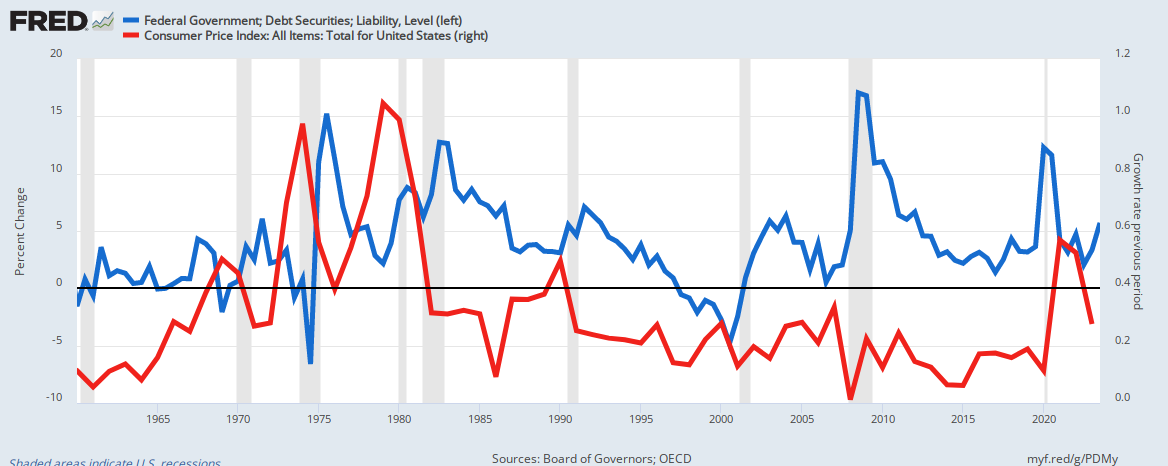
Federal deficits (blue) do not correspond with inflation (red).

SUMMARY Inflation, i.e., a general price increase, is caused by shortages, not federal deficit spending.

Federal deficit spending can cure inflation when the spending helps cure the shortages. Example: Deficit spending to fund more oil/gas production.

Deficit reductions mathematically lead to GDP reductions by taking dollars from the private sector.

The Inflation Reduction Act will do many things, some good and some bad, but it will not reduce inflation.

——-//——-

[No rational person would take dollars from the economy and give them to a federal government that has the infinite ability to create dollars.]

Rodger Malcolm Mitchell
Monetary Sovereignty

Twitter: @rodgermitchell Search #monetarysovereignty
Facebook: Rodger Malcolm Mitchell

……………………………………………………………………..

THE SOLE PURPOSE OF GOVERNMENT IS TO IMPROVE AND PROTECT THE LIVES OF THE PEOPLE.

The most important problems in economics involve:

  1. Monetary Sovereignty describes money creation and destruction.
  2. Gap Psychology describes the common desire to distance oneself from those “below” in any socio-economic ranking, and to come nearer those “above.” The socio-economic distance is referred to as “The Gap.”

Wide Gaps negatively affect poverty, health and longevity, education, housing, law and crime, war, leadership, ownership, bigotry, supply and demand, taxation, GDP, international relations, scientific advancement, the environment, human motivation and well-being, and virtually every other issue in economics. Implementation of Monetary Sovereignty and The Ten Steps To Prosperity can grow the economy and narrow the Gaps: Ten Steps To Prosperity:

  1. Eliminate FICA
  2. Federally funded Medicare — parts A, B & D, plus long-term care — for everyone
  3. Social Security for all
  4. Free education (including post-grad) for everyone
  5. Salary for attending school
  6. Eliminate federal taxes on business
  7. Increase the standard income tax deduction, annually. 
  8. Tax the very rich (the “.1%”) more, with higher progressive tax rates on all forms of income.
  9. Federal ownership of all banks
  10. Increase federal spending on the myriad initiatives that benefit America’s 99.9% 

The Ten Steps will grow the economy and narrow the income/wealth/power Gap between the rich and the rest.

MONETARY SOVEREIGNTY