Gift to Johns Hopkins. Why doesn’t the government do this.

We’ll introduce this short article with a few facts:

1. The U.S. federal government has infinitely more dollars than does Michael Bloomberg and the Bloomberg Philanthropies.

2. Unlike state/local taxes, which fund state/local spending, federal taxes do not fund federal spending.

The federal government creates new dollars, ad hoc, to fund all its spending.

3. When Bloomberg and/or his foundation give to any charity, this does not add as many growth dollars to the economy as federal spending.

(To the degree that charitable gifts reduce Bloomberg’s taxes, those dollars are not taken from the economy.)

4. America has a shortage of trained healthcare workers (See next:)

Staff Shortages Choking U.S. Health Care System, A growing shortage of health care workers is being called the nation’s top patient safety concern., By Steven Ross Johnson, July 28, 2022

The situation is quite serious and has been exacerbated by the COVID-19 pandemic. 

Physician Shortage: The nation is facing a projected shortage of up to 124,000 physicians by 2033.

Nursing Shortage: There is an urgent need to hire at least 200,000 nurses each year to meet rising demands and replace retiring nurses. Among support personnel, a shortage of home health aides is most acute.

Overall Health Workforce: The health care industry employed 16.3 million people in 2022, making it the largest employment sector in the U.S.

Despite this, there is still a shortage, with a projected need for 1.1 million new registered nurses across the U.S. to address retirements and the growing demand.

Impact of COVID-19: An estimated 1.5 million health care jobs were lost in the first two months of the pandemic. Although many of those jobs have since returned, health care employment remains below pre-pandemic levels.

Patient Safety Concerns: Staffing shortages are now the nation’s top patient safety concern, leading to longer wait times and even patients being turned away in life-threatening emergencies.

This shortage is affecting various levels of healthcare provision, from hospitals to private practices, and is a major concern for the future of healthcare services in the country.

So, the title question is, Why Doesn’t the Federal Government Do This? (I’ll tell you the answer.)

Most Johns Hopkins Medical Students to Receive Free Tuition After $1 Billion Gift Story by Alyssa Lukpat

A majority of medical students at Johns Hopkins University are set to receive free tuition after the school received a $1 billion gift from Bloomberg Philanthropies, making Hopkins the latest medical school to go tuition free because of a large donation.

Hopkins said Monday that students from families earning under $300,000 would receive free tuition starting in the fall.

And, of course, free tuition isn’t enough for many families, so:

Students whose families earn as much as $175,000 will have their living expenses covered.

The school estimates nearly two-thirds of its students would qualify for either of the benefits.

A growing number of philanthropists and medical schools are pushing to make education free for aspiring doctors and reduce the financial barriers that can deter them.

Another financial barrier often is overlooked. Many families rely on their young people to quit school and get jobs to help support the family.

The federal government should pay students a salary so parents would not be tempted to dissuade students from attending college.

Buoyed by donations, the Albert Einstein College of Medicine and the medical schools at New York University and Columbia University have given their students free tuition or scholarships if they have financial need.

Also, Kaiser Permanente Bernard J. Tyson School of Medicine Waived all tuition and fees for students entering between the fall of 2020 and 2025.

Cleveland Clinic Lerner College of Medicine at Case Western University offers full scholarships to all admitted students, to name a couple more.

The schools mentioned are all well-known and prestigious institutions within the United States. They have national and often international reputations for excellence in medical education and research.

Donors to such institutions tend to receive significant recognition for their contributions. America needs much more help than wealthy donors seeking applause can provide.

The cost of medical school has kept aspiring doctors out of the field, where they can graduate with hundreds of thousands of dollars in debt.

The student loan program is one of the most shortsighted, economically ignorant inventions the federal government ever has created.

It forces monetarily non-sovereign (meaning, limited dollars) students, to pay dollars to the Monetarily Sovereign (having unlimited dollars) federal government.

It’s a perfect plan if you want to discourage young people from attending college.

By offering financial freedom to more students, schools can give medical students the flexibility to choose jobs in important but lower-paying fields like internal medical and pediatrics.

Billionaire Michael Bloomberg’s philanthropic organization said Monday that the U.S. has a shortage of medical professionals yet the cost of attending school for these jobs is often too high.

“By reducing the financial barriers to these essential fields, we can free more students to pursue careers they’re passionate about,” he said.

Bloomberg has used his philanthropic organization, Bloomberg Philanthropies, to donate billions to several causes including public health, the environment and improving city governments.

Hopkins said Bloomberg’s donation would also be used to expand financial aid for nursing and public-health graduate students, in addition to graduate students in other fields.

“This new scholarship formula will ensure the most talented aspiring doctors representing the broadest and deepest range of socioeconomic and geographic backgrounds have the opportunity to graduate debt-free,” Hopkins said.

No, it doesn’t assure that at all.

It assures the relative handful of aspiring doctors, who can afford not to have any income for the next few years, will be relieved of many college costs.

And as vital as healthcare is, what about all the other specialties that are short of practitioners?

Consider the serious shortage of engineers.

Every year, the US will need about 400,000 new engineers.

Yet the next-generation skill sets that those engineers will require are sorely lacking, presenting the alarming possibility that nearly one in three engineering roles will remain unfilled each year through at least 2030.

This persistent talent gap risks short-circuiting the progress of several essential industries.

It may also seriously inhibit various US government initiatives intended to boost the economy and US competitiveness, such as the 2022 Build Back Better Act (BBBA) and the 2022 Chips and Science Act.

We also are short of trained people in Information Technology  (cybersecurity experts, data scientists, and software developers) and Teaching, particularly in STEM (Science, Technology, Engineering, Mathematics) subjects and special education.

Of course, this doesn’t include our shortages in trades not ordinarily associated with colleges but still requiring training: Electricians, plumbers, welders, HVAC technicians, truck drivers and logistics coordinators, agricultural workers, and skilled manufacturing workers who can operate complex machinery and robotics.

America relies on the private sector to pay for all this schooling and training.

Our state universities and colleges, for instance, are largely funded by the private sector, either through local and state taxes or private contributions and endowments.

All suffer from one common problem: Affordability.

1. Potential workers cannot afford to take the time and pay the costs involved in formalized training, whether in a college, university, or specialized school.

2. The private sector cannot afford to pay students and trainees for their time and costs involved in receiving training.

3. Schools and other training facilities cannot afford to provide their services without remuneration.

The federal government suffers no such limitations. It can:

1. Pay students salaries and personal expense allowances for attending schools and training facilities.

2. Remunerate students for their education and training costs

3. Remunerate educational and training facilities to provide their services without charge.

The private sector (which does not have unlimited funds) already does some of this—just not enough.

Sixty years ago, the company that employed me paid my tuition to Northwestern University for my MBA. They didn’t pay for my books, transportation, or time (night school), and I was locked into that company for the 3 years I attended, but it’s what a monetarily non-sovereign company chose to do.

The presumptive goal of government is to protect and improve people’s lives. Funding training and education is an important step in accomplishing that mission.

Why is funding left to the monetarily non-sovereign private sector?

Why are you forced to pay local taxes for grades K-12—taxes that, in most places, are insufficient to fund excellent schooling—when the Monetarily Sovereign federal government could easily fund higher teacher salaries and better facilities without charging you a penny in taxes?

The Lesson

Yes, it’s commendable that Mr. Bloomberg, in exchange for tax breaks and accolades, will provide a vanishingly tiny support for what the nation needs.

But why do we need to rely on the Bloombergs of the world when the money is there, waiting for the populace and our leaders to acknowledge its need and availability?

The tax breaks already demonstrate the government’s willingness and ability to fund about one-third of the support at Mr. Bloomberg’s whim.

There is no financial reason why the federal government cannot provide the entire nation with everything that Mr. Bloomberg provides to a select few.

What is the real reason it already is not happening? There are two reasons:

  1. The ignorance of the populace who have been brainwashed into believing that federal finances are like personal finances, and can’t afford to fund what America needs.
  2. The rich, who run America, do not want benefits that would narrow the income/wealth/power Gap between the rich and the rest.

Ignorance is the most expensive thing we can buy, yet each day, we pay mightily for another dollop of ignorance and allow the federal government to cry, “Poor.”


Rodger Malcolm Mitchell

Monetary Sovereignty Twitter: @rodgermitchell Search #monetarysovereignty Facebook: Rodger Malcolm Mitchell; MUCK RACK: https://muckrack.com/rodger-malcolm-mitchell; https://www.academia.edu/

……………………………………………………………………..

The Sole Purpose of Government Is to Improve and Protect the Lives of the People.

MONETARY SOVEREIGNTY

The “National Debt” isn’t national and it isn’t a debt. Eric Boehm remains clueless.

The problem with Libertarians like Eric Boehm . . . where do I begin? They have so many issues. First, they don’t understand this equation: Gross Domestic Product = Federal Spending + Non-federal Spending + Net Exports. Gross Domestic Product (GDP) is the most commonly used measure of the economy. The equation tells you that the more the federal government spends, the more the economy grows. But Libertarians don’t like government spending. How does one reason with such people? Mainly, how does one acquaint them with Monetary Sovereignty, which says, “Federal financing is different from non-federal financing.” If they can’t understand, or more accurately, refuse to understand, those two concepts—GDP and Monetary Sovereignty—how can their opinions be respected? Here is the latest “Boehmism,” which, remarkably, may exceed all his previous work in ignorance and/or deception (It’s hard to know which:

The National Debt Is a National Security Issue The growing debt will “slow economic growth, drive up interest payments,” and “heighten the risk of a fiscal crisis,” the CBO warns. ERIC BOEHM | 3.21.2024 1:50 PM

It’s a dangerously addictive habit that threatens to ruin our children’s lives and undermine America’s national security—and this week, Congress finally acknowledged as much. However, it remains unclear if lawmakers have the guts to do anything substantial.

No, I’m not talking about TikTok. I’m talking about the $34.6 trillion national debt.

The Senate unanimously approved a resolution on Wednesday calling the debt “a threat to the national security of the United States” and calling expected future budget deficits “unsustainable, irresponsible, and dangerous.”

Ticking Time Bomb Images – Browse 1,847 Stock Photos, Vectors, and Video | Adobe Stock
1940 “Debt” was called a “ticking time bomb.”
The Senate votes to please voters, and sadly, most voters believe anything called “debt” should not be large. They don’t understand that federal “Debt” is not federal and it isn’t debt.

“We have more than doubled our national debt in just ten years,” said Sen. Mike Braun (R–Ind.), who sponsored the resolution.

“America is moving down a dangerous and unsustainable path of reckless spending, and the federal government has yet to take it seriously.”

“Unsustainable” is the Libertarian’s favorite word when describing the so-called national (or federal) debt, which is neither national, federal, nor debt. They use that word because it has no specific meaning. They don’t say precisely what is “unsustainable” about it. The federal government, being uniquely Monetarily Sovereign (Libertarians don’t understand that concept, either), can pay any debt denominated in U.S. dollars.
Ticking Time Bomb Images – Browse 1,847 Stock Photos, Vectors, and Video | Adobe Stock
1950 “Debt” was called a “ticking time bomb.”
Whether a debt is $100 or $100 trillion, the federal government could pay it instantly by pressing computer keys. The federal government pays all its debts the same way. It creates new dollars ad hoc. To pay any creditor, the government sends instructions, not dollars, to the creditor’s bank, instructing the bank to increase the balance in the creditor’s checking account. Those instructions are electronic or paper (a check), saying, “Pay to the order of _____. ” The instant the bank does as instructed, new dollars are created and added to the M2 money supply measure.

Alan Greenspan: “A government cannot become insolvent concerning obligations in its own currency. There is nothing to prevent the federal government from creating as much money as it wants and paying it to somebody. The United States can pay any debt it has because we can always print the money to do that.”

That is how the federal government creates dollars and pays its bills. There is no limit to the government’s ability to send instructions, and thus no limit to the government’s ability to create dollars. No debt is “unsustainable.”
Ticking Time Bomb Images – Browse 1,847 Stock Photos, Vectors, and Video | Adobe Stock
1960 “Debt” was called  a “ticking time bomb.

The passage of a nonbinding resolution on the Senate floor is several steps short of addressing the federal government’s addiction to borrowing—but, as they say, recognizing that you have a problem is the first step toward solving it.

The federal (or national) debt is not a debt because the federal government does not borrow. Why would it? Given its infinite ability to create dollars, why would the federal government borrow dollars? It wouldn’t, and it doesn’t. Those things called T-bills, T-notes, and T-bonds do not represent borrowing. Although “notes” and “bonds” are evidence of borrowing in the private sector, federal finance is different.
Ticking Time Bomb Images – Browse 1,847 Stock Photos, Vectors, and Video | Adobe Stock
1970 “Debt” was called a “ticking time bomb.
T-securities are evidence of deposits into savings accounts at the Federal Reserve, the contents of which are wholly owned by the depositors. The government neither needs nor uses those deposits. It merely holds them in safekeeping for the depositors. The federal government’s main purpose in offering T-security accounts is to provide the public and other nations with a safe, interest-paying place to store unused dollars, which helps stabilize the dollars. By paying interest, these accounts help the federal government control interest rates.
Ticking Time Bomb Images – Browse 1,847 Stock Photos, Vectors, and Video | Adobe Stock
1980 “Debt” was called a “ticking time bomb.
The government does not owe the dollars deposited in T-security accounts. The government merely stores them for the depositors. Upon maturity of any T-security, the government merely gives the dollars, that never had left the account, back to their owner, the depositor. It’s not a federal debt, just as the contents of a bank safe deposit box are not a bank debt.

And the approval of that resolution was timely. Later on Wednesday, the Congressional Budget Office (CBO) published its latest long-term budget projections. The report shows that annual budget deficits are on pace to grow from an expected $1.6 trillion this year to $2.6 trillion in 2034, $4.4 trillion in 2044, and $7.3 trillion in 2054.

A federal budget deficit is much different from a personal budget deficit.
Ticking Time Bomb Images – Browse 1,847 Stock Photos, Vectors, and Video | Adobe Stock
1990 “Debt” was called a “ticking time bomb.
If you or I were to run a budget deficit, we would have to obtain the money to pay our bills, either by borrowing or from our income or savings. The federal deficit merely is the bookkeeping difference between taxes and spending. The spending has already been paid for by money creation. Here again, one must understand Monetary Sovereignty. State and local taxes do fund state and local taxes. The state and local governments are monetarily non-sovereign, like you and me.
Ticking Time Bomb Images – Browse 1,847 Stock Photos, Vectors, and Video | Adobe Stock
2000 “Debt” was called a “ticking time bomb.
So what is the purpose of federal taxes, if not to fund federal spending?
  1. To help the federal government control the economy by taxing what the government wishes to discourage and by giving tax breaks to what the government wishes to reward/
  2. To assure demand for the U.S. dollar by requiring federal taxes to be paid in dollars.
  3. To make the public believe that federal benefits are limited by tax receipts or borrowing. (This last is at the behest of the very rich, who get wealthier by widening the income/power Gap between them and the rest of us.)

As a result of those rising budget deficits, the national debt will continue to accelerate upward.

The misnamed “national debt” is not a threat or a burden on anyone- not the government or taxpayers. Even if the “debt” were hundreds of trillions of dollars, the federal government could continue paying its bills without collecting a penny more in taxes, nor borrowing a single dollar.
Ticking Time Bomb Images – Browse 1,847 Stock Photos, Vectors, and Video | Adobe Stock
2010 “Debt” was called a “ticking time bomb.

The CBO projects that the federal government’s debt will total $114 trillion by 2054. The debt is already roughly the size of the nation’s economy and is expected to surpass the all-time high of 106.4 percent of gross domestic product (GDP) by 2028.

By the end of the 30-year projection, the debt is estimated to reach 166 percent of GDP.

The oft-mentioned “Debt”/GDP ratio is meaningless for several reasons:
  1. The government does not owe or pay the “debt.”
  2. GDP does not owe or pay the “Debt.”
  3. The ratio says nothing about the health of the U.S. economy.
  4. The ratio says nothing about the federal government’s ability to pay its bills.

“Such large and growing debt would have significant economic and financial consequences,” the CBO warns. “

Among its other effects, it would slow economic growth, drive up interest payments to foreign holders of U.S. debt, heighten the risk of a fiscal crisis, increase the likelihood of other adverse outcomes, and make the nation’s fiscal position more vulnerable to an increase in interest rates.”

The above paragraph is wrong in every respect:
Ticking Time Bomb Images – Browse 1,847 Stock Photos, Vectors, and Video | Adobe Stock
2220 “Debt” was called a “ticking time bomb.
  1. A large and growing “Debt” merely means our Monetarily Sovereign federal government is pumping more growth dollars into the economy. The larger the “Debt,” the more growth dollars and the faster the economic growth. Remember: GDP = Federal Spending + Non-federal Spending + Net Exports. Federal Spending even increases Non-federal Spending
  2. Our Monetarily Sovereign U.S. federal government has the infinite ability to create the dollars that pay foreign holders of U.S. debt. Paying dollars to foreign nations increases foreigners’ ability to purchase our goods and services (Net Exports).
  3. No “fiscal crisis” has been or can be caused by the growing federal debt. The federal government always will be able to pay all its bills.
  4. The large and growing “Debt” causes no “other adverse outcomes. The Debt/GDP ratio is fiscally meaningless for a Monetarily Sovereign nation.
  5. Our Monetarily Sovereign government’s fiscal position is vulnerable only to the ignorance of those who do not understand the differences between Monetary Sovereignty and monetary non-sovereignty. The government can pay any amount of interest simply by pressing computer keys.
In 1940, the federal “Debt” was only $43 billion. Those who are ignorant about federal finances called it a “ticking time bomb.” Today, the “Debt” totals more than $33 trillion, and that phony time bomb is still a dud—and always will be.

Higher interest rates are already significantly affecting the federal budget. This year, payments on the existing debt will total an estimated $870 billion, which is more than the Pentagon’s budget. Thanks to higher interest rates and a larger debt load, debt payments have jumped by 32 percent since 2023.

Interest payments have indeed had an effect on the federal budget. They have forced the federal government to spend more, which pumps more growth dollars into the economy and increases GDP. Again, the Libertarians seem to have forgotten: GDP = Federal Spending + Non-federal Spending + Net Exports. Not only does Federal Spending directly lift GDP, but it also lifts Non-federal Spending, which, in turn, lifts GDP
As federal “Debt” has grown, so has the economy (GDP).
As federal spending has grown, so has the economy (GDP).
There seems to be no sign that federal spending or federal “Debt” is “unsustainable,” “slows economic growth,” “heightens the risk of a fiscal crisis,” “causes other adverse outcomes,” or makes the nation’s fiscal position more vulnerable to an interest rate increase.” On the contrary, increases in federal “Debt,” yield all positive outcomes, while decreases in debt cause depressions and recessions:

U.S. depressions tend to come on the heels of federal surpluses.

1804-1812: U. S. Federal Debt reduced 48%. Depression began 1807. 1817-1821: U. S. Federal Debt reduced 29%. Depression began 1819. 1823-1836: U. S. Federal Debt reduced 99%. Depression began 1837. 1852-1857: U. S. Federal Debt reduced 59%. Depression began 1857. 1867-1873: U. S. Federal Debt reduced 27%. Depression began 1873. 1880-1893: U. S. Federal Debt reduced 57%. Depression began 1893. 1920-1930: U. S. Federal Debt reduced 36%. Depression began 1929. 1997-2001: U. S. Federal Debt reduced 15%. Recession began 2001.

Deficit reductions (purple line) lead to recessions (vertical gray bars) which are cured by deficit increases.
GDP = Federal Spending + Non-federal Spending + Net Exports. Not only does Federal Spending increase GDP directly, but it also increases Non-federal Spending by providing the private sector with money.

The new CBO report shows that debt payments will be one of the fastest-growing parts of the budget for the foreseeable future, along with the twin old-age entitlement programs of Social Security and Medicare.

By 2051, interest payments will be the single largest line item in the federal budget.

If there’s a sliver of good news to be found in the new CBO projections, it is that the situation looks slightly less dire than it did last year. That improvement is due to higher expected levels of immigration and stronger estimates of future economic growth—not because of anything that policy makers in Washington have done.

(If anything, they seem determined to prevent those improvements from coming to pass, whether by limiting immigration or regulating the economy more strictly.)

This is the ultimate of ignorance. The data stare him in the face, but instead of reevaluating his position, he claims the good news comes despite the data. In essence, Boehm has two conclusions:
  1. If the data support his belief, he calls attention to that.
  2. If the data do not support his belief, he ignores the data.
Thus, he is incapable of learning.

We should also keep in mind the usual caveats here: The CBO does not account for the possibility of recessions, natural disasters, wars, or other unpredictable events that could cause the federal government to borrow more heavily than current law expects.

The past 30 years have included 9/11, the war on terror, the Great Recession, and the COVID-19 pandemic, so it seems pretty likely that the next three decades will include at least a few emergencies that drive deficits higher.

Boehm doesn’t stop to think about why emergencies drive deficits higher: Emergencies, in of themselves, tend to impede economic growth, so the government increases deficit spending to save the troubled economy. Why does the government need to wait for emergencies before it stimulates economic growth. Why not stimulate growth during non-emergency times, too? This is a question the Libertarians and the right wing never asks, because the answer goes against their beliefs.

“There is no way to look at these eye-popping numbers without realizing we need to make a change,” Maya MacGuineas, president of the Committee for a Responsible Federal Budget, which advocates for lower deficits, said in a statement about the CBO report.

“And yet we have lawmakers promising what they won’t do: I won’t raise taxes, I won’t fix Social Security, I won’t pay for all the things I do want to do. And so we continue on this dangerous path.”

MacGuineas has been president of the CRFB for many years. She and her group are bought and paid for by the rich, so they espouse beliefs that would make the rich righer by widening the Gap between the rich and the rest.
  1. “I won’t raise taxes.” That is a good thing. Federal taxes remove growth dollars from the economy.
  2. “I won’t fix Social Security.” To MacGuineas, “fix” means cut benefits or raise taxes, both of which are unnecessary and harmful to the economy. The federal government has infinite money to pay for Social Security.
  3. “I won’t pay for all the things I want to do.” The government is perfectly capable of paying for anything and everything. It’s people like Boehm and MacGuimeas who hinder the government from doing what it was created to do: Protect and improve the lives of the people.

Indeed, on Thursday, Speaker of the House Mike Johnson (R–La.) told reporters that he supports plans for a so-called “fiscal commission”—which could propose some solutions to Congress’ budgeting problems—but only if the agency could not suggest tax increases or cuts to entitlement programs.

Obama had a “fiscal commission.” Its “increase- taxes, cut-spending” recommendations would have sent the economy into a depression. Fortunately, Congress didn’t listen.

That approach guarantees that the federal government will have to continue borrowing heavily to make ends meet.

Again, the U.S. government never borrows its own sovereign currency. Boehm does not recognize the differences between a Monetarily Sovereign entity and a monetarily non-sovereign entity. Either he is paid to act ignorant or he does it without pay.

Despite the Senate’s declaration that the national debt is a national security risk and the CBO’s attempts to sound the alarm about the federal government’s fiscal trajectory, there’s still a major shortage of elected officials who want to take the problem seriously.

He is correct that there’s “a major shortage of elected officials who want to take the problem seriously.” Without that shortage, the government could fund such benefits to America as:
  1. Comprehensive, no-deductible healthcare insurance or every American.
  2. More medical personnel at all levels, plus more hospitals with advanced equipment
  3. Social Security for Americans of all ages.
  4. The reduction of poverty and homelessness in America
  5. With the reduction of poverty, there would be a significant reduction in crime.
  6. A greater ability to accept fully vetted immigrants, whose work and intelligence would help America grow.
  7. Education, including advanced degrees, for all those who want it.
  8. More scientific innovation in disease prevention and cure.
  9. More efforts to reduce global warming.
  10. A dramatic reduction in federal taxes, which do nothing but remove growth dollars from the economy.
  11. Pay students a salary so that families would not need to favor dropping out of school to help support the family.
The government can pay for all of it, without taxes and without inflation. Anyone not want it? Rodger Malcolm Mitchell Monetary Sovereignty Twitter: @rodgermitchell Search #monetarysovereignty Facebook: Rodger Malcolm Mitchell

……………………………………………………………………..

The Sole Purpose of Government Is to Improve and Protect the Lives of the People.

MONETARY SOVEREIGNTY

America’s most dangerous and harmful conspiracy theory

It’s not the hammer. My problem is that I have a headache. Get me an aspirin.

What is America’s most dangerous and harmful conspiracy theory?

No, it’s not the idiocy from QAnon. There is no group of Satanists, cannibals, and child sex abusers plotting against Donald Trump.

Only the mentally challenged believe that tripe.

No, it’s not the ages-old, anti-Semitic B.S. that Jews drink children’s blood on holidays. Jews famously love children. Mogen David wine is the preferred imbibement.

And no, it isn’t that Trump was cheated out of the election (though he and the entire GOP already plan to make the same claim if they lose again).

Fifty lawsuits, dozens of judges — some Republican — and numerous recounts have demonstrated the ongoing perfidy of that assertion.

The guy lost by over 7 MILLION individual votes and 74 electoral votes! And still, he whines. What does it take to convince the MAGAs?

Only the bottom segment of America’s intelligence range still believes those ideas.

The single most dangerous and harmful conspiracy theory is believed by the majority of America because it is repeated by the majority of America. Repetition is convincing.

Here is a classic example:

The CRFB Fiscal Blueprint for Reducing Debt and Inflation October 26, 2022

The United States faces numerous economic and fiscal challenges, including surging inflation, rising interest rates, trust funds heading toward insolvency, a broken budget process, and an unsustainably increasing national debt.

The CRFB (Committee for a Responsible Federal Budget) is part of a conspiracy to spread the false theory that these are problems caused by too much federal deficit spending.

The very rich, who support the CRFB, want you to believe that if you would accept less help from Medicare and Social Security while paying more of your salary to FICA, America could survive financially.

You working stiffs who struggle to pay for food, clothing, a car, a few days of vacation, and education for your kids are simply being selfish by asking the government to help you with your medical bills and retirement.

Shame on you, especially when the rich have to scrimp along on the few millions they get from tax loopholes. After all, rich Donald Trump paid minimal taxes in three of the past ten years. What more do you expect?

In order to help the Federal Reserve fight inflation, reduce interest costs, and support economic growth, policymakers should put forward a plan to put the national debt on a sustainable long-term path.

Though there is no one single “correct” fiscal metric, the higher the debt-to-Gross-Domestic-Product (GDP) ratio and its growth trajectory, the more vulnerable the U.S. economy is.

If you believe those two sentences, you have been royally conned. They are lies.

You have been fed the same baloney since at least 1940 when the “debt” first was called a “ticking time bomb.” The so-called “national debt” was only $40 billion back then.

Today, it’s somewhere in the neighborhood of $25 TRILLION, an astounding 62,400% increase. Yet here we are. Still sustaining. How is that possible?

First, the so-called national debt isn’t really a debt; second, it is infinitely sustainable. The federal “debt” is two different things united by an unnecessary law.

I. The so-called “debt” is the net total of federal deficits, i.e., the difference between federal income (mainly tax collections) and federal spending.

But, while state/local government taxes fund state/local government spending, federal taxes do not fund federal spending. The Monetarily Sovereign federal government destroys every tax dollar it receives, and it funds all its spending by creating new dollars, ad hoc, every time it pays a bill. It works like this:

When you pay taxes, you take dollars from your checking account. Those dollars are part of the “M2” money supply measure.

When those dollars reach the U.S. Treasury, they suddenly are not part of any money supply measure. Because the federal government has infinite dollars, there is no measure of the government’s money. 

Your tax dollars disappear from existence. They effectively are destroyed.

State/local governments, being monetarily non-sovereign, put tax dollars into banks, where they continue to be part of the M2 money supply measure. While state/local government debt really is debt, the federal government has infinite money, so it has no measurable debt.

II. The so-called “debt” is the total of deposits into Treasury security accounts resembling bank safe deposit boxes. You put money into your T-security account, the government adds some money, and later, when the account matures, the government returns the dollars already in your account — just like your safe deposit box.

The contents of the boxes are yours, from beginning to end. The government doesn’t “owe” them to you because you never lose ownership of them. The government isn’t indebted to you for those dollars any more than the banks are indebted to you for the box’s contents.

In both cases, the bank and the government do not touch the contents of the “account box.” The government and banks simply store them for you.

Another reason why that misnamed “debt-that-isn’t-a-debt” is infinitely sustainable: The federal government, being Monetarily Sovereign, has the infinite ability to create its sovereign currency, the U.S. dollar. 

It never, never, never can unintentionally run short of dollars.

Quote from former Fed Chairman Ben Bernanke when he was on 60 Minutes: Scott Pelley: Is that tax money the Fed is spending? Ben Bernanke: It’s not tax money… We simply use the computer to mark up the size of the account.

Statement from the St. Louis Fed: “As the sole manufacturer of dollars, whose debt is denominated in dollars, the U.S. government can never become insolvent, i.e., unable to pay its bills. In this sense, the government is not dependent on credit markets to remain operational.”

In plain English, the federal government does not borrow dollars. Nor does it rely on taxes. It creates dollars, at will, by pressing computer keys.

Implant this in your mind: THE U.S. GOVERNMENT CANNOT UNINTENTIONALLY RUN SHORT OF DOLLARS. NOT TODAY. NOT TOMORROW. NOT EVER.

Even if the misnamed “debt” doubled or tripled tomorrow, that would have zero effect on the federal government’s ability to pay its bills.

And what goes for the government as a whole also goes for federal agencies. Medicare cannot run short of dollars unless that is what the President and Congress want.

Similarly, Social Security cannot run short of dollars unless that is what our leaders want.

The next time you hear some Congressperson expressing anguish about the “debt” or the “debt ceiling,” you can be sure he/she is lying or ignorant about federal finances.

And when you hear that the Medicare or Social Security fake “trust funds” are running short of money, you will know you are hearing the most dangerous and harmful conspiracy theory in America.

The conspiracy theory continues:

Ideally, debt should be gradually reduced to its half-century historical average of about 50 percent of GDP.

The “debt”/GDP ratio is 100% meaningless. It has no predictive value. It tells you nothing about the federal government’s ability to pay its bills. “Debt” is a measure that accounts for the full lifetime of America. GDP is a one-year measure.

“Debt” is the difference between federal income and federal spending. GDP is total spending (federal + non-federal) + net exports. They are as comparable as apples vs. Apple computers.

Here are the nations having the lowest Debt/GDP ratios: Suriname, United Kingdom, Mauritania, Costa Rica, Tunisia, Brazil, El Salvador, Croatia, Sao Tome/Prin, Austria, Belize, India, Bahamas, Hungary, Morocco, Slovenia, Albania, Qatar, Mauritius, Yemen, Trinidad/Tobago, Sierra Leone, Montenegro, South Africa, Sudan

Here are the nations having the highest Debt/GDP ratios: Japan, Greece, Lebanon, Italy, Singapore, Cape Verde, Portugal, Angola, Bhutan, Mozambique, United States, Djibouti, Jamaica, Belgium, France, Spain, Cyprus, Bahrain, Jordan, Egypt, Canada, Argentina.

What generalizations can you make about these nations? What does the Debt/GDP ratio tell you about their financial health? Absolutely nothing.

Yet it is quoted frequently by those who either want to fool you or are ignorant about national finances.

Every time you see or hear someone quoting that ratio as having some importance, know this: That person should not be listened to.

Given political constraints, we suggest at least stabilizing the debt at its current level within a decade, requiring roughly $7 trillion in savings.

The CRFB wants to reduce the “debt” by $7 trillion — about 25% — guaranteeing a depression that would make 1929 look like Christmas. What the CRFB doesn’t want you to know is every time we reduce the “debt,” we have a recession or a depression:

1804-1812: U. S. Federal Debt reduced 48%. Depression began 1807.
1817-1821: U. S. Federal Debt reduced 29%. Depression began 1819.
1823-1836: U. S. Federal Debt reduced 99%. Depression began 1837.
1852-1857: U. S. Federal Debt reduced 59%. Depression began 1857.
1867-1873: U. S. Federal Debt reduced 27%. Depression began 1873.
1880-1893: U. S. Federal Debt reduced 57%. Depression began 1893.
1920-1930: U. S. Federal Debt reduced 36%. Depression began 1929.
1997-2001: U. S. Federal Debt reduced 15%. Recession began 2001.

The Great Depression, which some “experts” claim was caused by “excessive speculation” or some other myth, actually was caused by federal surpluses.

The federal surplus President Clinton loves to boast about led to a recession that President Bush had to deal with.

Mathematically, a growing economy requires a growing supply of money, but federal surpluses take dollars out of the economy and destroy them, which leads to reduced economic growth or negative economic growth.


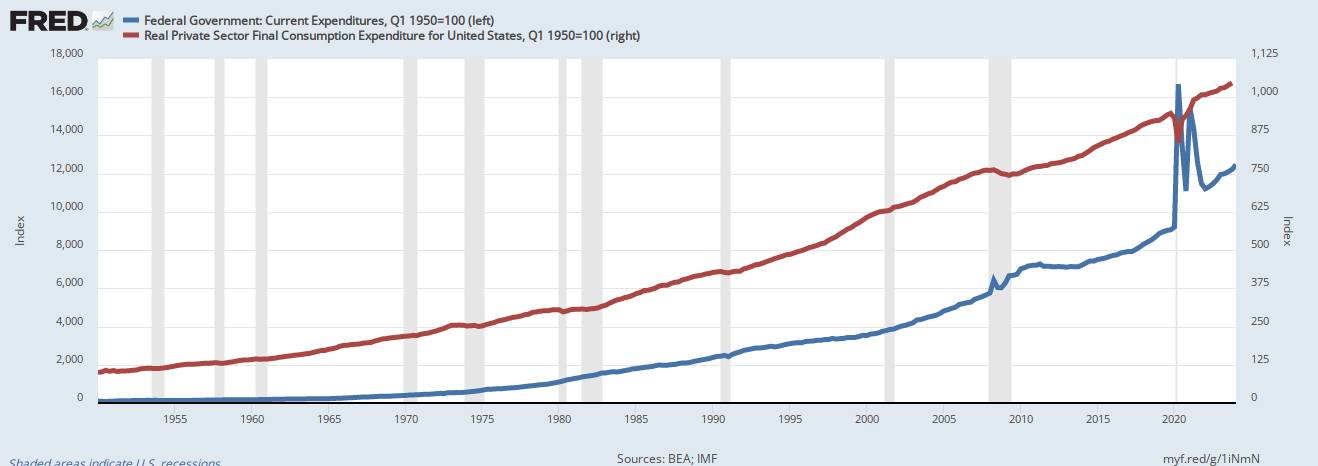
America's money supply growth (red) parallels GDP growth (blue)
America’s money supply growth parallels America’s GDP growth.

(The CRFB) blueprint puts forward a framework to achieve these goals through a combination of revenue and spending changes – with savings from health care, tax reform, discretionary spending caps, energy reforms, Social Security solvency, and other changes to the budget.

About 40 percent of the deficit reduction comes from revenue and 60 percent from changes in spending.

And virtually all of the deficit reduction comes from the middle classes and the poor.

Translation: The CRFB wants to cut Medicare (“health care”), increase the FICA tax (“tax reform”), reduce aids to the poor (“discretionary spending caps”), ignore global warming (“energy reforms”), and cut Social Security (“Social Security solvency”).

The very rich are laughing all the way to the bank.


Rodger Malcolm Mitchell
Monetary Sovereignty

Twitter: @rodgermitchell Search #monetarysovereignty
Facebook: Rodger Malcolm Mitchell

……………………………………………………………………..

Government’s Sole Purpose is to Improve and Protect the People’s Lives.

MONETARY SOVEREIGNTY

–The federal government soon will run out of dollars!

Twitter: @rodgermitchell; Search #monetarysovereignty
Facebook: Rodger Malcolm Mitchell

Mitchell’s laws:
●Those, who do not understand the differences between Monetary Sovereignty and monetary non-sovereignty, do not understand economics.
●The more federal budgets are cut and taxes increased, the weaker an economy becomes. .
Liberals think the purpose of government is to protect the poor and powerless from the rich and powerful. Conservatives think the purpose of government is to protect the rich and powerful from the poor and powerless.
●Austerity is the government’s method for widening
the gap between rich and poor.
●Until the 99% understand the need for federal deficits, the upper 1% will rule.
To survive long term, a monetarily non-sovereign government must have a positive balance of payments.
●Everything in economics devolves to motive,
and the motive is the Gap.
==================================================================================================================================================================

Yes, that’s right. The federal government soon will run out of its own sovereign currency, the dollar.

How do I know? I read it in the Washington Times:

Obamacare may not have enough enrollees to stay solvent
Fewer than 10 million projected; 13 million needed to stay solvent

The administration on Monday said fewer than 10 million Americans will enroll in Obamacare’s health exchanges this go-around, well short of the 13 million target congressional scorekeepers deemed critical to its economics.

The number of enrollees is key, because if too few take part in the exchanges, the pool of customers is too small, and it could skew the economics of Obamacare, forcing insurers to raise premiums and pushing even more people to forgo coverage, choosing to pay the tax penalty instead.

So there you have it. The U.S. Department of Health and Human Services, of which the Affordable Care Act is a part, soon will be insolvent.

And because the U.S. Department of Health and Human Services is an agency of, and embedded in, the United States federal government, its insolvency means the federal government itself will be insolvent.

In short, the federal government, which invented the dollar, soon will run of the dollars it invented — if Congress wants that to happen.

The new projection comes as Republicans prepare to take full control of Congress and redouble their efforts to repeal the law.

Repealing ACA would be a good idea — it’s a crappy law — if Congress and the President had a better idea.

For instance, a better idea would be to create a simple: Comprehensive, federally funded Medicare, Parts A, B and D, with no deductibles, for every man, woman and child in America.

The federal government, being Monetarily Sovereign and so having the unlimited ability to pay its bills, easily could fund such a Medicare.

But there is a problem.

It would benefit the lower- and middle-income groups, thus narrowing the Gap between the rich and the rest. And Congress and the President are not paid to narrow the Gap.

No, they are paid by the rich (via campaign contributions and promises of lucrative employment later), to widen the Gap.

You know about the Gap. It is what makes the rich rich, for if there were no Gap, no one would be rich, and the wider the Gap, the richer they are.

More than dollars, more than expensive toys, widening the Gap is what the rich crave most.

So Congress and the President will claim the government “can’t afford” to support Medicare, can’t afford to support Social Security, and surely cannot afford the ACA.

And when facts show that to be a lie (actually, part of the Big Lie), Congress and the President will warn us about hyperinflation.

And by the time facts show that also to be a lie, the people will be so confused, they will accept whatever their leaders tell them.

Yes, we will run short of the dollars the government easily could provide, and as usual, the lower 99.9% will be punished.

Meanwhile, the right wing Supreme Court will say money is nothing more than free speech. The rich will continue to “speak more freely”— right into the pockets of the politicians — than you and I.

And the politicians will use that “free speech” to buy elections and an opulent lifestyle — including blue ribbon, gold-standard health care — for themselves and their families.

And you will impoverish yourself trying to pay for your health care insurance, and health care itself — all because the federal government told you it has “run out of dollars.”

Seems impossible, but that’s how that works.

Rodger Malcolm Mitchell
Monetary Sovereignty

===================================================================================
Ten Steps to Prosperity:
1. Eliminate FICA (Click here)
2. Federally funded Medicare — parts A, B & D plus long term nursing care — for everyone (Click here)
3. Provide an Economic Bonus to every man, woman and child in America, and/or every state a per capita Economic Bonus. (Click here) Or institute a reverse income tax.
4. Free education (including post-grad) for everyone. Click here
5. Salary for attending school (Click here)
6. Eliminate corporate taxes (Click here)
7. Increase the standard income tax deduction annually. (Refer to this.)
8. Tax the very rich (.1%) more, with higher, progressive tax rates on all forms of income. (Click here)
9. Federal ownership of all banks (Click here and here)

10. Increase federal spending on the myriad initiatives that benefit America’s 99% (Click here)

The Ten Steps will add dollars to the economy, stimulate the economy, and narrow the income/wealth/power Gap between the rich and the rest.
——————————————————————————————————————————————

10 Steps to Economic Misery: (Click here:)
1. Maintain or increase the FICA tax..
2. Spread the myth Social Security, Medicare and the U.S. government are insolvent.
3. Cut federal employment in the military, post office, other federal agencies.
4. Broaden the income tax base so more lower income people will pay.
5. Cut financial assistance to the states.
6. Spread the myth federal taxes pay for federal spending.
7. Allow banks to trade for their own accounts; save them when their investments go sour.
8. Never prosecute any banker for criminal activity.
9. Nominate arch conservatives to the Supreme Court.
10. Reduce the federal deficit and debt

No nation can tax itself into prosperity, nor grow without money growth. Monetary Sovereignty: Cutting federal deficits to grow the economy is like applying leeches to cure anemia.
1. A growing economy requires a growing supply of dollars (GDP=Federal Spending + Non-federal Spending + Net Exports)
2. All deficit spending grows the supply of dollars
3. The limit to federal deficit spending is an inflation that cannot be cured with interest rate control.
4. The limit to non-federal deficit spending is the ability to borrow.

THE RECESSION CLOCK
Monetary Sovereignty

Monetary Sovereignty

Vertical gray bars mark recessions.

As the federal deficit growth lines drop, we approach recession, which will be cured only when the growth lines rise. Increasing federal deficit growth (aka “stimulus”) is necessary for long-term economic growth.

#MONETARYSOVEREIGNTY