Recently, I had a conversation with a young man who told me that federal deficit spending causes inflation.
If you took an economics course in school, you probably agree with him because that is what they teach. His logic was simple. He has been taught:
Federal deficit spending increases the supply of dollars. When one increases the supply of any product, without increasing demand, the value of that product decreases. When the value of the dollar decreases, we experience inflation.
Adding money to the economy increases demand, which, in the absence of increased supply, causes shortages, which create inflation.
The problem with #1 is that money is unlike any other product or service. The demand for money is relatively inelastic.
Example: You own a Tesla and learn that Teslas are now on sale at bargain prices. Will you buy an additional Tesla?
Or you see that tomatoes are on sale, but you have a dozen at home. Do you want additional tomatoes? Probably not.
But you have a million dollars and hear of an investment that will pay you another million at no risk. Do you want that additional million dollars? Probably so.
Currency printing didn’t cause inflation. Scarcities cause inflation, which causes a government to print currency.
The point: Federal deficit spending adds dollars to the economy, but that additional supply doesn’t reduce the dollar’s value.
In fact, if those extra dollars are used to obtain products or services that are in short supply, they can reduce the inflation caused by the shortages.
That is the problem with #2, because when the federal government spends dollars in the economy, the economy usually responds by increasing the supply of goods and services.
While deficit spending can be inflationary if it leads to excessive demand without corresponding increases in supply, spending can address supply-side constraints, boost productivity, and ultimately help reduce inflation.
There can be no economic growth without federal deficit spending.
The illusion that deficit spending causes inflation may come from hyperinflations, where governments print currencies in response to inflations.
It’s the “wheelbarrows filled with currency” visual we all have seen.
In those situations, inflation has been caused by scarcities of critical products and services, such as oil, food, labor, transportation, etc., and the additional dollars do nothing to relieve those scarcities.
When a government fails to address the real causes of inflation but instead prints currency, the inflation worsens,
The illusion of cause and effect is reversed. Money “printing” doesn’t cause inflation. Inflation can cause money printing if a government doesn’t understand what really causes inflation: Shortages of crucial goods and/or services.
It’s like a baseball team losing by five runs because it is short of good pitchers. So it trades its few decent pitchers for more hitters and starts losing by ten runs.
Here is a graph demonstrating the relationship (or rather, lack of relationship) between federal deficit spending and inflation:
The blue line shows the annual inflation rate in the U.S. The red line shows the annual deficit increase in the U.S. The lines are not parallel. Recessions (gray vertical bars) result from declining deficit growth and are cured by increased deficit growth.
Presumably, if federal deficit spending caused inflation, the two lines would generally be parallel. They are not. In fact, they tend to move in opposite directions.
One could use the above graph to demonstrate that federal deficit spending often cures inflation by reducing the shortages that do lead to inflation.
By comparison, please look at the following graph:
The blue line again shows the annual inflation rate. The green line shows the annual percentage changes in oil prices.
The lines in the above graph are essentially parallel, indicating a close relationship between oil prices and inflation.
Changes in oil supplies have had a far more profound and sudden effect on oil prices than changes in oil demand, which generally are slow.
Overall, the graphs suggest that federal deficit spending plays, at most, a minor role in inflation, and possibly none at all, while oil supplies (in addition to supplies of food, shipping, labor, and other products) are the main drivers of inflation.
Our most recent inflation was caused by COVID-related shortagesof oil, food, shipping, labor, metals, wood, and other products. When these shortages were eased by federal deficit spending, inflation eased.
This is an important fact because the threat of inflation is often used as an excuse for not federally funding social programs like Social Security, Medicare, and anti-poverty efforts.
The income/wealth/power Gapis what makes the rich wealthy. Without the Gap, no one would be rich; we would all be the same. The wider the Gap, the wealthier are the rich.
The wealthy are aware of this, and in their efforts to become even richer, they try to widen the Gap by increasing their own wealth and power and/or diminishing the resources of others.
One way they do this is by claiming that the social programs are becoming insolvent and so must be cut or taxes increased.
However, it is difficult for them to deny that the federal government could afford to fund these programs. Even the lie that the federal government would have to borrow dollars is easily debunked for two reasons:
As a Monetarily Sovereign entity, the federal government can create dollars at will by simply pressing keys on a computer.
Former Fed Chairman Ben Bernanke:“The U.S. government has a technology, called a printing press (or, today, its electronic equivalent), that allows it to produce as many U.S. dollars as it wishes at essentially no cost. It’s not tax money… We simply use the computer to mark up the size of the account.”
Even if the notion of future borrowing and increased interest payments were accurate (it isn’t), it would be of no significance to an entity that possesses the unlimited capacity to settle its debts by pressing computer keys. Statement from the St. Louis Fed:
“As the sole manufacturer of dollars, whose debt is denominated in dollars, the U.S. government can never become insolvent, i.e., unable to pay its bills. In this sense, the government is not dependent on credit markets to remain operational.”
So, the rich resort to the false claim that federal spending causes inflation.
What they fail to mention is the following graph, which highlights the relationships between federal deficits and recessions:
When federal deficit growth (red) decreases, we have recessions (vertical gray bars). Recessions always are cured by increases in federal deficit growth.
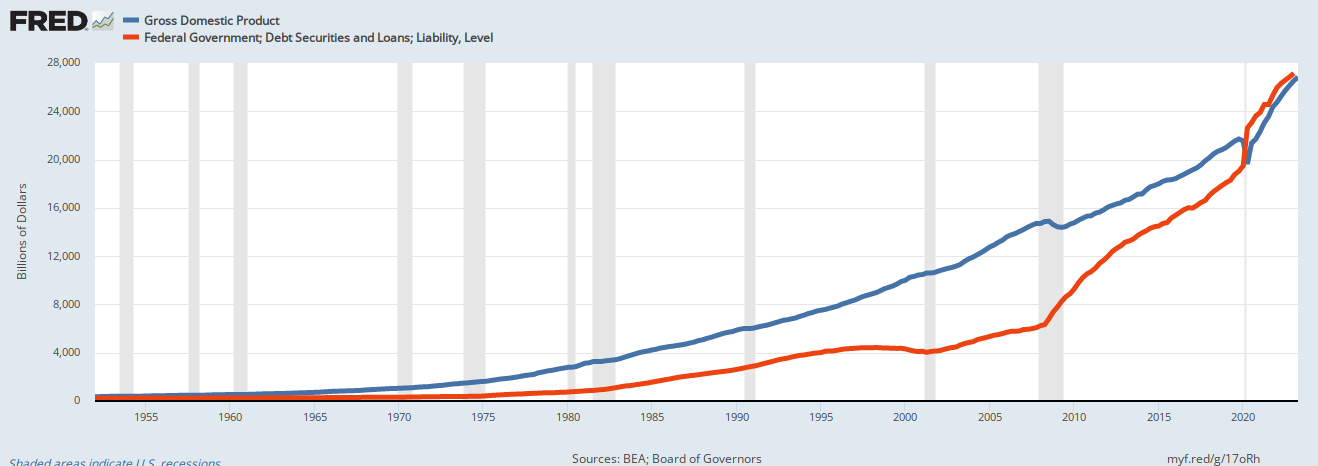
Economic growth requires money growth. Here is an example of the close relationship between economic growth and money growth
Gross Domestic Product (GDP) closely mirrors money (debt) growth.
The formula for Gross Domestic Product shows how money growth is necessary for economic growth:
GDP = Federal Spending + Non-Federal Spending + Net Exports
Net Exports generally are negative. (We import more than we export). So, GDP growth relies on federal and non-federal spending growth.
Federal Spending is a large part of M3, which in turn, is a large part of GDP. Federal Spending growth is necessary for GDP (economic) growth.
Then, of course, there is the fact that federal surpluses (the extreme version of deficit reduction) cause depressions (the extreme version of recessions). In fact, every depression in American history has resulted from surpluses.
1804-1812: U. S. Federal Debt reduced 48%. Depression began 1807.
1817-1821: U. S. Federal Debt reduced 29%. Depression began 1819.
1823-1836: U. S. Federal Debt reduced 99%. Depression began 1837.
1852-1857: U. S. Federal Debt reduced 59%. Depression began 1857.
1867-1873: U. S. Federal Debt reduced 27%. Depression began 1873.
1880-1893: U. S. Federal Debt reduced 57%. Depression began 1893.
1920-1930: U. S. Federal Debt reduced 36%. Depression began 1929.
1997-2001: U. S. Federal Debt reduced 15%. Recession began 2001.
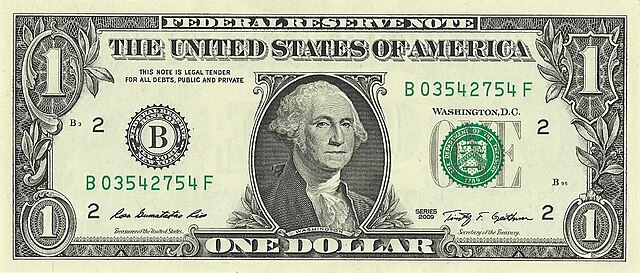
All money is a form of debt. Have you noticed that every dollar bill (“bill” is a word that denotes debt) is a Federal Reserve note (“note” is another word denoting debt)?
Each bill is signed by the Treasurer and the Secretary of the Treasury.
The U.S. dollar is nothing more than a number on the federal government’s books. It is not a physical entity. There are no physical dollars. The U.S. dollar bill is a title to a dollar showing that the bearer is owed a dollar by the United States government.
For example, an author owns a story he has written, though the story is not a physical entity. Similarly, the federal government is an author of federal dollars, though those dollars are not physical entities. And just as the author can create infinite stories, the government can create infinite dollars.
All debt requires collateral. The collateral for federal debt is “full faith and credit.”
This may sound nebulous to some, but it involves certain, specific, and valuable guarantees, among which are:
A. –The government will accept only U.S. currency in payment of debts to the government
B. –It unfailingly will pay all its dollar debts with U.S. dollars and will not default
C. –It will force all your domestic creditors to accept U.S. dollars if you offer them to satisfy your debt.
D. –It will not require domestic creditors to accept any other money
E. –It will take action to protect the value of the dollar.
F. –It will maintain a market for U.S. currency
G. –It will continue to use U.S. currency and will not change to another currency.
H. –All forms of U.S. currency will be reciprocal, that is five $1 bills always will equal one $5 bill and vice versa.
The value of debt, i.e., the U.S. dollar, is based in part on the value of its collateral. Should any of A – H no longer be in effect, the dollar’s value would plummet.
Another key factor influencing the value of the U.S. dollar is interest rates. Investments denominated in dollars, such as bonds and Treasury securities, are more sought after when they offer higher interest rates.
Be cautious with this, as the value of a bond decreases when interest rates rise. Newly issued bonds offer higher rates and compete with older bonds.
The key point is that dollars do not lose value, and inflation is not caused by the federal government’s increasing deficit spending. The government could easily fund Social Security and Medicare without imposing FICA taxes or triggering inflation.
The wealthy classes’ arguments for cutting SS and Medicare benefits and raising taxes are unfounded and based on misleading claims.
IN SUMMARY
Inflations are caused by scarcities, often due to oil and food shortages. Shortages of shipping, labor, metals, wood, and electronics can also be significant factors.
While deficit spending can be inflationary if it leads to excessive demand without corresponding increases in supply, spending can address supply-side constraints, boost productivity, and ultimately help reduce inflation.
Without federal deficit spending, there can be no economic growth and no solution to scarcity. The lack of federal debt growth causes recessions and depressions. Recessions are cured by federal (money) deficit growth.
The federal government could and should fund a comprehensive, no-deductible Medicare and Social Security for every man, woman, and child, regardless of age and income, while eliminating FICA.
We’ll end this post with excerpts from an article on the MSN website:
Some House Republicans (show) interest in reviving the party’s longtime passion for gutting the social safety net in the wake of Donald Trump’s reelection and the coming Republican trifecta.
Reports have surfaced about cuts to programs like Medicaid and food stamps to offset the cost of extending Trump’s 2017 tax cuts.
Others are openly suggesting that Medicare and Social Security may be on the chopping block as part of Elon Musk and Vivek Ramaswamy’s performative venture into government spending cuts through the new Department of Government Efficiency.
But MAGA Republicans on Capitol Hill who recently spoke to TPM were unwilling to be pinned down on the issue.
The Republican Party promulgates public ignorance about the differences between federal (Monetarily Sovereign) finances and personal (monetarily non-sovereign) finances to put forth a “small government” agenda that will widen the income/wealth/power Gap between the rich and the rest of us.
Rodger Malcolm Mitchell
Monetary SovereigntyTwitter: @rodgermitchellSearch #monetarysovereigntyFacebook: Rodger Malcolm Mitchell;MUCK RACK: https://muckrack.com/rodger-malcolm-mitchell; https://www.academia.edu/
……………………………………………………………………..
The Sole Purpose of Government Is to Improve and Protect the Lives of the People.
Page 1.
As federal debt (red) has risen, so has the economy (blue — GDP). Higher federal debt leads to higher GDP growth. The reason: GDP=Federal Spending +Non-federal Spending + Net Exports.
Page 2. The reason:
Economic growth and federal debt growth have been extraordinarily high since the end of the COVID recession. Despite efforts to reduce Federal Debt growth — efforts that, if successful, would reduce GDP growth — federal debt and GDP have continued to grow rapidly.
Page 3.
There is no relationship between federal debt and inflation. No data suggest that “too much” federal spending causes inflation.
Page 4.
A strong relationship exists between inflation (green) and oil prices (gray) as dictated by oil supply. Shortages cause price increases. Inflation is a general increase in prices. All inflations throughout history have been caused by shortages of crucial goods and services, usually energy and food.
Page 5.
Changes in federal debt (incorrectly called federal “borrowing”) do not reduce the availability of lending funds (yellow). There is no relationship between federal debt and the amount of lending.
Rodger Malcolm Mitchell
Monetary SovereigntyTwitter: @rodgermitchellSearch #monetarysovereigntyFacebook: Rodger Malcolm Mitchell
……………………………………………………………………..
The Sole Purpose of Government Is to Improve and Protect the Lives of the People.
For anyone harboring hopes that massive tax cuts pay for themselves . . .
Translation: “For anyone harboring hopes that taking less money from your pocket (i.e. tax cuts) will be matched by taking more money from your pocket . . .” (i.e. pay for themselves). . .
Sure, paying more taxes to pay for a tax cut is what we all hope for, isn’t it? Peter Weber seems to think so.
. . . the nonpartisan Congressional Budget Office has some bad news. The CBO said Tuesday that the federal deficit hit $895 billion in the first 11 months of fiscal 2018, an increase of $222 billion, or 32 percent, over the same period of 2017.
Translation: “Bad news. The federal government will pump 895 billion economic growth dollars into the private sector, in the first 11 months of this fiscal year, an increase of 222 billion economic growth dollars over the same period of 2017.”
The private sector, which requires income to grow, will receive $895 billion from the federal government, which has the unlimited ability to create dollars, and needs no income. So, why is this “bad news”?
The only “bad” part is that the amounts are too low. If instead of $895 billion, the amount were closer to $2 trillion, That would yield more economic growth and put more dollars into your pocket.
GDP = Federal Spending + Non-federal Spending + Net Exports. GDP cannot grow without federal deficits. Period.
The tax cuts Republicans pushed through in December plus spending increases pushed government outlays up about 7 percent while revenue grew by 1 percent, the CBO said.c
Why? Because the federal government has the unlimited ability to “print” its own sovereign currency, the dollar. It produces all the dollars it needs and uses.
No reason to ask anyone else (including you) for U.S. dollars.
The government took in about $105 billion more in individual and payroll taxes but $71 billion less in corporate taxes.
You, the public, paid more taxes, but the corporations paid less. The GOP’s new tax laws will exacerbate that imbalance, with the rich making out like bandits — yes, exactly like bandits.
Spending on interest on the public debt increased by $55 billion, or 19 percent.
This is one reason why, contrary to what you have been told, raising interest rates is stimulative for the economy, and gives you more money.
The deficit will near $1 trillion by the end of fiscal 2018 and almost certainly top it by the end of the calendar year.
That’s another $1 trillion added to the economy. The rich people want you to believe that’s bad for the economy, to prevent you from asking for federal benefits.
It’s all a gigantic con job, perpetuated, either in ignorance or intent, by writers like Peter Weber.
The myth that tax cuts, and federal deficits and debt are bad for the economy, and that your children will pay for the debt, and that we’ll become Zimbabwe and Argentina, has been foisted on you for almost 80 years, and amazingly, after all this time, most of the public still believes the lie.
The single most important problems in economics involve the excessive income/wealth/power Gaps between the have-mores and the have-less.
Wide Gaps negatively affect poverty, health and longevity, education, housing, law and crime, war, leadership, ownership, bigotry, supply and demand, taxation, GDP, international relations, scientific advancement, the environment, human motivation and well-being, and virtually every other issue in economics.
Implementation of The Ten Steps To Prosperity can narrow the Gaps:
Those, who do not understand the differences between Monetary Sovereignty and monetary non-sovereignty, do not understand economics.
=================================================================================================================================================================================================================
There is something of a rule in problem-solving that questions beginning with “How” are to be preceded by a thorough examination of questions beginning with “Should.” President Bush II failed to do that when he asked his advisors questions like, “How do we fight a war in Iraq and Afghanistan” and “How do we arrest Saddam Hussein.” The correct questions were “Should we fight a war in Iraq and Afghanistan” and “Should we arrest Saddam Hussein.”
A football coach does not begin with “How can we increase our passing yardage?” He begins with “Should we increase our passing yardage?” A company does not begin with, “How can we increase the number of our stores?” It begins with a thorough examination of “Should we increase the number of our stores?”
Sadly, President Obama, Congress, the media and the old-line economists work feverishly to answer the question, “How can we reduce the federal deficit?” They believe a thorough examination of “Should we reduce the federal deficit?” is unnecessary. They already “know” the answer, despite massive evidence to the contrary.
When you ask the wrong question, you find the wrong answer. Congress and the President can’t agree on an answer, because the question is wrong. It’s akin to asking, “How should we sail a ship without falling off the edge of the world?”
The correct question is, “Should we reduce the federal deficit?” Many people give perfunctory, knee-jerk answers, such as, “The deficit is not sustainable” or “Our children will pay for it.” But no answers have been based on the one, overriding, undeniable fact:
Federal deficits = net non-federal saving
Cut deficits and you cut saving. Cut saving and you cut economic growth. Cut economic growth and you enter recessions and depressions and the unemployment that accompanies them. The facts are that simple and undeniable. But, the President and members of Congress do not work from facts; they work from what each believes is common sense.
Common sense consists of beliefs most people consider obvious and sound, things “everyone knows.” Yet, your common sense may be different from my common sense, because it is affected by our different personal experiences, as well as by analogy, religion, social mores, history, logic, teaching, folklore, aphorisms, leaders and every form of information transfer, all of which vary from person to person.
The earth must be flat, not round, else the oceans would pour out. Nothing can be in two places at the same time – except in Quantum Mechanics. Running fast does not make your watch run slower – except in Relativity. If a roulette wheel lands on red five times in a row, it is more likely to land on black the next spin. Common sense.
Because common sense does not require research, it allows for fast decisions and is powerfully built into our genes. We have great difficulty departing from our common sense beliefs, because they are evolutionarily valuable. We experience and use common sense every day of our lives. We do not need research to tell us to avoid walking blindly into a street or reaching into a fire. Anyone who intentionally does these things is a “fool.”
So powerful is common sense, we angrily consider all those who depart from of our visions of common sense to be fools. Here are examples of common sense for most Americans:
1. Debt is a burden on the debtor; the more debt, the greater the burden. Debtors can be forced into bankruptcy by creditors.
2. A deficit is worse than a surplus. Outgo requires income. Taxes and borrowing pay for government spending.
3. Everything has a cost and a limit. Nothing can be created from nothing. Nothing goes on forever. There is no such thing as a free lunch. No pain; no gain. If it sounds too good, it is.
4. The greater the supply, the less the value. “Printing” money causes inflation. You can have too much of a good thing.
5. Dollars are real and scarce. They can be held, stored and moved.
Every one of these common sense beliefs either is always false or often false, when applied to the U.S. federal government, because:
1. Federal debt is not a burden. Unlike state and local governments, the federal government cannot be forced into bankruptcy (except by Congress). It can service any debt of any size, any time.
2. Federal deficits stimulate the economy while surpluses cause recessions and depressions. The federal government, being Monetarily Sovereign, neither needs nor uses taxes or borrowing to pay its bills.
3. The federal government creates money by marking up the bank accounts of creditors, in a cost-free, pain-free, limit-free process. To the federal government, money is a “free lunch.”
4. Increasing the supply does reduce value, unless demand increases more. Money demand is increased by interest rates. Since we went off the gold standard, there has been no relationship between federal deficit spending and inflation.
5. Dollars have no physical reality. They are nothing more than numbers in bank accounts. Even dollar bills are not dollars; they are receipts or titles for dollars. Dollars are not scarce to the federal government.
These truths are counter to intuition, counter to common sense and counter to the beliefs of most Americans, yet they are truths, nonetheless.
Very soon, Americans will face the cold reality of recession or depression, caused by Congress’s and the President’s following their “common sense,” rather than economic fact. Federal spending for Social Security, Medicare, Medicaid, and many other vital federal services will decline. We will suffer “invisible” pain from the loss of scientific and medical research, declining infrastructure, a weaker military, poorer schools, less food and drug inspection, and worse investment protections. Our standard of living will decline. Unemployment will worsen. Destitution will increase. Our children and our grandchildren will lead meaner lives. Their futures will be impoverished.
And most Americans will not realize what has been done to them.





 #Monetary Sovereignty - Mitchell