Economics: Faux complexity of the simple, or faux simplicity of the complex?

One definition of “science” is: A systematic enterprise that builds and organizes knowledge in the form of testable explanations and predictions about the universe.

Economics is a “social science. One wonders whether it can be called a science at all, for it really is an accounting-based branch of psychology, which itself holds to the title, “science,” by its fingertips.

As for “testable explanations” and “testable predictions,” not so good. The psychology role in economics testing is at its best when “predicting” history, but fails repeatedly when trying to predict the future.

Economics approximates religion, which predicts that your following (or not following) certain arbitrary, often illogical and meaningless, rules will be rewarded in some vague way by an omniscient entity.

Accounting
While accounting can have complex and changing rules, it is based on simplicity: The direct relationships among income, saving, and outgo.Image result for complexity vs simplicity

Any change in one factor is balanced by a mathematically equal change in the other factors, thus the word “balance” sheet.

Based on its arbitrary rules, accounting strictly is logical and eminently predictable. Adding to the left side of a balance sheet always requires adding to the right side, yesterday and tomorrow.

Though based on arithmetic, and in one sense on algebra (the relationship to the “=” sign), accounting is not a science. Though it organizes knowledge, it doesn’t create testable explanations and predictions about the universe.  It simply is a score-keeping method for money-related valuations.

Psychology
This brings us to the other leg of economic’s extremely shaky, two-legged stool, psychology.

In its attempts to rise above religion (the pompous quest to know God’s mind) psychology does run tests and many of these tests provide results that pass for explanations that even are the basis for predictions.

But the economic results seldom are conclusive, while the explanations are subjective, and the predictions often are laughably random — just like with religion.

In real science, testing attempts to change one variable while holding all other variables stable. In psychology, and so in economics, holding all other variables stable generally proves to be impossible. So results vary wildly.

But that impossibility does not deter people known as “chartists.” From Investopedia:

A chartist is an individual who uses charts or graphs of a security’s historical prices or levels to forecast its future trends.

Chartists generally believe that price movements in a security are not random but can be predicted through a study of past trends and other technical analysis.

Generally, chartists will use a combination of indicators, personal sentiment, and trading psychology to make investment decisions.

Serious chartists can seek to obtain the Chartered Market Technician designation which is sponsored and written by the Market Technicians Association.

Even if charting could predict future prices, it still could not predict future prices. 

Future stock prices are based on demand. So if charting could predict future prices, everyone would wish to buy or sell according to what the chart indicates.

In that way, charting would affect demand, which in turn would affect charts in an endless helix of price changes, all having little to do with a security’s underlying value. 

Thus, charts destroy their own predictions, the “better” the chart, the more the destruction.

Though securities charting doesn’t work as claimed, it does have one value: It establishes a pseudo-scientific, mathematical veneer to its one area of economics.

That is why economics is obsessed with graphs. We economists wish to use mathematics, so to demonstrate our “real science” chops.

That also is why economists love complexification. Read any economics textbook, I dare you. You will discover a convoluted amalgam of graphs, charts, and equations and balance sheets, and difficult wording, all designed to give scientific credence to a non-credible forecasting ability.

How about “Externality,” “Autraky,” “Opportunity set,” “Convexity,” “Dynamic stochastic general equilibrium,” and one of my favorites that often is in the news, “quantitative easing.”)

I too am guilty of graphs and charts, though I use them mostly to disprove economic nonsense. For instance.

Blue line: Gross federal debt. Red line: Gross federal debt/GDP. Green line: GDP

The above graph disputes the “debt-clock” worriers, who falsely claim the federal debt is like personal debt and so is “unsustainable” because of the following myths:

A. The federal debt is too big (blue line) to sustain, [though it has grown massively and still is “sustained.”]
B. The federal debt is too high a percentage of GDP (red line), [though it repeatedly has passed predicted limits with no ill economic effects.]
C. The huge federal debt will slow economic growth (green line), [which has shown scant signs of slowing for 80 years.]

The faux simplicity is the false claim that federal debt is like personal debt. The public understands personal debt, so it is led to believe it understands federal debt.

The effect of complexity is to confuse either the author or the readers, and in that it has done remarkably well. The vast majority of the literate world is confused.

Once we wipe away the faux complexity, we are left with the following simplicity:

I. The U.S. federal government, unlike state, local, and euro governments is Monetarily Sovereign, which means it is sovereign over the U.S. dollar. It never unintentionally can run short of dollars. Even if all federal tax collections fell to $0, the federal government could pay any size debt denominated in dollars. Further, it has absolute control over the relative value of the dollar.

Monetary Sovereignty is fundamentally simple. Anyone who has played the board game, Monopoly, knows the Monopoly Bank is Monetarily Sovereign. By rule, it never can run short of Monopoly dollars and can create all it needs.

II. Recessions are caused by a lack of money, and they are cured by money creation, particularly by federal deficit spending.

III. Inflations are not caused by government currency printing but rather by shortages, usually shortages of food or energy. Counter-intuitively (for many), increased government spending, to reduce food or energy shortages, reduces inflation.

IV. The human side of economics is ruled by Gap Psychycholgy, the desire to distance oneself from those “below” on any social scale and to approach those “above.”

If you understand the above four simplicities, you understand the Ten Steps to Prosperity (below).

You understand why the federal government can eliminate FICA, increase Social Security and Medicare, fund advanced education for all who want it, and reduce poverty, while preventing and curing recessions, depressions, and inflations.

And you also understand why the government doesn’t do these things that would benefit the middle and lower-income/wealth/power groups.

In short, you will know more economics than your favorite politician, news source, or friend.

And you won’t even have to learn to calculate “cross elasticity of demand.”

Rodger Malcolm Mitchell
Monetary Sovereignty
Twitter: @rodgermitchell
Search #monetarysovereignty Facebook: Rodger Malcolm Mitchell

…………………………………………………………………………………………………………………………………………………………………………………………………………………………………………………………………………………………..

The most important problems in economics involve:

  1. Monetary Sovereignty describes money creation and destruction.
  2. Gap Psychology describes the common desire to distance oneself from those “below” in any socio-economic ranking, and to come nearer those “above.” The socio-economic distance is referred to as “The Gap.”

Wide Gaps negatively affect poverty, health and longevity, education, housing, law and crime, war, leadership, ownership, bigotry, supply and demand, taxation, GDP, international relations, scientific advancement, the environment, human motivation and well-being, and virtually every other issue in economics.

Implementation of Monetary Sovereignty and The Ten Steps To Prosperity can grow the economy and narrow the Gaps:

Ten Steps To Prosperity:

1. Eliminate FICA

2. Federally funded Medicare — parts a, b & d, plus long-term care — for everyone

3. Provide a monthly economic bonus to every man, woman and child in America (similar to social security for all)

4. Free education (including post-grad) for everyone

5. Salary for attending school

6. Eliminate federal taxes on business

7. Increase the standard income tax deduction, annually. 

8. Tax the very rich (the “.1%”) more, with higher progressive tax rates on all forms of income.

9. Federal ownership of all banks

10. Increase federal spending on the myriad initiatives that benefit America’s 99.9% 

The Ten Steps will grow the economy and narrow the income/wealth/power Gap between the rich and the rest.

MONETARY SOVEREIGNTY

Right vs. left vs. Trump: The great Gap Psychology misunderstanding.

For as long as I have been alive, which now exceeds 80 years, the right-wing (conservatives) and the left-wing (progressives) have seen the same world with different eyes.

Though generalities, by definition, do not apply to all cases, one can say that conservatives wish to “conserve” and progressives wish to “progress.”

This fundamental difference manifests in several ways. Conservatives are more likely to be “originalists,” wishing to interpret the Constitution through the eyes of the original drafters, while progressives wish to interpret the Constitution through the eyes of someone living today.

Image result for opposites photo

When viewed through original eyes vs. today’s eyes, many issues can be seen quite differently.

Gun ownership, aid to the less fortunate, abortion, voting rights, female rights, religion, speech, morals, war, government power, etc. — identical facts often are interpreted in opposition — and perhaps no more so than today, by people who sincerely want a better world, but merely see different paths for getting there.

Donald Trump has exaggerated the differences so that opposing sides neither understand, nor seemingly even want to understand, the others.

The reason is that Trump, who formerly was a Democrat, then myseriously became a Republican, does not have a philosophy regarding any of the above issues, but rather employs the philosophy: “What’s best for Trump is best for the world.”

To achieve his personal goals, Trump deliberately has set the two sides in bitter opposition through the politics of hate.

In Trump’s world, the only good people are those who support him, and all the others must be destroyed. Compromise is weakness. Apology is weakness. Compassion is weakness. The truth is what he claims it is.

Why does this Trump-centric philosophy have strong appeal to a large number of people?

It begins with the fact that Trump demonstrates hatred of the same people his followers hate: The poor, the non-white, the immigrants, the non-Christians, the gay, the progressives.

Seemingly, the people Trump admires most are hate-mongering strongmen, dictators like Vladimir Putin, Kim Jong-un, Rodrigo Duterte, and Recep Tayyip Erdoğan.

And all this hatred has its basis in Gap Psychology.

The foundation of hatred is fear.

It is almost impossible to hate someone or something unless you fear them in some way. Do you hate the poor? Do you fear they will impinge on your neighborhood, alter your life in some way, take money from you?

Do you hate the non-white for the same reasons, or that they will bring criminality or unwanted changes to your life? Do you fear the non-Christians for their “alien” beliefs that will affect your own beliefs? Do you fear the gays for turning your children gay? Do you fear the progressives for their support of the people you fear?

Gap Psychology describes the fear that the upper-income/wealth/power groups have of the lower-income/wealth/power groups. Imagine the fear and loathing many people feel when a ragged panhandler approaches.

Trump exploits these often-latent fears and brings them to the surface. He tells you Mexicans are rapists and criminals. He tells you Muslims are terrorists.  He tells you immigrants will take your job.

He tells you the poor will take your money, and the progressives will take your guns and kill your babies and steal your money. He tells you only he can save you.

And this politics of fear works on those who are most susceptible to belief in conspiracy theories and undocumented allegations. The politics of fear works on those who already are afraid.

This “fear-of-the-other” is merely a subset of Gap Psychology, which has two parts:

  1. Wanting to distance oneself from those “below” you on any socio-economic measure, and
  2. Wanting to come closer to those “above” you.

The importance of Gap Psychology in our daily lives cannot be overstated. It, along with Monetary Sovereignty, describes almost everything that happens in the world of Economics.

Quoting from What is Gap Psychology? A brief explanation”

“Gap Psychology affects the clothes you wear, the house in which you live, the schools you attend, the car you drive, the stores and restaurants you frequent, the church you attend, your job, your hobbies, your vacations, your voting, the person you marry, even the name you give your child.”

Gap Psychology is both cohesive and dividing. Evolution has retained it as an integral part of higher-level social species’ interactions. It both strengthens and weakens groups.

Gap Psychology creates ambition and enthusiasm, aversion and disgust. It supports dictators and causes wars. Gap Psychology is the basis for Donald Trump’s hate-mongering power.

Economists don’t speak of or even consider Gap Psychology, and it is seldom if ever taught in economics courses,  which represents a huge hole in the science.

Teaching economics without teaching Gap Psychology is comparable to teaching mathematics without arithmetic.

Gap Psychology not only should be part of every economics course. It should be a part of every class. It is that fundamental.

Rodger Malcolm Mitchell
Monetary Sovereignty
Twitter: @rodgermitchell
Search #monetarysovereignty Facebook: Rodger Malcolm Mitchell

…………………………………………………………………………………………………………………………………………………………………………………………………………………………………………………………………………………………..

The most important problems in economics involve:

  1. Monetary Sovereignty describes money creation and destruction.
  2. Gap Psychology describes the common desire to distance oneself from those “below” in any socio-economic ranking, and to come nearer those “above.” The socio-economic distance is referred to as “The Gap.”

Wide Gaps negatively affect poverty, health and longevity, education, housing, law and crime, war, leadership, ownership, bigotry, supply and demand, taxation, GDP, international relations, scientific advancement, the environment, human motivation and well-being, and virtually every other issue in economics.

Implementation of Monetary Sovereignty and The Ten Steps To Prosperity can grow the economy and narrow the Gaps:

Ten Steps To Prosperity:

1. Eliminate FICA

2. Federally funded Medicare — parts a, b & d, plus long-term care — for everyone

3. Provide a monthly economic bonus to every man, woman and child in America (similar to social security for all)

4. Free education (including post-grad) for everyone

5. Salary for attending school

6. Eliminate federal taxes on business

7. Increase the standard income tax deduction, annually. 

8. Tax the very rich (the “.1%”) more, with higher progressive tax rates on all forms of income.

9. Federal ownership of all banks

10. Increase federal spending on the myriad initiatives that benefit America’s 99.9% 

The Ten Steps will grow the economy and narrow the income/wealth/power Gap between the rich and the rest.

MONETARY SOVEREIGNTY

A perfect illustration of The Big Lie. It’s what the rich want you to believe.

The following cartoon appeared in an August 30, 2019 Email from Reason Foundation.

It is a perfect representation of The Big Lie, the lie that the U.S. government can run short of U.S. dollars.

The Big Lie illustrated

The cartoon, by Toles, not only shows the U.S. Treasury empty, but just in case you didn’t get the point, it also shows America asking the “deaf, dumb and blind” Republicans why they emptied it.

It is a lie, a lie that is told thousands of times a day — a lie that has been told for at least 80 years that we can document. (See: It is 2019, and the phony federal debt “time bomb” still is ticking.)

Take it from me: It is absolutely, positively 100% impossible for the U.S. Treasury to run short of U.S. dollars.

If you won’t take it from me, take it from past Chairman of the Federal Reserve Board, Alan Greenspan who said, “A government cannot become insolvent with respect to obligations in its own currency.”

(All federal obligations can be satisfied with U.S. dollars.)

Oh, you don’t believe Greenspan or me? Then how about past Chairman of the Federal Reserve Board, Ben Bernanke, who said, “The U.S. government has a technology, called a printing press (or, today, its electronic equivalent), that allows it to produce as many U.S. dollars as it wishes at essentially no cost.” 

Not good enough? Then how about these comments (courtesy of Professor John T. Harvey) that appeared in the Sep 25, 2013 issue of Forbes Magazine:

“In the case of United States, default is absolutely impossible. All U.S. government debt is denominated in U.S. dollar assets.” Peter Zeihan, Vice President of Analysis for STRATFOR

“In the case of governments boasting monetary sovereignty and debt denominated in its own currency, like the United States (but also Japan and the UK), it is technically impossible to fall into debt default.” Erwan Mahe, European asset allocation and options strategies adviser

“There is never a risk of default for a sovereign nation that issues its own free-floating currency and where its debts are denominated in that currency.” Mike Norman, Chief Economist for John Thomas Financial

“As the sole manufacturer of dollars, whose debt is denominated in dollars, the U.S. government can never become insolvent, i.e., unable to pay its bills. In this sense, the government is not dependent on credit markets to remain operational.” Federal Reserve Bank of St. Louis

“There is no inherent limit on federal expenses and therefore on federal spending…When the U.S. government decides to spend fiat money, it adds to its banking reserve system and when it taxes or borrows (issues Treasury securities) it drains reserves from its banking system. These reserve operations are done solely to maintain the target Federal Funds rate.” Monty Agarwal , managing partner and chief investment officer of MA Managed Futures Fund

And then there’s:

We’ve got the right to print our own money that’s the key.

Greece lost their power to print their money. If they could print drachmas they would not have this problem.

They’d have other problems, but they would not have a debt problem. Seventeen countries in Europe gave up their right to print their own money, that’s enormously important.

We’ve got the right to print our own money so our credit is good (Warren Buffet, 2011)

Get it? Despite cartoonists like Toles, who after all is just a guy who can draw stuff, not an economist, the federal government cannot run short of dollars.

And despite cartoons like the Committee for a Responsible Federal Debt (CRFB), that has been highly paid to claim falsely, year after year after year, since 1975, that the federal debt is “unsustainable,” the federal government can “sustain” any size debt.

That’s 45 years of bogus, “sky-is-falling,” Big Lies from the CRFB. They are economists, yet still they lie and presumably feel no shame.

Cartoons are supposed to be funny, and indeed to knowledgeable people, Toles’s cartoon and the CRFB’s articles are hilarious in how wrong they are.

Except for one thing: Most Americans have been led to believe The Big Lie, by the constant, unrelenting drumbeat of disinformation. And this is sad, because the endless disinformation has cost middle-income and poor Americans billions.

Try to pay no attention to the lies. Just remember one main idea:

You can run short of dollars. Your city, county, and state can run short of dollars.  Your company can run short of dollars. All are monetarily non-sovereign.

But the U.S. government is different. It is Monetarily Sovereign. It cannot run short of dollars.

Period.

And as for that so-called federal “deficit,” it is necessary to grow the economy.

A federal deficit occurs when the government pumps more dollars into the economy, via spending, than it takes out, via taxing.

A federal deficit is a surplus for the economy. That is how the economy grows.

And as for that so-called federal “debt,” it nothing like your debt. Federal “debt” is the total of deposits into Treasury Security accounts. It’s paid back, not with tax dollars, but simply by returning the dollars in those accounts to the account owners.

The federal “debt” (deposits) is no burden on the government, on taxpayers or on the economy, nor does the federal “debt” (deposits) cause inflation, recession, difficulty in borrowing, or any other myths and fables being foisted on the innocent American public.

In fact, since the federal debt evolves from the federal “deficit” (economic surplus), increases in the federal debt are necessary for long-term economic growth.

But the very rich (who run America) don’t want you to know this, because they fear your demanding increases in Social Security, Medicare, and other social spending. So, they tell you its unaffordable, and the mythical Social Security and Medicare “trust funds” are running out of money.

Neither the federal government, nor any agency of the federal government, can run short of dollars unless Congress and the President want that to happen.

The rich are rich because they have much more than you do, and because of  Gap Psychology, they want to keep it that way by cutting your income.

It has been ever thus.

Rodger Malcolm Mitchell
Monetary Sovereignty
Twitter: @rodgermitchell
Search #monetarysovereignty Facebook: Rodger Malcolm Mitchell

…………………………………………………………………………………………………………………………………………………………………………………………………………………………………………………………………………………………..

The most important problems in economics involve the excessive income/wealth/power Gaps between the richer and the poorer.

Wide Gaps negatively affect poverty, health and longevity, education, housing, law and crime, war, leadership, ownership, bigotry, supply and demand, taxation, GDP, international relations, scientific advancement, the environment, human motivation and well-being, and virtually every other issue in economics.

Implementation of The Ten Steps To Prosperity can narrow the Gaps:

Ten Steps To Prosperity:

1. Eliminate FICA

2. Federally funded Medicare — parts a, b & d, plus long-term care — for everyone

3. Provide a monthly economic bonus to every man, woman and child in America (similar to social security for all)

4. Free education (including post-grad) for everyone

5. Salary for attending school

6. Eliminate federal taxes on business

7. Increase the standard income tax deduction, annually. 

8. Tax the very rich (the “.1%”) more, with higher progressive tax rates on all forms of income.

9. Federal ownership of all banks

10. Increase federal spending on the myriad initiatives that benefit America’s 99.9% 

The Ten Steps will grow the economy, and narrow the income/wealth/power Gap between the rich and you.

MONETARY SOVEREIGNTY


Why nations pretend not to understand Monetary Sovereignty

Preface: Monetary Sovereignty means just what it says: Being sovereign over your form of money.

The U.S. government is Monetarily Sovereign over its sovereign currency, the U.S. dollar. The federal government created the very first dollars out of thin air.

It continues to create dollars at will. Even without collecting taxes or receiving any other form of income, the federal government can pay any debt denominated in dollars. It never can run short of dollars. It can control the value of the dollar by controlling interest rates.

U.S. cities, counties, and states are monetarily non-sovereign. They have no sovereign currency. Instead, they use the U.S. dollar.

They cannot create dollars at will. They need taxes or other forms of income, in order to pay their debts. They can run short of dollars with which to pay their bills.

England is Monetarily Sovereign over the British pound. Germany is monetarily non-sovereign. It uses the euro, over which it has little control. It can run short of euros and be unable to pay its debts denominated in euros.

Japan and China are Monetarily Sovereign over their currencies. They never can run short. Italy and Greece are monetarily non-sovereign. They use the euro.

For reasons I will explain, Monetarily Sovereign nations pretend they are monetarily non-sovereign.

They pretend to borrow, when they really don’t. They collect taxes, though they have no financial need for income. They strive to export more, though increased importing would be more beneficial.

They allow poverty, though they easily could cure it. And they allow the Gap between the rich and the poor to be excessive, though they easily could cure that, too.

I mention all this because recently I read the following article excerpts:

Quantitative Easing vs. Currency Manipulation
1. In general, countries prefer their currency to be weak because it makes them more competitive on the international trade front.

A lower currency makes a countries exports more attractive because they are cheaper on the international market. For example, a weak U.S. dollar makes U.S. car exports less expensive for offshore buyers.

2. Secondly, by boosting exports, a country can use a lower currency to shrink its trade deficit.

3. Finally, a weaker currency alleviates pressure on a country’s sovereign debt obligations.

After issuing offshore debt, a country will make payments, and as these payments are denominated in the offshore currency, a weak local currency effectively decreases these debt payments.

Consider the Monetarily Sovereign United States. It has the unlimited ability to create U.S. dollars.

Exports are a method by which the U.S.  sends goods and services, created by the natural assets and labor of its citizens, to a foreign nation, in exchange for dollars.

The article says countries wish to make exports more attractive and shrink their trade deficit. But why?

It’s easy to understand why a monetarily non-sovereign nation, like Portugal for instance, would want to acquire money in exchange for natural assets. To Portugal, which uses the euro, money is in limited supply.

Portugal needs income to pay its bills.

To all nations, natural assets are limited; labor is limited. But to the U.S., dollars are unlimited. The U.S. needs no income to pay its bills.

Why should the U.S. exchange its limited assets to gain an asset of which it has an unlimited supply?

A common answer is that U.S. exports help U.S. businesses grow and profit, and with those profits, pay employees. But the answer is illogical.

“Grow and profit” means to acquire dollars, of which the federal government has an unlimited supply.

The easier and more sensible plan would be for the federal government to do what businesses are designed to do, i.e. provide dollars to employees. This would cost the government nothing (remember that unlimited money supply), and more importantly, no scarce natural resources would be expended.

One such method would be to implement the Ten Steps to Prosperity. (See below.)

The article says,

“A weaker currency alleviates pressure on a country’s sovereign debt obligations.

“After issuing offshore debt, a country will make payments, and as these payments are denominated in the offshore currency, a weak local currency effectively decreases these debt payments.”

The whole idea is illogical and factually wrong.

First, federal so-called “debt” actually is nothing more than deposits into Treasury security accounts. When you “lend” to the federal government, you don’t really lend. You make a deposit into your T-bill, T-note, or T-bond account at the Federal Reserve Bank.

Your dollars remain in your account, gathering interest, until your account matures, at which time your dollars are returned to you. Your dollars never leave your account until maturity.

The exchange rate of those dollars is irrelevant. Whether a dollar is worth one pound, two yen, or three partridges in a pear tree makes no difference. To pay off the misnamed “debt.” the government returns whatever is in your account.

The federal government does not use your dollars, but even if it did, giving you your money back would be no burden on a government that has the unlimited ability to create its own sovereign currency.

Third, making a currency weaker is inflationary because imported goods instantly become more expensive. (Fortunately, the U.S. government has the unlimited ability to strengthen the dollar, simply by increasing interest rates.)

This increases the demand for dollars, which makes them more valuable.

Bottom line:

  1. Increasing the level of exports does not benefit a Monetarily Sovereign government
  2. Shrinking the trade deficit similarly does not benefit a Monetarily Sovereign government
  3. Federal “debt” and federal finances are substantially different from personal (monetarily non-sovereign) debt an finances. Unlike you and me, the Monetarily Sovereign federal government needs no income, can produce dollars at will, can control the value of those dollars, and never can run short of dollars.

Why then does the federal government pretend dollars are scarce to it? Why does it pretend that total deposits in T-security accounts are a burden and a threat? Why the claim that a trade surplus is superior to a trade deficit.

United States Balance of Trade
For the past 10 years the U.S. has run persistent trade deficits.

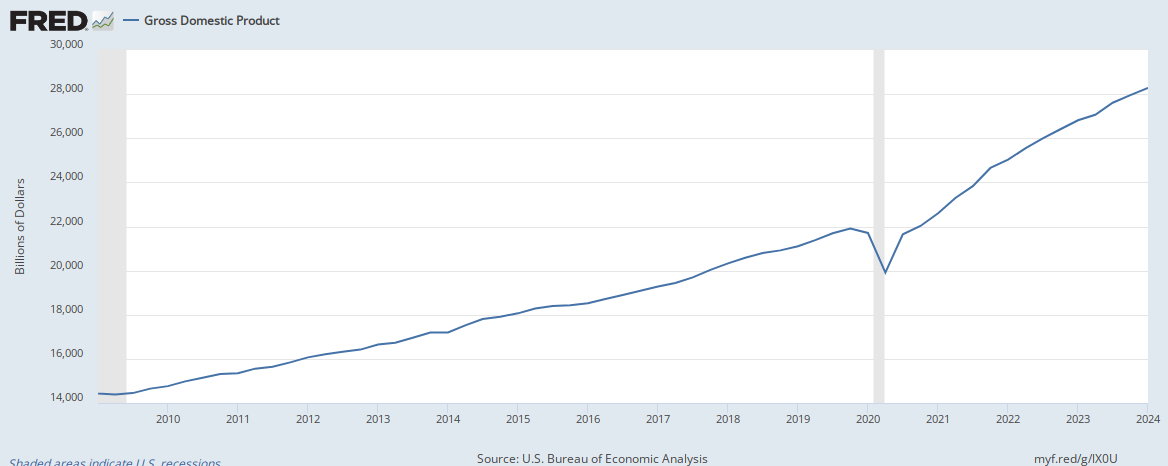
For the past 10 years the U.S. has run persistent trade deficits. During that same period, Gross Domestic Product has risen from $14.5 trillion, to $21.3 trillion, a massive 47% increase.

In the past 10 years, GDP has risen from $14.5 trillion, to $21.3 trillion, a massive 47% increase.

Clearly, trade deficits have not prevented GDP growth. The reason is that federal deficit spending has more than made up for the dollar loss trade deficits cause.

And that is the whole point and the reason why trade deficits do not harm a Monetarily Sovereign nation. Any dollar loss easily is overcome by federal deficit spending.

The question then is, “Why do nations pretend not to understand Monetary Sovereignty?” Why everywhere you turn, do your information sources — the politicians, the media, the economists — tell you that the federal deficit and debt are so high as to be “ticking time bombs“?

The answer is this: The rich run America.

“Rich” is a comparative word. The farther distant one is from the poor the richer one is.

Owning a million dollars makes one rich if everyone else owns one dollar. Owning a million dollars does not make one rich if everyone else also owns a million dollars.

Being “rich” depends on the Gap between the rich and the rest.  To be richer, the rich want to widen the Gap between the rich and the rest. That is called, “Gap Psychology.

So:

–The rich bribe the politicians via campaign contributions and promises of lucrative employment when their political careers end.
–The rich bribe the media via advertising dollars and via ownership.
–The rich bribe the economists via gifts to their universities and employment in “think tanks.”

The rich do not want you to learn that the federal government has the unlimited ability to provide you with free medical care, free schooling, fine housing, food and clothing, and the other benefits that the rich receive.

The rich don’t want you to know you can have all these benefits, without paying a penny in taxes.

If you understood that you could have a much better life, you naturally would want it. But, that would narrow the Gap between the rich and the rest. And narrowing the Gap would make the rich less rich.

So, in addition to trying to gather more for themselves, the rich also want you to have less, thus widening both sides of the Gap.

We’ll finish with a few excerpts from an article in the TILJournal,  a massive exercise in ignorance, demonstrating the point:

The National Debt: America’s Ticking Time Bomb
By D.T. Osborn
Each taxpayer in America owes approximately 250,000 dollars to places including China through its state-controlled institutions of finance. Here comes the worst news of all; 22 trillion is only a small part of the real National Debt.

That’s because the official dollar amount does not include America’s unfunded liabilities. Unfunded liabilities are those items the Federal government must pay for by American law.

By far the largest and most significant of these are Social Security, Medicare, and Medicaid. Together they currently total more than 50 trillion dollars. When added to the Debt, the total becomes slightly more than 73 trillion dollars… for the moment.

The final figure also includes items such as Federal pensions for workers and elected officials and interest paid on the Debt. The grand total of America’s real debt is about 130 trillion dollars!

This means each American taxpayer owes over 1 million dollars of the real debt as it exists today. So, what do you say, fellow taxpayer? Got an extra million to chip in for poor old Uncle Sam? Yeah, me neither.

This is a path which will lead to the eventual bankruptcy of America.e

And that lie, that you owe someone over 1 million dollars, is the ridiculous scare tactic being fed to you and the rest of the American public. It wrongly assumes that federal financing is similar to personal financing.

It isn’t.

Personal financing requires a person must have some form of income — salary, interest, borrowing, inheritance, etc. — in order to acquire the dollars with which to pay his bills. That is known as “monetary non-sovereignty.”

By contrast, the federal government is Monetarily Sovereign. It needs no form of income — not even taxes — because it has the unlimited ability to create its own sovereign currency, the U.S. dollar, to pay an infinite number of bills.

Former Federal Reserve Chairman, Alan Greenspan: “A government cannot become insolvent with respect to obligations in its own currency.”

Former Federal Reserve Chairman, Ben Bernanke: “The U.S. government has a technology, called a printing press (or, today, its electronic equivalent), that allows it to produce as many U.S. dollars as it wishes at essentially no cost.”

St. Louis Federal Reserve: “As the sole manufacturer of dollars, whose debt is denominated in dollars, the U.S. government can never become insolvent, i.e., unable to pay its bills. In this sense, the government is not dependent on credit markets to remain operational.

And here, in one sentence, By author D.T. Osborn expresses the big lie the rich want you to believe:

“Any real solution to stave off national insolvency requires massive changes in how unfunded liabilities are handled.”

The rich want the federal government to cut Social Security, cut Medicare, and cut Medicaid, thus widening the Gap between the rich and the rest.

That is how they make themselves richer.

Rodger Malcolm Mitchell
Monetary Sovereignty
Twitter: @rodgermitchell
Search #monetarysovereigntyFacebook: Rodger Malcolm Mitchell

…………………………………………………………………………………………………………………………………………………………………………………………………………………………………………………………………………………………..

The most important problems in economics involve the excessive income/wealth/power Gaps between the richer and the poorer.

Wide Gaps negatively affect poverty, health and longevity, education, housing, law and crime, war, leadership, ownership, bigotry, supply and demand, taxation, GDP, international relations, scientific advancement, the environment, human motivation and well-being, and virtually every other issue in economics.

Implementation of The Ten Steps To Prosperity can narrow the Gaps:

Ten Steps To Prosperity:

1. Eliminate FICA

2. Federally funded Medicare — parts a, b & d, plus long-term care — for everyone

3. Provide a monthly economic bonus to every man, woman and child in America (similar to social security for all)

4. Free education (including post-grad) for everyone

5. Salary for attending school

6. Eliminate federal taxes on business

7. Increase the standard income tax deduction, annually. 

8. Tax the very rich (the “.1%”) more, with higher progressive tax rates on all forms of income.

9. Federal ownership of all banks

10. Increase federal spending on the myriad initiatives that benefit America’s 99.9% 

The Ten Steps will grow the economy, and narrow the income/wealth/power Gap between the rich and you.

MONETARY SOVEREIGNTY