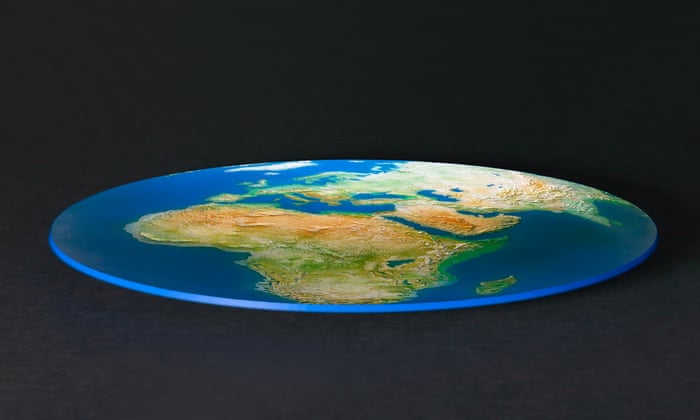
The world is flat

There was a time when people believed the world was flat. Their descendants now are economists.
Why bad ideas refuse to die | Science and scepticism | The Guardian
The earth is flat, Trump won, and your federal taxes fund federal spending.
Before I show you some “flat-earth” economic opinions about the federal tax, here are the facts: There are several money-supply measures, with the most liquid being termed, “M1.”
What Is M1? M1 is the money supply that is composed of physical currency and coins, demand deposits, travelers’ checks, other checkable deposits, and negotiable order of withdrawal (NOW) accounts. M1 includes the most liquid portions of the money supply because it contains currency and assets that either are or can be quickly converted to cash.
M1 includes the most easily spent forms of money. The dollars in your checking account are the M1 dollars you send to the U.S. Treasury. But what happens to those M1 dollars when they reach the U.S. Treasury? They disappear. They are not part of any money-supply measure. There is no money supply measure for dollars at the Treasury. You might think they become a part of the money the federal government “has,” but how much is that? How much money does the federal government have? Don’t feel bad if you don’t know. And don’t bother trying to “google” the answer. You won’t find it. You might just as well ask, “How many numbers are there?” The answer to both questions is: “Infinite.” The U.S. Treasury “has” infinite U.S. dollars. The U.S. federal government, being the original creator of the U.S. dollar (which it created from thin air by creating laws from thin air), has the infinite ability to create “dollar” laws and that gives it the infinite ability to create dollars). The federal government is Monetarily Sovereign. This is different from state/local governments which do not have that infinite ability to create dollars. They are monetarily non-sovereign. How does the federal government create dollars? Answer: By spending dollars. This is the process:
  1. To pay a creditor, the federal government sends instructions (not dollars) to the creditor’s bank.
  2. The instructions are in the form of physical checks (“Pay to the order of”) or electronic messages.
  3. The instructions tell the bank to increase the balance in the creditor’s checking (M1) account.
  4. The instant the bank obeys those instructions, new M1 dollars are created and added to the M1 supply.
  5. The bank then balances its books by clearing the instructions through the Federal Reserve, which debits the Treasury, the owner of infinite dollars. No money is destroyed because infinite minus any amount, still is infinite.
When you pay creditors, you follow the same first four steps. The difference is in step #5. The Federal Reserve sends your instructions back to your bank, telling your bank to reduce the balance in your checking account. At that moment, the dollars you created with your check, immediately are destroyed. There is a moment of time, between when your instructions create dollars and when the dollars are destroyed. Those dollars often are known as the “float.” When you spend, the money you create — the “float” — exists anywhere from a few seconds to a day or two. When the federal government spends, much of the float is permanent. It stays in the economy. The rest is destroyed by federal tax collections. The “float” money created by the federal government — the money that is not destroyed by taxes — is called the federal debt.  In short, federal spending creates dollars and federal taxing destroys dollars. The federal deficit is the net number of dollars added in any single year. The federal debt is the net total of all deficits. Contrary to popular wisdom, the federal deficit and debt are not a burden on the federal government. They are not a burden on future taxpayers. To “pay off” any part of the federal debt, the federal government merely returns dollars that exist in T-security accounts. No taxes are involved. The federal deficit and debt are assets to the economy. The larger the federal deficit and debt, the more money is added to the economy. If there were no federal deficit and debt, there would be no U.S. dollars. Gross Domestic Product (GDP) is the most common measure of the U.S. economy. The formula for GDP is:

GDP = Federal Spending + Non-federal spending + Net Exports

Mathematically, any reduction in the federal deficit and debt will reduce GDP. Most recessions and all depressions have been caused by reductions in deficit and debt growth.
Reductions in federal debt growth lead to inflation
Recessions are the vertical gray lines. Recessions repeatedly come on the heels of deficit growth reductions and are cured with deficit growth increases.
Federal surpluses remove dollars from the economy, which causes depressions and recessions.

1804-1812: U. S. Federal Debt reduced 48%. Depression began 1807. 1817-1821: U. S. Federal Debt reduced 29%. Depression began 1819. 1823-1836: U. S. Federal Debt reduced 99%. Depression began 1837. 1852-1857: U. S. Federal Debt reduced 59%. Depression began 1857. 1867-1873: U. S. Federal Debt reduced 27%. Depression began 1873. 1880-1893: U. S. Federal Debt reduced 57%. Depression began 1893. 1920-1930: U. S. Federal Debt reduced 36%. Depression began 1929. 1997-2001: U. S. Federal Debt reduced 15%. Recession began 2001.

No government can tax itself into prosperity, but governments easily can tax themselves into recession. While it is true that private banks create massive numbers of dollars simply by lending, this process begins with the very existence of U.S. dollars. The first dollars ever created constituted the beginning of the federal debt. If the federal government had not created dollars from thin air, there would be no dollars. How is the process different for state/local governments? For state/local governments, which like you, are monetarily non-sovereign, the process is identical to your personal spending process. Their money-creation instructions end up not at the Treasury but at private banks, so money the that is created, very quickly is destroyed when it comes out of the state/local government checking accounts. Why does the federal government levy taxes, if it has the infinite ability to create dollars? Answer: To control the economy by taxing what it wishes to discourage and by giving tax breaks to what it wishes to discourage. The federal government does not levy taxes to acquire spending money. So why would the federal government borrow dollars? Answer: The federal government does not borrow dollars. What erroneously is termed “borrowing” actually is the acceptance of deposits into Treasury security accounts. Those dollars are owned by the account holders and are not touched by the federal government. They remain in the accounts, gathering interest, until maturity, at which time the dollars are returned to the account owners. In short, while state/local governments do borrow and do spend taxpayers’ money, the federal government does neither.

The federal government neither borrows nor does it spend taxpayer dollars.

It creates new dollars, ad hoc, every time it pays for anything. Those Social Security dollars you receive each month are newly created. The Medicare dollars your doctor receives are newly created. The military salaries are newly created dollars. Every single dollar spent by the federal government is newly created. None are tax dollars. None are borrowed. Which now takes us to some words from “flat-earthers.”
How are U.S. taxpayer dollars spent? By: Dave Roos Your federal income tax dollars help to pay for the items on the federal budget. In fiscal year 2010, the government collected $2.4 trillion in tax revenue, but spent $3.5 trillion. The gap between revenue and spending is known as the budget deficit. The money the federal government borrows to cover the budget deficit is what creates the national debt, which stood at $14 trillion at the end of 2011.
Sorry Dave, you’re wrong about “U.S. taxpayer dollars.” And, you’re wrong about “federal government borrows.” And the gap between revenue and spending actually is net dollars added to the economy. Rather than being referred to with the pejorative word “deficit,” they more properly should be called, the “economic surplus.” And the Big Lie is everywhere:
Donald Trump Built a National Debt So Big (Even Before the Pandemic) That It’ll Weigh Down the Economy for Years The “King of Debt” promised to reduce the national debt — then his tax cuts made it surge. Add in the pandemic, and he oversaw the third-biggest deficit increase of any president. by Allan Sloan, ProPublica, and Cezary Podkul for ProPublica Jan. 14, 2021 One of President Donald Trump’s lesser-known but profoundly damaging legacies will be the explosive rise in the national debt that occurred on his watch. The financial burden that he’s inflicted on our government will wreak havoc for decades, saddling our kids and grandkids with debt. The national debt has risen by almost $7.8 trillion during Trump’s time in office. That’s nearly twice as much as what Americans owe on student loans, car loans, credit cards and every other type of debt other than mortgages, combined, according to data from the Federal Reserve Bank of New York. It amounts to about $23,500 in new federal debt for every person in the country.
Sorry, Allan and Cezary, but what your saying is total bull excrement. While Donald Trump ranks among the worst, most dangerous traitors in American history, his deficit increase was not “profoundly damaging,” nor is it a “financial burden” on the government, nor will it “wreak havoc,” nor will it saddle our kids and grandkids with debt. In fact, the deficits and debt grew the economy (as adding dollars to the economy always does), and they are not a burden on anyone. Allan and Cezary, the “havoc”  will come only when guys like you convince the nation that running federal surpluses is financially prudent, at which time we will sink into the recession or depression federal surpluses always cause. Ignorantly comparing federal debt to personal debt, and implying that each person in America owes the federal debt is so atrociously wrong as to get you fired if your bosses understood economics, which seemingly they don’t. This is the sort of nonsense one expects from flat-earthers and conspiracy theorists, not from your self-described “nonprofit newsroom that investigates abuses of power.” We’ll end this blog with one last bit of garden fertilizer:
JULY 8, 2020 How worried should you be about the federal deficit and debt? David Wessel Even before the pandemic, the federal deficit was large by historical standards and projected to rise. The sharp recession and the spending increases that Congress and the president approved in response has made the deficit even bigger. Big deficits mean a growing federal debt—the total the government owes—already at its highest point since World War II. Extraordinarily low interest rates allow the U.S. to shoulder a heavier debt burden, but the debt is on an unsustainable course and its size may limit the government’s ability or willingness to continue to fight the economic ill effects of the pandemic or future economic downturns.
Ah, David, so few words, so many errors. The federal government does not “owe” the debt any more than your bank “owes” you the contents of your safe deposit box. Like a safe deposit box, the deposits into T-security accounts are not touched by the government, and when you want your money back, your deposits simply are returned to you. Having infinite money, the government does not benefit from “extraordinarily low interest rates.” It could pay a 50% rate just as easily as a .0005% rate. No difference for a Monetarily Sovereign entity. And as for the debt being “unsustainable,” this is exactly the same claim that has been made by debt fools since 1940, when the debt was only $40 billion. David, your problem is you don’t know the difference between Monetary Sovereignty and monetary non-sovereignty, which means, you don’t understand economics. Monetary Sovereignty is the foundation of U.S. economics, and not understanding it is like not understanding heat in a baking class. Your comments would apply perfectly to state/local government deficits and debt, but they are truly laughable when applied to federal deficits and debt. Well, perhaps not laughable, because the Big Lie is far too damaging to be laughed at. Yes, folks, the earth is flat, politicians tell the truth, and your federal taxes fund federal spending. Believe all three. Rodger Malcolm Mitchell Monetary Sovereignty Twitter: @rodgermitchell Search #monetarysovereignty Facebook: Rodger Malcolm Mitchell

……………………………………………………………………..

THE SOLE PURPOSE OF GOVERNMENT IS TO IMPROVE AND PROTECT THE LIVES OF THE PEOPLE.

The most important problems in economics involve:
  1. Monetary Sovereignty describes money creation and destruction.
  2. Gap Psychology describes the common desire to distance oneself from those “below” in any socio-economic ranking, and to come nearer those “above.” The socio-economic distance is referred to as “The Gap.”
Wide Gaps negatively affect poverty, health and longevity, education, housing, law and crime, war, leadership, ownership, bigotry, supply and demand, taxation, GDP, international relations, scientific advancement, the environment, human motivation and well-being, and virtually every other issue in economics. Implementation of Monetary Sovereignty and The Ten Steps To Prosperity can grow the economy and narrow the Gaps: Ten Steps To Prosperity:
  1. Eliminate FICA
  2. Federally funded Medicare — parts A, B & D, plus long-term care — for everyone
  3. Social Security for all
  4. Free education (including post-grad) for everyone
  5. Salary for attending school
  6. Eliminate federal taxes on business
  7. Increase the standard income tax deduction, annually. 
  8. Tax the very rich (the “.1%”) more, with higher progressive tax rates on all forms of income.
  9. Federal ownership of all banks
  10. Increase federal spending on the myriad initiatives that benefit America’s 99.9% 
The Ten Steps will grow the economy and narrow the income/wealth/power Gap between the rich and the rest.

MONETARY SOVEREIGNTY

A writer who thinks the federal government is short of money — but you aren’t.

While state taxes fund state spending and local taxes fund local spending, federal taxes do not fund federal spending. Even if all federal tax collections fell to $0, the federal government still continue to spend, forever.

The reason: The federal government uniquely is Monetarily Sovereign. It has the unlimited ability to create its own sovereign currency, the U.S. dollar. Unlike state and local governments, the federal government never unintentionally can run short of dollars.

……………………………………………………………………………………………………………………………………………………..

Economics is one of those sciences everyone has mastered — or at least, everyone thinks they have mastered — simply by reading an occasional newspaper or by watching the TV news.

In that vein, allow me to introduce you to Jeff Spross:

How Democrats can raise taxes without technically raising taxes
By Jeff Spross, September 16, 2019

Income tax brackets have been indexed to inflation since the 1980s (meaning that as incomes gradually rise due to inflation, taxpayers aren’t pushed into paying higher and higher tax rates), and the White House was considering extending that same benefit to people who pay capital gains taxes. It ultimately demurred.

But Democrats — or anyone, really — should take a hint from Trump’s decision. It’s not just that capital gains shouldn’t be indexed to inflation; income taxes shouldn’t be either.

Doing away with that indexing would raise plenty of new revenue for the government. But more fundamentally, it would fix a basic misunderstanding about good macroeconomic policy.

Mr. Spross is one of the many writers who strangely seems to think your Monetarily Sovereign federal government is running short of dollars, but you aren’t.

So he advocates you sending more of your hard-earned money to a government that never has, and never can, run short of dollars.

If you think that sounds nuts, you’re right.

The U.S. income tax has several brackets, each with its own tax rate. When you pay taxes in 2021, the rates will be the same, but the income thresholds — where each bracket ends and the next one begins — will have risen. That’s inflation indexing at work.

The Economic Recovery Tax Act of 1981, passed under President Reagan, was primarily a massive tax cut. But it also introduced inflation indexing into the tax code. Before that, the cutoff for each tax bracket would remain the same year after year until Congress explicitly changed it. Thanks to the Economic Recovery Tax Act, those brackets have automatically adjusted with inflation every year since 1985.

Had Congress not introduced income tax indexing, everyone in America now would pay at the highest tax rate.

Mr. Spross seems to think that would be just fine:

Congress should go back to the old, pre-1985 way of doing business. Doing so would have two advantages.

First off, it would bring in a lot of new tax revenue without having to do the politically unpopular thing of actually hiking rates.

President Trump and the Republicans didn’t end inflation indexing, but they did change the measure of inflation in the tax code to a new version that tends to rise more slowly — thus, the tax bracket thresholds will rise more slowly in the future as well.

According to one estimate, that change will net the government an extra $134 billion in tax revenue over the next 10 years.

Thus, while an exact figure is beyond my abilities to calculate, the revenue brought in over a decade by simply getting rid of inflation indexing entirely should be several times that $134 billion haul.

Mr. Spross opts for taking not just $134 billion from the economy, but “several times that $134 billion haul.”

But, taking “several times $134 billion” from the economy would cause a recession if we are lucky and a depression if we aren’t.

Federal surpluses take money from the economy. Here is what they do to the economy:

I. U.S. depressions are caused by federal surpluses.

1804-1812: U. S. Federal Debt reduced 48%. Depression began 1807.
1817-1821: U. S. Federal Debt reduced 29%. Depression began 1819.
1823-1836: U. S. Federal Debt reduced 99%. Depression began 1837.
1852-1857: U. S. Federal Debt reduced 59%. Depression began 1857.
1867-1873: U. S. Federal Debt reduced 27%. Depression began 1873.
1880-1893: U. S. Federal Debt reduced 57%. Depression began 1893.
1920-1930: U. S. Federal Debt reduced 36%. Depression began 1929.
1997-2001: U. S. Federal Debt reduced 15%. Recession began 2001.

II. U.S. recessions come on the heels of reductions in federal debt/money growth (See graph, below), while debt/money growth has cured recessions. Taxes reduce debt/money growth. That is why tax cuts stimulate economic growth.

Reductions in federal debt growth lead to inflation
Recessions show vertical gray bars. Blue line shows changes in federal debt.

No government can tax itself into prosperity, but many governments have taxed themselves into recessions. Tax increases (aka “austerity”), cause recessions and depressions.

Plenty of economists and experts argue bracket creep damages the economy: By shoving people into higher tax rates, even though their pay hasn’t increased, bracket creep discourages economic activity and slows down growth.

Here’s the problem with that logic: If your economy is experiencing high inflation, like what we went through in 1980, then it needs to slow down.

No, the economy does not need to “slow down.” Economic growth and inflation are completely different, having no relationship. It is most common to have one without the other.

Mainstream macroeconomics assumes that high inflation is evidence of an overheating economy: too much demand chasing too little supply. In which case, to cool inflation off, money needs to be taken out of the economy. And taxes are one tool for doing just that.

The above may be popular wisdom but is completely false. As shown in number I. above, every depression in U.S. history has been caused by taking money out of the economy.

Depression is not a cure for inflation. In fact, nearly all hyper-inflations have occurred simultaneously with a depressed economy.

The notion of cutting demand by impoverishing the populace is incredibly wrongheaded.

Inflations never are caused by federal deficit spending. Inflations are caused by shortages: Most often shortages of food, and sometimes shortages of energy (oil).

The illusion that inflations are caused by money “printing” comes when a government prints money in response to inflation. That is, the inflation causes the money-“printing,” and not the other way around.

In other words, a system of income tax brackets that isn’t indexed to inflation would act as a kind of natural thermostat for an overheating economy.

As inflation rates rise, bracket creep would shove more people into higher rates more quickly.

As a result, the same set of tax brackets and rates would take more money out of the economy than it did before, and help to cool the economy off and bring inflation back down. Bracket creep is a feature, not a bug.

I do not have the words to describe how incredibly wrong is the notion of impoverishing the economy to cure inflation.

The belief that an economy should be “cooled” (i.e. kept from growing) is utter nonsense. Inflation is not caused by a so-called “overheated” economy. Overall price increases (inflation) are caused by shortages of food and energy.

The problem is not that you are demanding too much food and energy; the problem is that these commodities have become in too-short supply, because of some exterior circumstance.

The notorious Zimbabwe hyperinflation came when its President Robert Mugabe stole farmland from white farmers and gave it to blacks, who did not know how to farm.

The inevitable food shortage caused hyperinflation.

The green line is federal deficit spending. The red line is inflation.

While federal deficit spending has increased massively, inflation has remained modest.

Do you see how the dramatic increase in deficit spending that began in 2008 did not change inflation, as Mr. Spross’s hypotheses demands?

Ironically, the shortages of food and energy, which cause inflation, can be cured by increased federal deficit spending to increase food and energy production.

Russel Long, a Democratic senator from Louisiana at the time, made this exact point, arguing indexing would “make inflation worse by pumping more money into circulation at a time inflation is at its worst.”

Clearly, Russel Long does not understand economics.

There are, of course, other ways to remove money from the economy when it overheats.

Over the last few decades, we’ve primarily relied on the Federal Reserve to do that, through interest rate hikes.

Wrong again: Interest rate hikes do not remove money from the economy. In fact, higher interest rates require the federal government to spend more on interest, which adds dollars to the economy.

Interest rate hikes combat inflation by increasing the demand for dollars.

But the social and human costs of interest rate hikes fall disproportionately on the poor, the uneducated, and minorities, through lower employment rates and lower wage growth.

Bracket creep hits people at all income levels, and thus its pain can be spread a lot more evenly across the whole population. This would be even more true if Congress went back to having 30 or so tax brackets, as opposed to the current seven.

Bracket creep does not “hit people at all income levels.” Bracket creep hits the lower-income groups hardest.

The very rich pay at the highest levels, whether or not there is bracket creep. The current highest level is 37%, which begins at an income of about $500,000 (depending on marital status).

For someone earning $1 million a year, bracket creep is pocket change. However, for someone earning $100 thousand a year, bracket creep can constitute a significant tax hit.

We’ll end with the article’s final bit of foolishness:

For the sake of the government’s coffers, for the sake of better macroeconomic management, and for the sake of economic justice, inflation indexing for the income tax should go.

  1. The federal government has no “coffers.” In fact, it destroys those tax dollars you send it, and it creates new dollars, ad hoc, every time it pays a bill.
  2. Reducing the economy’s money supply does not constitute “better macroeconomic management.” It is a formula for recessions and depressions.
  3. Economic justice” is not achieved by raising the tax rates for the non-rich to the tax rate the rich pay. Quite the opposite.

Aside from being wrong on every point, Mr. Spross’s article serves as a valuable lesson — in how economic ignorance could drive us to economic disaster.

Rodger Malcolm Mitchell
Monetary Sovereignty
Twitter: @rodgermitchell
Search #monetarysovereignty Facebook: Rodger Malcolm Mitchell

…………………………………………………………………………………………………………………………………………………………………………………………………………………………………………………………………………………………..

The most important problems in economics involve the excessive income/wealth/power Gaps between the richer and the poorer.

Wide Gaps negatively affect poverty, health and longevity, education, housing, law and crime, war, leadership, ownership, bigotry, supply and demand, taxation, GDP, international relations, scientific advancement, the environment, human motivation and well-being, and virtually every other issue in economics.

Implementation of The Ten Steps To Prosperity can narrow the Gaps:

Ten Steps To Prosperity:

1. Eliminate FICA

2. Federally funded Medicare — parts a, b & d, plus long-term care — for everyone

3. Provide a monthly economic bonus to every man, woman and child in America (similar to social security for all)

4. Free education (including post-grad) for everyone

5. Salary for attending school

6. Eliminate federal taxes on business

7. Increase the standard income tax deduction, annually. 

8. Tax the very rich (the “.1%”) more, with higher progressive tax rates on all forms of income.

9. Federal ownership of all banks

10. Increase federal spending on the myriad initiatives that benefit America’s 99.9% 

The Ten Steps will grow the economy, and narrow the income/wealth/power Gap between the rich and you.

MONETARY SOVEREIGNTY