The single most misunderstood and misused word in economics

The word is “debt.”

Virtually everyone believes they know what it means—I assume you do—but virtually everyone, including economists, is confused by the term.

Here is a dictionary definition:

Debt is an obligation that requires one party, the debtor, to pay money or otherwise withheld from another party, the creditor. Debt may be owed by a sovereign state , country, local government, company, or individual.

Loans, bonds, notes, and mortgages are all types of debt.

Here is what an AI (Artificial Intelligence) says about federal debt. Read it, keeping in mind that the Monetarily Sovereign U.S. government has the infinite ability to create its own sovereign currency.

As we will discuss, the so-called federal debt isn’t debt and it isn’t federal.

The U.S. government never, unintentionally, can run short of U.S. dollars:

The federal debt of the United States is the total national debt owed by the federal government to Treasury security holders. 

It encompasses the accumulated borrowing and the associated interest owed to investors who purchased these securities.

Federal debt is the same as national debt?? Immediately we arrive at confusion because “national” debt can include the debt of the non-federal (private) sector, i.e., the total of mortgages, car loans, business loans, etc., and state/county/city debt. 

Because the federal government is Monetarily Sovereign and the other entities are monetarily non-sovereign, one rightly should assume that federal debt should be treated differently. 

Let’s break it down further:

    1. Federal Deficits:

      • Federal deficits occur when the government spends more money than it collects in revenue during a fiscal year. To cover these deficits, the government borrows money by issuing Treasury bonds, bills, and other securities.
      • These deficits contribute to the overall national debt because they represent the accumulated borrowing over time.
    2. Treasury Securities:

      • Treasury securities are financial instruments issued by the U.S. Department of the Treasury to raise funds for government operations.
      • There are several types of Treasury securities:
        • Treasury bills, Treasury notes, Treasury bonds, Treasury inflation-protected securities (TIPS), Floating rate notes (FRN)
      • These securities are issued to the public and other entities, including individuals, corporations, state or local governments, foreign governments, and other non-federal entities.
    3. Federal Debt Held by the Public:

      • The federal debt held by the public consists of securities held outside the government. It includes:
        • Interest-bearing marketable securities: These are marketable Treasury securities (bills, notes, bonds, TIPS, and FRN) held by various entities.
        • Interest-bearing nonmarketable securities: These include Government Account Series held by fiduciary and certain deposit funds, foreign series, state and local government series, domestic series, and savings bonds.
        • Non-interest-bearing marketable and nonmarketable securities: These include matured and other types of securities.
      • The total federal debt held by the public is calculated based on face value less net unamortized premiums and discounts, including accrued interest.

The federal debt represents the total outstanding obligations owed by the U.S. government, including both deficits and the issuance of Treasury securities. It reflects the financial position of the government and its ability to meet its obligations

That is generally what most people believe. It is wrong on several counts.

First, the federal debt does not “reflect the financial position of the government and its ability to meet its obligations.  The federal government has the infinite ability to meet its obligations. 

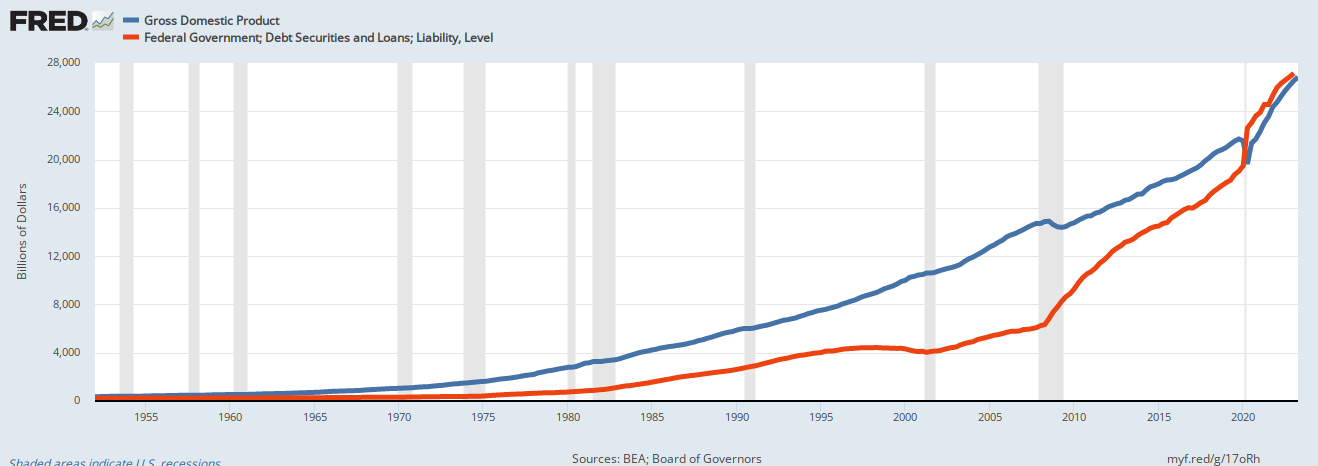
Deficit reductions (red line) result in recessions (vertical gray bars), which are cured by deficit increases.
Even the COVID recession of 2020 was cured by the increase in federal spending — the so-called “debt” — that year.

Read it again while again keeping in mind the Monetarily Sovereign U.S. government has the infinite ability to create its own sovereign currency. It never, unintentionally, can run short of U.S. dollars.

Now ask yourself: Why would the federal government borrow dollars? The answer: It doesn’t. 

Notice the definitions of federal debt encompass two completely different things:

  1. The total of federal deficits, i.e. the net total difference between what the government has spent and what it has received in taxes.
  2. The total of Treasury Security accounts.

1. Total Federal of Deficits: In most years, the federal government spends more than it receives in taxes. This is called a “deficit.” Over the years these deficits total to what is called the “federal debt.”

All forms of debt require at least one debtor and at least one creditor. But with regard to federal deficits, who is the debtor and who is the creditor, and what is owed?

A quick response might be that the government is the debtor, and those supplying the government with goods and services would be the creditors. But that quick response would be wrong.

Although the federal “debt” is upwards of $30 trillion, the federal government does not owe its suppliers $30 trillion. They all have been paid.

Clearly, the total of deficits is not federal debt. There are no creditors, no debtor, and nothing is owed.

2. The Total of Treasury Security Accounts: Are they “federal debt”? If so, how and why did the “debt” occur. 

Look back at the definitions: The Treasury Securities are bills, notes, and bonds, issued by the federal government to raise funds for government operations.

A “bill” is a request for payment of money owed, or the piece of paper on which it is written. In the private sector, a bill is created by a creditor and sent to a debtor as a demand for payment. The way most people understand it.

But federal terminology is diametrically different. Here, the “debtor” (the government) creates and issues the T-bill and the creditor buys it, as though it were a bond. 

Consider a dollar bill. It is not a request for payment by a creditor, but rather a document created by the debtor — the federal government, which owes the holder one dollar. The dollar bill itself is not the dollar. It is an IOU for a dollar.

The dollar is just a number in the federal government’s financial books.

You cannot see, feel, smell, or taste a dollar. It has no form or substance. If someone asked you what does the number “five” look like would your answer be: “5,” or “V,” or “(2+3);” or the binary “101,” or “√25.”

Although you can describe a five dollar bill, you cannot say what five dollars look like. Dollars result from laws, and again, no one can say what a law looks like. Like dollars, laws are just concepts, not physical entities.

That fact that dollars are not physical gives the federal government the infinite ability to create them just by pressing computer keys.

But that’s a minor, though confusing, semantic issue. The major, and even more confusing, semantic question: Why does a Monetarily Sovereign entity, having the infinite ability to create dollars, ever borrow dollars?

As two former Chairmen of the Federal Reserve have said:

Alan Greenspan: “A government cannot become insolvent with respect to obligations in its own currency. There is nothing to prevent the federal government from creating as much money as it wants and paying it to somebody. The United States can pay any debt it has because we can always print the money to do that.”

Ben Bernanke: “The U.S. government has a technology, called a printing press (or, today, its electronic equivalent), that allows it to produce as many U.S. dollars as it wishes at essentially no cost.”

Question: If the U.S. government cannot become insolvent, can create as much money as it wants, and can pay any debt, why does it borrow dollars? Why does it pay interest when it can produce as many dollars as it wishes at essentially no cost?

Answer: It doesn’t borrow, and the interest is produced at no cost.

Because of words like “bill,” “note.” and “bond,” many people, including even economists, believe these represent federal borrowing and debt.

They do not. The federal government never borrows dollars. It creates all the dollars it needs by spending dollars. Spending is how the government creates new dollars. The process is:

When an agency of the federal government pays an invoice (a bill) from a creditor, it sends instructions (not dollars) to the creditor’s bank. The instructions may be in the form of a check or a wire (“Pay to the order of ____”)

The bank obeys the instructions by increasing the balance in the creditor’s checking account. At that instant, new dollars are created and added to the M2 money supply measure.

The bank balances its books by informing the Federal Reserve of the instructions, which debits the government’s account. 

At no time are any physical dollars exchanged because there are no physical dollars. It’s all numbers in bookkeeping accounts.

But what is the purpose of those T-security accounts? They have two purposes, neither of which is to provide spending money for the government:

A. To provide a safe place to store unused dollars, which stabilizes the dollar. Because dollars have no physical existence, they can’t be stored in a box and watched. So, it is especially important that large, unused sums be kept on trusted books

No books are more trusted with dollars than the U.S. government’s.

B. To help the Fed control interest rates. Because T-securities are known to be safe, the interest paid by federal storage sets a floor for all private sector interest rates. 

T-security accounts resemble bank safe deposit boxes in that the contents are not owed to the depositors and not used by the bank. They are not federal in that the contents of the accounts are wholly owned by the depostors. The federal government never touches those dollars.

Just as they are not debts, they also are not federal. To close an account, the bank and the government simply return the contents to their owners, the depositors. The government does not owe the money because it never takes ownership of the money.

Why then, does the federal government need to lend rather than give money (for instance, student loans) or need to collect taxes.

It doesn’t. 

The federal government could forgive all student loans and continue spending forever, all without collecting a single penny in taxes. It could accomplish this simply by creating dollars.

Some claim that “excessive” federal deficit spending would cause inflation. That claim is false; the reasons are described here. While a government response to inflation may be to print currency, the cause of all inflations has been shortages of critical goods and services.

The most recent inflation was caused not by federal spending, which had been go on for  many years, but by new, COVID-relaed shortages of oil, food, computer chips, lumber, paper, shipping, steel, and many other products, and labor.

While state/local taxes and borrowing help monetarily non-sovereign government pay for things, the purpose of federal taxes is not to pay for things but rather:

  1. To control the economy by taxing what the government wishes to discourage and by giving tax breaks to what the government wishes to reward.
  2. To support demand for the U.S. dollar by requiring taxes be paid in dollars.

But the biggest, unofficial reason for taxes is to support the myth that federal debt is paid by taxes, and that taxes are necessary to fund spending. It’s a myth promulgated by the people who really run America, the rich.

They are rich because of the income/wealth/power Gap between the rich and the rest. The wider the Gap, the richer they are.

The debt/taxation myth limits the federal spending that supports the middle- and the lower-income groups, but allows for the federal tax breaks that are given to the rich. Contrary to popular belief, federal taxation widens the Gap between the rich and the rest, making the rich richer.

Without the debt/taxation myth we could fund free, comprehensive, no-deductible Medicare for every man, woman, and child in America, no-FICA Social Security for everyone, an end to poverty in America, free college for everyone who wants it, and many other benefits (free public transportation, housing support, local infrastructure improvements, lower local taxes, etc.) all of which are of no interest to the rich.

Donald Trump didn’t pay less taxes than you paid the past ten years, not just because he cheated, but also because, being rich, he took advantage of the tax breaks that you can’t.

Tax breaks are financially the same to the federal government as such benefits as Social Security and Medicare, the difference being there is no financial limit put on tax breaks while the benefits are limited by tax collections.

SUMMARY

Unlike state/local governments, businesses, you and me, the federal government is Monetarily Sovereign. It cannot unintentionally run short of dollars. It can pay any financial obligation immediately. 

The federal government and its taxpayers are not burdened by federal debt. The federal government does not borrow dollars. It creates dollars ad hoc, by spending.

People have complained about the fictional “federal debt” since 1940, calling it a “ticking time bomb.” yet after all these years the ticking time bomb hasn’t exploded. In that time, the “federal debt” rose from $40 billion to $30 trillion, the economy is healthy, the government is paying its bills, and all the scare stories have proved to be false.

The federal debt, whether it be the total of deficits or the total of T-securities, neither is federal nor debt. It is not a burden on taxpayers nor on the federal government. It doesn’t cause inflation or recession.

Deficit spending is necessary to grow the economy and attempts to reduce deficit spending have caused causes recessions and depressions.

Accepting deposits into T-bill, note, and bond accounts does not constitute borrowing or debt, for a Monetarily Sovereign entity never borrows its own sovereign currency. 

It’s not debt if there is nothing owed, nothing borrowed, no creditors, no debtors, an no payment burden.


Rodger Malcolm Mitchell
Monetary Sovereignty

Twitter: @rodgermitchell Search #monetarysovereignty
Facebook: Rodger Malcolm Mitchell

……………………………………………………………………..

The Sole Purpose of Government Is to Improve and Protect the Lives of the People.

MONETARY SOVEREIGNTY
A child’s picture book for those who tell you the federal debt is too high

Page 1.
As federal debt (red) has risen, so has the economy (blue — GDP). Higher federal debt leads to higher GDP growth. The reason: GDP=Federal Spending +Non-federal Spending + Net Exports.
Page 2. The reason:
Economic growth and federal debt growth have been extraordinarily high since the end of the COVID recession. Despite efforts to reduce Federal Debt growth — efforts that, if successful, would reduce GDP growth — federal debt and GDP have continued to grow rapidly.
Page 3.
There is no relationship between federal debt and inflation. No data suggest that “too much” federal spending causes inflation.
Page 4.
A strong relationship exists between inflation (green) and oil prices (gray) as dictated by oil supply. Shortages cause price increases. Inflation is a general increase in prices. All inflations throughout history have been caused by shortages of crucial goods and services, usually energy and food.
Page 5.
Changes in federal debt (incorrectly called federal “borrowing”) do not reduce the availability of lending funds (yellow). There is no relationship between federal debt and the amount of lending.
Rodger Malcolm Mitchell Monetary Sovereignty Twitter: @rodgermitchell Search #monetarysovereignty Facebook: Rodger Malcolm Mitchell

……………………………………………………………………..

The Sole Purpose of Government Is to Improve and Protect the Lives of the People.

MONETARY SOVEREIGNTY

Oh, Veronique, you write so much and seem to know so little about America’s #1 scam.

Veronique de Rugy
Veronique d Rugy. Is she lying or does she really not understand federal finance? Or?

VERONIQUE DE RUGY is a contributing editor at Reason.

She is a senior research fellow at the Mercatus Center at George Mason University.

According to the 2017 Global Go To Think Tank Index Report (Think Tanks and Civil Societies ProgramUniversity of Pennsylvania), Mercatus is number 39 in the “Top Think Tanks in the United States” and number 18 of the “Best University-Affiliated Think Tanks”. 

The Koch family has been a major financial supporter of the organization since the mid-1980s. Charles Koch serves on the group’s board of directors.

The following is Ms. de Rugy’s article from the Libertarian website, REASON.com.

Social Security Is on the Brink of Collapse. The GOP Won’t Touch It. In 1950, there were more than 16 workers for every beneficiary. In 2035, that ratio will be only 2.3 workers per retiree. VERONIQUE DE RUGY | 1.26.2023 12:01 AM

If you follow policy debates long enough, arguments you never thought you’d hear can become key components of the two parties’ policy platforms.

That’s certainly the case when it comes to some Republicans, and their new “never touch Social Security and Medicare” position.

Over the weekend, newly elected Sen. J.D. Vance (R–Ohio) tweeted that former President Donald Trump was 100 percent correct to demand that “under no circumstances should Republicans vote to cut a single penny from Medicare or Social Security.”

Vance’s tweet was issued amid the debt ceiling fight, but Trump has long held this position.

The Republicans would love to cut Medicare and Social Security benefits because that would increase the income/wealth/power Gap between the rich and the rest. The Gap is what makes the rich rich. If not for the Gap, no one would be rich. We all would be the same. The wider the Gap, the richer are the rich. The GOP, the party of the rich, is always ready to help make the rich richer. Their big tax reduction during the Trump years enriched the rich and did nothing for the middle and poor. The GOP complaints about funding the IRS had to do with protecting the rich. So long as the IRS is underfunded, they don’t have the manpower to investigate the complex tax returns of the rich, so currently, they focus on the middle and lower levels. The only reason the GOP won’t try to cut Medicare and Social Security benefits is that they would be punished at the polls, not because they care about the health and well-being of the middle or poor. They don’t. Watch for the GOP “solution” to the non-problem of Social Security and Medicare finances to be something that doesn’t hurt the rich, such as increasing the FICA income limit. Rich people aren’t worried about paying FICA taxes on an above $150M salary. Not only is that chump change for the rich, but many don’t pay any FICA because they aren’t salaried.

Now, to be fair, the GOP’s well-intentioned engagement in the overall debt ceiling dispute is limited by the short time Congress has to raise the limit, all but ruling out credible reforms of Medicare or Social Security.

GOP’s “well-intentioned” engagement in the debt ceiling dispute?? I didn’t realize Veronique was a humor writer. Or perhaps she believes her readers are fools.

Reforming these two programs will take a considerable amount of time and requires bipartisan action. However, this reality is no reason to assert that the programs’ benefits should never be touched.

In right-wing speak (Yes, Libertarians are closet right-wingers), “reform” Social Security and Medicare means cut benefits to the middle class and the poor.

I cannot wait to hear the grand plan that the “don’t touch Social Security and Medicare” Republican caucus has to address the $116 trillion over 30-year shortfall—that’s 6 percent of U.S. GDP—facing the two programs.

No action from Congress means no money to pay for all the benefits. That means enormous cuts that will hurt the low-income seniors who depend on the programs.

That is a bald-faced lie. The federal government could double, triple, or quadruple benefits for both programs while eliminating all FICA collections and still have money to pay Congressional, Presidential, and SCOTUS salaries. Contrary to popular myth, FICA pays for nothing. Every FICA dollar ripped from your paycheck and sent to the U.S. Treasury is destroyed upon receipt. The dollars come from the M2 money supply, so when you pay $1 in federal taxes, the M2 money supply declines by $1. But when those M2 dollars reach the Treasury, they instantly cease to exist in any money supply measure. There is no money supply measure for federal funds simply because the federal government has the infinite ability to create dollars. Thus, the federal government, being Monetarily Sovereign, has infinite dollars. Adding your tax dollars to infinity doesn’t change infinity.

Of course, if Vance and friends insist on not touching benefits, they could address the Social Security and Medicare shortfalls with enormous tax hikes.

Federal taxes don’t fund federal spending, so they can’t “address Social Security and Medicare shortfalls.”

For Social Security alone, when the trust fund dries out, they will have to agree to immediately raise the payroll tax from 12.4 percent to 15.64 percent—or close to a 25 percent tax increase.

Add to that the tax hike necessary for Medicare and then repeat the exercise over the years to fill the entire shortfall.

The tax hikes would have no effect on Social Security and Medicare solvency. These federal agencies and all other federal agencies are solvent because they are funded by the infinitely solvent U.S. government. The misnamed federal “debt” is not a debt of the federal government. The government has paid all its debt the same way: By creating dollars from thin air. The federal debt is the net total of all federal deficits — the difference between total spending and total taxing. That difference is bridged by federal money creation so that all obligations are paid on time. Have you ever wondered how the federal government can raise the debt ceiling whenever it wishes? According to the U.S. Department of the Treasury, the debt ceiling has been raised, extended, or revised 78 separate times since 1960. And all these increases were done without tax increases (otherwise, the debt ceiling would not have been reached) because federal taxes don’t fund anything. (State and local governments (unlike the federal government) are monetarily NON-sovereign. They don’t have the unlimited ability to create dollars, so their taxes do fund their spending.)

It’s not as if we haven’t been warning politicians that these troubles were brewing. Back in 2000, roughly when I started working on fiscal issues, experts already warned that the Social Security trust fund would run out of assets by 2037, triggering painful benefit cuts.

Not only does the Social Security trust fund not pay SS benefits, but it isn’t even a trust fund. To quote right-winger Pete Peterson:

WHAT ARE FEDERAL TRUST FUNDS? Sep 20, 2016, Peter G. Peterson Foundation

A federal trust fund is an accounting mechanism used by the federal government to track earmarked receipts (money designated for a specific purpose or program) and corresponding expenditures.

The largest and best-known funds finance Social Security, Medicare, highways and mass transit, and pensions for government employees.

Federal trust funds bear little resemblance to their private-sector counterparts.

In private-sector trust funds, receipts are deposited and assets are held and invested by trustees on behalf of the stated beneficiaries.

In federal trust funds, the federal government does not set aside the receipts or invest them in private assets.

Rather, the receipts are recorded as accounting credits in the trust funds, and the receipts themselves are comingled with other receipts that Treasury collects and spends.

The misnamed trust funds are wholly owned and controlled by the federal government. It can add to them, subtract from them or do whatever else it wishes with them. The notion that the trust funds will run out of money and so can’t pay Social Security or Medicare benefits is ridiculous on its face. The federal government pays whatever benefits it wishes, regardless of so-called “trust funds.’ Further, the government has the unlimited power to add to, or subtract from those fake trust funds whenever it wishes. The whole Social Security/Medicare trust fund fiction is a giant scam to make you believe the government can’t afford SS and Medicare benefits. When politicians whined that Medicare for All or Social Security for All needed to be “paid for” by tax increases or benefit cuts, the sole purpose was to make you agree to widening the income/wealth/power Gap between you and the rich. It is America’s biggest, most crooked scam, and you have been falling for it since Social Security began on August 14, 1935. And you still fall for it without complaint. It’s a scam that makes Bernie Madoff look like an angel. One wonders why you don’t fret about the White House trust fund, the SCOTUS trust fund, the Congress trust fund, the Bureau of Labor Statistics trust fund, the Capitol Police trust fund, the Army trust fund, the Coast Guard trust fund, and all the other federal department and agency trust funds. Oh, they don’t have trust funds? So where do they get their money? Ah, the federal government simply pays the bills by creating dollars from thin air. Just pay thepreciselyand stop lying about “trust funds.” that is exactly what the federal government should do about Social Security and Medicare.

Today, the situation has deteriorated further, with the trust fund now on track to run dry in 2035, along with any practicable hope for fixing the problem.

The fake “trust fund” will run dry only if Congress and the President want it to run dry.

In other words, these problems shouldn’t surprise anyone. When Social Security started, life expectancies were lower. In 1950, there were more than 16 workers for every beneficiary. That ratio is now below three workers per retiree and will be only 2.3 workers per retiree by 2035.

The number of workers per beneficiary is completely irrelevant. Workers do not pay for beneficiaries. FICA does not pay for anything. It’s destroyed. It exists only to con you. Period.

Add to this trend decades of politicians buying votes by expanding benefits beyond incoming payroll taxes, and you have a true fiscal crisis.

To the Libertains’ sneering and twisted minds, giving the populace benefits is “buying votes.” But the sole purpose of any government is to protect and enhance the people’s lives.  If any government doesn’t provide benefits, it’s not doing what it was created to do.

That’s why it’s so alarming that so many in the GOP are giving up on educating a public that’s been brainwashed for years with misleading soundbites like “You earned your Social Security benefits, so you are entitled to the benefits now promised,” or “There’s an account with your name on it.”

There is, in fact, an account with your name on it, and it’s called a T-security account. If you have deposited money into a T-bill, T-note, or a T-bond, you have put dollars into your T-security account. Those dollars belong to you. The federal government never touches them. When your account matures, the government returns the dollars in your account. The total of dollars in all T-security accounts is erroneously termed, “the federal debt.” But it not federal and it is not debt. Your dollars belong to you, not the federal government, and there is no debt. Your dollars are safe and comfortably resting in your account just as though they were in your pocket or safe deposit box. Just as the contents of bank safe deposit boxes are not bank debt, the contents of T-security accounts are not federal debt.

Such misinformation has made serious discussion of reform very difficult.

Yes, that is exactly what misinformation has done.

There’s no question that retirees deserve fair treatment, but the facts are that the Supreme Court ruled in 1960 that workers do not have a legally binding right to Social Security benefits, and if Congress cuts benefits even by, say, 50 percent, it can do so—no matter how much anyone has paid into the program.

And so goes the “trust fund” myth. If they were trust funds, you would have a legal right to those benefits, but you don’t and SCOTUS has said so. And they are not trust funds. Congress and the President have 100% control over benefits, which can be raised or cut, arbitrarily, as can the amount of money claimed to be in those fake “trust funds.” What does that say about the mythical trust funds? What does that say about Veronique de Rugy’s claims?

It won’t come to that, but the ruling still stands. It’s also fiction that all the benefits that have been promised were earned by workers—they weren’t.

That’s in part because current retirees are paid with taxes from current workers, not from funds saved out of the payroll taxes retirees paid when they were in the workforce.

No, no, no. Current retirees are not paid with federal taxes. They are paid by the federal government’s infinite ability to create dollars. The purpose of federal taxes is not to fund federal spending. The purpose of federal taxes is to control the economy by punishing what the government wishes to discourage and by rewarding (via tax breaks) what the government wishes to encourage.

It’s magical thinking to say that touching Social Security and Medicare is a nonstarter.

Touching Social Security and Medicare is not a financial nonstarter. The government could increase or decrease benefits at will. But decreasing benefits could be a voter nonstarter and increasing benefits could a rich-donor nonstarter. That rug-of-war is the called the “debt-limit-debate. It’s a debate between the rich and the rest, except the “rest” don’t even know there is a debate, much less a solution.

Even more strange, many of the same Republicans want to spare these two programs while still putting Medicaid on the chopping block. Medicaid should be reformed too, but at least that program serves poor people.

By contrast, the seniors who receive Social Security and Medicare today are overrepresented in the top income quintile while younger Americans are overrepresented in the bottom quintile.

So these guys want to cut benefits for poor people on Medicaid while subsidizing relatively wealthy boomers with taxes taken from relatively poor youngsters.

Yikes.

No, the real “yikes” to to writers like Veroique de Rugy who repeatedly promulgate misinformation about the federal “debt” and the fictional Social Security and Medicare “trust funds.” YIKES!!!!!

The GOP’s transformation into the party of big and fiscally reckless government is proceeding apace.

We agree there. Rodger Malcolm Mitchell Monetary Sovereignty Twitter: @rodgermitchell Search #monetarysovereignty Facebook: Rodger Malcolm Mitchell

……………………………………………………………………..

The Sole Purpose of Government Is to Improve and Protect the Lives of the People.

MONETARY SOVEREIGNTY

 
CONGRESS, GOVERNMENT SPENDING, SOCIAL SECURITY, MEDICARE, MEDICAID, DONALD TRUMP, ENTITLEMENTS, POLICY, FISCAL POLICY, OHIO, DEBT, NATIONAL DEBT, DEBT CEILING, REPUBLICAN PARTY, DEMOCRATIC PARTY, GDP, INCOME, POVERTY, TAXES, PAYROLL TAX, POLITICS, RETIREMENT, RETIREMENT BENEFITS, EMPLOYMENT, MISINFORMATION, SUPREME COURT, WEALTH, GOVERNMENT, FEDERAL GOVERNMENT, BIG GOVERNMENT, ECONOMY, ECONOMICS

New York Post tells it like it isn’t — ticking time bomb version

Readers of this blog are familiar with the “ticking time bomb” series; examples are here, here, here and elsewhere. The point of this endless series is that since 1939, the media, politicians, and economists have been wringing their hands about the so-called federal debt, explicitly claiming it is a “ticking time bomb.” That’s 84 years of “the-world-is-about-to-end” predictions that demonstrably have been wrong, and the predictors have learned nothing from their ongoing failures. In 1939, the gross federal debt was $39 billion. Last year it was $27 TRILLION. If my math is correct, that’s a 30,000% increase, not even a firecracker. Are the doomsday shouters embarrassed by failure? Nah. The New York Post just keeps vomiting up the garbage. Worse yet, they combine that turd of ignorance by conflating the fake federal debt-that-isn’t-debt with real, private-sector debt.
Overview image
Stephen Moore

America’s ticking time bomb: $66 trillion in debt that could crash the economy By Stephen Moore December 4, 2022, 6:29pm Updated

The national debt is $31 trillion when including Social Security’s and Medicare’s unfunded liabilities.

Wake up, America.

That ticking sound you’re hearing is the American debt time bomb that with each passing day is getting precariously close to detonating and crashing the US economy.

The “national debt” is not the “federal debt.” It is Moore’s strange amalgam of all sorts of things he lumped under the word “debt,” perhaps to make them look huge. Federal debt is deposits into Treasury Security accounts, similar to safe deposit boxes. The federal government never touches those dollars. It merely safeguards them. And when the accounts mature, and depositors want their money, the government merely sends them the dollars from their accounts. This return of dollars is not a burden on the government or taxpayers. It’s significantly different from the federal government’s paying for goods and services. In that case, the federal government creates new dollars ad hoc, which it has the infinite ability to do. The federal government is Monetarily Sovereign, meaning it made (and still creates) the laws that create U.S. dollars. Because it has the infinite ability to create rules, it has the endless ability to create dollars. You can’t do it. I can’t do it. Businesses and local governments can’t do it. That is why it makes no sense to lump federal finances with non-federal finances. The two bear no relationship. But that fact doesn’t stop the NY Post writers.

Businesses, consumers, and especially the federal and state governments have become hooked on red ink as if it were crack cocaine.

The federal government has scant red ink. It pays all its bills by creating new dollars. It cannot run short of dollars unless some damn fool politician decides not to allow the federal government to pay its bills (i.e., the so-called “debt limit).

Two factors have fueled this borrowing binge: an era of low-interest rates (that’s coming to an end) and falling real wages thanks to the 15% rise in prices of Bidenflation.

In addition to merging two different situations into one make-believe situation, the Post writer falsely claims the federal government’s non-existent “debt” comes from borrowing. The federal government never borrows dollars. Given the infinite ability to create dollars, why would it borrow dollars? The writer, a senior advisor to Donald Trump (of course), thinks T-bills, T-notes, and T-bonds, are like personal notes and bonds. They aren’t. You, your business, and your local government borrow when you need dollars. Not only does the Monetarily Sovereign federal government never need dollars – – it creates them at will — but it never touches the dollars invested in T-securities. As Fed Chair famously said, “The U.S. government has a technology, called a printing press (or, today, its electronic equivalent), that allows it to produce as many U.S. dollars as it wishes at essentially no cost.”  Why would such a government need to borrow dollars?

Let’s review the borrowing up-escalator that accelerated during COVID but hasn’t subsided.

The King Kong of borrowing is Uncle Sam. The national debt is $31 trillion when including Social Security’s and Medicare’s unfunded liabilities.

No federal obligations are “unfunded.” All are funded by the U.S. federal government’s full faith and credit, which includes the infinite power to create dollars.

That’s getting close to 150% of our national gross domestic product of $22 trillion.

The “debt”/GDP ratio is meaningless. It has neither predictive nor evaluative worth. It tells you nothing about the financial health of a Monetarily Sovereign government. “Debt” is a many years measure of deposits. GDP is a one-year measure of spending. The two comprise the ultimate in an apples/anvils comparison.

Some $5 trillion has been added in just the past three years. Balancing the budget seems like a pipe dream these days.

More confusion from the Trump writer. First, he talked about state governments. Now it’s unclear what he is talking about- federal or national finances? In any event, balancing the federal budget would be a disaster for the U.S. economy. A growing economy (as measured by GDP) requires an increasing money supply. But “balancing the budget” implies no growth. No growth is “recession,” and the word for no growth with population growth plus inflation is “depression.”

Next, add state and local government debt and unfunded liabilities. The American Legislative Exchange Council estimates that at just under $6 trillion.

State and local governments are part of the private sector, including businesses and people. When state and local governments levy taxes, one segment of the private sector ships dollars to another segment of the private sector. There is no net money growth for economic growth. The sole source of net money growth is the federal government, which has the infinite ability to create dollars.

Now, what about American households? The latest estimate for consumer debt is $16.5 trillion, per the New York Federal Reserve. Most of that debt is mortgages, but increasingly Americans are taking on debt for routine expenses to pay monthly bills like groceries and gas at the pump. Thanks, President Biden.

The federal government easily could ameliorate private debt by enacting Social Security for All, Medicare for All, and other social benefits. Of course, Mr. Stephen Moore would hate that because . . . well, just because.

Then we have corporate America and small businesses. Their debt burden, according to the Federal Reserve Board, just surpassed $10 trillion for the first time. Business borrowing can be a good thing — indicating economic optimism. But we have to wonder how many more FTX-type bubbles are out there inflated by low-interest rates and all that helicopter money from Washington.

Then we have the National Enquireresque’s “we have to wonder” phrasing. He doesn’t know, so he wonders.

So add it all up, and American society now owes $66,000,000,000,000 of debt! That’s roughly three times our annual GDP.

You have just read perhaps the most misleading piece of nonsense you ever will encounter. Moore adds Treasury deposits to personal and business debt, most of which comprises the private sector owing the private sector. What does he recommend? No mortgages? No business borrowing? If less, how much less? If that phony “$66,000,000,000,000” is too much, what is the right amount? $0? Moore never says because he is clueless about federal financing.

Another danger sign: With wages (5% growth) falling behind consumer price inflation (7.5% growth), American families are borrowing more just to maintain their current living standard. Americans on average have lost $4,000 in purchasing power and some $30,000 in 401(k) plans in the Biden era.

It’s not “the Biden era.” It’s the COVID era. Inflation is caused by COVID-related shortages. Prices go up when goods and services become scarce. COVID, which Trump denied, caused scarcities of oil, food, transpiration, computer chips, and many other products. Staying home with COVID caused service shortages.

By far the biggest debtor has been Uncle Sam — which has created a national culture of living beyond our means.

An entity with infinite ability to create dollars has no “means” to live beyond. That national culture has existed for over 80 years, during good times and bad.

During COVID, President Donald Trump pumped $2 trillion of “stimulus” red ink into the country when the private economy was shut down. But then, in an act of near-criminal financial negligence, Biden entered office and shoveled out $4 trillion more in green-energy giveaways, state bailout funds, student loan bailouts and welfare handouts to families with no one working.

First, Moore complains about people having lost $4,000 in purchasing power and $30,000 in 401(k) plans. Then, incredibly, he complains about the government giving these people money to help with their finances. That is the kind of idiocy one expects from a Trumpist graduate of the Heritage Foundation. And now we come to Moore’s virtual admission that he knows nothing about economics.

A new-wave economic strategy called Modern Monetary Theory facilitated this borrowing blowout.

The loony idea is predicated on the notion that because the US dollar is the world reserve currency, we can run up the federal credit card by trillions and still feel good about ourselves in the morning.

Until that is, interest rates start to rise.

OMG! Modern Monetary Theory has nothing to do with the U.S. dollar being the most popular reserve currency. A reserve currency is a currency banks hold in reserve to facilitate trade among nations. It has nothing to do with U.S. borrowing. While the dollar is the most commonly held reserve currency, other currencies also are held in reserve. The euro, the yen, the lira, and others are reserve currencies. Moore is clueless about this. Further, using a credit card implies borrowing, which the federal government doesn’t do. Finally, rising interest rates have nothing to do with the federal government’s ability to pay its bills. It has the infinite ability to pay bills, no matter how high interest rates go.

Consumers are now engaged in the same reckless monkey-see, monkey-do behavior. The latest Federal Reserve Bank of New York report says credit card debt has skyrocketed by 16% this year to above $1 trillion.

The Christmas season is witnessing even more debt to buy Yuletide gifts. Low-income Americans are taking on debt at the fastest pace of all. Come January, don’t be surprised if Americans look at their credit card debt and suffer severe buyers’ remorse.

People may be borrowing more, which could bite them, but it has nothing to do with the federal government spending more. Moore is just lashing in all directions at anything involving more money.

For now, defaults and delinquencies are low, but we should have learned financial seas can shift on a dime. Meanwhile, the feds keep feeding the debt surge by increasing taxpayer mortgage insurance for million-dollar homes.

There is no such thing as “taxpayer mortgage insurance.” Federal taxpayers do not fund anything. All federal tax dollars are destroyed upon receipt by the U.S. Treasury. The purpose of taxes is not to fund federal spending. Taxes help the government control the economy by punishing what the government doesn’t like and rewarding (tax breaks) what the government wishes to encourage. You pay your taxes with dollars in the M2 money supply, and when they hit the Treasury, they cease to be part of any money supply measure. They effectively cease to exist.

Debt isn’t necessarily a bad thing. It depends on what we’re getting for it. When we borrow for roads or factories or homes or to finance our military to win wars, borrowing can be necessary and appropriate.

If you know what this last paragraph is supposed to mean, please feel free to let me know.

Stephen Moore is a senior fellow at the Heritage Foundation. He served as a senior economic adviser to Donald Trump. His latest book is “Govzilla: How the Relentless Growth of Government Is Devouring Our Economy.”

Quite a combination: Heritage Foundation + Donald Trump. That says it all. Rodger Malcolm Mitchell Monetary Sovereignty Twitter: @rodgermitchell Search #monetarysovereignty Facebook: Rodger Malcolm Mitchell

……………………………………………………………………..

The Sole Purpose of Government Is to Improve and Protect the Lives of the People.

MONETARY SOVEREIGNTY