Admirably, President Bident wishes to narrow the income/wealth/power Gap between the rich and the rest of us. I agree with this sentiment because the current Gap, very simply, is bad economics and bad for humanity.
Wide Gaps negatively affect health and longevity, education, housing, law and crime, war, leadership, ownership, bigotry, supply and demand, GDP, international relations, scientific advancement, the environment, human motivation and well-being, freedom, and virtually every other issue in economics and the human condition.
To narrow the Gaps, Biden proposes changes to federal law. In broad strokes, he has just three options:
Increase taxes on the rich (“rich” by any arbitrary measure).
Reduce taxes on those who are not rich.
Provide supplementary income and benefits to those who are not rich.
All three would narrow the Gap, though in different ways. From the standpoint of the U.S. economy, as measured by Gross Domestic Product, #1 would have a dramatically different effect than #2 and #3.
Increasing taxes on the rich (if the rich actually paid those increased tax levels) would take dollars out of the economy. #2 and #3 would add dollars to the economy). In short, #1 is recessive, and #s 2 and 3, would grow the economy.
This is demonstrated by the formula:
GDP = Federal Spending + Nonfederal Spending – Net Imports.
If the rich paid more taxes (#1), Nonfederal Spending would decline. The amount of the decline would be determined by various factors, most having to do with how much the rich actually pay.
History indicates that payment would be less than anticipated because of existing loopholes and/or new loopholes the rich would bribe Congress to enact.
Considering that the top tax rate in the 1950s was 90%, the rich did not pay much more in that period than they do now. And some of the richest among us pay little if anything.
For example, Donald Trump paid no income taxes at all, during ten of the fifteen years, 2000-2015, despite being a billionaire. Tax laws, favorable to the rich, gave him the ability to claim losses on investments that an ordinary taxpayer may not look at as “losing” money.
In summary, using federal taxation of the rich to narrow the Gap is bad economics. History shows the rich would find ways to avoid paying higher rates.
But, even if the rich were forced to pay more, the higher rates would take dollars out of the economy and recess the economy. Option #1 is a “heads-you-lose (the rich don’t pay more), tails-you-lose” (GDP falls) plan.
Sadly, that is the plan Biden seems to have chosen, and it will cost him the November election.
The electorate may be ignorant about economics, but the rich would make sure the voters understood that raising taxes — anyone’s taxes — would hurt the economy.
It’s simple math. The more the federal government takes out of the economy, the less the economy (GDP) has.
Reducing federal taxes and/or providing supplementary benefits to those who are not rich, (#2 and #3) are the sole economically sensible ways to narrow the income/wealth/power Gap.
Sadly this sensible approach is blocked by the non-sensible belief that federal deficit spending is “unsustainable.”
That’s associated with the equally wrong belief that “excessive” federal spending or an “overheated” economy cause inflation. The fact: Inflation is not caused by “heat” (whatever that is) or by federal spending.
All inflations are caused by shortages of critical goods and services, most often oil and food. Inflation can be cured by additional federal spending to acquire and distribute the scarce goods and services.
Here is what the right-leaning Tax Foundation thinks:Details and Analysis of President Biden’s Fiscal Year 2025 Budget Proposal
March 22, 2024, By: Garrett Watson, Erica York, William McBride, Alex Muresianu, Huaquin Li, Alex Durante
11-Year Revenue (Trillions)
Long-run GDP
Long-Run Wages
Long-Run FTE Jobs
+$2.2T
-2.2%
-1.6%
-788k
In plain English, the government would remove from the economy, an additional $2,2 Trillion. This would cause GDP to fall by 2.2%, wages to fall by 1.6%, and Full-Time Equivalent Jobs to shrink by 788 thousand.
Because the Tax Foundation has a right-wing agenda, one may doubt the specifics of their calculations, but I believe they are on the right track. When the federal government collects more taxes, the economy loses money.
When the economy loses money, the GDP, wages, and jobs all shrink. It’s straightforward math.
The tax changes Biden proposes fall under three main categories: additional taxes on high earners, higher taxes on U.S. businesses—including increasing taxes that Biden enacted with the Inflation Reduction Act (IRA)—and more tax credits for a variety of taxpayers and activities.
The combination of policies would move the tax code further away from simplicity, transparency, and neutrality while making the U.S. economy less competitive.
The increase in the corporate tax rate and the additional taxes on top earners would result in U.S. top marginal tax rates on income that are among the highest in the developed world.
The federal government is running short of money while the private sector has too much money.
The middle- and lower-income taxpayers will not understand that taking dollars from the economy is recessive, and instead will happily vote for a “soak-the-rich” administration.
The ignorance and cynicism of these beliefs cannot be overstated. Biden seems to believe that taking the populist approach will gain him votes.
But, it is such government deceit that keeps you from:
The end of the FICA tax deduction from your salary
Comprehensive, no deductible Medicare for every adult and child.
Social Security benefits for everyone of all ages
Food cost aid
Free college for those who want it
Free public transportation
Housing aid
And a myriad of other benefits our Monetarily Sovereign government easily could afford, while preventing recessions and inflations.
Biden could beat Trump in a “truth vs. lies” competition, but he will not be able to out-lie Trump.
If he tries, he will lose.
Narrowing the Gap is good economics, but doing it by taxing businesses and the rich is a lie.
It may be a good time to repeat a few facts:
•Those, who do not understand the differences between Monetary Sovereignty and monetary non-sovereignty, do not understand economics.
•Any monetarily NON-sovereign government — be it city, county, state or nation — that runs an ongoing trade deficit, eventually will run out of money.
•The more federal budgets are cut and taxes increased, the weaker an economy becomes.
•Liberals think the purpose of government is to protect the poor and powerless from the rich and powerful. Conservatives think the purpose of government is to protect the rich and powerful from the poor and powerless.
•The single most important problem in economics isthe Gap between rich and poor.
•Austerity is the government’s method for widening the Gap between rich and poor.
•Until the lower 99% understand the need for federal deficits, the upper 1% will continue to rule.
•Everything in economics devolves into motive, and the motive is the Gap between the rich and the rest.
This fundamental truth requires no great insight. Visualize anything that has been created — a painting, a building, a song, a poem, an idea, a theory — and you will see that what preceded it was wholly, or partly, destroyed in its making.
The blank canvas, the random pile of bricks, the notes and the spaces between those notes, the meanings of words, the false beliefs, the earlier truths — all are destroyed by creation.
War is destruction and is one of the most creative of all human endeavors. No fields of the creative arts and sciences are unrelated to war.
This is not to claim that destruction, in of itself, is creative or beneficial. Rather, that beneficial creativity requires some measure of destruction.
With this as background, I suggest that the world can be changed, massively and irretrievably, by the two-word destruction: End FICA.
FICA, otherwise known as the Federal Insurance Contributions Act, supposedly funds Social Security and Medicare. Even its title, which includes the words “insurance contributions” is a lie.
You wrongly have been told that Medicare, for instance, is funded through trust funds. But these so-called “trust funds” are not anything like private trust funds.
These “trust funds” are fictional accounts that are debited and credited arbitrarily by the federal government. The Supplementary Medical Insurance (SMI) Trust Fund, which “pays for” Medicare Parts B and D, receives whatever funds Congress authorizes.
There are no limits on what Congress can authorize. This “trust fund” can run short of dollars only if Congress wants it to run short. This financing has nothing to do with tax collections. It all is strictly arbitrary.
You never had been told that fact.
The elimination of FICAwould immediately accomplish one great thing. It would reduce the needless, harmful destruction of private sector dollars, that currently are sent to the U.S. Treasury, where they are destroyed.
Yes, every one of your federal tax dollars that you send to the U.S. Treasury is destroyed upon receipt. It is not saved somewhere for future use. It is destroyed.
By definition, large economies have more money than do small economies. Thus, a growing economy requires a growing supply of dollars. Taking dollars from the U.S. economy restricts economic growth, and even can lead to recessions an depressions.
U.S. depressions tend to come on the heels of federal surpluses, which remove dollars from the economy .
1804-1812: U. S. Federal Debt reduced 48%. Depression began 1807.
1817-1821: U. S. Federal Debt reduced 29%. Depression began 1819.
1823-1836: U. S. Federal Debt reduced 99%. Depression began 1837.
1852-1857: U. S. Federal Debt reduced 59%. Depression began 1857.
1867-1873: U. S. Federal Debt reduced 27%. Depression began 1873.
1880-1893: U. S. Federal Debt reduced 57%. Depression began 1893.
1920-1930: U. S. Federal Debt reduced 36%. Depression began 1929.
1997-2001: U. S. Federal Debt reduced 15%. Recession began 2001
As such, the federal government does not save tax dollars in order to pay bills. Instead, the federal government creates brand new dollars, ad hoc, every time it pays a creditor. (See: Have you ever played Monopoly?)
In this regard, no one can answer the question, “How much money does the federal government own?” Retaining the unlimited ability to create dollars at will, the federal government can be said to “own” infinite dollars — or no dollars at all.
Those FICA tax dollars, that are destroyed by the U.S. Treasury, were taken from the salaried class, the very people upon whom economic growth most urgently relies.
More importantly, FICA is resoundingly regressive. It is a tax that widens the income/wealth/power Gap between the rich and the rest. (See: Gap Psychology.)
All of the above-referenced benefits of FICA elimination pale in comparison to the real benefit. The destruction of FICA would open the way toward the understanding of one great economic truth: Monetary Sovereignty — the unlimited power that a money creator has over its own sovereign currency.
The very existence of FICA lends credence to “The Big Lie,” the false belief that federal taxes fund federal spending.
The Big Lie itself encompasses several sub-lies, such as:
Federal debt is an unsustainable burden on the federal government and on federal taxpayers.
Federal finances are similar to state and local government finances and similar to personal finances.
Social Security, Medicare, and many other federal agencies are in danger of becoming insolvent.
Federal wasteful spending is a burden on federal taxpayers.
Federal deficit spending leads to inflations and hyperinflations.
Federal social spending (incorrectly termed “socialism”) is unaffordable and unsustainable.
Cuts to federal deficit spending (aka “austerity) are financially prudent.
In science, one fact begets another. Many decades after Relativity and Quantum Mechanics first were proposed, discoveries still are being made based on these two great theories. They have shown light on many dark corners of physics.
So too, does Monetary Sovereignty shine a light on the dark corners of economics.
The elimination of FICA would require the open discussion of Monetary Sovereignty, because the immediate question would emerge, “Who will pay for it?”
Answering that question requires understanding the realities of federal economics, i.e. the realities of Monetary Sovereignty.
Every knowledgable and honest economist understands two truths:
The U.S. federal government created an arbitrary number of the original U.S. dollars from thin air and gave them an arbitrary value.
The U.S. federal government continues to create U.S. dollars from thin air and retains the power to give them an arbitrary value.
Thus, it functionally is impossible for the federal government to run short of its own sovereign currency, a power it has demonstrated for the entire 240 years of its existence.
And because the federal government cannot run short of dollars, no agency of the federal government can run short of U.S. dollars unless that is what Congress and the President want.
Social Security, Medicare, Medicaid, poverty aids, roads, bridges, education, et al — all federal agencies — cannot become insolvent unless that is what Congress and the President decide, FICA or other tax collections notwithstanding.
The question, “Who will pay for it?” answers itself. Eliminating FICA will force the federal government to admit that the federal government will pay for goods and services the same way it always has — by creating dollars, ad hoc.
Eliminating FICA will force a rational conversation about Monetary Sovereignty, from which the public finally learns that federal taxes pay for nothing.
(This is unlike state and local governments, which are monetarily non-sovereign, and in which taxes do pay for state and local government spending.)
Further, the U.S. federal government has the unlimited power to give its sovereign currency, the U.S. dollar, any value it chooses.
It is a power the federal government has demonstrated many times with respect to silver and gold, and other currencies, most recently in 1971, when the government arbitrarily decided the value of the dollar would float freely on world currency markets.
The federal government retains the power to change that decision, and so, can control and prevent inflation, at will.
Question: What is a U.S. dollar worth? Answer: Whatever the U.S. government says it is worth. The government is sovereign over the dollar.
No doubt, you have been told that federal deficit spending will lead to a Zimbabwe-like hyper-inflation. Yet, no hyper-inflations have been caused by money “printing.”
Inflations are general increases in prices. They always are caused by shortages of goods and services (usually food), with government currency printing being an ignorant government reaction.
Even cursory logic demonstrates the facts. If the price of milk rises, what is the cause? Government money printing? No, the cause is a shortage of milk. That is true of all price increases, including general price increases.
Prices increase when there is insufficient product or services to meet demand. Inflation = shortages.
The cure for inflations, including hyperinflations, always is the same: Increase the availability of whatever products are in short supply, most often, food.
The elimination of FICA will force illuminating discussions of these basic facts.
Finally, you might ask,
“If Monetary Sovereignty is so straightforward, logical and factual, why would the politicians, the media and the economics professors not want you, the public, to know the truth?”
The fundamental reason has to do with Gap Psychology, the human desire to widen the income/wealth/power Gap below, and to narrow it above.
It’s our little secret. Don’t tell the people we don’t use their tax dollars.
Ben Bernanke: “The U.S. government has a technology, called a printing press (or, today, its electronic equivalent), that allows it to produce as many U.S. dollars as it wishes at essentially no cost.”
Alan Greenspan: “Central banks can issue currency, a non-interest-bearing claim on the government, effectively without limit. A government cannot become insolvent with respect to obligations in its own currency.”
St. Louis Federal Reserve: “As the sole manufacturer of dollars, whose debt is denominated in dollars, the U.S. government can never become insolvent, i.e.,unable to pay its bills. In this sense, the government is not dependent on credit markets to remain operational.
The very rich, who run America and the world, want to become richer. That is the heart of Gap Psychology.
“Rich” is not an absolute; it is a comparative. So there are two ways for the rich to become richer: Either acquire more for themselves or allow you to have less.
The best way to allow you to have less is to prevent the government from giving you more. The rich do not want you to understand that you can have free medical care, free education, free housing and food, free clothing, and all the other things the rich can afford but you can’t.
The rich want to widen the Gaps between themselves and you. So they bribe the sources of information to tell you these things cannot be given to you.
They bribe the politicians via campaign contributions and promises of lucrative employment, later.
They bribe the media via ownership and advertising dollars.
They bribe the university economics professors via university contributions and jobs at think tanks.
Thus all the misinformation you receive regarding Social Security “insolvency,” and federal debt “unsustainability” and the need for FICA and other federal taxes, etc. originates with the bribes from the rich.
They spend billions to convince you that federal deficits are a danger to you and your children, and the good things in life are unaffordable to the government, and there is no such thing as a free lunch, etc., etc. etc.
It’s called “brainwashing.”
And it works. You undoubtedly have been brainwashed.
Do you know a college professor, or a politician, or a media writer? Ask him or her, “Why exactly is FICA necessary?” If the answer is, “To pay for Social Security,” you will know for certain that he or she has been brainwashed or has been bribed.
Then ask, “Is federal financing the same as state and local government financing?” and listen for the double-talk.
The federal government, being Monetarily Sovereign, has the unlimited ability to create U.S. dollars, so does not use tax dollars to pay for anything.
This is different from state and local governments, which are monetarily non-sovereign, and which do use tax dollars to pay creditors.
The rich have it all. There is no reason why you too cannot have it all. The rich don’t want that, but you can have it if you don’t fall for the brainwashing.
Think. It’s in your power to change the world.
Begin by demanding the end of FICA. Destroy this harmful tax and along with it, the Big Lies about limits to federal financing.
The most important problems in economics involve the excessive income/wealth/power Gaps between the richer and the poorer.
Wide Gaps negatively affect poverty, health and longevity, education, housing, law and crime, war, leadership, ownership, bigotry, supply and demand, taxation, GDP, international relations, scientific advancement, the environment, human motivation and well-being, and virtually every other issue in economics.
Implementation of The Ten Steps To Prosperity can narrow the Gaps:
Those, who do not understand the differences between Monetary Sovereignty and monetary non-sovereignty, do not understand economics.
=================================================================================================================================================================================================================
There is something of a rule in problem-solving that questions beginning with “How” are to be preceded by a thorough examination of questions beginning with “Should.” President Bush II failed to do that when he asked his advisors questions like, “How do we fight a war in Iraq and Afghanistan” and “How do we arrest Saddam Hussein.” The correct questions were “Should we fight a war in Iraq and Afghanistan” and “Should we arrest Saddam Hussein.”
A football coach does not begin with “How can we increase our passing yardage?” He begins with “Should we increase our passing yardage?” A company does not begin with, “How can we increase the number of our stores?” It begins with a thorough examination of “Should we increase the number of our stores?”
Sadly, President Obama, Congress, the media and the old-line economists work feverishly to answer the question, “How can we reduce the federal deficit?” They believe a thorough examination of “Should we reduce the federal deficit?” is unnecessary. They already “know” the answer, despite massive evidence to the contrary.
When you ask the wrong question, you find the wrong answer. Congress and the President can’t agree on an answer, because the question is wrong. It’s akin to asking, “How should we sail a ship without falling off the edge of the world?”
The correct question is, “Should we reduce the federal deficit?” Many people give perfunctory, knee-jerk answers, such as, “The deficit is not sustainable” or “Our children will pay for it.” But no answers have been based on the one, overriding, undeniable fact:
Federal deficits = net non-federal saving
Cut deficits and you cut saving. Cut saving and you cut economic growth. Cut economic growth and you enter recessions and depressions and the unemployment that accompanies them. The facts are that simple and undeniable. But, the President and members of Congress do not work from facts; they work from what each believes is common sense.
Common sense consists of beliefs most people consider obvious and sound, things “everyone knows.” Yet, your common sense may be different from my common sense, because it is affected by our different personal experiences, as well as by analogy, religion, social mores, history, logic, teaching, folklore, aphorisms, leaders and every form of information transfer, all of which vary from person to person.
The earth must be flat, not round, else the oceans would pour out. Nothing can be in two places at the same time – except in Quantum Mechanics. Running fast does not make your watch run slower – except in Relativity. If a roulette wheel lands on red five times in a row, it is more likely to land on black the next spin. Common sense.
Because common sense does not require research, it allows for fast decisions and is powerfully built into our genes. We have great difficulty departing from our common sense beliefs, because they are evolutionarily valuable. We experience and use common sense every day of our lives. We do not need research to tell us to avoid walking blindly into a street or reaching into a fire. Anyone who intentionally does these things is a “fool.”
So powerful is common sense, we angrily consider all those who depart from of our visions of common sense to be fools. Here are examples of common sense for most Americans:
1. Debt is a burden on the debtor; the more debt, the greater the burden. Debtors can be forced into bankruptcy by creditors.
2. A deficit is worse than a surplus. Outgo requires income. Taxes and borrowing pay for government spending.
3. Everything has a cost and a limit. Nothing can be created from nothing. Nothing goes on forever. There is no such thing as a free lunch. No pain; no gain. If it sounds too good, it is.
4. The greater the supply, the less the value. “Printing” money causes inflation. You can have too much of a good thing.
5. Dollars are real and scarce. They can be held, stored and moved.
Every one of these common sense beliefs either is always false or often false, when applied to the U.S. federal government, because:
1. Federal debt is not a burden. Unlike state and local governments, the federal government cannot be forced into bankruptcy (except by Congress). It can service any debt of any size, any time.
2. Federal deficits stimulate the economy while surpluses cause recessions and depressions. The federal government, being Monetarily Sovereign, neither needs nor uses taxes or borrowing to pay its bills.
3. The federal government creates money by marking up the bank accounts of creditors, in a cost-free, pain-free, limit-free process. To the federal government, money is a “free lunch.”
4. Increasing the supply does reduce value, unless demand increases more. Money demand is increased by interest rates. Since we went off the gold standard, there has been no relationship between federal deficit spending and inflation.
5. Dollars have no physical reality. They are nothing more than numbers in bank accounts. Even dollar bills are not dollars; they are receipts or titles for dollars. Dollars are not scarce to the federal government.
These truths are counter to intuition, counter to common sense and counter to the beliefs of most Americans, yet they are truths, nonetheless.
Very soon, Americans will face the cold reality of recession or depression, caused by Congress’s and the President’s following their “common sense,” rather than economic fact. Federal spending for Social Security, Medicare, Medicaid, and many other vital federal services will decline. We will suffer “invisible” pain from the loss of scientific and medical research, declining infrastructure, a weaker military, poorer schools, less food and drug inspection, and worse investment protections. Our standard of living will decline. Unemployment will worsen. Destitution will increase. Our children and our grandchildren will lead meaner lives. Their futures will be impoverished.
And most Americans will not realize what has been done to them.
Those, who do not understand the differences between Monetary Sovereignty and monetary non-sovereignty, do not understand economics.
====================================================================================================================================================================================================
When you ask the wrong question, you get the wrong answer. Congress and the President are asking, “How should we reduce the federal deficit?” The correct question is, “Should we reduce the federal deficit?” And the answer is “No.”
=================================================================================================================================================================================================
Sometimes, something is so simple it can be hard to understand, as though “It just couldn’t be that easy.” This is one of those times.
The media don’t understand it. The columnists don’t understand it. The Tea Party, the Republicans, the Democrats and the debt hawks don’t understand it. For sure, President Obama doesn’t understand it. The old-line economics professors do understand it, but they’re afraid to admit it, because it makes them look like boobs for not telling you, all these years.
It is the single most important equation in economics. It’s so simple as to be laughable, yet it will amaze you (unless you are among the one-in-ten-thousand who already understands it). And once you understand it, you will look at the politicians in wonderment at their incredible ignorance.
Are you ready? Here it is:
Federal Deficits – Net Imports = Net Private Saving
This is not a hypothesis. It’s not a theory. It’s not my opinion or anyone else’s opinion. It is an accounting fact. In a closed economy (where money exports equal money imports), your annual savings, plus my annual savings, plus everyone else’s annual savings equals annual federal deficit spending, to the penny. In such an economy, Federal Deficits = Net Private Savings.
This means, if the federal deficit is reduced $1, our combined savings will be reduced by exactly $1 — not $.99; not $1.01 — exactly $1.00.
Today, the politicians in Washington are talking about a $4 trillion (!) deficit reduction. That means our savings will be reduced by $4 trillion. There are about 310 million people in America. A deficit reduction of $4 trillion will reduce the savings of each man, woman and child in America by an average of $12,900.
That’s $12,900 out of your pocket, another $12,900 out of the pockets of your spouse, each of your children and each of your grandchildren. A four-person family will lose $51,600 in savings. If both your parents are alive, they’ll lose another $25,800 in savings.
Why do the politicians want to reduce your savings? Sheer ignorance of Monetary Sovereignty. They think “deficit” is a bad word and want to eliminate it. But a federal deficit is money in your pocket. And a federal surplus? That’s money taken out of your pocket.
How can this be? Again, simple. When federal spending exceeds federal taxes, it’s called a “deficit.” When the federal government spends, its payments for goods and services enter the economy. When you pay taxes, the money leaves the economy. So federal deficits add money to the economy, and where does that money go? Into your pocket as savings. Similarly, federal taxes take money out of your pocket.
Now tell me, how much would you like the federal deficit to be reduced? That is, how much of your savings would you like to lose? Tell your Congressperson.
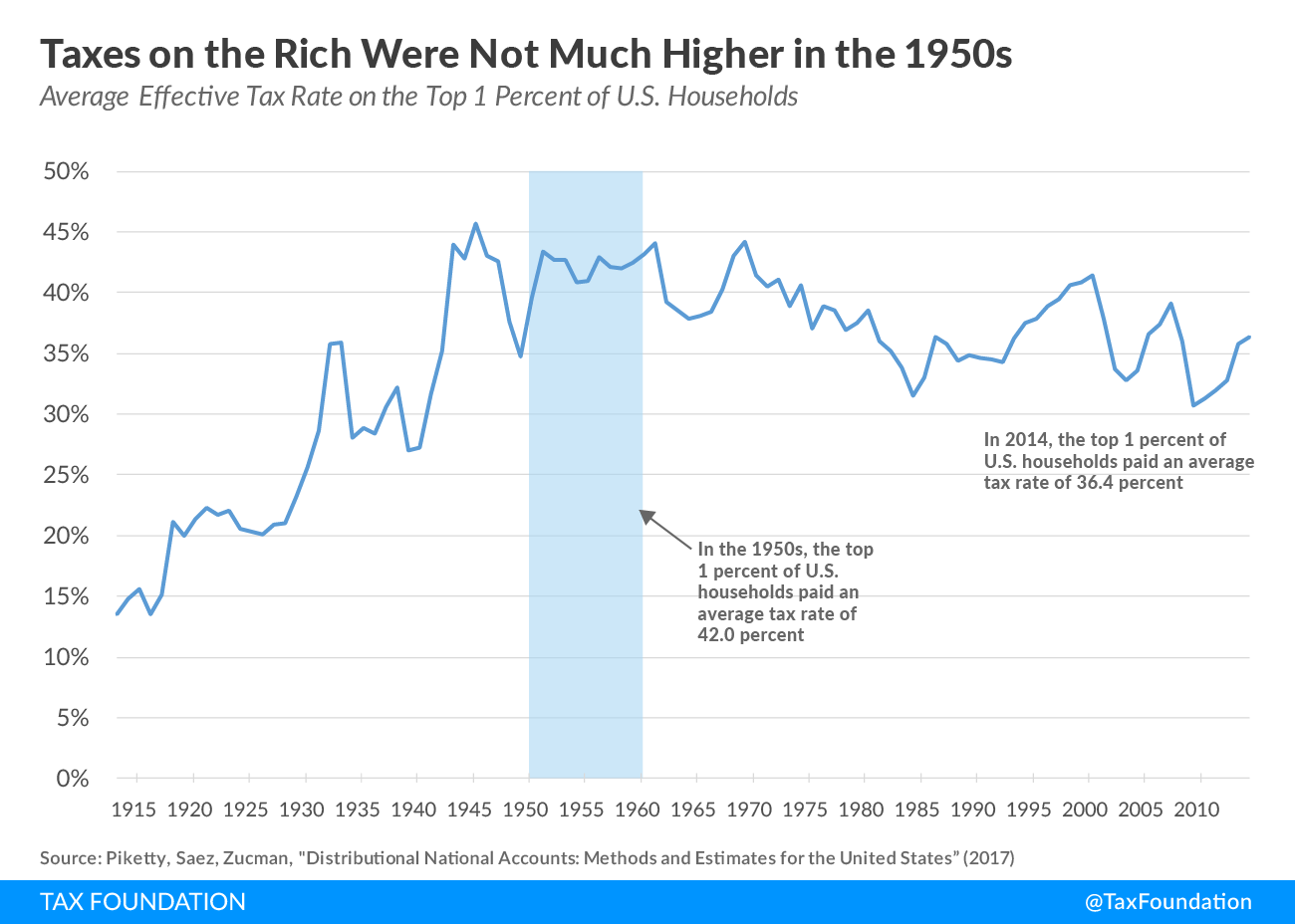 Considering that the top tax rate in the 1950s was 90%, the rich did not pay much more in that period than they do now. And some of the richest among us pay little if anything.
For example, Donald Trump paid no income taxes at all, during ten of the fifteen years, 2000-2015, despite being a billionaire. Tax laws, favorable to the rich, gave him the ability to claim losses on investments that an ordinary taxpayer may not look at as “losing” money.
In summary, using federal taxation of the rich to narrow the Gap is bad economics. History shows the rich would find ways to avoid paying higher rates.
But, even if the rich were forced to pay more, the higher rates would take dollars out of the economy and recess the economy. Option #1 is a “heads-you-lose (the rich don’t pay more), tails-you-lose” (GDP falls) plan.
Sadly, that is the plan Biden seems to have chosen, and it will cost him the November election.
The electorate may be ignorant about economics, but the rich would make sure the voters understood that raising taxes — anyone’s taxes — would hurt the economy.
It’s simple math. The more the federal government takes out of the economy, the less the economy (GDP) has.
Reducing federal taxes and/or providing supplementary benefits to those who are not rich, (#2 and #3) are the sole economically sensible ways to narrow the income/wealth/power Gap.
Sadly this sensible approach is blocked by the non-sensible belief that federal deficit spending is “unsustainable.”
That’s associated with the equally wrong belief that “excessive” federal spending or an “overheated” economy cause inflation. The fact: Inflation is not caused by “heat” (whatever that is) or by federal spending.
All inflations are caused by shortages of critical goods and services, most often oil and food. Inflation can be cured by additional federal spending to acquire and distribute the scarce goods and services.
Here is what the right-leaning Tax Foundation thinks:Details and Analysis of President Biden’s Fiscal Year 2025 Budget Proposal
Considering that the top tax rate in the 1950s was 90%, the rich did not pay much more in that period than they do now. And some of the richest among us pay little if anything.
For example, Donald Trump paid no income taxes at all, during ten of the fifteen years, 2000-2015, despite being a billionaire. Tax laws, favorable to the rich, gave him the ability to claim losses on investments that an ordinary taxpayer may not look at as “losing” money.
In summary, using federal taxation of the rich to narrow the Gap is bad economics. History shows the rich would find ways to avoid paying higher rates.
But, even if the rich were forced to pay more, the higher rates would take dollars out of the economy and recess the economy. Option #1 is a “heads-you-lose (the rich don’t pay more), tails-you-lose” (GDP falls) plan.
Sadly, that is the plan Biden seems to have chosen, and it will cost him the November election.
The electorate may be ignorant about economics, but the rich would make sure the voters understood that raising taxes — anyone’s taxes — would hurt the economy.
It’s simple math. The more the federal government takes out of the economy, the less the economy (GDP) has.
Reducing federal taxes and/or providing supplementary benefits to those who are not rich, (#2 and #3) are the sole economically sensible ways to narrow the income/wealth/power Gap.
Sadly this sensible approach is blocked by the non-sensible belief that federal deficit spending is “unsustainable.”
That’s associated with the equally wrong belief that “excessive” federal spending or an “overheated” economy cause inflation. The fact: Inflation is not caused by “heat” (whatever that is) or by federal spending.
All inflations are caused by shortages of critical goods and services, most often oil and food. Inflation can be cured by additional federal spending to acquire and distribute the scarce goods and services.
Here is what the right-leaning Tax Foundation thinks:Details and Analysis of President Biden’s Fiscal Year 2025 Budget Proposal
 FICA is a federal tax. Like all federal taxes, it funds nothing. (See:


 #Monetary Sovereignty - Mitchell