We did it for COVID. We did it for the Great Recession.” Why can’t we do it all the time?

We did it with the “Economic Stimulus Act 2008. The federal government simply sent people money.

Generally, low and middle-income taxpayers received up to $300 per person or $600 per couple.

The purpose was to stimulate economic growth and to cure the recession.

It worked:
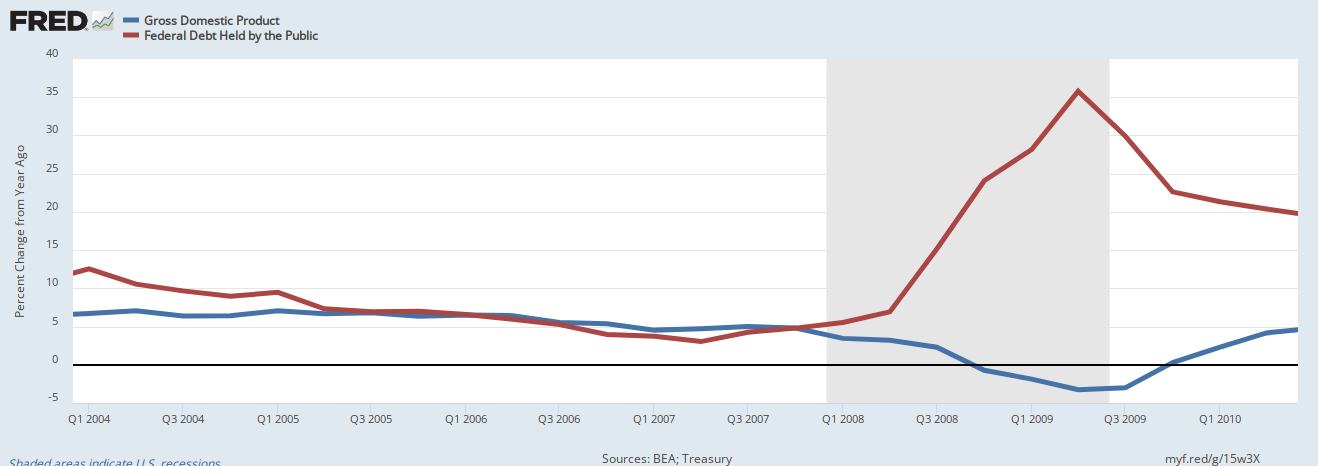
As federal deficits (blue) declined, we fell into a deep recession, cured only by a robust increase in federal deficit spending (red).

Gross Domestic Product (GDP) is a common measure of the economy. The above graph should come as no surprise. The formula for economic growth is:

GDP = Federal Spending+ Nonfederal Spending + Net Exports

Mathematically, as federal deficit spending decreases, economic growth falls, and as federal deficit spending increases, economic growth increases.

If you want economic growth, you want federal deficit spending to increase.

I’ve written about this many times. It’s simple algebra. I’m not sure why this is a mystery to the politicians who think a debt limit is prudent finance. It’s exceedingly ignorant finance.

I mention this again because of an article I just read on MEDPAGETODAY:

Uninsured Rate Hits Record Low of 8.3%
— But that number will slowly rise as pandemic health insurance protections unwind, experts say
by Joyce Frieden, Washington Editor, MedPage Today May 24, 2023

WASHINGTON — The uninsured rate in the U.S. has fallen to a record-low 8.3%, but that percentage is expected to gradually increase as insurance protections from the COVID-19 pandemic wind down, according to officials from the Congressional Budget Office (CBO).

Why will insurance protections “wind down.” For the same reason we currently have a debt=limit battle in Congress. Sheer ignorance.

The federal government has repeatedly proved that it has the infinite ability to pay for anything. Why is it “winding down” payments for healthcare insurance?

The temporary policies enacted in the wake of the COVID-19 pandemic “have contributed to a record low uninsurance rate in 2023 of 8.3% and record-high enrollment in both Medicaid and ACA [Affordable Care Act] marketplace coverage,”said Caroline Hanson, Ph.D., principal analyst at the CBO, during a briefing sponsored by Health Affairs.

“As those temporary policies expire under current law, the distribution of coverage will change and the share of people who lack insurance is expected to increase by 2033.”

CBO is projecting an uninsured rate of 10.1% by 2033, and “while that’s obviously higher than the 8.3% that we’re estimating for 2023, it is nevertheless lower than the uninsured rate in the last year prior to the COVID-19 pandemic,” which was about 12%, she said.

Think about it. America has about 330 million people. A ten percent uninsured rate means 33 MILLION (!) people in America will have to do without health care insurance. I hope you’re not among them.

Whether or not you have insurance, here are some data that should concern you:

“A widely cited study published in the American Journal of Public Health in 2009 analyzed data from the National Health Interview Survey and found that uninsured individuals had a 40% higher risk of death compared to their insured counterparts. This study estimated that lack of health insurance contributed to approximately 45,000 deaths annually in the United States.

“Another study published in the Annals of Internal Medicine in 2017 conducted a systematic review and meta-analysis of previous research. The analysis concluded that uninsured individuals faced a 25% higher risk of mortality compared to those with insurance.”

When you don’t have healthcare insurance, you die younger. 

“Throughout the 2023-33 period, employment-based coverage will remain the largest source of health insurance, with average monthly enrollment between 155 million and 159 million,” Hanson and co-authors wrote in an article published in Health Affairs.

Employer-based health care insurance has two features seldom discussed.

  1. It ties employees to their employer, making job negotiation and movement much more difficult
  2. It is paid for by the employee because the employer figures the cost as part of the employment. Salaries could be higher without this “perk.”

If the federal government funded a comprehensive Medicare for All plan, employees would earn more without costing employers more.

However, they added, “in addition to policy changes over the course of the next decade, demographic and macroeconomic changes affect trends in coverage in the CBO’s projections.”

The Families First Coronavirus Response Act of 2020 gave states a 6.2-percentage-point boost in their Medicaid matching rates as long as the states didn’t disenroll anyone in Medicaid or CHIP for the duration of the COVID public health emergency.

Hanson noted that this law “allowed people to remain enrolled regardless of their changes in eligibility. So, for example, even if they had an income increase that would have made them ineligible but for the policy,” they were still able to stay on Medicaid.

The COVID public health emergency has been canceled now. Disenrollments can begin.

As a result of the law, Medicaid enrollment has grown substantially since 2019 — by 16.1 million enrollees, she said. But that has been superseded by another act of Congress, which allowed states to begin “unwinding” the continuous eligibility rules and start disenrolling people from Medicaid and CHIP beginning on April 1.

In total, “15.5 million people will be transitioning out of Medicaid after eligibility redetermination,” said Hanson. “Among that 15.5 million people, CBO is estimating that 6.2 million of them will go uninsured and the remainder will be enrolled in another source of coverage,” such as individual coverage or employment-based coverage.

Of those who are leaving Medicaid, how many are leaving voluntarily and how many are “falling through the cracks” because they didn’t receive their disenrollment notification or failed to fill out the required paperwork to reapply?

“We recognize that before these continuous eligibility requirements were put into place, people were losing Medicaid coverage, both because they were becoming no longer eligible for Medicaid, and … because they did not complete the application process despite remaining eligible,” said CBO analyst Claire Hou, PhD. However, she added, “we’re currently not aware of any data that would allow us to quantify the size of those two different groups.”

All of the above would be unnecessary if our Monetarily Sovereign federal government (which has unlimited funds) simply would fund a comprehensive, no-deductibles Medicare for All program.

Hanson delivered some bad news for those footing the bill for private health insurance. “We are projecting relatively high short-term premium growth rates in private health insurance, and this is for a few reasons,” she said.

“One is the economy-wide inflation that we’re experiencing in 2023 and that we have been experiencing, and that has not fully reflected itself in premiums yet.

And another contributor is the continued bouncing back of medical spending after the suppressed utilization that we saw earlier in the pandemic.”

The study authors project average premium increases of 6.5% in 2023, 5.9% during 2024-2025, and 5.7% in 2026-2027.

The current and projected-to-increase hardship on the American people is totally unnecessary. The federal government efficiently could ameliorate this hardship by: 

  1. Funding comprehensive, no-deductible Medicare for every man, woman, and child in America
  2. Funding Social Security benefits for every man, woman, and child in America.

Both would add dollars to Gross Domestic Product, thus growing the economy.

Instead, Congress battles over the unbelievably stupid debt ceiling. How do those people manage to dress themselves in the morning, much less be elected to America’s Congress? It boggles the mind.

Rodger Malcolm Mitchell
Monetary Sovereignty

Twitter: @rodgermitchell Search #monetarysovereignty
Facebook: Rodger Malcolm Mitchell

……………………………………………………………………..

The Sole Purpose of Government Is to Improve and Protect the Lives of the People.

MONETARY SOVEREIGNTY

The surprising connections among, taxes, religion, and Medicare for All

Background The federal government, being Monetarily Sovereign, neither needs nor even uses tax dollars. The Treasury destroys all the dollars it receives. It creates new dollars, ad hoc, each time it pays for anything.

Even if the federal government collected zero dollars in taxes, it easily could fund comprehensive Medicare for every man, woman, and child in America.

The sole purposes of federal taxes are:

  1. To control the economy by taxing what the government wishes to discourage and by giving tax break to what the government wishes to encourage.
  2. To assure demand for the U.S. dollar by requiring that dollars be used for paying taxes.
  3. To help the rich, who control America, get richer, that is, widen the Gap between them and the rest of us. This is accomplished by pretending the federal government can’t afford to fund such benefits as Social Security, Medicare, poverty aids, etc.

Because the federal government does not fund Medicare for All, most businesses pay for some part of a private healthcare insurance policy.

This gives the business great power, not only over your working day, and not only over your salary, but even over your health, just by the terms of the policies they provide.

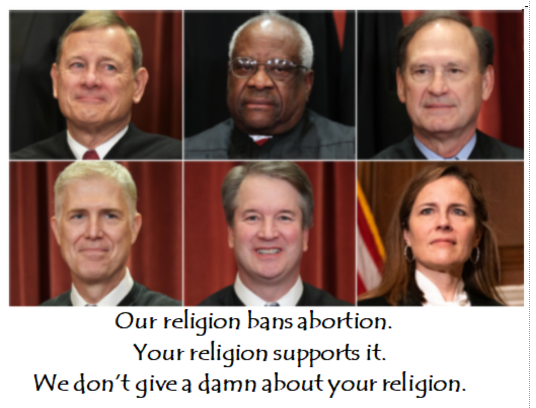
The latest evidence of that power relates to religion. Businesses, more and more, are able to exercise religious bigotry, and the right-wing courts love it.

The federal government encourages charitable giving by providing tax deductions. According to the Internal Revenue Service, a charity involves these activities:

The exempt purposes set forth in Internal Revenue Code section 501(c)(3) are charitable, religious, educational, scientific, literary, testing for public safety, fostering national or international amateur sports competition, and the prevention of cruelty to children or animals. 

The term charitable is used in its generally accepted legal sense and includes relief of the poor, the distressed, or the underprivileged; advancement of religion; advancement of education or science; erection or maintenance of public buildings, monuments, or works; lessening the burdens of government; lessening neighborhood tensions; eliminating prejudice and discrimination; defending human and civil rights secured by law; and combating community deterioration and juvenile delinquency.

All but one of the above are for the benefit of the general public. That one is religion.

Religion is not charity in the true sense of the word “charity.” When you make a contribution to your religion, it’s tax deductible. But that gift goes to your own — what shall we call it — club, sect, group, creed, cult, faction, team, clan, clique, party, etc.

If, for instance, you happen to be a Catholic Republican who belongs to a country club and has season tickets for the Cubs, your gift to your Church is deductible, but your gift to the GOP, your country club, and the Cubs are not.

According to the IRS:

To define churches and other religious entities, some of the IRS guidelines consider whether or not an institution has:

  1. a distinct legal existence and religious history,
  2. a recognized creed and form of worship
  3. established places of worship
  4. a regular congregation and regular religious services, and
  5. an organization or ordained ministers.

The IRS doesn’t say who or what you must worship.

Based on that logic, I could start a group called, “MAGAs for Trump.”

From what I can tell, MAGAs are more worshipful of Trump than of any other “god,” I should be able to give tax-deductible gifts to the group.

And for sure, many football fans worship their team with much greater fervor than any god. So football tickets should be tax deductible.

Religion is something invented not by any supreme, magical entities in the sky but rather, by people.

Every culture down through the centuries seems to have invented religions. That is why there are, and have been, hundreds or even thousands of religions. Sun gods, moon gods, river gods, we have gods by the trainload. 

And no god is better or worse or more realistic than any other god.

The Romans and Greeks had many religons. Currently, we have such religions as Confucianism, Shinto, and Taoism. There are Japanese religions, Chinese, Korean, Mongolian, and Vietnamese religions.

We have invented Buddhism, Neo-Buddhism, Hinduism, Jainism, Sikhism, Baháʼí, dozens of types of Christianity, Druze, Islam of various types, Khawarij, and Judaism of various types. And did I mention Mandaeism and Yazdânism?

Each little tribe hidden in the jungles of Africa and South America has its own religions. And by IRS definition, contributions to any of them would be tax deductible.

But why?

Why does the federal government wish to encourage these clubs, sects, groups, etc? Few of them are charities in the true sense of the word.

Most religions are nothing more than political groups hawking their gods, no different from the Dems and the GOP, selling their candidates.

The only thing that differentiates religions from Trump’s GOP is that religions are devoted to preaching myths. Hmmm. On second thought, maybe Trump’s GOP is a religion.

Judaism teaches that there are eight levels of charity. Look it up. The highest level is helping someone stand on their own gwo feet so they won’t need charity. The lowest level is to give unwillingly.

The other six levels involve different degrees of anonymity for the giver and for the recipient. For example, giving under the condition your gift will be announced to the world is a much lower level than giving anonymously.

But every level of charity involves giving to someone else, not to yourself. No level of charity involves giving to your own group, cult, clan, etc.

I’ll interrupt this discourse by saying I have no objection to charitable tax deductions. In fact, I consider all federal tax deductions to be economically beneficial.

The federal government has no need for your tax dollars so, in that sense, all deductions are good deductions. They all add stimulus dollars to the economy.

But if the primary purpose of federal taxes is to control the economy, I suggest that tax-deductible giving to religions is wrong.

It’s economically wrong because religions (most of them) are no different from advertising agencies or political parties.. They do everything agencies and political parties do and more. Religions often combine book and media publishing, radio stations, TV stations, real estate holdings, and speaking into massive income. 

But unlike secular publishers, broadcasters, real estate holders, and speakers, religions can receive tax-deductible contributions, giving them a huge economic advantage.

It’s legally wrong because giving preferential treatment to religious donations violates the Constitution’s establishment clause.

But most importantly, and ironically, it’s morally wrong because too many religions have a terrible moral history of murder, torture, various forms of corruption, and above all, bigotry.

And here is the latest immoral example to come to my notice. 

From Slate Magazine, Mark Joseph Stern, USING GOD TO DENY BASIC HEALTH CARE

Placing a boss’s claims of religious objections ahead of access to lifesaving medication is “morally and intellectu­ally repulsive,” said Mark Joseph Stern.

But a federal judge’s ruling last week that the government can’t require employers to cover PrEP antiretrov­iral drugs, which prevent HIV, could portend something far worse: bans on mandates for “almost any preventative care.”

A group of Texas plaintiffs argued that the Affordable Care Act’s rules made the complicit in potential “homosexual behavior,” drug use, and extramarital sex, violating their religious beliefs.

District Judge Reed O’Connor, known for trying to strike down the entire ACA in 2018, endorsed that argument.

But he also went further and ruled that the government agencies that decide on ACE requirements for preventative care lack the authority to create such policy.

The decision will be appealed. But it can give the Supreme Court’s conservative supermajority “the opportunity it craves” to hobble these agencies.

All sorts of treatments — HIV tests, breast cancer screening, heart medication — could be next.

That would “shred the ACA,” and cause “grievous harm to millions of Americans.”

For example, if you are gay, and your boss’s religion bans gay sex, your company’s health insurance policy could refuse to cover any disease that came from your gay partner –not just AIDS but any disease. 

You go to the hospital for monkeypox? Your company insurance won’t cover it because you caught it from your gay partner, and your boss’s religion doesn’t recognize gay couplings.

And how far is this from denying insurance for someone of a different religion? After all, Muslims don’t recognize Hindus.

The Catholic hospital won’t accept you because you’re Hindu? The baker won’t bake your cake because you’re living together without official marriage? Here it comes.

THE BOTTOM LINE

Tax deductible gifts to religions cost the federal government money, just as Medicare for All would cost the government money.

Both those costs are economically beneficial because they leave money in the economy rather than taking money from the economy and giving it to the federal government, which destroys it.

Having the federal government pay for health care insurance is economically wiser than having businesses or individuals pay. When the government pays, it pumps growth dollars into the economy.

Further, the absence of comprehensive Medicare for All incentivizes businesses to pay for healthcare insurance, which gives them “moral” and religious power over employees.

We are seeing the return of government-backed bigotry disguised as “freedom of religion.”

Rodger Malcolm Mitchell
Monetary Sovereignty

Twitter: @rodgermitchell Search #monetarysovereignty
Facebook: Rodger Malcolm Mitchell

The Ten Steps will grow the economy and narrow the income/wealth/power Gap between the rich and the rest.

MONETARY SOVEREIGNTY

The employer health-care insurance scam

In the posts, “‘The “Medicare for All’ controversy”, and “Ten Steps to Prosperity: Step 2. Federally funded Medicare — Parts A, B & D, plus long-term care — for everyone”, we describe how easily the federal government could provide free healthcare insurance to every man, woman, and child in America.

The program could pay for comprehensive, no deductible, no-coinsurance, no-limit, no out-of-pocket costs of any kind insurance, without levying a penny in federal taxes.

Instead of that, America, the wealthiest nation on earth has this:Even Golden Handcuffs Are Shackles

‘Focused on survival’: Millions of laid-off Americans still living without health insurance
Alexis Keenan·Reporter
Fri, September 25, 2020, 3:12 PM CDT
With hundreds of thousands of Americans filing new unemployment claims every week, sobering evidence of the difficulties faced by laid-off workers is showing up in the estimated number of U.S. adults now lacking health insurance.

Since the onset of COVID-19 in mid-March, workers who lost employment-based healthcare insurance (ESI) far outnumber those who gained coverage, either through a public or private option.

Approximately 4.6 million to 5.6 million workers who lost job-based coverage since March are now uninsured.

It’s common for those who have lost job-based insurance to go without it. Unless you have a serious health issue, insurance is just not on the priority list.

Medicaid eligibility largely depends on the state where the laid-off worker resides, and is based on current monthly income.

In states that have expanded Medicaid, those with current monthly income less than 138% of the federal poverty level are eligible. For a family of 3, the limit is approximately $2,500 per month. For an individual, the limit is approximately $1,466 per month.

In states that have not expanded Medicaid, eligibility is limited to parents with minor children whose median income is below 40% of the federal poverty level, or whose annual income did not exceed $8,532 for a family of three in 2019.

ESI is designed to seem like a wonderful perk. In most cases, the employer seems to pay most or all of the premiums, and you, the employee, usually are guaranteed coverage, even with pre-existing conditions.

Except:

  1. The employer really doesn’t pay. He’s just a go-between. When hiring, employers calculate the cost of employees to include all costs (salaries, perks, office space, expense accounts, etc.) The reality is, the employee pays for everything, with the only benefit being the tax benefits for running the costs through the employer. Salaries could be higher if the employer didn’t pay for healthcare insurance.
  2.  Most insurance plans charge according to experience, so the employers pay more for “expensive employees” (older employees and those with expensive medical conditions.) That is one reason why you “expensive employees” have more difficulty finding jobs. Employers quietly discriminate against you.
  3. If you lose your job, you may have difficulty finding healthcare insurance, or if you do, it probably will be at a high cost at just the time when your income has disappeared. So the “free” ESI is a pair of golden handcuffs (that you really pay for).

Especially, if you are in your 50s or older, the terror of losing your healthcare insurance, at just the time in your life when you will begin to need it  most, can leave you completely at the mercy of your employer.

And that is the whole point.

America’s rich write America’s laws, including tax laws.

From H&R Block:

In 2018, the IRS allowed you to deduct medical expenses that exceeded 7.5% of your adjusted gross income.

Beginning Jan. 1, 2019, all taxpayers may deduct only the amount of the total unreimbursed allowable medical care expenses for the year that exceeds 10% of their adjusted gross income.

You aren’t able to claim both an itemized tax deduction with your standard deduction. Essentially, your medical deduction needs to be significant, along with other itemizations, to give you a great deduction.

For the current tax year, the standard deduction is worth $12,000 for single taxpayers and $24,000 for married taxpayers filing jointly. If you’re filing as the head of household, it’s worth $18,000.

Get it? For a business, all medical expenses are tax-deductible. Businesses pay taxes on profits. But,, for you individually, medical expenses only are deductible after they go above 10% of your adjusted gross income or your standard deduction.

If, for instance, your income is $50,000, the first $5,000 of your medical expenses isn’t tax deductible.

Side note: The so-called “standard deduction” is not a deduction. It is the amount you can’t claim if you wish to itemize your expenses. The higher the “standard deduction,” the less you can claim as a deduction for expenses.

The above paragraph about standard deductions really should read, “For the current tax year, single taxpayers can’t take the first $12,000 expenses as deductions. Married taxpayers can’t take the first $24,000, and heads of households can’t take the first $18,000.”

That means the vast majority of Americans can’t take any expense deduction at all. By contrast, businesses can deduct almost all their expenses.

It’s just another con job by the rich.

Getting back to Medicare for All, if the federal government funded a comprehensive plan that covered all your hospital, doctor, equipment, and long-term care costs, not only could your salary be higher, but your employer would not “own” you. Losing your job would be far less traumatic.

The federal government already has done the hard work by creating Medicare for All (over 65), so the functional problems have been solved. It would be a simple matter to reduce the qualifying age to 0, and to eliminate deductibles and co-pays.

Except, that is not what the rich want. They want to widen the Gap between the rich and the rest, and one sneaky way to do it is via employer-provided healthcare insurance.

And now, we’ll entertain the false claims that Medicare for All is “unsustainable” and/or “socialism.”

Rodger Malcolm Mitchell

Monetary Sovereignty Twitter: @rodgermitchell Search #monetarysovereignty Facebook: Rodger Malcolm Mitchell …………………………………………………………………………………………………………………………………………………………………………………………………………………………………………………………………………………………..

THE SOLE PURPOSE OF GOVERNMENT IS TO IMPROVE AND PROTECT THE LIVES OF THE PEOPLE.

The most important problems in economics involve:

Ten Steps To Prosperity:

  1. Eliminate FICA
  2. Federally funded Medicare — parts A, B & D, plus long-term care — for everyone
  3. Social Security for all or a reverse income tax
  4. Free education (including post-grad) for everyone
  5. Salary for attending school
  6. Eliminate federal taxes on business
  7. Increase the standard income tax deduction, annually. 
  8. Tax the very rich (the “.1%”) more, with higher progressive tax rates on all forms of income.
  9. Federal ownership of all banks
  10. Increase federal spending on the myriad initiatives that benefit America’s 99.9% 

The Ten Steps will grow the economy and narrow the income/wealth/power Gap between the rich and the rest.

MONETARY SOVEREIGNTY