–Coming soon to a world near you: Economics for cyborgs. Humans as a transition species.

Mitchell’s laws: The more budgets are cut and taxes inceased, the weaker an economy becomes. To survive long term, a monetarily non-sovereign government must have a positive balance of payments. Austerity = poverty and leads to civil disorder. Those, who do not understand the differences between Monetary Sovereignty and monetary non-sovereignty, do not understand economics.
==========================================================================================================================================

Let’s predict.

Unfortunately, to predict, we tend to use today as a starting place, then visualize a linear transition to the future. So, our predictions generally include more powerful computers, better medicine, more efficient rockets – in short, more/better versions of today. A hundred 100 years ago, who could have predicted the Internet, a seemingly non-linear transition from 1900?

So, given that caveat . . .

Those of you who are Star Trek fans – the Captain Picard version – will remember the Borg. They were an alien people, part humanoid and part machine, the defining characteristic of whom was a “hive mind,” i.e. all knowledge and decisions linked by radio. Individuals were not individual, but were part of the collective, perhaps less independent even than ants and bees.

My prediction is that one day, possibly within the lifetimes of my grandchildren, we all will be well on our way toward becoming cyborgs, and this will have a profound effect on economics.

.Monetary sovereignty
—-CAPTAIN PICARD IS FORCED TO JOIN THE BORG COLLECTIVE

An article in NewScientist Magazine hints at this:

Beyond Kinect: Gestural computer spells keyboard death
15 May 2012 by Jim Giles

The advent of multi-touch screens and novel gaming interfaces means the days of the traditional mouse and keyboard are well and truly numbered. With Humantenna and SoundWave, you won’t even have to touch a computer to control it, gesturing in its direction will be enough.

(A technology called) Humantenna uses the human body as an antenna to pick up the electromagnetic fields – generated by power lines and electrical appliances – that fill indoor and outdoor spaces. Users wear a device that measures the signals picked up by the body and transmits them wirelessly to a computer. “It’s just an electrode that measures voltage, digitises it and sends the signal for processing,” says Desney Tan of Microsoft Research in Redmond, Washington.

By studying how the signal changes as users move through the electromagnetic fields, the team was able to identify gestures, such as a punching motion or swipe of the hand. In all, the researchers found that the technology could detect 12 gestures with over 90 per cent accuracy.

One version of the system, presented this week at the Conference on Human Factors in Computing Systems in Austin, Texas, runs off a sensor that sits in a small bag. With training, that sensor can learn to recognise specific gestures. Another paper, under review, describes a version that relies on a much smaller wristwatch-sized sensor. Thanks to advances in processing techniques, this newer system needs no training to recognise the same 12 gestures.

Our brain causes our hand to gesture. A computer senses and decodes our gesture, and makes something happen. But what if instead of decoding our gesture, the computer were able to decode our brain’s signal. Our thoughts alone could make something happen. Such technology already exists.

Monkey think, monkey do with robotic arm
By David Templeton / Pittsburgh Post-Gazette

Making things happen with the mind has long been a favorite topic of science fiction. But with new technology developed at the University of Pittsburgh School of Medicine, a rhesus monkey, with arms comfortably restrained, learned to use a robotic arm to feed itself by thinking about the action.

The monkey used the arm to grasp marshmallows and fruit and put them in its mouth. It even used the grasper, as it would its own hand, to prevent the food from falling from its lips. In a 2004 study, Pitt researchers taught a monkey partially to use a robotic arm, but in the latest research published in the journal Nature they taught the monkey to control the arm fully with its mind.

Back to the NewScientist article:

All sorts of applications would open up if Humantenna can be commercialised. The body could become a kind of universal remote control, and basic gestures such as pointing or swiping might be used to control lights, appliances and computers in the home. Fitness monitoring is another possibility, says Tan. We already have devices that can infer how hard a person is exercising by tracking step patterns, but Humantenna could provide a more holistic measure by monitoring whole body movements.

Imagine switching a phone to silent mode just by pressing a finger to your lips. This is one possible application of Touché, a system that turns any object, including the human body, into a touch interface.

Researchers at Disney Research in Pittsburgh, Pennsylvania, built Touché by sending a small current through everyday objects. A person touching the object changes the flow of electricity depending on the type of touch, be it a finger or a firm grasp.

The system can also send low levels of current through the human body. The current changes when users clasp their hands or touch their faces. The signal generated could one day be used to control a phone or other electronic device.

I don’t know how far and how fast this will go, but clearly the merger of machine and human — the cyborg — is ahead of us. Biology is frail. Machines can be stronger, faster, more accurate and with better sensors — superior in every way to our human body. Consider this article:

Self-Repairing And Self-Sustaining Autonomous Machines
The George Washington University

Machines are subject to wear due to friction between moving parts. Researchers at the George Washington University have developed a real-time sensor and nanotechnology-based system that detects the component surface damage in moving parts, such as gears, and repairs and sustains the moving parts of the machines automatically.

Our future cyborg body not only will be stronger, faster, more accurate and with better sensors, but will be self repairing. We could live forever. And this unstoppable train is bearing down on us, faster and faster. Our grandchildren or great grandchildren will see it happen.

What will be the economics of a “Borgworld”?

Some things will become less important than they are, today. The traditional “big three” — food, clothing and shelter — surely will become far less important. Visualize you, as a borg, standing outdoors. You don’t care about the elements. You use power only to heat or cool your brain, and any other human body parts that remain. Compare that minimal energy use with heating and cooling all the air in all the rooms in your house.

Two-dimensional, human-controlled, surface transportation will give way to three dimensional, computer controlled, air transportation. With dramatic decreases in agriculture (for food, clothing and housing), more efficient transportation (i.e. no traffic jams), and less need to heat and cool homes, much less energy will be used.

Our need for oil, coal, natural gas and certain ores used for shelter-building, will fall dramatically. The resultant reduction in pollution will reverse the trend toward global warming. Farm land will return to nature; trees will convert carbon dioxide to oxygen.

The incidence of disease will decline. Sports will change. Religion will change. Our need for creature comfort will decrease, since “comfort” merely is our brain’s translation of sensory input. Given the appropriate programming, our brains could translate a bed of spikes into “comfort.”

Computers will create any product, just by following your thoughts. Product lack and envy will become less important in the demand equation, so crime will decrease. Economics, being greatly dependent on human desire, will reflect the new reality. Or it may disappear as a science.

With our reduced need for food, shelter, clothing, along with less crime and envy, our need for money and for security will decline. And because the primary purposes of governments are to provide food, shelter, clothing, security and money, our desire for government will decline. A benign form of anarchy-in-unity will emerge — one language, one source of information, one “human nature.”

All human knowledge will be available to everyone, instantly. We won’t have to look for information on the Internet; we will live the Internet. Of course, we don’t have the mental capacity to assimilate all that is on the Internet, so in the final conversion, our brains too, will be replaced.

Homo sapiens will have been a transition species. And at last, immune to aging, radiation and boredom, we will be ready to fly to the stars.

I truly believe, that with the ever-increasing rate of technological advancement, it all will be accomplished well before the end of this century.

Rodger Malcolm Mitchell
http://www.rodgermitchell.com


==========================================================================================================================================
No nation can tax itself into prosperity, nor grow without money growth. Monetary Sovereignty: Cutting federal deficits to grow the economy is like applying leeches to cure anemia. Two key equations in economics:
Federal Deficits – Net Imports = Net Private Savings
Gross Domestic Product = Federal Spending + Private Investment and Consumption + Net exports

#MONETARY SOVEREIGNTY
–#Occupy, to get ahead, get a head, and stay the hell away from Chicago during the NATO summit.

Mitchell’s laws: The more budgets are cut and taxes inceased, the weaker an economy becomes. To survive long term, a monetarily non-sovereign government must have a positive balance of payments. Austerity = poverty and leads to civil disorder. Those, who do not understand the differences between Monetary Sovereignty and monetary non-sovereignty, do not understand economics.
==========================================================================================================================================

#Occupy Wall Street and its sister groups around the world, seem to take inordinate pride in not having leaders. I’m not sure why, but perhaps it’s because #Occupy wishes to disassociate themselves from their “enemies,” i.e. governments and big business,” which do have leaders.

For whatever the reason, lacking a head, #Occupy runs aimlessly, chicken-like, and expends great energy for little gain. It wishes to deliver a message, but what message? Ask the person in the street what #Occupy stands for or wants, and you surely will get a mixture of anti- this and anti- that, and for very little.

They seem like a group of young people for whom protest is an exciting break — think Spring Break on Daytona Beach. And like all young people whose primary mission is to have fun and outdo each other in daring naughtiness, they break things, flout authority and incite trouble. “Innocently” camping in the park for weeks on end, is neither innocent nor meant to be. The sole purpose is to provoke authority, then whine about their First Amendment rights, when authority gets tough. Even the worst police show more discipline than the protesters.

Pity, because #Occupy’s message should be to close the gap between rich and poor, by lifting the poor. But the message is lost in the medium.

If #Occupy had a head, he/she would be smart enough not to come to Chicago for the NATO summit.

Questions: Why NATO and why the summit? NATO has only a distant relationship to #Occupy’s prime message, whatever it may be. Mostly, NATO is a combination war and anti-war organization (depending on how you look at it), specifically designed to protect Europe from the Soviet Union, and more recently as a military alternative to the unwieldy United Nations. Do you think of #Occupy as primarily being an anti-war group? I don’t. If it is, I must have missed the message.

And in any event, if you don’t like NATO, the last place you want to be is the summit, where every kook from around the world, is coming to march, yell, carry some sort of sign, and possibly cause a bit of bother. What is the key message the world will get from the upcoming summit protests? Just one: How well, or how poorly, the Chicago police “handled” the protesters.

As for which message, take your pick: Poverty? War? Global warming? Energy? Tyranny? Starvation? Disease? Ecology? Overfishing? Overlumbering? Pollution? Save the birds? The list goes on and on, and for each item a group of protesters will scream, march, carry nutty signs and attempt to provoke the police, while acting oh-so put upon if the police respond. (Think wild 12-year-olds trying to tickle the noses of the human statues guarding Buckingham Palace.)

Is this the message with which the headless, leaderless, messageless #Occupy wishes to associate itself? Is this is the memory #Occupy wishes the public to carry away?

If #Occupy wishes to make a statement, first it should have a statement to make — a sharp, clear, focused statement. And then it should make that statement, not in the maelstrom of a thousand screaming children, but on a calm, clear day, when their voices are the only ones to be heard.

In short, #Occupy, to get ahead you need to get a head, preferably one with enough good sense not to try painting a picture while standing under a waterfall. Sure, come to Chicago, but not at a time when you’ll be blamed for every misdeed, and accomplish nothing, except to have your message drowned out. Come when yours is the one voice, so the media can support your ideas.

#Occupy, please stay the hell away from Chicago during the NATO summit.

(Ah, but it’s too late, isn’t it?)

Rodger Malcolm Mitchell
http://www.rodgermitchell.com


==========================================================================================================================================
No nation can tax itself into prosperity, nor grow without money growth. Monetary Sovereignty: Cutting federal deficits to grow the economy is like applying leeches to cure anemia. Two key equations in economics:
Federal Deficits – Net Imports = Net Private Savings
Gross Domestic Product = Federal Spending + Private Investment and Consumption + Net exports

#MONETARY SOVEREIGNTY

–Why Greece will look back at the other euro nations and laugh.

Mitchell’s laws: The more budgets are cut and taxes inceased, the weaker an economy becomes. To survive long term, a monetarily non-sovereign government must have a positive balance of payments. Austerity = poverty and leads to civil disorder. Those, who do not understand the differences between Monetary Sovereignty and monetary non-sovereignty, do not understand economics.
==========================================================================================================================================

My family has a saying: “Good comes from bad.” Certainly, Greece’s suffering has been awful. But perhaps some good can come from it. Perhaps the world at last will understand the folly of restricted government spending and the need for Monetary Sovereignty.

(U.S. Tea Party, are you listening?)

BBC News, Europe
EU central bankers ponder Greece euro exit

European central bankers have been openly expressing views on the possibility of Greece leaving the eurozone as its leaders struggle to form a government.

Germany’s top banker said it was up to the Greeks to decide, but if they did not keep to their bailout commitments, they would receive no new aid.

This is the best thing that could happen to Greece: Leave the euro and don’t accept any more “aid” (i.e additional indebtedness, unemployment, poverty and austerity).

After last week’s elections in France and Greece, two things began to change in the eurozone. First was the talk that “spending” could replace “austerity” as a way out of the crisis. That’s perhaps more aspirational than practical but it pleased the voters.

This is news??? The voters are smarter than their leaders. Government spending is the only way out of a recession or depression. Reduced government spending (ala the U.S. Tea Party foolishness) always has the same consequences: Worse recession and deeper depression.

Second was the growing confidence amongst eurozone ministers that Greece could – and maybe should – quit the euro. Some speculate it’s a PR exercise to manage expectations – slowly re-introducing the notion that the 17 Euro nations could soon be 16. Others suggest it’s a long overdue move, that would have eased the problems much sooner.

I said this more than six years ago.

If the country simply quits the euro and resurrects the drachma, while still trying to pay off its debts, an inevitable slump in the value of the drachma would make those debts even more unaffordable.

Absolutely false. First, there is no evidence, one way or another, that the drachma would be valued less than the euro. I personally would rather lend to a “drachma Greece” than to a “euro Greece.” More assurance of being paid.

Second, even with inflation, a Monetarily Sovereign nation (which Greece then would be) can pay any debt of any size, any time. No debt is “unaffordable.” Using the word “unaffordable” demonstrates ignorance of the difference between Monetary Sovereignty and monetary non-sovereignty.

Greek voters punished mainstream parties which backed the bailout at last Sunday’s parliamentary election.

As well they should have. Only the EU would call additional lending to a nation that already is unable to pay its debts, a “bailout.” The U.S. banks did exactly the same thing, which led to the Great Recession.

Visualize the Mafia extending additional credit to a guy who already can’t pay what he owes them. Is that a “bailout”?

Syriza – a leftist, anti-bailout party – firmly rejects the terms of the most recent EU-IMF bailout, which requires tough austerity measures in return for loans worth 130bn euros.

They reject additional, unaffordable debt and more austerity. As the kids say, “Well, DUH!

On Saturday, German central bank chief Jens Weidmann said: “If Athens doesn’t keep its word, it will be a democratic choice. The consequence will be that the basis for fresh aid will disappear.”

Translation: The basis for deeper Greek austerity will disappear, and all of us “1%ers” who foisted the euro on an innocent public, will look like total idiots, and possibly lose our jobs. Hey, are they building a guillotine outside my window?

“We’re a breath away from the drachma and disaster,” liberal Greek daily Kathimerini warned on Saturday.

Translation: We’re a breath away from fiscal freedom.

Within two years after Greece leaves the euro, and re-adopts the drachma, its economy will grow, while the other euro nations sink deeper and deeper into austerity.

Rodger Malcolm Mitchell
http://www.rodgermitchell.com


==========================================================================================================================================
No nation can tax itself into prosperity, nor grow without money growth. Monetary Sovereignty: Cutting federal deficits to grow the economy is like applying leeches to cure anemia. Two key equations in economics:
Federal Deficits – Net Imports = Net Private Savings
Gross Domestic Product = Federal Spending + Private Investment and Consumption + Net exports

#MONETARY SOVEREIGNTY

–At long last, are we ready to end private banking?

Mitchell’s laws: The more budgets are cut and taxes inceased, the weaker an economy becomes. To survive long term, a monetarily non-sovereign government must have a positive balance of payments. Austerity = poverty and leads to civil disorder. Those, who do not understand the differences between Monetary Sovereignty and monetary non-sovereignty, do not understand economics.
==========================================================================================================================================

In the 9/14/11 post titled, “How about socialized banking,” and elsewhere, I have suggested that all banks be federally owned – i.e. the elimination of private banking.

I gave the following reasons:

No bank ever would become insolvent. There would be no “runs” on banks by depositors. Savings would be 100% protected. The lack of a profit motive would eliminate “credit default swaps” and other risky investment derivative beasts that helped lead to the Great Recession. The lack of a profit motive also would eliminate the temptation to lend to credit-poor borrowers.

The absence of outrageous, multi-million dollar salaries would translate into less costly banking services, plus services would be offered in what are now “bank deserts,” where the poor are required to use expensive, neighborhood check-cashing storefronts. There would be no need for “reserves” or for the massive bureaucracy needed to track reserves, nor for the massive compliance bureaucracies, nor for FDIC insurance. No need for Fannie Mae or Freddie Mac.

I was reminded of this when I read in the naked capitalism blog:

JP Morgan Loss Bomb Confirms That It’s Time to Kill VaR
Posted: 11 May 2012

One of the amusing bits of the hastily arranged JP Morgan conference call on its $2 billion and growing “hedge” losses and related first quarter earning release was the way the heretofore loud and proud bank was revealed to have feet of clay on the risk management front. Jamie Dimon said that the bank had determined that its Value at Risk model was “inadequate” and it would be using an older model.

While firms look at VaR over a range of time frames, daily VaR (what is the most I can expect to lose in the next 24 hours) to a 99% threshold is widely used. The fact that VaR is a lousy metric should not come as a surprise.

When people are paid bonuses annually, with no clawbacks for losses, and banks show profits a fair bit of the time, who is going to question bad metrics when the insiders come out big winners regardless?

But VaR is a particularly troubling example, more so because it is sufficiently, dangerously simple minded enough that regulators and managers a step or two removed from markets have become overly attached to its deceptive simplicity.

As mathematician Benoit Mandelbrot discovered in the 1960s, and Nassim Nicholas Taleb popularized in his book Black Swan, risks in financial markets do not have normal (Gaussian) distributions. Taleb, in his article The Fourth Quadrant, pointed out there are many situations where statistics are at best questionable and at worst unreliable: where you have non-Gaussian risk distributions (as you have in financial markets) and complex payoffs.

Now VaR isn’t the only risk model JP Morgan is using, but it has served to allow the inmates to run the asylum.

Basel Committee on Banking Supervision has considered alternative risk metrics, in particular expected shortfall (ES). ES measures the riskiness of a position by considering both the size and the likelihood of losses above a certain confidence level. In other words, it is the expected value of those losses beyond a given confidence level. The Committee recognises that moving to ES could entail certain operational challenges; nonetheless it believes that these are outweighed by the benefits of replacing VaR with a measure that better captures tail risk.

See the problem, here? The regulators believe that to prevent bank failures and malfeasance, banks need a better model to evaluate risk. That’s like saying, “To prevent losing in Las Vegas, people need to improve their gambling systems.” How about, just not gambling? Wouldn’t that work better?

Banks are run by humans. As long as humans are rewarded for risky behavior, they will engage in risky behavior. Period. No models, no regulations, no punishments can prevent it.

Rather than trying to develop the impossible — a system that not only will evaluate risk, but prevent motivated humans from engaging in risk — how about if we eliminate the risk and the motivation, altogether.

If all banks were owned by the federal government, there would be no profit motive — no reason why banks would trade for their accounts — and no personal motivations for bonus rewards based on trading success.

JPMorgan, “a-too-big-to-fail” bank, is not the first — not by a long shot — to engage in excessively risky behavior. And it absolutely, positively will not be the last. So long as there is a profit motive and a bonus motive, these events will happen, again and again and again.

The Basel Committee on Banking Supervision is whistling past the graveyard if it believes there is any solution for the problem, so long as banks are profit-making enterprises. There is not one good reason why banks should be privately owned, and a multitude of reasons why they should be owned by the federal government.

In the past decade, how many U.S. banks have failed? Go to: The FDIC’s “Failed Bank List”. I was too lazy to count; you can see for yourself. At least 450 U.S. banks have failed in the past 10 years!

That’s an astounding number. A ridiculous number. And those are just the banks taken over by the FDIC. This huge list doesn’t include all those banks that were rescued without FDIC intervention. The cause was always the same: The profit motive led to greed overriding sense.

And this was not an unique occurrence. In the 1980’s hundreds of Savings and Loans went bankrupt, costing the public hundreds of millions of dollars. Why. Again, the profit motive overrode sense.

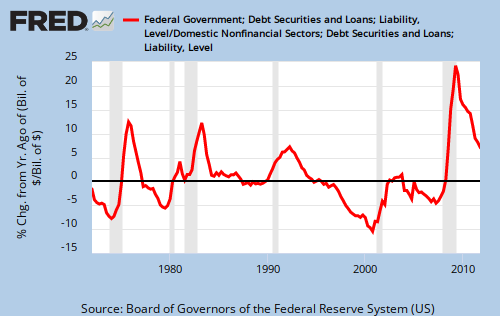
Finally, there is one more reason the federal government should own the banks and indeed, all lending institutions. Today, there are about $38 trillion dollars in the U.S. domestic economy. Of these, only about $10 trillion (26%) were created by the federal government. The rest were created by banks.

History shows that when the federal government begins to lose control over its money creation, we have recessions. It seems that when times are good, banks become more and more reckless with their lending and investment, until they cause a recession, at which time the federal government has to step in with stimulus spending.

Monetary sovereignty

Wouldn’t we be better off if there were no recessions and no reasons for the federal government to save the risk-takers and the public?

I call on Congress and the President to have the courage to protect the public and to do what is necessary: End private banking, and have the federal government assume ownership of all lending institutions.

Rodger Malcolm Mitchell
http://www.rodgermitchell.com


==========================================================================================================================================
No nation can tax itself into prosperity, nor grow without money growth. Monetary Sovereignty: Cutting federal deficits to grow the economy is like applying leeches to cure anemia. Two key equations in economics:
Federal Deficits – Net Imports = Net Private Savings
Gross Domestic Product = Federal Spending + Private Investment and Consumption + Net exports

#MONETARY SOVEREIGNTY